Web Appendix 13A: Degree of Leverage
Copyright Cengage Learning. Powered by Cognero.
Page 1
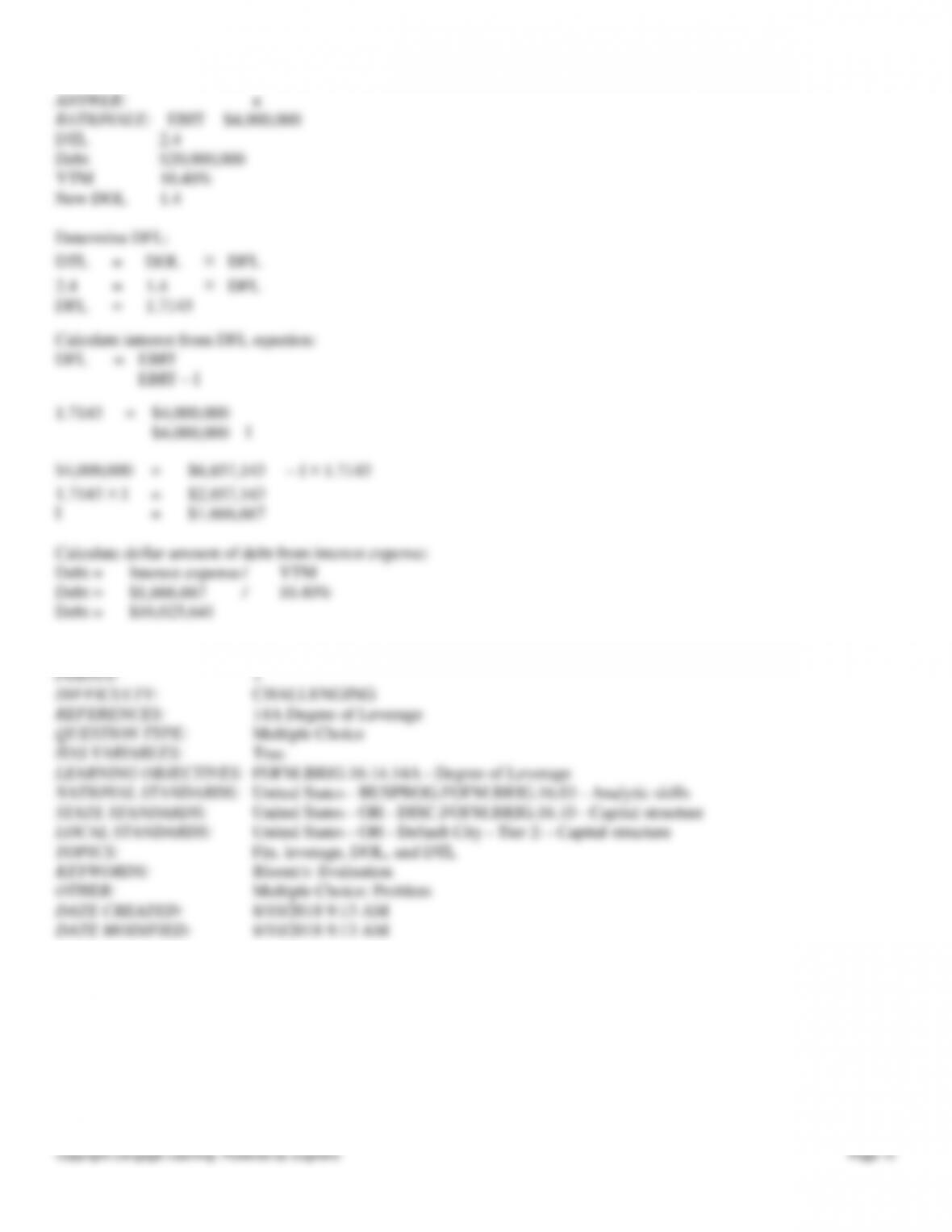
1. A company currently sells 75,000 units annually. At this sales level, its EBIT is $4 million, and its degree of total
leverage is 2.0. The firm’s debt consists of $15 million in bonds with a 9.5% coupon. The company is considering a new
production method which will entail an increase in fixed costs but a decrease in variable costs, and will result in a degree
of operating leverage of 1.750. The president, who is concerned about the stand-alone risk of the firm, wants to keep the
degree of total leverage at 2.0. If EBIT remains at $4 million, what dollar amount of bonds must be retired to accomplish
this? Do not round intermediate calculations.
a. $10,418,421.05
b. $10,905,263.16
c. $9,736,842.11
d. $11,684,210.53
e. $7,497,368.42
Web Appendix 13A: Degree of Leverage
Copyright Cengage Learning. Powered by Cognero.
Page 3
b. An increase in interest expense will reduce the company’s degree of financial leverage.
c. If the company has no debt outstanding, then its degree of total leverage equals its degree of operating leverage.
d. If a firm’s degree of operating leverage increases, its degree of financial leverage must also have increased.
e. If the company has no debt outstanding, then its degree of total leverage equals its degree of financial leverage.
4. The Quick Company expects its sales to increase by 50% in the coming year. The firm’s current EPS is $1.75. Its
degree of operating leverage is 1.6, while its degree of financial leverage is 2.1. What is the firm’s projected EPS for the
coming year using the DTL approach? Do not round intermediate calculations.
a. $4.69
b. $4.50
c. $3.99
d. $4.36
e. $5.53
Copyright Cengage Learning. Powered by Cognero.
Page 7
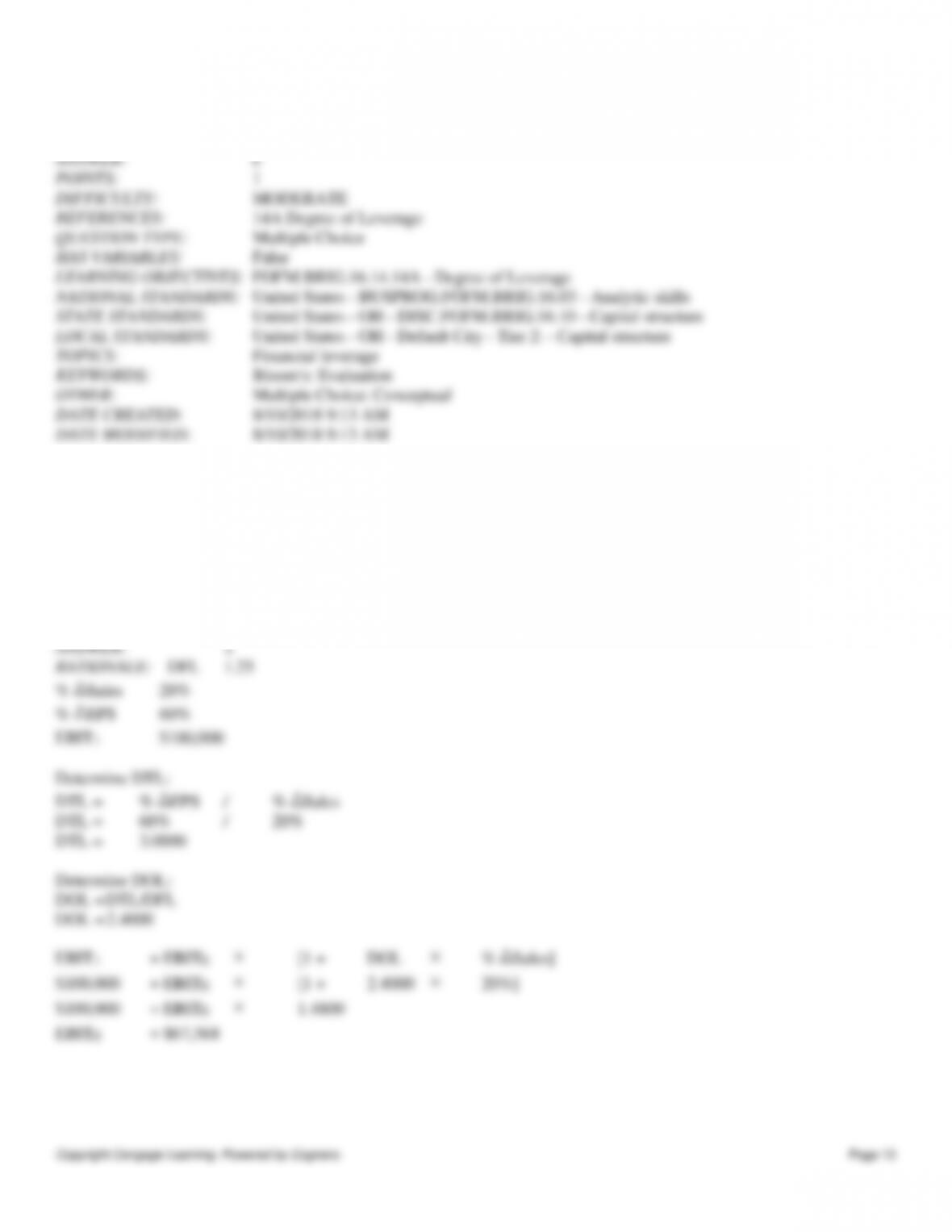
10. Coats Corp. generates $10,000,000 in sales. Its variable costs equal 85.00% of sales and its fixed costs are $500,000.
Therefore, the company’s operating income (EBIT) equals $1,000,000. The company estimates that if its sales were to
increase 9.50%, its net income and EPS would increase 17.50%. What is the company’s interest expense? Do not round
intermediate calculations.
a. $222,857
b. $148,571
c. $185,714
d. $224,714
e. $143,000
Web Appendix 13A: Degree of Leverage
Web Appendix 13A: Degree of Leverage
Web Appendix 13A: Degree of Leverage
Copyright Cengage Learning. Powered by Cognero.
Page 12
16. The use of financial leverage by the firm has a potential impact on which of the following?
(1) The risk associated with the firm.
(2) The return experienced by the shareholder.
(3) The variability of net income.
(4) The degree of operating leverage.
(5) The degree of financial leverage.
a. 1, 3, 5
b. 1, 2, 5
Web Appendix 13A: Degree of Leverage
Copyright Cengage Learning. Powered by Cognero.
Page 13
c. 2, 3, 5
d. 2, 3, 4, 5
e. 1, 2, 3, 5
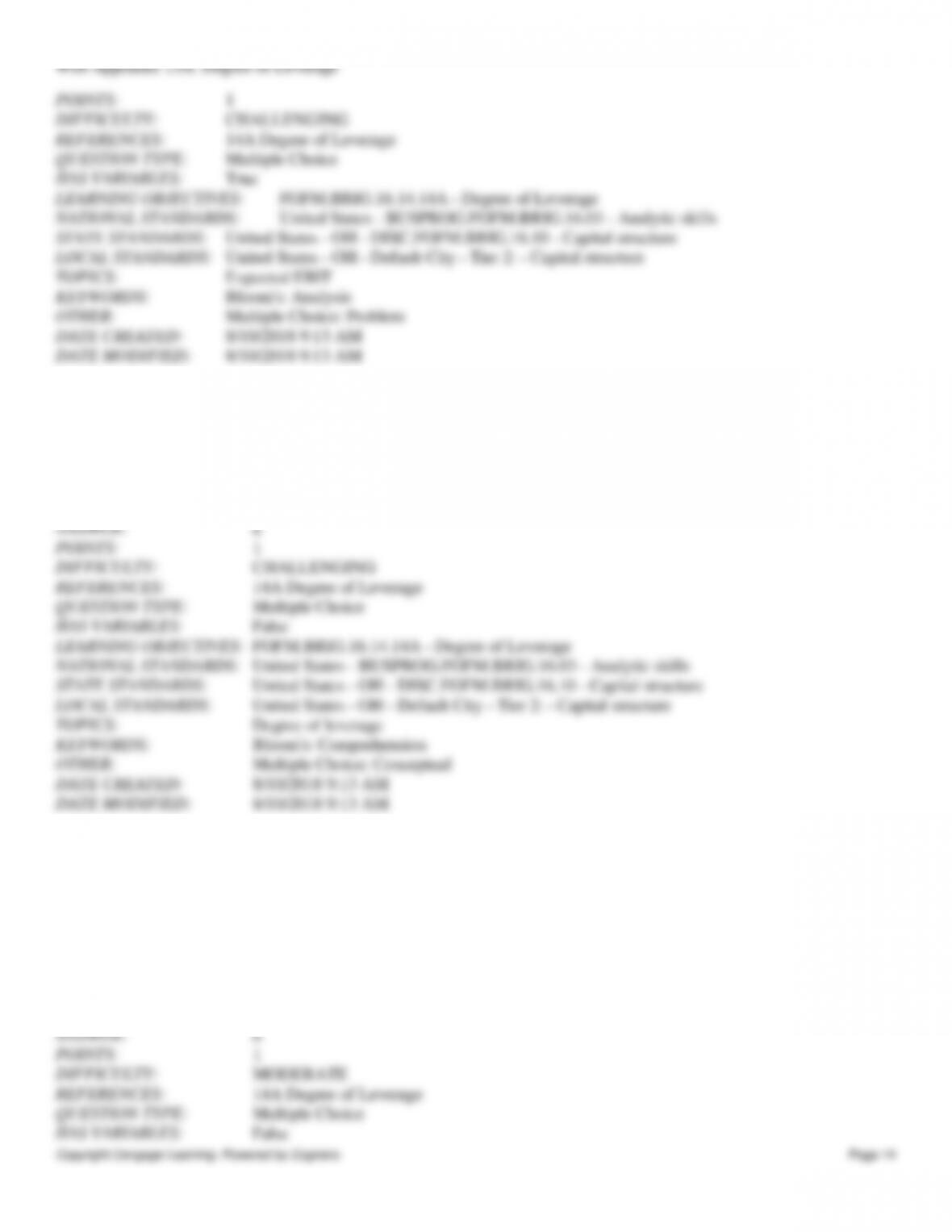
17. Assume that a firm has a degree of financial leverage of 1.25. If sales increase by 20%, the firm will experience a 60%
increase in EPS, and it will have an EBIT of $100,000. What will be the EBIT for this firm if sales do not increase? Do
not round intermediate calculations.
a. $64,189
b. $77,703
c. $67,568
d. $54,054
e. $68,243
Web Appendix 13A: Degree of Leverage
Copyright Cengage Learning. Powered by Cognero.
Page 16
a. $480,000
b. $455,000
c. $400,000
d. $500,000
e. $420,000
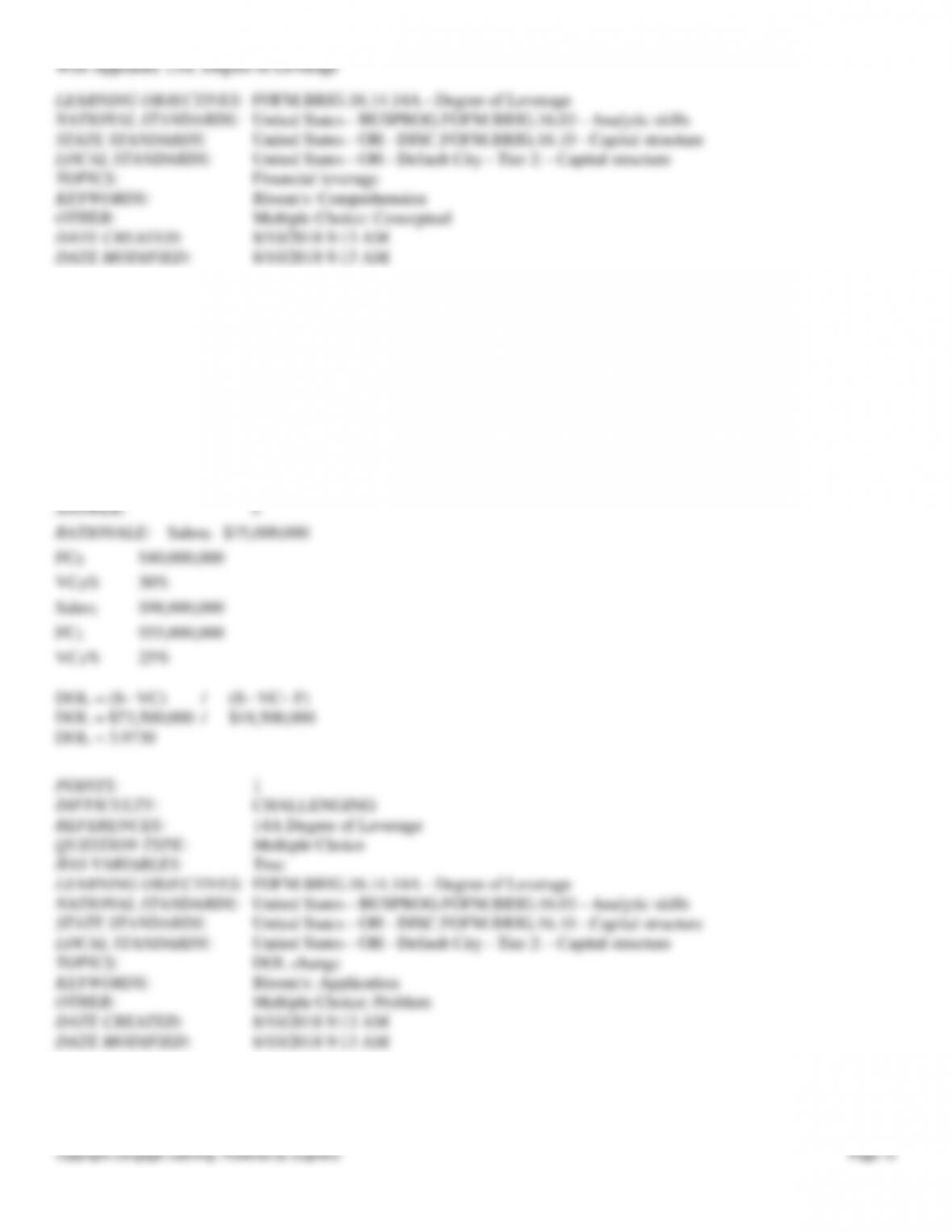
Calculate DFL:
Calculate DOL:
Copyright Cengage Learning. Powered by Cognero.
Page 17
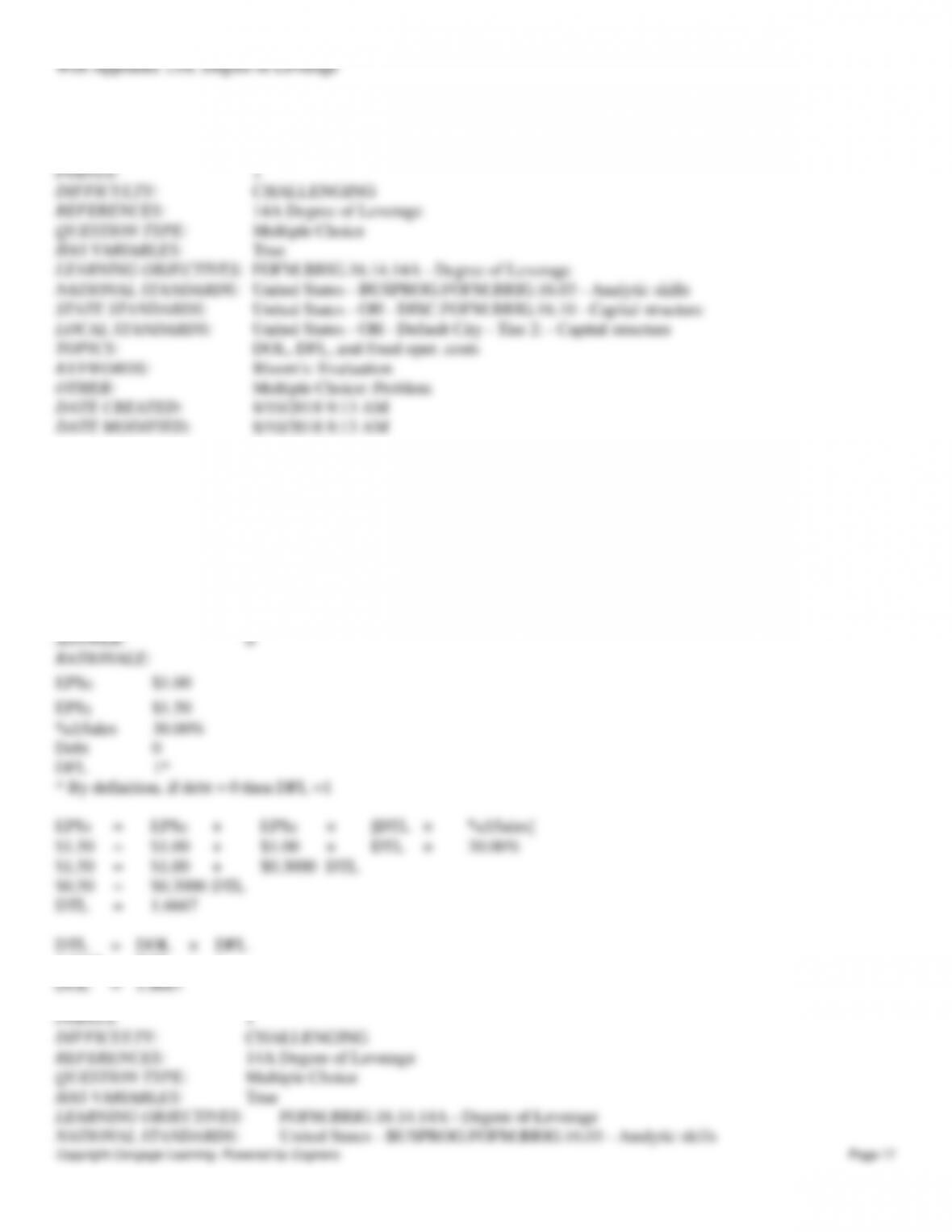
22. The “degree of leverage” concept is designed to show how changes in sales will affect EBIT and EPS. If a 30.00%
increase in sales causes EPS to increase from $1.00 to $1.50, and if the firm uses no debt, then what is its degree of
operating leverage? Do not round intermediate calculations.
a. 1.2500
b. 1.5667
c. 2.0333
d. 1.6667
e. 1.3000
1.6667 = DOL × 1