Web Appendix 07A: Zero Coupon Bonds
Copyright Cengage Learning. Powered by Cognero.
Page 1
1. Which of the following statements is CORRECT?
a. If interest rates increase, a 10-year zero coupon bond’s price will drop by a greater percentage than will a 10-year,
8% coupon bond.
b. One nice thing about zero coupon bonds is that individual investors do not have to pay any taxes on a zero coupon
bond until it matures, even if they are not holding the bonds as part of a tax-deferred account.
c. If a bond with a sinking fund provision has a yield to maturity greater than its coupon rate, the issuing company
would prefer to comply with the sinking fund by calling the bonds in at par rather than buying the bonds back in the open
market.
d. Because of the IRS’s tax treatment of zero coupon bonds, pension funds and other tax-exempt entities rarely, if
ever, invest in zero coupon bonds.
e. Interest must be paid on a zero coupon bond‘s accrued value, but while the first year’s interest is taxable at the
ordinary income tax rate, subsequent years are taxed at the long-term capital gains rate (since they are received after more
than a year).
2. Consider each of the following bonds:
Bond A: 8-year maturity with a 7% annual coupon.
Bond B: 10-year maturity with a 9% annual coupon.
Bond C: 12-year maturity with a zero coupon.
Each bond has a face value of $1,000 and a yield to maturity of 8%. Which of the following statements is NOT correct?
a. Bond A sells at a discount, while Bond B sells at a premium.
b. If the yield to maturity on each bond falls to 7%, Bond C will have the largest percentage increase in its price.
c. Bond C has the most reinvestment risk.
d. Bond C has the most price risk.
e. If the yield to maturity is constant, the price of Bond A will continue to increase over its life until it finally sells at
Copyright Cengage Learning. Powered by Cognero.
Page 3
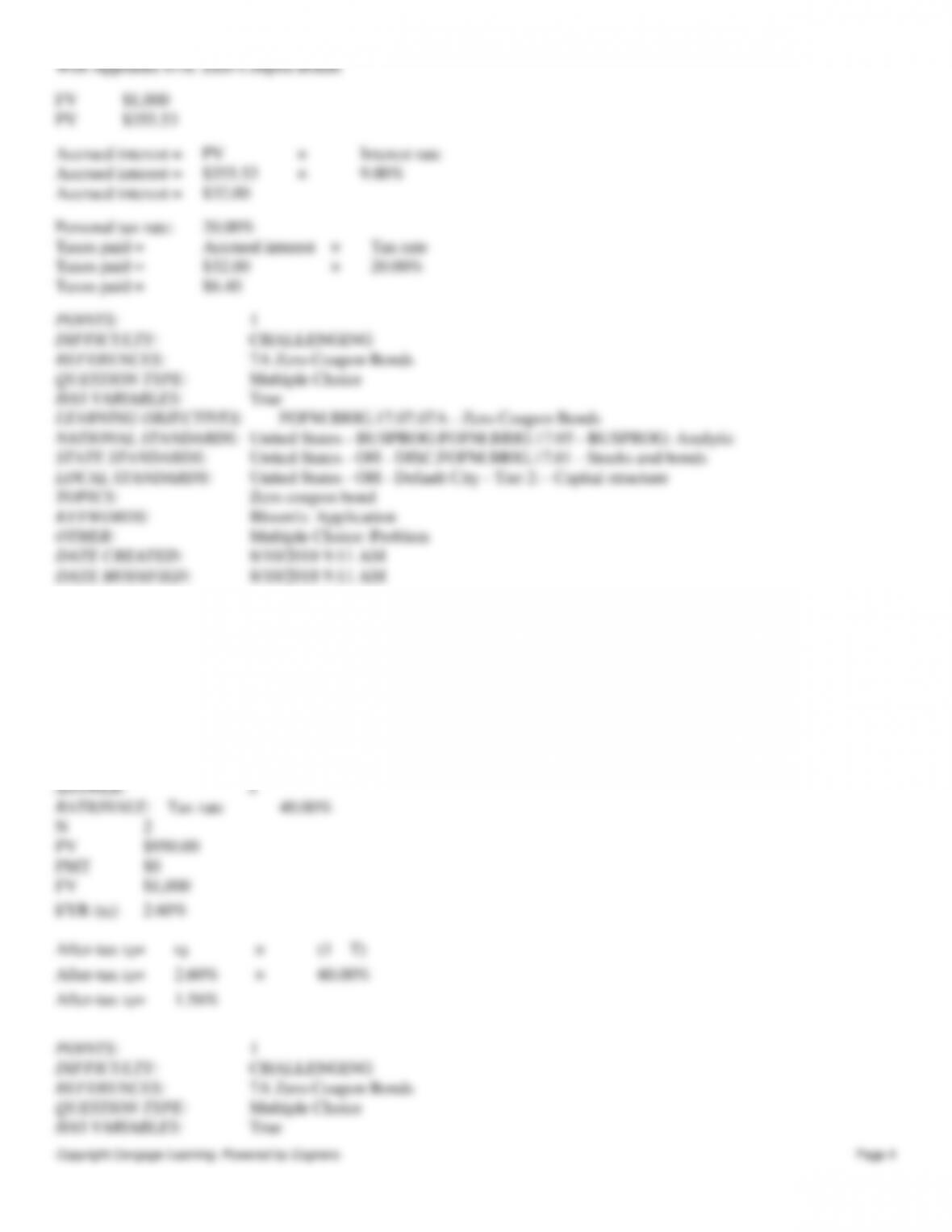
4. At the beginning of the year, you purchased a 5-year zero coupon bond with a yield to maturity of 5.00% and a face
value of $1,000. Your tax rate is 30.00%. What is the total tax that you will have to pay on the bond during the first
year? Do not round your intermediate calculations.
a. $14.34
b. $11.87
c. $11.75
d. $10.23
e. $10.70
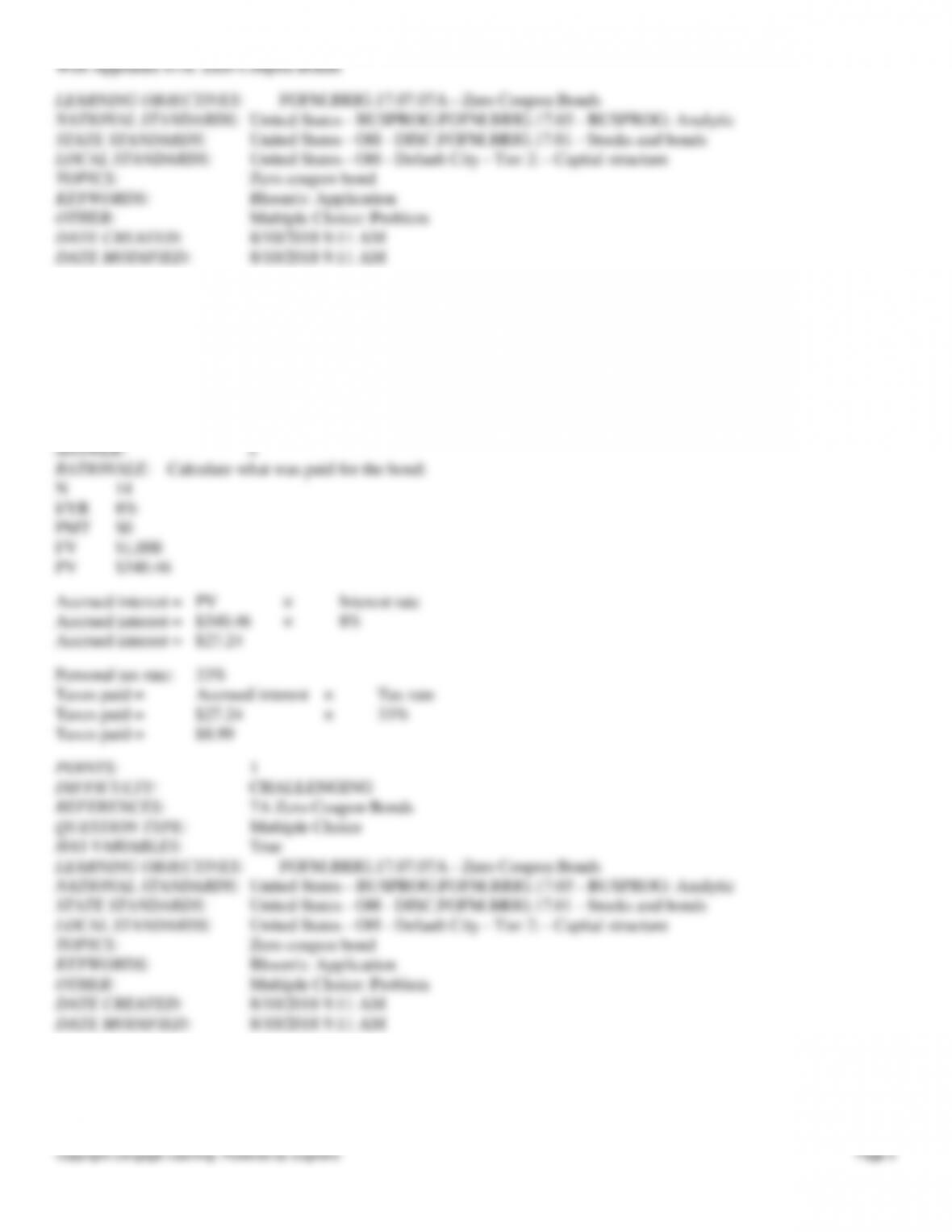
5. You just purchased a 12-year, $1,000 face value, zero coupon bond with a yield to maturity of 9.00%. If your tax rate is
20.00%, how much in taxes will you have to pay at the end of the first year of holding the bond? Do not round your
intermediate calculations.
a. $5.57
b. $5.25
c. $7.74
d. $6.66
e. $6.40
Web Appendix 07A: Zero Coupon Bonds
Copyright Cengage Learning. Powered by Cognero.
Page 6
b. $11.04
c. $10.26
d. $9.77
e. $9.87
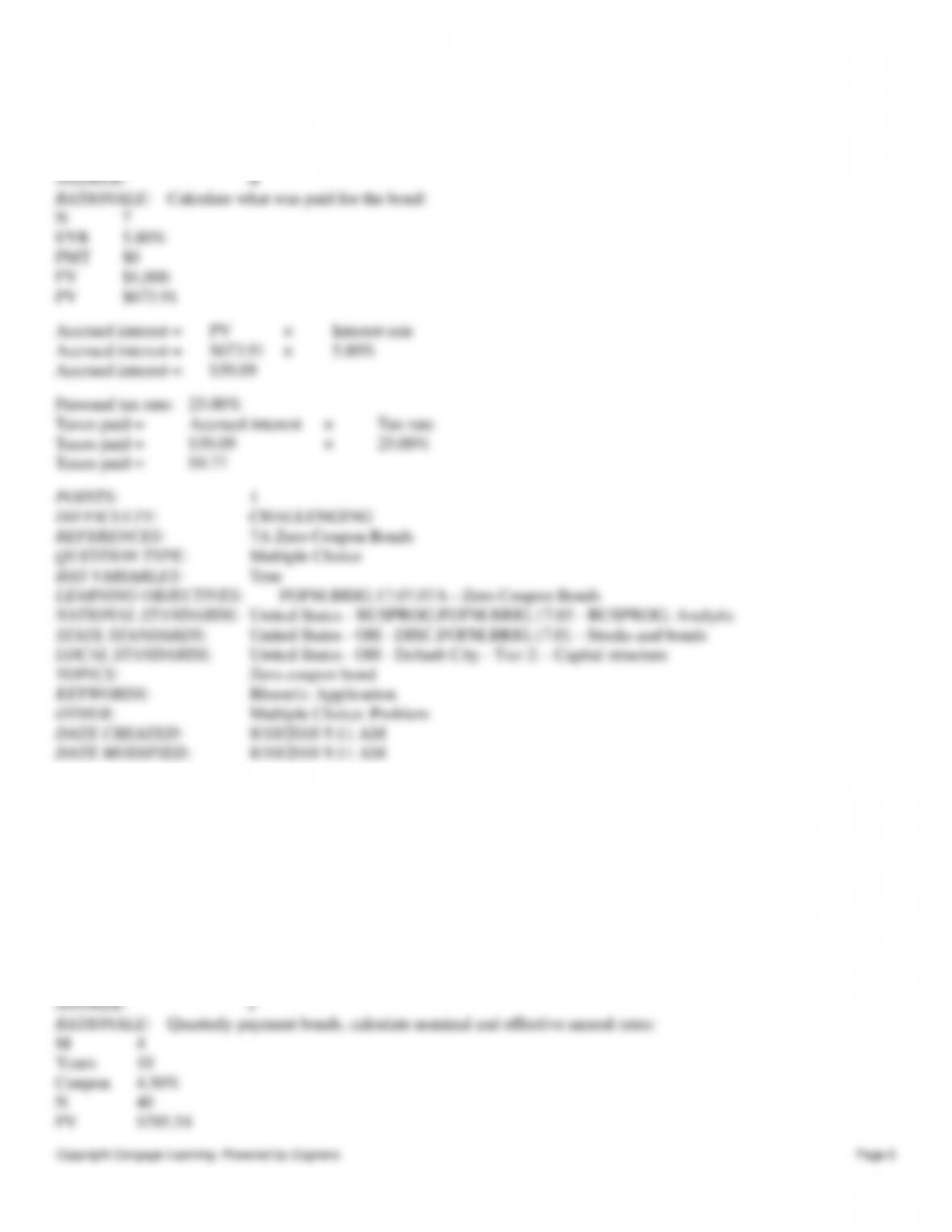
9. U.S. Delay Corporation, a subsidiary of the Postal Service, must decide whether to issue zero coupon bonds or
quarterly payment bonds to fund construction of new facilities. The $1,000.00 par value quarterly payment bonds would
sell at $795.54, have a 4.50% coupon rate, and mature in 10 years. At what price would the zero coupon bonds with a
maturity of 10 years have to sell to earn the same effective annual rate as the quarterly payment bonds? Do not round your
intermediate calculations.
a. $585.26
b. $460.53
c. $479.72
d. $546.89
e. $374.18