Chapter 17: Multinational Financial Management
Copyright Cengage Learning. Powered by Cognero.
Page 39
77. If one British pound can purchase $2.00 U.S. dollars, how many British pounds can one U.S. dollar buy?
a. 0.5050
b. 0.4400
c. 0.3950
d. 0.5000
e. 0.5250
78. If one U.S. dollar buys 0.61 euro, how many dollars can you purchase for one euro?
a. 1.4426
b. 1.5574
c. 1.6393
d. 1.9672
Chapter 17: Multinational Financial Management
Copyright Cengage Learning. Powered by Cognero.
Page 40
e. 2.0000
79. If one U.S. dollar sells for 0.40 British pound, how many dollars should one British pound sell for?
a. 2.7500
b. 1.9750
c. 2.1250
d. 2.3250
e. 2.5000
Chapter 17: Multinational Financial Management
Copyright Cengage Learning. Powered by Cognero.
Page 43
83. Suppose the exchange rate between U.S. dollars and Swiss francs is SF 1.41 = $1.00, and the exchange rate between
the U.S. dollar and the euro is $1.00 = 0.45 euro. What is the cross rate of Swiss francs to euros? (In other words, how
many Swiss francs are needed to purchase one euro?) Do not round the intermediate calculations and round the final
answer to four decimal places.
a. 3.0393
b. 3.6973
c. 3.1333
d. 2.9767
e. 2.7887
84. Suppose that currently, 1 British pound equals 1.98 U.S. dollars and 1 U.S. dollar equals 1.90 Swiss francs. How many
Swiss francs are needed to purchase 1 pound?
a. 3.5739
b. 3.8372
c. 4.4015
d. 2.8591
e. 3.7620
Chapter 17: Multinational Financial Management
Copyright Cengage Learning. Powered by Cognero.
Page 45
1 British pound = 1.65 U.S. dollars
Given this information, how many Mexican pesos can be purchased for 1 Danish krone?
a. 1.8251
b. 1.8456
c. 2.4403
d. 2.1532
e. 2.0507
87. In 1985, a given Japanese imported automobile sold for 1,476,000 yen, or $8,200. If the car still sold for the same
amount of yen today but the current exchange rate is 138 yen per dollar, what would the car be selling for today in U.S.
dollars?
a. $11,979
b. $8,450
c. $10,375
d. $10,696
e. $11,444
Chapter 17: Multinational Financial Management
Copyright Cengage Learning. Powered by Cognero.
Page 48
91. Stover Corporation, a U.S. based importer, makes a purchase of crystal glassware from a firm in Switzerland for
39,960 Swiss francs, or $24,000, at the spot rate of 1.665 Swiss francs per dollar. The terms of the purchase are net 90
days, and the U.S. firm wants to cover this trade payable with a forward market hedge to eliminate its exchange rate risk.
Suppose the firm completes a forward hedge at the 90-day forward rate of 1.682 Swiss francs. If the spot rate in 90 days is
actually 1.609 Swiss francs, how much in U.S. dollars will the U.S. firm have saved or lost by hedging its exchange rate
exposure? Do not round the intermediate calculations and round the final answer to the nearest cent.
a. $905.41
b. $937.75
c. $1077.87
d. $1,120.98
e. $1,261.11
92. Suppose a U.S. firm buys $200,000 worth of television tubes from a Mexican manufacturer for delivery in 60 days
with payment to be made in 90 days (30 days after the goods are received). The rising U.S. deficit has caused the dollar to
depreciate against the peso recently. The current exchange rate is 5.52 pesos per U.S. dollar. The 90-day forward rate is
5.45 pesos/dollar. The firm goes into the forward market today and buys enough Mexican pesos at the 90-day forward rate
to completely cover its trade obligation. Assume the spot rate in 90 days is 5.30 Mexican pesos per U.S. dollar. How
much in U.S. dollars did the firm save by eliminating its foreign exchange currency risk with its forward market
hedge? Do not round the intermediate calculations and round the final answer to the nearest cent.
a. $4,758.46
b. $5,733.08
Chapter 17: Multinational Financial Management
Copyright Cengage Learning. Powered by Cognero.
Page 49
c. $6,478.38
d. $6,650.37
e. $5,905.07
93. Suppose 90-day investments in Britain have a 6.00% annualized return and a 1.50% quarterly (90-day) return. In the
U.S., 90-day investments of similar risk have a 4.00% annualized return and a 1.00% quarterly (90-day) return. In the 90–
day forward market, 1 British pound equals $1.85. If interest rate parity holds, what is the spot exchange rate ($/£)? Do
not round the intermediate calculations and round the final answer to four decimal places.
a. $1.8592
b. $2.1380
c. $1.8963
d. $2.2310
e. $1.9893
Chapter 17: Multinational Financial Management
Copyright Cengage Learning. Powered by Cognero.
Page 51
95. Suppose 6 months ago a Swiss investor bought a 6-month U.S. Treasury bill at a price of $9,708.74, with a maturity
value of $10,000.00. The exchange rate at that time was 1.435 Swiss francs per dollar. Today, at maturity, the exchange
rate is 1.324 Swiss francs per dollar. What is the annualized rate of return to the Swiss investor? Do not round the
intermediate calculations and round the final answer to two decimal places.
a. –11.62%
b. –9.93%
c. –10.03%
d. –9.74%
e. –8.94%
96. A product sells for $750 in the United States. The spot exchange rate is $1 to 1.67 Swiss francs. If purchasing power
parity (PPP) holds, what is the price of the product in Switzerland?
a. 1,277.55
b. 1,528.05
c. 1,465.43
d. 1,252.50
e. 1,315.13
Chapter 17: Multinational Financial Management
Copyright Cengage Learning. Powered by Cognero.
Page 54
return of 6.50% and a periodic return of 3.25%. If interest rate parity holds, what is the U.S. dollar-Canadian dollar
exchange rate in the 180-day forward market? In other words, how many Canadian dollars are required to purchase one
U.S. dollar in the 180-day forward market? Do not round the intermediate calculations and round the final answer to four
decimal places.
a. 1.5774
b. 1.3854
c. 1.6460
d. 1.3717
e. 1.1111
Note that the forward exchange rate gives the number of U.S dollars for 1 Canadian dollar, but the problem asks for the
number of Canadian dollars per U.S. dollar. So, we need the inverse of the number above.
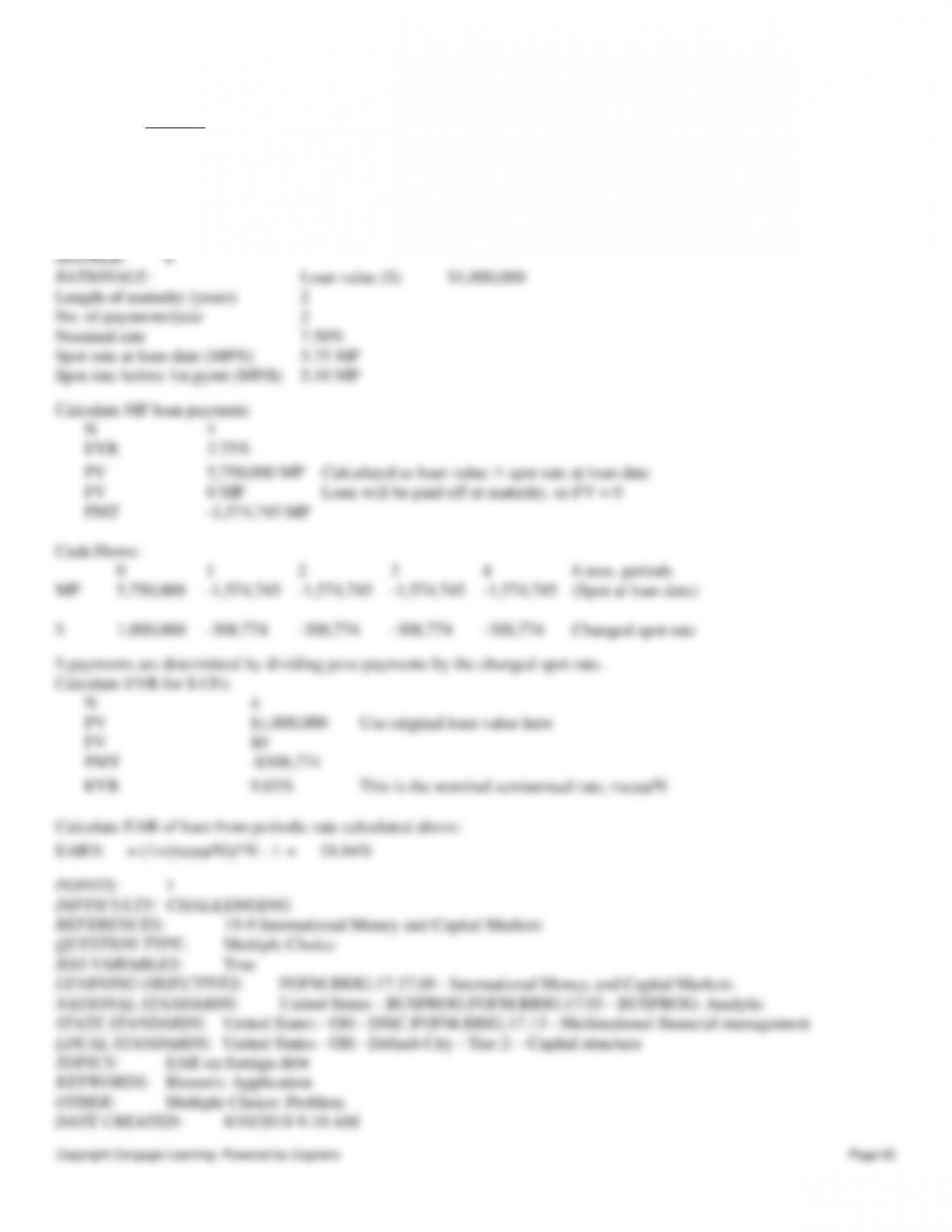
100. Blenman Corporation, based in the United States, arranged a 2-year, $1,000,000 loan to fund a project in Mexico.
The loan is denominated in Mexican pesos, carries a 7.50% nominal rate, and requires equal semiannual payments. The
exchange rate at the time of the loan was 5.75 pesos per dollar, but it dropped to 5.10 pesos per dollar before the first
payment came due. The loan was not hedged in the foreign exchange market. Thus, Blenman must convert U.S. funds to
Chapter 17: Multinational Financial Management
Copyright Cengage Learning. Powered by Cognero.
Page 55
Mexican pesos to make its payments. If the exchange rate remains at 5.10 pesos per dollar through the end of the loan
period, what effective annual interest rate will Blenman end up paying on the loan? Do not round the intermediate
calculations and round the final answer to two decimal places.
a. 21.29%
b. 21.86%
c. 14.89%
d. 22.43%
e. 18.84%