Chapter 17: Multinational Financial Management
Copyright Cengage Learning. Powered by Cognero.
Page 21
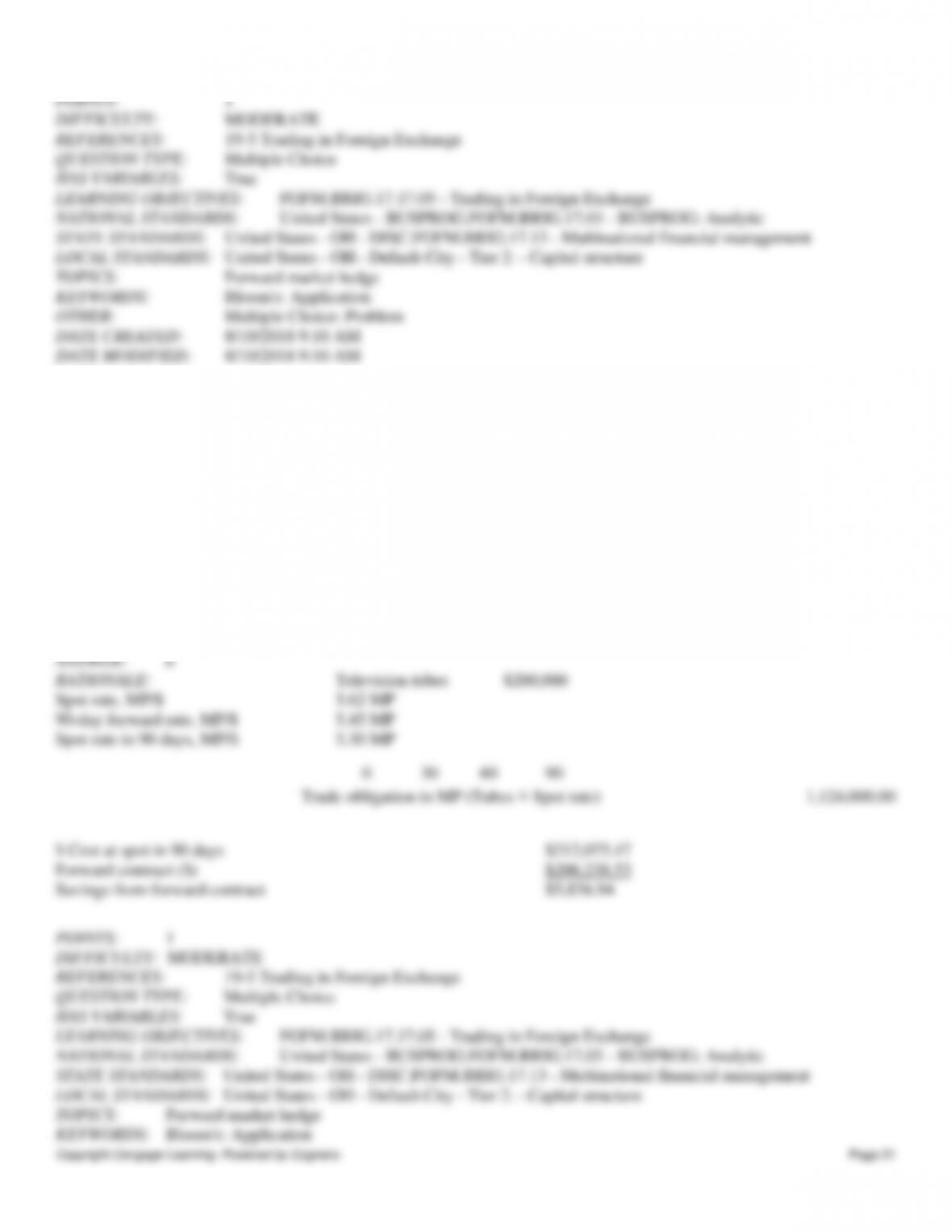
42. Suppose a U.S. firm buys $200,000 worth of television tubes from a Mexican manufacturer for delivery in 60 days
with payment to be made in 90 days (30 days after the goods are received). The rising U.S. deficit has caused the dollar to
depreciate against the peso recently. The current exchange rate is 5.62 pesos per U.S. dollar. The 90-day forward rate is
5.45 pesos/dollar. The firm goes into the forward market today and buys enough Mexican pesos at the 90-day forward rate
to completely cover its trade obligation. Assume the spot rate in 90 days is 5.30 Mexican pesos per U.S. dollar. How
much in U.S. dollars did the firm save by eliminating its foreign exchange currency risk with its forward market
hedge? Do not round the intermediate calculations and round the final answer to the nearest cent.
a. $5,545.09
b. $5,836.94
c. $4,377.70
d. $5,778.57
e. $7,121.07
Chapter 17: Multinational Financial Management
Copyright Cengage Learning. Powered by Cognero.
Page 23
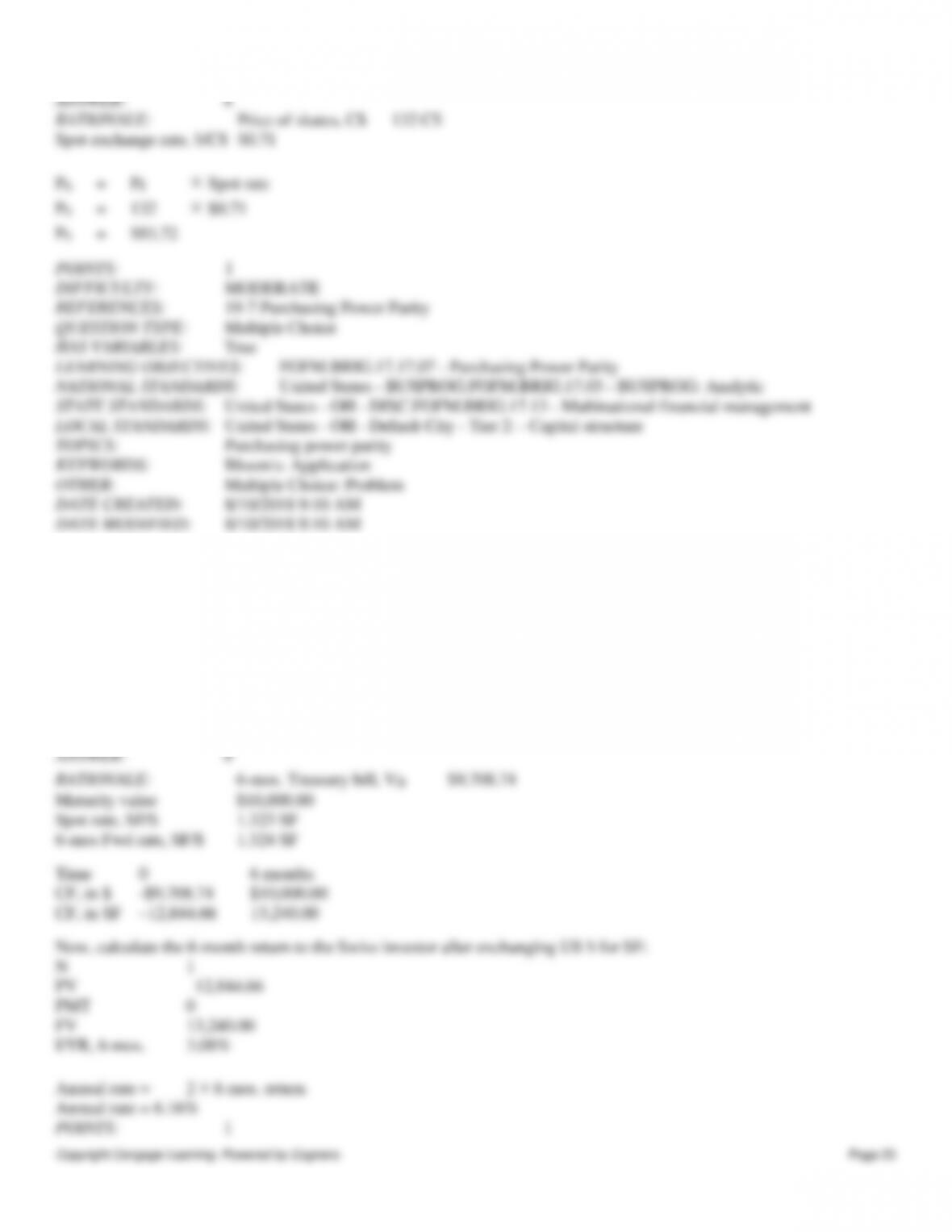
45. Suppose 6 months ago a Swiss investor bought a 6-month U.S. Treasury bill at a price of $9,708.74, with a maturity
value of $10,000.00. The exchange rate at that time was 1.323 Swiss francs per dollar. Today, at maturity, the exchange
rate is 1.324 Swiss francs per dollar. What is the annualized rate of return to the Swiss investor? Do not round the
intermediate calculations and round the final answer to two decimal places.
a. 6.46%
b. 6.16%
c. 4.92%
d. 6.65%
e. 6.71%
Chapter 17: Multinational Financial Management
Copyright Cengage Learning. Powered by Cognero.
Page 25
d. 1.0800
e. 1.4112
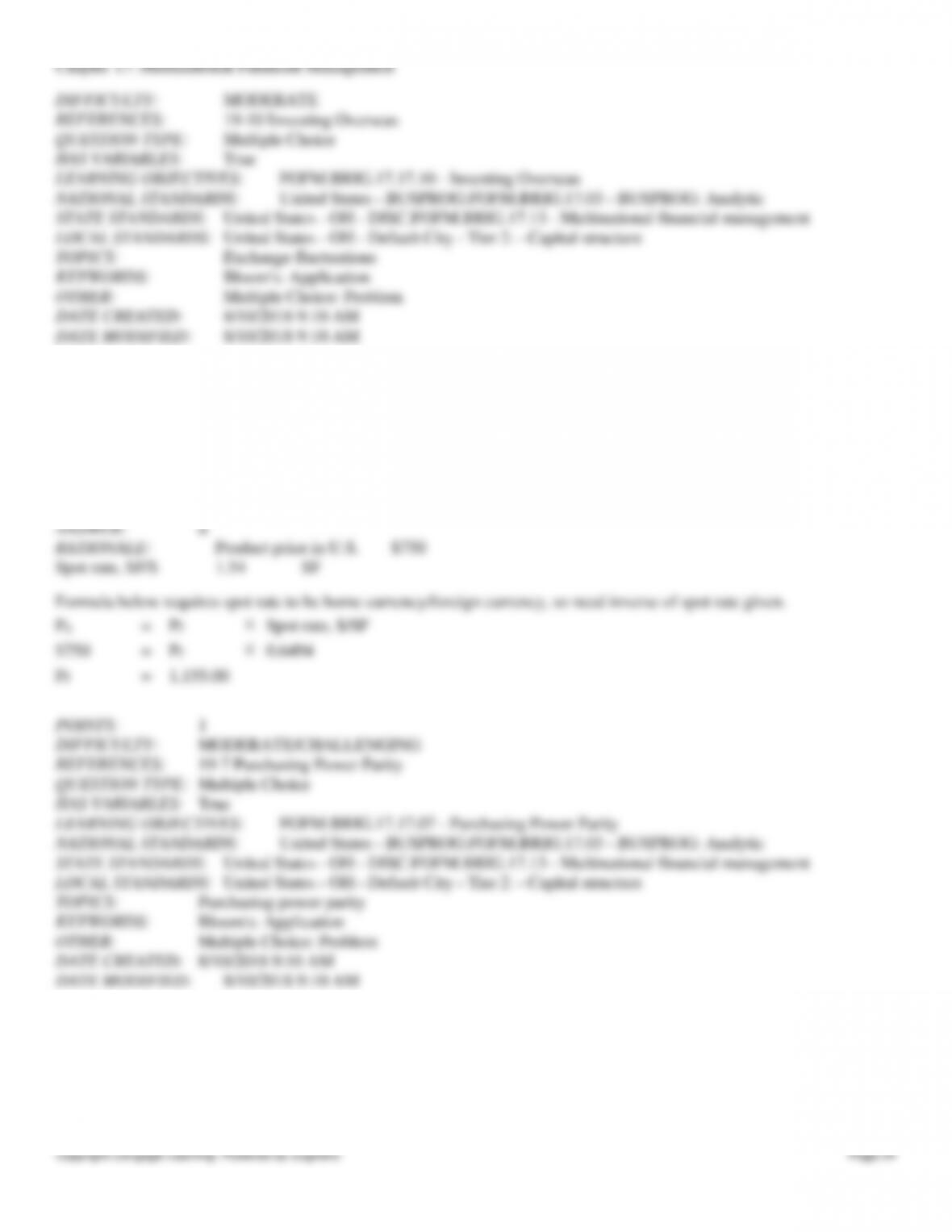
48. One year ago, a U.S. investor converted dollars to yen and purchased 100 shares of stock in a Japanese company at a
price of 3,150 yen per share. The stock‘s total purchase cost was 315,000 yen. At the time of purchase, in the currency
market 1 yen equaled $0.00952. Today, the stock is selling at a price of 3,465 yen per share, and in the currency market
$1 equals 90 yen. The stock does not pay a dividend. If the investor were to sell the stock today and convert the proceeds
back to dollars, what would be his realized return on his initial dollar investment from holding the stock?
a. 28.67%
b. 28.38%
c. 33.21%
d. 26.40%
e. 32.93%
Chapter 17: Multinational Financial Management
Copyright Cengage Learning. Powered by Cognero.
Page 30
a. True
b. False
56. Calculating a currency cross rate involves determining the exchange rate for two currencies by using a third currency
as a base.
a. True
b. False
57. A Eurodollar is a U.S. dollar deposited in a bank outside the United States.
a. True
b. False
Chapter 17: Multinational Financial Management
Copyright Cengage Learning. Powered by Cognero.
Page 33
64. A foreign currency will, on average, depreciate against the U.S. dollar at a percentage rate approximately equal to the
amount by which its inflation rate exceeds that of the United States.
a. True
b. False
65. The cash flows relevant for a foreign investment should, from the parent company’s perspective, include the financial
cash flows that the subsidiary can legally send back to the parent company plus the cash flows that must remain in the
foreign country.
a. True
b. False
Copyright Cengage Learning. Powered by Cognero.
Page 38
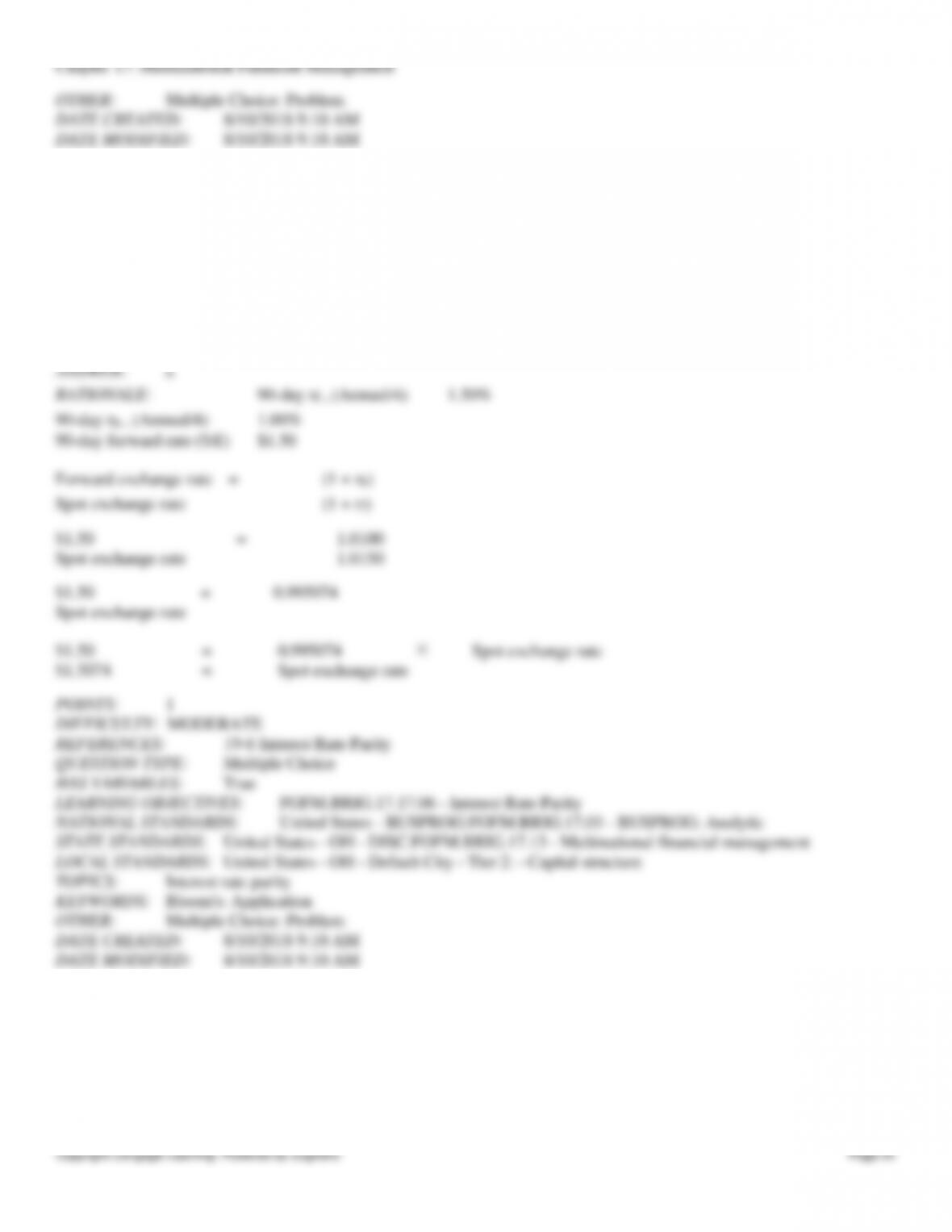
75. If one Swiss franc can purchase 0.80 U.S. dollar, how many Swiss francs can one U.S. dollar buy?
a. 1.5250
b. 1.2500
c. 1.4500
d. 1.4875
e. 1.2250
76. If one U.S. dollar buys 1.69 Canadian dollars, how many U.S. dollars can you purchase for one Canadian dollar?
a. 0.5266
b. 0.5503
c. 0.6864
d. 0.6805
e. 0.5917