Chapter 17: Multinational Financial Management
Copyright Cengage Learning. Powered by Cognero.
Page 1
1. Multinational financial management requires that financial analysts consider the effects of changing currency values.
a. True
b. False
2. Legal and economic differences among countries, although important, do NOT pose significant problems for most
multinational corporations when they coordinate and control worldwide operations and subsidiaries.
a. True
b. False
3. When the value of the U.S. dollar appreciates against another country’s currency, we may purchase more of the foreign
currency with the U.S. dollar.
a. True
b. False
Copyright Cengage Learning. Powered by Cognero.
Page 5
12. If an investor can obtain more of a foreign currency for a dollar in the forward market than in the spot market, then the
forward currency is said to be selling at a discount to the spot rate.
a. True
b. False
13. If a dollar will buy fewer units of a foreign currency in the forward market than in the spot market, then the forward
currency is said to be selling at a premium to the spot rate.
a. True
b. False
14. A foreign currency will, on average, depreciate against the U.S. dollar at a percentage rate approximately equal to the
amount by which its inflation rate exceeds that of the United States.
a. True
b. False
Chapter 17: Multinational Financial Management
Copyright Cengage Learning. Powered by Cognero.
Page 13
c. 2.6585
d. 2.3171
e. 2.4390
30. Suppose 144 yen could be purchased in the foreign exchange market for one U.S. dollar today. If the yen depreciates
by 6.0% tomorrow, how many yen could one U.S. dollar buy tomorrow?
a. 180.1152
b. 158.7456
c. 154.1664
d. 152.6400
e. 189.2736
Chapter 17: Multinational Financial Management
Copyright Cengage Learning. Powered by Cognero.
Page 20
e. $2.4004
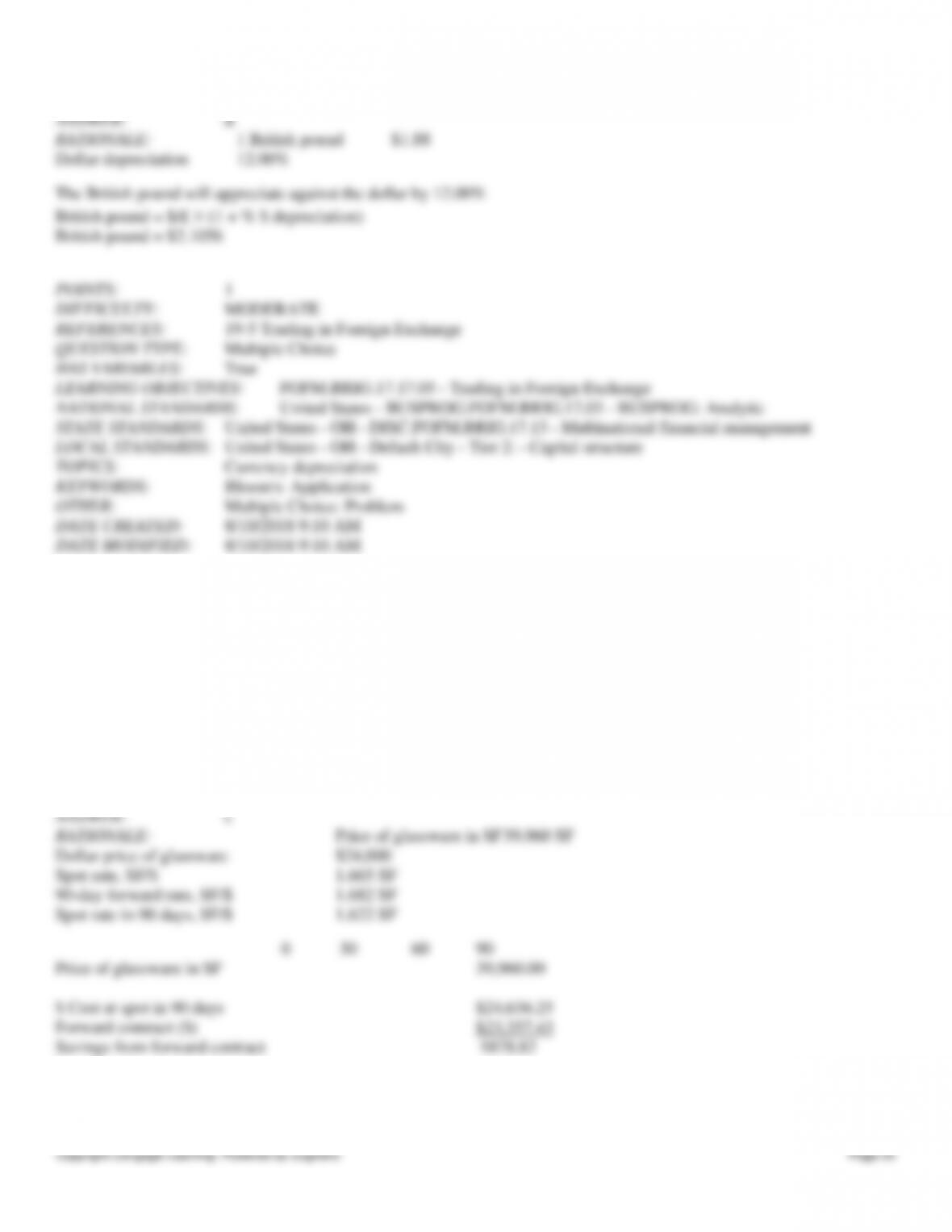
41. Stover Corporation, a U.S. based importer, makes a purchase of crystal glassware from a firm in Switzerland for
39,960 Swiss francs, or $24,000, at the spot rate of 1.665 Swiss francs per dollar. The terms of the purchase are net 90
days, and the U.S. firm wants to cover this trade payable with a forward market hedge to eliminate its exchange rate risk.
Suppose the firm completes a forward hedge at the 90-day forward rate of 1.682 Swiss francs. If the spot rate in 90 days is
actually 1.622 Swiss francs, how much in U.S. dollars will the U.S. firm have saved or lost by hedging its exchange rate
exposure? Do not round the intermediate calculations and round the final answer to the nearest cent.
a. $1,001.85
b. $773.36
c. $878.82
d. $940.34
e. $817.30