Chapter 14: Distributions to Shareholders: Dividends and Share Repurchases
Copyright Cengage Learning. Powered by Cognero.
Page 21
48. Which of the following statements is NOT CORRECT?
a. Stock repurchases can be used by a firm as part of a plan to change its capital structure.
b. After a 3-for-1 stock split, a company’s price per share should fall, but the number of shares outstanding will rise.
c. Investors may interpret a stock repurchase program as a signal that the firm’s managers believe the stock is
undervalued, or, alternatively, as a signal that the firm does not have many good investment opportunities.
d. A company can repurchase stock to distribute a large one-time cash inflow, say from the sale of a division, to
stockholders without having to increase its regular dividend.
e. Stockholders pay no income tax on dividends if the dividends are used to purchase stock through a dividend
reinvestment plan.
49. Which of the following statements is CORRECT?
a. If a firm follows the residual dividend model, then a sudden increase in the number of profitable projects would
be likely to lead to a reduction of the firm’s dividend payout ratio.
b. The clientele effect explains why so many firms change their dividend policies so often.
c. One advantage of adopting the residual dividend model is that this policy makes it easier for a corporation to
attract a specific and well-identified dividend clientele.
d. New-stock dividend reinvestment plans are similar to stock dividends because they both increase the number of
shares outstanding but don’t change the firm’s total amount of book equity.
e. Investors who receive stock dividends must pay taxes on the value of the new shares in the year the stock
dividends are received.
Chapter 14: Distributions to Shareholders: Dividends and Share Repurchases
Copyright Cengage Learning. Powered by Cognero.
Page 23
b. 60.03%
c. 62.39%
d. 58.86%
e. 59.45%
52. Becker Financial recently declared a 2-for-1 stock split. Prior to the split, the stock sold for $100 per share. If the
firm’s total market value is unchanged by the split, what will the stock price be following the split?
a. $51.50
b. $45.50
c. $50.00
d. $38.50
e. $49.00
Chapter 14: Distributions to Shareholders: Dividends and Share Repurchases
Copyright Cengage Learning. Powered by Cognero.
Page 27
c. $230,769
d. $205,385
e. $186,923
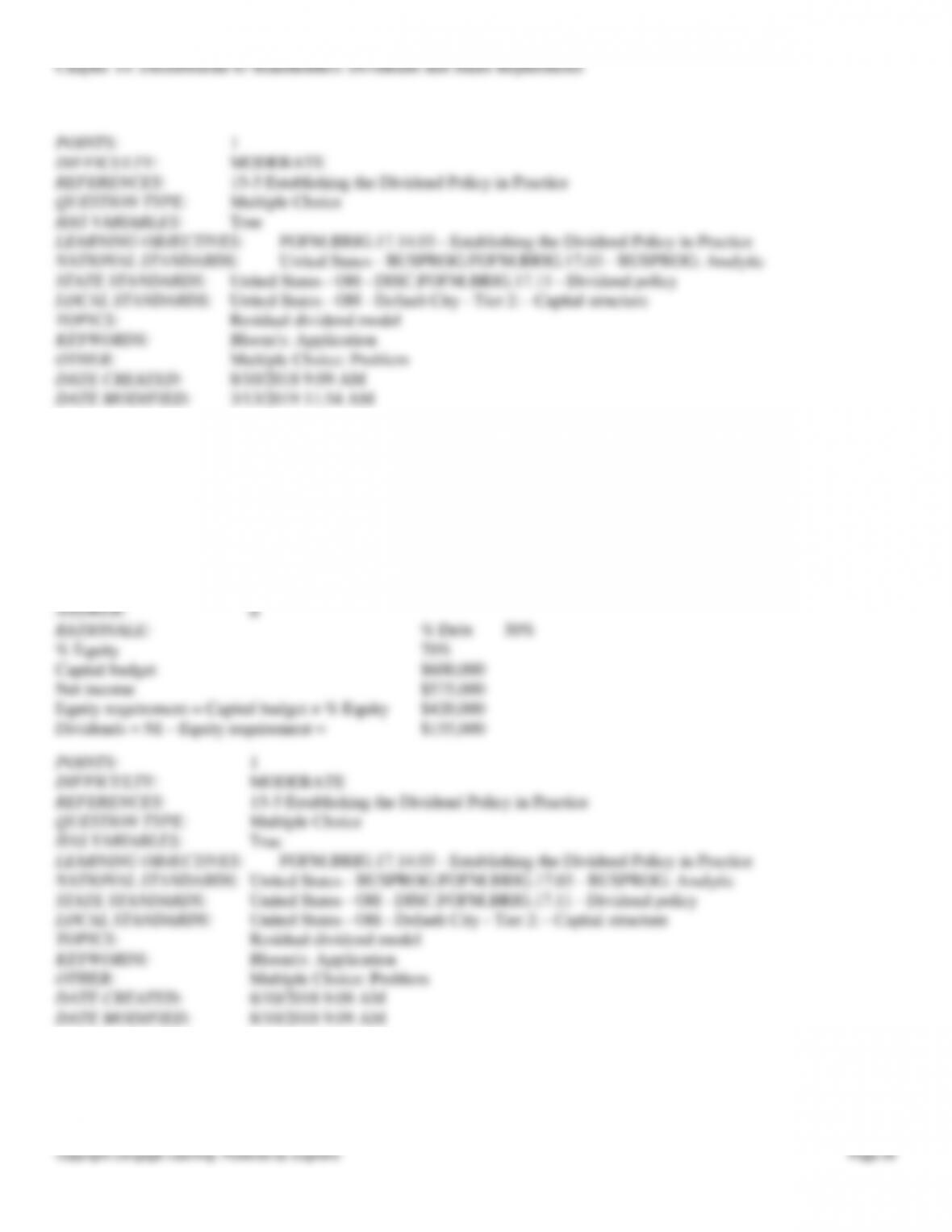
59. Dentaltech Inc. projects the following data for the coming year. If the firm follows the residual dividend model and
also maintains its target capital structure, what will its dividend payout ratio be?
EBIT $2,500,000 Capital budget $1,275,000
Interest rate 10% % Debt 40%
Debt outstanding $6,500,000 % Equity 60%
Shares outstanding 5,000,000 Tax rate 25%
a. 44.9%
b. 52.9%
c. 52.5%
d. 39.5%
e. 38.1%
Chapter 14: Distributions to Shareholders: Dividends and Share Repurchases
Copyright Cengage Learning. Powered by Cognero.
Page 29
% Debt 60%
Net income (NI) $635,000
a. $213,150
b. $240,100
c. $262,150
d. $245,000
e. $284,200
62. NY Fashions has the following data. If it follows the residual dividend model, how much total dividends, if any, will it
pay out?
Capital budget $1,400,000
% Debt 65%
Net income (NI) $735,000
a. $247,450
b. $186,200
c. $225,400
d. $301,350
e. $245,000
Chapter 14: Distributions to Shareholders: Dividends and Share Repurchases
Copyright Cengage Learning. Powered by Cognero.
Page 31
a. 48.71%
b. 47.33%
c. 44.58%
d. 38.14%
e. 45.95%
65. New Orleans Builders Inc. has the following data. If it follows the residual dividend model, what is its forecasted
dividend payout ratio?
Capital budget $7,000
% Debt 40%
Net income (NI) $7,000
a. 39.60%
b. 37.20%
c. 49.20%
d. 31.60%
e. 40.00%
Chapter 14: Distributions to Shareholders: Dividends and Share Repurchases
Copyright Cengage Learning. Powered by Cognero.
Page 34
a. $1,923,900
b. $1,669,500
c. $1,494,600
d. $1,590,000
e. $1,192,500
70. Purcell Farms Inc. has the following data, and it follows the residual dividend model. Currently, it finances with 10%
debt. Some Purcell family members would like for the dividend payout ratio to be increased. If Purcell increased its debt
ratio, which the firm’s treasurer thinks is feasible, by how much could the dividend payout ratio be increased, holding
other things constant?
Capital budget $3,000,000
Net income (NI) $3,500,000
% Debt now 10%
% Debt after change 53%
a. 28.0%
b. 39.1%
c. 38.3%
d. 31.7%
e. 36.9%
Chapter 14: Distributions to Shareholders: Dividends and Share Repurchases
Copyright Cengage Learning. Powered by Cognero.
Page 39
Policy Changes
Current policy Increase debt Lower payout Do both
Projected NI $270.0 $270.0 $270.0 $270.0
% Debt 25.0% 75.0% 25.0% 75.0%
% Equity 75.0% 25.0% 75.0% 25.0%
% Payout 65.0% 65.0% 20.0% 20.0%
a. 252.0; 162.0; 738.0
b. 254.5; 131.2; 848.7
c. 209.2; 187.9; 590.4
d. 257.0; 179.8; 804.4
e. 259.6; 142.6; 752.8