Chapter 13: Capital Structure and Leverage
Copyright Cengage Learning. Powered by Cognero.
Page 36
74. A group of venture investors is considering putting money into Lemma Books, which wants to produce a new reader
for electronic books. The variable cost per unit is estimated at $250, the sales price would be set at twice the VC/unit, or
$500, and fixed costs are estimated at $600,000. The investors will put up the funds if the project is likely to have an
operating income of $500,000 or more. What sales volume would be required in order to meet the minimum profit goal?
(Hint: Use the break-even formula, but include the required profit in the numerator.)
a. 3,300
b. 4,400
c. 3,696
d. 5,412
e. 5,104
75. El Capitan Foods has a capital structure of 45% debt and 55% equity, its tax rate is 25%, and its beta (leveraged) is
1.20. Based on the Hamada equation, what would the firm’s beta be if it used no debt, i.e., what is its unlevered beta, bU?
a. 0.74
b. 0.58
c. 0.86
d. 0.77
e. 0.95
Copyright Cengage Learning. Powered by Cognero.
Page 40
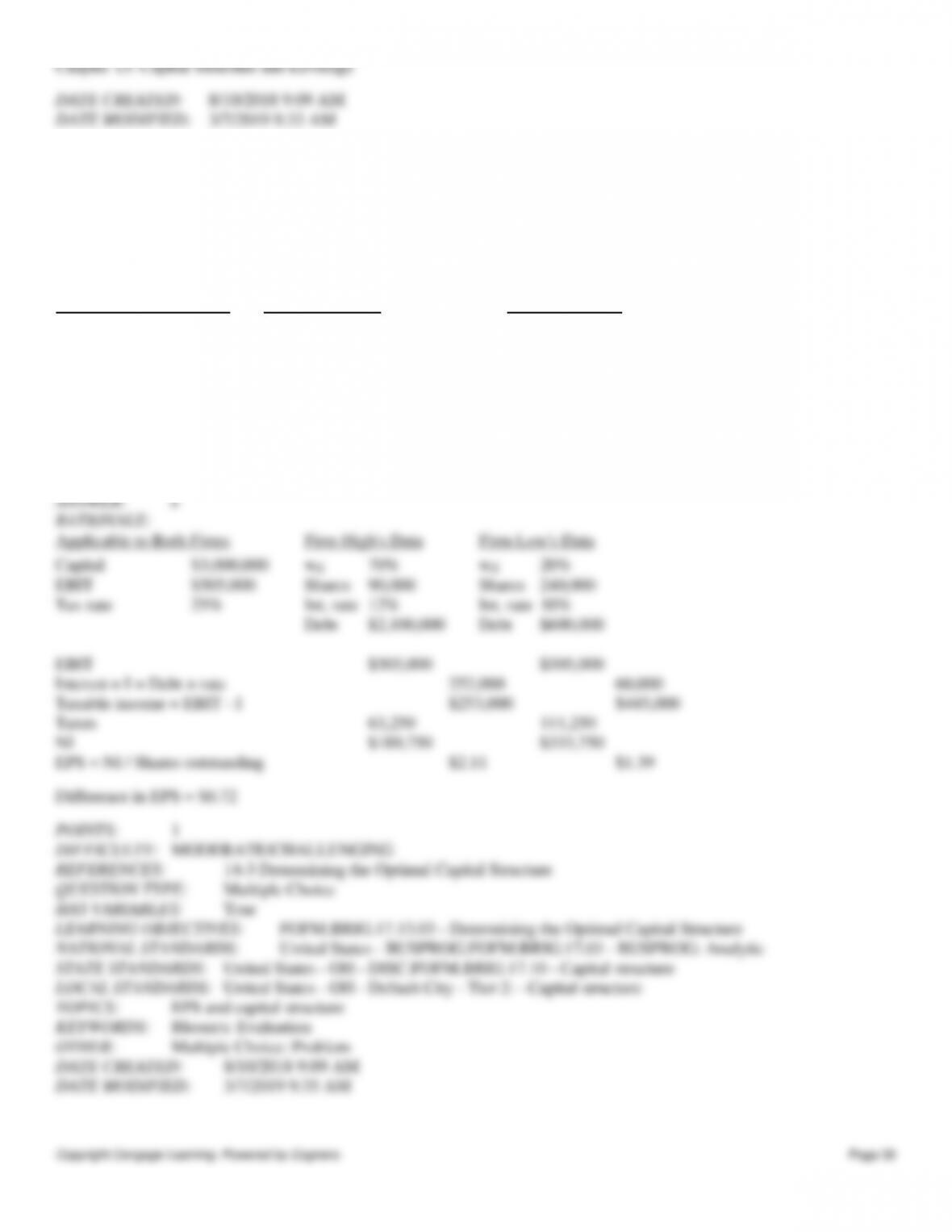
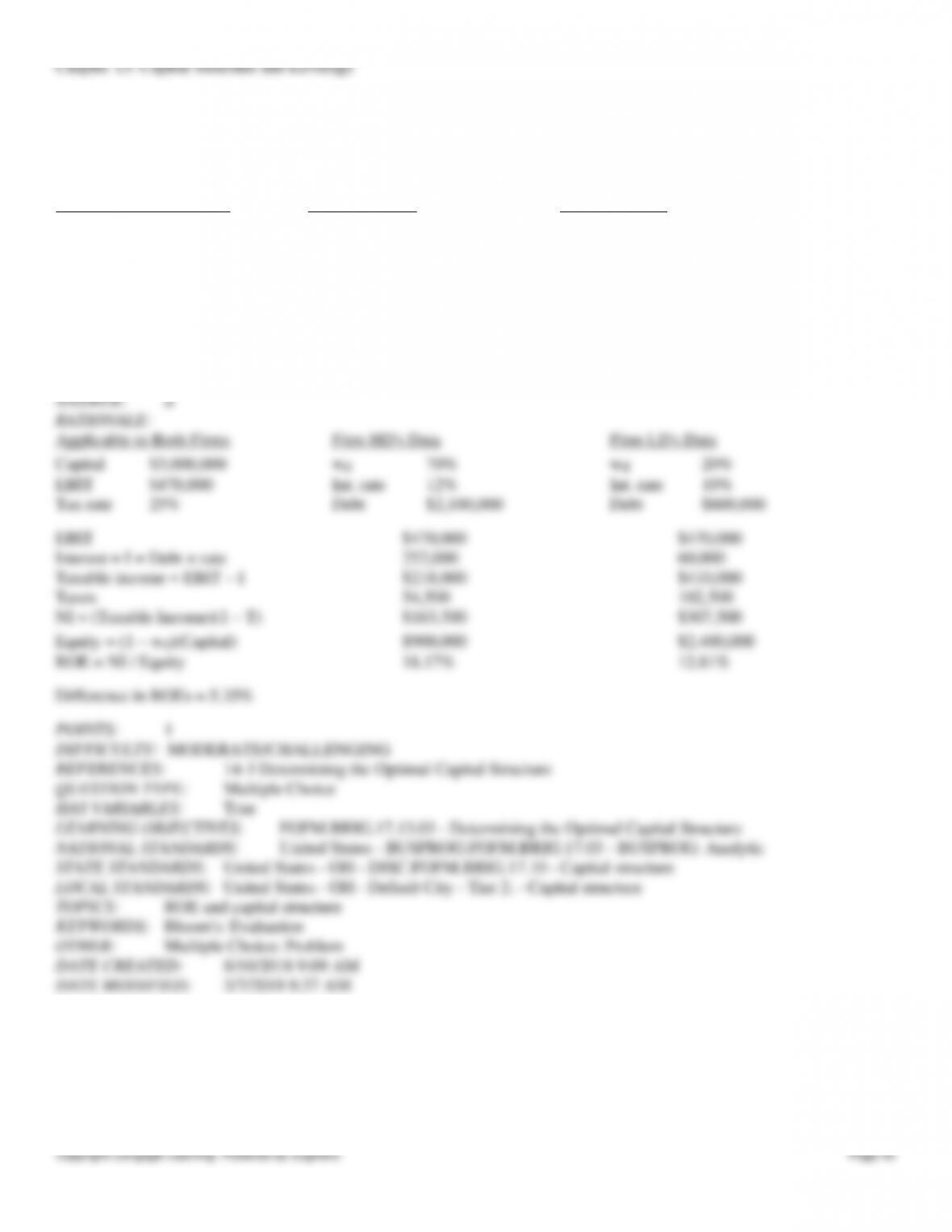
79. Firms HD and LD are identical except for their use of debt and the interest rates they pay—HD has more debt and thus
must pay a higher interest rate. Both companies are small, so they are not subject to the interest deduction
limitation. Based on the data given below, how much higher or lower will HD’s ROE be versus that of LD, i.e., what is
ROEHD – ROELD? Do not round your intermediate calculations.
Applicable to Both Firms Firm HD’s Data Firm LD’s Data
Capital $3,000,000 wd 70% wd 20%
EBIT $470,000 Int. rate 12% Int. rate 10%
Tax rate 25%
a. 5.62%
b. 4.02%
c. 6.69%
d. 5.35%
e. 5.09%
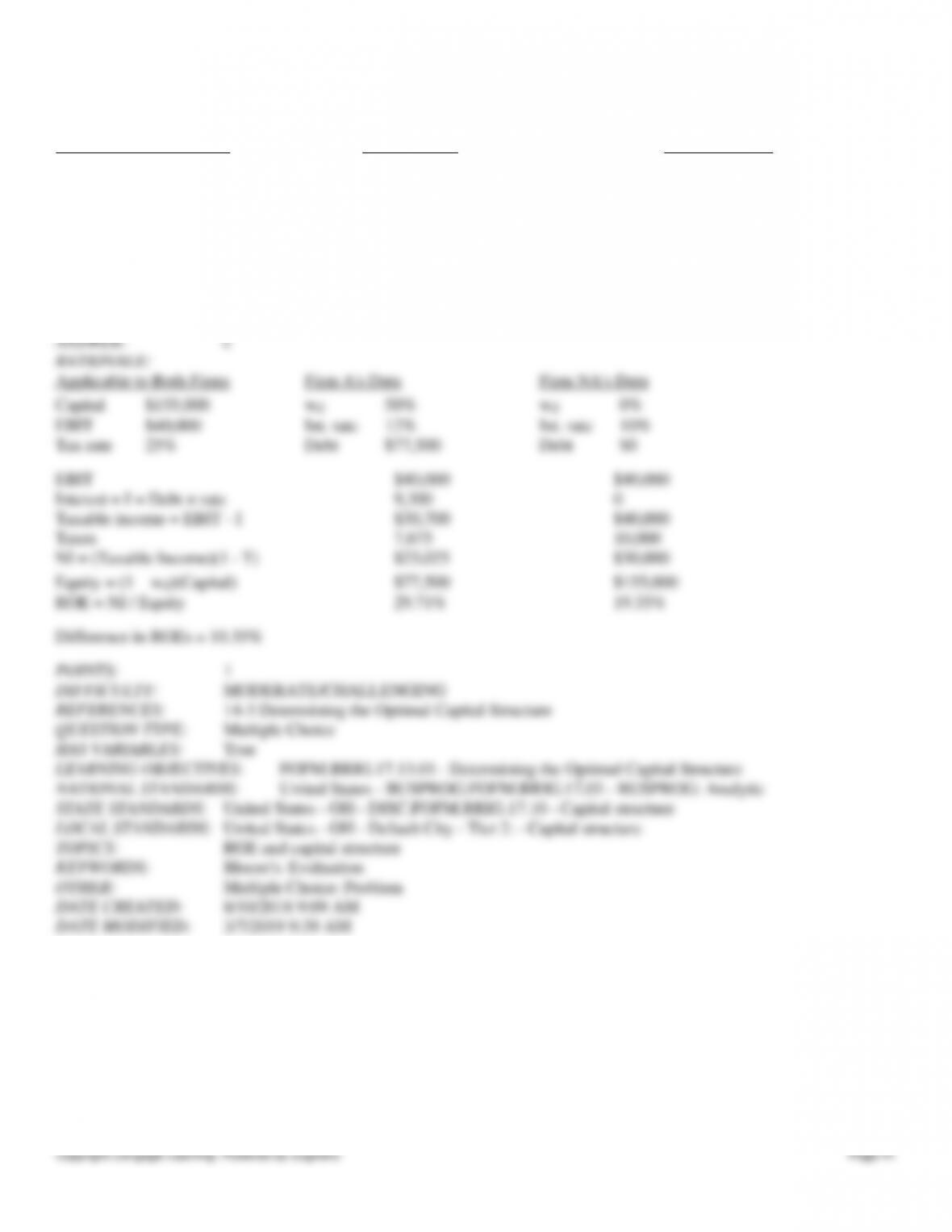
80. Firm A is very aggressive in its use of debt to leverage up its earnings for common stockholders, whereas Firm NA is
not aggressive and uses no debt. The two firms’ operations are identical—they have the same total investor-supplied
capital, sales, operating costs, and EBIT. Thus, they differ only in their use of financial leverage (wd). Both companies are
small, so they are not subject to the interest deduction limitation. Based on the following data, how much higher or lower
Chapter 13: Capital Structure and Leverage
Copyright Cengage Learning. Powered by Cognero.
Page 41
is A’s ROE than that of NA, i.e., what is ROEA – ROENA? Do not round your intermediate calculations.
Applicable to Both Firms Firm A’s Data Firm NA’s Data
Capital $155,000 wd 50% wd 0%
EBIT $40,000 Int. rate 12% Int. rate 10%
Tax rate 25%
a. 10.25%
b. 12.01%
c. 10.35%
d. 12.12%
e. 12.84%
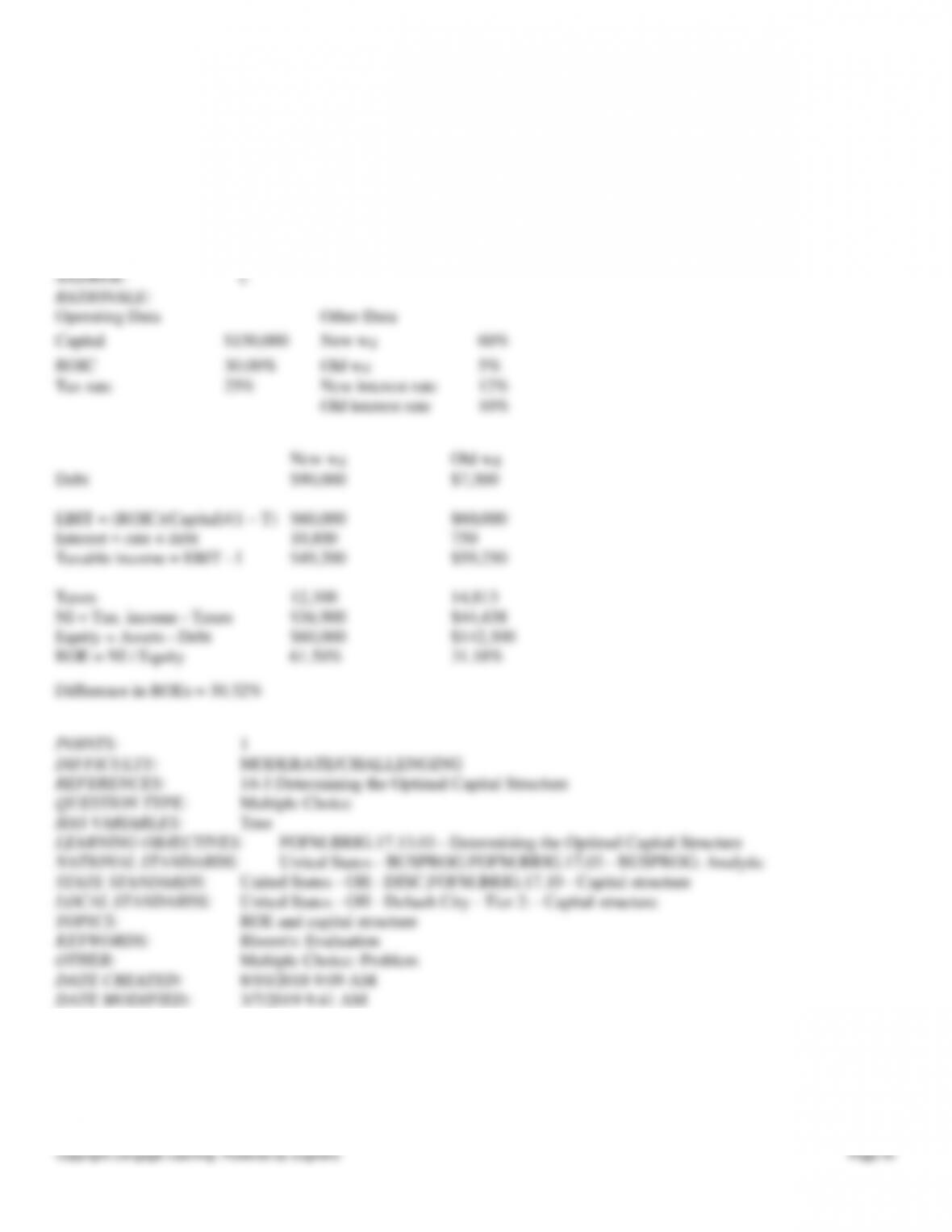
81. Your firm’s debt ratio is only 5.00%, but the new CFO thinks that more debt should be employed. She wants to sell
bonds and use the proceeds to buy back and retire common shares so the percentage of common equity in the capital
structure (wc) = 1 – wd. Other things held constant, and based on the data below, if the firm increases the percentage of
debt in its capital structure (wd) to 60.0%, by how much would the ROE change, i.e., what is ROENew – ROEOld? Do not
round your intermediate calculations.
Operating Data Other Data
Capital $150,000 Old wd 5%
Chapter 13: Capital Structure and Leverage
Copyright Cengage Learning. Powered by Cognero.
Page 42
ROIC = EBIT (1 – T)/Capital 30.00% Old interest rate 10%
Tax rate 25% New wd 60%
New interest rate 12%
a. 31.23%
b. 26.98%
c. 30.32%
d. 34.56%
e. 26.07%
82. You have been hired by a new firm that is just being started. The CFO wants to finance with 60% debt, but the
president thinks it would be better to hold the percentage of debt in the capital structure (wd) to only 10%. Both
companies are small, so they are not subject to the interest deduction limitation. Other things held constant, and based on
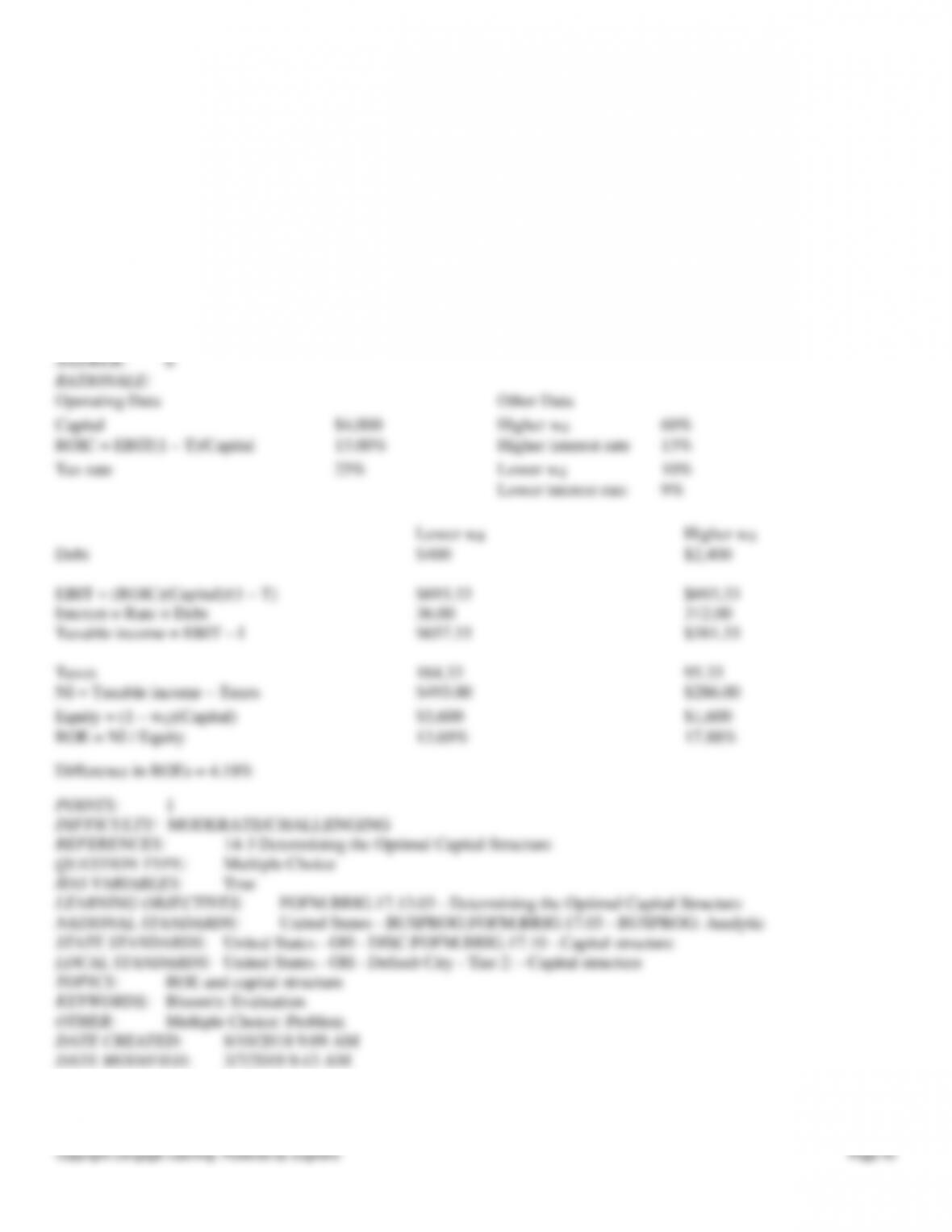
the data below, if the firm uses more debt, by how much would the ROE change, i.e., what is ROEHigher – ROELower? Do
Chapter 13: Capital Structure and Leverage
Copyright Cengage Learning. Powered by Cognero.
Page 43
not round your intermediate calculations.
Operating Data Other Data
Capital $4,000 Higher wd 60%
ROIC = EBIT(1 – T)/Capital 13.00% Higher interest rate 13%
Tax rate 25% Lower wd 10%
Lower interest rate 9%
a. 3.72%
b. 4.18%
c. 4.77%
d. 3.93%
e. 4.68%
83. Your girlfriend plans to start a new company to make a new type of cat litter. Her father will finance the operation, but
she will have to pay him back. You are helping her, and the issue now is how to finance the company, with equity only or
Chapter 13: Capital Structure and Leverage
Copyright Cengage Learning. Powered by Cognero.
Page 44
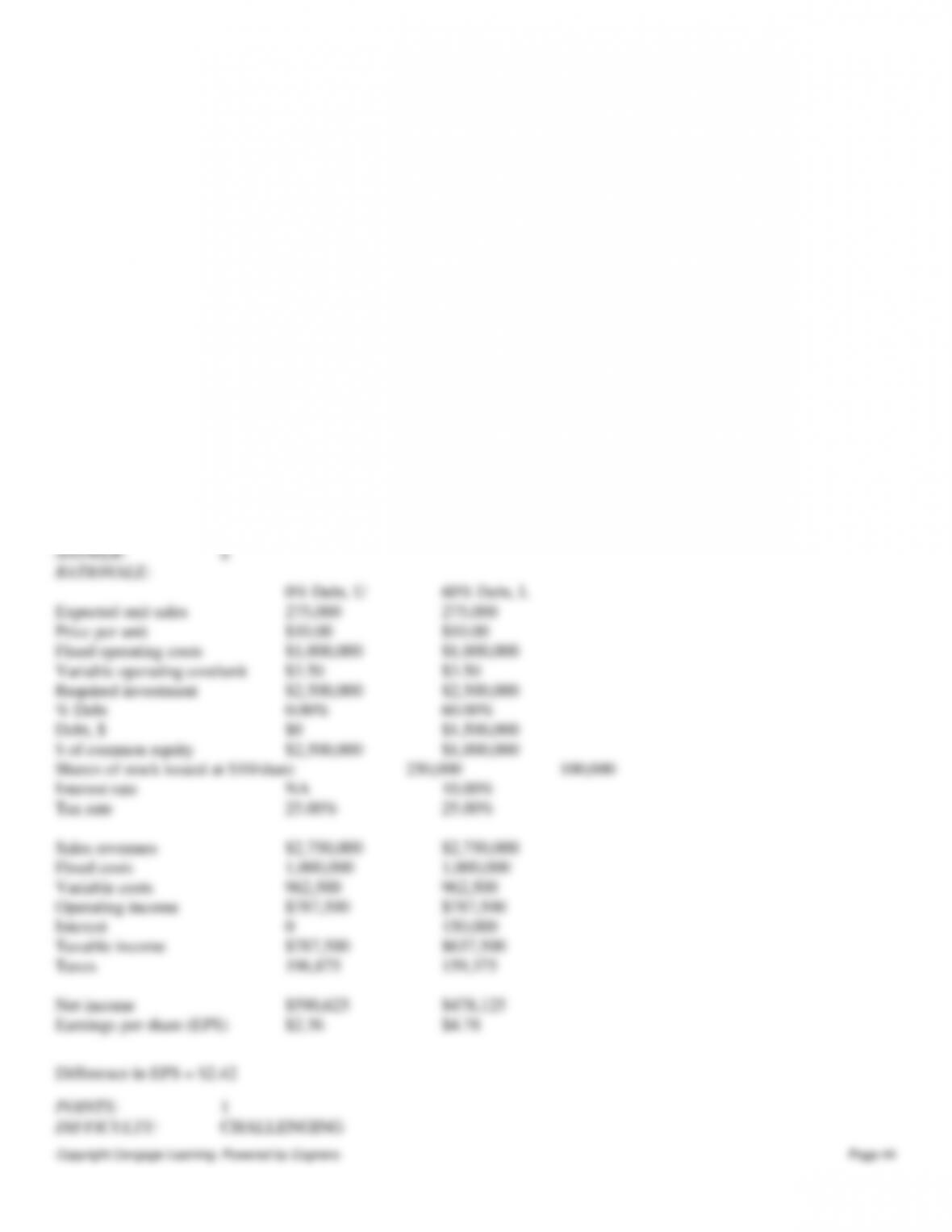
with a mix of debt and equity. The price per unit will be $10.00 regardless of how the firm is financed. The expected fixed
and variable operating costs, along with other information, are shown below. How much higher or lower will the firm’s
expected EPS be if it uses some debt rather than only equity, i.e., what is EPSL – EPSU? Do not round your intermediate
calculations.
0% Debt, U 60% Debt, L
Expected unit sales 275,000 275,000
Price per unit $10.00 $10.00
Fixed costs $1,000,000 $1,000,000
Variable cost/unit $3.50 $3.50
Required investment $2,500,000 $2,500,000
Shares issued at $10/share 250,000 100,000
% Debt 0.00% 60.00%
Debt, $ $0 $1,500,000
Equity, $ $2,500,000 $1,000,000
Interest rate NA 10.00%
Tax rate 25.00% 25.00%
a. $2.42
b. $2.78
c. $1.94
d. $2.18
e. $2.06
Chapter 13: Capital Structure and Leverage
Copyright Cengage Learning. Powered by Cognero.
Page 49
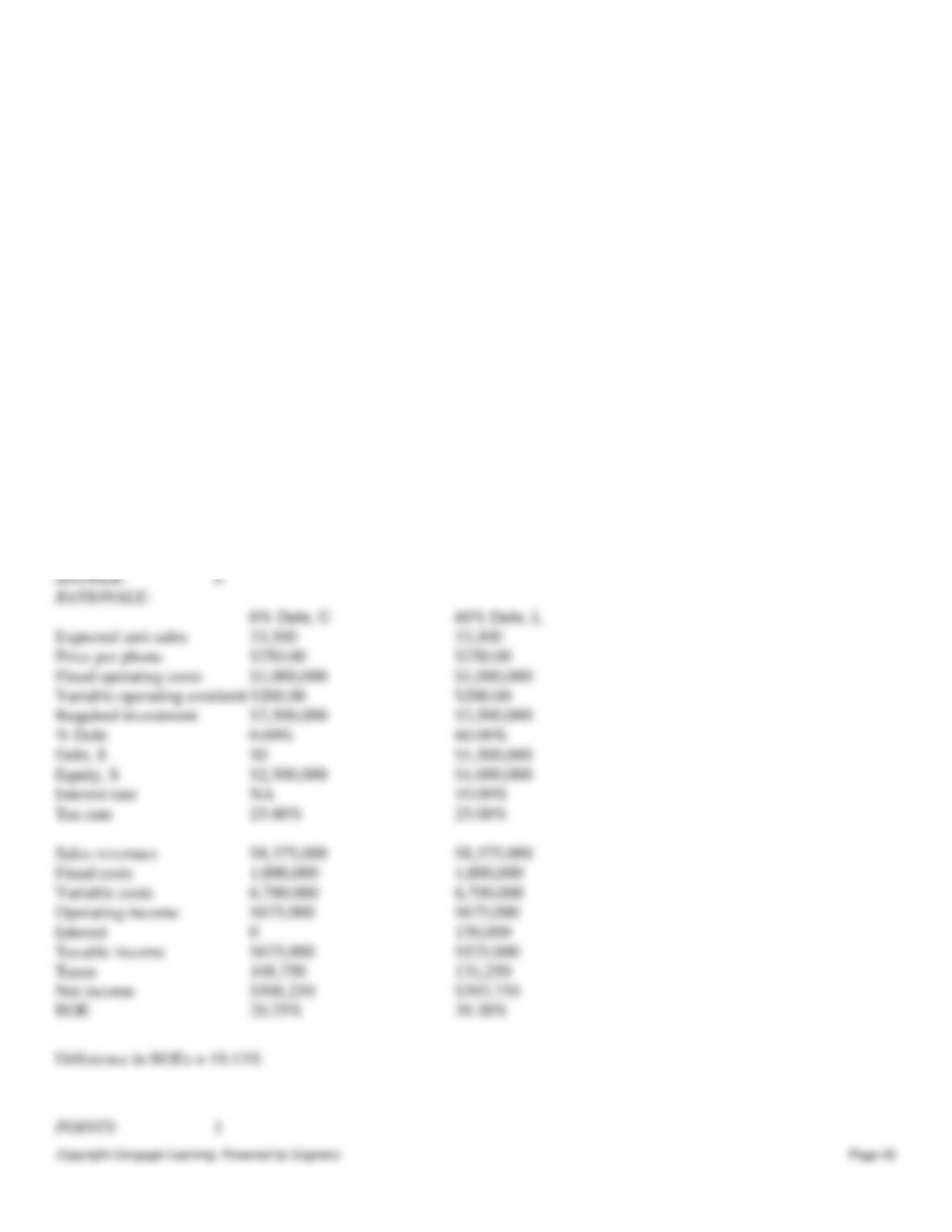
88. You were hired as the CFO of a new company that was founded by three professors at your university. The company
plans to manufacture and sell a new product, a cell phone that can be worn like a wrist watch. The issue now is how to
finance the company, with equity only or with a mix of debt and equity. The price per phone will be $250.00 regardless of
how the firm is financed. The expected fixed and variable operating costs, along with other data, are shown below. How
much higher or lower will the firm’s expected ROE be if it uses 60% debt rather than only equity, i.e., what is ROEL –
ROEU?
0% Debt, U 60% Debt, L
Expected unit sales (Q) 33,500 33,500
Price per phone (P) $250.00 $250.00
Fixed costs (F) $1,000,000 $1,000,000
Variable cost/unit (V) $200.00 $200.00
Required investment $2,500,000 $2,500,000
% Debt 0.00% 60.00%
Debt, $ $0 $1,500,000
Equity, $ $2,500,000 $1,000,000
Interest rate NA 10.00%
Tax rate 25.00% 25.00%
a. 14.92%
b. 19.13%
c. 17.40%
d. 21.04%
e. 20.85%