Chapter 11: The Basics of Capital Budgeting
Copyright Cengage Learning. Powered by Cognero.
Page 53
96. Malholtra Inc. is considering a project that has the following cash flow and WACC data. What is the project’s MIRR?
Note that a project’s projected MIRR can be less than the WACC (and even negative), in which case it will be rejected.
WACC: 10.00%
Year 0 1 2 3 4
Cash flows –$975 $300 $320 $340 $360
a. 13.04%
b. 9.16%
c. 14.10%
d. 11.98%
e. 11.75%
97. Hindelang Inc. is considering a project that has the following cash flow and WACC data. What is the project’s MIRR?
Note that a project’s projected MIRR can be less than the WACC (and even negative), in which case it will be rejected.
Chapter 11: The Basics of Capital Budgeting
Copyright Cengage Learning. Powered by Cognero.
Page 54
WACC: 11.50%
Year 0 1 2 3 4
Cash flows –$850 $300 $320 $340 $360
a. 19.67%
b. 17.23%
c. 16.26%
d. 15.77%
e. 16.91%
98. Stern Associates is considering a project that has the following cash flow data. What is the project’s payback?
Year 0 1 2 3 4 5
Cash flows -$1,000 $300 $310 $320 $330 $340
a. 2.89 years
b. 2.92 years
c. 3.40 years
d. 3.21 years
e. 3.92 years
Copyright Cengage Learning. Powered by Cognero.
Page 56
100. Masulis Inc. is considering a project that has the following cash flow and WACC data. What is the project’s
discounted payback?
WACC: 10.00%
Year 0 1 2 3 4
Cash flows -$1,300 $525 $485 $445 $405
a. 2.62 years
b. 3.32 years
c. 2.75 years
d. 3.42 years
e. 3.05 years
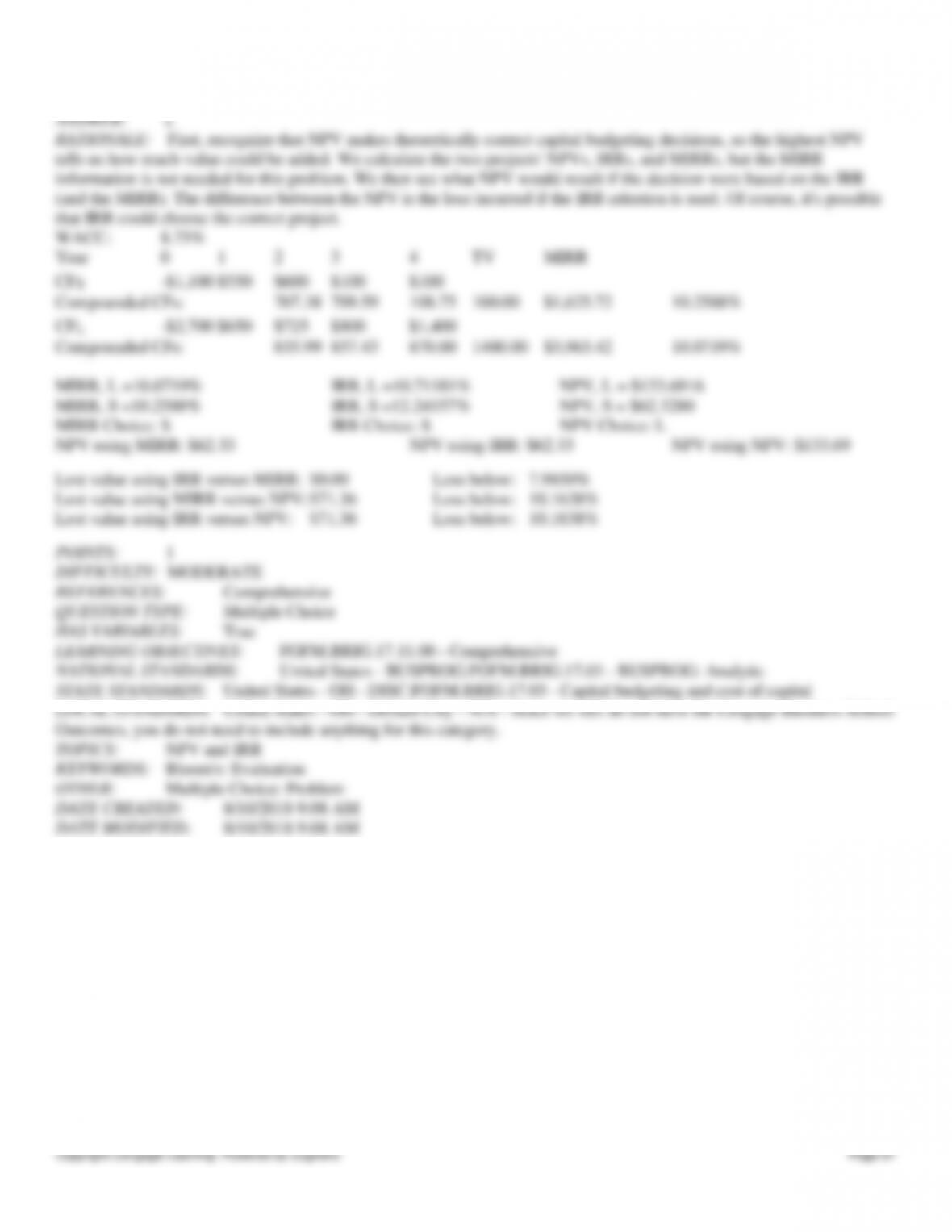
101. Tesar Chemicals is considering Projects S and L, whose cash flows are shown below. These projects are mutually
exclusive, equally risky, and not repeatable. The CEO believes the IRR is the best selection criterion, while the CFO
advocates the NPV. If the decision is made by choosing the project with the higher IRR rather than the one with the higher
NPV, how much, if any, value will be forgone, i.e., what’s the chosen NPV versus the maximum possible NPV? Note that
(1) “true value” is measured by NPV, and (2) under some conditions the choice of IRR vs. NPV will have no effect on the
value gained or lost.
WACC: 8.75%
0 1 2 3 4
CFS -$1,100 $550 $600 $100 $100
CFL -$2,700 $650 $725 $800 $1,400
a. $79.93
b. $70.65
c. $71.36
d. $88.49
Chapter 11: The Basics of Capital Budgeting
Copyright Cengage Learning. Powered by Cognero.
Page 57
e. $68.51
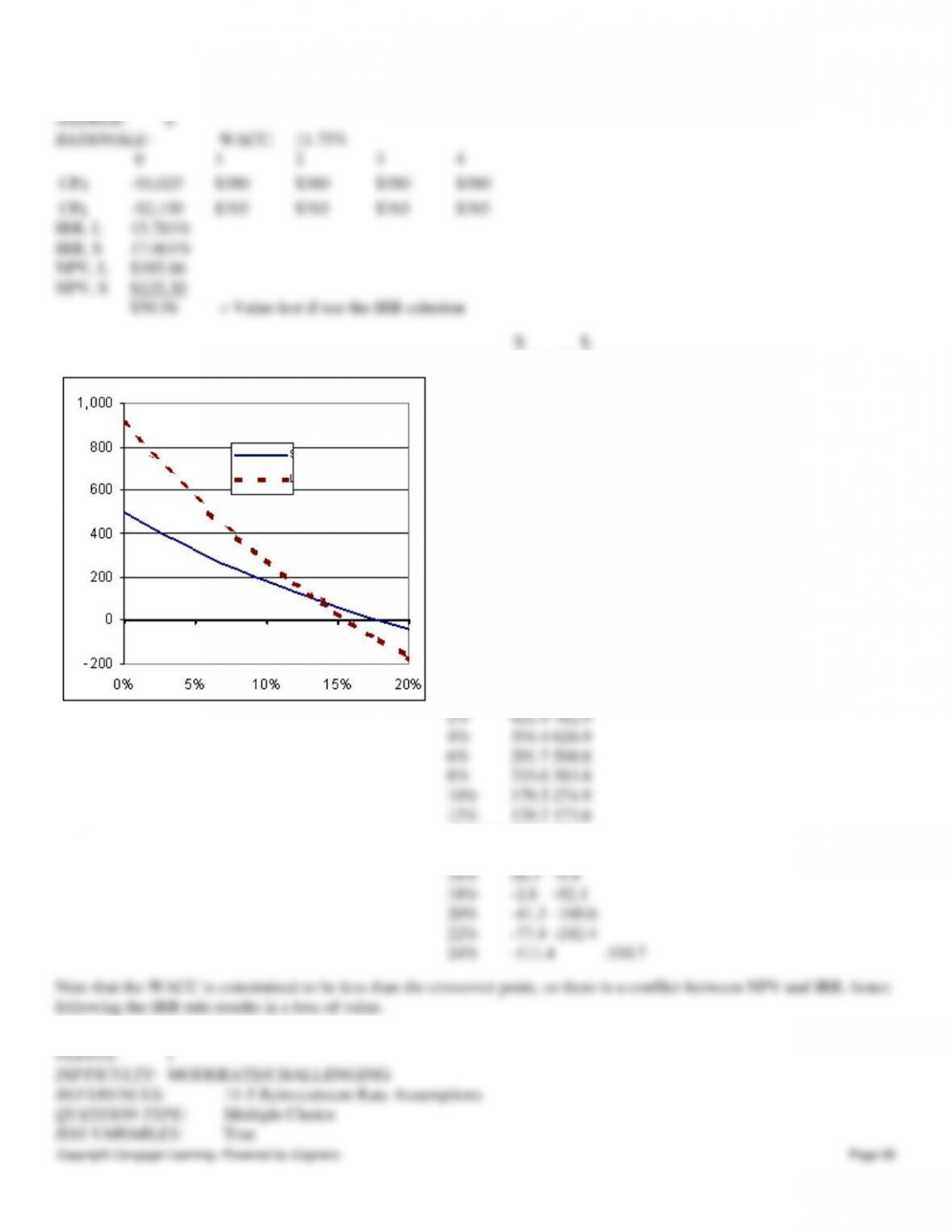
102. A firm is considering Projects S and L, whose cash flows are shown below. These projects are mutually exclusive,
equally risky, and not repeatable. The CEO wants to use the IRR criterion, while the CFO favors the NPV method. You
were hired to advise the firm on the best procedure. If the wrong decision criterion is used, how much potential value
would the firm lose?
WACC: 11.75%
0 1 2 3 4
CFS -$1,025 $380 $380 $380 $380
CFL -$2,150 $765 $765 $765 $765
a. $45.51
b. $50.56
c. $62.70
d. $57.64
Chapter 11: The Basics of Capital Budgeting
Copyright Cengage Learning. Powered by Cognero.
Page 58
e. $45.00
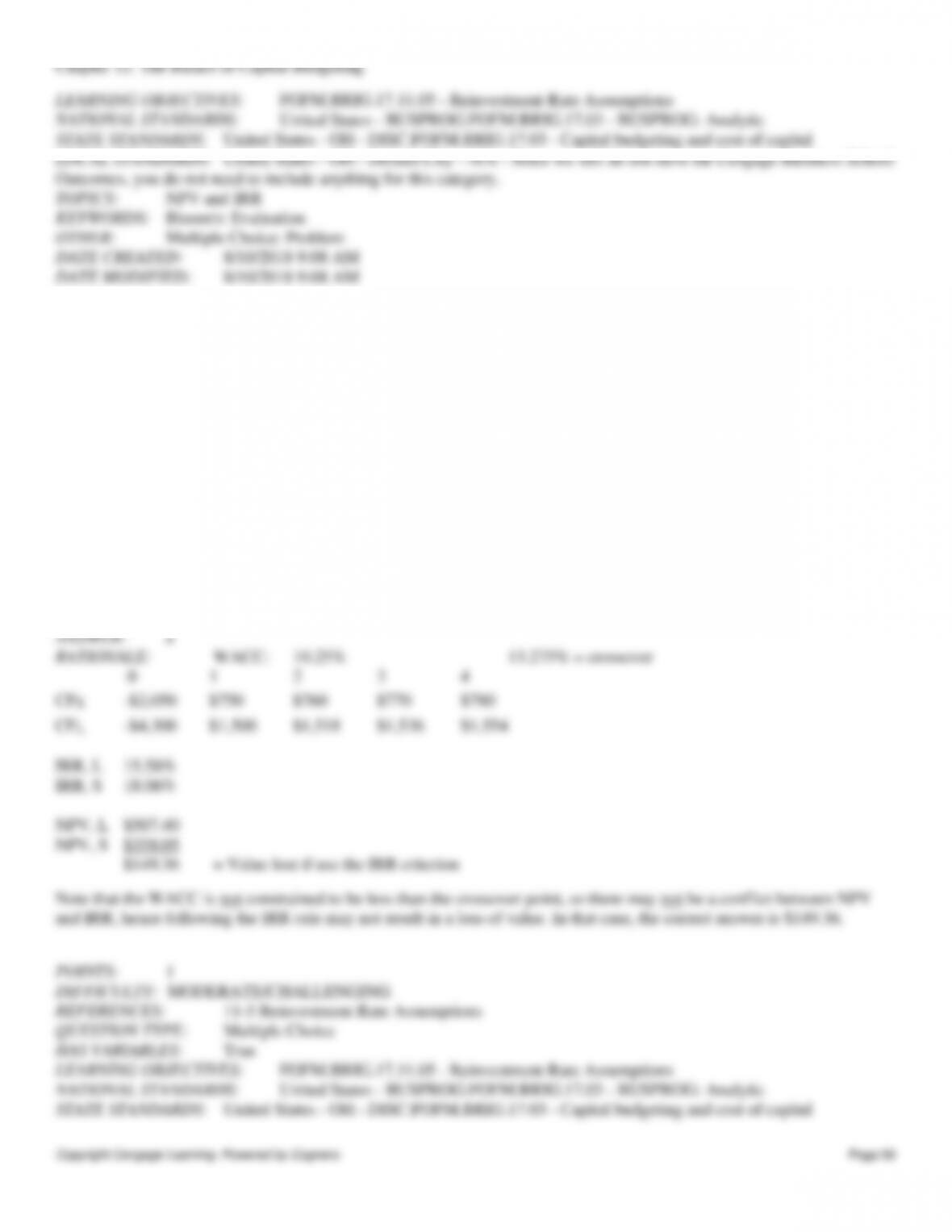
135.3 185.9
0% 495.0 910.0
13.860% 85.4 85.4
14% 82.2 79.0
Copyright Cengage Learning. Powered by Cognero.
Page 60
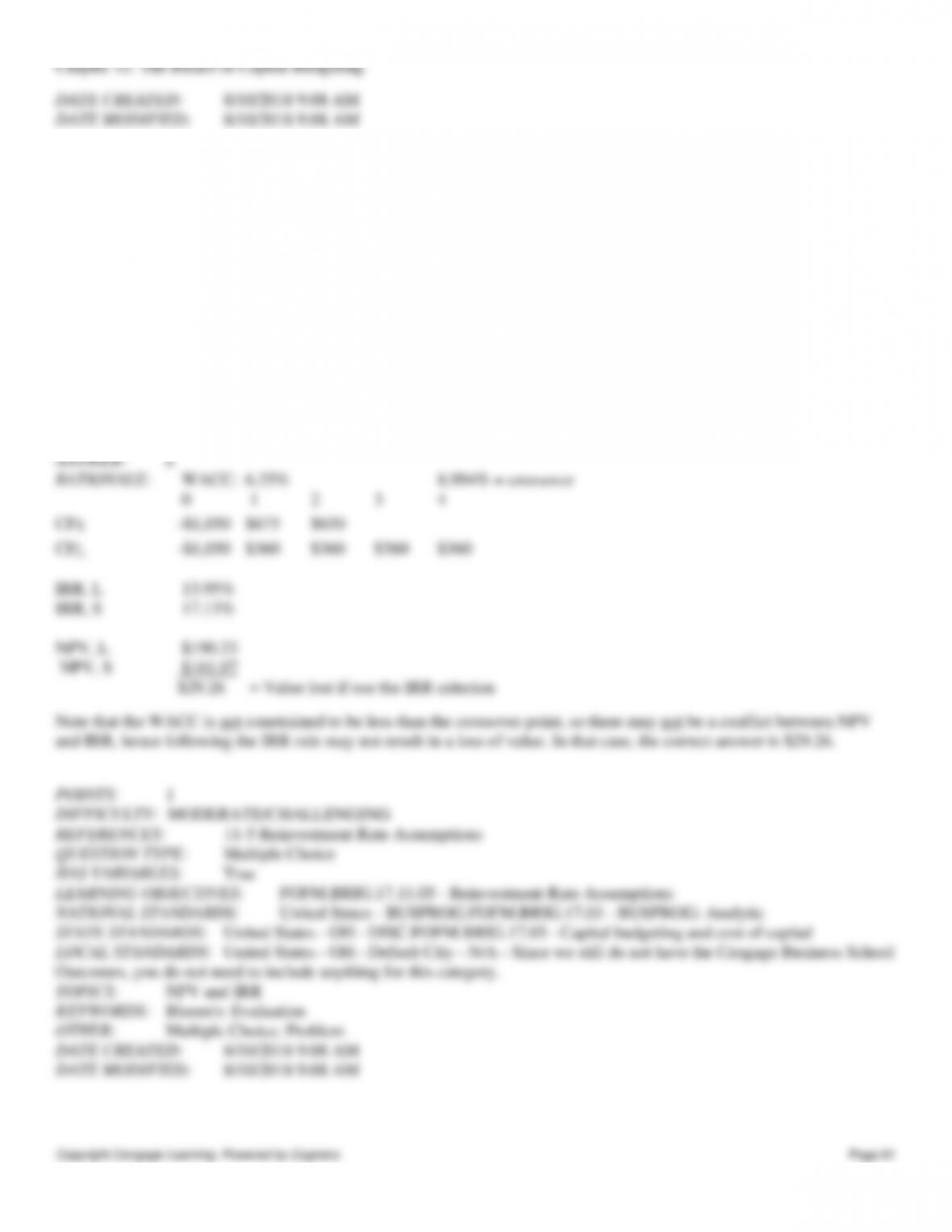
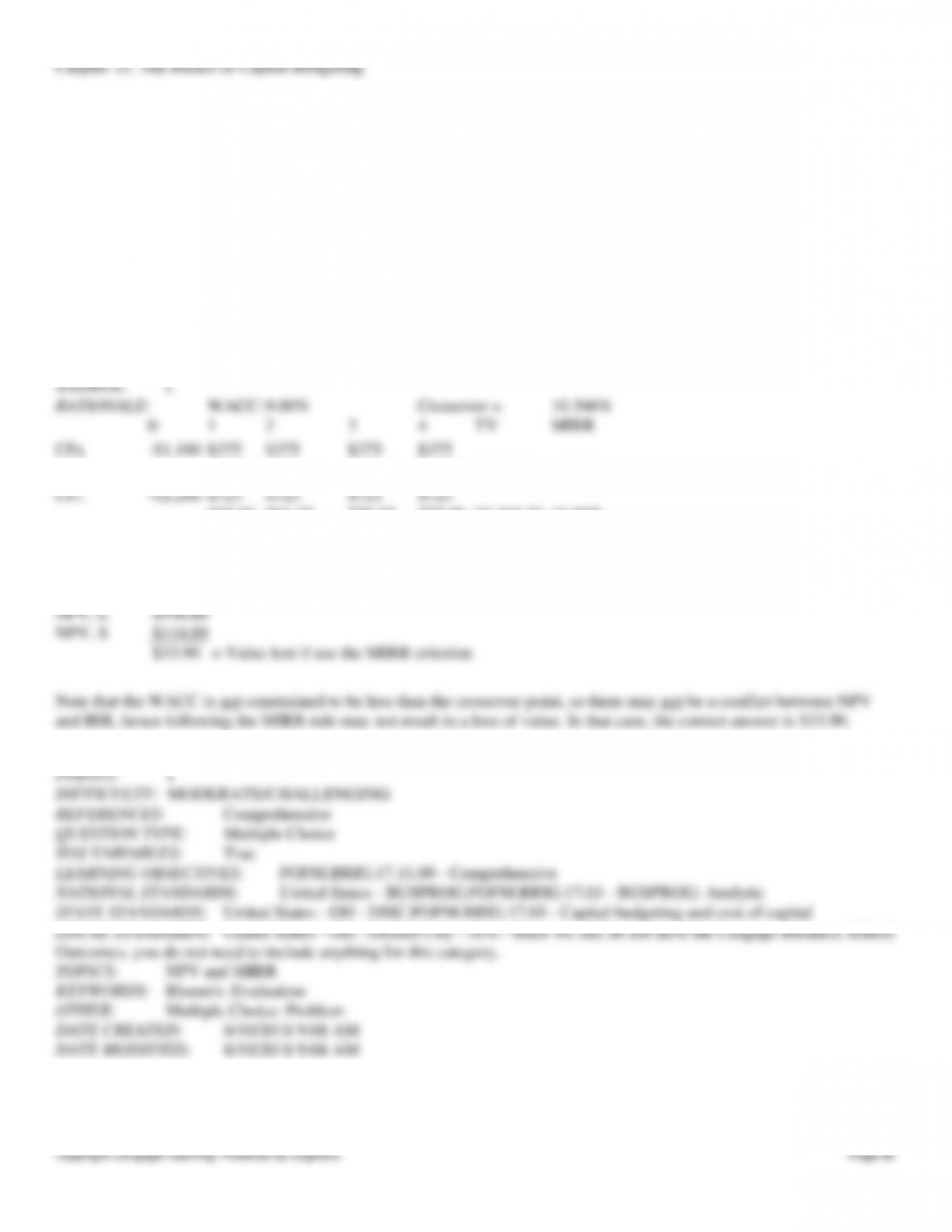
104. Moerdyk & Co. is considering Projects S and L, whose cash flows are shown below. These projects are mutually
exclusive, equally risky, and not repeatable. If the decision is made by choosing the project with the higher IRR, how
much value will be forgone? Note that under certain conditions choosing projects on the basis of the IRR will not cause
any value to be lost because the one with the higher IRR will also have the higher NPV, i.e., no conflict will exist.
WACC: 7.75%
0 1 2 3 4
CFS -$1,025 $650 $450 $250 $50
CFL -$1,025 $100 $300 $500 $700
a. $35.63
b. $42.42
c. $40.30
d. $50.06
e. $52.18
Copyright Cengage Learning. Powered by Cognero.
Page 62
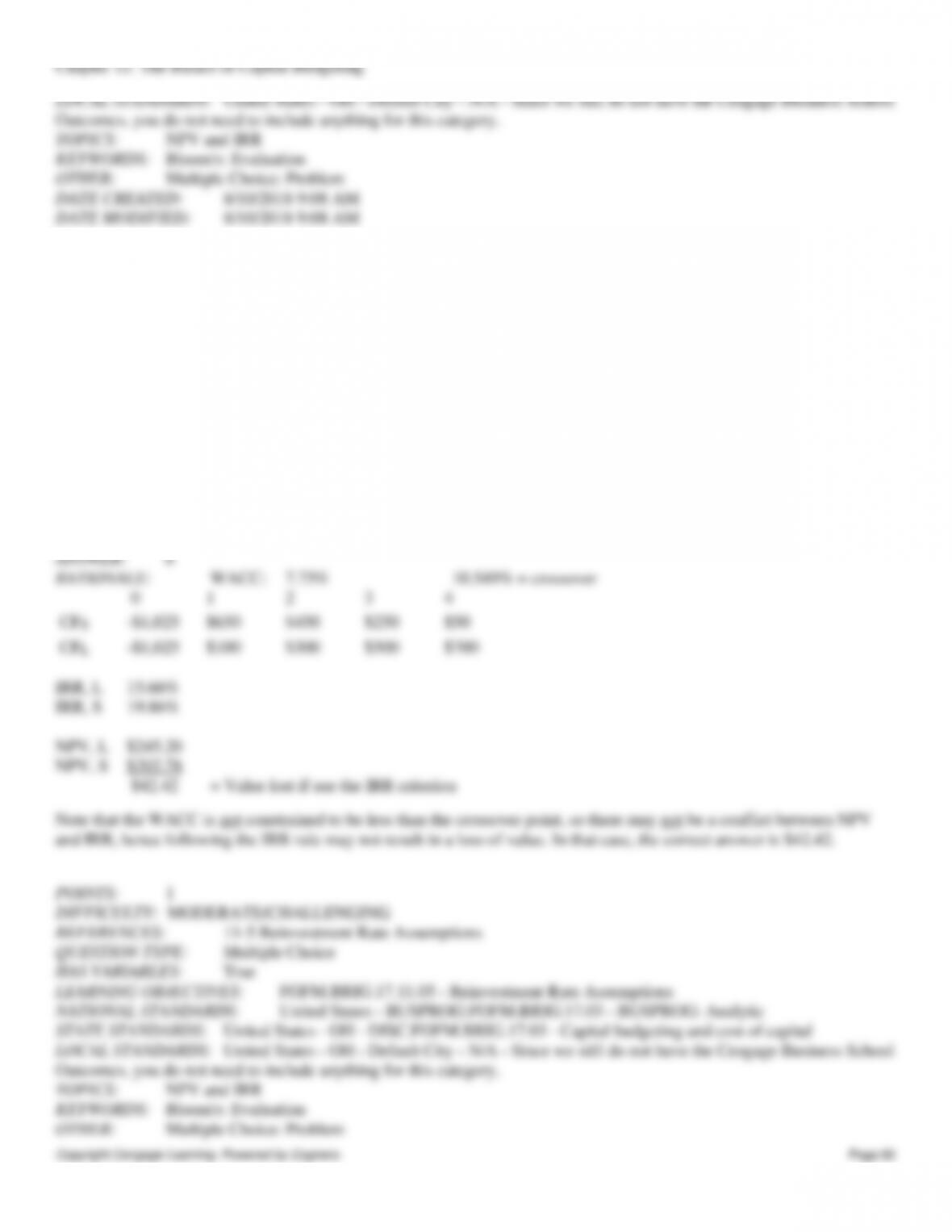
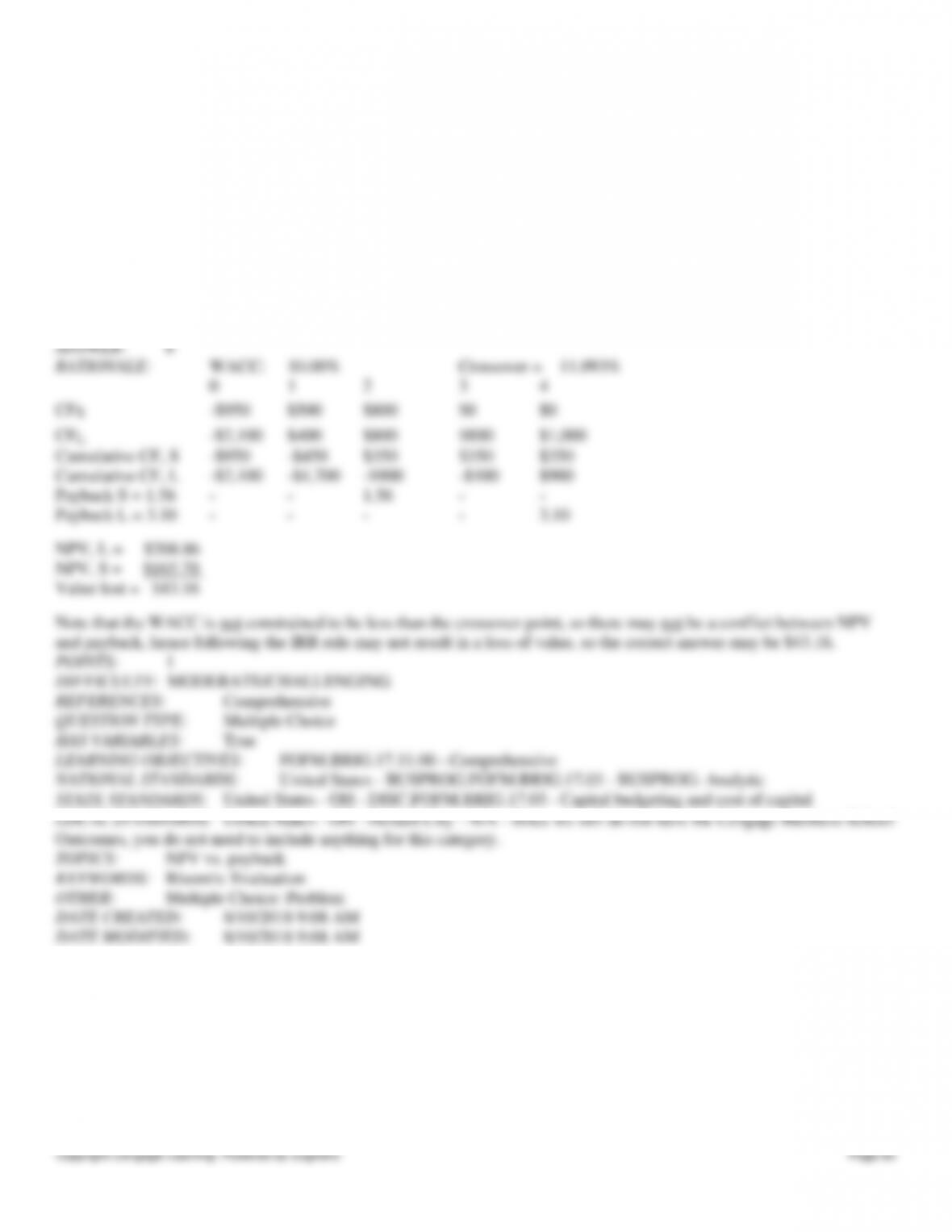
106. Nast Inc. is considering Projects S and L, whose cash flows are shown below. These projects are mutually exclusive,
equally risky, and not repeatable. If the decision is made by choosing the project with the higher MIRR rather than the one
with the higher NPV, how much value will be forgone? Note that under some conditions choosing projects on the basis of
the MIRR will cause $0.00 value to be lost.
WACC: 9.00%
0 1 2 3 4
CFS -$1,100 $375 $375 $375 $375
CFL -$2,200 $725 $725 $725 $725
a. $34.24
b. $26.78
c. $33.90
d. $27.80
e. $25.77
485.64 445.54 408.75 375.00 $1,714.92 11.74%
938.90 861.37 790.25 725.00 $3,315.52 10.80%
MIRR, L 10.80%
MIRR, S 11.74%
107. Yonan Inc. is considering Projects S and L, whose cash flows are shown below. These projects are mutually
exclusive, equally risky, and not repeatable. If the decision is made by choosing the project with the shorter payback,
Chapter 11: The Basics of Capital Budgeting
Copyright Cengage Learning. Powered by Cognero.
Page 63
some value may be forgone. How much value will be lost in this instance? Note that under some conditions choosing
projects on the basis of the shorter payback will not cause value to be lost.
WACC: 10.00%
0 1 2 3 4
CFS -$950 $500 $800 $0 $0
CFL -$2,100 $400 $800 $800 $1,000
a. $35.82
b. $43.16
c. $53.08
d. $51.36
e. $38.41
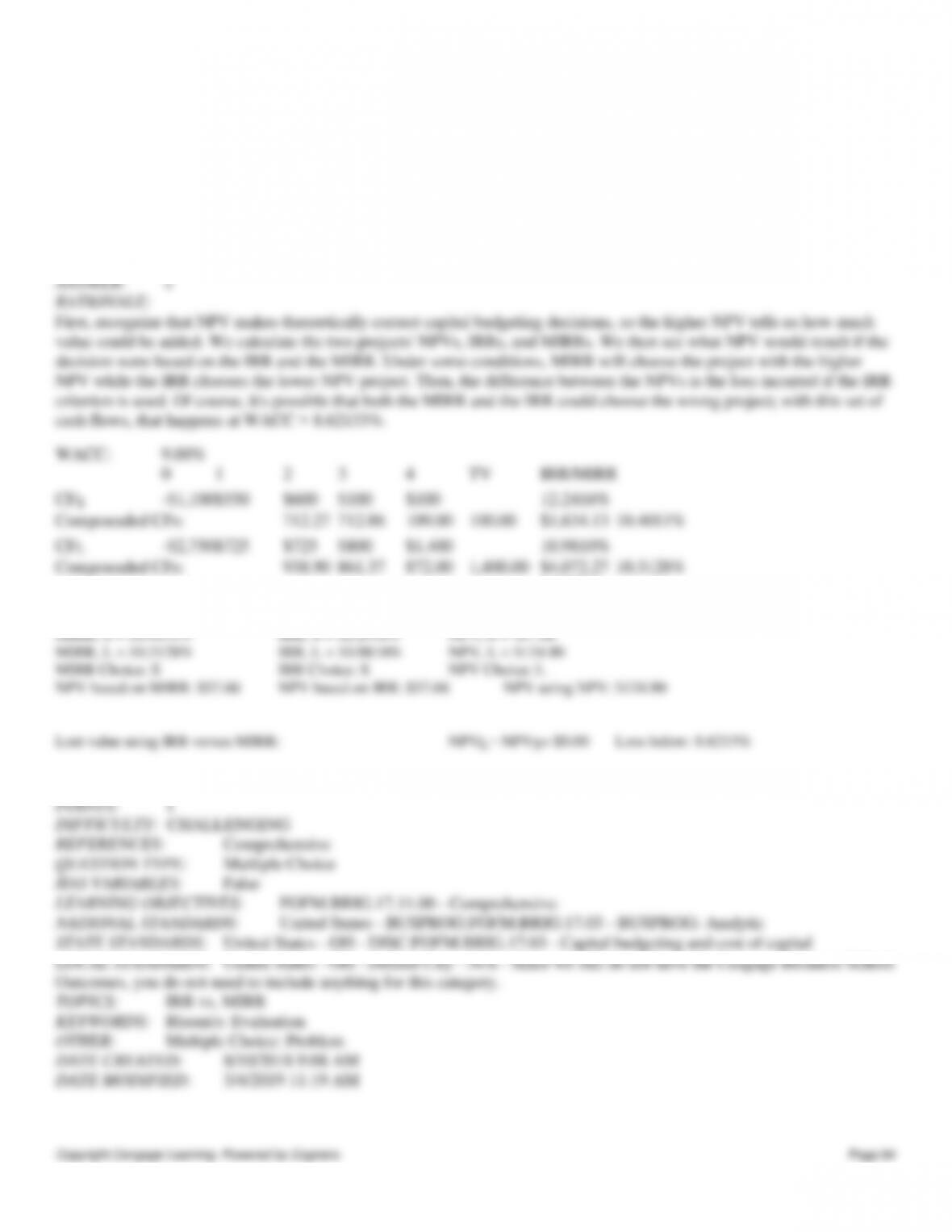
108. Noe Drilling Inc. is considering Projects S and L, whose cash flows are shown below. These projects are mutually
exclusive, equally risky, and not repeatable. The CEO believes the IRR is the best selection criterion, while the CFO
advocates the MIRR. If the decision is made by choosing the project with the higher IRR rather than the one with the
higher MIRR, how much, if any, value will be forgone, i.e., what’s the NPV of the chosen project versus the maximum
possible NPV? Note that (1) “true value” is measured by NPV, and (2) under some conditions the choice of IRR vs. MIRR
will have no effect on the value lost.
WACC: 9.00%
Chapter 11: The Basics of Capital Budgeting
Copyright Cengage Learning. Powered by Cognero.
Page 64
0 1 2 3 4
CFS -$1,100 $550 $600 $100 $100
CFL -$2,750 $725 $725 $800 $1,400
a. $92.69
b. $62.57
c. $0.00
d. $95.01
e. $78.79
0.0882%