
Chapter 11: The Basics of Capital Budgeting
Copyright Cengage Learning. Powered by Cognero.
Page 1
1. A firm should never accept a project if its acceptance would lead to an increase in the firm’s cost of capital (its WACC).
a. True
b. False
2. Because “present value” refers to the value of cash flows that occur at different points in time, a series of present values
of cash flows should not be summed to determine the value of a capital budgeting project.
a. True
b. False
3. Assuming that their NPVs based on the firm’s cost of capital are equal, the NPV of a project whose cash flows accrue
relatively rapidly will be more sensitive to changes in the discount rate than the NPV of a project whose cash flows come
in later in its life.
a. True
b. False


Chapter 11: The Basics of Capital Budgeting
Copyright Cengage Learning. Powered by Cognero.
Page 3
a. True
b. False
7. The internal rate of return is that discount rate that equates the present value of the cash outflows (or costs) with the
present value of the cash inflows.
a. True
b. False
8. Other things held constant, an increase in the cost of capital will result in a decrease in a project’s IRR.
a. True
b. False






Copyright Cengage Learning. Powered by Cognero.
Page 9
21. The NPV and IRR methods, when used to evaluate two equally risky but mutually exclusive projects, will lead to
different accept/reject decisions and thus capital budgets if the cost of capital at which the projects’ NPV profiles cross is
greater than the crossover rate.
a. True
b. False
22. A conflict will exist between the NPV and IRR methods, when used to evaluate two equally risky but mutually
exclusive projects, if the projects’ cost of capital is less than the rate at which the projects’ NPV profiles cross.
a. True
b. False
23. Project S has a pattern of high cash flows in its early life, while Project L has a longer life, with large cash flows late
in its life. Neither has negative cash flows after Year 0, and at the current cost of capital, the two projects have identical
NPVs. Now suppose interest rates and money costs decline. Other things held constant, this change will cause L to
become preferred to S.
a. True
b. False



Chapter 11: The Basics of Capital Budgeting
Copyright Cengage Learning. Powered by Cognero.
Page 12
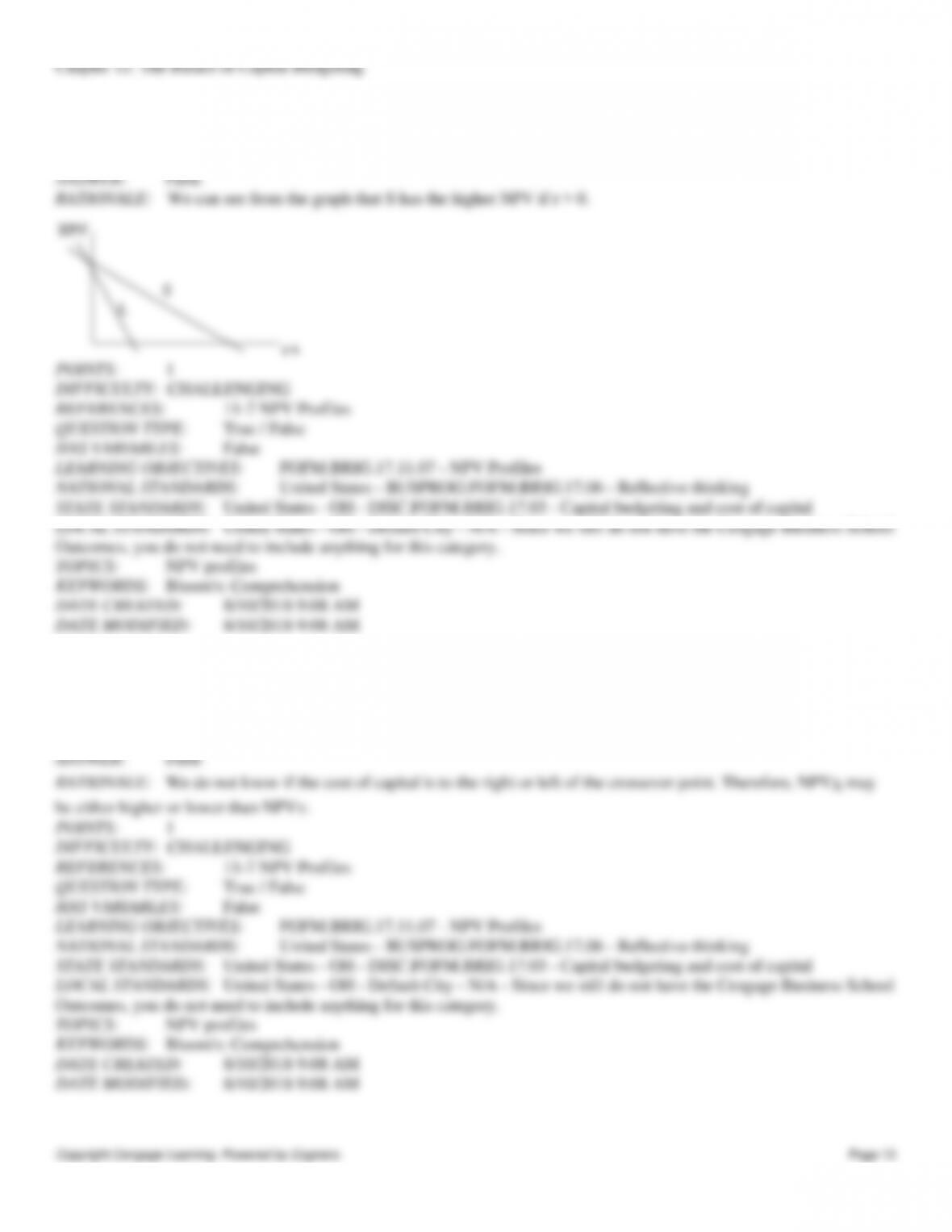
29. The IRR of normal Project X is greater than the IRR of normal Project Y, and both IRRs are greater than zero. Also,
the NPV of X is greater than the NPV of Y at the cost of capital. If the two projects are mutually exclusive, Project X
should definitely be selected, and the investment made, provided we have confidence in the data. Put another way, it is
impossible to draw NPV profiles that would suggest not accepting Project X.
a. True
b. False
Copyright Cengage Learning. Powered by Cognero.
Page 13
30. Normal Projects S and L have the same NPV when the discount rate is zero. However, Project S’s cash flows come in
faster than those of L. Therefore, we know that at any discount rate greater than zero, L will have the higher NPV.
a. True
b. False
31. If the IRR of normal Project X is greater than the IRR of mutually exclusive (and also normal) Project Y, we can
conclude that the firm should always select X rather than Y if X has NPV > 0.
a. True
b. False

Copyright Cengage Learning. Powered by Cognero.
Page 14
32. Which of the following statements is CORRECT? Assume that the project being considered has normal cash flows,
with one outflow followed by a series of inflows.
a. A project’s NPV is found by compounding the cash inflows at the IRR to find the terminal value (TV), then
discounting the TV at the WACC.
b. The lower the WACC used to calculate it, the lower the calculated NPV will be.
c. If a project’s NPV is less than zero, then its IRR must be less than the WACC.
d. If a project’s NPV is greater than zero, then its IRR must be less than zero.
e. The NPV of a relatively low-risk project should be found using a relatively high WACC.
33. Which of the following statements is CORRECT?
a. One defect of the IRR method is that it does not take account of cash flows over a project’s full life.
b. One defect of the IRR method is that it does not take account of the time value of money.
c. One defect of the IRR method is that it does not take account of the cost of capital.
d. One defect of the IRR method is that it values a dollar received today the same as a dollar that will not be received
until sometime in the future.
e. One defect of the IRR method is that it assumes that the cash flows to be received from a project can be reinvested
at the IRR itself, and that assumption is often not valid.

Copyright Cengage Learning. Powered by Cognero.
Page 15
34. Which of the following statements is CORRECT?
a. One defect of the IRR method versus the NPV is that the IRR does not take account of cash flows over a project’s
full life.
b. One defect of the IRR method versus the NPV is that the IRR does not take account of the time value of money.
c. One defect of the IRR method versus the NPV is that the IRR does not take account of the cost of capital.
d. One defect of the IRR method versus the NPV is that the IRR values a dollar received today the same as a dollar
that will not be received until sometime in the future.
e. One defect of the IRR method versus the NPV is that the IRR does not take proper account of differences in the
sizes of projects.
35. Which of the following statements is CORRECT? Assume that the project being considered has normal cash flows,
with one outflow followed by a series of inflows.
a. A project’s regular IRR is found by compounding the cash inflows at the WACC to find the terminal value (TV),
then discounting this TV at the WACC.
b. A project’s regular IRR is found by discounting the cash inflows at the WACC to find the present value (PV),
then compounding this PV to find the IRR.
c. If a project’s IRR is greater than the WACC, then its NPV must be negative.
d. To find a project’s IRR, we must solve for the discount rate that causes the PV of the inflows to equal the PV of
the project’s costs.
e. To find a project’s IRR, we must find a discount rate that is equal to the WACC.