Chapter 10: The Cost of Capital
Copyright Cengage Learning. Powered by Cognero.
Page 38
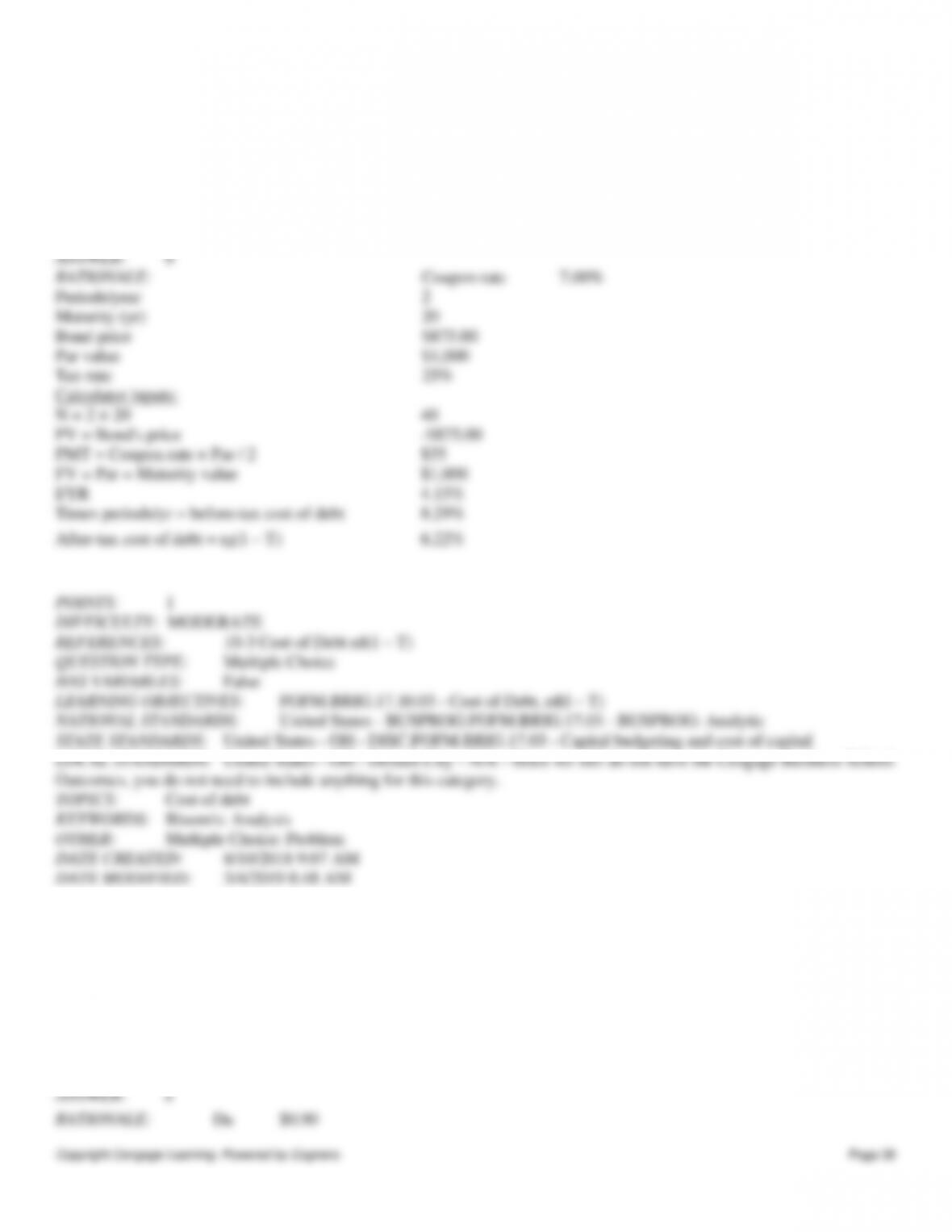
74. Several years ago the Jakob Company sold a $1,000 par value, noncallable bond that now has 20 years to maturity and
a 7.00% annual coupon that is paid semiannually. The bond currently sells for $875 and the company’s tax rate is 25%.
What is the component cost of debt for use in the WACC calculation? Do not round your intermediate calculations.
a. 4.92%
b. 6.22%
c. 5.92%
d. 5.02%
e. 4.33%
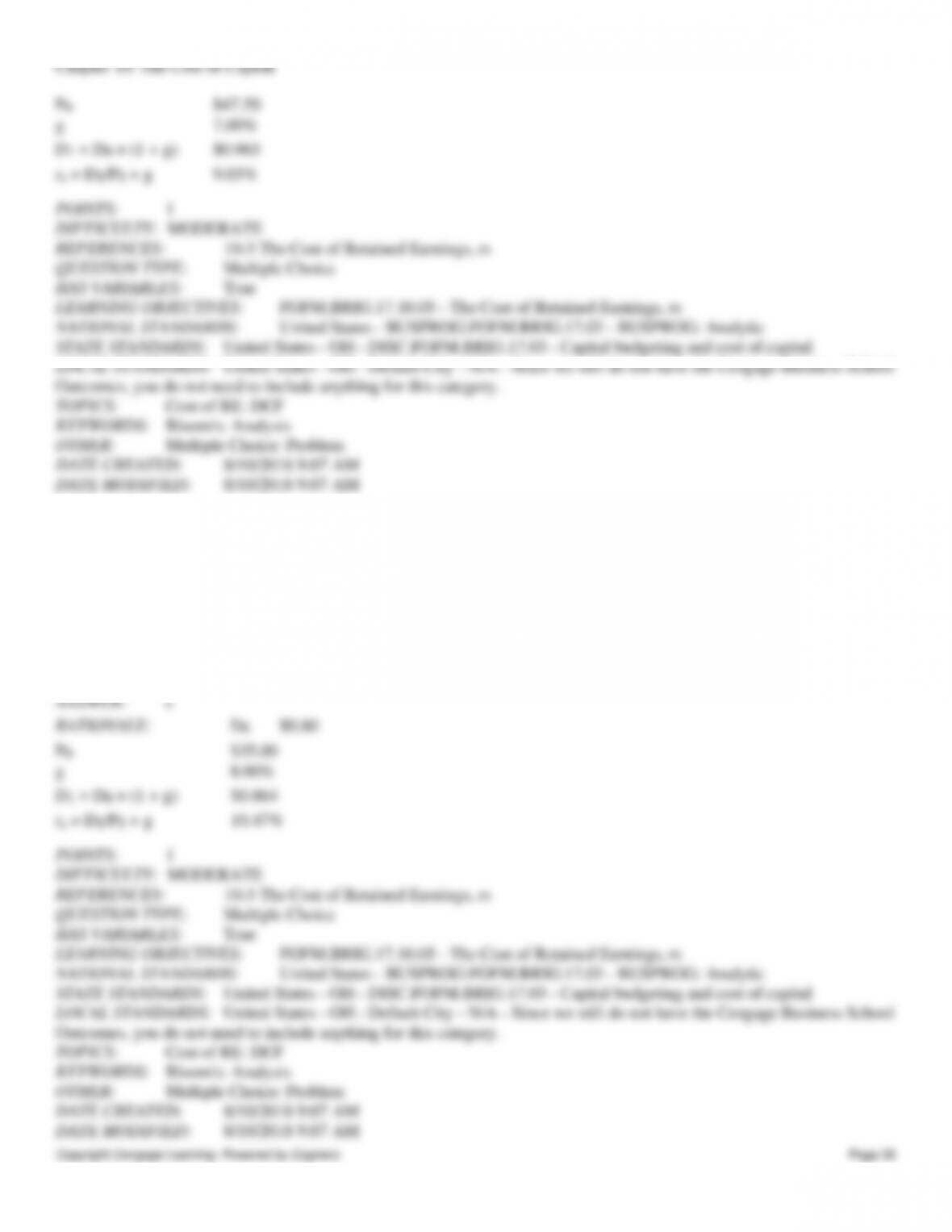
75. Assume that Kish Inc. hired you as a consultant to help estimate its cost of capital. You have obtained the following
data: D0 = $0.90; P0 = $47.50; and g = 7.00% (constant). Based on the DCF approach, what is the cost of equity from
retained earnings? Do not round your intermediate calculations.
a. 10.11%
b. 7.22%
c. 11.28%
d. 6.95%
e. 9.03%
Copyright Cengage Learning. Powered by Cognero.
Page 40
77. Trahan Lumber Company hired you to help estimate its cost of capital. You obtained the following data: D1 = $1.25;
P0 = $20.00; g = 5.00% (constant); and F = 6.00%. What is the cost of equity raised by selling new common stock?
a. 13.98%
b. 11.65%
c. 12.35%
d. 11.07%
e. 13.75%
78. You were recently hired by Scheuer Media Inc. to estimate its cost of capital. You obtained the following data: D1 =
$1.75; P0 = $95.00; g = 7.00% (constant); and F = 5.00%. What is the cost of equity raised by selling new common stock?
a. 8.22%
b. 7.60%
c. 8.76%
d. 8.94%
e. 10.01%
Chapter 10: The Cost of Capital
Copyright Cengage Learning. Powered by Cognero.
Page 42
c. 7.35%
d. 7.13%
e. 5.10%
81. You were hired as a consultant to Quigley Company, whose target capital structure is 35% debt, 10% preferred, and
55% common equity. The interest rate on new debt is 6.50%, the yield on the preferred is 6.00%, the cost of retained
earnings is 10.50%, and the tax rate is 25%. The firm will not be issuing any new stock. What is Quigley’s WACC?
Round final answer to two decimal places. Do not round your intermediate calculations.
a. 9.37%
b. 6.73%
c. 6.11%
d. 8.08%
e. 6.97%
Chapter 10: The Cost of Capital
Copyright Cengage Learning. Powered by Cognero.
Page 45
and the firm’s tax rate is 25%. The CFO thinks the WACC should be based on market value weights, but the president
thinks book weights are more appropriate. What is the difference between these two WACCs?
a. 2.62%
b. 2.28%
c. 1.87%
d. 2.19%
e. 3.11%
85. The CFO of Lenox Industries hired you as a consultant to help estimate its cost of capital. You have obtained the
following data: (1) rd = yield on the firm’s bonds = 7.00% and the risk premium over its own debt cost = 4.00%. (2) rRF =
5.00%, RPM = 6.00%, and b = 1.65. (3) D1 = $1.20, P0 = $35.00, and g = 8.00% (constant). You were asked to estimate
the cost of equity based on the three most commonly used methods and then to indicate the difference between the highest
and lowest of these estimates. What is that difference?
Chapter 10: The Cost of Capital
Copyright Cengage Learning. Powered by Cognero.
Page 46
a. 3.90%
b. 4.29%
c. 3.74%
d. 4.60%
e. 4.21%
86. Eakins Inc.’s common stock currently sells for $50.00 per share, the company expects to earn $2.75 per share during
the current year, its expected payout ratio is 70%, and its expected constant growth rate is 6.00%. New stock can be sold
to the public at the current price, but a flotation cost of 8% would be incurred. By how much would the cost of new stock
exceed the cost of retained earnings? Do not round your intermediate calculations.
a. 0.23%
b. 0.33%
c. 0.44%
d. 0.20%
e. 0.40%
Chapter 10: The Cost of Capital
Copyright Cengage Learning. Powered by Cognero.
Page 51
4 1.00% 10.23% 10.40% $25
5 2.00% 11.23% 10.80% $0
6 2.00% 11.23% 10.90% $0
7 2.00% 11.23% 13.00% $25
Exhibit 10.1
Assume that you have been hired as a consultant by CGT, a major producer of chemicals and plastics, including plastic
grocery bags, styrofoam cups, and fertilizers, to estimate the firm’s weighted average cost of capital. The balance sheet
and some other information are provided below.
Assets
Current assets $38,000,000
Net plant, property, and equipment $101,000,000
Total assets $139,000,000
Liabilities and Equity
Accounts payable $10,000,000
Accruals $9,000,000
Current liabilities $19,000,000
Long-term debt (40,000 bonds, $1,000 par value) $40,000,000
Total liabilities $59,000,000
Common stock (10,000,000 shares) $30,000,000
Retained earnings $50,000,000
Total shareholders’ equity $80,000,000
Total liabilities and shareholders’ equity $139,000,000
The stock is currently selling for $15.25 per share, and its noncallable $1,000.00 par value, 20-year, 9.00% bonds with
semiannual payments are selling for $930.41. The beta is 1.22, the yield on a 6-month Treasury bill is 3.50%, and the
yield on a 20-year Treasury bond is 5.50%. The required return on the stock market is 11.50%, but the market has had an
average annual return of 14.50% during the past 5 years. The firm’s tax rate is 25%.
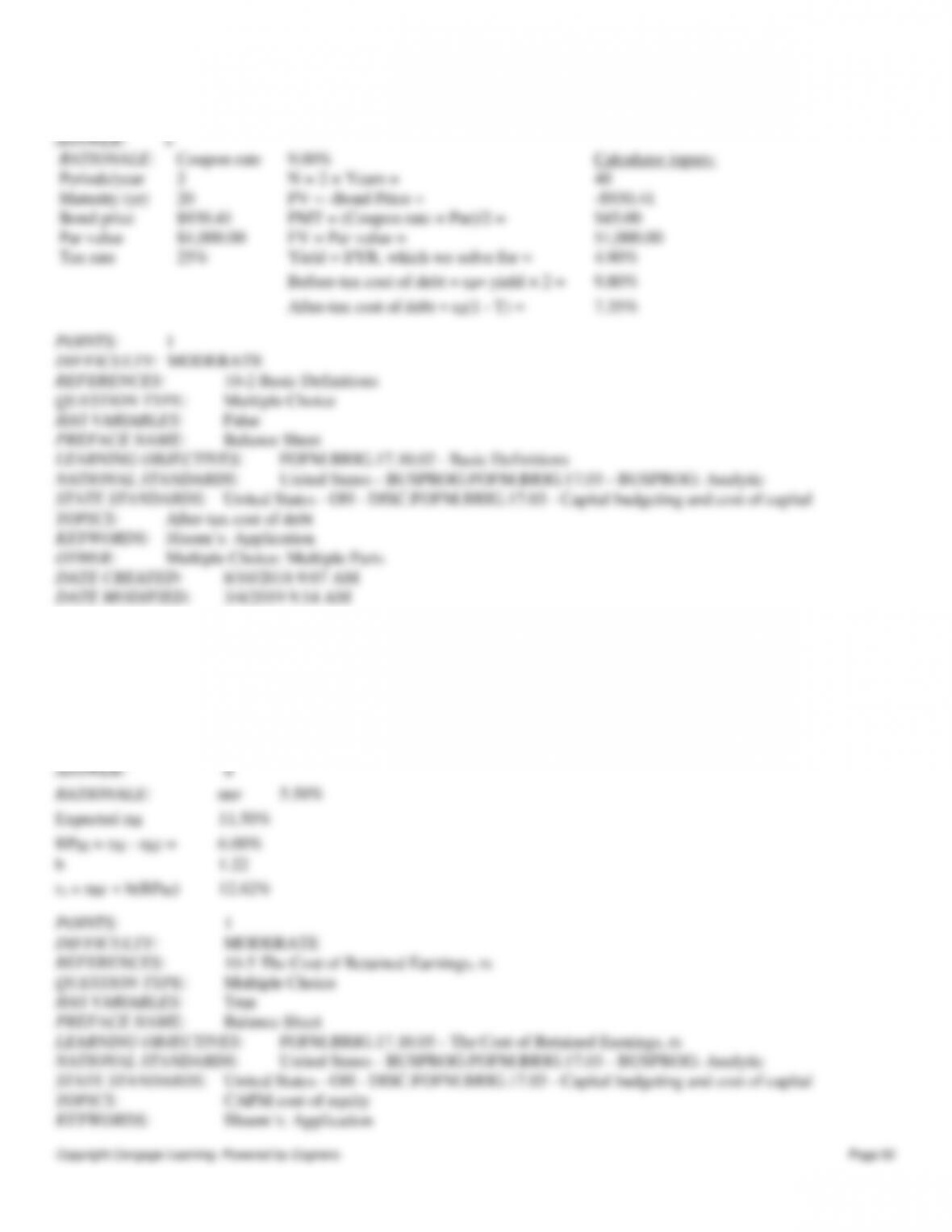
91. Refer to Exhibit 10.1. What is the best estimate of the after-tax cost of debt?
a. 5.23%
b. 5.59%
c. 7.35%
Chapter 10: The Cost of Capital
Copyright Cengage Learning. Powered by Cognero.
Page 52
d. 6.17%
e. 6.48%
92. Refer to Exhibit 10.1. Based on the CAPM, what is the firm’s cost of equity?
a. 11.41%
b. 11.92%
c. 12.44%
d. 12.82%
e. 13.33%