
Chapter 01: An Overview of Financial Management
Copyright Cengage Learning. Powered by Cognero.
Page 18
c. The board of directors is the highest ranking body in a corporation, and the chairman of the board is the highest
ranking individual. The CEO generally works under the board and its chairman, and the board generally has the authority
to remove the CEO under certain conditions. The CEO, however, cannot remove the board, but he or she can endeavor to
have the board voted out and a new board voted in should a conflict arise. It is possible for a person to simultaneously
serve as CEO and chairman of the board, though many corporate control experts believe it is bad to vest both offices in
the same person.
d. The CFO generally reports to the firm’s chief accounting officer, who is normally the controller.
e. The CFO is responsible for raising capital and for making sure that capital expenditures are desirable, but he or
she is not responsible for the validity of the financial statements, as the controller and the auditors have that responsibility.
41. Which of the following statements is CORRECT?
a. One drawback of forming a corporation is that it generally subjects the firm to additional regulations.
b. One drawback of forming a corporation is that it subjects the firm’s investors to increased personal liabilities.
c. One drawback of forming a corporation is that it makes it more difficult for the firm to raise capital.
d. One advantage of forming a corporation is that it subjects the firm’s investors to fewer taxes.
e. One disadvantage of forming a corporation is that it is more difficult for the firm’s investors to transfer their
ownership interests.

Chapter 01: An Overview of Financial Management
Copyright Cengage Learning. Powered by Cognero.
Page 19
42. Which of the following statements is CORRECT?
a. If a corporation elects to be taxed as an S corporation, then both it and its stockholders can avoid all Federal taxes.
This provision was put into the Federal Tax Code in order to encourage the formation of small businesses.
b. The more capital a firm is likely to require, the smaller the probability that it will be organized as a corporation.
c. It is generally easier to transfer one’s ownership interest in a partnership than in a corporation.
d. One danger of starting a proprietorship is that you may be exposed to personal liability if the business goes
bankrupt. This problem would be avoided if you formed a corporation to operate the business.
e. Corporate shareholders are exposed to unlimited liability, but this factor is offset by the tax advantages of
incorporation.
43. Which of the following statements is CORRECT?
a. Due to limited liability, unlimited lives, and ease of ownership transfer, the vast majority of U.S. businesses (in
terms of number of businesses) are organized as corporations.
b. Most businesses (by number and total dollar sales) are organized as proprietorships or partnerships because it is
easier to set up and operate one of these forms rather than as a corporation. However, if the business gets very large, it
becomes advantageous to convert to a corporation, primarily because corporations have important tax advantages over
proprietorships and partnerships.
c. Due to legal considerations related to ownership transfers and limited liability, which affect the ability to attract
capital, most business (measured by dollar sales) is conducted by corporations in spite of large corporations’ less favorable
tax treatment.
d. Large corporations are taxed more favorably than proprietorships.
e. Corporate stockholders are exposed to unlimited liability.



Chapter 01: An Overview of Financial Management
Copyright Cengage Learning. Powered by Cognero.
Page 23
d. Increase the proportion of executive compensation that comes from stock options and reduce the proportion that is
paid as cash salaries.
e. Eliminate a requirement that members of the board of directors have a substantial investment in the firm’s stock.
50. Which of the following actions would be likely to encourage a firm’s managers to make decisions that are in the best
interests of shareholders?
a. The percentage of executive compensation that comes in the form of cash is increased and the percentage coming
from long-term stock options is reduced.
b. The state legislature passes a law that makes it more difficult to successfully complete a hostile takeover.
c. The percentage of the firm’s stock that is held by institutional investors such as mutual funds, pension funds, and
hedge funds rather than by small individual investors rises from 10% to 80%.
d. The firm’s founder, who is also president and chairman of the board, sells 90% of her shares.
e. The firm’s board of directors gives the firm’s managers greater freedom to take whatever actions they think best
without obtaining board approval.

Chapter 01: An Overview of Financial Management
Copyright Cengage Learning. Powered by Cognero.
Page 24
51. Which of the following actions would be most likely to reduce potential conflicts of interest between stockholders and
bondholders?
a. Compensating managers with stock options.
b. Financing risky projects with additional debt.
c. The threat of hostile takeovers.
d. The use of covenants in bond agreements that limit the firm’s use of additional debt and constrain managers’
actions.
e. Abolishing the Security and Exchange Commission.
52. Which of the following actions would be most likely to reduce potential conflicts between stockholders and
bondholders?
a. Including restrictive covenants in the company’s bond indenture (which is the contract between the company and
its bondholders).
b. Compensating managers with more stock options and less cash income.
c. The passage of laws that make it harder for hostile takeovers to succeed.
d. A government regulation that banned the use of convertible bonds.
e. The firm begins to use only long-term debt, e.g., debt that matures in 30 years or more, rather than debt that
matures in less than one year.

Chapter 01: An Overview of Financial Management




Chapter 01: An Overview of Financial Management
Copyright Cengage Learning. Powered by Cognero.
Page 29
e. Stockholders in general would be better off if managers never disclosed favorable events and therefore caused the
price of the firm’s stock to sell at a price below its intrinsic value.
61. Which of the following statements is CORRECT?
a. One disadvantage of operating as a corporation rather than as a partnership is that corporate shareholders are
exposed to more personal liability than are partners.
b. Relative to proprietorships, corporations generally face fewer regulations, and they also find it easier to raise
capital.
c. There is no good reason to expect a firm’s stockholders and bondholders to react differently to the types of assets
in which it invests.
d. Stockholders should generally be happier than bondholders to have managers invest in risky projects with high
potential returns as opposed to safe projects with lower expected returns.
e. Stockholders in general would be better off if managers never disclosed favorable events and therefore caused the
price of the firm’s stock to sell at a price below its intrinsic value.
62. Which of the following statements is CORRECT?

Chapter 01: An Overview of Financial Management
Copyright Cengage Learning. Powered by Cognero.
Page 30
a. Because bankruptcy requires that corporate bondholders be paid in full before stockholders receive anything,
bondholders generally prefer to see corporate managers invest in high risk/high return projects rather than low risk/low
return projects.
b. Since bondholders receive fixed payments, they do not share in the gains if risky projects turn out to be highly
successful. However, they do share in the losses if risky projects fail and drive the firm into bankruptcy. Therefore,
bondholders generally prefer to see corporate managers invest in low risk/low return projects rather than high risk/high
return projects.
c. One advantage of operating a business as a corporation is that stockholders can deduct their pro rata share of the
taxes the firm pays, thereby eliminating the double taxation investors would face in a partnership.
d. One drawback of forming a corporation is that you lose the limited liability that you would otherwise receive as a
proprietor.
e. Potential conflicts between stockholders and bondholders are increased if a firm’s bonds are convertible into its
common stock.
63. Which of the following statements is CORRECT?
a. Corporations face few regulations and more favorable tax treatment than do proprietorships and partnerships.
b. Managers who face the threat of hostile takeovers are less likely to pursue policies that maximize shareholder
value compared to managers who do not face the threat of hostile takeovers.
c. Bond covenants are an effective way to resolve conflicts between shareholders and managers.
d. Because of their simplified organization, it is easier for proprietors and partnerships to raise large amounts of
outside capital than it is for corporations.
e. One advantage to forming a corporation is that the owners of the firm have limited liability.

Chapter 01: An Overview of Financial Management
Copyright Cengage Learning. Powered by Cognero.
Page 32
DATE MODIFIED: 8/10/2018 9:02 AM
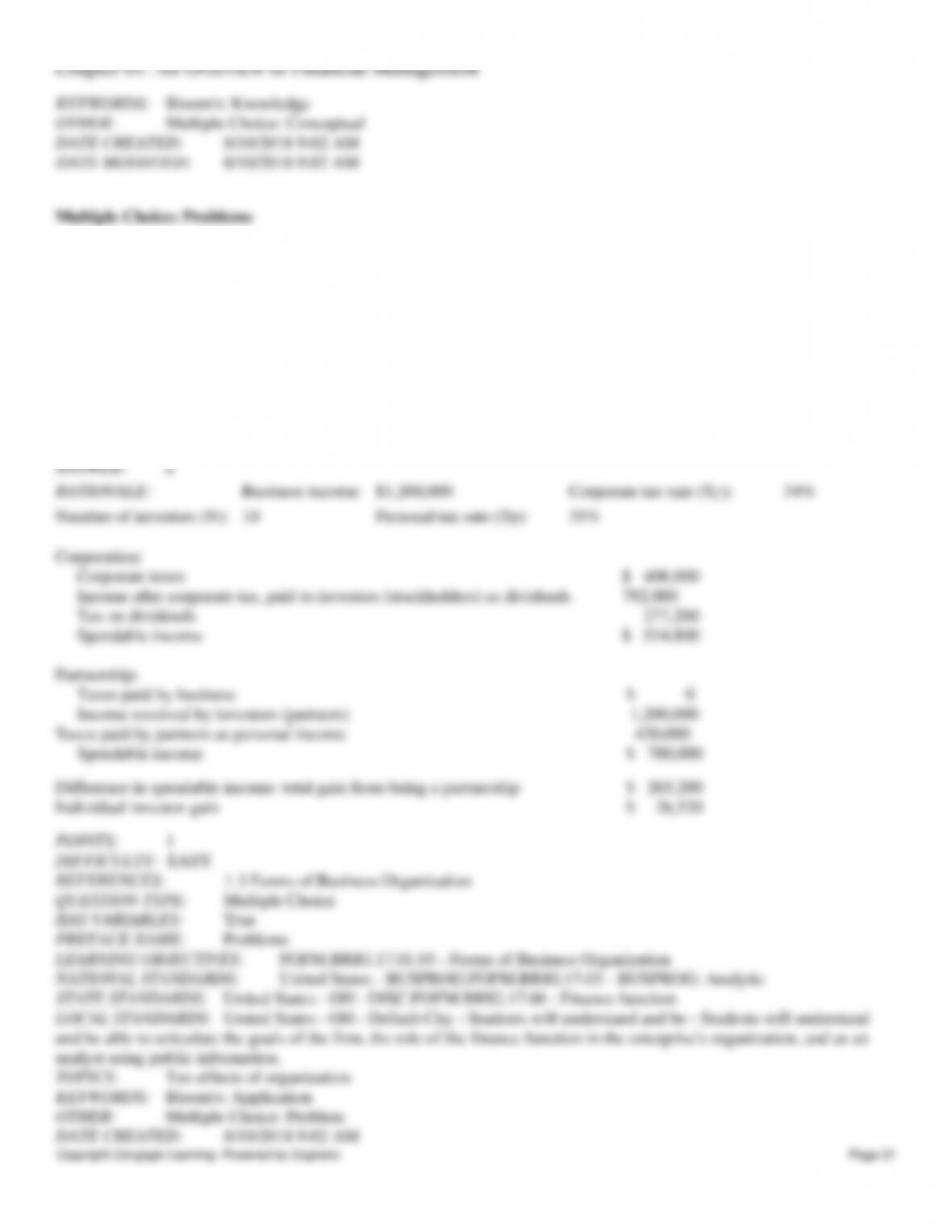
65. Assume that the corporate tax rate is 34% and the personal tax rate is 34%. The founders of a newly formed business
are debating between setting up the firm as a partnership versus a corporation. The firm will not need to retain any
earnings, so all of its after-tax income will be paid out to its investors, who will have to pay personal taxes on whatever
they receive. What is the difference in the percentage of the firm’s pre-tax income that investors actually receive and can
spend under the corporate and partnership forms of organization ?
a. 23.56%
b. 22.44%
c. 19.52%
d. 24.68%
e. 17.05%
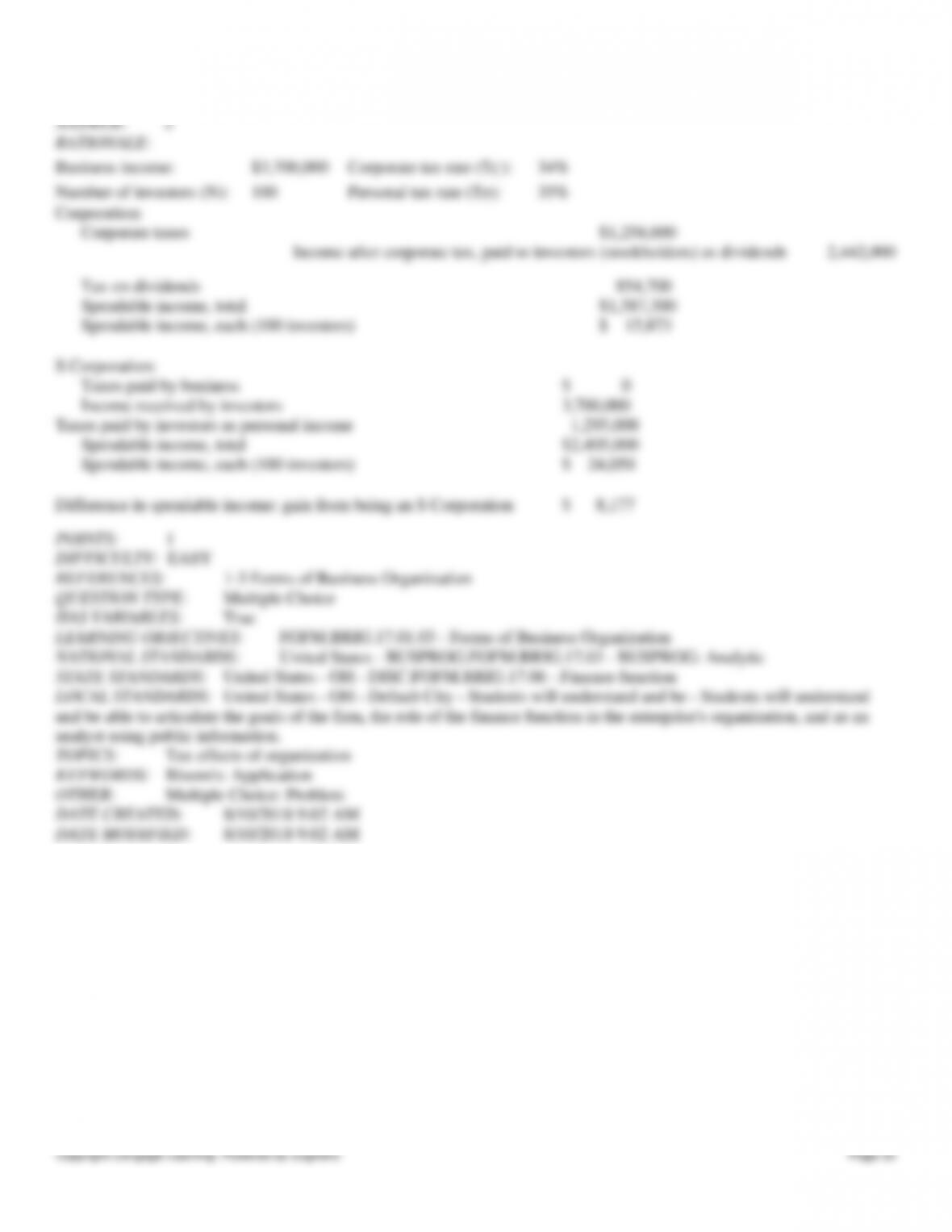
66. Charleston Corporation (CC) now operates as a “regular” corporation, but it is considering a switch to S Corporation
status. CC is owned by 100 stockholders who each hold 1% of the stock, and each faces a personal tax rate of 35%. The
firm earns $3,700,000 per year before taxes, and since it has no need for retained earnings, it pays out all of its earnings as
dividends. Assume that the corporate tax rate is 34% and the personal tax rate is 35%. How much more (or less) spendable
income would each stockholder have if the firm elected S Corporation status?
a. $10,139
b. $7,605
c. $8,177
d. $8,749
Chapter 01: An Overview of Financial Management
Copyright Cengage Learning. Powered by Cognero.
Page 33
e. $6,787