9-18
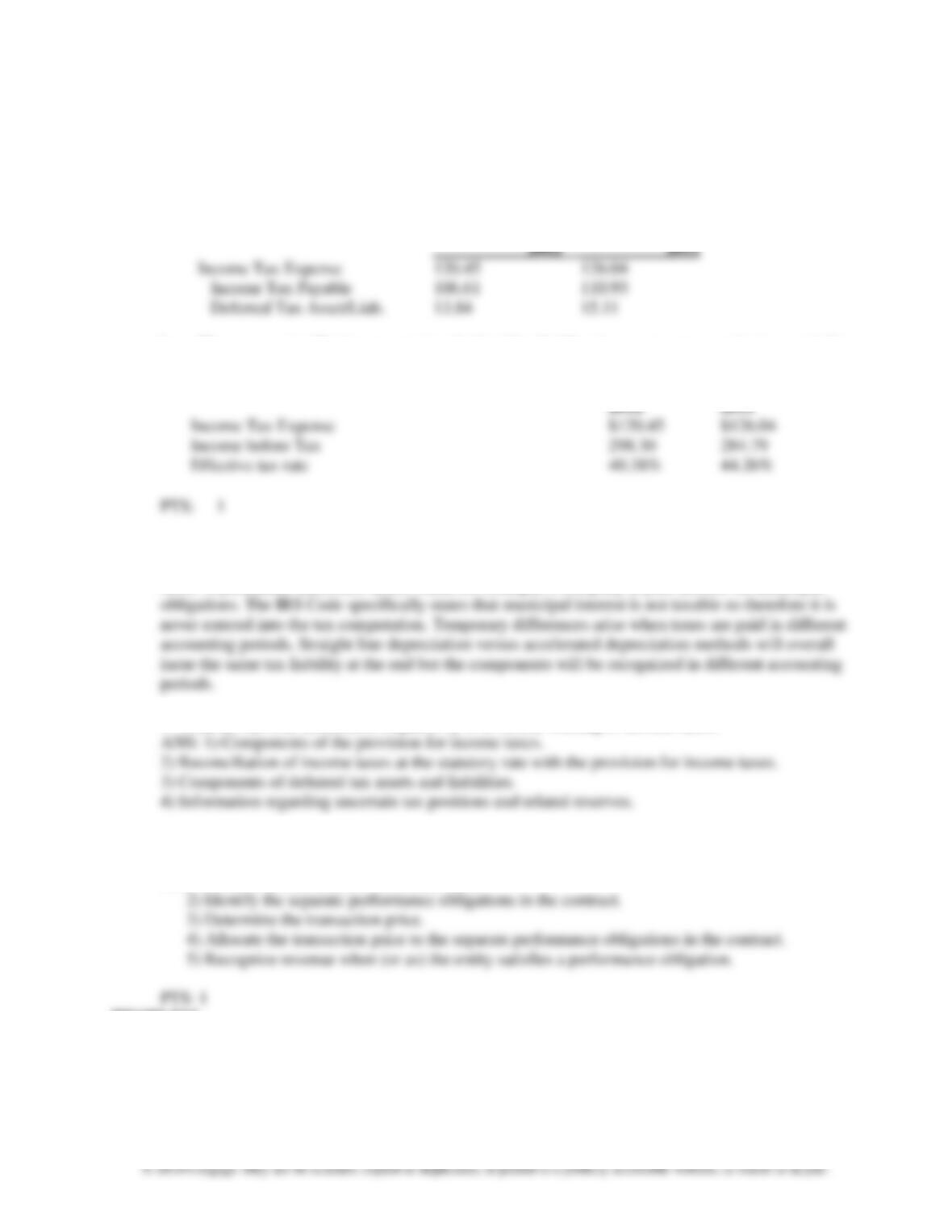
a. Using the information provided for Global, prepare the company’s journal entry to record income
taxes for 2012 and 2011.
b. Using the information provided for Global, determine the company‘s effective tax rate for 2012
and 2011.
ANS:
a.
b. The company’s effective tax rate is calculated by dividing income tax expense by income before
tax.
2012 2011
8. Explain the difference between a temporary and a permanent timing difference for income tax
purposes”
ANS: A permanent difference arises when, for example, a company is paid interest on municipal
9. What are the four disclosures required by U.S. GAAP relating to income taxes?
10. What are the five steps to apply the core principles of revenue recognition?
ANS: 1) Identify the contract with a customer.
PROBLEM
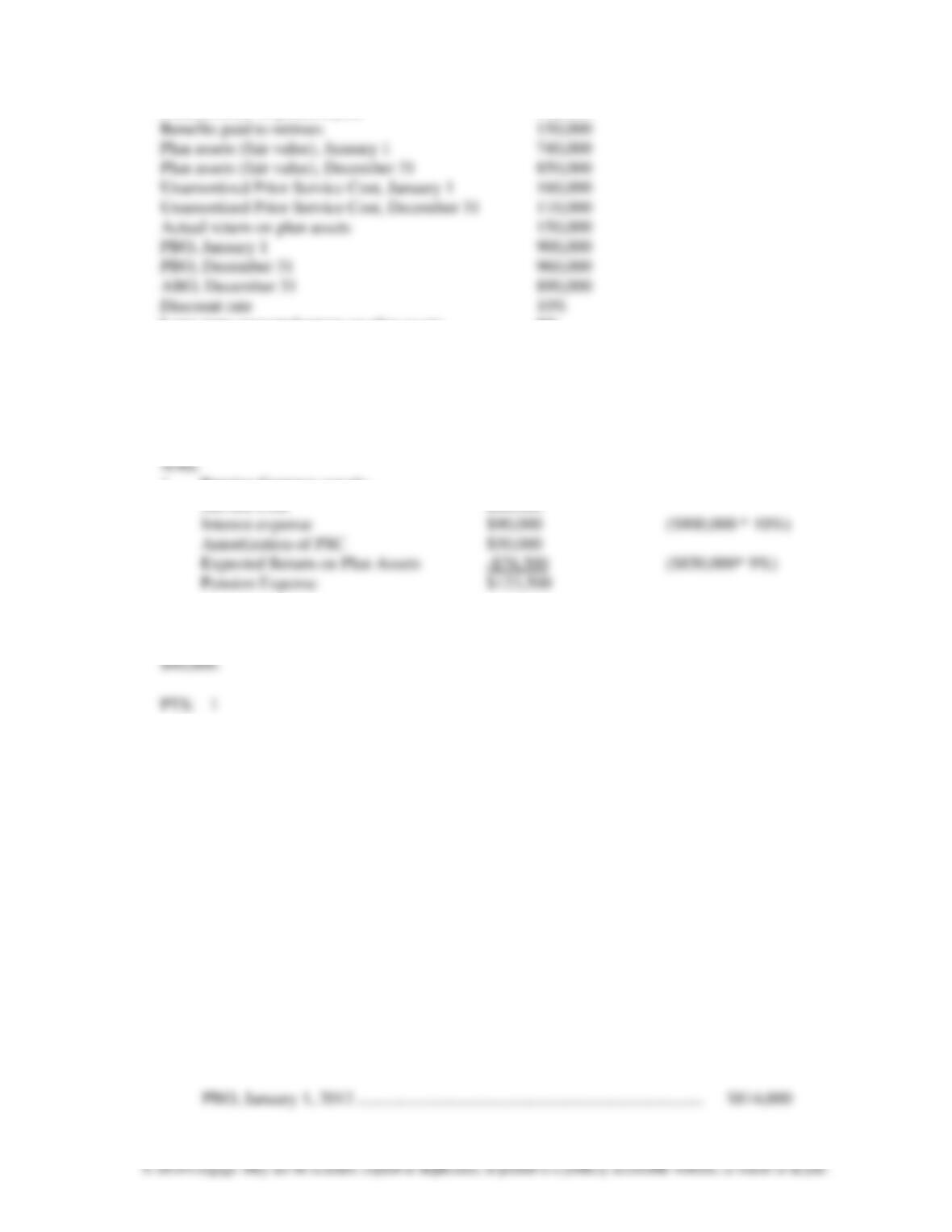
1. The following information is related to the defined benefit pension plan of Xavier Company for 2012:
Service cost $60,000
9-19
Contributions to pension plan 142,400
Long-term expected return on plan assets 9%
Required:
1. Using the above information calculate pension expense for 2012?
2. Will it be necessary for the company to report a minimum pension liability at Dec. 31, 2012? If
so what is the amount.
1. Pension Expense equals:
Service Cost $60,000
2. At Dec. 31, 2012, the company’s ABO exceeds its plan assets by $40,000, given that the
company does not have prepaid or accrued pension cost than its minimum pension liability will also be
2. Given the following information, compute December 31, 2012 projected benefit obligation (PBO) and
fair market value (FMV) of plan assets for Eagan Company.
Prior service cost granted in a 2012 plan amendment $115,000
Interest on PBO 73,000
Actual return on plan assets 101,000
Service cost 84,000
Contribution sent to plan trustee 62,000
Benefit payments to retirees 24,000
Liability loss (gain) (37,000)
FMV of plan assets, January 1, 2012 735,000
PBO, January 1, 2012 814,000
What amount of asset or liability will be reported on the balance sheet at December 31, 2012?
ANS:
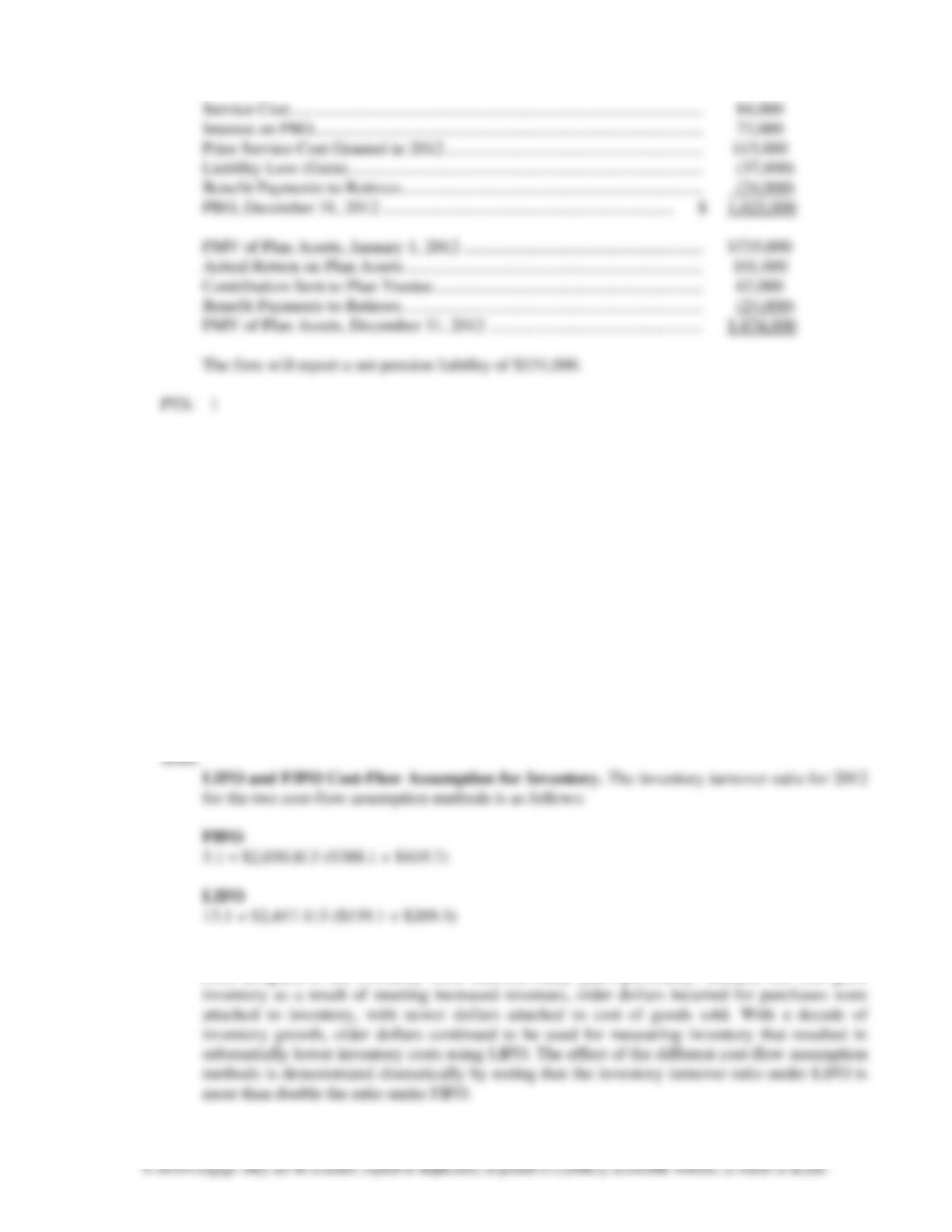
Reconcile PBO/FMV of Plan Assets.
9-20
© 2018 Cengage. May not be scanned, copied or duplicated, or posted to a publicly accessible website, in whole or in part.
Service Cost …………………………………………………………………………………… 84,000
Interest on PBO ………………………………………………………………………………. 73,000
Prior Service Cost Granted in 2012 …………………………………………………… 115,000
Liability Loss (Gain) ……………………………………………………………………….. (37,000)
Benefit Payments to Retirees ……………………………………………………………. (24,000)
PBO, December 31, 2012 ………………………………………………………….. $ 1,025,000
FMV of Plan Assets, January 1, 2012 ……………………………………………….. $735,000
Actual Return on Plan Assets …………………………………………………………… 101,000
Contribution Sent to Plan Trustee ……………………………………………………… 62,000
Benefit Payments to Retirees ……………………………………………………………. (24,000)
FMV of Plan Assets, December 31, 2012 ………………………………………….. $ 874,000
The firm will report a net pension liability of $151,000.
PTS: 1
3. A large manufacturer recently changed its cost-flow assumption method for inventories at the
beginning of 2012. The manufacturer has been in operation for almost 40 years, and for the last
decade, it has reported moderate growth in revenues. The firm changed from the LIFO method to the
FIFO method and reported the following information:
December 31: (amounts in millions)
2011 2012
Inventories at FIFO cost $ 388.1 $ 419.7
Excess of FIFO cost over LIFO cost (229.0) (210.4)
Cost of goods sold (FIFO) $2,050.8
Cost of goods sold (LIFO) $2,417.1
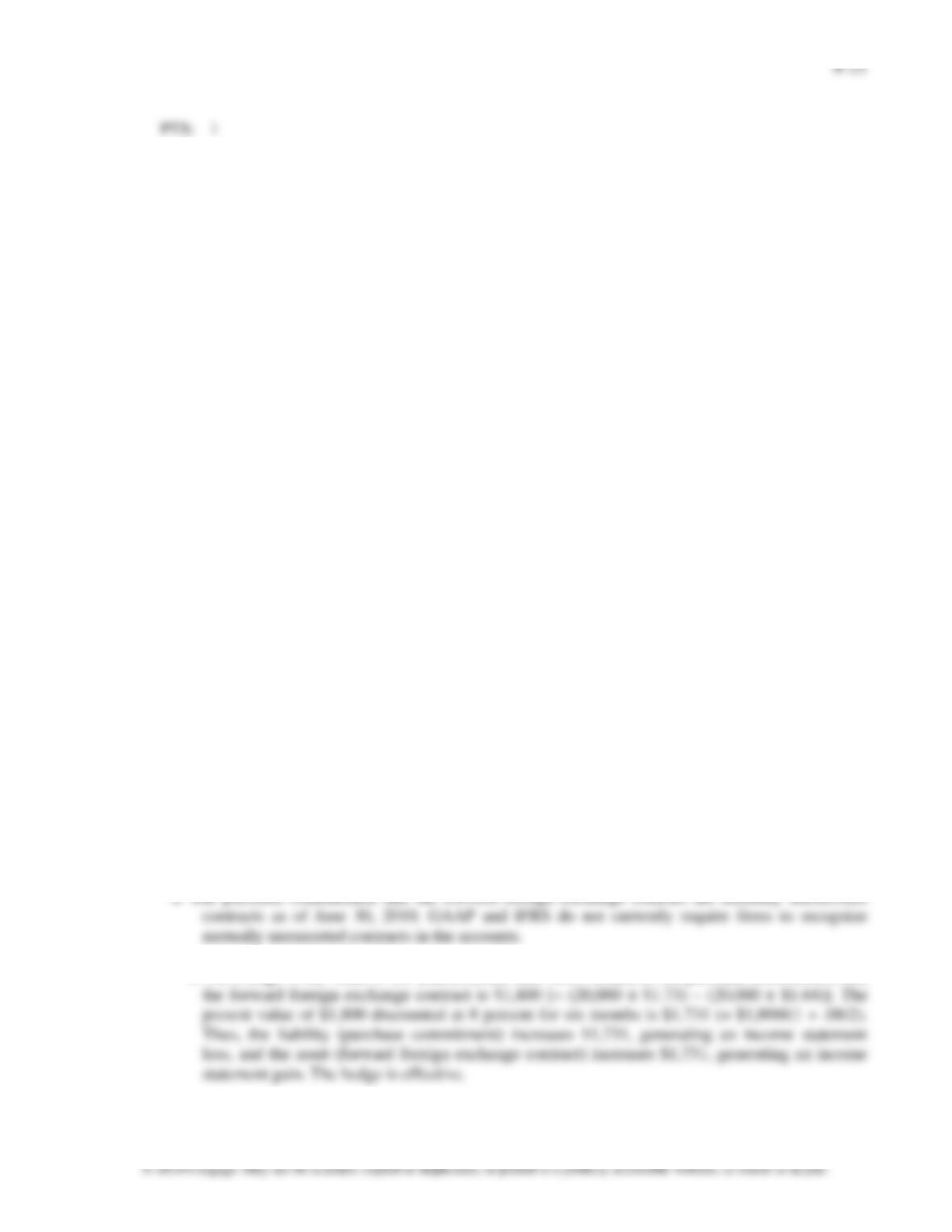
Calculate the inventory turnover ratio for 2012 using the LIFO and FIFO cost-flow assumption
methods. Explain why the costs assigned to inventory under LIFO at the end of 2011 and 2012 are so
much less than they are under FIFO.
Inventory measured using the LIFO cost-flow assumption is substantially lower because the
costs assigned to the inventory were incurred many years previously. Because the firm grew
© 2018 Cengage. May not be scanned, copied or duplicated, or posted to a publicly accessible website, in whole or in part.
4. Firm A places its order for the equipment on June 30, Year 1. It simultaneously signs a forward
foreign exchange contract for 20,000 GBP. The forward rate on June 30, Year 1, for settlement on
June 30, Year 2, is $1.64 per GBP. Firm A designates the forward foreign exchange contract as a fair
value hedge of the firm commitment.
Required
a. U.S. GAAP and IFRS do not require Firm A to record the purchase commitment or the
forward foreign exchange contract on the balance sheet as a liability and an asset on
June 30, Year 1. What is the logic for this accounting?
b. On December 31, Year 1, the forward foreign exchange rate for settlement on June
30, Year 2, is $1.73 per GBP. Using the financial statement effects template, show the
financial statement effects of recording the change in the value of the purchase commitment
and the change in the value of the forward contract for Year 1. Assume an 8 percent per year interest
rate for discounting cash flows to their present values on December 31, Year 1.
c. Show the financial statement effects on June 30, Year 2, of recording the change in the present value
of the purchase commitment and the forward foreign exchange contract for the passage of time.
d. On June 30, Year 2, the spot foreign exchange rate is $1.75 per GBP. Show the financial
statement effects of recording the change in the value of the purchase commitment and the change in
the value of the forward contract due to changes in the exchange rate during the first six months of
Year 2.
e. Show the financial statement effects of the June 30, Year 2, purchase of 20,000 GBP with U.S.
dollars and acquisition of the equipment.
f. Show the financial statement effects on June 30, Year 2, to settle the forward foreign
exchange contract.
g. How would the effects in Parts b–f differ if Firm A had chosen to designate the forward
foreign exchange contract as a cash flow hedge instead of a fair value hedge?
h. Suggest a scenario that would justify Firm A treating the forward foreign exchange contract as a fair
value hedge and a scenario that would justify the firm treating the contract as a cash flow hedge.
ANS:
a. The purchase commitment and the forward foreign exchange contract are mutually unexecuted
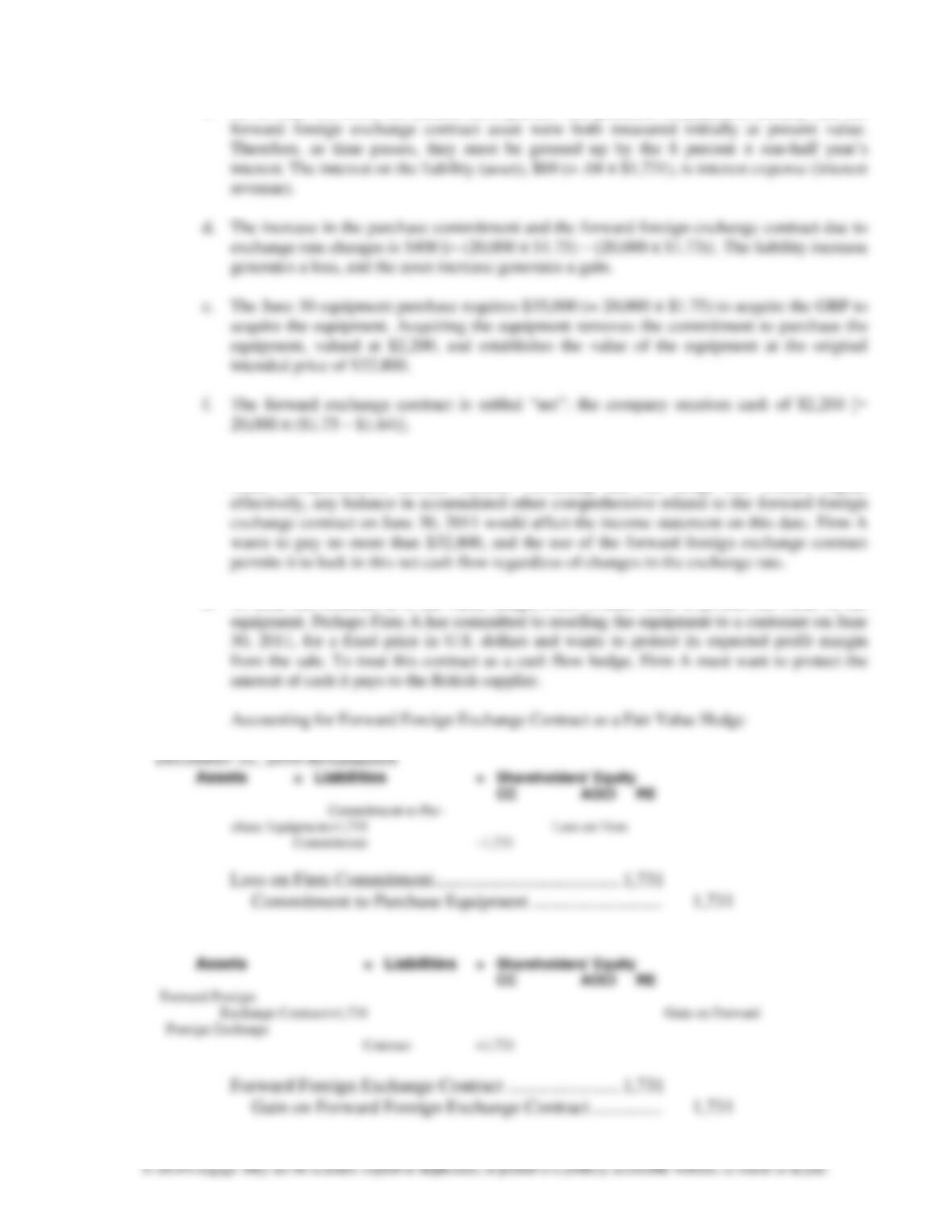
b. The change in the value of the undiscounted cash flows related to the purchase commitment and
9-22
c. As of June 30, 2011, six months have passed. The purchase commitment liability and the
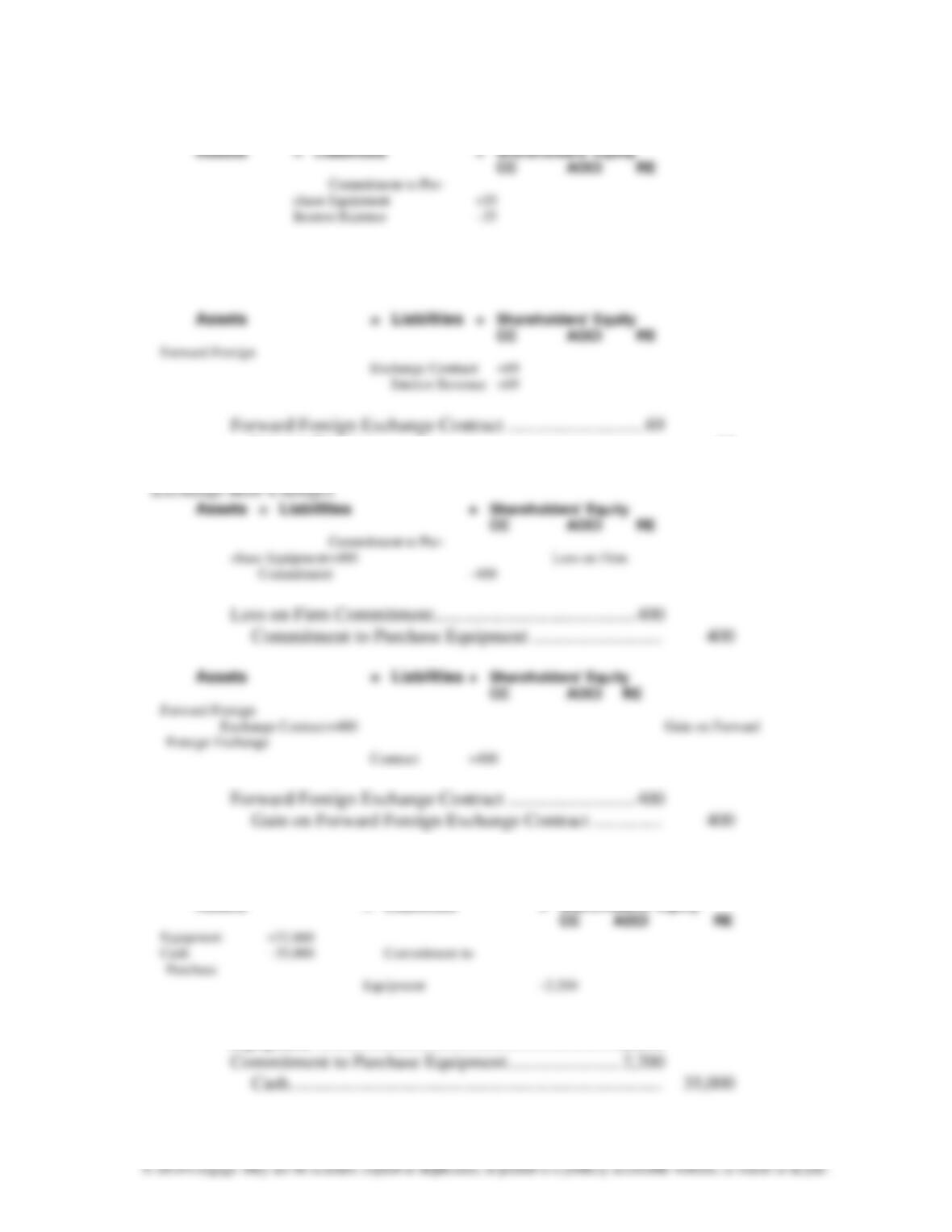
g. Each entry involving income statement accounts in Parts b.–g. would affect Accumulated
Other Comprehensive Income instead. Assuming that the hedge had worked highly
h. To treat this contract as a fair value hedge, Firm A must want to protect the value of the
9-23
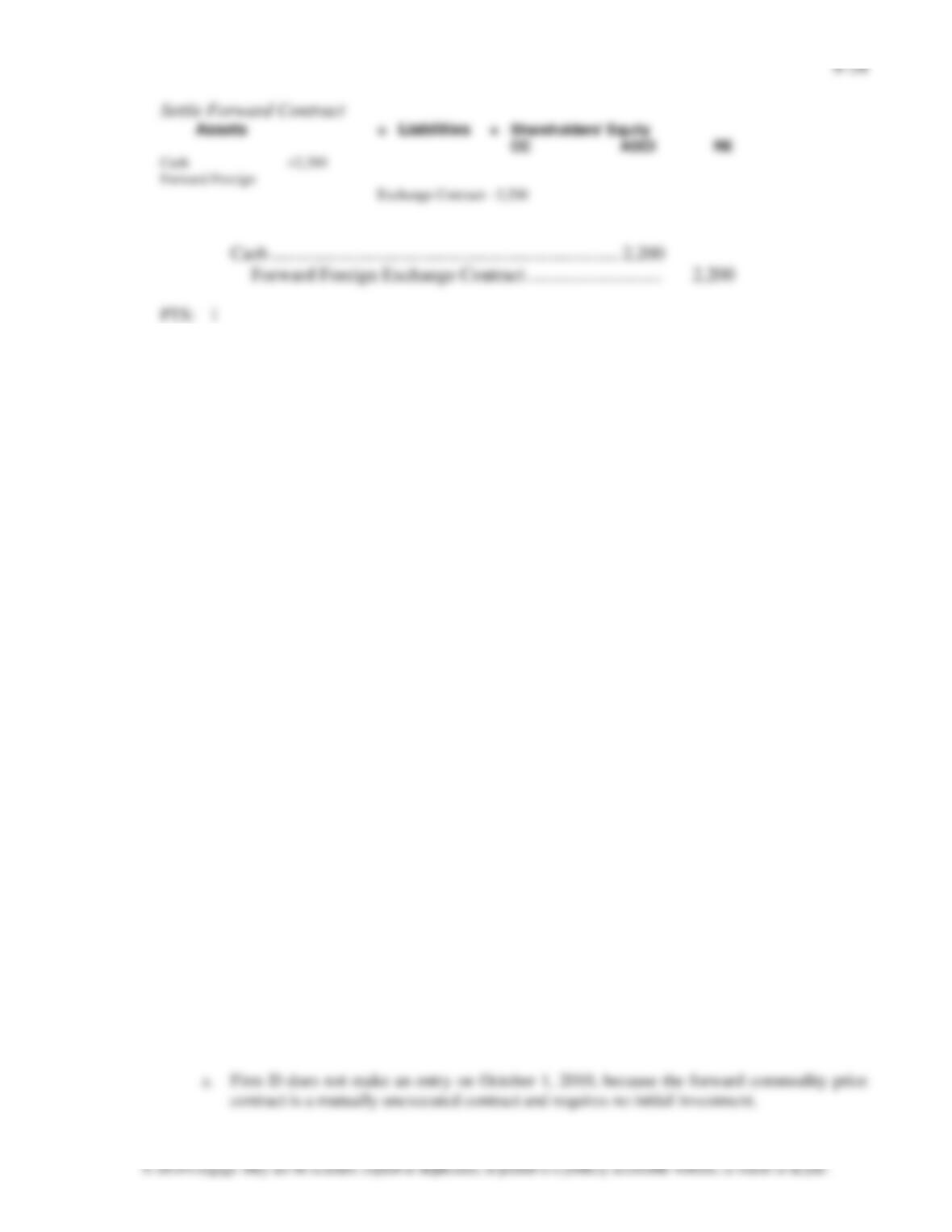
June 30, 2011 Interest Component
Interest Expense ……………………………………………………. 69
Commitment to Purchase Equipment ………………………. 69
Interest Revenue……………………………………………………. 69
Acquisition of Equipment
Assets = Liabilities + Shareholders’ Equity
Equipment ……………………………………………………… 32,800
© 2018 Cengage. May not be scanned, copied or duplicated, or posted to a publicly accessible website, in whole or in part.
5. Firm D holds 20,000 gallons of chemicals in inventory on October 31, Year 1, that cost $225
per gallon. Firm D contemplates selling the chemicals on March 31, Year 2, when it completes
the processing. Uncertainty about the selling price of the chemical on March 31, Year 2, leads
Firm D to acquire a forward contract on the chemical. The forward contract does not require an initial
investment of funds. Firm D designates the forward commodity contract as a cash flow hedge of an
anticipated transaction. The forward price on October 31, Year 1, for delivery on March 31, Year 2, is
$320 per gallon.
Required
a. Using the financial statement effects template, show the financial statement effects,
if any, that Firm D would have on October 31, Year 1, when it acquires the forward
commodity price contract.
b. On December 31, Year 1, the end of the accounting period for Firm D, the forward
price of the chemical for March 31, Year 2, delivery is $310 per gallon. Show the financial
statement effects of recording the change in the value of the forward commodity
price contract. Ignore the discounting of cash flows in this part and in the remainder
of the problem.
c. Show the financial statement effects of the December 31, Year 1, decline in value of
the chemical inventory.
d. On March 31, Year 2, the price of the chemical declines to $270 per gallon. Show the
financial statement effects of revaluing the forward contract.
e. Show the financial statement effects on March 31, Year 2, to reflect the decline in
value of the inventory.
f. Show the financial statement effects on March 31, Year 2, to settle the forward contract.
g. Assume that Firm D sells the chemical on March 31, Year 2, for $270 a gallon. Show
the financial statement effects of recording the sale and recognizing the cost of
goods sold.
ANS:
9-25
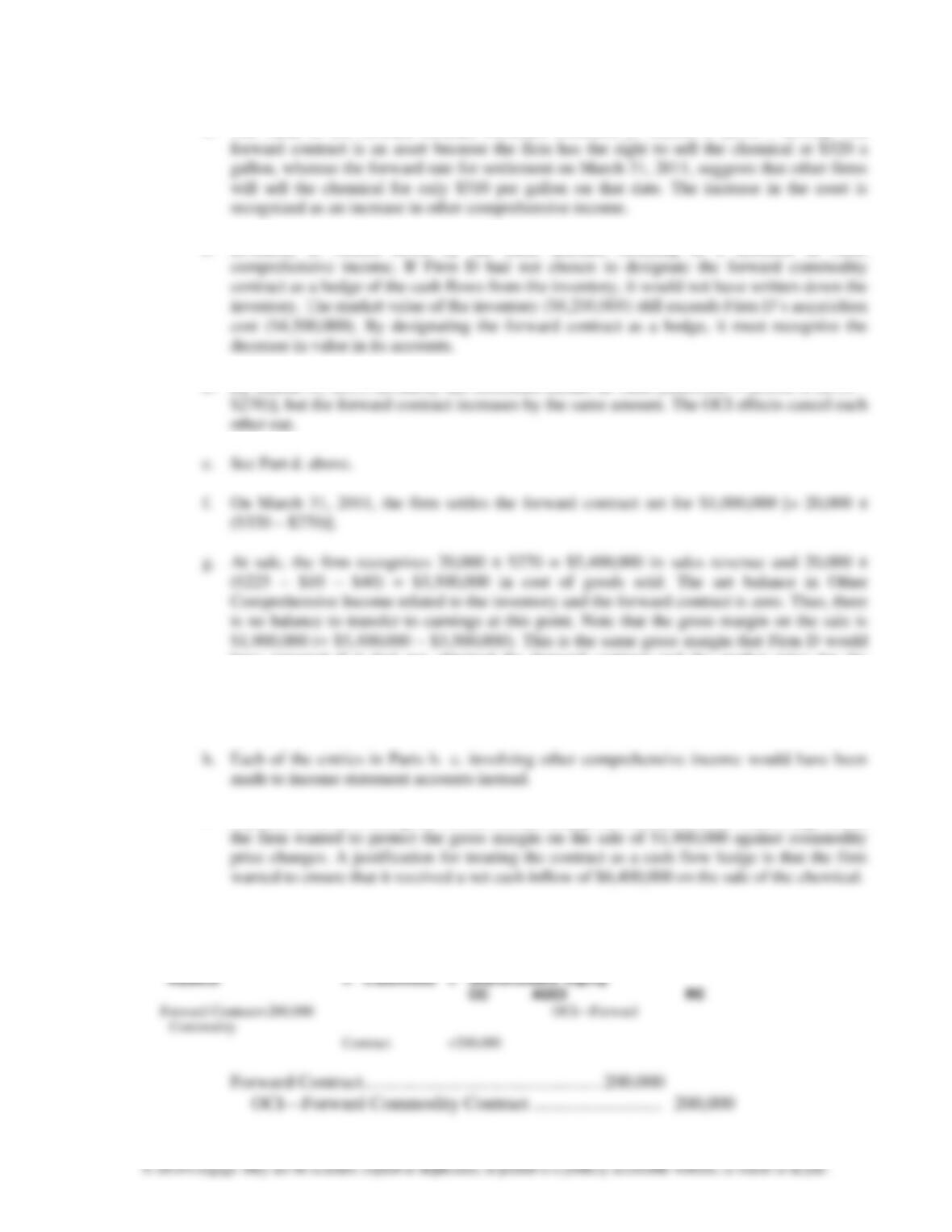
b. The value of the forward contract increases $200,000 [= 20,000 x ($320 – $310)]. The
c. Inventory is written down by the same amount, resulting in a decrease in other
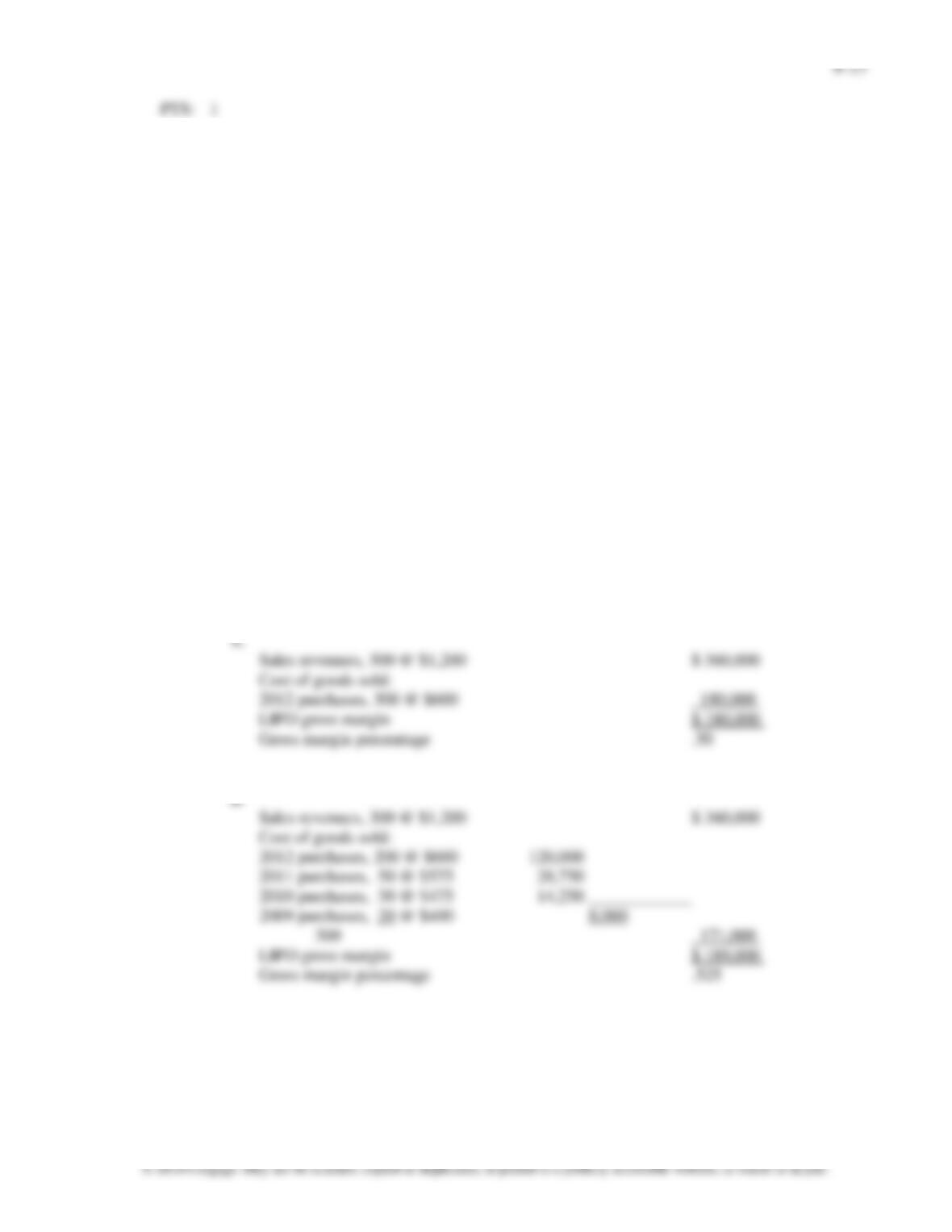
d. By March 31, 2011, inventory has decreased further in value [$800,000 = 20,000 x ($310 –
have reported if it had not obtained the forward contract and the market price for the
chemical on March 31, 2011, had been Firm D’s anticipated amount of $320 per gallon
($1,900,000 = $6,400,000 – $4,500,000). The forward contract shifted the risk of changes in
the selling price to the counterparty.
i. A justification for treating the forward commodity price contract as a fair value hedge is that
Accounting for Forward Commodity Price Contract as a Cash Flow Hedge
December 31, 2010 Revaluation
Assets = Liabilities + Shareholders’ Equity
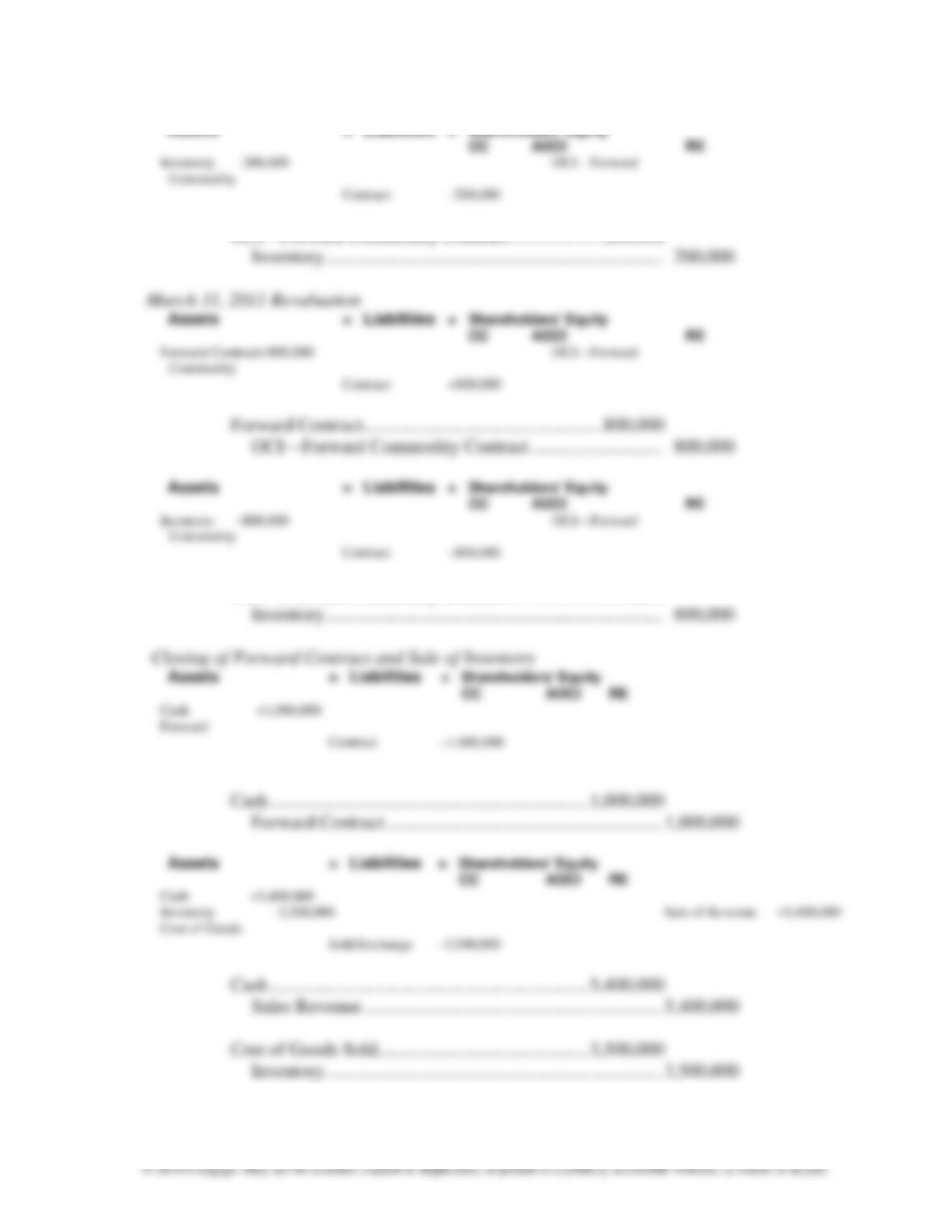
9-26
Assets = Liabilities + Shareholders’ Equity
OCI—Forward Commodity Contract ……………….. 200,000
OCI—Forward Commodity Contract ……………….. 800,000
© 2018 Cengage. May not be scanned, copied or duplicated, or posted to a publicly accessible website, in whole or in part.
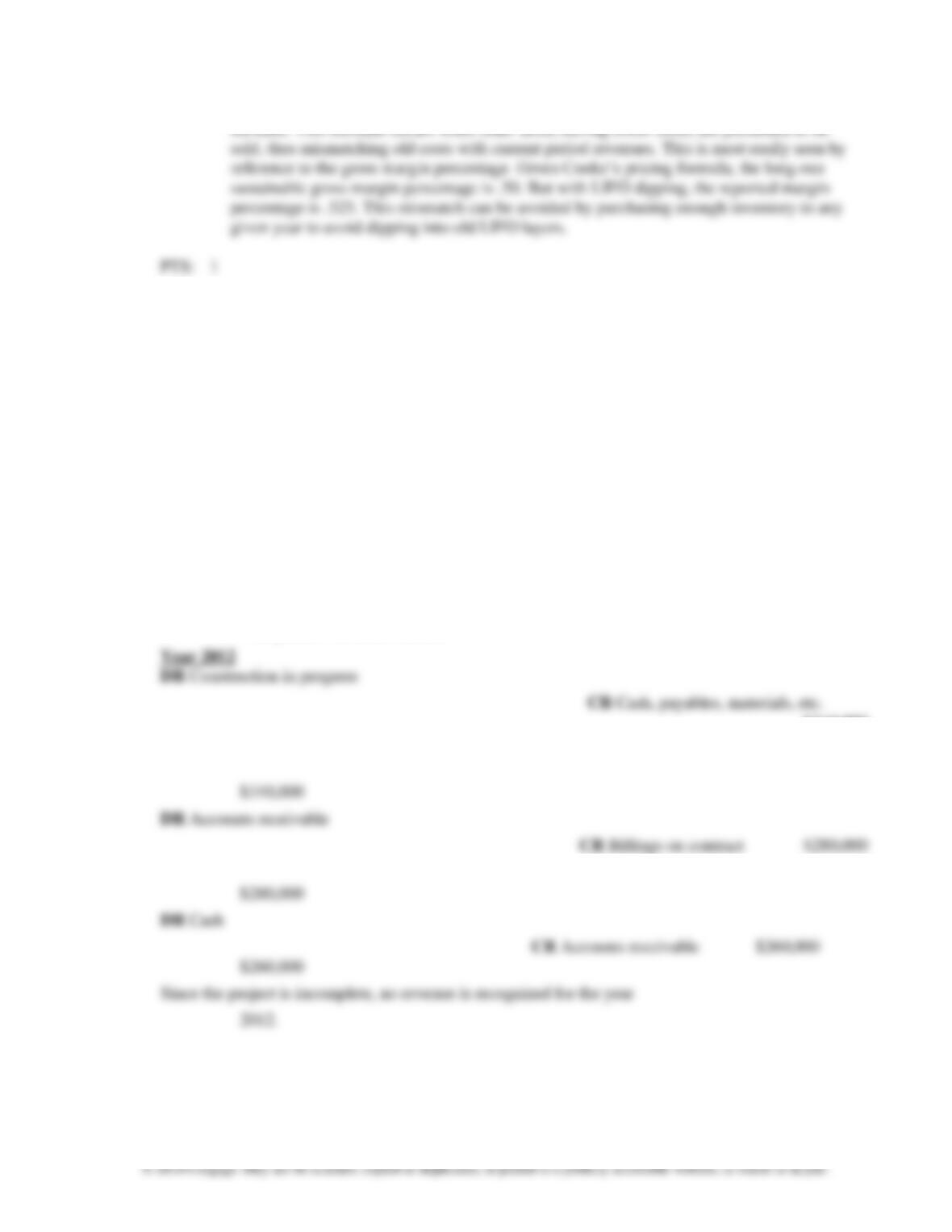
6. Cooke Industries imports and sells quality merchandise. The company had the following layers in its
LIFO inventory at January 1, 2012, at which time the replacement cost of the inventory was $600 per
unit.
Year LIFO Layer Added Units Unit Cost
2009 40 $400
2010 30 $475
2011 50 $575
The replacement cost of the merchandise remained constant throughout 2012. Cooke sold 300 units
during 2012. The company established the selling price of each unit by doubling its replacement cost
at the time of sale.
Required:
1. Determine the gross margin and the gross margin percentage for 2012 assuming that Cooke
purchased 310 units during the year.
2. Determine the gross margin and the gross margin percentage for 2012 assuming that Cooke
purchased 200 units during the year.
3. Explain why the assumed number of units purchased makes a difference in your answers.
ANS:
2.
3.
9-28
When prices are rising, selling more units than are purchased results in a gross margin
increase. This increase occurs when older units, having lower costs, are presumed to be
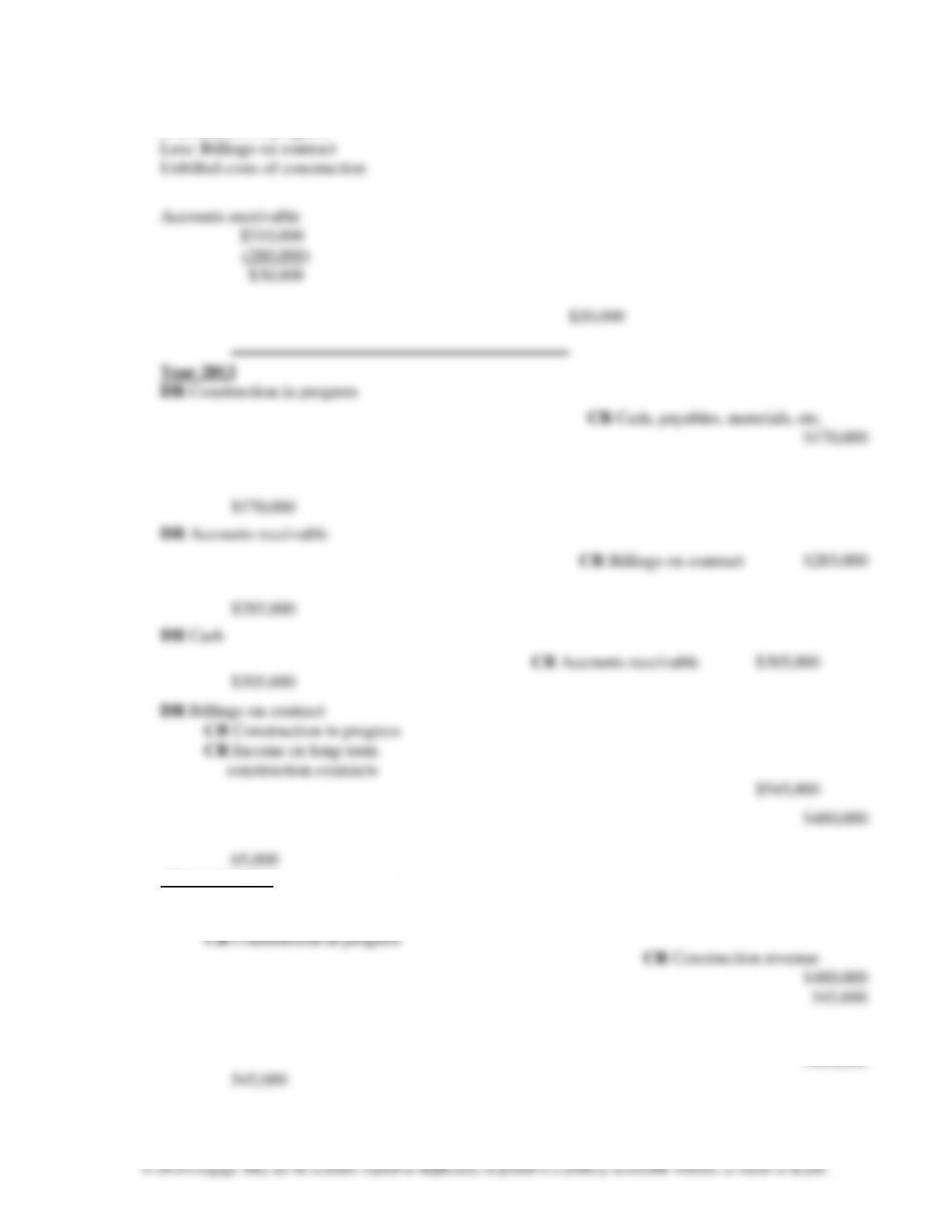
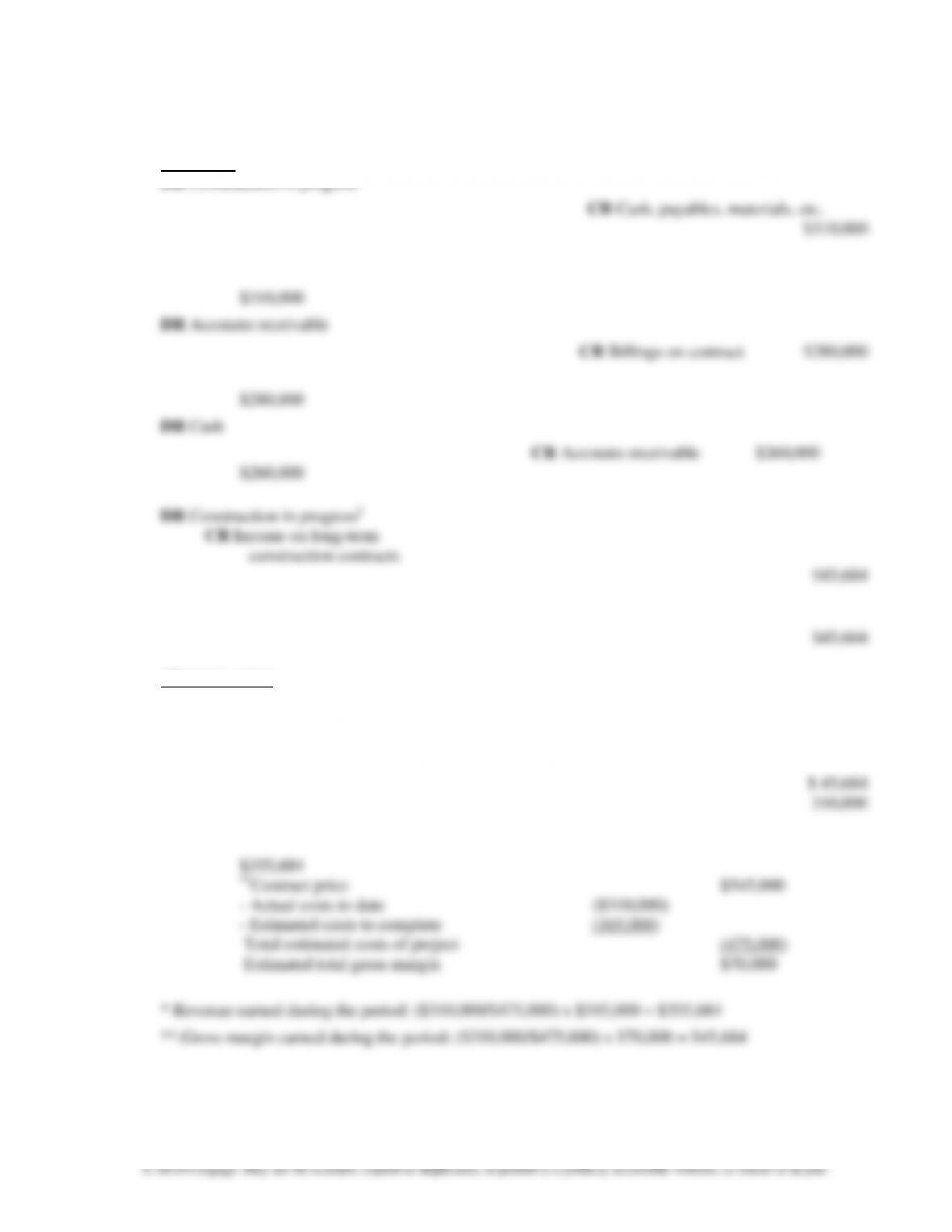
7. Magnum Construction contracted to construct a factory building for $545,000. The company started
during 2012 and was completed in 2013. Information relating to the contract is as follows:
2012 2013
Costs incurred during the year $310,000 $170,000
Estimated additional cost to complete 165,000 —
Billings during the year 280,000 285,000
Cash collections during the year 260,000 305,000
Required:
Record the preceding transactions in Magnum’s books under completed-contract and the percentage of
completion methods. Determine amounts that will be reported on the balance sheet at the end of 2012.
ANS:
Completed–Contract Method
$310,000
Balance Sheet Presentation at the End of 2012
Completed-Contract Method
9-29
Current Assets:
Construction in progress
Alternate entry:
DR Construction expense
DR Billings on contract
$480,000
9-30
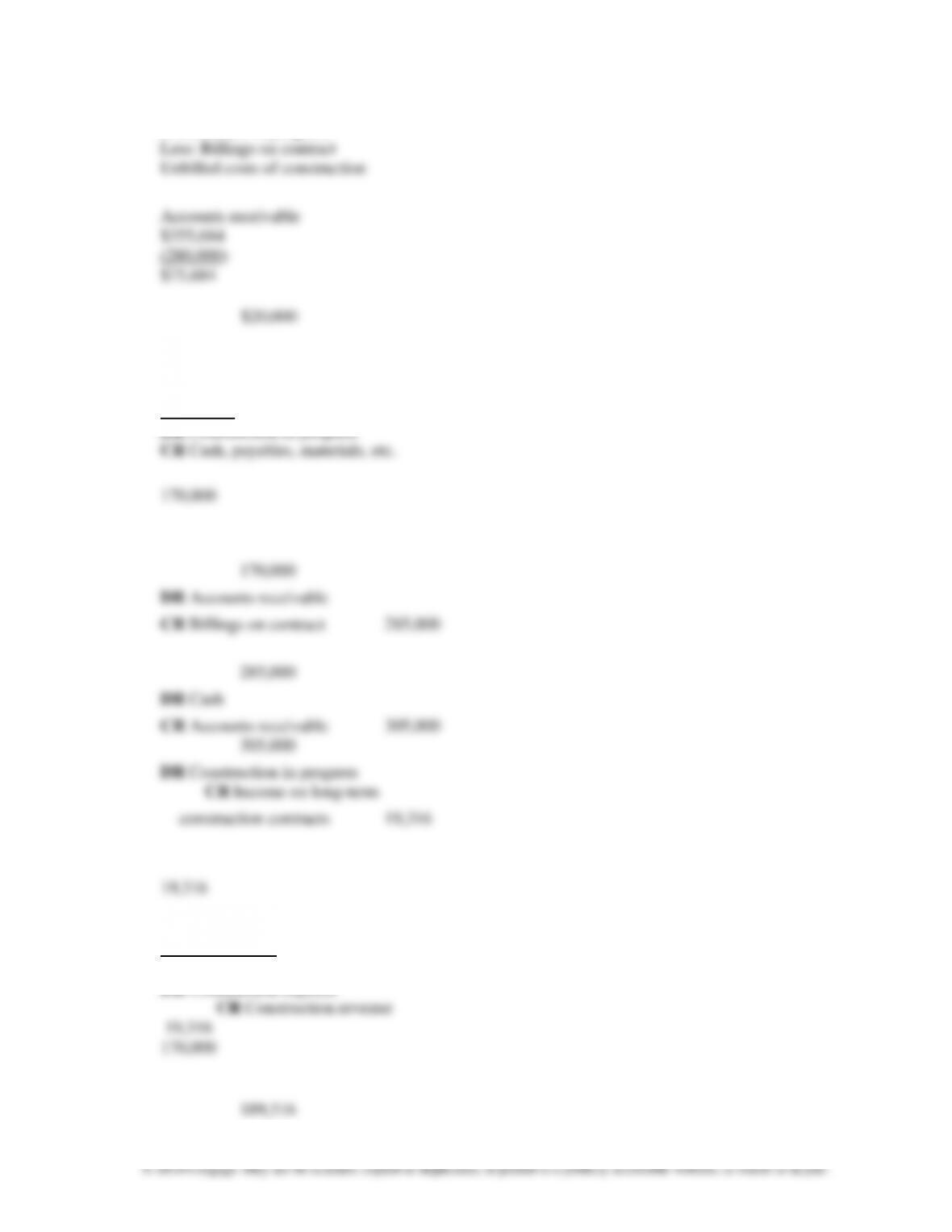
Percentage-of-Completion Method
Year 2012
DR Construction in progress
Alternate entry:
DR Construction in progress**
DR Construction expense
CR Construction revenue*
Balance Sheet Presentation at the End of 2012
Percentage-of-Completion Method
9-31
Current Assets:
Construction in progress
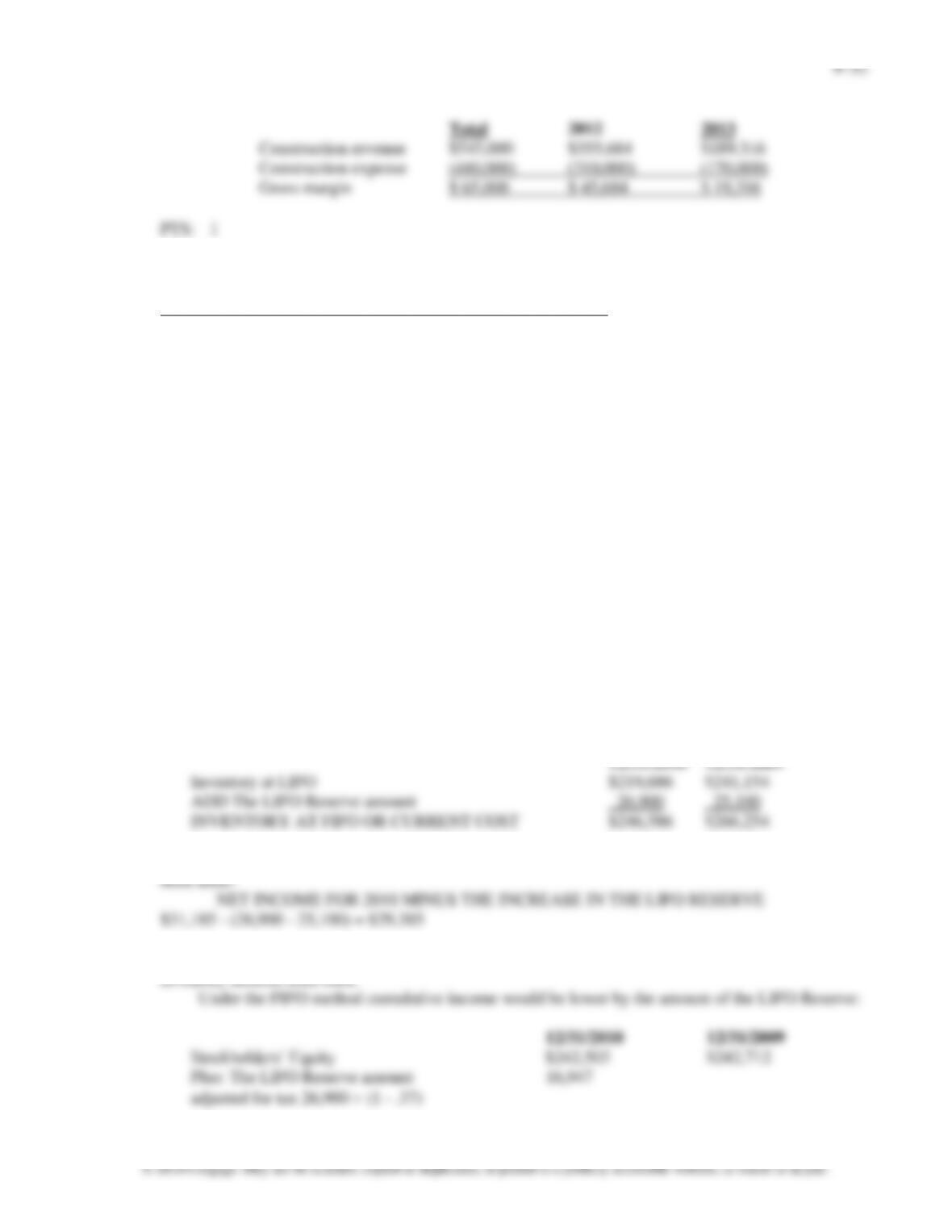
Year 2013
DR Construction in progress
Alternate Entry:
DR Construction in progress
DR Construction expense
© 2018 Cengage. May not be scanned, copied or duplicated, or posted to a publicly accessible website, in whole or in part.
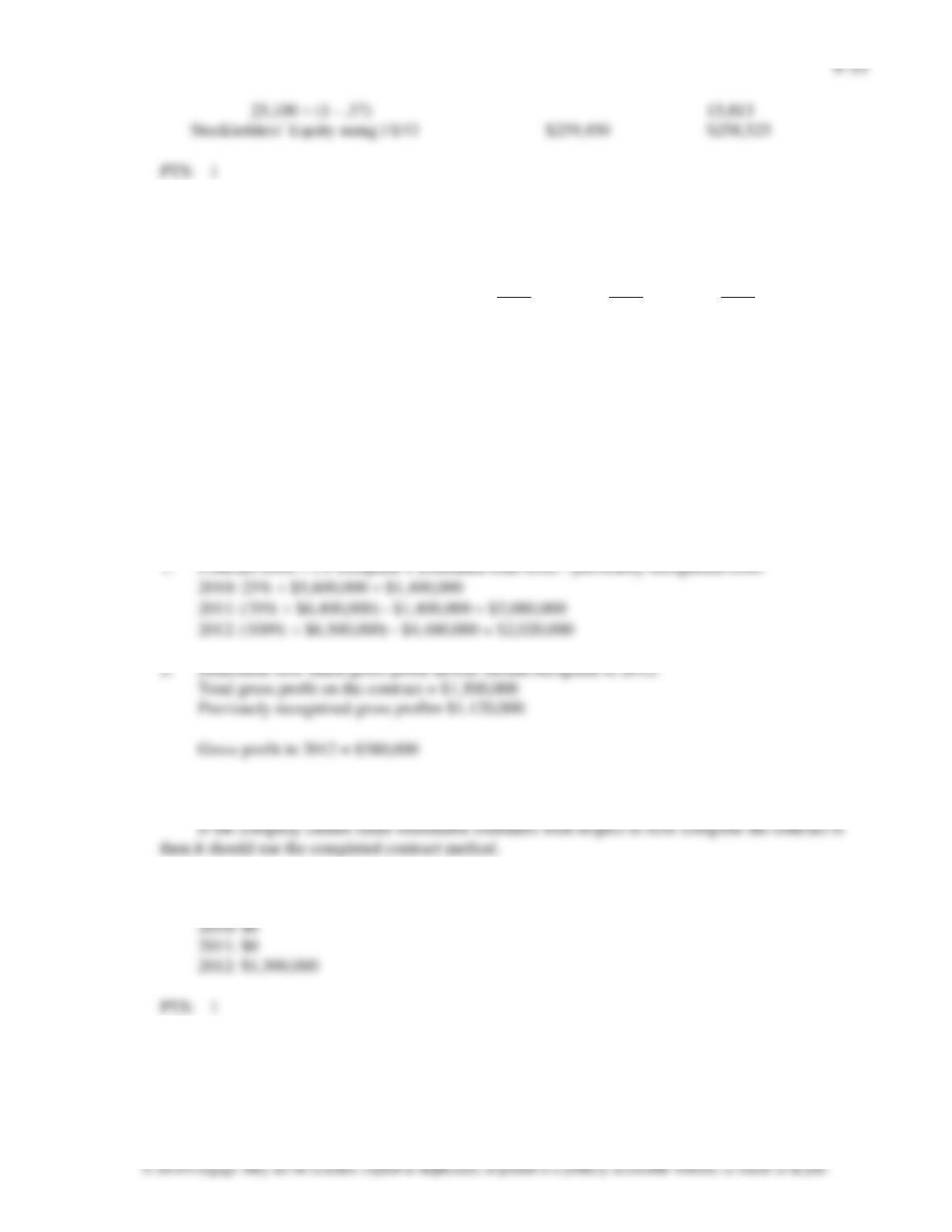
8. The following information is taken from Satin financial statements (amounts in thousands):
12/31/2010 12/31/2009
Inventory at LIFO $219,686 $241,154
Cost of goods sold 754,661 675,138
Stockholders’ Equity 242,503 242,712
Net Income 31,185 64,150
Tax rate 37% 37%
Inventory Footnote: If the first-in, first-out method of accounting for inventory had been used,
inventory would have been approximately $26.9 million and $25.1 million higher than reported at
12/31/2010 and 12/31/2009, respectively.
Required:
a. Calculate what inventory would have been at 12/31/2010 and 12/31/2009 had the FIFO inventory
method been used.
b. What would net income for the year ended 12/31/2010, have been if the FIFO inventory method
been used?
c. Calculate what stockholders’ equity would have been at 12/31/2010 and 12/31/2009 had the FIFO
inventory method been used.
ANS:
a. Calculate what inventory would have been at 12/31/2010 and 12/31/2009 had the FIFO inventory
method been used.
b. What would net income for the year ended 12/31/2010, have been if the FIFO inventory method
c. Calculate what stockholders’ equity would have been at 12/31/2010 and 12/31/2009 had the FIFO
inventory method been used.
© 2018 Cengage. May not be scanned, copied or duplicated, or posted to a publicly accessible website, in whole or in part.
9. Bower Construction Comp. has consistently used the percentage-of-completion method for
recognizing revenue on its long-term contracts. During 2010 Bower entered into a fixed-price contract
to construct an office building for $8,000,000. Information relating to the contract is as follows:
2010 2011 2012
Percent Complete 25% 70% 100%
Estimated Total Cost at Completion $5,600,000 $6,400,000 $6,500,000
Gross Profit Recognized to date 600,000 1,120,000 ?
Required (Show Calculations):
1. Compute contract costs incurred during 2010, 2011 and 2012.
2. Determine how much gross profit Bower should recognize in 2012.
3. Under what conditions would it not be reasonable for a company to use the percentage of
completion method of recognizing revenue on long-term contracts?
4. If Bower had used the completed contract method of accounting for this long-term contract how
much gross profit would it have earned in 2010, 2011 and 2012?
ANS:
3. Under what conditions would it not be reasonable for a company to use the percentage of
completion method of recognizing revenue on long-term contracts?
4. If Bower had used the completed contract method of accounting for this long-term contract how
much gross profit would it have earned in 2010, 2011 and 2012?
10. The following information is available from Sheldon Corp.:
Information from the Balance Sheet:
2012 2011
9-34
Depreciable Assets $2,458,600 $1,985,400
Accumulated Depreciation (1,350,700) (1,046,000)
Depreciable Assets (Net) $1,107,900 $939,400
From the Income Statement 2012
Depreciation Expense $384,500
Use the information above to calculate the following:
a. Average age of the depreciable assets
b. Average remaining useful life of the depreciable assets
ANS:
The following schedule was taken out of the inventory records for the Happy Dog Company
units purchased cost per unit total cost of inventory
Beg Inv 300 $15 $4,500
Computation using FIFO units total