8-1
Chapter 8—Investing Activities
MULTIPLE CHOICE
1. An analyst can estimate the average total life of depreciable assets by:
a. dividing average depreciable assets by depreciation expense for the year.
b. dividing depreciation expense for the year by average depreciable assets.
c. dividing average gross depreciable assets by accumulated depreciation.
d. Subtracting depreciation expense from accumulated depreciation.
2. A company would need to record an impairment loss for its equipment when:
a. the original cost of the equipment exceeds its fair value and is deemed not recoverable.
b. management determines that the equipment will no longer be used.
c. the carrying amount of the equipment exceeds its fair value and is deemed not recoverable.
d. the cash flows from the equipment are less than its fair value.
3. Using the information below, calculate the average total depreciable life of the assets:
Information from the Balance Sheet:
2012 2011
Depreciable Assets $600,000 $400,000
Accumulated Depreciation (175,000) (100,000)
Depreciable Assets (Net) $425,000 $300,000
From the Income Statement 2012
Depreciation Expense $50,000
a. 6.54 years
b. 7.25 years
c. 6.91 years
d. 9.15 years
4. Which of the following is a difficulty in determining current market values when determining the
value of fixed assets?
a. There is an absence of active markets for many fixed assets.
b. It is difficult to identify comparable assets currently available in the marketplace to value assets in
place.
c. It is difficult to make assumptions about the effects of technology and other improvements when
using the prices of new assets currently available on the market in the valuation process.
d. All of these are correct.
5. GAAP stipulates that firms should do what with expenditures that increase the service potential of an
asset beyond that originally anticipated?
a. Expense the expenditure immediately.
b. Capitalize the expenditure and depreciate it over the remaining service life of the asset.
c. Capitalize the expenditure, but do not depreciate the asset.
d. Charge it off to shareholders’ equity.
6. How should Focus Company record expenditures for research and development costs according to
U.S. GAAP?
a. expense as incurred
b. capitalize and depreciate
c. amortize them over 60 months
d. None of these are correct.
7. Using the information below, calculate the average total depreciable life of the assets:
Information from the Balance Sheet:
2012 2011
Depreciable Assets $2,458,600 $1,985,400
Accumulated Depreciation (1,350,700) (1,046,000)
Depreciable Assets (Net) $1,107,900 $939,400
From the Income Statement 2012
Depreciation Expense $384,500
a. 5.8 years
b. 10 years
c. 2.9 years
d. 5.3 years
8. Firms recognize an impairment loss when the carrying amount of a tangible fixed asset is deemed “not
recoverable” as specified by GAAP. GAAP defines a carrying amount as “not recoverable” if:
a. it is greater than the sum of the cash flows expected from the asset’s use and disposal.
b. it is greater than the sum of the undiscounted cash flows expected from the asset’s use and
disposal.
c. it is less valuable than its current carrying value.
d. it is less valuable than its current fair value.
9. All of the following statements are true regarding accounting for software development costs except:
a. Firms must expense as incurred all costs incurred internally in developing computer software until
such development achieves the technological feasibility of a product.
b. Firms must capitalize as incurred all costs incurred internally in developing computer software.

8-3
c. Researchers have found a significant association between costs and future earnings, which support
capitalizing and amortizing product development costs permitted by U.S. GAAP and IFRS.
d. The interpretation of the meaning of technological feasibility has created diversity in the practice
of accounting for software development costs.
10. The term used to describe the amount of a company’s annual interest cost that should be capitalized is
known as:
a. tangible interest
b. actual interest
c. average accumulated expenditures
d. avoidable interest
11. Which of the following would not be used to determine the cost of an asset?
a. cash paid
b. sales and excise taxes
c. cost incurred to get the asset ready for its intended use
d. depreciation method
12. Currently, the FASB’s Statements of Accounting Concepts (Nos. 5 and 6) define an asset
as having all of the following characteristics except:
a. costs not guided by management’s judgment
b. probable future benefits
c. resulting from past transactions and events
d. something that is obtained/controlled by the entity
13. A key characteristic of asset measurement is best described as:
a. average value based on all assets held by the company
b. disposal cost less depreciation
c. fair value at the acquisition date
d. fair value less depreciation
14. All of the following are typically costs that fail the future benefits test of long-lived operating assets
except:
a. costs related to research and development
b. costs related to marketing
c. costs related to brand-building activities
d. costs of equipment used in production
15. Managers are typically faced with all of the following primary choices and estimates when allocating
acquisition costs of tangible assets and intangible assets to the periods benefited except:

8-4
a. choosing an allocation method
b. estimating useful life
c. estimating salvage value
d. establishing a reserve for obsolescence
16. All of the following are consistent with the purpose of determining the useful life of a long-lived asset
except:
a. using the information to convey expectations about the future usefulness of the assets to
stakeholders.
b. using the information to help project a rational basis for depreciation
c. using the information to help project a systematic basis for depreciation
d. using the information to manage earnings upward.
17. Which of the following terms is least consistent with the allocation of costs using a rational and
systematic method?
a. depreciation
b. amortization
c. depletion
d. upward revaluation
18. All of the following are difficulties encountered in determining fair values except:
a. the need to make assumptions about the effect of technological and other improvements when
using the prices of new assets currently available on the market in the valuation process
b. the need to identify comparable assets currently available in the market to value assets in place
c. the absence of U.S. GAAP and IFRS standards related to reporting long-lived assets
d. the absence of active markets for many used fixed assets, particularly those specific to a particular
firm’s needs
19. Which of the following is the least effective way for an analyst to understand whether existing long–
lived assets must be replaced?
a. understand industry conditions and firm strategies for capital expenditure growth
b. calculate the average age of depreciable assets
c. calculate the percentage of ownership the firm has in another entity
d. calculate the proportion of depreciable assets consumed
20. All of the following are types of intercorporate investments in capital stock except:
a. minority, passive
b. minority, active
c. majority, active
d. majority, passive
21. When a firm sells a trading security, it recognizes:
8-5
a. the average of the selling price and the book value as a gain or loss in measuring net income.
b. the difference between the selling price and the book value as a gain or loss in measuring net
income.
c. amortizes any difference between the acquisition cost and maturity value as interest revenue over
the life of the debt.
d. the difference between the selling price and the acquisition cost of the security as a realized gain or
loss on the income statement.
22. When a company records the cost of cutting down timber, this cost is deemed to be:
a. exploration cost.
b. asset retirement obligation.
c. development cost.
d. depletion cost.
23. Which one of the following is an example of the expected benefit approach for valuing long-lived
assets?
a. Current cost.
b. Historical cost.
c. Discounted present value.
d. Current replacement value.
24. Expenditures included in the cost of a long-lived asset are:
a. intangible.
b. charged off.
c. expensed.
d. capitalized.
25. Which of the following items would be charged to the cost of the building?
a. Architectural fees.
b. Cost of foundation.
c. Capitalization of interest financing charges.
d. All of the above
26. For U.S. GAAP, software development costs are capitalized as intangible assets:
27. The method used to account for oil and gas exploration costs that capitalizes the exploration costs of
productive wells is the:
a. reserve recognition accounting.
8-6
b. successful efforts approach.
c. soft asset approach.
d. full-cost approach.
28. When certain kinds of assets are built that require public welfare and safety expenditures at the end of
the asset’s life:
a. these asset retirement costs are expensed when asset retirement occurs.
b. a liability simultaneously arises.
c. these estimated future expenditures are added to the carrying value of the asset.
d. this fact is only reported in the financial statement footnotes.
29. Under IFRS, when an asset is revalued upwards, subsequent depreciation is based on:
a. the asset’s fair value.
b. the asset’s original cost.
c. the method used for determining depreciation on the company‘s tax returns.
d. the amount of future cash flows the asset is expected to generate.
30. Which of the following is not a classification for a minority, passive investment?
a. trading securities
b. equity securities
c. available-for-sale securities
d. held-to-maturity securities
31. When dividends from an investment are recognized as income, the investment must have been of
which type?
a. Minority, Passive Investment
b. Majority, Passive Investment
c. Majority, Active Investment
d. Minority, Active Investment
32. When dividends from an investment are recognized as a reduction of the investment account, the
investment must have been of which type?
a. Minority, Passive Investment
b. Majority, Passive Investment
c. Majority, Active Investment
d. Minority, Active Investment
33. Solo Corp. purchased $500,000 of bonds for $515,000 as an investment. If Solo expects to hold the
bonds until they mature, the initial investment should be recorded at:
a. Investment in Bonds – $500,000
Additional Investment Expense – $15,000
b. Investment in Bonds – $515,000
8-7
c. Investment in Bonds – $500,000
Prepaid Interest Revenue – $15,000
d. Accumulated Other Comprehensive Investment – $500,000
Snowflake Corp.
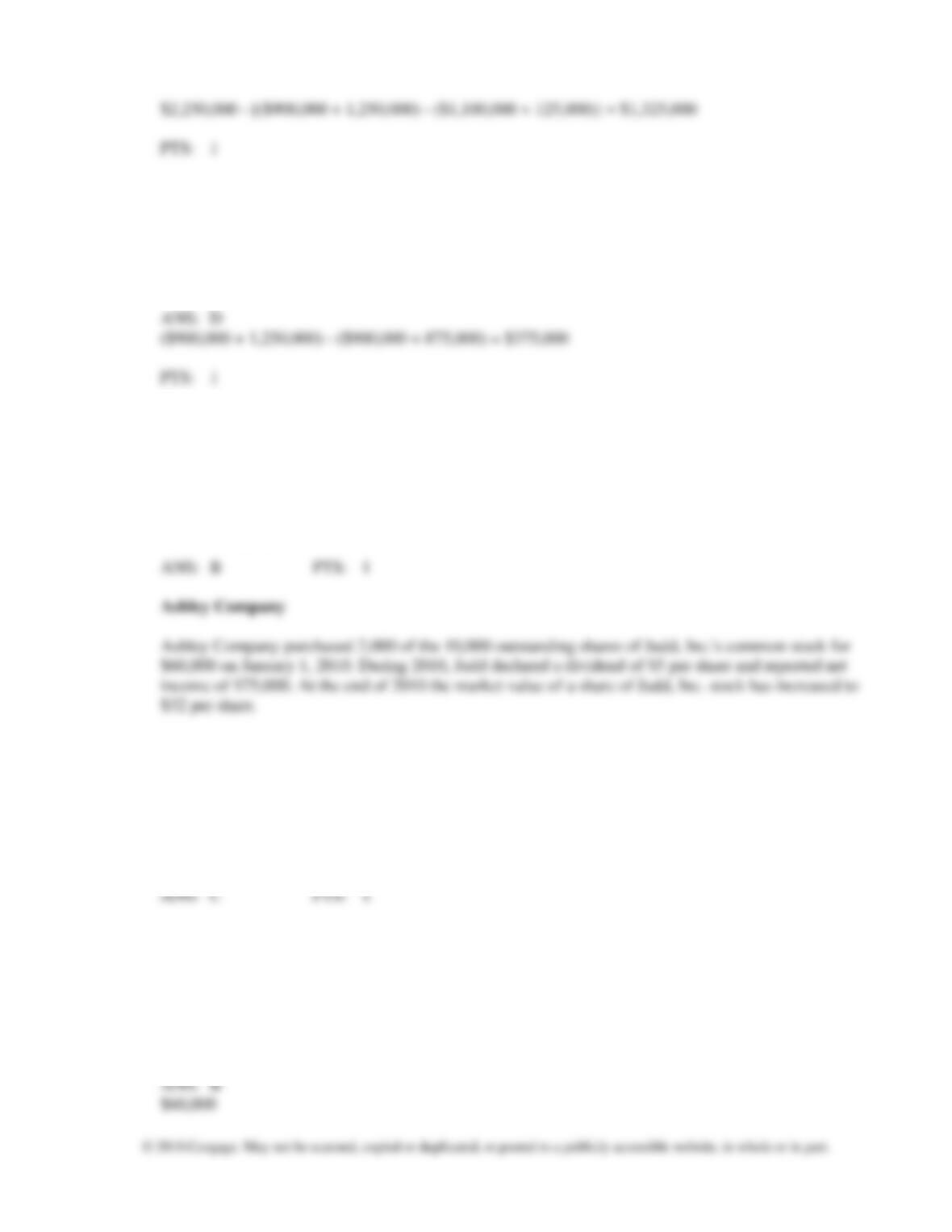
Penguin, Inc. acquires 100% of the outstanding shares of Snowflake Corp. for $2,250,000 and
accounts for the transaction using the purchase method. Snowflake’s balance sheet at the acquisition
date is as follows:
34. Based on the information concerning Snowflake Corp. what is the market value of the company’s
shareholders’ equity at the acquisition date?
a. $1,775,000
b. $475,000
c. $2,250,000
d. $0
35. Based on the information concerning Snowflake Corp. what is the value of the goodwill related to the
acquisition?
a. $1,775,000
b. $475,000
c. $2,250,000
d. $1,325,000
8-8
45. Olivia Co. owns 5,600 of the 14,000 outstanding shares of Hobbitt Corp. common stock and exercises
significant influence over the company. During 2011, Hobbitt earns $90,000 and pays cash dividends
of $25,000. If the beginning balance in the investment account was $190,000, the balance at December
31, 2011 should be:
a. $192,000
b. $172,000
c. $180,000
d. $216,000
46. Olivia Co. owns 4,000 of the 10,000 outstanding shares of Hobbitt Corp. common stock and exercises
significant influence over the company. During 2011, Hobbitt earns $80,000 and pays cash dividends
of $30,000. For the year ended December 31, 2011, Olivia should report income related to the
investment equal to:
a. $0
b. $12,000
c. $32,000
d. $20,000
47. Under which of the following scenarios would an entity not be classified as a variable interest entity?
a. The equity investing firms do not have the obligation to absorb the expected losses of the variable
interest entity if they occur.
b. The investing firms do not have the right to receive the expected residual returns of the variable
interest entity if they occur.
c. The total equity investment at risk is sufficient to permit the variable interest entity to finance its
activities without additional subordinated financial support from other parties.
d. The equity investing firms do not have the direct or indirect ability to make decisions about the
variable interest entity’s activities through voting rights or similar rights.
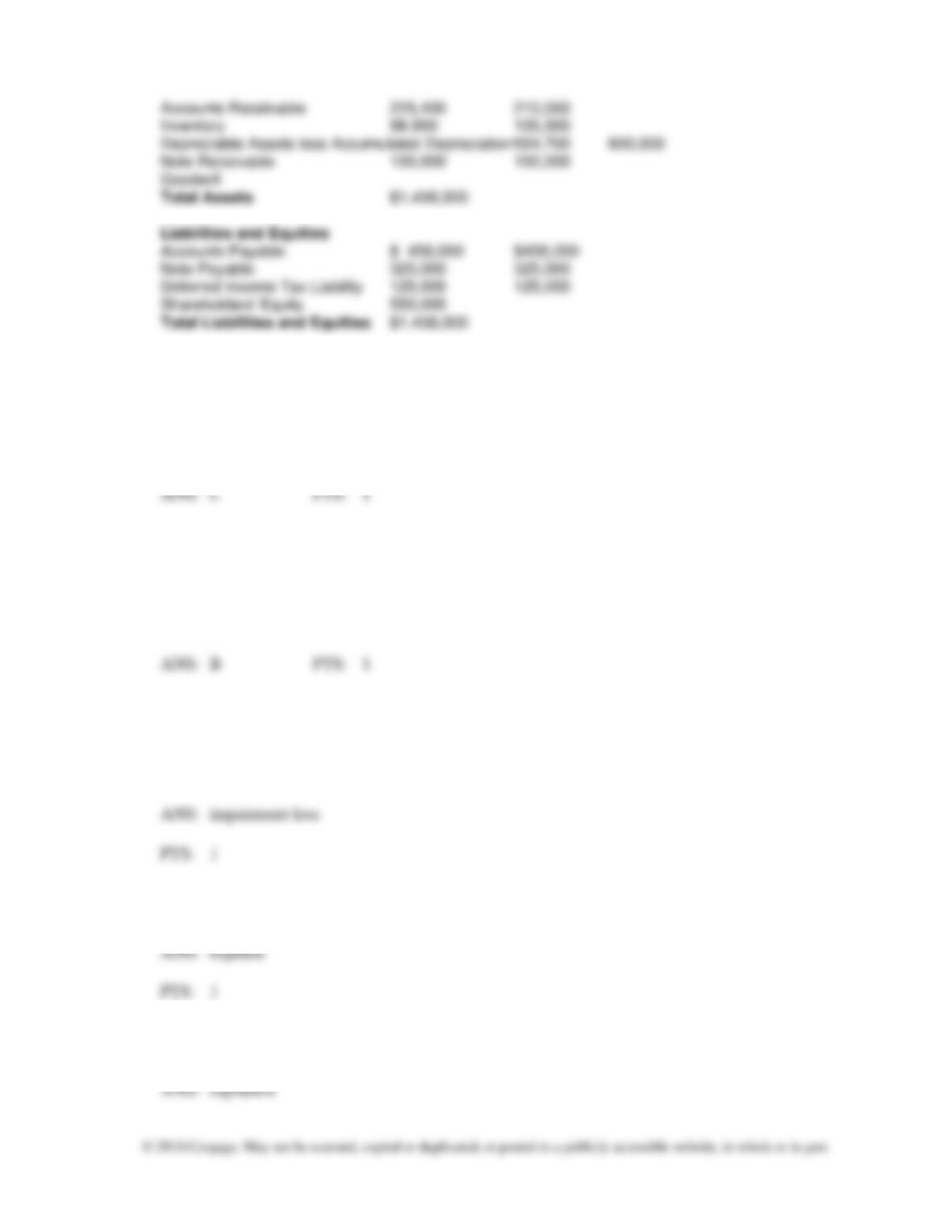
Record Corporation
CD Inc. acquires 100% of the outstanding shares of Record Corp. for $1,200,000 and accounts for the
transaction using the purchase method. Record Corp’s balance sheet at the date of acquisition appears
below:
8-11

11. The ____________________ method views a corporate acquisition as conceptually identical to the
purchase of any single asset.
12. When the purchase price of another entity exceeds the book value of the entity’s net assets the
purchaser allocates the excess to identifiable assets and liabilities in order to revalue them to market
value and any additional excess is allocated to ____________________.
13. When one company acquires another company it may not be able to estimate the potential losses
inherent in the acquired assets or the potential liability of the acquired company, for these reasons the
acquirer may establish ________________________________________.
14. When a company has a minority passive investment it will recognize changes in the market value of
the investment as ____________________ gains and losses.
15. Securities that are purchased in order to take advantage of short-term changes in market value should
be classified as ____________________ securities.
16. Unrealized gains and losses that appear in accumulated other comprehensive income are from
securities classified as ___________________________________ securities.
17. Held-to-maturity securities are accounted for at
__________________________________________________.
18. When a firm can exercise control or significantly influence the operations of a company it has only a
minority interest in, it should account for the investment using the
______________________________.
19. Under the equity method the investor’s share of investee income ____________________ the
investment account and dividends ____________________ the investment account.
20. When a foreign entity operates as a relatively self-contained and integrated unit within a foreign
country, normally, its functional currency is the
____________________________________________________________.
21. When a foreign entity operates as a direct and integral extension of the U.S. parent, normally, its
functional currency is the _________________________.
22. An investing firm consolidates the variable interest entity if it absorbs the majority of the entity’s
expected ____________________ if they occur, receives a majority of the entity’s expected
______________________________ if they occur, or both.
23. The functional currency of a foreign unit whose receivables and payables are denominated in foreign
currency and not usually remitted to parent company is the ______________________________.
24. Ownership of 50% or more of the voting stock of another company implies an ability to
____________________ the company and _________________ should be prepared
8-16
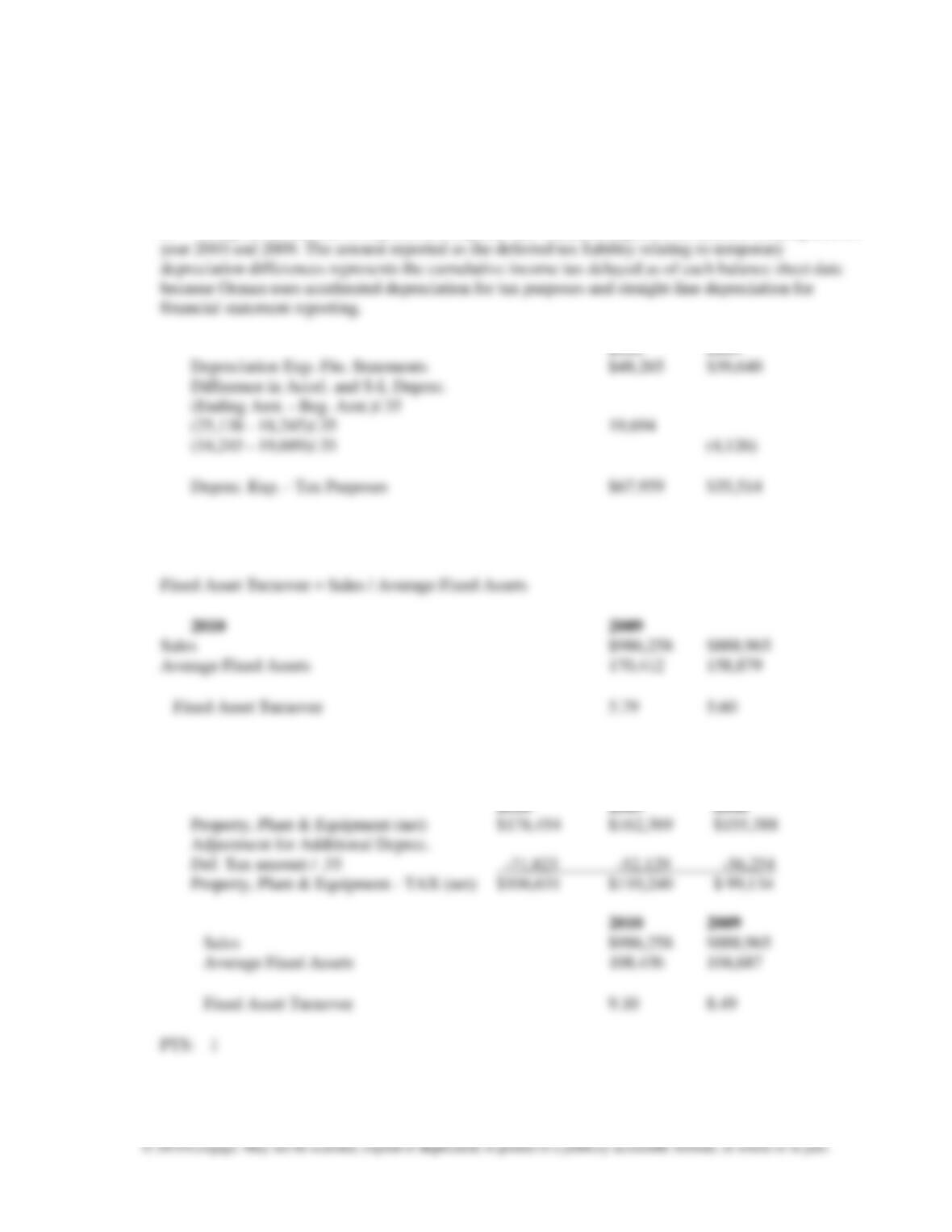
b. Compute the fixed asset turnover ratio for years 2010 and 2009 using the amounts reported for
financial statement purposes.
c. Compute the fixed asset turnover ratio for years 2010 and 2009 using the amounts reported for
tax purposes.
ANS:
a. Compute the amount of depreciation expense that Orman recognized for income tax purposes for
2010 2009
b. Compute the fixed asset turnover ratio for years 2010 and 2009 using the amounts reported for
financial statement purposes.
c. Compute the fixed asset turnover ratio for years 2010 and 2009 using the amounts reported for
tax purposes.
2010 2009 2008
2. Discuss how firms should account for intangible assets under U.S. GAAP. Your answer should include
discussion of the following areas: