
7-1
Chapter 7—Financing Activities
MULTIPLE CHOICE
1. All of the following are primary events that typically lead to changes in book value of shareholders’
equity except:
a. Investments by shareholders, usually net cash received by the company at equity issue date.
b. Profitable operating and investing activities, with net income being a large component of this
increase.
c. Debtholders requiring firms to enter into debt covenants.
d. Distributions to shareholders, usually in the form of periodic cash dividend payments
to investors and sometimes in the form of share repurchases.
2. Which of the following is the typical tradeoff when issuing preferred stock?
a. The tradeoff between different accounting for an initial issuance of preferred stock as compared to
a common stock issuance.
b. The tradeoff between maintaining corporate control and creating a class of shareholders with
preference in all asset distributions.
c. The tradeoff of giving common shareholders priority over preferred shareholders in corporate
liquidations.
d. The tradeoff of a convertibility feature of common shares into preferred shares.
3. Which of the following is the date on which a company incurs a legal liability to distribute the
dividend to owners of the stock?
a. date of record
b. commitment date
c. date of declaration
d. date of payment
4. Which of the following is the date on which a company determines the owners of the stock that will
receive a dividend?
a. date of record
b. measurement date
c. date of declaration
d. date of payment
5. Which of the following is the date on which the dividend distribution occurs?
a. date of record
b. commitment date
c. date of declaration
d. date of payment

6. Which kind of dividend is a return of the original investment by shareholders?
a. cash dividend
b. stock dividend
c. liquidating dividend
d. scrip dividend
7. Which kind of dividend has an interest-bearing promise to pay dividends?
a. property dividend
b. stock dividend
c. liquidating dividend
d. scrip dividend
8. Which kind of dividend typically pays dividends with investments in other corporations’ stock?
a. property dividend
b. stock dividend
c. liquidating dividend
d. scrip dividend
9. Which kind of dividend typically pays dividends with additional shares of the corporation’s stock?
a. property dividend
b. stock dividend
c. liquidating dividend
d. scrip dividend
10. Which is the date when a firm gives a stock option to employees?
a. vesting date
b. grant date
c. exercise date
d. market date
11. Which is the date when employees elect to exchange the option and cash for shares of common stock?
a. vesting date
b. grant date
c. exercise date
d. market date
12. Which is the first date when employees can exercise their stock options?
a. vesting date
b. grant date
c. exercise date
d. liquidating date

7-3
© 2018 Cengage. May not be scanned, copied or duplicated, or posted to a publicly accessible website, in whole or in part.
ANS: A PTS: 1
13. In some countries the account Reserve for Contingencies may be most comparable to which of the
following accounts for a company reporting under U.S. GAAP?
a. Contingency Expense
b. Retained Earnings Appropriated for Contingencies
c. Unearned Contingency Fees
d. Contingency Losses
14. Under IFRS, cash payments for purchase of treasury stock:
a. operating cash outflow
b. investing cash outflow
c. financing cash outflow
d. Both A and C are correct.
15. According to U.S. GAAP, which of the following provides the most reliable measure for fair value
measurement?
a. Observable market data serving as inputs into estimates into present value-based measurements
such as foreign exchange rates.
b. Quoted market prices of identical assets or liabilities in inactive markets
c. Observable quoted market prices in active markets for identical assets or liabilities
d. Unobservable inputs used by the reporting entity when modeling how the market would determine
the fair value of the asset or liability in question
16. Regarding accounting for troubled debt, which of the following statements is true?
a. The treatment for troubled debt is the same under both U.S. GAAP and IFRS.
b. The settlement of troubled debt results in an economic loss to the debtor because the creditor
accepts more than the book value of the debt to settle the debt.
c. U.S. GAAP uses a “10 percent rule” to determine whether a gain is recognized by the debtor in a
troubled debt situation.
d. Because IFRS uses the present value approach to determine the magnitude of the settlement for
troubled debt, the magnitude of the new book value of the restructured debt will be lower and the gain
recognition will be larger under IFRS.
17. FASB has set forth all of the following conditions for recognizing transfers of receivables as sales only
if the following conditions of surrendering control of the receivables are met except:
a. The assets transferred have been isolated from the selling firm.
b. The buying firm obtains the right to pledge or exchange the transferred assets, and no condition
both constrains the transferee from taking advantage of its right and provides more than a trivial
benefit to the transferor.
c. The selling firm does not maintain effective control over the assets transferred through (a) an
agreement that both entitles and obligates it to repurchase the assets or (b) the
ability to unilaterally cause the transferee to return specific assets.
d. A creditor of the selling firm can access the receivables in the event of the seller’s bankruptcy.

7-4
18. Financial reporting requires that firms recognize product financing arrangements as liabilities
if which of the following conditions is met?
a. The arrangement requires the sponsoring firm to purchase the inventory, substantially
identical inventory, or processed goods of which the inventory is a component at specified prices.
b. The selling or sponsoring firm physically controls the inventory.
c. The payments made to the other entity cover all acquisition, holding, and financing
costs.
d. Both A and C are correct.
19. All of the following are benefits of leasing except:
a. They have the ability to shift the tax benefits from depreciation and other deductions from a lessee
that has little or no taxable income to a lessor that has substantial taxable income.
b. They provide flexibility to change capacity as needed without having to purchase or sell assets.
c. They have the ability to reduce the risk of technological obsolescence, relative to outright
ownership, by maintaining the flexibility to shift to technologically more advanced assets.
d. In an operating lease, the lessee recognizes the signing of the lease as the simultaneous acquisition
of a long-term asset and the incurring of a long-term liability for lease payments.
20. Under U.S. GAAP, which of the following items would require a lessee to classify a lease of
equipment as a capital lease?
a. There is no transfer of ownership to the lessee at the end of the lease term.
b. The lease does not contain a bargain purchase option.
c. The lease term is 90% of the estimated economic life of the lease property.
d. The present value of the contractual minimum lease payments is 75% of the fair value of the
leased property.
21. All of the following are correct regarding operating leases except:
a. Cash outflow is in the form of rent payments
b. The rights to use the property for a specified period of time are conferred to the lessee by the
lessor.
c. At the end of the lease the lessee returns the property to the lessor
d. Depreciation expense can be recorded on the books by the lessee
Porter Corporation
NOTE: The following multiple choice questions require present value information.

© 2018 Cengage. May not be scanned, copied or duplicated, or posted to a publicly accessible website, in whole or in part.
22. What accounting method should Porter use to account for the equipment lease?
a. Operating Lease method
b. Capital Lease method
c. Equipment Lease method
d. Lessee Accounting method
23. Under which of the following conditions does the equipment lease qualify for capital lease
accounting?
a. The lease contains a bargain purchase option.
b. The lease term is equal to or greater than 75% of the asset’s economic life.
c. A, and B are correct answers.
d. The lease transfers ownership to the lessee at the end of the lease term.
24. At January 1, 2012, Porter should record an asset and liability with respect to the equipment lease
equal to:
a. $258,726
b. $239,562
c. $275,000
d. $0
25. For the year ended December 31, 2012, Porter should record depreciation expense for the leased
equipment equal to:
a. $55,000
b. $39,927
c. $47,912
d. $0
Santa Corporation
NOTE: These multiple choice questions require present value information.
Santa Corporation manufactures Christmas decorations and supplies throughout the world. The
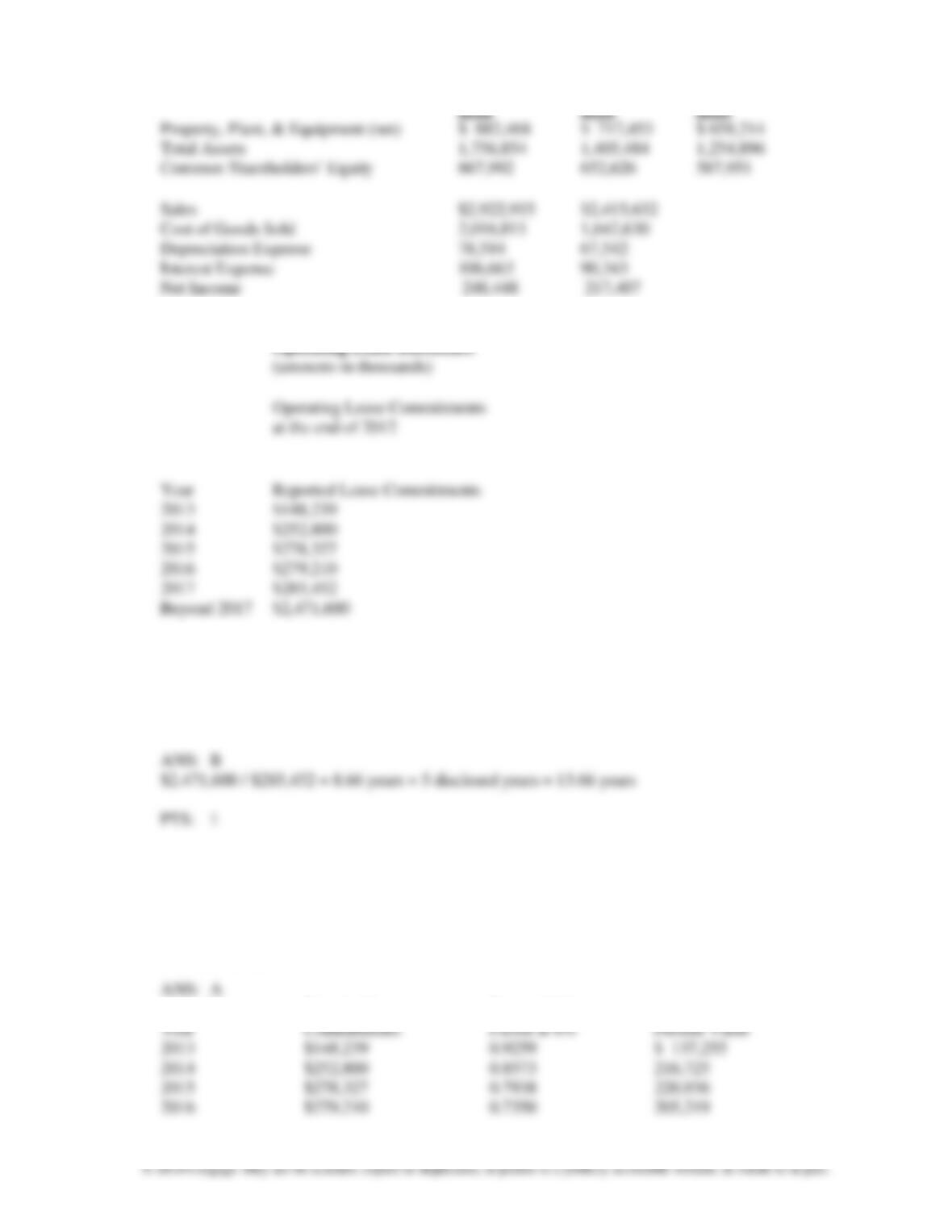
7-6
2012 2011 2010
Santa Corp.
Operating Lease Disclosure
26. Using the information provided by Santa Corporation, estimate the average life of the operating leases.
a. 8.66 years
b. 13.66 years
c. 10 years
d. Not able to determine
27. Using the information provided by Santa Corporation, calculate the present value of the operating
leases.
a. $2,155,843
b. $2,024,945
c. $1,482,390
d. $2,854,452
Reported Lease Present Value
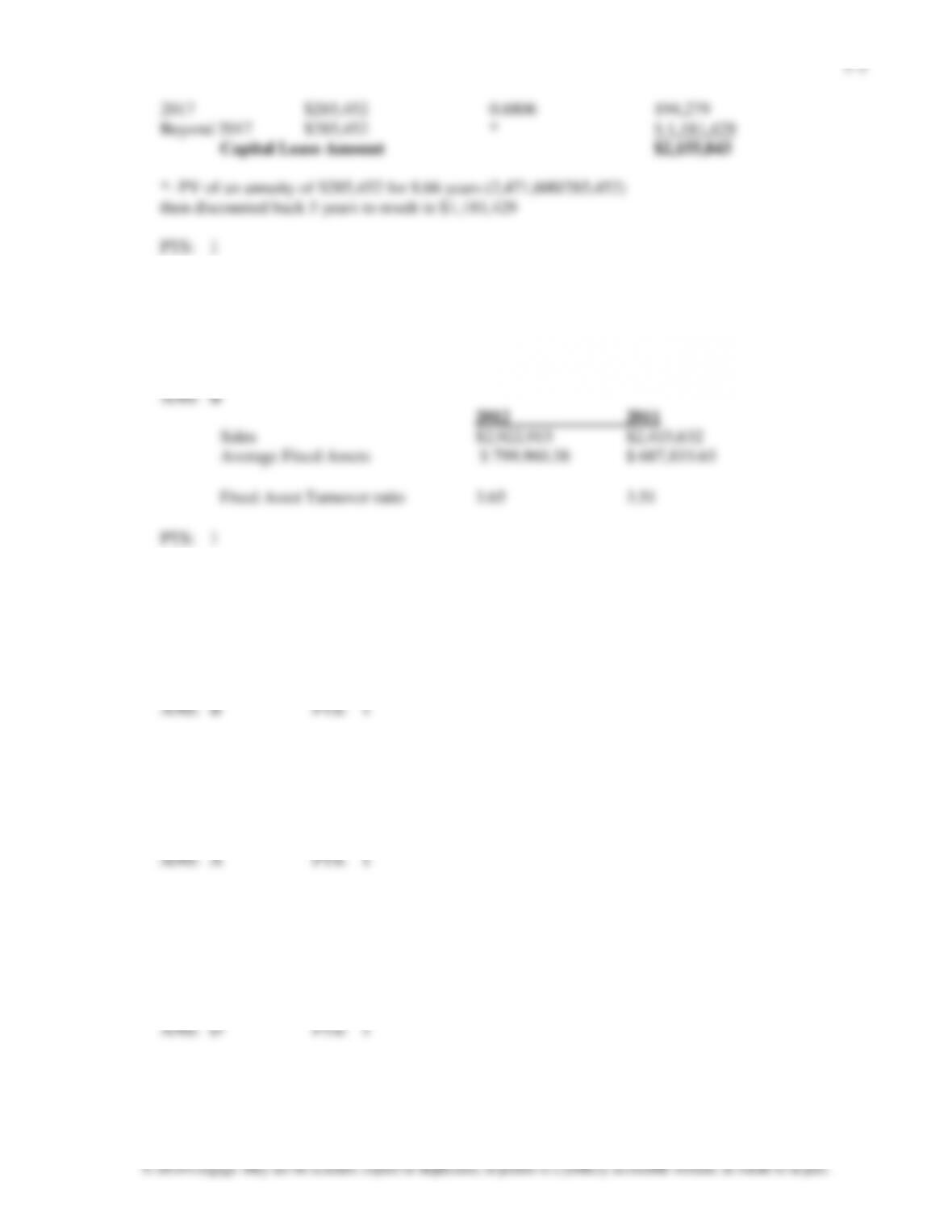
© 2018 Cengage. May not be scanned, copied or duplicated, or posted to a publicly accessible website, in whole or in part.
28. Using the information provided by Santa Corporation, calculate the company’s 2012 fixed asset ratio.
a. 3.0
b. 3.65
c. 3.23
d. 5.21
29. Assuming that Santa Corporation was required to capitalize its operating lease, how would the
company’s fixed asset ratio change under this assumption?
a. increase
b. decrease
c. no effect
d. unable to determine
30. Under the fair value method of accounting for stock options, firms must value stock options on the:
a. grant date
b. intrinsic date
c. measurement date
d. fair value date
31. Which of the following does not represent an acceptable method of transferring receivables to increase
cash flow?
a. With recourse
b. Without recourse
c. Factoring
d. Tax deferred Method
32. Where in the financial statements are changes in the fair value of cash flow hedges reported:
a. On the Balance Sheet as part of retained earnings
b. On the Income Statement as other gains/losses

7-8
c. As other comprehensive income and accumulated in other comprehensive income on the Balance
Sheet.
d. On the Statement of Stockholder’s Equity
33. Which of the following is not one of the three criteria for recognition of a liability?
a. The obligation involves a probable future sacrifice of resources at a specified or determinable date.
b. The firm is required to make a cash payment for the goods or services.
c. The firm has little or no discretion to avoid the transfer.
d. The transaction or event giving rise to the liability has already occurred.
34. Which of the following is not true concerning the recognition of unrealized gains and losses on foreign
currency translation during the consolidation process?
a. Firms do not recognize these gains/losses in current income.
b. Firms recognize these gain/losses in the statement of other comprehensive income
c. Firms increase/reduce their investment accounts by the translation gains/losses
d. Unrealized gains and losses increase/decrease other accumulated comprehensive income in
shareholders’ equity.
35. Which of the following is not one of the GAAP classifications for derivatives?
a. Speculative investment
b. Fair value hedge
c. Asset-liability hedge
d. Cash flow hedge
36. Derivatives are financial instruments that derive their value from changes in any of the following
underlying securities except:
a. Stock prices
b. Percentage discount on accounts receivable
c. Interest rates
d. Commodity prices
37. Which of the following best describes the accounting treatment for derivative instruments not held for
purposes of hedging?
a. Record as an asset or liability and recognize changes in fair value in other comprehensive income.
b. Do not record as an asset or liability; record income from the transaction at maturity and recognize
in earnings.
c. Record as an asset or liability; recognize changes in fair value currently in earnings.
d. Record as an asset or liability if off-balance sheet risk is material.
38. Which of the following is not a distinguishing characteristic of a derivative instrument?
a. Derivative instruments have terms that require or permit net settlement.

7-9
b. Derivative instruments have a low initial net investment.
c. Derivative instruments are highly effective throughout their term.
d. Derivative instruments have one or more underlyings and notional amounts.
39. Under current U.S. GAAP, unrealized gains and losses from four balance sheet items are reported in
accumulated other comprehensive income or loss. Which of the following is not one of the balance
sheet items?
a. Derivatives held as cash flow hedges
b. Deferred tax assets related to net operating loss carryforwards
c. Minimum pension obligations
d. Investment securities classified as available for sale
COMPLETION
1. __________ means that a company will buy back those receivables that are not collected by the
company they are factored to.
2. A(n) ____________________ lease arrangement is one in which the lessee enjoys the use of the
property for a set period of time.
3. Under an operating lease agreement the lessee recognizes ______________________________ each
period that the leased asset is used.
4. Convertible preferred stock has both the attributes of _____________ and
__________________________.

5. One criterion that must be satisfied for a firm to recognize an obligation is that the transaction or event
giving rise to the obligation has already ____________________.
6. The first date at which employees can exercise their stock options is termed the
_________________________.
7. The acceptable method of accounting for stock options is the _________________________ method.
8. The _________________________ is the date a firm gives a stock option to employees.
9. Under the fair value method of accounting for stock options, firms must value stock options on the
date of ____________________.
10. A derivative has one or more ____________________, which are a specified interest rate, commodity
price, foreign exchange rate, or other variable.
11. Derivative instruments acquired to hedge exposure to variability in expected future cash are
_________________________ hedges.
12. Gains and losses on cash flow hedges affect earnings ____________________ than those on fair value
hedges.
7-11
© 2018 Cengage. May not be scanned, copied or duplicated, or posted to a publicly accessible website, in whole or in part.
PTS: 1
13. When firms use derivatives effectively to manage risks, the net gain or loss each period should be
relatively ____________________.
14. Derivative instruments acquired to hedge exposure to changes in the fair value of an asset or liability
are ______________________________ hedges.
SHORT ANSWER
1. Why can exercising stock options create cash flow problems for managers at the exercise date? What
is an alternative to this problem?
ANS:
Because the manager must pay the exercise price and may have to pay taxes on compensation in order
2. Assume that you are currently negotiating a lease transaction in the role of the lessee. Discuss whether
you would rather structure the lease as an operating lease or a capital lease and why. In addition,
provide the conditions that would require that the lease be accounted for as a capital lease.
ANS:
1. If the lease extends for at least 75% of the asset’s total expected useful life, or
3. Discuss the method of accounting for employee stock options. In your answer discuss the how the
accounting has changed during recent years.
ANS:
The FASB requires the fair value method of accounting for stock options. The preferred valuation
method for valuing stock options is the Black-Scholes options pricing model.
5. There are three dates that are important to a corporation when they issue new shares of stock.
Identify the three dates and explain the significance of each?
Date of declaration- The board of directors declare a cash dividend and the dividend now becomes a
6. Discuss the difference between transferring receivables with and without recourse.
ANS: