
6-1
Chapter 6—Accounting Quality
MULTIPLE CHOICE
1. All of the following are true regarding a high quality balance sheet except:
a. It should portray the economic resources that can be reasonably expected to generate future
economic benefits.
b. It should provide a complete and fair portrayal of all of the firm’s obligations at a point in time,
including the present value of long-term liabilities for future payments.
c. It should minimize measurement error and bias.
d. It should be optimistic in terms of accounting numbers.
2. Firms’ choices and estimates within U.S. GAAP or IFRS should be determined by all of the following
except:
a. firms’ underlying economic circumstances.
b. conditions in the company’s industry.
c. the company’s competitive strategy.
d. accelerated management efforts to meet earnings projections.
3. Examples of poor earnings quality that hinder the forecasting of expected future earnings include all of
the following except:
a. Earnings dominated by a substantial one-time gain from the sale of real estate tangential to the
firm’s operations.
b. Reporting a large expense from a warehouse fire that was not covered by insurance.
c. A local government corrects a processing error and a firm receives an unexpected rebate on
property taxes previously paid.
d. The company adds equipment that reduces carbon emissions in response to EPA requirements and
increases production efficiency.
4. The best measure of a firm’s sustainable income is:
a. net income.
b. income from continuing operations.
c. income before extraordinary items.
d. income before extraordinary item and change in accounting principle.
5. On the income statement, income from discontinued operations is shown:
a. as an accounting principle change.
b. without any income tax effect.
c. as a separate section of income from continuing operations.
d. net of taxes after income from continuing operations.

6. Users of financial statements should consider which of the following when evaluating the quality of
accounting information?
a. Economic faithfulness of accounting measurements and classifications.
b. Reliability of the measurements.
c. Reasonableness of the estimates made in applying GAAP or IFRS.
d. All of these should be considered.
7. Income or loss from discontinued operations would best be regarded by an analyst as:
a. sustainable earnings.
b. impairments.
c. transitory earnings.
d. permanent earnings.
8. Which one of the following is an example of sustainable earnings?
a. A gain from corporate restructuring.
b. A loss from debt retirement.
c. A settlement paid by the company for a class action suit.
d. Earnings from repeat customers.
9. As transitory components become a more important part of a firm’s reported earnings, the
reported earnings:
a. are more quality enhanced.
b. become a more reliable indicator of sustainable cash flows.
c. are a less reliable indicator of sustainable cash flows.
d. are a more reliable indicator of fundamental value.
10. The assessment of earnings quality is best accomplished through the use of which one of the
following?
a. Balance sheet and cash flow statement.
b. Single-step financial statements.
c. Single-step income statement, balance sheet, and cash flow statement.
d. Multi-step income statement, balance sheet, and cash flow statement.
11. Under new accounting standards passed in 2006 firms must report changes in accounting principle in
the current and prior years as if the new accounting principle had been applied all along. The rationale
for this change was:
a. using the same accounting principle in current and prior periods enhances the information content
of reported earnings in forecasting future earnings.
b. conservatism.
c. comparability.
d. materiality.

6-3
© 2018 Cengage. May not be scanned, copied or duplicated, or posted to a publicly accessible website, in whole or in part.
ANS: A PTS: 1
12. During July 2013, Ralston Company decides to dispose of one of its subsidiaries, which qualifies for
accounting as a discontinued operation. At the July 2013 measurement date, Ralston Company
estimates that it will report net income of $300,0000 dollars from the measurement date until the
disposal date, which is expected to be in April 2014. In addition, Ralston estimates that it will lose
100,000 on the sale of the segment. How much gain or loss on discontinued operations will Ralston
report in its 2012 income statement (net of income taxes)?
a. $200,000 gain
b. $0
c. $100,000 loss
d. $300,000 loss
13. During July 2012, Ralston Company decides to dispose of one of its subsidiaries, which qualifies for
accounting as a discontinued operation. At the July 2012 measurement date, Ralston Company
estimates that it will report net losses of $1,500,000 dollars from the measurement date until the
disposal date, which is expected to be in April 2013. In addition, Ralston estimates that it will lose
$300,000 on the sale of the segment. How much gain or loss on discontinued operations will Ralston
report in its 2012 income statement (net of income taxes)?
a. $1,500,000 loss
b. $0
c. $1,800,000 loss
d. $300,000 loss
14. Which of the following does not describe an extraordinary gain or loss?
a. infrequent in occurrence
b. peripheral to the company’s core business
c. unusual in nature
d. material in amount
15. Which of the following items is consistent with earnings not being informative about current
performance but are informative about future earnings?
a. The firm recognizes an unexpected gain
b. The firm recognizes a fair value gain on a financial asset as a result of a favorable move in interest
rates.
c. The firm recognizes additional expenses this period due to pre-opening costs associated with new
stores.
d. The firm experiences a large jump in sales and earnings as a result of successful research and
development of new products.
16. Which of the following items is consistent with earnings being informative about current performance
but not informative about future earnings?
a. The firm recognizes an unexpected gain
b. The firm recognizes a fair value gain on a financial asset as a result of a favorable move in interest
rates.

6-4
c. The firm recognizes additional expenses this period due to pre-opening costs associated with new
stores.
d. The firm experiences a large jump in sales and earnings as a result of successful research and
development of new products.
17. Which of the following items is consistent with earnings being informative about current performance
and informing the analyst that level of current earnings is sustainable?
a. The firm recognizes an unexpected gain
b. The firm recognizes a fair value gain on a financial asset as a result of a favorable move in interest
rates.
c. The firm recognizes additional expenses this period due to pre-opening costs associated with new
stores.
d. The firm experiences a large jump in sales and earnings as a result of successful research and
development of new products.
18. Which of the following items is consistent with earnings being informative about current performance
and informing the analyst that level of current earnings are not sustainable?
a. The firm recognizes an unexpected gain
b. The firm recognizes a fair value gain on a financial asset as a result of a favorable move in interest
rates.
c. The firm recognizes additional expenses this period due to pre-opening costs associated with new
stores.
d. The firm experiences a large jump in sales and earnings as a result of successful research and
development of new products.
19. In a restructuring it is possible that managers may use the opportunity to write down assets that do not
even relate directly to the restructuring action. Why might a manager decide to write down an asset
that is not included in the restructuring action?
a. The manager is practicing conservatism.
b. The write down relieves future periods of depreciation expense, which increases cash flows.
c. Normally the stock market reacts positively to restructuring and the greater the amount the better.
d. The write down relieves future periods of depreciation expense, which increases earnings.
20. When a company makes a change in an estimate that it has used in its financial statements, it should
account for the change by:
a. retroactively restating all prior financial statements
b. treat the change as a cumulative effect change in accounting estimate
c. spread the effect of the change over the current and future periods
d. companies are not allowed to make changes to estimates
21. Many times a financial analyst may decide to make adjustments to the financial statements in order to
make the statements more useful. Which of the following would not require an adjustment to the
financial statement?

6-5
a. A company signs a new contract with a customer.
b. A delivery company incurs a loss from disposition of used delivery trucks.
c. A company changes the useful life of its equipment from 5 years to 8 years.
d. A company incurs a charge related restructuring its operations.
22. Which of the following is not considered a motive to manage earnings?
a. To create optimal manager compensation payments
b. To create optimal job security for senior management
c. To create optimal measures of assets and liabilities for balance sheet purposes
d. To manage reported earnings in order to reduce industry-specific actions
23. One definition of earnings management is that it occurs when managers use:
a. judgment in financial reporting to alter financial reports to mislead stakeholder.
b. an accounting method that is inconsistent with other industry members.
c. more conservative accounting estimates than other companies.
d. pro forma accounting results as opposed to GAAP results.
24. The Orbus Company has a 30,000 unrealized gain and a 10,000 unrealized loss. Where would Orbus
Company report these transactions?
a. Only in non-current assets and liabilities
b. In stockholders’ equity
c. Other comprehensive income
d. On the balance sheet as a current asset
25. Firm’s choices and estimates within U.S. GAAP should be determined by:
a. how the industry operates.
b. the firm’s underlying economic circumstances.
c. SEC interpretations regarding specific choices.
d. the firm’s auditor.
26. Earnings that are high quality would:
a. be informative about current performance and provide information about the long-run
sustainability of profits.
b. be informative about past performance and provide information about the long-run sustainability
of profits.
c. be informative about current performance and provide information about the long-run
sustainability of assets.
d. be informative about past performance and provide information about the long-run sustainability
of assets and liabilities.
27. When evaluating the quality of accounting information, an analyst should consider all of the following
except:

6-6
a. reliability of the measurements made
b. adequacy of disclosures
c. comparability of estimates
d. economic faithfulness of the measurements made
28. Which of the following are characteristics of an extraordinary item?
a. Unusual in nature
b. Infrequent in occurrence
c. Material in amount
d. All of the above
29. How is a disposal of a segment of the business reported?
a. separately stated item on the income statement
b. balance sheet
c. statement of cash flows
d. statement of retained earnings
30. Accounting information should provide a fair and complete representation about a number of a firm’s
characteristics. Which of the following is not one of those characteristics?
a. risk
b. position
c. performance
d. conservatism
31. All of the following are criteria that financial reporting requires before recognizing an obligation as a
liability except:
a. The transaction or event that gave rise to the obligation has already occurred.
b. The firm has a present obligation and little or no discretion to avoid the transfer.
c. The firm must know the precise amount of the obligation before recording it.
d. The obligation involves a probable future sacrifice of economic benefits—a future transfer of cash,
goods, or services; the forgoing of a future cash receipt; or the transfer of equity shares—at a specified
or determinable date. The firm can measure with reasonable precision the cash-equivalent value of the
resources needed to satisfy the obligation.
32. All of the following are the general principles underlying the valuation of liabilities except:
a. Liabilities requiring future cash payments appear at the present value of the required future cash
flows discounted at an interest rate that reflects the uncertainty that the firm will be able to make the
cash payments.
b. The fair value of a liability cannot differ from the amount appearing on the balance sheet,
particularly for long-term debt.
c. Liabilities representing cash advances from customers appear at the amount of the cash advance.
d. Liabilities requiring the future delivery of goods or services appear at the estimated cost of those
goods and services.

6-7
© 2018 Cengage. May not be scanned, copied or duplicated, or posted to a publicly accessible website, in whole or in part.
ANS: B PTS: 1
33. All of the following are typically recognized as accounting liabilities except:
a. Obligations with Fixed Payment Dates and Amounts
b. Obligations under Mutually Unexecuted Contracts
c. Obligations Arising from Advances from Customers on Unexecuted Contracts and Agreements
d. Obligations with Fixed Payment Amounts but Estimated Payment Dates
34. Warranties payable and Notes payable are considered which of the following?
a. Accounting Liabilities
b. Assets
c. Stockholders’ Equity
d. Other Financial Assets
35. All of the following are typically recognized as accounting liabilities except:
a. Bonds Payable
b. Rental Fees Received in Advance
c. Loan Guarantees
d. Taxes Payable
1. Accounting information should be a fair and complete representation of the firm’s economic
____________________, ____________________, and ____________________.
2. Accounting information should provide relevant information to forecast the firm’s expected future
earnings and _________________________.
3. Quality accounting information seeks to maximize relevance and economic faithfulness, subject to the
constraints of the ____________________ of the measurements.
4. Quality accounting information should be informative as to both the
__________________________________________________ of the current period’s earnings and the
long-run sustainability of profits.
6-8
5. The _________________________ is the date on which a firm commits itself to a formal plan to
dispose of a business segment.
6. A(n) ____________________ of operations differs from a discontinuation of operations because the
firm continues to operate in the business segment.
7. A change in the useful life of an asset is treated as a(n) _____________
8. Gains and losses differ from revenues and expenses in that they are produced by
____________________ activities.
9. When evaluating the quality of accounting information the user should consider the reasonableness of
the ____________________ made in applying GAAP.
10. When evaluating the quality of accounting information the user should consider the
____________________ of the measurements made.
11. When evaluating the quality of accounting information the user should consider the
____________________ of the firm’s disclosures.
© 2018 Cengage. May not be scanned, copied or duplicated, or posted to a publicly accessible website, in whole or in part.
12. When evaluating the quality of accounting information the user should consider the
_____________________________________________ of the measurements made.
13. Earnings are informative if they signal the portion of current period’s due to a new product and the
additional earnings in the future as a result of the ____________________ of this new earnings
stream.
14. On the income statement the disposal of a segment of a business should be shown _________ .
15. An extraordinary gain or loss is unusual in nature,
_____________________________________________, and material in amount.
16. Under current GAAP unrealized gains and losses from four balance sheet items are reported in
___________________________________________________________________________.
17. Some firms attempt to maximize the amount of restructuring charge in a particular year; analysts refer
to this as the _________________________ approach.
18. U.S. GAAP requires that changes in estimates be accounted for by recognizing the effect
________________________________________ period(s).
19. ____________________ represents the concept of being able to compare financial statement data
across years for any particular firm.
20. In bankruptcy prediction analysis, a type ____________________ error is classifying a firm as
nonbankrupt when it ultimately goes bankrupt.
21. In bankruptcy prediction analysis, a type ____________________ error is classifying a firm as
bankrupt and it ultimately survives.
22. One of the conditions that must be met to recognize an estimated loss from a contingency is that the
amount of loss can be estimated with ________________________________________.
SHORT ANSWER
1. Banks Corp. reported net income of $595,000 in 2012. During 2012 Banks reported a loss of $87,435
from a peripheral activity. The loss was included as part of income from continuing operations.
Assuming that the loss is a one-time event and that Banks has an effective tax rate of 35%, calculate
Banks’ adjusted net income. Show all of your calculations for credit.
In addition, discuss why analysts might make an adjustment of this type.
ANS:
The analyst may decide to adjust income totals because the gains or losses do not relate to the sale of
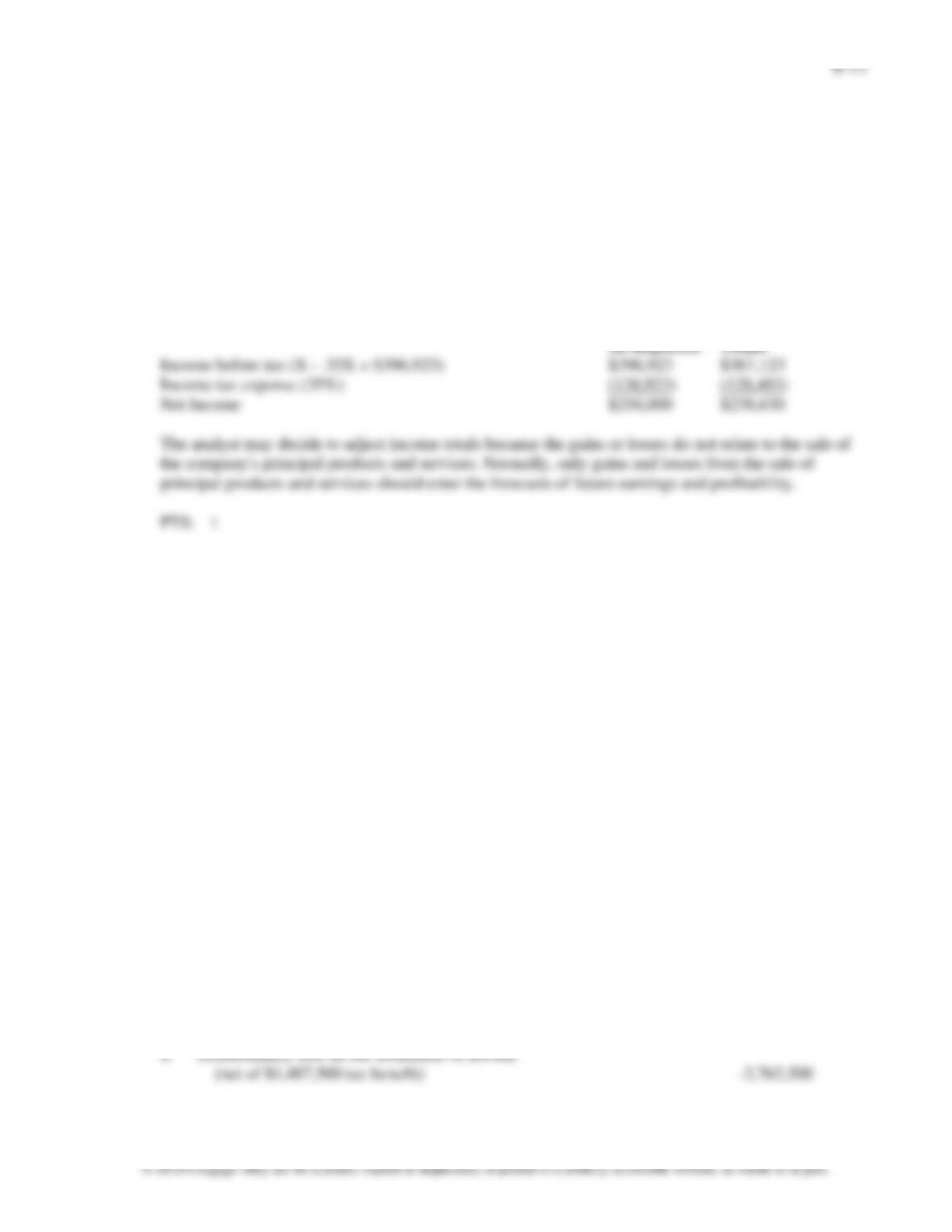
2. Creighton Corp., a textile manufacturer, reported net income of $258,000 in 2012. During 2012
Creighton reported a gain of $29,800 from the sale of three used delivery trucks. The gain was
included as part of income from continuing operations. Assuming that the gain is a one-time event and
that Creighton has an effective tax rate of 35% calculate Creighton’s adjusted net income. Show all of
your calculations for credit.
In addition, discuss why analysts might make an adjustment of this type.
ANS:
Creighton’s income statement:
Adjusted
As Reported Totals
3. First Bank recognized an extraordinary loss from the settlement of a lawsuit with Fifth Street Bank
that it had impeded on a processing patent. The extraordinary loss was in the amount of $4,250,000
and First Bank Corporation has an effective tax rate of 35%. First Bank paid the settlement
immediately and recognized the tax benefit as a receivable to offset the current period’s taxes.
Instructions:
a. Prepare the extraordinary item portion of First Bank Corporation’s financial statement.
b. Using the analytical framework discussed in the text and reprinted below show the effect of
following event on First Bank Corporation’s financial statements.
Analytical Framework:
Shareholders’ Equity
Entry
Assets
=
Liabilities
+
CC
+
AOCI
+
RE
ANS:
6-12
b. Analytical Framework:
4. Many times an analyst will have to make judgments as to whether to include unrealized gains and
losses when assessing earnings persistence and predicting future profitability. Discuss the case for and
the case against including unrealized gains and losses as part of sustainable earnings when examining
earnings persistence and future profitability.
ANS:
The case for including unrealized gains and losses:
The case against including unrealized gains and losses:
5. Healy and Wahlen state that one type of earnings management occurs when managers use judgement
in financial reporting to alter financial reports in order to mislead some stakeholder about the
economic performance of the company. Earnings management is a consequence of a judgement by
management which results in lower economic information content of the financial reports.
Discuss five motives that encourage managers to practice earnings management.
ANS: