3-13
ANS:
1. Adjusting revenues and expenses for changes in non-working capital accounts, for example
2. Discuss operating, investing, and financing cash flows in relation to the various stages of the product
life cycle.
ANS:
3. What is working capital from operations? Discuss what types of firms will have similar net income
and working capital from operations? For which types of firms will net income and working capital
from operations be significantly different?
ANS:
4. For the following types of companies, discuss whether you think their cash flows from operations,
investing, and financing will be positive (the activity provides cash) or negative (the activity uses
cash). Provide support for your answer.
1. Tech Corporation is a developer of computer software for the gaming industry. The company
recently launched its first software title. The company is expanding its operations by hiring additional
developers and administrative staff. The company is not yet profitable, but expects to break even
within two years. Investors view it as having a first mover advantage and have been happy to invest in
the company.
2. Midwest Corporation is a supplier to the agricultural industry. The company is experiencing its
25th year of profitability, but is concerned that sales have contracted for the fifth year in a row.
Midwest prides itself in paying dividends and having no debt on its balance sheet.
3. Semi Inc. manufactures semiconductors. The company has just introduced its ninth new product
and is the leader in market share for the industry. The company continues to invest in research and
development and expand by purchasing competitors. The company has yet to pay dividends, but is
considering it in the future. The company’s largest current asset is cash, due to its high profit margin.
ANS:
5. Cilca Corporation is a supplier to the pulp and paper industry. Selected financial information about
Cilca is listed below:
• Purchased real estate for $440,000 in cash. The cash was borrowed from a bank.
• Sold investments for $400,000.
• Paid dividends of $480,000.
• Issued shares of common stock for $200,000.
• Purchased machinery and equipment for $100,000 cash.
• Paid $360,000 on a bank loan.
• Reduced accounts receivable by $80,000.
• Increased accounts payable $160,000.
Sales for the period were $450,000
Use the above information to calculate Cilca’s:
a. cash used or provided by operating activities
b. cash used or provided by financing activities
ANS:
a. cash used or provided by operating activities:
b. cash used or provided by investing activities
6. Luke Corporation is a manufacturer of home furnishings. Selected financial information about Luke is
listed below:
3-15
• Borrowed $850,000 from a bank.
Purchased equipment for $210,000 in cash.
• Purchase investments for $285,000.
• Received dividends of $51,000 from an investment in Davis Corp.
• Paid dividends of $55,000.
• Issued shares of preferred stock for $500,000.
Repurchased outstanding common shares using $100,000 in cash.
• Purchased land for $100,000 cash.
• Paid $36,000 interest expense on a bank loan.
• Increased Inventories by $320,000
• Increased accounts receivable by $217,000.
• Increased accounts payable $85,000.
Use the above information to calculate Luke’s:
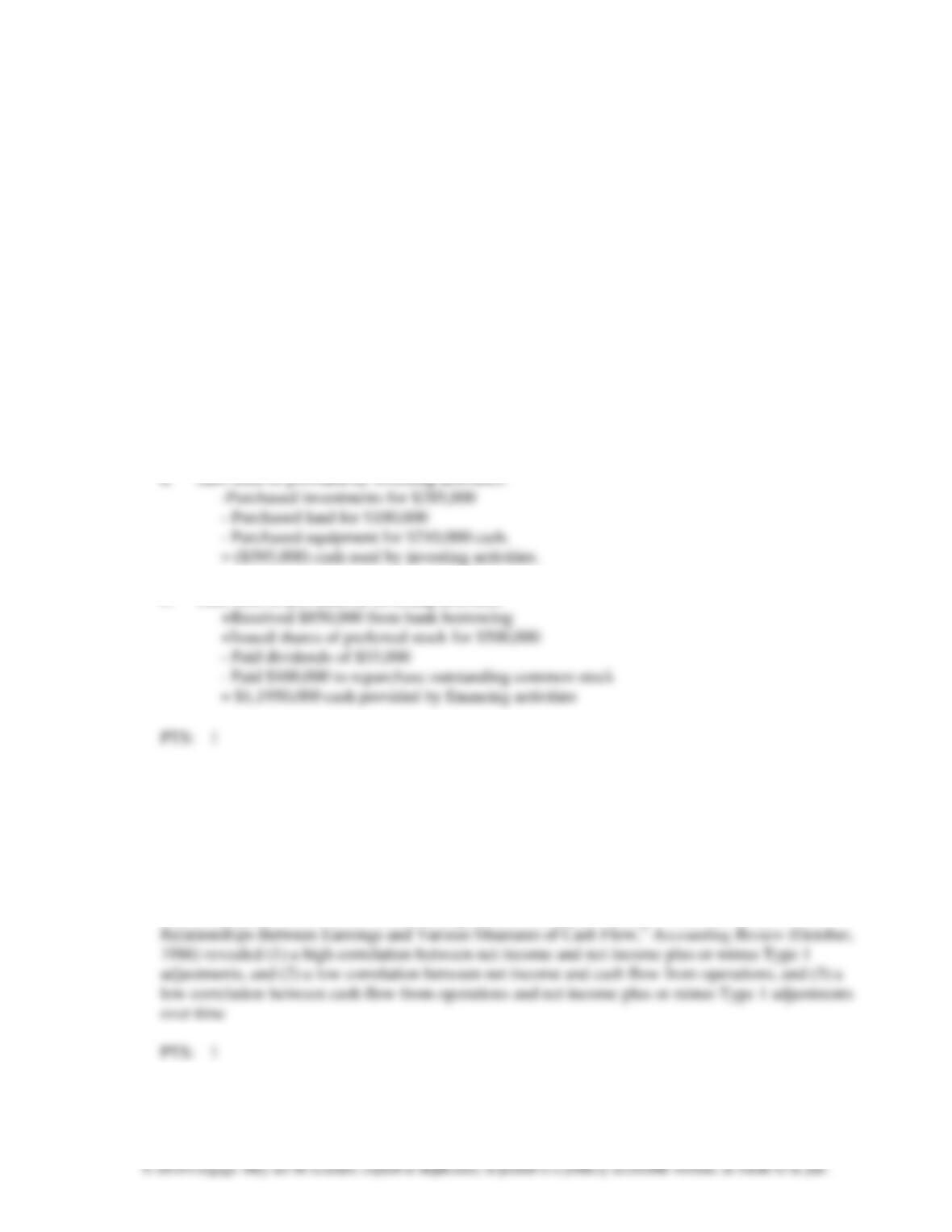
a. cash used or provided by investing activities
b. cash used or provided by financing activities
ANS:
a. cash used or provided by investing activities:
b. cash used or provided by investing activities
7. Discuss the correlations that have been found between net income, net income plus or minus Type 1
adjustments (i.e., adjustments to net income for revenues, expenses, gains, and losses that are
recognized in income and are associated with changes in noncurrent assets, noncurrent liabilities, and
shareholders’ equity, but do not affect cash by the same amounts for the period), and cash flow from
operations.
ANS:
The study by Robert M. Bowen, David Burgstahler, and Lane A. Daley, “Evidence on the
8. Selected financial statement information for Filmco appears below:
3-16
Balance Sheet accounts Jan. 1, 2010 Dec. 31, 2010
Inventory $210,000 $90,000
Accounts Receivable $85,000 $45,000
Income Statement (partial) For the year ended Dec. 31, 2010
Sales $900,000
Cost of Goods Sold $730,000
Gross Profit $170,000
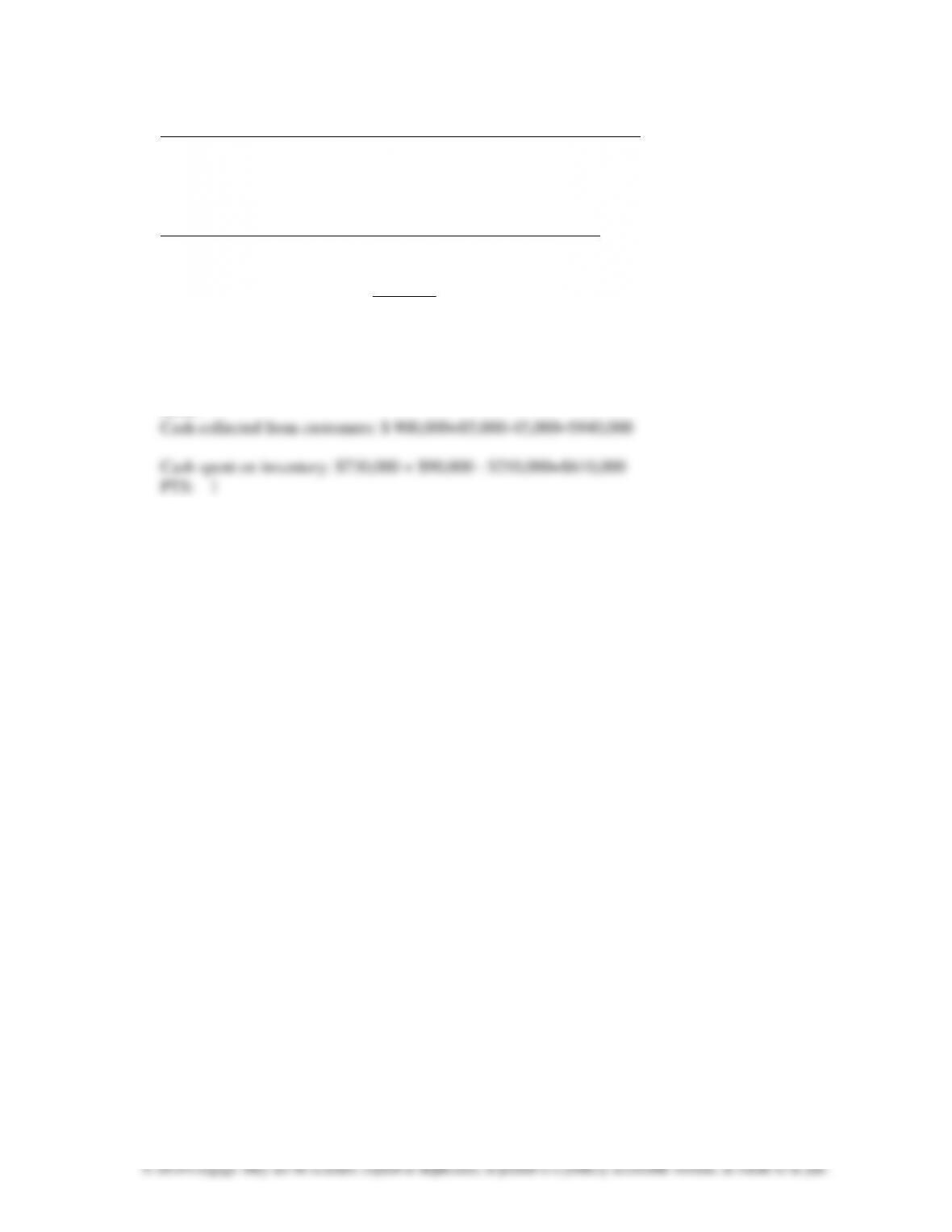
Calculate the amount of cash collected from customers and the amount of cash spent on inventory for
2010 by Filmco.
ANS:
PROBLEM
1. J. Jill is a women’s clothing retailer. The company started as a mail order company and has expanded
into mall department stores. The company now receives approximately half of its revenues from mail
order and half from retail outlets. Over the time period 2010 to 2012, sales increased approximately
25%.
Discuss the relationship between net income, working capital from operations, and cash flow
from operations, and between cash flows from operating, investing, and financing activities over the
three-year period.
CASH FLOW STATEMENT (in thousands)
Cash from operations 12/25/2012 12/27/2011 12/28/2010
Net income 8,706 7,025 18,434
Depreciation & amortization 18,663 16,131 12,672
Net increase (decrease) in assets & liab. 6,696 26,659 10,623
Other adjustments, net 1,396 924 3,996
Net cash provided by (used in) operations 35,461 50,739 45,725
Cash from investments
(Increase) decrease in property & plant -28,784 -34,265 -34,734
Other cash inflow (outflow) -35,434 -1,143 -2,454
Net cash provided by (used in) investing -64,218 -35,408 -37,188
Cash from financing
Issuances (purchases) of equity shares 3,142 870 7,800
Increase (decrease) in borrowings -1,706 -1,648 -1,755
Net cash provided by (used in) financing 1,436 –778 6,045
– – –
Net change cash & cash equivalents -27,321 14,553 14,582
Cash and cash equivalents at start of year 59,287 44,734 30,152
Cash and cash equivalents at year end 31,966 59,287 44,734
3-17
ANS:
Some points that may be addressed:
1. J. Jill is expanding into retail space which results in additional capital expenditures to construct
the interiors of the company’s retail space. From J. Jill’s annual report management estimates that the
2. As sales have increased so has its need for working capital. It is important to ensure that the
3. J. Jill is experiencing a net growth in current operating liabilities (as can be noted in the operating
4. J. Jill is still issuing equity (but to a lesser degree than in 2012 and 2011) and paying down debt.
2. Olive Corporation manufactures food processing equipment. Use Olive Corporation’s two most recent
balance sheets and most recent income statement to prepare a statement of cash flows for 2010. The
company paid dividends of $6,250 during 2010.
Olive Corporation
Balance Sheet
As of December 31, 2010 2009
Assets:
Cash and cash equivalents $41,900 $25,000
Accounts Receivable 24,000 6,250
Inventory 30,000 36,000
Current Assets 95,900 67,250
Equipment 42,000 38,500
Less: Accumulated depreciation -14,000 -7,000
Land 25,000 10,000
Total assets $148,900 $108,750
Liabilities
Accounts Payable $17,500 $22,500
Accrued Salaries Payable 5,500 8,000
Rent Expense Payable 2,200 1,000
Income Tax Payable 6,900 4,000
Current Liabilities 32,100 35,500
Long-term note payable 50,000 30,000
Total Liabilities 82,100 65,500
Stockholders’ Equity:
Common stock 42,000 30,000
Retained earnings 24,800 13,250
3-18
Total liabilities and stockholders’ equity $148,900 $108,750
Olive Corporation
Income Statement
For the year ended December 31, 2010
Revenues $147,000
Cost of goods sold -84,000
Gross Profit $63,000
Operating Expenses
Depreciation expense -7,000
Salary expense -14,600
Insurance Expense -2,500
Rent Expense -10,000
Interest Expense -4,200
Total Operating Expenses -38,300
Income from Operations 24,700
Income Tax Expense -6,900
Net income $17,800
ANS:
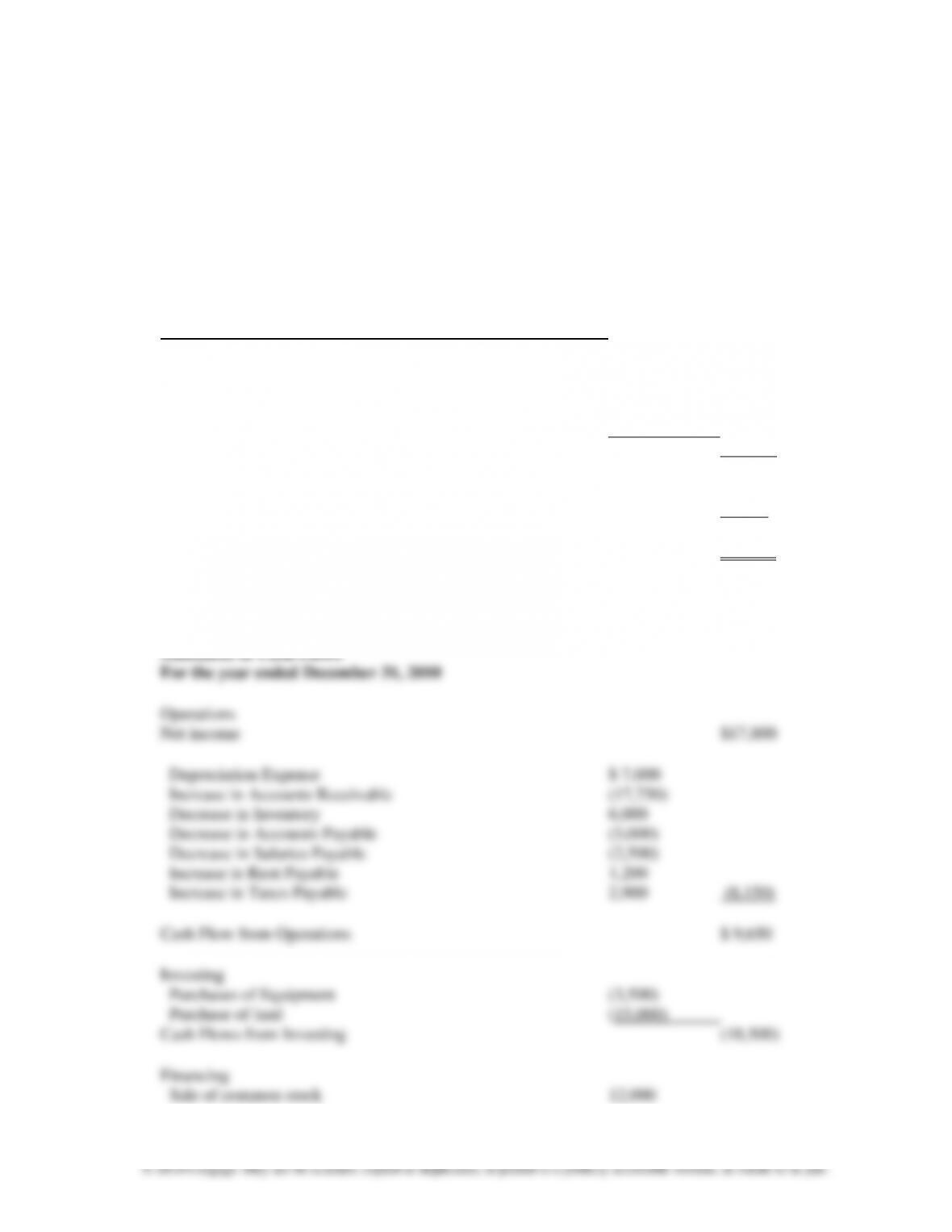
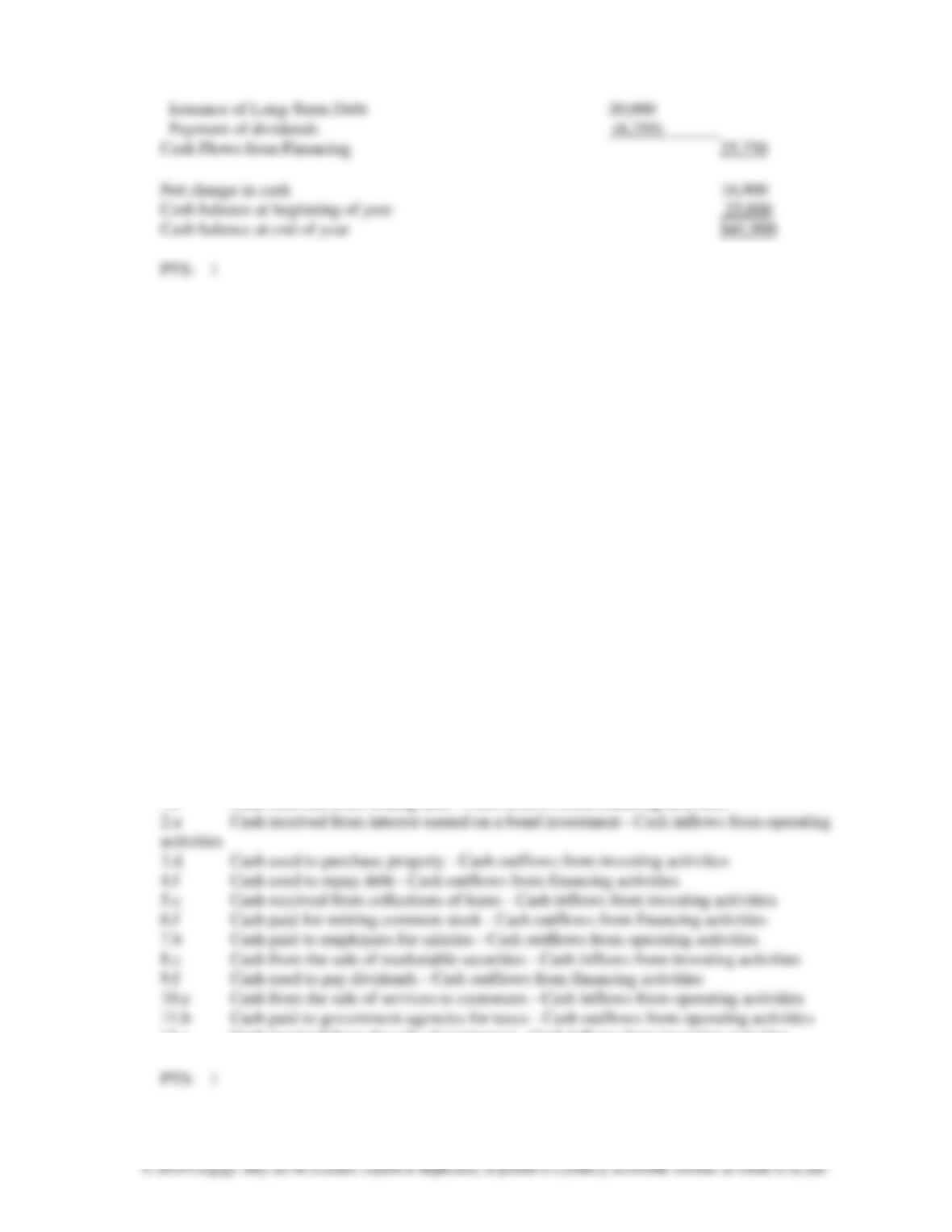
Olive Corporation
Statement of Cash Flows
3-19
© 2018 Cengage. May not be scanned, copied or duplicated, or posted to a publicly accessible website, in whole or in part.
3. Listed below is a list of cash inflows and cash outflows for Toggle Inc.
1. Cash received from issuing debt
2. Cash received from interest earned on a bond investment
3. Cash used to purchase property
4. Cash used to repay debt
5. Cash received from collections of loans
6. Cash paid for retiring common stock
7. Cash paid to employees for salaries
8. Cash from the sale of marketable securities
9. Cash used to pay dividends
10. Cash from the sale of services to customers
11. Cash paid to government agencies for taxes
12. Cash received from the sale of equipment
For each item indicate where it should appear on Toggle’s statement of cash flows. Select from:
a. Cash inflows from operating activities
b. Cash outflows from operating activities
c. Cash inflows from investing activities
d. Cash outflows from investing activities
e. Cash inflows from financing activities
f. Cash outflows from financing activities
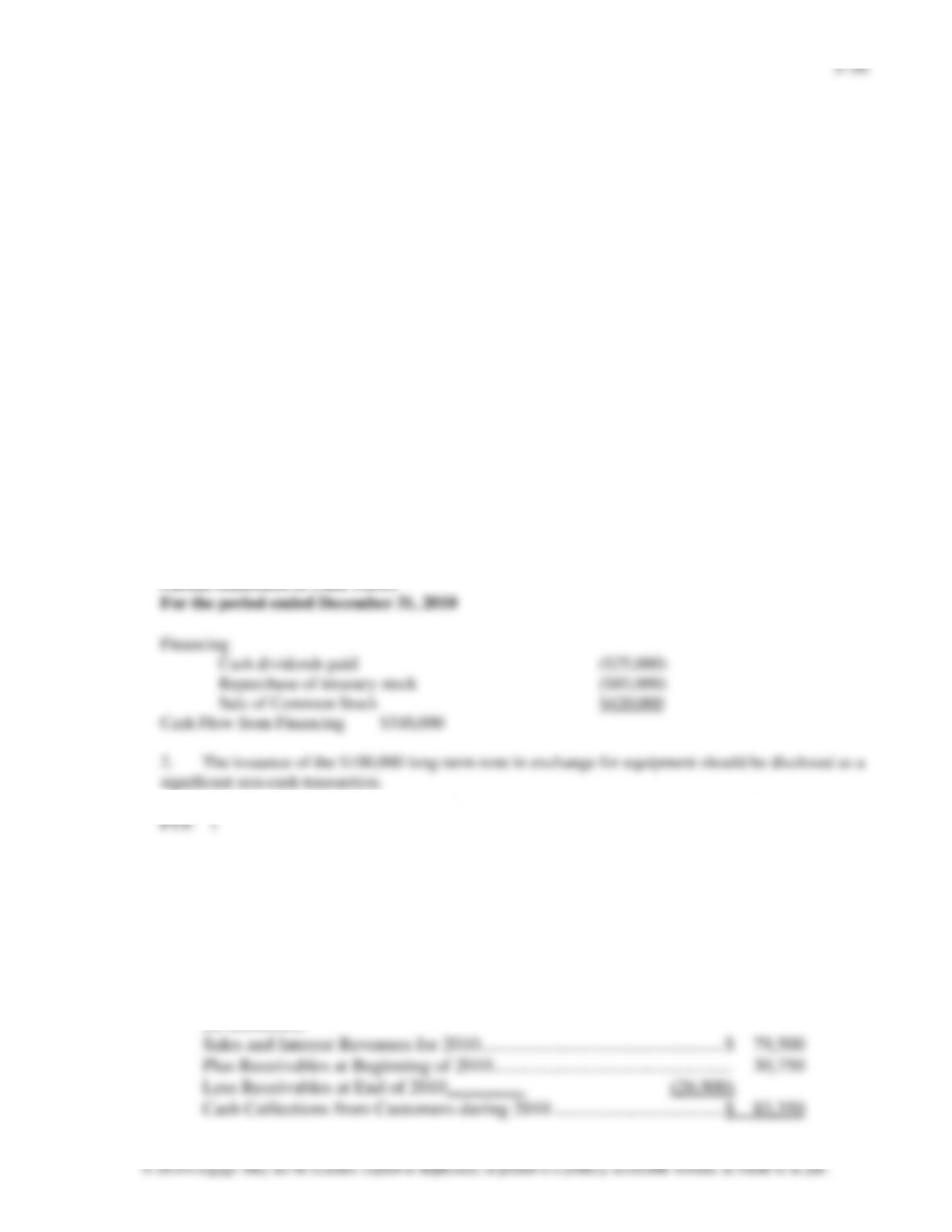
ANS:
1.e Cash received from issuing debt – Cash inflows from financing activities
12.c Cash received from the sale of equipment – Cash inflows from investing activities
4. Plano Corporation presented the following account balances for 2010 and 2009:
December 31, 2010 December 31, 2009
Dividends payable $ 20,000 $ 25,000
Additional Paid-in-Capital $580,000 $230,000
Treasury Stock $185,000 $100,000
Equipment $800,000 $700,000
Accumulated Depreciation $225,000 $140,000
Common Stock $630,000 $560,000
Long-Term Notes Payable $225,000 $125,000
Additional information:
1. Cash dividends of $20,000 were declared on December 15, 2010, payable on January 15, 2011.
2. The company issued 70,000 shares of $1 par value common stock during 2010.
3. The company repurchased 34,000 shares of its own common stock during the period. No
treasury stock was sold during the period.
4. Additional equipment was purchased by issuing a $100,000 long-term note payable.
Required:
1. Prepare the financing section of Plano’s 2010 statement of cash flows.
2. Indicate if any of the events will be reported as a significant noncash transaction.
ANS:
1. Plano Corporation
Partial Statement of Cash Flows
5. Clarion Industries manufactures computer equipment and provides financing for purchases by its
customers. Clarion reported sales and interest revenues of $79,500 million for 2010. The
balance sheet showed current and noncurrent receivables of $ 30,750 million at the beginning
of 2010 and $ 26,900 million at the end of 2010. Compute the amount of cash collected
from customers during 2010.
ANS:
(in $millions)
© 2018 Cengage. May not be scanned, copied or duplicated, or posted to a publicly accessible website, in whole or in part.
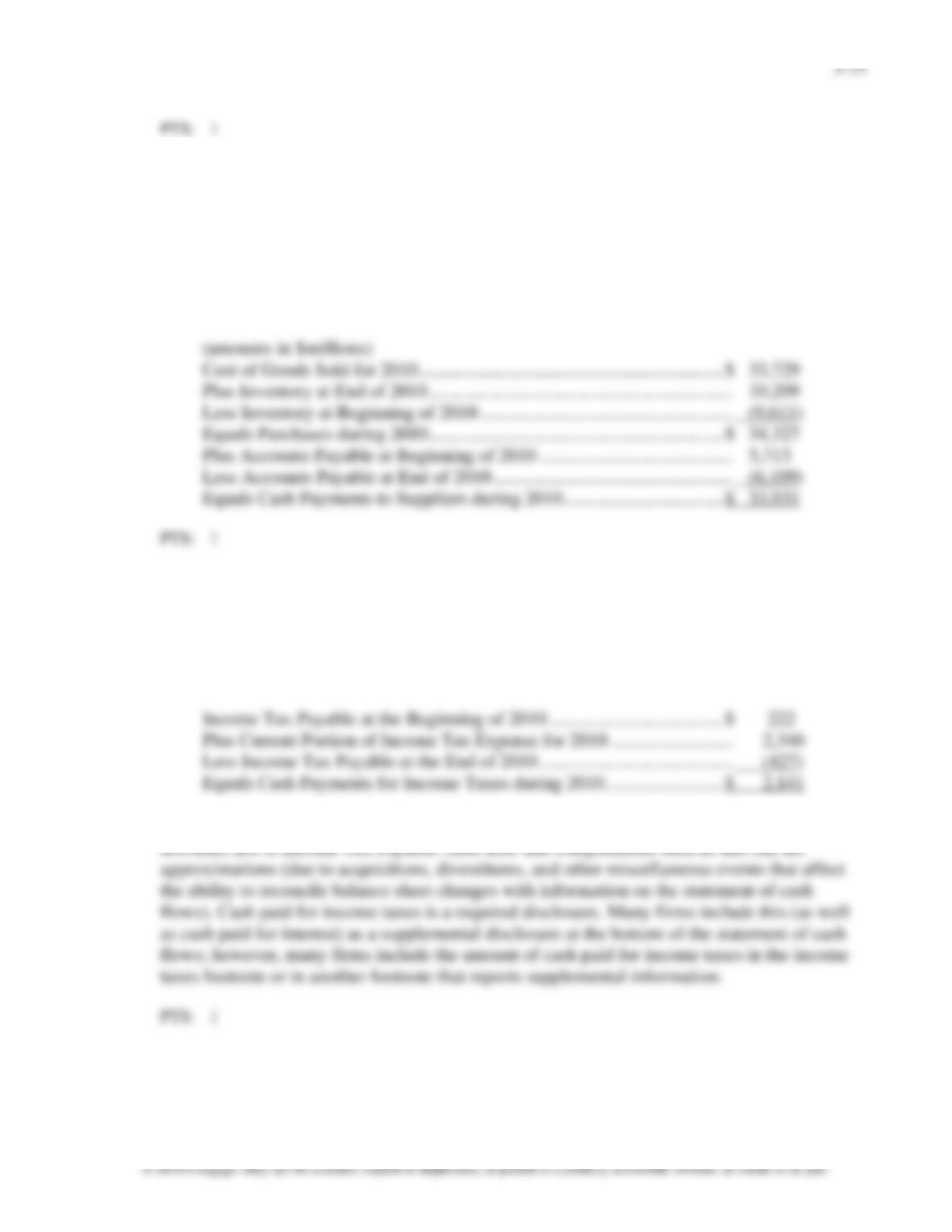
6. Jarrett Company, home improvement retailer, reported cost of goods sold of $33,729 million for the
fiscal year ended January 30, 2010. It reported merchandise inventories of $9,611 million at the
beginning of fiscal 2010 and $10,209 million at the end of fiscal 2010. It reported
accounts payable to suppliers of $5,713 million at the beginning of fiscal 2010 and $6,109
million at the end of fiscal 2010. Compute the amount of cash paid to merchandise suppliers
during fiscal 2010.
ANS:
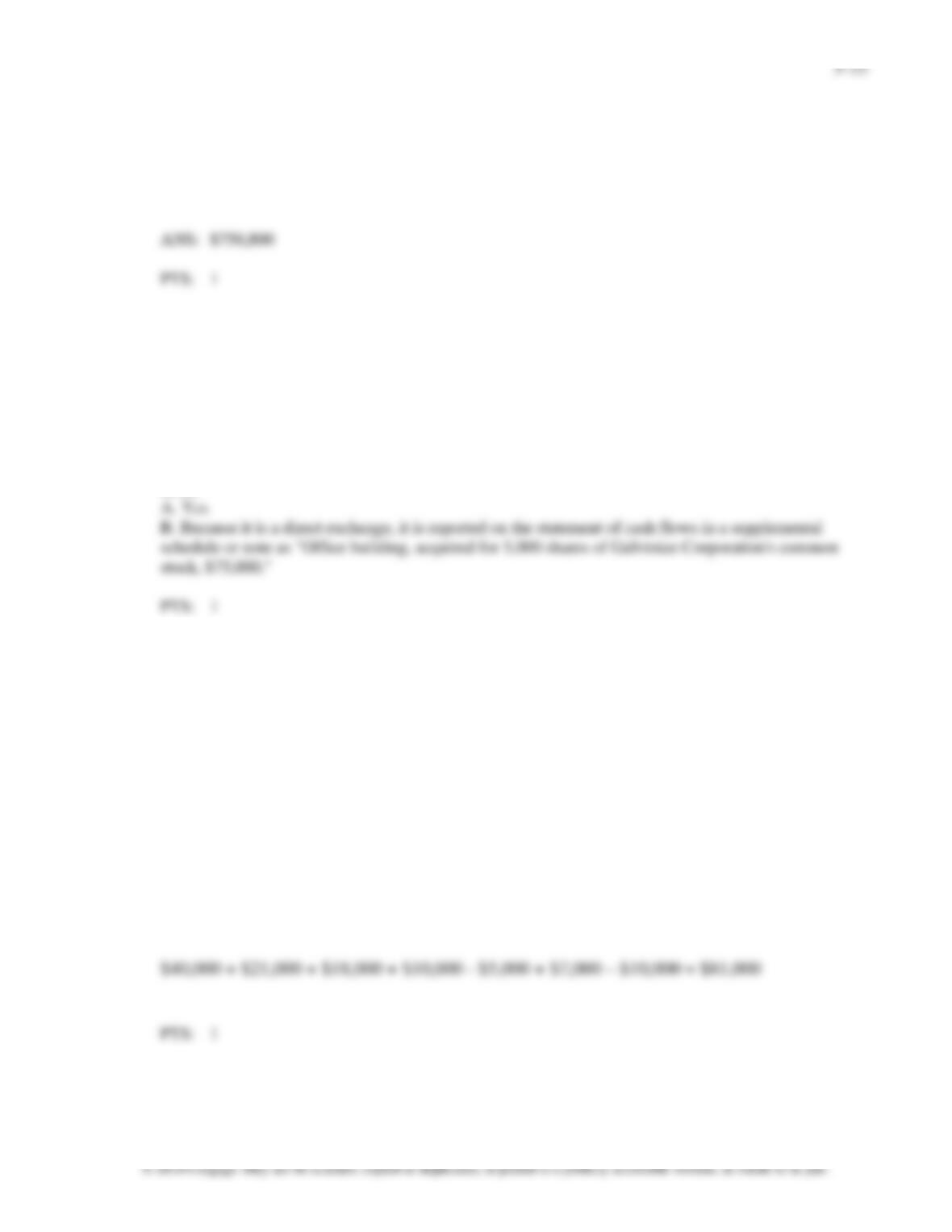
7. Krenzer, Inc., a financial company, reported income tax expense of $2,648 million for 2010,
comprising $2,346 million of current taxes and $302 million of deferred taxes. The balance sheet
showed income taxes payable of $222 million at the beginning of 2010 and $427 million at the end of
2010. Compute the amount of income taxes paid in cash during 2010.
ANS:
Note that the deferred portion of income taxes expense relates to various deferred income tax
8. In 2010, Lamar Industries reported the following: Sales $700,000; Accounts receivable
beginning of 2010 $450,000; Accounts receivable end of 2010 $369,200; Depreciation
expense $55,400; Rent Expense $30,000. What is the net cash provided (used) by operating
activities
9. While preparing a statement of cash flows, you encountered the following transaction:
February 1, 2011: Galvinize Corporation acquired a small office building in exchange for
5,000 shares of its own common stock; par value $10 per share; market value $15 per share.
A. Should this transaction be shown on the statement of cash flows?
B. Why or why not?
ANS:
10. Bankers Company reported net income of $40,000, which included depreciation expense and
depletion expense of $21,000 and $18,000, respectively. The following changes also occurred
during 2010:
Inventory $10,000 decrease
Accounts payable 5,000 decrease
Notes payable (long-term) 15,000 decrease
Income taxes payable 7,000 increase
Accounts receivable 10,000 increase
Required:
Calculate cash flows from operating activities.
ANS:
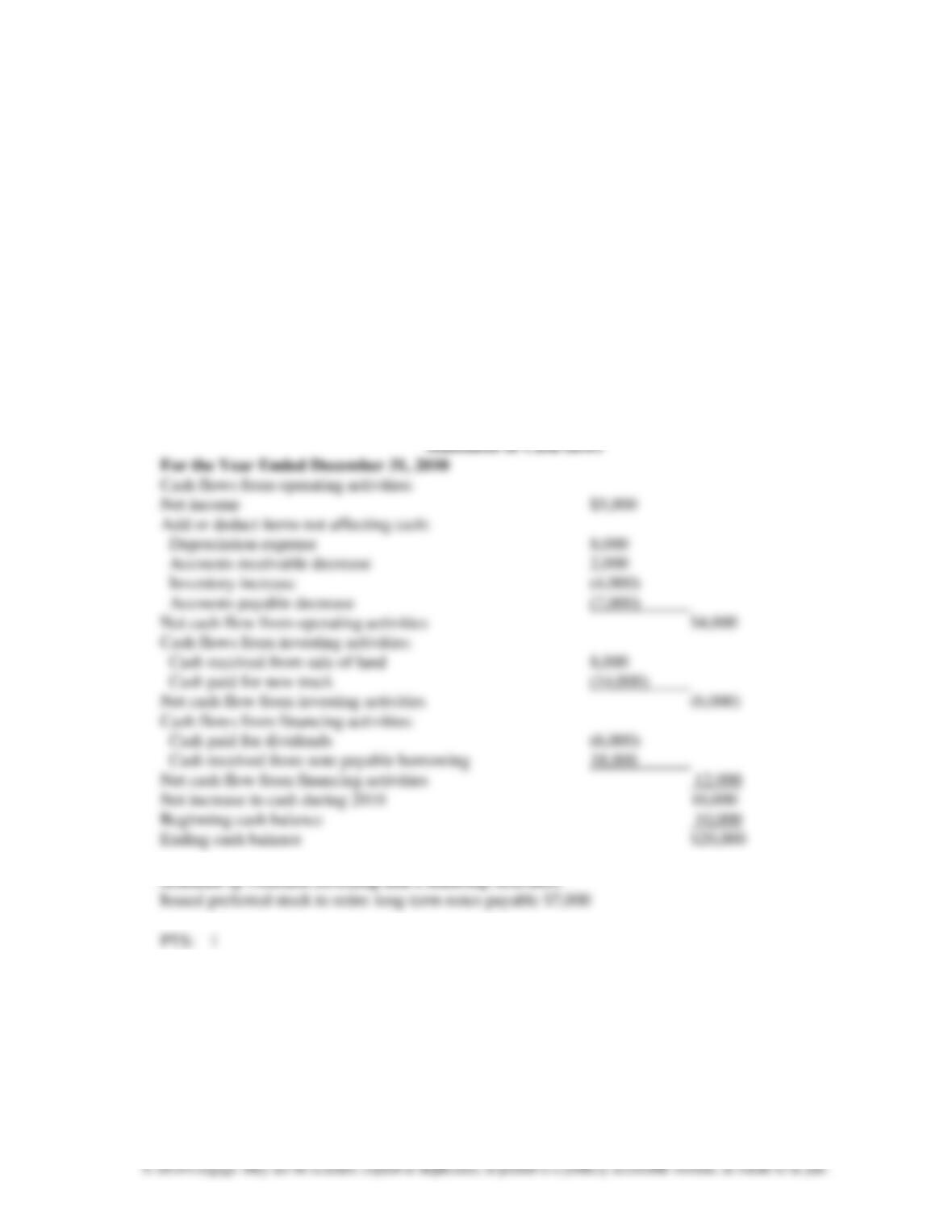
11. Use the following information to prepare a statement of cash flows (indirect method) for Sink
Industries for the year ended December 31, 2010:
3-23
Net income for the year 2010 was $5,000. Accounts receivable decreased $2,000, while
inventories increased $4,000, and accounts payable decreased $7,000. Depreciation expense
included in net income was $8,000.
During the year, a piece of land held for future expansion was sold for its book value of
$8,000 and a new service truck was purchased for $14,000.
The company borrowed $18,000 on a two-year note from the bank. Dividends of $6,000 were
paid in cash. Preferred stock was issued to retire $7,000 of long-term notes payable.
The beginning cash balance was $10,000 and the ending balance was $20,000.
ANS:
Sink Industries