
12-1
Chapter 12—Valuation: Cash-Flow-Based Approaches
1. Which of the following is not a problem with using a dividend-based valuation formula?
a. Dividends are arbitrarily established.
b. Dividends represent a transfer of wealth to shareholders.
c. Some firms do not pay a regular periodic dividend.
d. It is a challenge to forecast the final liquidating dividend.
2. The conceptual framework for free cash flows separates the balance sheet equation into the following
categories:
a. CA + LT A = CL + LT L + SE
b. OA + FA = OL + FL + SE
c. OA + FA = OL + FL + OSE + FSE
d. Non-FA + FA = Non-FL + FL + SE
3. The conceptual framework for free cash flows separates all assets and liabilities into the following
categories:
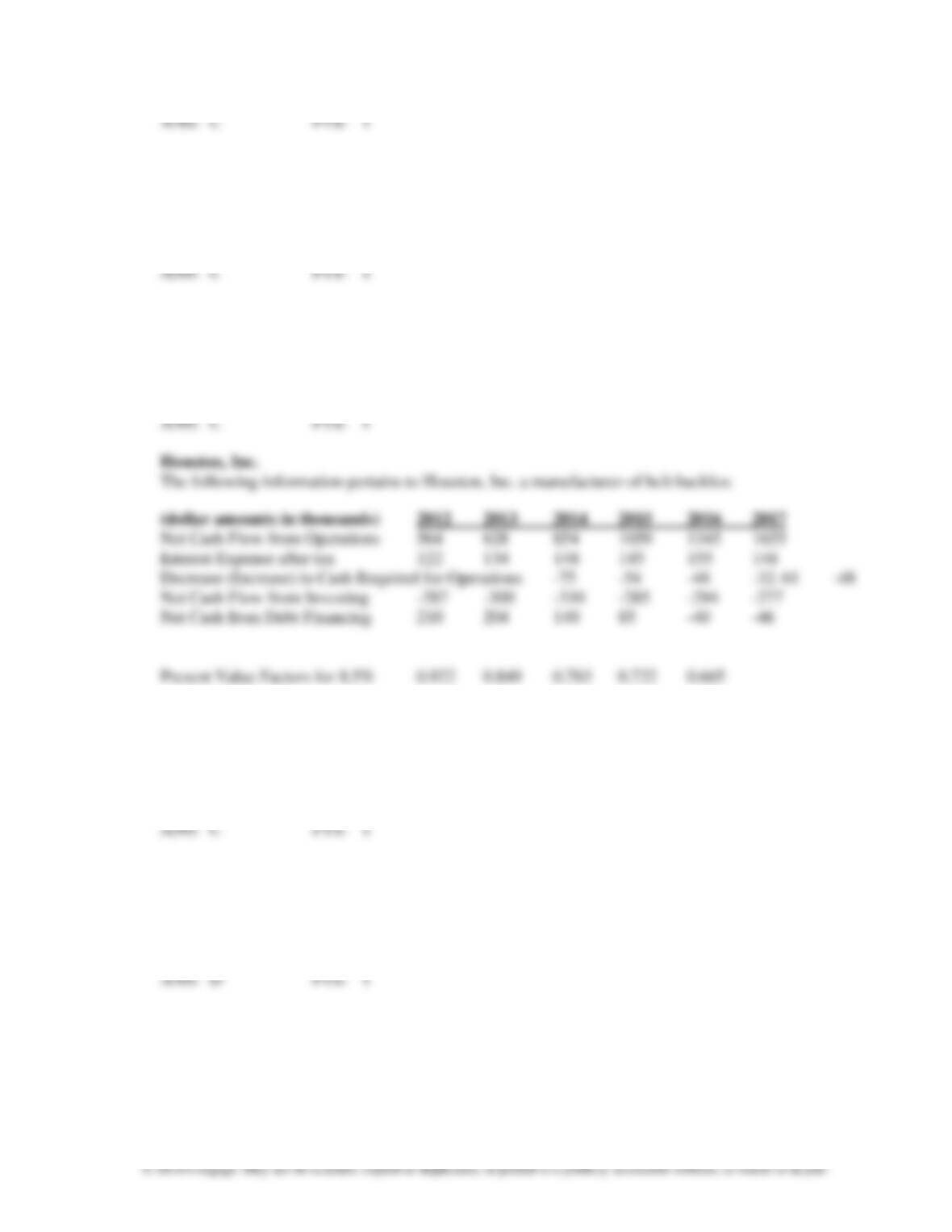
a. Current and non-current
b. Monetary and non-monetary
c. Operating and non-operating
d. Operating and financial
4. Starting with net cash flow from operations and adjusting for capital expenditures and dividends
equals:
a. free cash flows for all debt and equity capital stakeholders.
b. free cash flow.
c. free cash flows to common equity capital shareholders.
d. free cash flow from operations.
5. When calculating free cash flows to common equity shareholders, financing activities do not include:
a. Debt cash flows
b. Adjustments for capital expenditures
c. Adjustments for Preferred stock cash flows
d. Financial asset cash flows
6. If an analyst wants to value a potential investment in the common stock equity in a firm, the relevant
cash flows the analyst should use are:
a. free cash flow from operations.
b. free cash flows for all debt and equity capital stakeholders.
c. free cash flows to common equity shareholders.

12-2
d. cash flow from operations.
7. If an analyst wants to value a potential investment in the net operating assets of a division of another
firm, the relevant cash flows the analyst should use are:
a. free cash flow from operations.
b. free cash flows for all debt and equity capital stakeholders.
c. free cash flows to common equity shareholders.
d. cash flow from operations.
8. If an analyst wants to value a potential investment in the common stock equity of a firm, the analyst
should discount the projected free cash flows at the:
a. required return on equity capital.
b. weighted average cost of capital.
c. risk-free rate.
d. market risk premium.
9. If an analyst wants to value a potential investment in the net operating assets of a division of another
firm, the analyst should discount the projected free cash flows at the:
a. cost of debt capital.
b. cost of equity capital.
c. weighted average cost of capital.
d. risk-free rate.
10. A disadvantage of the free cash flow valuation method is:
a. The terminal value tends to dominate the total value in many cases.
b. The projection of free cash flows depends on earnings estimates.
c. The free cash flow method is not rigorous.
d. The free cash flow method is not used widely in practice.
11. Continuing free cash flows represent:
a. the cash flows remaining after deducting cash flows attributable to debt holders.
b. the free cash flows after the point at which the firm has settled into a long-run steady-state growth
rate.
c. all sustainable free cash flows.
d. all after-tax free cash flows.
12. Steady-state growth in free cash flows could be driven by long-run expectations for growth attributable
to:
a. interest rates
b. national exports
c. general economic productivity
d. balance of payments
12-3
13. Financial assets include all of the following except:
a. excess cash
b. short term investments
c. intangible assets
d. long-term investments
14. Financial liabilities include all of the following except:
a. mortgages payable
b. current maturities of long-term debt
c. accrued taxes
d. bonds payable
15. What is Houston’s free cash flow for all debt and equity holders for year 2012?
a. $564
b. $399
c. $324
d. $202
16. What is Houston’s free cash flow for common equity holders for year 2012?
a. $564
b. $399
c. $324
d. $412
17. All of the following are logical steps that enable the analyst to determine reliable estimates of value
except:
a. Understand the economics of the industry
b. Assess the particular firm’s strategy
c. Evaluate the quality of the firm’s accounting

12-4
d. Derive a single point estimate of value for a share’s current price
18. Free cash flow is calculated as net cash provided by operating activities less:
a. dividends.
b. capital expenditures and depreciation.
c. capital expenditures.
d. capital expenditures and dividends.
19. Plough Corporation reports the following information:
Net cash provided by operating activities $300,000
Average current liabilities 150,000
Average long-term liabilities 100,000
Dividends paid 80,000
Capital expenditures 140,000
Payments of debt 35,000
Plough’s free cash flow is:
a. $80,000
b. $105,000
c. $45,000
d. $10,000
20. Sun Corporation reports the following information:
Net cash provided by operating activities $255,000
Average current liabilities 150,000
Average long-term liabilities 100,000
Dividends paid 60,000
Capital expenditures 110,000
Payments of debt 35,000
Sun’s free cash flow is:
a. $195,000
b. $145,000
c. $50,000
d. $85,000
21. If a firm’s stock returns co-vary identically with returns to a market-wide portfolio, then its market
beta from such a regression is:
a. equal to zero. c. less than one.
b. equal to one. d. greater than one.
22. Nonsystematic risk factors would include all of the following except:
a. the sustainability of the firm’s strategy
b. the firm’s ability to generate revenue growth
c. the firm’s ability to control expenses
d. unemployment levels
23. An equity security with systematic risk equal to the average amount of systematic risk of all equity
securities in the market:
a. has a market beta equal to one.
b. should expect to earn the same rate of return as the average stock in the market portfolio.
c. gives no insight into the risk premium of stock.
d. Both a and b are correct.
COMPLETION
1. Free cash flows for common equity shareholders are the cash flows specifically available to the
common shareholders after making all capital expenditures,
_____________________________________________ and
____________________________________________________________.
2. The risk-adjusted discount rate used to compute the present value of all the projected free cash flows
for common equity shareholders equals the
_______________________________________________________.
3. If the objective is to value operating assets net of operating liabilities of a firm then the appropriate
free cash flow measure to be used is
______________________________________________________________________.
4. The cash-flow-based valuation approach measures and values the cash flows that are “free” to be
________________________________________ unencumbered by necessary reinvestments in
operating assets or required payments to debt holders.
12-6
© 2018 Cengage. May not be scanned, copied or duplicated, or posted to a publicly accessible website, in whole or in part.
5. Net cash flow from operations ________________ dividends equals_______________________
6. If cash flow projections include the effect of inflation then the discount rate used should be a(n)
____________________ rate.
7. If a firm generates a rate of return on __________________________________________________
equal to the discount rate used by the investor then it does not matter if an analyst uses cash flows to
the investor or cash flows to the firm.
8. The present value of future free cash flows valuation method focuses on free cash flows, a base that
economists argue has more economic meaning than ____________________.
9. One advantage of the free cash flow valuation method is cash is the medium of exchange and therefore
is a fundamental source of ________________________
10. Changes in general price levels due to inflation or deflation cause the
______________________________ of the monetary unit to increase or decrease ______________
11. The forecasting and valuation process is particularly difficult for ______________________________
when the near term free cash flows tend to be negative.
12. Steady-state growth in ___________________________________ could be driven by long-run
expectations for growth attributable to economy-wide inflation, general economic productivity, the
population, or long-run growth in industry’s sales.
13. For most firms, ______________________________ include cash and short-term investment
securities, accounts receivable, inventory, property, plant and equipment, intangible assets and
investments in affiliated companies.
14. ________________________________________ typically include accounts payable, accrued
expenses, accrued taxes, deferred taxes, pension obligations and other retirement benefit obligations.
15. Even in relatively efficient securities markets, ______ is observable but ______ is not; therefore,
______ must be estimated.
16. ________________ is an estimate of systematic risk based on the degree of covariation between a
firm’s stock returns and an index of stock returns for all firms in the market.
17. The analyst can use expectations of the dividends to be paid to the investor or the free cash
flows to be generated by the firm (that will ultimately be paid to the investor) as equivalent
approaches to measure the ____________ expected payoffs to shareholders.
SHORT ANSWER
1. Provide the rationale for using expected free cash flow in valuation.
© 2018 Cengage. May not be scanned, copied or duplicated, or posted to a publicly accessible website, in whole or in part.
2. Cash serves as a measurable common denominator for comparing the future benefits of
alternative investment opportunities.
2. What three elements are needed to value a resource when using cash flows?
ANS:
1. The expected future free cash flows over the forecast horizon.
3. When should an analyst use nominal cash flows and when should an analyst use real cash flows?
ANS:
Nominal cash flows should be used when the projected free cash flows include the effects of changes
4. Starting with free cash flows from operations, discuss how an analyst would measure free cash flows
to common equity shareholders.
ANS:
5. Discuss under which scenario it is appropriate to use free cash flows for all debt and equity capital
stakeholders.
ANS:
Analysts should use free cash flows for all debt and equity capital stakeholders when the objective is to
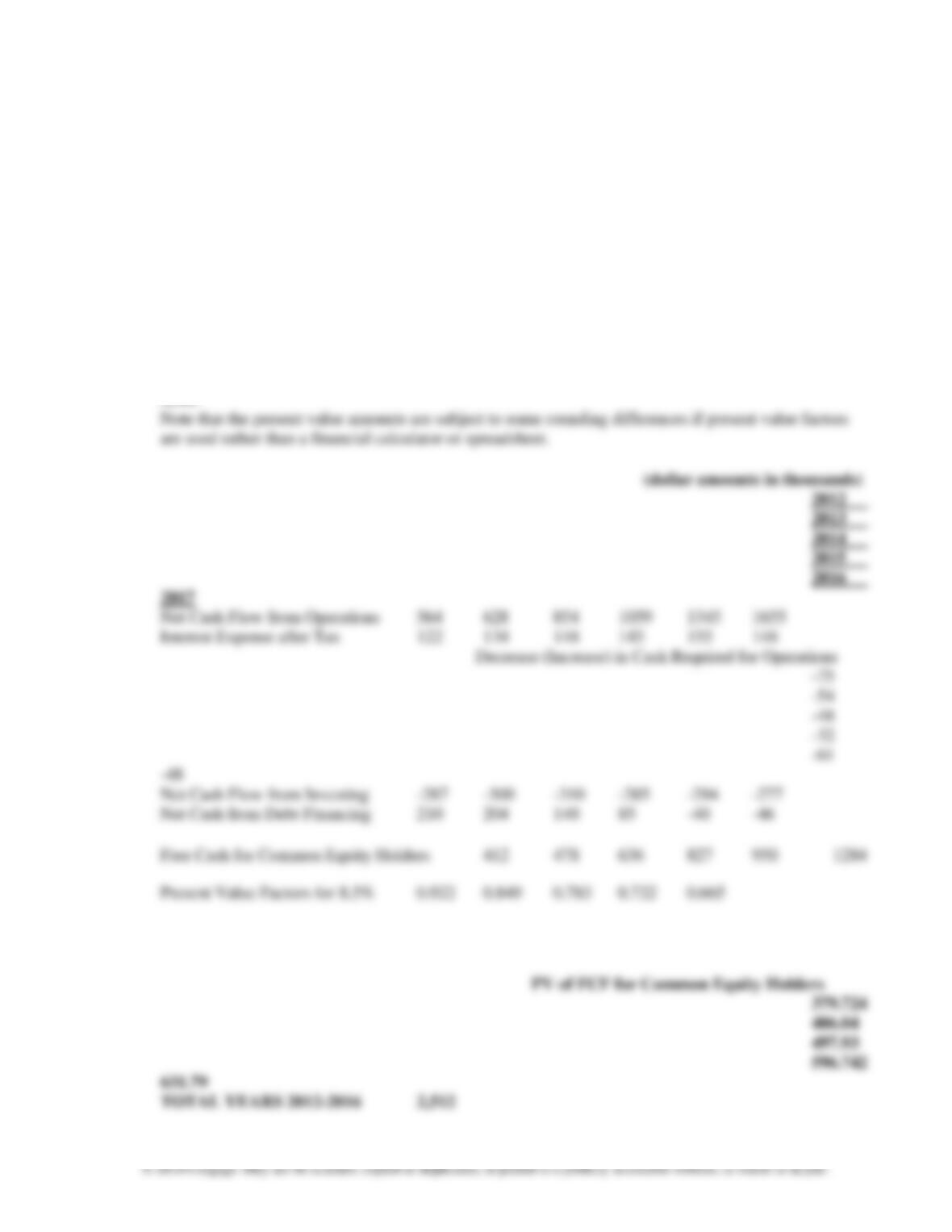
6. Shady Sunglasses operates retail sunglass kiosks in shopping malls. Below is information related to the
company:
(dollar amounts in thousands) 2012 2013 2014 2015 2016 2017
Net Cash Flow from Operations 564 628 854 1059 1345 1655
Interest Expense after Tax 122 134 148 145 155 148
Decrease (Increase) in Cash Required for Operations
12-9
–75
–54
–48
–32
–61
–48
Net Cash Flow from Investing –287 –300 –310 –285 –294 –277
Net Cash from Debt Financing 210 204 140 85 –40 –46
Present Value Factors (Re = 8.5%) 0.922 0.849 0.783 0.722 0.665
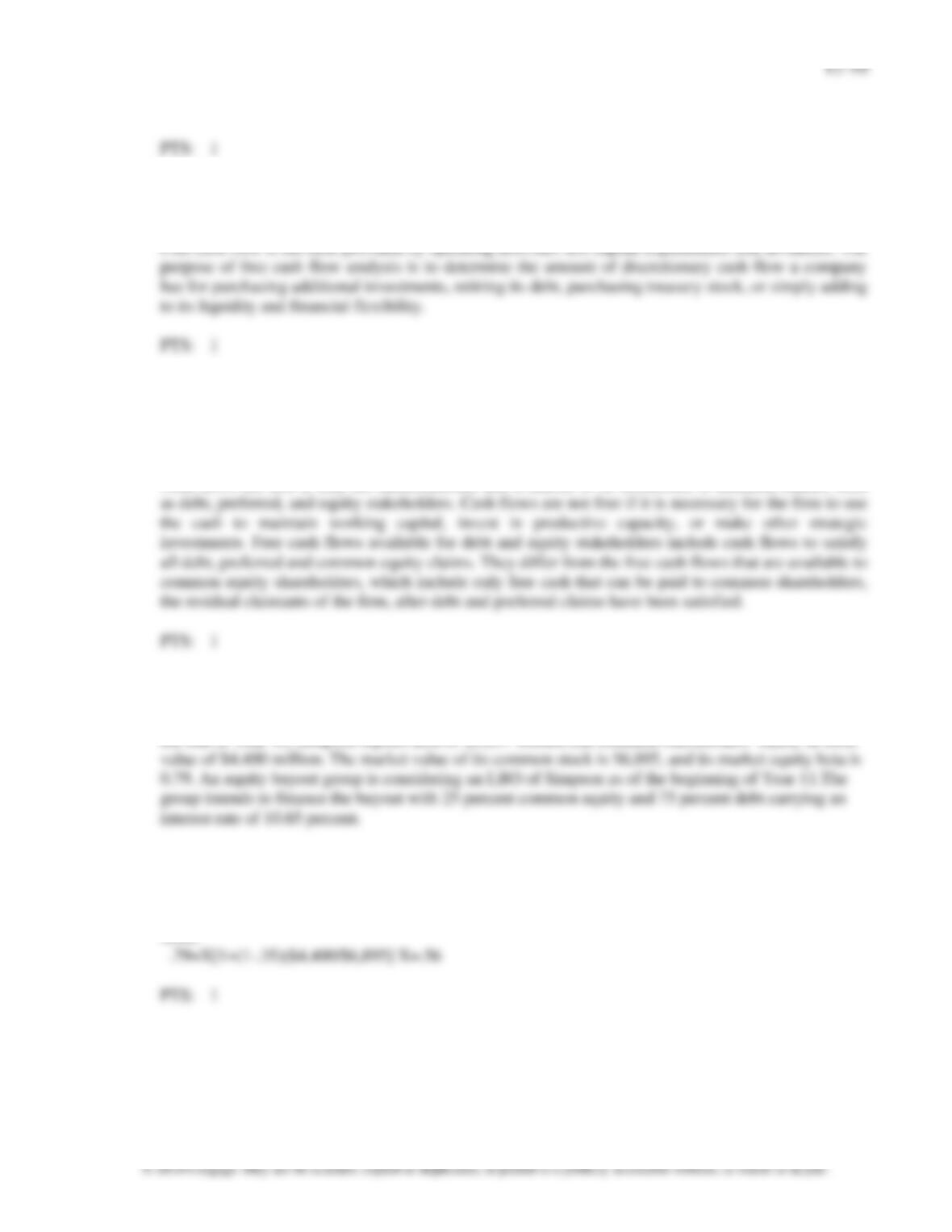
Using a five-year forecast horizon, compute the sum of the present value of free cash flows accruing to
common equity holders for years 2012 to 2016.
ANS:
© 2018 Cengage. May not be scanned, copied or duplicated, or posted to a publicly accessible website, in whole or in part.
7. What is the purpose of a free cash flow analysis?
ANS:
Free cash flow is net cash provided by operating activities less capital expenditures and dividends. The
8. Explain “free” cash flows. Describe which types of cash flows are free and which are not. How do free
cash flows available for debt and equity stakeholders differ from free cash flows available for common
equity shareholders?
ANS:
Cash flows are free if they are unencumbered and available to be distributed to financial claims, such
Simpson Department Store
Simpson Department Stores operates retail department store chains throughout the United States. At
the end of Year 10, Simpson reports debt of $5,897 million and common shareholders’ equity at book
9. Regarding the equity buyout, compute the unlevered market equity (asset) beta of Simpson before
consideration of the LBO. Assume that the book value of the debt equals its market value. The income
tax rate is 35 percent.
ANS:
10. Regarding the equity buyout, compute the cost of equity capital with the new capital structure that
results from the LBO. Assume a risk-free rate of 3.75percent and a market risk premium of 5.0
percent.
12-11
© 2018 Cengage. May not be scanned, copied or duplicated, or posted to a publicly accessible website, in whole or in part.
ANS:
Revised Equity Beta X=.56[1+(1-.35)(.75/.25)] X=1.65
X = .046 + (2.27 x .06) Revised Cost of Equity Capital X=.0375+(1.65x.05) X=.12
X = .182
PTS: 1
11. Regarding the equity buyout, compute the weighted average cost of capital of the new capital
structure.
12. Currently, financial reporting does not take into account changes in prices, either at the general level
or at the specific level. Many analysts believe that not taking price changes into account distorts the
meaningfulness of financial reports. How do changing prices affect financial reports?
ANS:
Measuring Unit Problem
Changes in the general level of prices in an economy (as measured by the prices of a broad basket of
Valuation Problem
Changes in the specific prices of individual assets and liabilities (for example, inventories, fixed
PROBLEM
1. Below is information from the statement of cash flow and income statement for Garland Products, Inc.
for 2012 and 2011. Marketable securities represent investments of excess cash that Garland Products
does not need for operations. Garland Products’ tax rate is 35%.
Cash Flow Statement
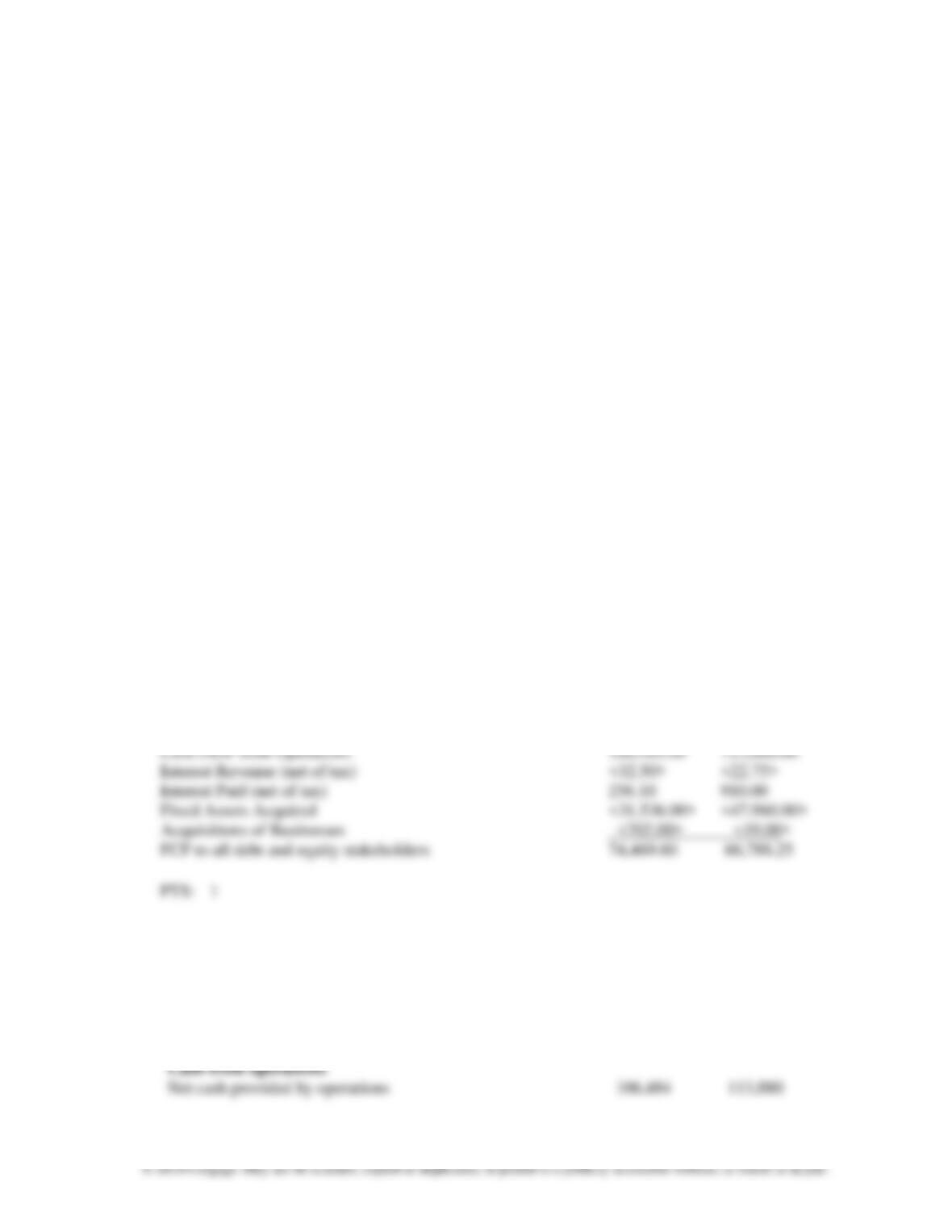
12-12
(in thousands)
12/30/2012 12/30/2011
Cash from operations
Net cash provided by operations 106,484 113,880
Cash from investments
(Increase) decrease in property & plant -31,536 -47,960
Acquisition (disposition) of subsidiaries or other business –702 –19
Increase (decrease) in marketable securities -18,825 380,737
Net cash provided by (used in) investing -51,063 332,758
Cash from financing
Issuances (purchases) of equity shares –370 -434,570
Issuances (repayment) of debt – –
Increase (decrease) in bank, or other borrowings -25,000 25,000
Dividends, other distributions -29,377 -37,202
Net cash provided by (used in) financing -54,747 -446,772
Net change cash & cash equivalents 674 –134
Cash and cash equivalents at start of year 3,255 3,389
Cash and cash equivalents at year-end 3,929 3,255
Interest Revenue 50 35
Interest Paid 394 1400
Using the above information calculate the amount of free cash flows to all debt and equity capital
stakeholders for Garland Products for year 2012 and 2011.
ANS:
2. Below is information from the statement of cash flow and income statement for Garland Products, Inc.
for 2012 and 2011. Marketable securities represent investments of excess cash that Garland Products
does not need for operations. Garland Products’ tax rate is 35%.
Cash Flow Statement
(in thousands)
12/30/2012 12/30/2011