11-1
Chapter 11—Risk-Adjusted Expected Rates of Return and the Dividends Valuation
Approach
MULTIPLE CHOICE
1. Which of the following is not a problem with using a dividend-based valuation formula?
a. Dividends are arbitrarily established.
b. Dividends represent a transfer of wealth to shareholders.
c. Some firms do not pay a regular periodic dividend.
d. It is a challenge to forecast the final liquidating dividend.
Zonk Corp.
The following data pertains to Zonk Corp., a manufacturer of ball bearings (dollar amounts in
millions):
2. Assuming that riskless rate is 4.6% and the market premium is 7.3%, calculate Zonk’s cost of equity
capital:
a. 10.4%
b. 7.69%
c. 11.89%
d. 8.28%
3. Determine the weight on debt capital that should be used to calculate Zonk’s weighted-average cost of
capital:
a. 21.7%
b. 21.00%
c. 50%
d. 58.2%
11-2
© 2018 Cengage. May not be scanned, copied or duplicated, or posted to a publicly accessible website, in whole or in part.
4. Determine the weight on equity capital that should be used to calculate Zonk’s weighted-average cost
of capital:
a. 79.00%
b. 78.3%
c. 41.8%
d. 50%
5. Using the above information, calculate Zonk’s weighted-average cost of capital:
a. 11.5%
b. 7.97%
c. 7.48%
d. 10.90%
6. Assume that Zonk is a potential leveraged buyout candidate. Assume that the buyer intends to put in
place a capital structure that has 70 percent debt with a pretax borrowing cost of 14 percent and 30
percent common equity. Compute the revised equity beta for Zonk based on the new capital structure.
a. 4.35
b. 4.77
c. 4.34
d. 3.91
7. Assume that Zonk is a potential leveraged buyout candidate. Assume that the buyer intends to put in
place a capital structure that has 70 percent debt with a pretax borrowing cost of 14 percent and 30
percent common equity. Compute the weighted average cost of capital for Zonk based on the new
capital structure.
a. 8.85%
b. 12.56%
c. 13.01%
d. 9.94%

8. Equity-based valuation models are based on all metrics except:
a. dividends
b. cash flow
c. working capital
d. earnings
9. One rationale for using expected dividends in valuation is:
a. Dividends are a necessary payment in order for a firm to have value.
b. Dividends are paid in cash, and cash serves as a measurable common denominator for comparing
the future benefits of alternative investment opportunities.
c. Dividends are the most reliable measure of value because most companies payout dividends to
shareholders.
d. Dividend payout ratios are set based on profitability.
10. When deriving the equity value of a firm, an analyst forecasts the real dividends expected to be paid in
the future. In this case, which discount rate should be used?
a. The nominal rate of return
b. The real rate of return
c. The risk-free rate of return
d. The risk adjusted rate of return
11. Equity valuation models based on dividends, cash flows, and earnings have been the topic of many
theoretical and empirical research studies in recent years. All of the following are true regarding these
studies except:
a. Share prices in the capital markets generally correlate closely with share value.
b. Share prices do not always equal share values.
c. Temporary deviations of price from value occur.
d. Unexpected changes in earnings, dividends, and cash flows do not correlate closely
with changes in stock prices.
12. The historical discount rate of the firm may be a good indicator of the appropriate discount
rate to apply to the firm in the future, when all of the following conditions hold true except:
a. The current risk of the firm is the same as the expected future risk of the firm.
b. Expected future interest rates are likely to equal current interest rates.
c. The existing capital structure of the firm is the same as the expected future capital structure of the
firm.
d. The current mix of debt and equity financing is equal.
13. Firm-specific factors that increase the firm’s nondiversifiable risk include all of the following
except:
a. Exposure to interest rate changes
b. Exposure to inflation

11-4
c. Exposure to management competence
d. Exposure to cyclicality
14. Investors typically accept a lower risk-adjusted rate of return on debt capital than on equity capital
because:
a. debt is typically less risky because fixed claims bear less residual risk than equity claims.
b. equity bears less residual risk than debt.
c. equity capital costs are tax deductible.
d. the yield to maturity on equity is inversely related to its market value.
15. All of the following are steps in the analysis and valuation framework used to understand the
fundamentals of a business and determine estimates of its value except:
a. Analyze the firm’s strategy in terms of the competition.
b. Assess the quality of the firm’s accounting and financial reporting.
c. Derive forecasts of future earnings from the firm’s projected financial statements.
d. Obtain the national ranking of the firm’s external auditors.
16. Under the cash-flow-based valuation approach, free cash flows can be used instead of dividends as the
expected future payoffs to the investor in the numerator of the general valuation model because:
a. this approach focuses on earnings as a measure of the capital that a firm creates.
b. over the life of the firm, the free cash flows into the firm and cash flows paid out of the firm in
dividends to shareholders will be equivalent.
c. over the life of the firm, the free cash flows out of the firm for investments and cash flows paid
into the firm in dividends from these investments will be equivalent.
d. this approach focuses on wealth distribution to shareholders.
17. Returns on systematic risk-free securities (like U.S. Treasury securities) should exhibit what type of
correlation with returns on a diversified market wide portfolio of stocks?
a. Nearly perfect correlation
b. Perfect correlation
c. No correlation
d. Unable to tell without specifics about the portfolio
18. If a firm has a market beta of 0.9, is subject to an income tax rate of 35 percent, has a risk-free rate of 6
percent, a market risk premium of 7 percent, and has a market value of debt to market value of equity
ratio of 60 percent, what does the market expect the firm to generate in terms of equity returns using
CAPM?
a. 6%
b. 7%
c. 12.3%
d. 13%

© 2018 Cengage. May not be scanned, copied or duplicated, or posted to a publicly accessible website, in whole or in part.
19. With respect to dividends and priority in liquidation, what has priority over common stock?
a. treasury stock
b. debt capital
c. preferred stock
d. nonconvertible common equity
COMPLETION
1. In theory, the value of a share of common equity is the present value of
____________________________________________________________.
2. To determine the appropriate weights to use in the weighted average cost of capital, an analyst will
need to determine the ______________________________ of the debt, preferred stock and common
equity capital.
3. One criticism in using the CAPM to calculate the cost of equity capital is that
______________________________ and the
__________________________________________________ are quite sensitive to the time period
and methodology used in their computation.
4. If dividend projections include the effect of inflation, then the discount rate used should be a(n)
____________________ rate.
5. A company with a new
Capital structure will increase the __________ and at the same time the __________ risk.
6. A company with a market beta of 1 has systemic risk ____________________ to the average amount
of systemic risk of all equity securities in the market.
7. Because the market equity beta reflects the level of operating leverage, financial leverage, variability
of sales, and other characteristics of a firm, there are situations where an analyst might have to adjust
the beta because of changes in the capital structure. A situation that might require an analyst to
estimate a new levered beta is a(n) ___________________________________.
8. Normally, valuation methods are designed to produce reliable estimates of the value of a firm’s
______________________________.
9. Dividends measure the cash that ____________________ ultimately receive from investing in an
equity share.
1. Suppose a firm has a market beta of 1.24 and the risk-free interest rate is 6.25. In addition, the excess
return over the risk-free rate is 6.3%. Calculate the firm’s cost of equity capital using the CAPM
model.
Bridgetron
An analyst wants to value the sum of the debt and equity capital of the firm and is provided with the
following information:
© 2018 Cengage. May not be scanned, copied or duplicated, or posted to a publicly accessible website, in whole or in part.
2. An analyst wants to value the common shareholders’ equity of Bridgetron, compute the relevant cost
of capital that should be used.
3. Provide the rationale for using expected dividends in a valuation model.
1. Cash is the primary medium of exchange for consumption, which is the ultimate source of value.
2. Dividends are paid in cash, and cash serves as a measurable common denominator for
comparing the future benefits of alternative investment opportunities. One might compare investment
4. In what case will using dividends expected to be paid to shareholders yield the same valuation for the
firm as using free cash flows expected to be generated by the firm?
5. Implementing a dividend valuation model to determine the value of the common shareholders’ equity
requires an analyst to measure three elements. What are the three elements that the analyst needs to
measure?
ANS:
6. Under the assumption of clean surplus accounting, how would you compute total dividends paid to
common equity holders in order to value the firm?
11-8
ANS:
7. Why are dividends value-relevant to common equity shareholders?
8. Explain why analysts and investors use risk-adjusted expected rates of return as discount rates in
valuation. Why do risk-adjusted expected rates of return increase with risk?
ANS:
Analysts and investors use risk-adjusted expected rates of return as discount rates in valuation
to capture the effects of the risk-return trade-off in their value estimates. When the value of an
9. The CAPM computes expected rates of return on common equity capital using the following model:
E[REj] = E[RF] + j x {E[RM] – E[RF]}
What are the roles of each of the three components of this model?
ANS:
The first component (E[RF]) represents the return an investor can expect on a risk-free
10. Identify the types of firm-specific factors that increase a firm’s nondiversifiable risk (systematic risk).
Identify the types of firm-specific factors that increase a firm’s diversifiable
11-9
risk (idiosyncratic risk or nonsystematic risk). Why do models of risk-adjusted expected
returns include no expected return premia for diversifiable risk?
ANS:
Firm-specific factors that increase the firm’s nondiversifiable risk (systematic risk) include the firm’s
11. Why do investors typically accept a lower risk-adjusted rate of return on debt capital than equity
capital? Suppose a stable, financially healthy, profitable, tax-paying firm that has been
financed with all equity and no debt decides to add a reasonable amount of debt to its capital
structure. What effect will that change in capital structure likely have on the firm’s
weighted average cost of capital?
ANS:
12. Explain the theory behind the dividends valuation approach. Why are dividends value-relevant to
common equity shareholders?
13. The dividends valuation approach measures value-relevant dividends to encompass various
transactions between the firm and the common shareholders. What transactions should the analyst
include in value-relevant dividends for purposes of implementing the dividends valuation model?
Why?
11-10
© 2018 Cengage. May not be scanned, copied or duplicated, or posted to a publicly accessible website, in whole or in part.
14. Why is the dividends valuation approach applicable to firms that do not pay periodic (quarterly or
annual) dividends?
ANS:
The dividends valuation approach is applicable to firms that do not pay periodic (quarterly or annual)
15. Conceptually, why should an analyst expect the dividends valuation approach to yield equivalent value
estimates to the valuation approach that is based on free cash flows available to be distributed to
common equity shareholders?
ANS:
Conceptually, the dividends valuation approach yields equivalent value estimates as the valuation
16. According to the text, dividends are value–relevant even though the firm’s dividend policy is
irrelevant. How can that be true? What is the key assumption in the theory of dividend policy
irrelevance?
ANS:
Dividends are relevant even though the firm’s dividend policy is irrelevant. The irrelevance of
dividend policy depends on the assumption that the firm will reinvest capital to earn the rate of return
© 2018 Cengage. May not be scanned, copied or duplicated, or posted to a publicly accessible website, in whole or in part.
1. The following financial statement data pertains to Southwater, Inc., a manufacturer of women’s suits
(dollar amounts in millions):
Total Assets $154,287
Interest-Bearing Debt $33,984
Average Pre-tax borrowing cost 7.75%
Common Equity:
Book Value $21,365
Market Value $66,735
Income Tax Rate 39.6%
Market Equity Beta 0.77
Market Premium 7.45%
Risk-free interest rate 2.5%
Required:
a. Calculate the company’s cost of equity capital.
b. Calculate the weight on debt capital that should be used to determine Northridge’s weighted–
average cost of capital.
c. Calculate the weight on equity capital that should be used to determine Northridge’s weighted–
average cost of capital.
d. Calculate Northridge’s weighted-average cost of capital.
ANS:
2. The following data pertain to Loren Corporation (dollar amounts in thousands):
Total Assets $10,254
Interest-Bearing Debt $1,257
Average Pre-tax borrowing cost 9.20%
Common Equity:
Book Value $5,624
Market Value $21,479
Income Tax Rate 32%
Market Equity Beta 1.56
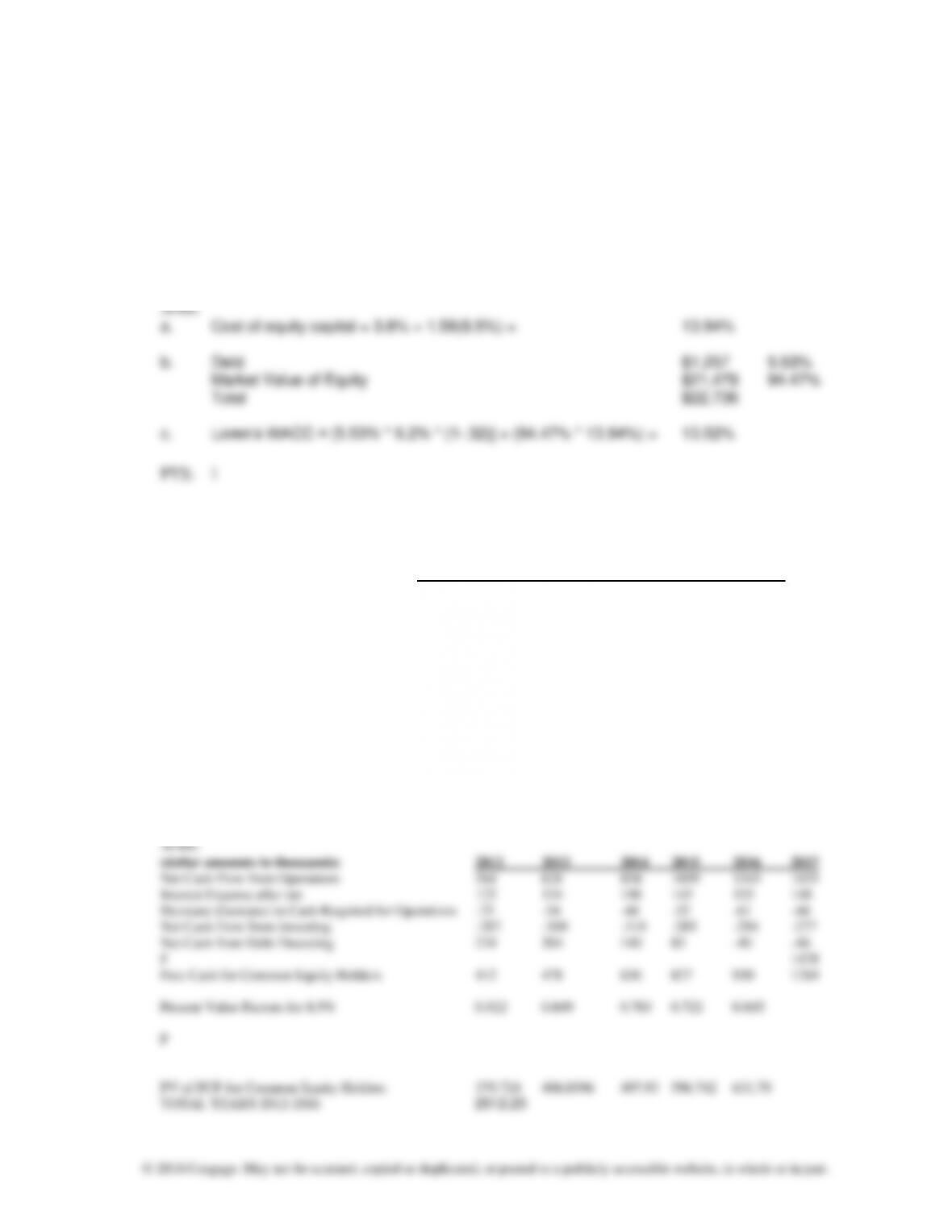
11-12
Riskless interest rate 3.8%
Market risk premium 6.5%
Using this information, calculate the following:
a. Loren Corporation’s cost of equity capital
b. The weight on debt capital that should be used to calculate Loren’s weighted-average cost of
capital.
c. Loren Corporation’s weighted-average cost of capital
3. Shady Sunglasses operates retail sunglass kiosks in shopping malls. Below is information related to the
company:
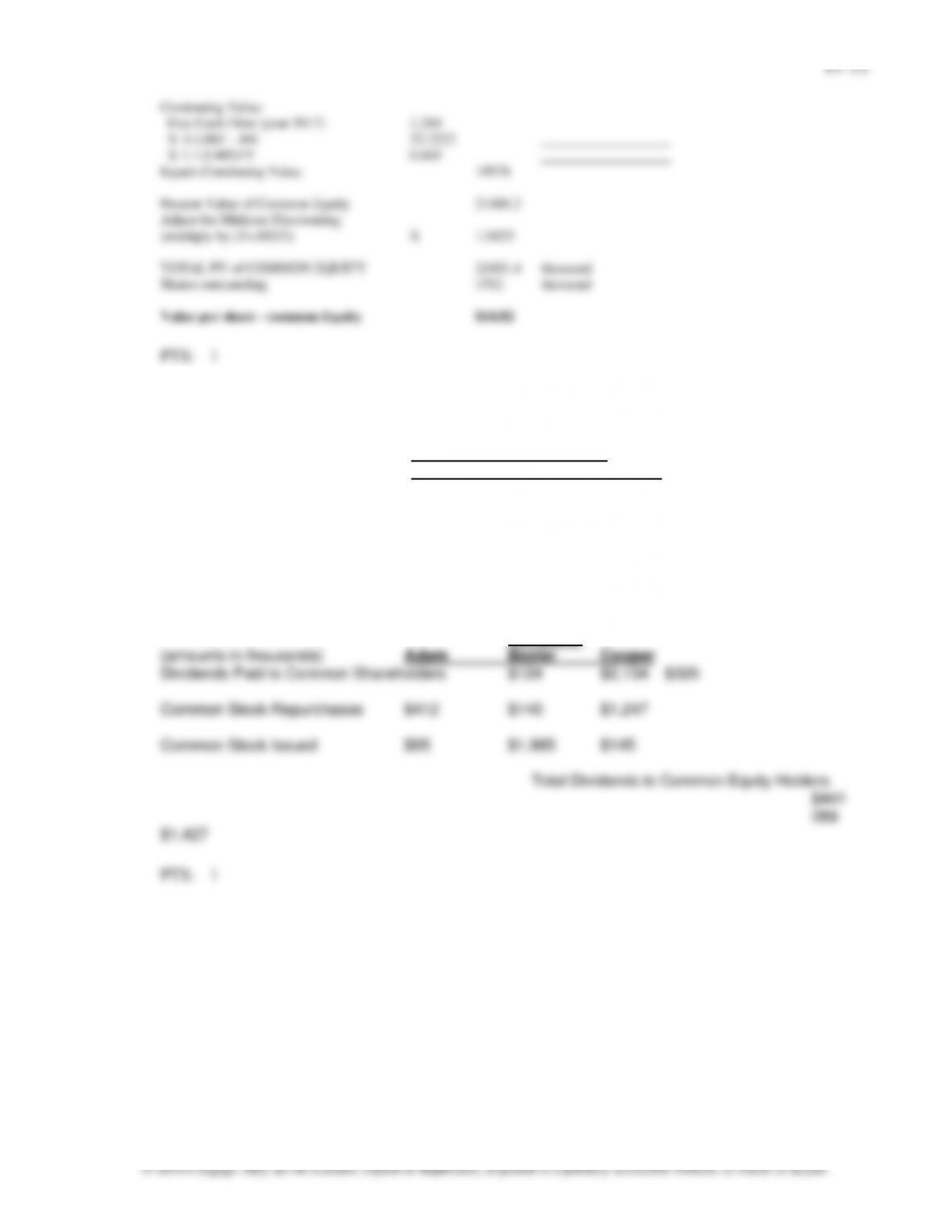
(dollar amounts in thousands) 2012 2013 2014 2015 2016 2017
Net Cash Flow from Operations 564 628 854 1059 1345 1655
Interest Expense after tax 122 134 148 145 155 148
Decrease (Increase) in Cash Required for Operations –75 –54 –48 –32 –61 –48
Net Cash Flow from Investing –287 –300 –310 –285 –294 –277
Net Cash from Debt Financing 210 204 140 85 –40 –46
Present Value Factors (Re = 8.5%) 0.922 0.849 0.783 0.722 0.665
Common Shares Outstanding
in thousands 1,512
Using the above information and assuming that steady-state growth in year 2017 and beyond will be
4% calculate Shady Sunglasses value per share.
© 2018 Cengage. May not be scanned, copied or duplicated, or posted to a publicly accessible website, in whole or in part.
4. For each of the following companies, determine the total dividends paid to common equity holders in
order to value the firm:
Company
(amounts in thousands) Adam Baxter Cooper
Dividends Paid to Common Shareholders $124 $2,134 $325
Common Stock Repurchases $412 $140 $1,247
Common Stock Issued $95 $1,985 $145
ANS:
Company
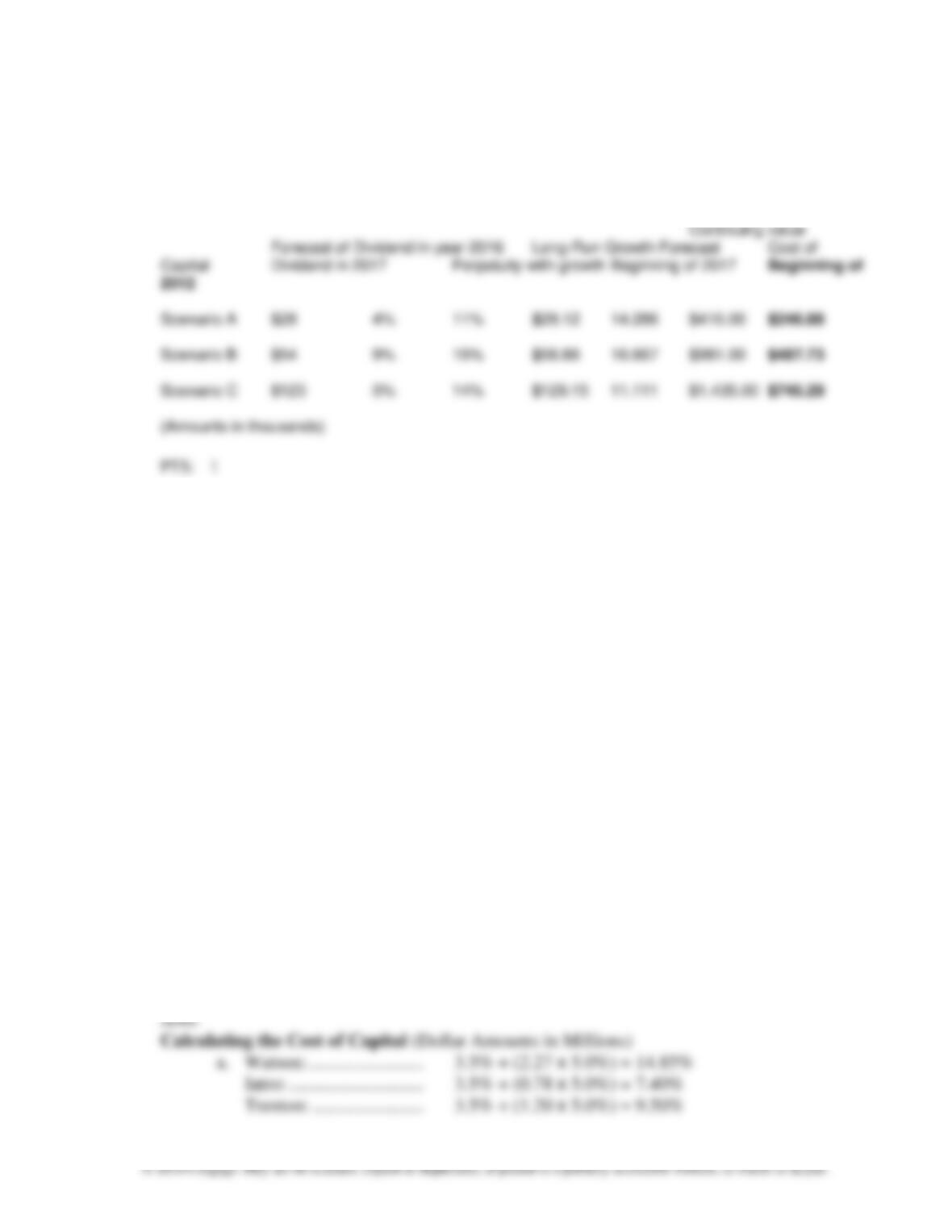
5. For each of the following scenarios determine the value as of the beginning of 2012 of the continuing
dividend:
Forecast of Dividend in year 2016 Long-Run Growth Forecast Cost of
Capital
Scenario A $28 4% 11%
Scenario B $54 9% 15%
11-14
Scenario C $123 5% 14%
(Amounts in thousands)
ANS:
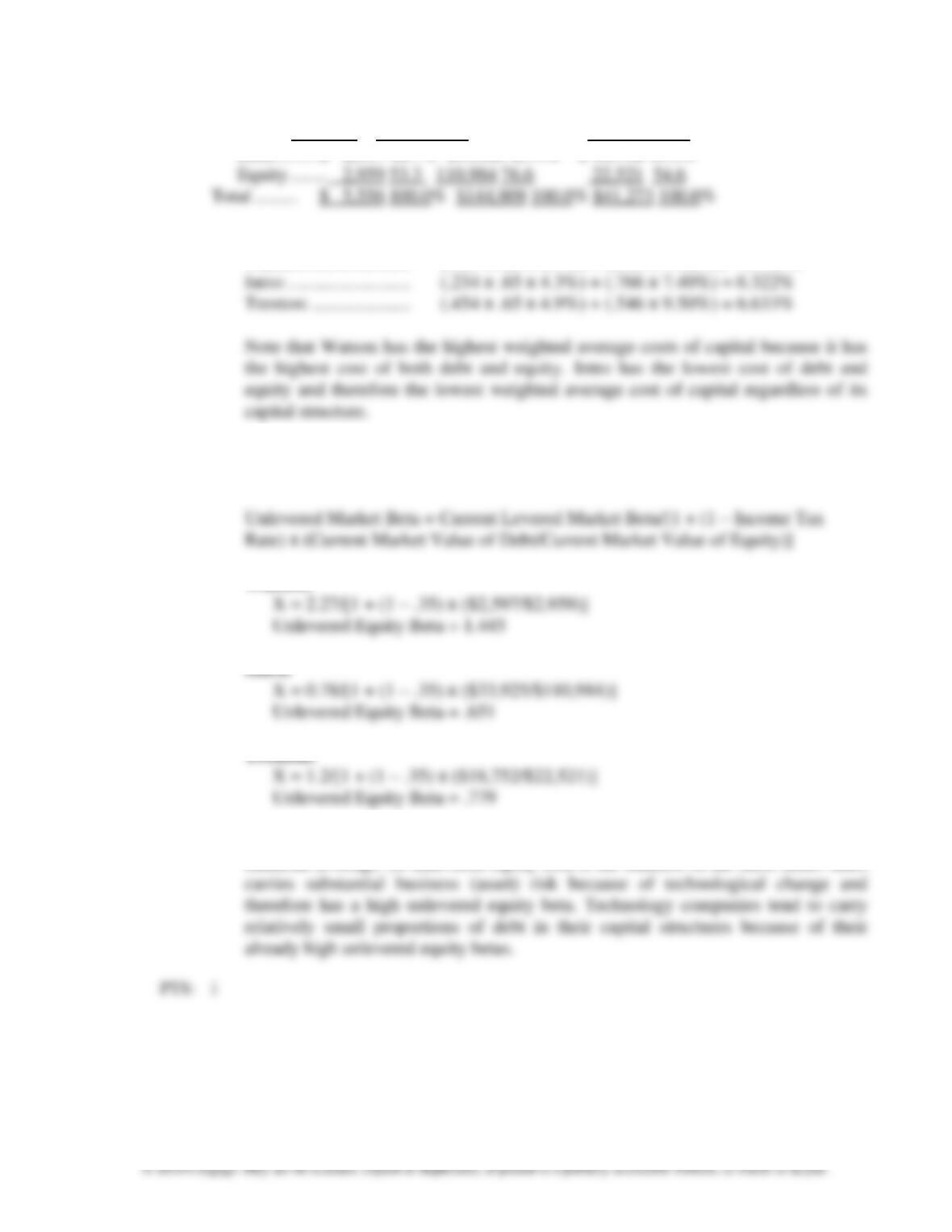
6. Watson manufactures and sells appliances. Intro develops and manufactures computer technology.
Trenton operates general merchandise retail stores. Selected data for these companies appear in the
following table (dollar amounts in millions). For each firm, assume that the market value of the debt
equals its book value.
($ amounts in millions) Watson Intro Trenton
Total Assets $13,532 $109,524 $44,106
Interest-Bearing Debt $ 2,597 $ 33,925 $18,752
Average Pretax Borrowing Cost 6.1% 4.3% 4.9%
Common Equity:
Book Value $ 3,006 $ 13,465 $13,712
Market Value $ 2,959 $110,984 $22,521
Income Tax Rate 35.0% 35.0% 35.0%
Market Equity Beta 2.27 0.78 1.2
Required
a. Assume that the intermediate-term yields on U.S. Treasury securities
are roughly 3.5 percent. Assume that the market risk premium is 5.0 percent.
Compute the cost of equity capital for each of the three companies.
b. Compute the weighted average cost of capital for each of the three companies.
c. Compute the unlevered market (asset) beta for each of the three companies.
11-15
b. Watson Intro____ Trenton___
Debt ……… $ 2,597 46.7% $33,925 23.4% $ 18,752 45.4%
Weighted Average Cost of Capital:
Watson: …………………. (.467 x .65 x 6.1%) + (.533 x 14.85%) = 9.767%
c. As shown in the chapter, the formula to compute unlevered equity (asset) beta
from a levered equity beta is as follows:
Watson:
Trenton:
Note that a large part of the high levered equity beta for Watson comes from its
financial leverage. Its unlevered equity beta is the smallest of the three firms. Intro
7. Carr Industries must raise $100 million on January 1, 2012 to finance its expansion into a new market.
The company will use the money to finance construction of four retail outlets and a distribution center.
The stores are expected to open later this year. The CFO has come up with three alternatives for
raising the money:
11-16
1) Issue $100 million of 8% nonconvertible debt due in 20 years.
2) Issue $100 million of 6% nonconvertible preferred stock (100,000 shares).
3) Issue $100 million of common stock (1 million shares).
The company’s internal forecasts indicate the following 2012 year-end amounts before any option is
chosen:
$ in millions
Total debt $425
Total shareholders’ equity 250
Net income for the year 10
Carr has no preferred stock outstanding but currently has 10 million shares of common stock
outstanding. EPS has been declining for the past several years. Earnings in 2011 were $1 per share,
which was down from $1.10 during 2010, and management wants to avoid another decline during
2012. One of the company’s existing loan agreements requires a debt–to-equity ratio to be less than 2.
Carr pays taxes at a 40% rate.
Required:
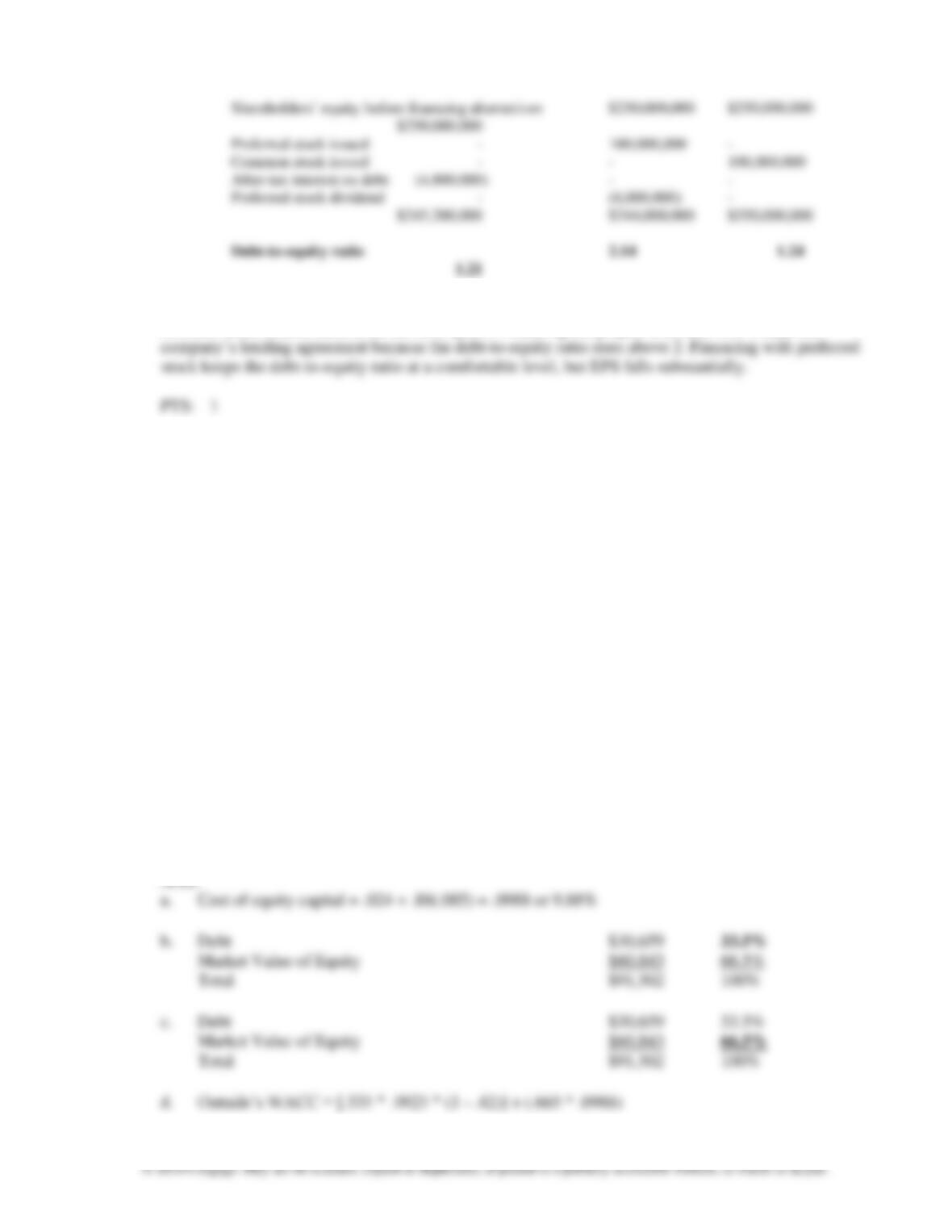
1. Assess the impact of each financing alternative on 2012 EPS and the year-end debt to equity ratio.
2. Which financing alternative would you recommend and why?
ANS:
1. Calculations for earnings per share (EPS) and the debt-to-equity ratio are detailed in the following
schedule:
Financing Alternatives
11-17
© 2018 Cengage. May not be scanned, copied or duplicated, or posted to a publicly accessible website, in whole or in part.
2. Considering only the effects of each alternative on EPS and the debt-to-equity ratio, issuing
common stock would seem to be the best option. Financing the project with debt will violate the
8. The following financial statement data pertains to Outside, Inc., a manufacturer of men’s outerwear
(dollar amounts in millions):
Total Assets $145,782
Interest-Bearing Debt $30,659
Average Pre-tax borrowing cost 9.25%
Common Equity:
Book Value $22,515
Market Value $60,843
Income Tax Rate 42%
Market Equity Beta 0.88
Market Premium 8.5%
Risk-free interest rate 2.4%
Required:
a. Calculate the company’s cost of equity capital.
b. Calculate the weight on debt capital that should be used to determine Outside’s weighted-average
cost of capital.
c. Calculate the weight on equity capital that should be used to determine Outside’s weighted–
average cost of capital.
d. Calculate Outside’s weighted-average cost of capital.
ANS:

© 2018 Cengage. May not be scanned, copied or duplicated, or posted to a publicly accessible website, in whole or in part.