
4-1
Chapter 4—Profitability Analysis
1. One important difference between return on assets (ROA) and return on common shareholder’s equity
(ROCE) is that:
a. ROA does not differentiate based on how a company finances its assets; ROCE does.
b. ROA does not distinguish between the different types of income items, such as income from
continuing operations, discontinued operations, extraordinary items and changes in accounting
principles; ROCE does.
c. ROCE does not distinguish between the different types of income items, such as income from
continuing operations, discontinued operations, extraordinary items and changes in accounting
principles; ROA does.
d. ROCE does not differentiate based on how a company finances its assets; ROA does.
2. Asset turnover represents:
a. The ability of the firm to generate income from operations for a particular level of sales.
b. The ability to generate sales from a particular investment in assets.
c. The ability to manage the level of investment in assets for a particular level of assets.
d. The number of days, on average, it takes management to turnover assets.
3. Which factor does not explain differences or changes in ROA?
a. Operating leverage
b. Cyclicality of sales
c. Product life cycle
d. Financial leverage
4. Which of the following industries would you expect to have, on average, high asset turnover and low
profit margin?
a. Hotels
b. Grocery stores
c. Utilities
d. Oil and Gas extraction
5. Firms with high levels of operating leverage experience which of the following in comparison to firms
with low levels of operating leverage?
a. Higher levels of risk in operations.
b. Lower expected rates of return.
c. Lower variability in returns on assets.
d. Higher sales.
6. Return on assets can be disaggregated into three components. Which of the following is not one of the
components?
a. Assets Turnover ratio
b. Profit Margin ratio
c. Debt to Equity ratio
d. Capital Structure Leverage ratio
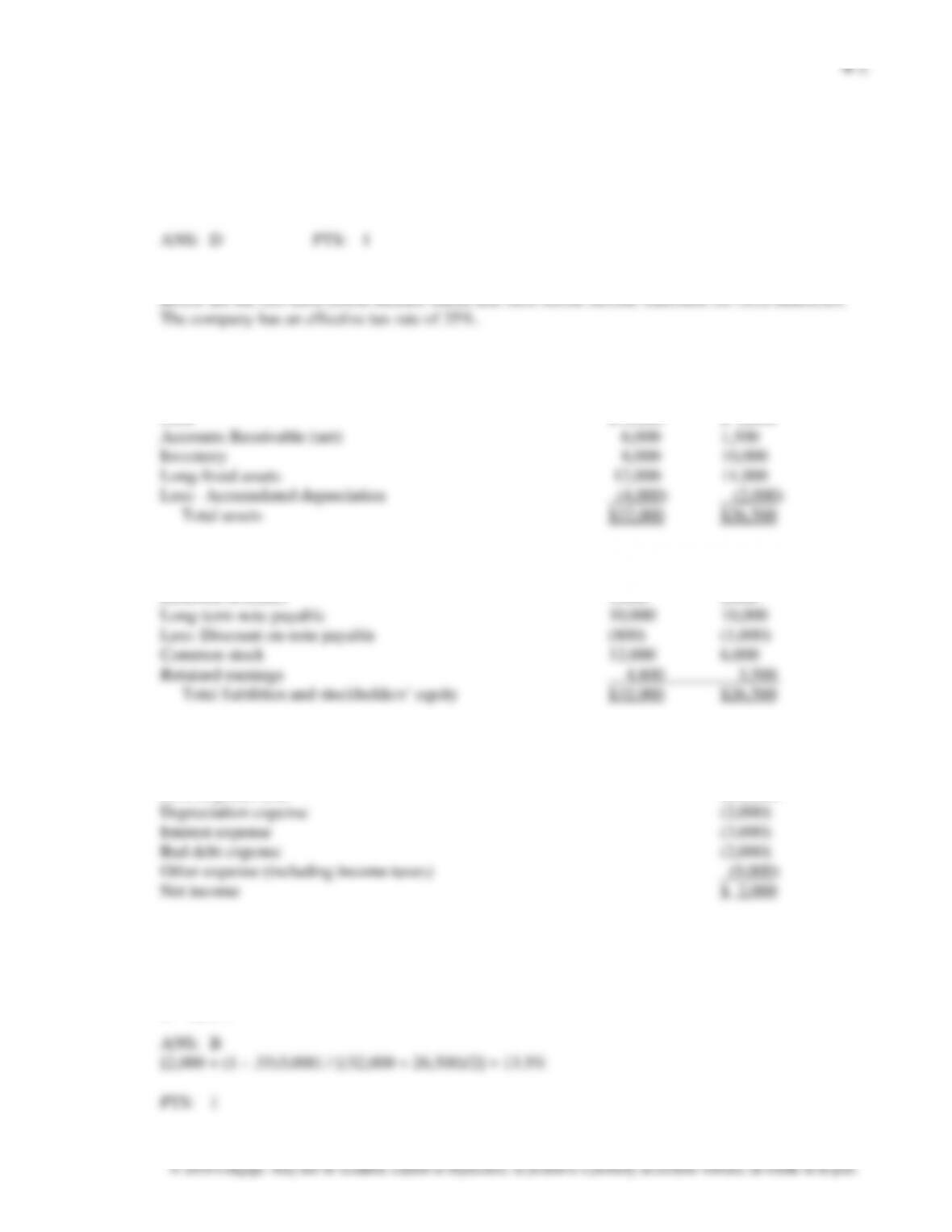
Orca Industries
Balance Sheet
2011 2010
Assets:
Cash $10,000 $ 6,000
Liabilities and Stockholders’ Equity:
Accounts payable $ 5,000 $ 6,000
Deferred revenues 1,000 2,000
Income Statement
For the year ended December 31, 2011
Revenues $42,000
Cost of goods sold (24,000)
7. Refer to the information for Orca Industries. The return on assets for Orca Industries is:
a. 6.8%
b. 13.5%
c. 10%
d. 12.3%
8. Refer to the information for Orca Industries. The return on common shareholders’ equity for Orca
Industries is:
a. 15.2%
b. 13.5%
c. 10%
d. 11.9%
9. Refer to the information for Orca Industries. The profit margin for computing ROA for Orca
Industries is:
a. 9.4%
b. 13.5%
c. 4.8%
d. 12.3%
10. Refer to the information for Orca Industries. Orca’s asset turnover is:
a. 1.31
b. 1
c. 1.58
d. 1.44
11. Refer to the information for Orca Industries. Orca’s accounts receivable turnover is (assume that
Orca makes all sales on account):
a. 7.0
b. .53
c. 11.2
d. 10
12. Refer to the information for Orca Industries. Orca’s basic earnings per share is:
a. .22
b. .13
c. .25
d. .30
4-4
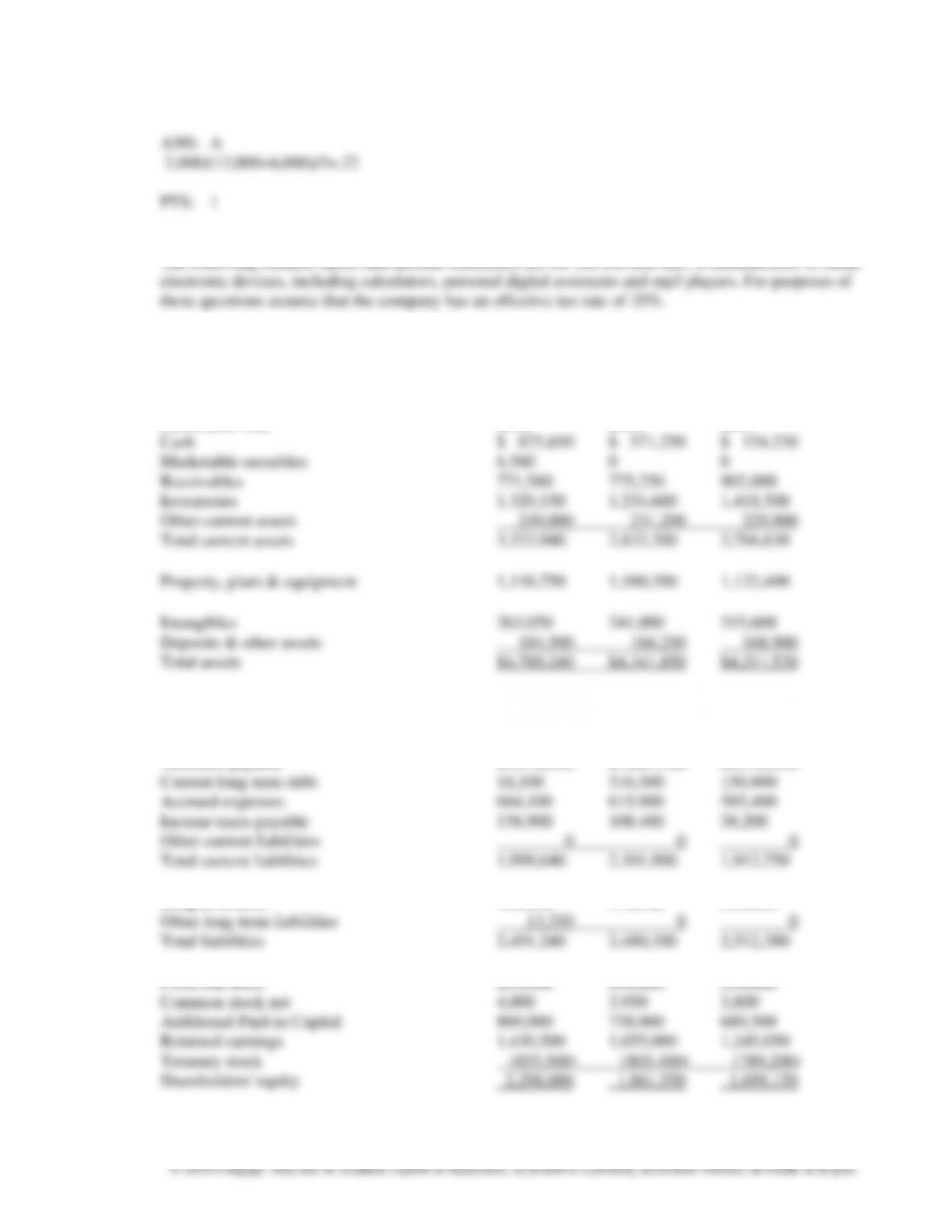
Net Devices Inc.
The following balance sheets and income statements are for Net Devices Inc., a manufacturer of small
BALANCE SHEETS
ASSETS ($ in thousands)
Fiscal year end 2011 2010 2009
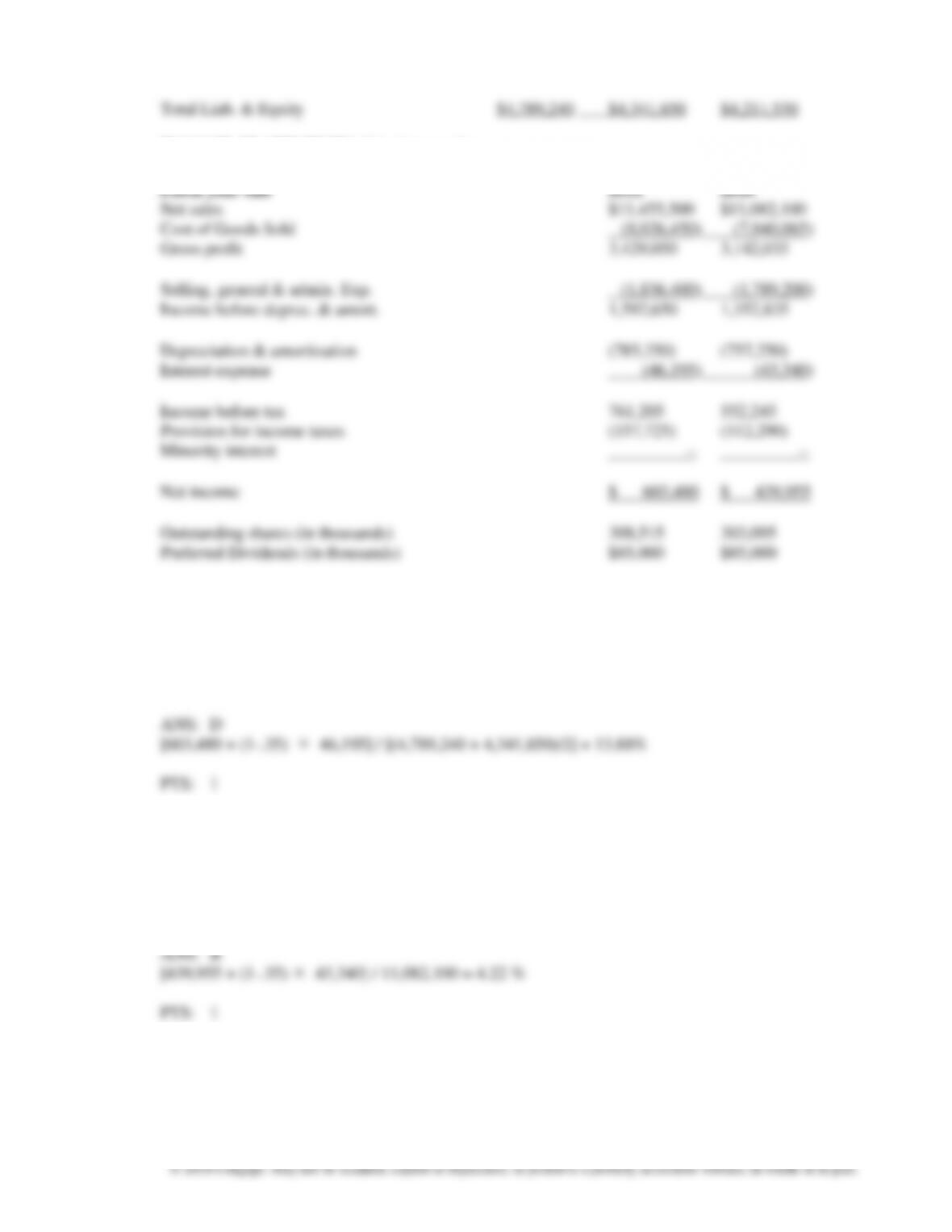
LIABILITIES ($ in thousands)
Fiscal year end 2011 2010 2009
Accounts payable $1,178,540 $1,061,100 $1,138,250
Long term debt 478,250 378,400 599,630
4-5
© 2018 Cengage. May not be scanned, copied or duplicated, or posted to a publicly accessible website, in whole or in part.
INCOME STATEMENTS ($ in thousands)
13. Refer to the information for Net Devices Inc. What is the rate of return on assets for Net Devices for
2011?
a. 11.64%
b. 14.50%
c. 12.60%
d. 13.88%
14. Refer to the information for Net Devices Inc. What is the profit margin for ROA for Net Devices for
2010?
a. 7.26%
b. 4.22%
c. 5.00%
d. 3.97%
15. Refer to the information for Net Devices Inc. What is the accounts receivable turnover ratio for Net
Devices for 2011?
a. 24.65
4-6
b. 14.85
c. 14.81
d. 10.50
16. Refer to the information for Net Devices Inc. What is the inventory turnover for Net Devices for
2011?
a. 10.32
b. 8.90
c. 2.51
d. 6.23
17. Refer to the information for Net Devices Inc. What is Net Devices’ return on common shareholders’
equity for 2011?
a. 26.54%
b. 30.89%
c. 35.81%
d. 42.16%
18. Refer to the information for Net Devices Inc. What is Net Devices’ capital structure leverage ratio for
2011?
a. 3.89
b. 1.68
c. 3.71
d. 10.32
19. Refer to the information for Net Devices Inc. What is Net Devices’ earnings per share for 2011?
a. $1.00
b. $1.70
c. $1.96
d. $0

© 2018 Cengage. May not be scanned, copied or duplicated, or posted to a publicly accessible website, in whole or in part.
20. Which of the following might an analyst not want to eliminate from past earnings when using past
earnings to forecast future earnings?
a. Nonrecurring gains from the sale of assets
b. Unusual asset impairment charges
c. Nonrecurring restructuring charges
d. Revenue from the sale of inventory
21. Sustainable earnings represent:
a. the level of earnings expected to persist in the future.
b. the level of earnings and the growth in the levels of earnings expected to persist in the future.
c. the growth rate of future earnings.
d. retained earnings.
22. The statutory tax rate differs from a firm’s average tax rate due to which of the following reasons?
a. The statutory tax rate is a marginal tax rate.
b. Some expenses are included in book income but do not enter into taxable income.
c. The average tax rate is for a period of three years.
d. The statutory tax rate does not affect GAAP measures of revenues and expenses.
23. The profit margin for ROA indicates the ability of a firm to generate earnings for a particular level of:
a. sales
b. assets
c. working capital
d. shareholders’ equity
24. Which of the following would be considered a committed fixed cost (a cost that is incurred regardless
of the level of activity during the period)?
a. depreciation expense
b. bad debt expense
c. advertising expense
d. cost of goods sold
25. Hall and Porter argue that firms have two generic alternative strategies for any particular product.
These strategies are:
a. low risk focus, low risk focus
b. retail customer focus, wholesale customer focus
c. product differentiation, low-cost leadership
d. low operating leverage, high operating leverage
26. Which of the following is not a way a company can achieve a low-cost position?
a. economies of scale
b. production efficiency
c. customer service
d. outsourcing
27. Which of the following scenarios is consistent with an increasing cost of goods sold to sales
percentage and increasing inventory turnover?
a. Firm raises prices to increase its gross margin but inventory sells more slowly.
b. Weak economic conditions lead to reduced demand for a firm’s products, necessitating price
reductions to move goods.
c. Strong economic conditions lead to increased demand for a firm’s products, allowing price
increases.
d. Firm shifts its product mix toward lower margin, faster moving products.
Extreme Sports Company and All Sports Corporation
Below is financial information for two sporting goods retailers. Extreme Sports Company operates a
retail business and franchising business. At the end 2011, Extreme Sports had 263 Company-owned
Selected Data for All Sports and Extreme Sports
(amounts in millions)
All Sports Extreme Sports
Sales $5,320 $1,344
28. Refer to the information for Extreme Sports Company and All Sports Corporation.
Compute the Asset Turnover for All Sports.
a. 3.2%
b. 2.15
c. 8.9%
d. 1.1%
29. Refer to the information for Extreme Sports Company and All Sports Corporation.
What is the return on assets for All Sports?
a. 11.9%
4-9
b. 10.8%
c. 9.2%
d. 8.6%
30. Refer to the information for Extreme Sports Company and All Sports Corporation.
Calculate All Sports’ inventory turnover ratio.
a. 5.3
b. 1.2
c. 3.9
d. .256
31. Multiples of EPS to value firms are referred to as:
a. ROA
b. price-earnings ratios
c. ROCE
d. Weighted average number of common shares outstanding
32. Adjustments for dilutive securities and the adjustment to weighted average number of
shares outstanding presumes that the dilutive securities are converted to common shares:
a. as of the beginning of the year.
b. as of the end of the year.
c. as of the middle of the year.
d. as of the point in time where the maximum number of shares are outstanding.
33. To calculate diluted EPS, the accountant does all of the following except:
a. adds back to net income any compensation expense recognized on the employee stock options
b. adds back any interest expense (net of taxes) on convertible bonds
c. adds back any dividends on convertible preferred stock the firm subtracted in computing net
income to common shareholders.
d. enters only the net incremental shares issued (shares issued under options minus assumed shares
repurchased) in the computation of diluted EPS.
34. Which of the following is the primary objective in most financial statement analysis?
a. To value a firm’s equity securities
b. To look for unrecorded liabilities
c. To establish a firm’s strategy within the industry
4-10
d. To define markets for the firm
35. Time-series analysis helps answer all of the following questions except:
a. Is the firm becoming more or less profitable over time?
b. Is the firm becoming more or less risky?
c. How is management of the firm responding to external economic forces?
d. What is the amount of assets or capital required to generate a particular level of earnings?
36. Critics of EPS as a measure of profitability point out that it does not consider:
a. simple capital structures.
b. the amount of assets or capital required to generate a particular level of earnings.
c. the deduction of preferred stock dividends from net income.
d. adjustments for dilutive securities and the adjustment to weighted average number of
shares outstanding for complex capital structures.
Ramos Company
Ramos Company included the following information in its annual report:
2011 2010 2009
37. Refer to the information for Ramos Company. In a common size income statement for 2011, the
operating expenses are expressed as:
a. 30.3%
b. 28.0%
c. 43.8%
d. 100%
38. Refer to the information for Ramos Company. In a common size income statement for 2009, the cost
of goods sold is expressed as:
a. 64.3%
b. 40.0%
c. 87 %
d. 103%
39. Refer to the information for Ramos Company. In a common size income statement for 2011, the cost
of goods sold is expressed as:
a. 130%
b. 115%
c. 64.5%
d. 63.1%
40. Refer to the information for Ramos Company. In a percentage change income statement over the
period of 2009 to 2011, what is the change in sales?
a. 100%
b. 87.2%
c. 12.8%
d. 14.7%
41. Refer to the information for Ramos Company. In a percentage change income statement over the
period of 2009 to 2011, what is the change in net income?
a. 100%
b. 21.6%
c. 72.4%
d. 27.6%
42. Which of the following are better indicated by percentage change statements than common-size
statements?
a. monetary changes
b. profitability
c. stability
d. growth and decline
43. Common-size analysis requires the analyst to be aware that percentages can change because of all of
the following except:
a. changes in expenses in the numerator independent of changes in sales
b. changes in sales independent of changes in expenses
c. interaction effects between the numerator and denominator
d. All of these are possible explanations.
44. Firms with complex capital structures can use which of the following in calculating EPS?
a. Outstanding convertible bonds.
b. Stock options exercised
c. Stock warrants issued
d. All of these are correct.
45. The computation of the additional shares to be issued on the exercise of stock options
assumes that the firm would repurchase common shares on the open market using an
amount equal to the sum of all the following except:
a. any cash proceeds from such exercise
b. net incremental shares issued
c. any unamortized compensation expense on those options
d. any tax benefits that would be credited to additional paid-in capital
46. Another term for earnings power is:
a. nonrecurrent revenue.
b. nonrecurrent gains.
c. sustainable earnings.
d. net change in equity.
47. The three elements of risk that help in understanding differences across firms and changes over time in
ROAs are:
a. product life cycles, cyclicality of sales, competitive constraint.
b. operating leverage, cyclicality of sales, product life cycles.
c. cyclicality of sales, competitive constraint, operating leverage.
d. operating leverage, competitive constraint, product life cycles.
Carl Industries
Carl Industries has condensed balance sheets as shown:
2011 2010 2009
Assets:
Current assets 65,000 $46,500 $80,000
Liabilities & Stockholders’ Equity:
Current liabilities $70,000 $25,000 $33,500
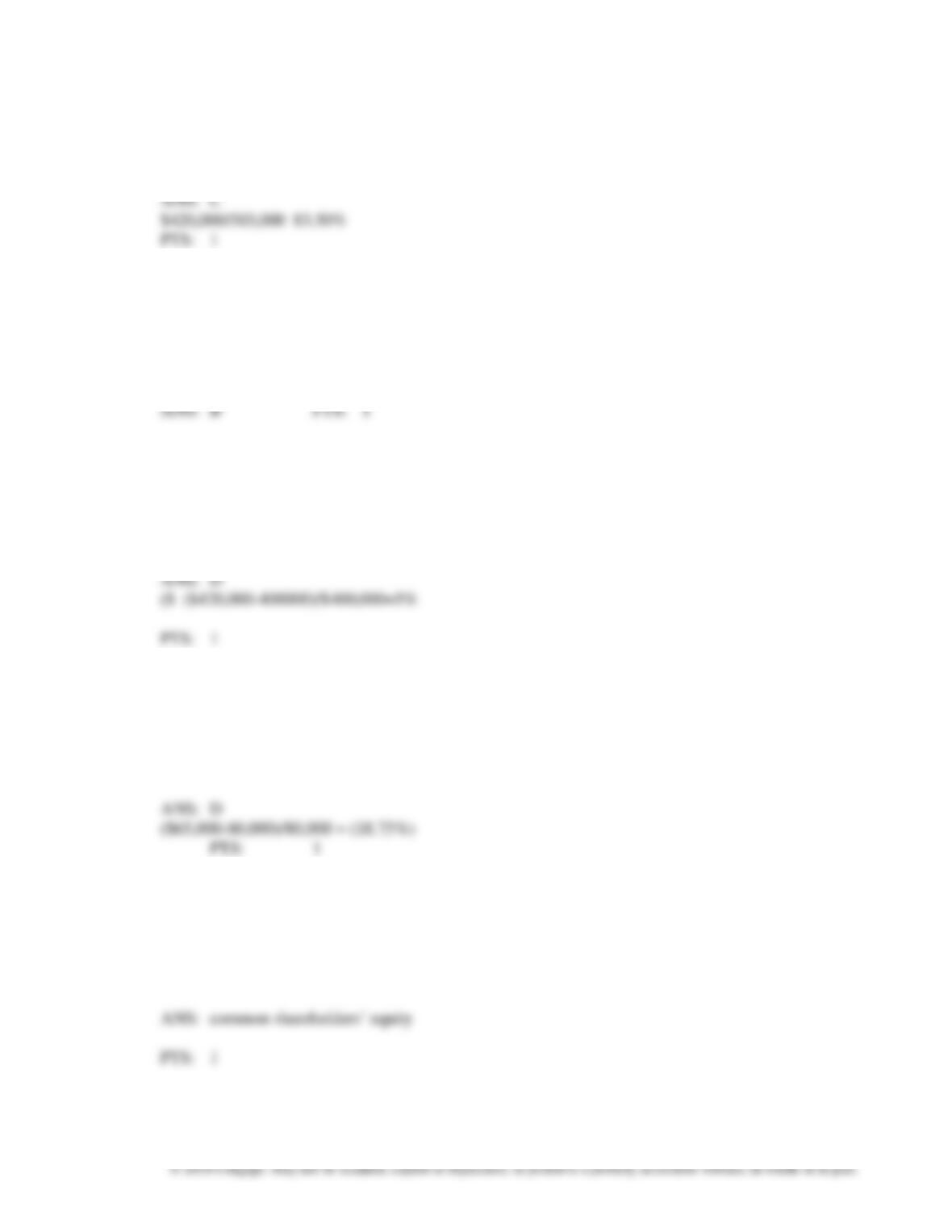
48. Refer to the information for Carl Industries. In a common size balance sheet for 2010, plant and
equipment (net) is expressed as:
4-13
a. 74.5%
b. 93.2%
c. 83.5 %
d. 30.5%
49. Refer to the information for Carl Industries. In a common size balance sheet for 2009, total liabilities
and equity are expressed as:
a. 25.9%
b. 100%
c. 74.1%
d. 103.6%
50. Refer to the information for Carl Industries. In a percentage change balance sheet over the period of
2009 to 2011, what is the change in long-term liabilities?
a. 94.7%
b. 15.4%
c. 5.3%
d. 5%
51. Refer to the information for Carl Industries. In a percentage change balance sheet over the period of
2009 to 2011, what is the change in current assets?
a. 78.6%
b. (27.3%)
c. (21.4%)
d. (18.75%)
COMPLETION
1. In order to measure how profitable a firm is in generating a return for its common shareholders, a
financial analyst would examine the return on
_____________________________________________.

2. When the financial analysts multiplies the profit margin for ROA with the assets turnover ratio the
result is called ______________
3. The ____________________ effect of interest expense on net income equals one minus the marginal
tax rate times the interest expense.
4. Return on common equity can be disaggregated into profit margin for ROCE, capital structure
leverage and _________________________________________________.
5. Return on assets can be disaggregated into asset turnover and
____________________________________________________________.
6. Return on assets will likely differ across firms and across time. Three elements of risk that will help
explain these differences are ________________________________________, cyclicality of sales and
stage and length of product life cycle.
7. Return on assets will likely differ across firms and across time. Three elements of risk that will help
explain these differences are operating leverage, ___________________________________, and
stage and length of product life cycle.
8. Firms with high operating leverage have a higher proportion of _________________________ in their
cost structure.

9. Firms with ____________________ levels of operating leverage experience greater variability in their
return on assets.
10. The ability of a firm to generate income from operations given a particular level of sales is measured
by the ______________________________.
11. The ability of a firm to manage the level of investment in assets for a particular level of sales is
measured by the ______________________________.
12. Accounts receivable turnover is calculated by dividing
________________________________________ by average net accounts receivable.
13. Inventory turnover is calculated by dividing ________________________________________ by
average inventories.
14. Return on assets can be a misleading ratio when analyzing technology firms because two important
assets, ______________________________ and ______________________________ do not appear
on their balance sheets
15. When calculating Basic earnings per share net income is adjusted by____________
16. When calculating the return on fixed assets sales is divided by _________________

© 2018 Cengage. May not be scanned, copied or duplicated, or posted to a publicly accessible website, in whole or in part.
17. One problem with using EPS as a measure of profitability is that it does not consider the amount of
____________________ or ____________________ required to generate a particular level of
earnings.
18. When an analyst uses measures of past profitability to forecast the firm’s future profitability the
expectation is that those revenues, gains, expenses and losses will ____________________.
19. ________________________________________ is the level of earnings and the growth in the levels
of earnings expected to persist in the future.
20. The ___________________________________ of interest expense on net income equals one minus
the marginal tax rate times interest expense.
21. The rationale for adding back the _______________________________________________________
relates to attaining consistency in the numerator and denominator of ROA.
22. Economic theory suggests that higher levels of ____________________ in any activity should lead to
higher levels of ___________________________________.
23. All else being equal, firms with high levels of ________________________________________ incur
more risk in their operations and should earn higher rates of return.