Chapter 09 – Long-Term Assets: Fixed and Intangible
(c)
Accumulated Depreciation—Machinery
8,000
Cash
8,000
POINTS:
1
DIFFICULTY:
Moderate
Bloom’s: Remembering
QUESTION TYPE:
Subjective Short Answer
HAS VARIABLES:
False
LEARNING OBJECTIVES:
FNMN.WAJO.19.09–01 – LO: 09–01
ACCREDITING STANDARDS:
ACCT.ACBSP.APC.13 – Long-term Assets Reporting
ACCT.AICPA.FN.03 – Measurement
BUSPROG: Analytic
DATE CREATED:
7/22/2017 6:24 PM
DATE MODIFIED:
10/16/2017 5:33 PM
178. On April 15, Compton Co. paid $2,800 to upgrade a delivery truck and $125 for an oil change. Journalize the entries
for the upgrade to delivery truck and oil change expenditures.
ANSWER:
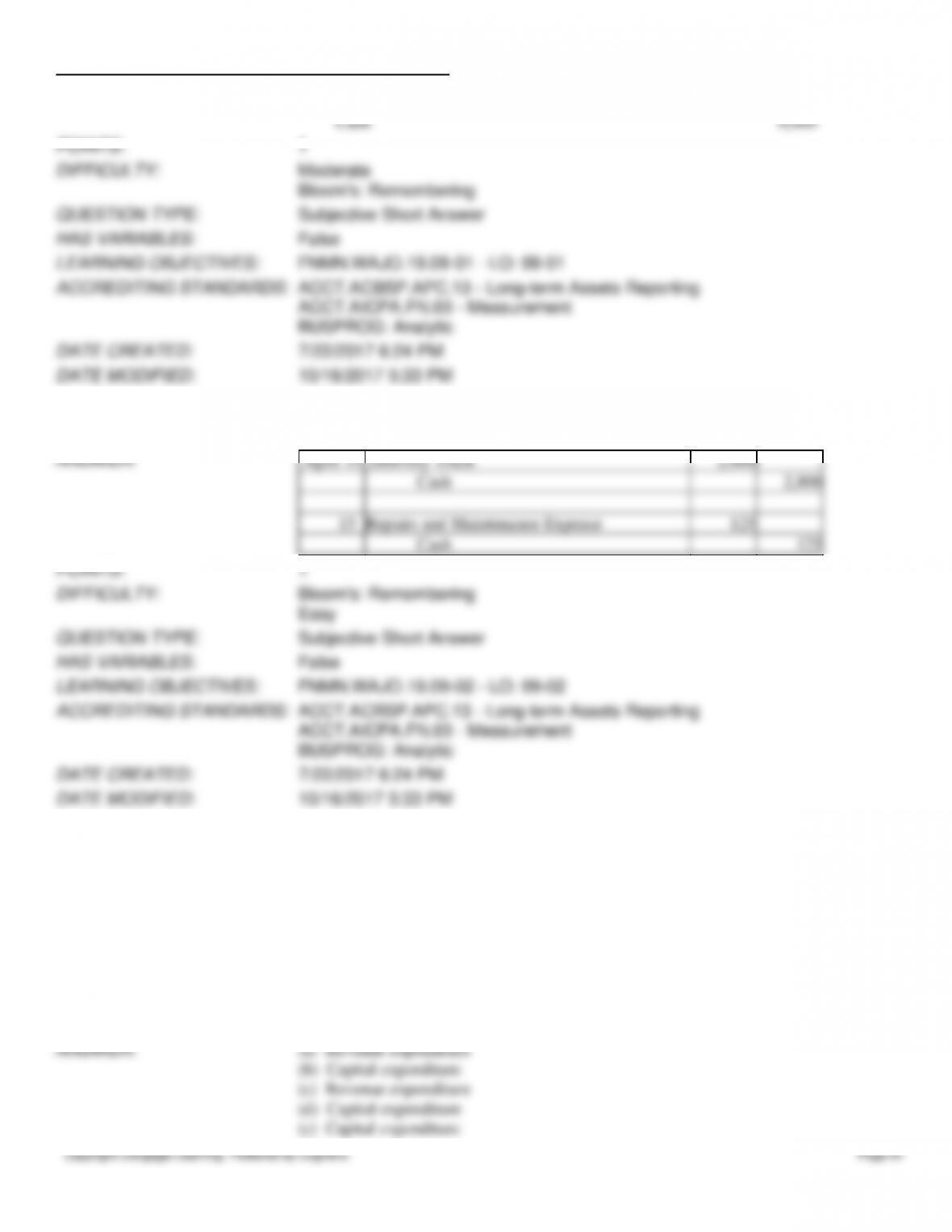
April 15
Delivery Truck
2,800
Cash
2,800
15
Repairs and Maintenance Expense
125
Cash
125
POINTS:
1
DIFFICULTY:
Bloom’s: Remembering
Easy
QUESTION TYPE:
Subjective Short Answer
HAS VARIABLES:
False
LEARNING OBJECTIVES:
FNMN.WAJO.19.09–02 – LO: 09–02
ACCREDITING STANDARDS:
ACCT.ACBSP.APC.13 – Long-term Assets Reporting
ACCT.AICPA.FN.03 – Measurement
BUSPROG: Analytic
DATE CREATED:
7/22/2017 6:24 PM
DATE MODIFIED:
10/16/2017 5:33 PM
179. XYZ Co. incurred the following costs related to the office building used in operating its sports supply company:
(a)
Replaced a broken window.
(b)
Replaced the roof that had been on the building 23 years.
(c)
Serviced all the air conditioners before summer started.
(d)
Replaced the air conditioners in the customer service areas.
(e)
Added a warehouse to the back of the building.
(f)
Repainted the interior walls.
(g)
Installed window shutters on all windows.
Classify each of the costs as a capital expenditure or a revenue expenditure.
ANSWER:
(a) Revenue expenditure
(b) Capital expenditure
(c) Revenue expenditure
(d) Capital expenditure
(e) Capital expenditure
Copyright Cengage Learning. Powered by Cognero.
Page 63
182. The double-declining-balance rate for calculating depreciation expense is determined by doubling the straight-line
rate. Assuming that an asset has a useful life of 25 years, determine the rate to be used if using the double-declining-
balance method.
ANSWER:
4% × 2 = 8%
POINTS:
1
DIFFICULTY:
Easy
Bloom’s: Applying
QUESTION TYPE:
Subjective Short Answer
HAS VARIABLES:
False
LEARNING OBJECTIVES:
FNMN.WAJO.19.09–02 – LO: 09–02
ACCREDITING STANDARDS:
ACCT.ACBSP.APC.13 – Long-term Assets Reporting
ACCT.AICPA.FN.03 – Measurement
BUSPROG: Analytic
DATE CREATED:
7/22/2017 6:24 PM
DATE MODIFIED:
10/16/2017 5:33 PM
183. Copy equipment was acquired at the beginning of the year at a cost of $72,000 that has an estimated residual value of
$9,000 and an estimated useful life of 5 years. It is estimated that the machine will output an estimated 1,000,000
copies. This year, 315,000 copies were made. Determine the (a) depreciable cost, (b) depreciation rate, and (c) the units-
of-output depreciation for the year.
ANSWER:
(a)
$63,000 (Initial cost – Estimated residual value = $72,000 – $9000)
(b)
$0.063 per copy (Depreciable cost / Total units of output = $63,000 / 1,000,000
copies)
(c)
$19,845 (315,000 copies × $0.063)
POINTS:
1
DIFFICULTY:
Moderate
Bloom’s: Applying
QUESTION TYPE:
Subjective Short Answer
HAS VARIABLES:
False
LEARNING OBJECTIVES:
FNMN.WAJO.19.09–02 – LO: 09–02
ACCREDITING STANDARDS:
ACCT.ACBSP.APC.13 – Long-term Assets Reporting
ACCT.AICPA.FN.03 – Measurement
BUSPROG: Analytic
DATE CREATED:
7/22/2017 6:24 PM
DATE MODIFIED:
10/16/2017 5:33 PM
184. A machine costing $57,000 with a 6-year life and $54,000 depreciable cost was purchased January 1. Compute the
yearly depreciation expense using straight-line depreciation.
ANSWER:
$54,000 ÷ 6 years = $9,000 per year
POINTS:
1
DIFFICULTY:
Easy
Bloom’s: Applying
QUESTION TYPE:
Subjective Short Answer
HAS VARIABLES:
False
LEARNING OBJECTIVES:
FNMN.WAJO.19.09–02 – LO: 09–02
ACCREDITING STANDARDS:
ACCT.ACBSP.APC.13 – Long-term Assets Reporting
Chapter 09 – Long-Term Assets: Fixed and Intangible
(b)
Depreciation Expense—Trucks
(e)
25 years
(f)
40 years
(g)
50 years
ANSWER:
(a) 50% (1/2)
(b) 12.5% (1/8)
(c) 10% (1/10)
(d) 5% (1/20)
(e) 4% (1/25)
(f) 2.5% (1/40)
(g) 2% (1/50)
POINTS:
1
DIFFICULTY:
Easy
Bloom’s: Applying
QUESTION TYPE:
Subjective Short Answer
HAS VARIABLES:
False
LEARNING OBJECTIVES:
FNMN.WAJO.19.09–02 – LO: 09–02
ACCREDITING STANDARDS:
ACCT.ACBSP.APC.13 – Long-term Assets Reporting
ACCT.AICPA.FN.03 – Measurement
BUSPROG: Analytic
DATE CREATED:
7/22/2017 6:24 PM
DATE MODIFIED:
10/16/2017 5:33 PM
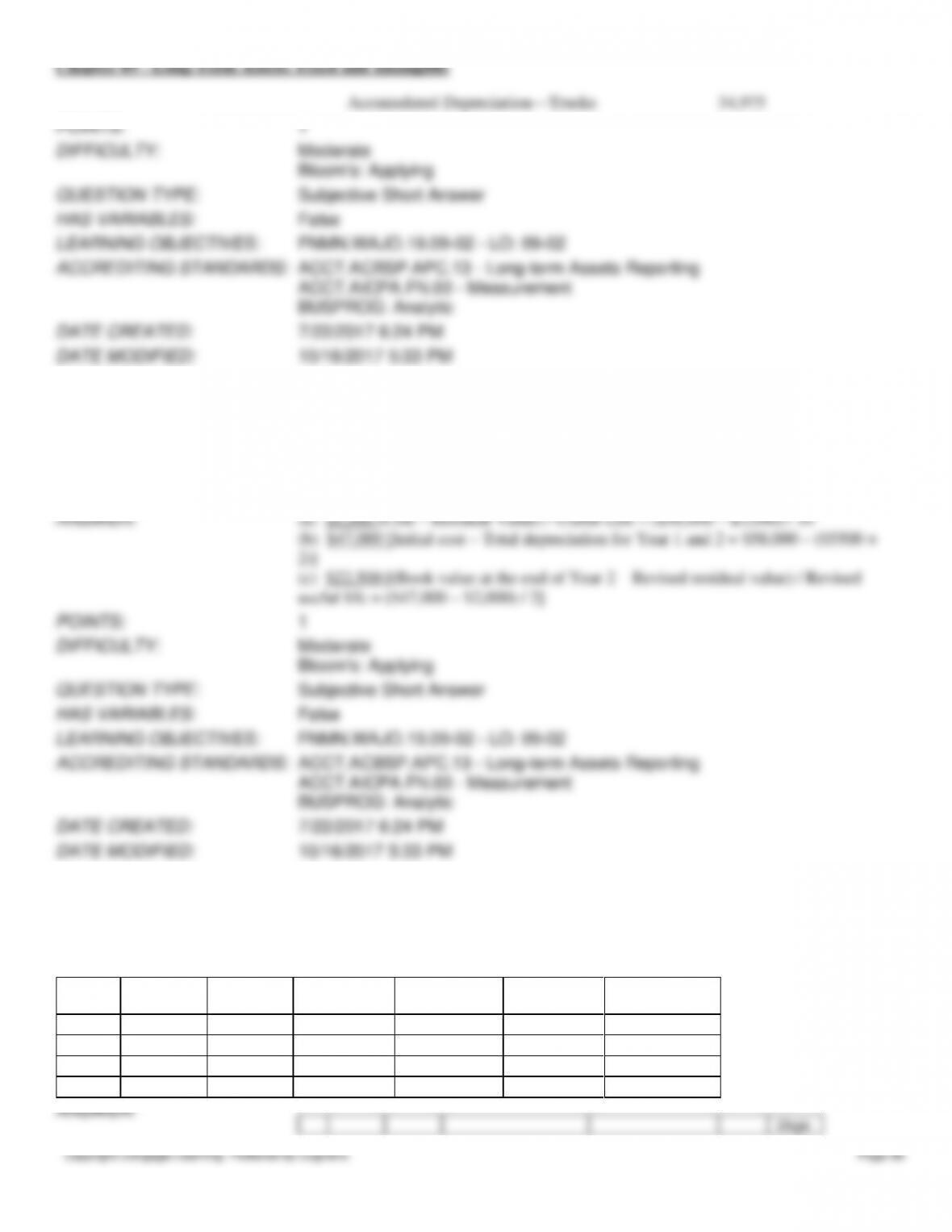
188. Prior to adjustment at the end of the year, the balance in Trucks is $300,900 and the balance in Accumulated
Depreciation—Trucks is $88,200. Details of the subsidiary ledger are as follows:
Truck
No.
Cost
Estimated
Residual Value
Estimated Useful
Life
Accumulated
Depreciation at
Beginning of Year
Miles Operated
During Year
1
$100,000
$13,000
300,000
—
30,000
2
72,900
9,900
300,000
$60,000
25,000
3
38,000
3,000
200,000
8,050
45,000
4
90,000
13,000
200,000
20,150
40,000
Required:
(a)
Based on the units-of-output method, determine the depreciation rates per mile and the
amount to be credited to the accumulated depreciation section of each of the subsidiary
accounts for the miles operated during the current year.
(b)
Journalize the entry to record depreciation for the year.
ANSWER:
(a)
Truck No.
Rate per Mile
Miles Operated
Depreciation
1
29.0 cents
30,000
$ 8,700
2
21.0
25,000
3,000*
3
17.5
45,000
4
38.5
40,000
15,400
Chapter 09 – Long-Term Assets: Fixed and Intangible
Copyright Cengage Learning. Powered by Cognero.
Page 68
(a)
straight-line
(b)
double-declining-balance
(c)
units-of-output (used for 1,600 hours during the current year)
ANSWER:
(a)
$28,125 [($240,000 – $15,000) ÷ 4 × 6/12]
(b)
$60,000 ($240,000 × 0.50 × 6/12)
(c)
$14,400 [($240,000 – $15,000) ÷ 25,000 hours × 1,600 hours]
POINTS:
1
DIFFICULTY:
Challenging
Bloom’s: Applying
QUESTION TYPE:
Subjective Short Answer
HAS VARIABLES:
False
LEARNING OBJECTIVES:
FNMN.WAJO.19.09–02 – LO: 09–02
ACCREDITING STANDARDS:
ACCT.ACBSP.APC.13 – Long-term Assets Reporting
ACCT.AICPA.FN.03 – Measurement
BUSPROG: Analytic
DATE CREATED:
7/22/2017 6:24 PM
DATE MODIFIED:
10/16/2017 5:33 PM
193. Determine the depreciation, for the year of acquisition and for the following year of a fixed asset acquired on
October 1 for $500,000, with an estimated life of 5 years, and residual value of $50,000, using (a) the double declining-
balance method and (b) the straight-line method. Assume a fiscal year ending December 31.
ANSWER:
(a)
Year of acquisition: $50,000 ($500,000 × 0.40 × 3/12)
Following year: $180,000 ($500,000 – $50,000 × 0.40)
(b)
Year of acquisition: $22,500 [($500,000 – $50,000 / 5) × 3/12]
Following year: $90,000 [($500,000 – $50,000) / 5]
POINTS:
1
DIFFICULTY:
Moderate
Bloom’s: Applying
QUESTION TYPE:
Subjective Short Answer
HAS VARIABLES:
False
LEARNING OBJECTIVES:
FNMN.WAJO.19.09–02 – LO: 09–02
ACCREDITING STANDARDS:
ACCT.ACBSP.APC.13 – Long-term Assets Reporting
ACCT.AICPA.FN.03 – Measurement
BUSPROG: Analytic
DATE CREATED:
7/22/2017 6:24 PM
DATE MODIFIED:
10/16/2017 5:33 PM
194. Equipment costing $80,000 with a useful life of 10 years and a residual value of $8,000 has been depreciated for 6
years by the straight-line method. Assume a fiscal year ending December 31.
(a)
What is the book value at the end of the sixth year of use?
(b)
If early in the seventh year it is estimated that the remaining useful life is 5 years
(instead of 4) and the residual value is $6,000, what is the amount of depreciation for
the seventh year?
ANSWER:
(a)
($80,000 – $8,000) = $72,000
$72,000 / 10 = $7,200
$7,200 × 6 = $43,200
$80,000 – $43,200 = $36,800