Chapter 06 – Inventories
Copyright Cengage Learning. Powered by Cognero.
Page 81
Calculate the cost of the ending inventory at June 30, using (a) the first-in, first-out (FIFO)
method and (b) the last-in, first-out (LIFO) method. Identify the quantity, unit price, and
total cost of each lot in the inventory.
ANSWER:
(a)
June 20
10 units at $62
$ 620
30
15 units at $63
945
Total
$1,565
(b)
June 1
5 units at $60
$ 300
8
5 units at $61
305
30
15 units at $63
945
Total
$1,550
POINTS:
1
DIFFICULTY:
Moderate
Bloom’s: Applying
QUESTION TYPE:
Subjective Short Answer
HAS VARIABLES:
False
LEARNING OBJECTIVES:
FNMN.WAJO.19.06-03 – LO: 06–03
ACCREDITING STANDARDS:
ACCT.ACBSP.APC.17 – Inventories Reporting
ACCT.AICPA.FN.03 – Measurement
BUSPROG: Analytic
DATE CREATED:
7/22/2017 6:20 PM
DATE MODIFIED:
10/16/2017 5:09 PM
190. Beginning inventory, purchases, and sales data for hammers are as follows:
Mar. 3
Inventory
12 units
@
$15
11
Purchase
13 units
@
$17
14
Sale
18 units
21
Purchase
9 units
@
$20
25
Sale
10 units
Assuming the business maintains a perpetual inventory system, complete the inventory cards and calculate the cost of
goods sold and ending inventory under the following assumptions:
(a) First-in, first-out
Purchases
Cost of Goods Sold
Inventory
Date
Qty.
Unit
Cost
Total
Cost
Qty.
Unit
Cost
Total
Cost
Qty.
Unit
Cost
Total
Cost
Mar.
3
14
21
Chapter 06 – Inventories
25
Balances
(b) Last-in, first-out
Purchases
Cost of Goods Sold
Inventory
Date
Qty.
Unit
Cost
Total
Cost
Qty.
Unit
Cost
Total
Cost
Qty.
Unit
Cost
Total
Cost
Mar.
3
11
14
21
25
Balances
ANSWER:
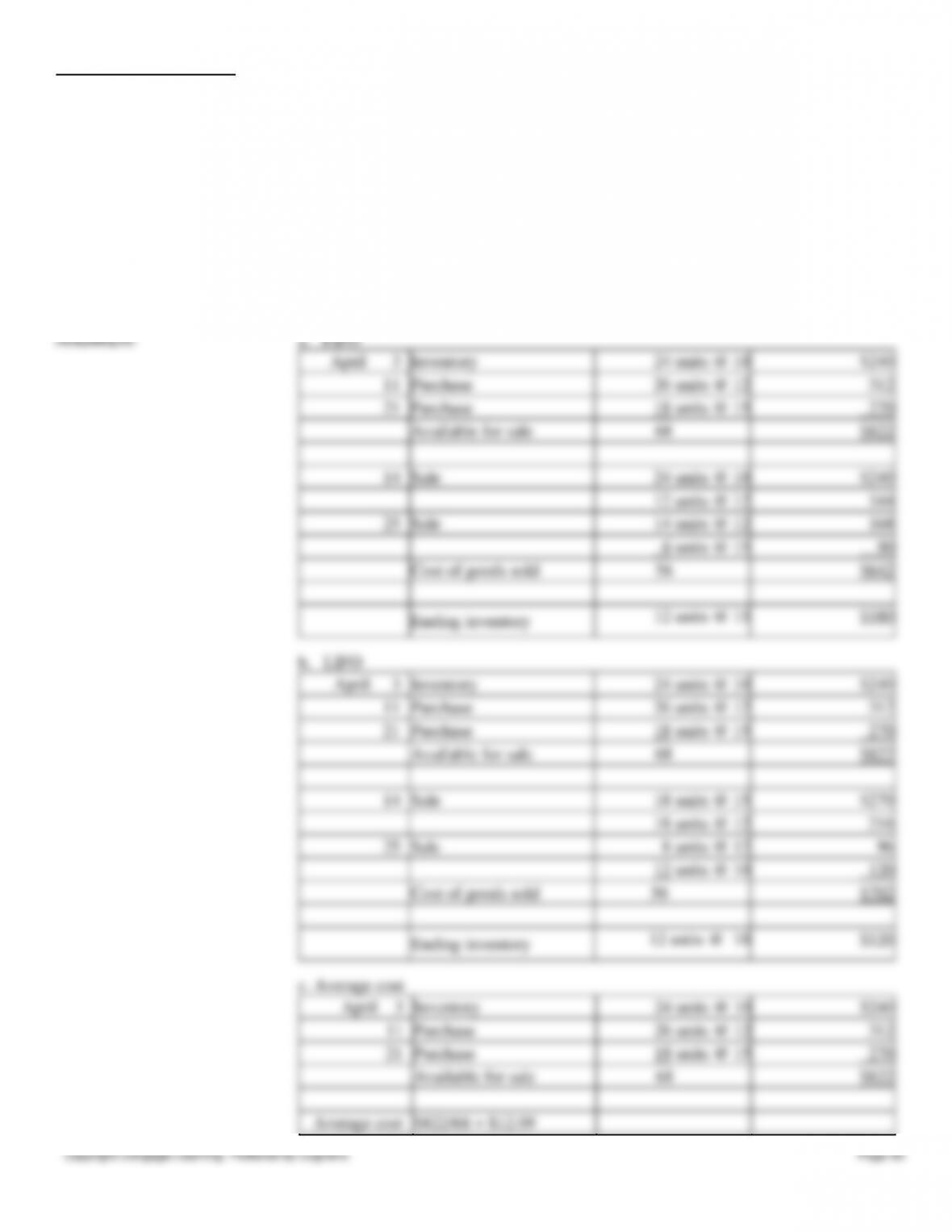
a. First-in, first-out
Purchases
Cost of Goods
Sold
Inventory
Unit
Total
Unit
Total
Unit
Total
Chapter 06 – Inventories
14
Sale
24 units @ 10
$240
12 units @ 12
144
25
Sale
14 units @ 12
168
6 units @ 15
90
Cost of goods sold
56
$642
Inventory
24 units @ 10
$240
Purchase
26 units @ 12
312
21
Purchase
18 units @ 15
270
Available for sale
$822
Sale
18 units @ 15
$270
18 units @ 12
216
Sale
12 units @ 10
Cost of goods sold
$702
Inventory
24 units @ 10
Purchase
26 units @ 12
Purchase
18 units @ 15
Available for sale
68
$822/68 = $12.09
April 3
Inventory
24 units
@
$10
11
Purchase
26 units
@
$12
14
Sale
36 units
21
Purchase
18 units
@
$15
25
Sale
20 units
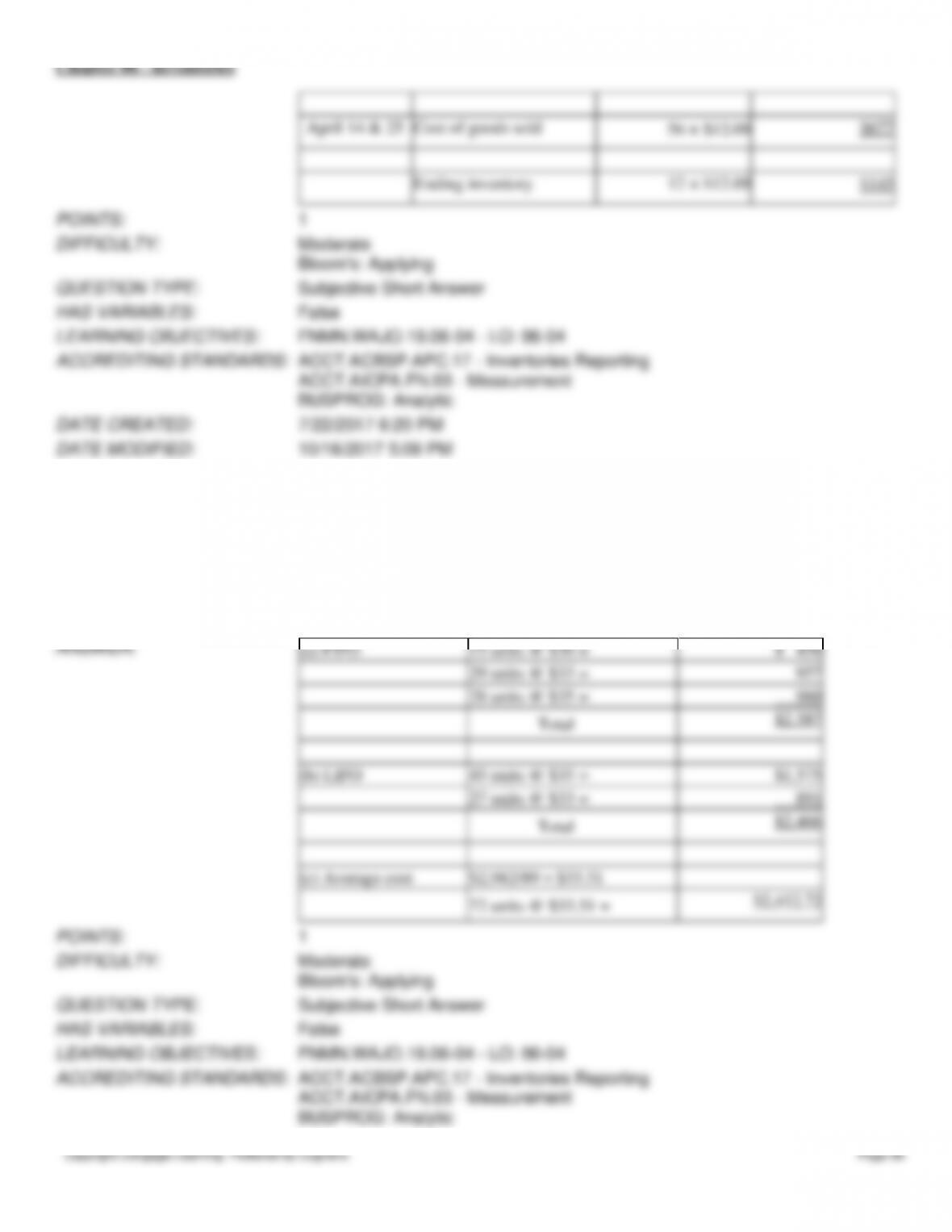
Assuming the business maintains a periodic inventory system, calculate the cost of goods sold and ending inventory under
the following assumptions:
a. FIFO
b. LIFO
c. Average cost (round cost of goods sold and ending inventory to the nearest dollar)
ANSWER:
a. FIFO
April 3
Inventory
24 units @ 10
$240
11
Purchase
26 units @ 12
312
21
Purchase
18 units @ 15
270
Available for sale
68
$822
Chapter 06 – Inventories
Merchandise shipped to a customer FOB destination was picked up by the freight company
(a)
no
(c)
no
(a)
Complete the table.
(b)
Determine the amount of reduction in the inventory at April 30 attributable to market
decline.
ANSWER:
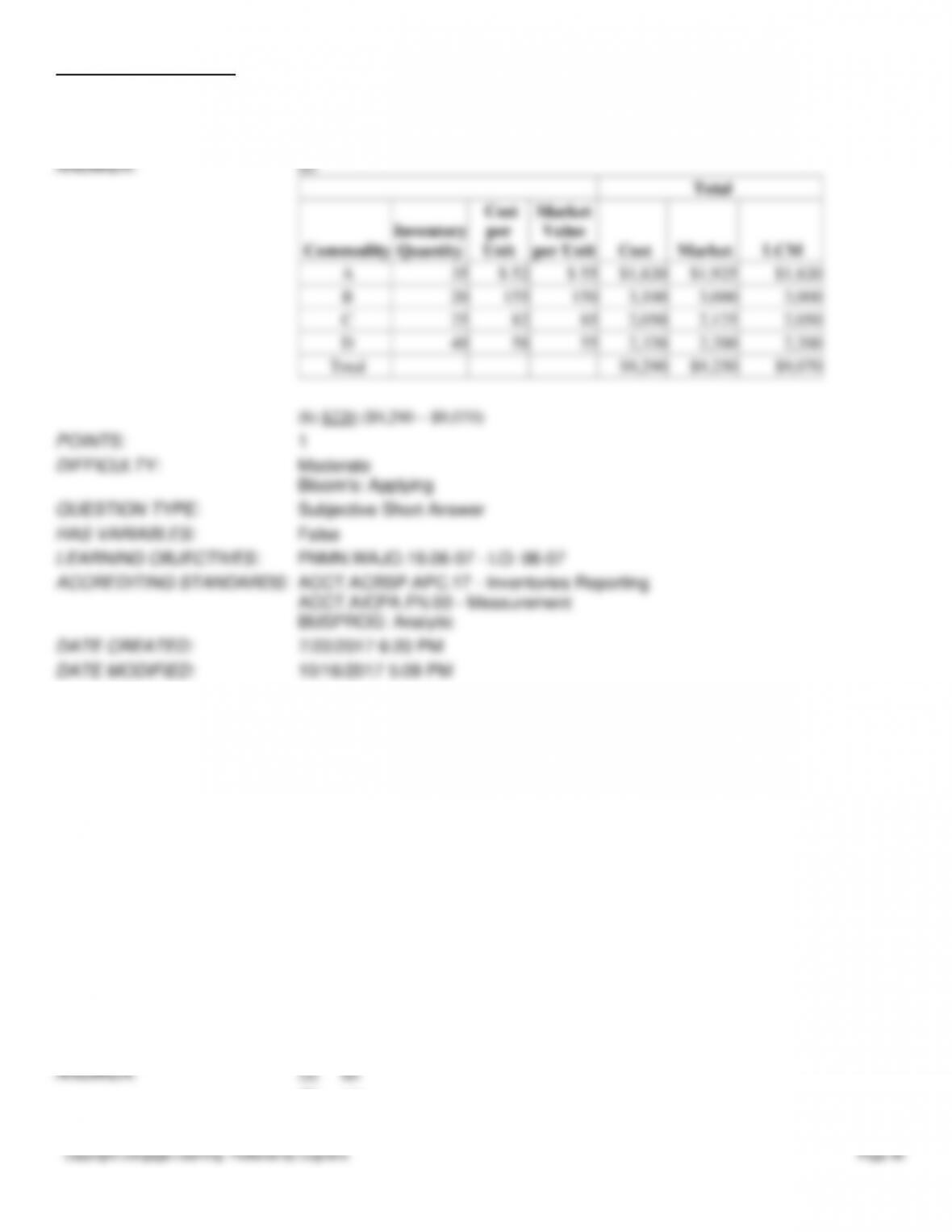
(a)
Total
Commodity
Inventory
Quantity
Cost
per
Unit
Market
Value
per Unit
Cost
Market
LCM
A
35
$ 52
$ 55
$1,820
$1,925
$1,820
B
20
155
150
3,100
3,000
3,000
C
25
82
85
2,050
2,125
2,050
D
40
58
55
2,320
2,200
2,200
Total
$9,290
$9,250
$9,070
(b) $220 ($9,290 – $9,070)
POINTS:
1
DIFFICULTY:
Moderate
Bloom’s: Applying
QUESTION TYPE:
Subjective Short Answer
HAS VARIABLES:
False
LEARNING OBJECTIVES:
FNMN.WAJO.19.06-07 – LO: 06–07
ACCREDITING STANDARDS:
ACCT.ACBSP.APC.17 – Inventories Reporting
ACCT.AICPA.FN.03 – Measurement
BUSPROG: Analytic
DATE CREATED:
7/22/2017 6:20 PM
DATE MODIFIED:
10/16/2017 5:09 PM
198. Hampton Co. took a physical count of its inventory on December 31. In addition, it had to decide whether or not the
following items should be added to this count.
(a)
Inventory on hand had been sold earlier in the year but had been returned by customers for
various warranty repairs.
(b)
Hampton Co. sent merchandise on a consignment basis on December 31 just prior to the
physical count.
(c)
On December 22, Hampton Co. ordered merchandise on FOB destination terms. The
merchandise was shipped by the supplier on December 30 but had not been received by
December 31.
(d)
On December 27, Hampton Co. ordered merchandise on FOB shipping point terms. The
merchandise was shipped on December 29 but had not been received by December 31.
(e)
Merchandise sold FOB shipping point on December 31 was picked up by the freight