Chapter 06 – Inventories
Bloom’s: Applying
10
Purchase
1
36
24
Purchase
1
37
Total
3
$108
Average cost per unit
$36
Assume one unit sells on July 28 for $45.
Determine the gross profit, cost of goods sold, and ending inventory on July 31 using (a) first-in, first-out, (b) last-in, first-
out, and (c) average cost flow methods.
ANSWER:
Gross Profit
Cost of Goods Sold
Ending Inventory
a) First-in, first-out
$45 – $35 = $10
$35
$108 – $35 = $73
b) Last-in, first-out
$45 – $37 = $8
$37
$108 – $37 = $71
c) Average
$45 – $36 = $9
$36
$108 – $36 = $72
POINTS:
1
DIFFICULTY:
Moderate
Bloom’s: Applying
QUESTION TYPE:
Subjective Short Answer
HAS VARIABLES:
False
LEARNING OBJECTIVES:
FNMN.WAJO.19.06-02 – LO: 06–02
ACCREDITING STANDARDS:
ACCT.ACBSP.APC.17 – Inventories Reporting
ACCT.AICPA.FN.03 – Measurement
BUSPROG: Analytic
TOPICS:
Example Exercise 7-1
DATE CREATED:
7/22/2017 6:20 PM
DATE MODIFIED:
10/16/2017 5:09 PM
POINTS:
1
Chapter 06 – Inventories
Copyright Cengage Learning. Powered by Cognero.
Page 65
31
70
5
31
Bal
ANSWER:
Purchases
Cost of Goods Sold
Inventory
Date
Qty
Unit
Cost
Total
Cost
Qty
Unit
Cost
Total
Cost
Qty
Unit
Cost
Total
Cost
July 2
600
12.00
7,200
600
12.00
7,200
5
200
13.00
2,600
600
200
12.00
13.00
7,200
2,600
7
300
12.00
3,600
300
200
12.00
13.00
3,600
2,600
10
325
14.00
4,550
300
200
325
12.00
13.00
14.00
3,600
2,600
4,550
12
300
150
12.00
13.00
3,600
1,950
50
325
13.00
14.00
650
4,550
18
250
13.00
3,250
50
325
250
13.00
14.00
13.00
650
4,550
3,250
22
50
205
13.00
14.00
650
2,870
120
250
14.00
13.00
1,680
3,250
25
120
14.00
1,680
180
13.00
2,340
70
13.00
910
28
330
15.00
4,950
70
330
13.00
15.00
910
4,950
31
70
5
13.00
15.00
910
75
325
15.00
4,875
31
Bal
17,67
5
4,875
POINTS:
1
DIFFICULTY:
Moderate
Bloom’s: Applying
QUESTION TYPE:
Subjective Short Answer
HAS VARIABLES:
False
LEARNING OBJECTIVE
S:
FNMN.WAJO.19.06-03 – LO: 06–03
ACCREDITING STANDA
RDS:
ACCT.ACBSP.APC.17 – Inventories Reporting
ACCT.AICPA.FN.03 – Measurement
BUSPROG: Analytic
DATE CREATED:
7/22/2017 6:20 PM
DATE MODIFIED:
10/16/2017 5:09 PM
167. Beginning inventory, purchases, and sales data for tennis rackets are as follows:
April 3
Inventory
12 units
@
$45
Chapter 06 – Inventories
Copyright Cengage Learning. Powered by Cognero.
Page 66
11
Purchase
13 units
@
$47
14
Sale
18 units
21
Purchase
9 units
@
$60
25
Sale
10 units
Complete the inventory cost card assuming the business maintains a perpetual inventory system and determine the cost of
goods sold and ending inventory using FIFO.
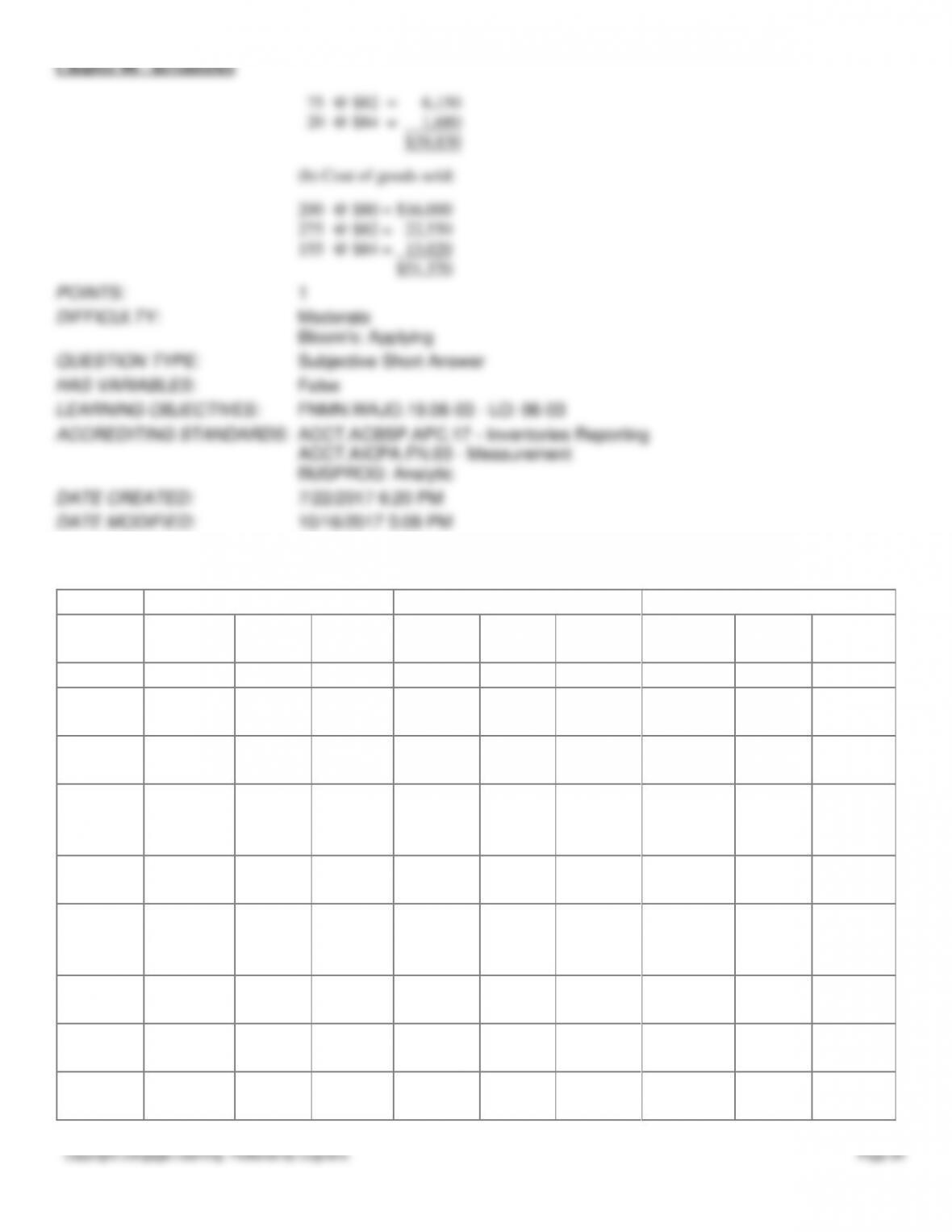
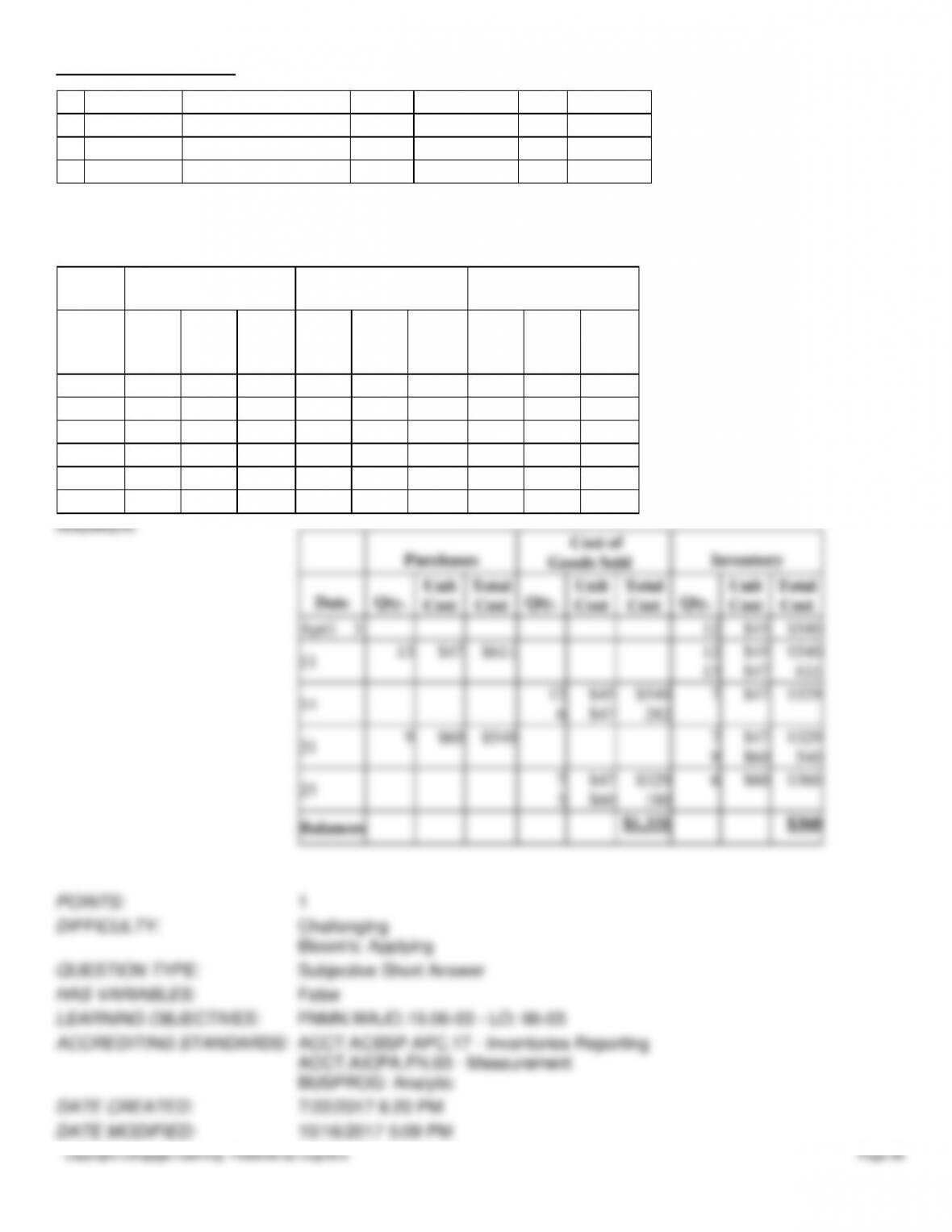
Purchases
Cost of
Goods Sold
Inventory
Date
Qty.
Unit
Cost
Total
Cost
Qty.
Unit
Cost
Total
Cost
Qty.
Unit
Cost
Total
Cost
Balances
ANSWER:
Purchases
Cost of
Goods Sold
Inventory
Date
Qty.
Unit
Cost
Total
Cost
Qty.
Unit
Cost
Total
Cost
Qty.
Unit
Cost
Total
Cost
April 3
12
$45
$540
11
13
$47
$611
12
13
$45
$47
$540
611
14
12
6
$45
$47
$540
282
7
$47
$329
21
9
$60
$540
7
9
$47
$60
$329
540
25
7
3
$47
$60
$329
180
6
$60
$360
Balances
$1,331
$360
POINTS:
1
DIFFICULTY:
Challenging
Bloom’s: Applying
QUESTION TYPE:
Subjective Short Answer
HAS VARIABLES:
False
LEARNING OBJECTIVES:
FNMN.WAJO.19.06-03 – LO: 06–03
ACCREDITING STANDARDS:
ACCT.ACBSP.APC.17 – Inventories Reporting
ACCT.AICPA.FN.03 – Measurement
BUSPROG: Analytic
DATE CREATED:
7/22/2017 6:20 PM
DATE MODIFIED:
10/16/2017 5:09 PM
Copyright Cengage Learning. Powered by Cognero.
Page 67
168. Beginning inventory, purchases, and sales data for tennis rackets are as follows:
April 3
Inventory
12 units
@
$45
11
Purchase
13 units
@
$47
14
Sale
18 units
21
Purchase
9 units
@
$60
25
Sale
10 units
Complete the inventory cost card assuming the business maintains a perpetual inventory system and determine the cost of
goods sold and ending inventory using LIFO.
Purchases
Cost of
Goods Sold
Inventory
Date
Qty.
Unit
Cost
Total
Cost
Qty.
Unit
Cost
Total
Cost
Qty.
Unit
Cost
Total
Cost
Balances
ANSWER:
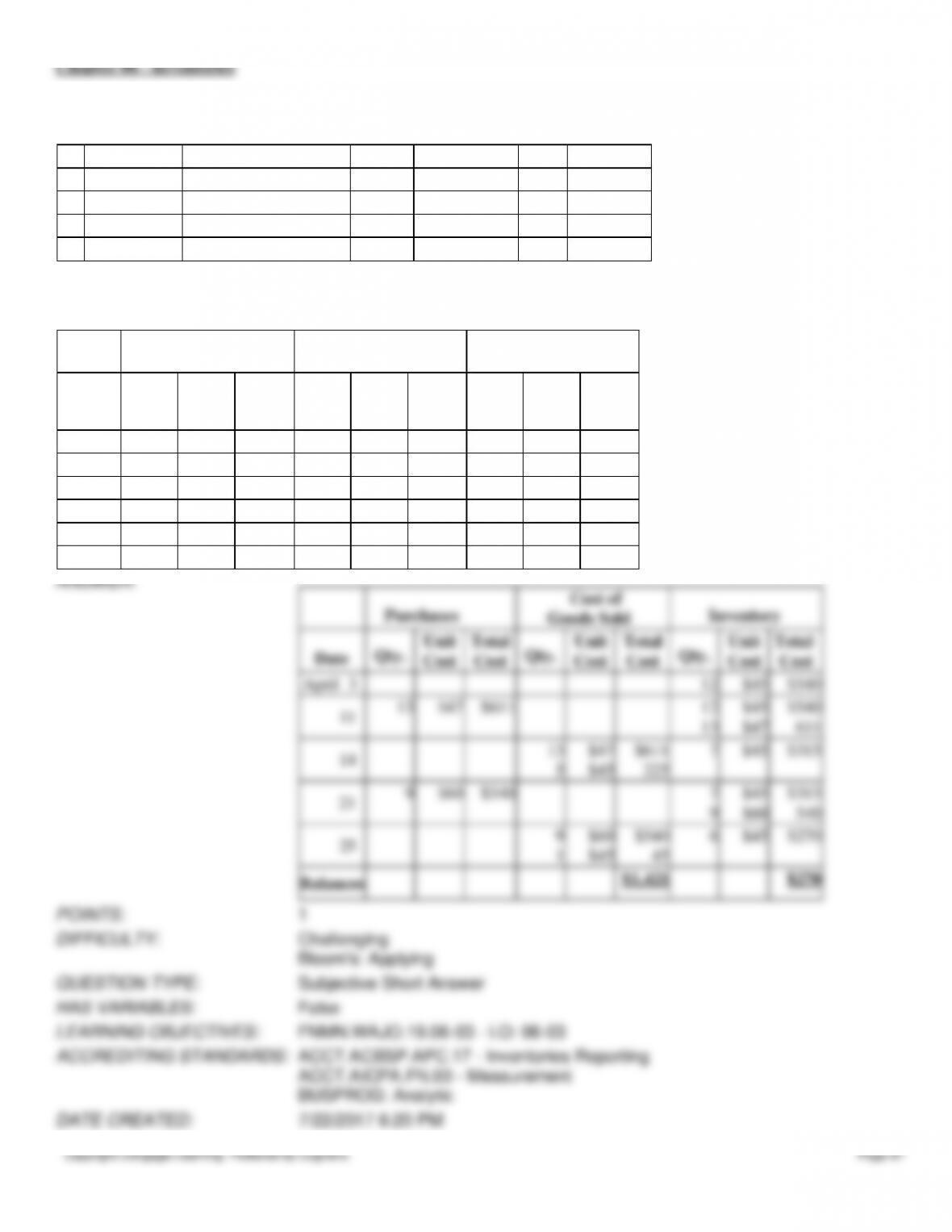
Purchases
Cost of
Goods Sold
Inventory
Date
Qty.
Unit
Cost
Total
Cost
Qty.
Unit
Cost
Total
Cost
Qty.
Unit
Cost
Total
Cost
April 3
12
$45
$540
11
13
$47
$611
12
13
$45
$47
$540
611
14
13
5
$47
$45
$611
225
7
$45
$315
21
9
$60
$540
7
9
$45
$60
$315
540
25
9
1
$60
$45
$540
45
6
$45
$270
Balances
$1,421
$270
1
DIFFICULTY:
Challenging
Bloom’s: Applying
QUESTION TYPE:
Subjective Short Answer
HAS VARIABLES:
False
LEARNING OBJECTIVES:
FNMN.WAJO.19.06-03 – LO: 06–03
ACCREDITING STANDARDS:
ACCT.ACBSP.APC.17 – Inventories Reporting
ACCT.AICPA.FN.03 – Measurement
BUSPROG: Analytic
DATE CREATED:
7/22/2017 6:20 PM