Chapter 05 – Accounting for Retail Businesses
Copyright Cengage Learning. Powered by Cognero.
Page 91
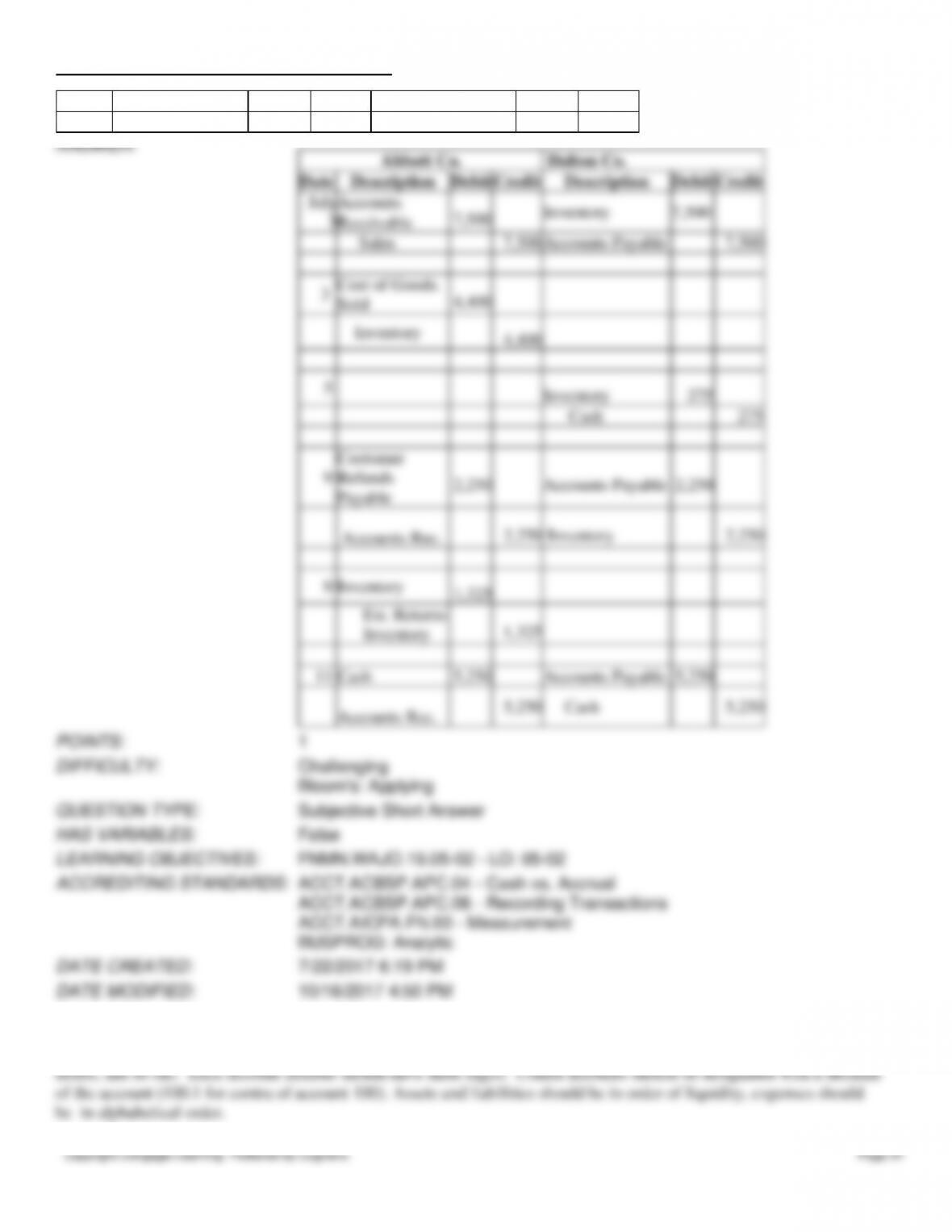
ANSWER:
Abbott Co.
Dalton Co.
Date
Description
Debit
Credit
Description
Debit
Credit
July
3
Accounts
Receivable
7,500
Inventory
7,500
Sales
7,500
Accounts Payable
7,500
3
Cost of Goods.
Sold
4,400
Inventory
4,400
5
Inventory
275
Cash
275
9
Customer
Refunds
Payable
2,250
Accounts Payable
2,250
Accounts Rec.
2,250
Inventory
2,250
9
Inventory
1,325
Est. Returns
Inventory
1,325
11
Cash
5,250
Accounts Payable
5,250
Accounts Rec.
5,250
Cash
5,250
POINTS:
1
DIFFICULTY:
Challenging
Bloom’s: Applying
QUESTION TYPE:
Subjective Short Answer
HAS VARIABLES:
False
LEARNING OBJECTIVES:
FNMN.WAJO.19.05–02 – LO: 05–02
ACCREDITING STANDARDS:
ACCT.ACBSP.APC.04 – Cash vs. Accrual
ACCT.ACBSP.APC.06 – Recording Transactions
ACCT.AICPA.FN.03 – Measurement
BUSPROG: Analytic
DATE CREATED:
7/22/2017 6:19 PM
DATE MODIFIED:
10/16/2017 4:50 PM
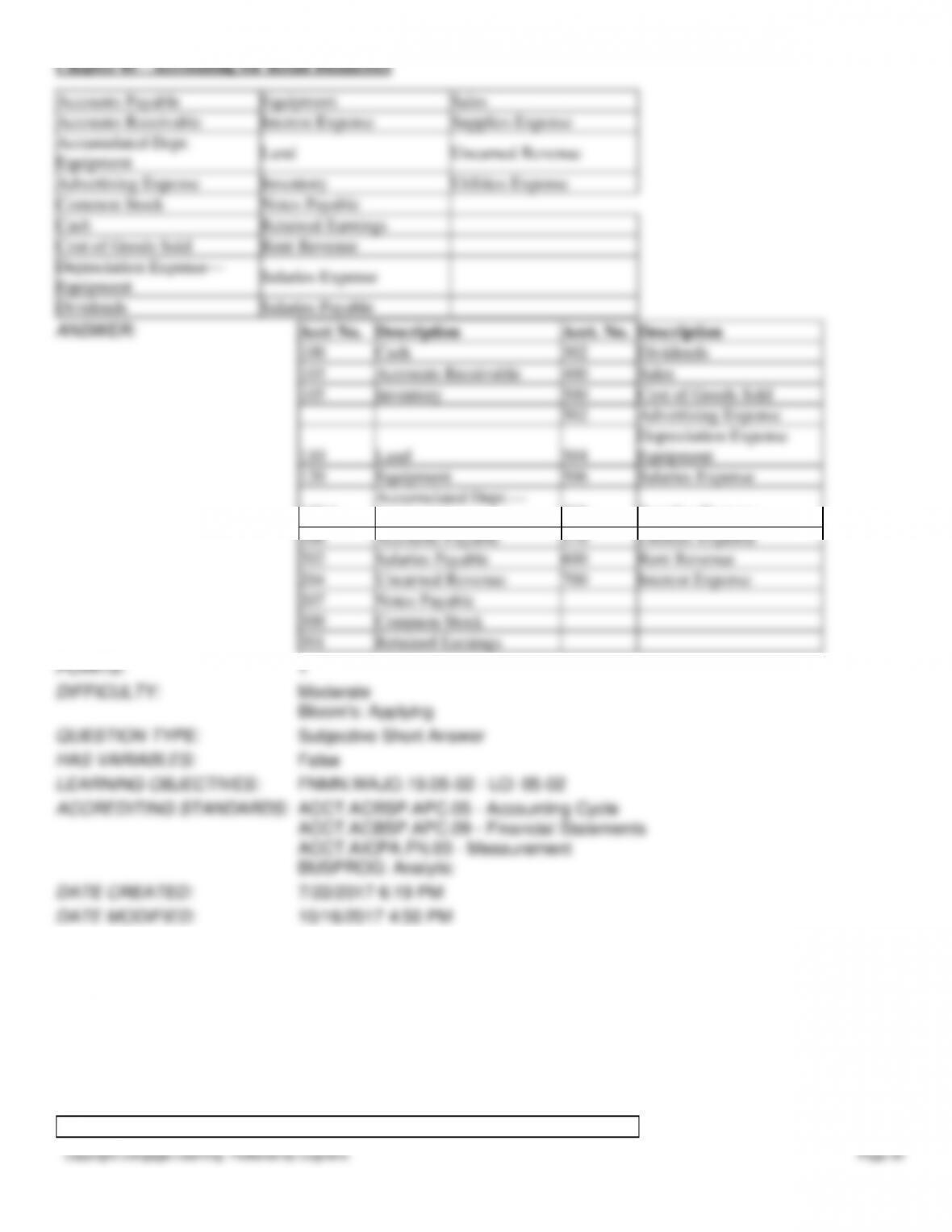
208. Using the list of accounts below, construct a chart of accounts for a merchandising business that rents out a portion of
its building, and assign account numbers and arranging the accounts in balance sheet and income statement order (“1” for
assets, and so on). Each account number should have three digits. Contra accounts should be designated with a decimal
of the account (100.1 for contra of account 100). Assets and liabilities should be in order of liquidity, expenses should
be in alphabetical order.
Chapter 05 – Accounting for Retail Businesses
Copyright Cengage Learning. Powered by Cognero.
Page 93
Date
Description
Debit
Credit
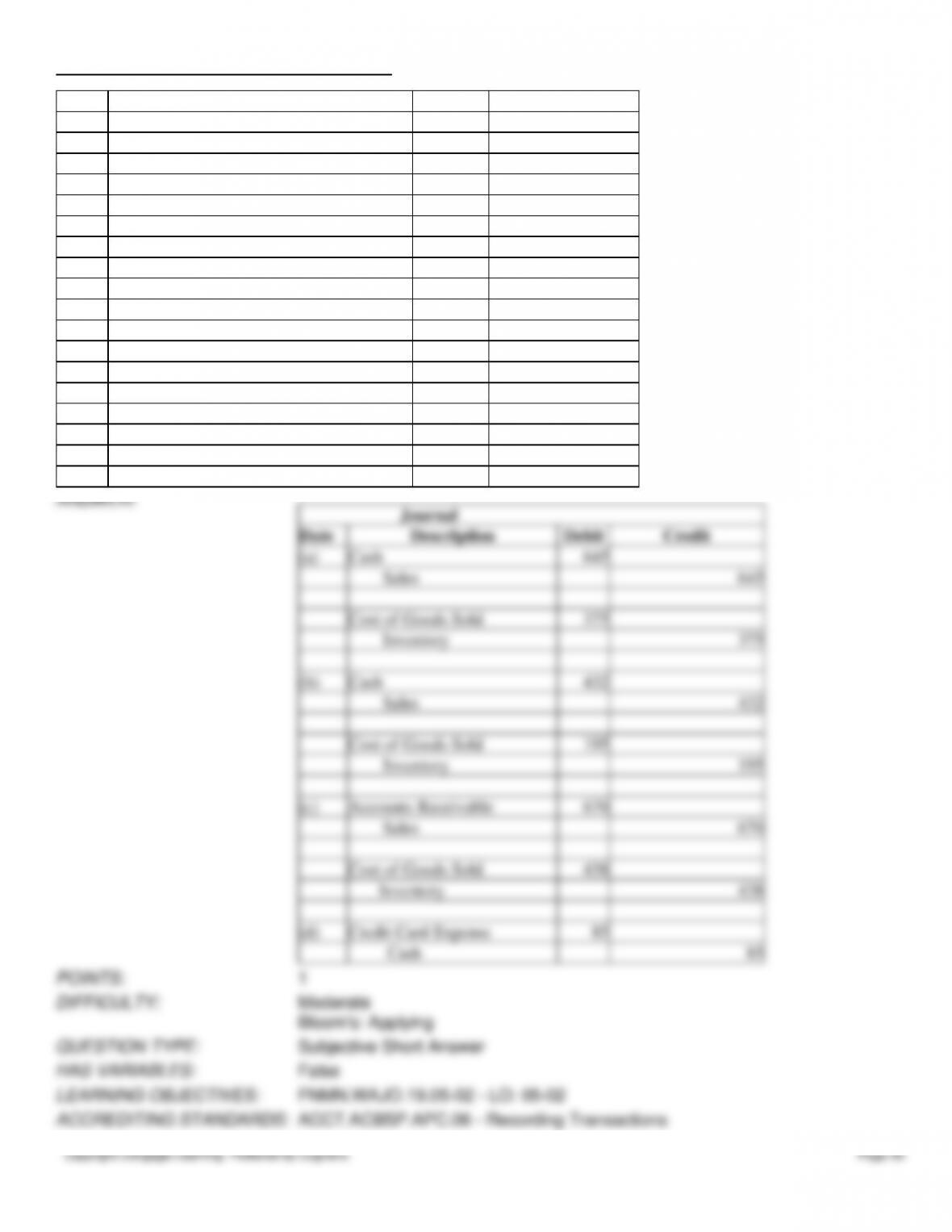
ANSWER:
Journal
Date
Description
Debit
Credit
(a)
Cash
645
Sales
645
Cost of Goods Sold
375
Inventory
375
(b)
Cash
432
Sales
432
Cost of Goods Sold
195
Inventory
195
(c)
Accounts Receivable
670
Sales
670
Cost of Goods Sold
438
Inventory
438
(d)
Credit Card Expense
85
Cash
85
POINTS:
1
DIFFICULTY:
Moderate
Bloom’s: Applying
QUESTION TYPE:
Subjective Short Answer
HAS VARIABLES:
False
LEARNING OBJECTIVES:
FNMN.WAJO.19.05–02 – LO: 05–02
ACCREDITING STANDARDS:
ACCT.ACBSP.APC.06 – Recording Transactions
Chapter 05 – Accounting for Retail Businesses
Copyright Cengage Learning. Powered by Cognero.
Page 95
(2) Inventory
(3) Sales
(4) Purchases Discounts
(5) Cost of Goods Sold
(6) Freight In
(7) Delivery Expense
ANSWER:
(1) a (2) c (3) c (4) a (5) b (6) a (7) c
POINTS:
1
DIFFICULTY:
Bloom’s: Understanding
Easy
QUESTION TYPE:
Subjective Short Answer
HAS VARIABLES:
False
LEARNING OBJECTIVES:
FNMN.WAJO.19.05–02 – LO: 05–02
FNMN.WAJO.19.05–05 – LO: 05–05
ACCREDITING STANDARDS:
ACCT.ACBSP.APC.17 – Inventories Reporting
ACCT.AICPA.FN.03 – Measurement
BUSPROG: Analytic
DATE CREATED:
7/22/2017 6:19 PM
DATE MODIFIED:
10/16/2017 4:50 PM
213. Using the letter preceding each account, arrange the following selected accounts in the order they would normally
appear in a chart of accounts of a company that uses a multiple-step income statement.
(a)
Accounts Payable
(b)
Accounts Receivable
(c)
Inventory
(d)
Miscellaneous Selling Expense
(e)
Interest Expense
(f)
Misc. Admin. Expense
(g)
Freight Out
ANSWER:
(b) (c) (a) (g) (d) (f) (e)
POINTS:
1
DIFFICULTY:
Bloom’s: Understanding
Moderate
QUESTION TYPE:
Subjective Short Answer
HAS VARIABLES:
False
LEARNING OBJECTIVES:
FNMN.WAJO.19.05–02 – LO: 05–02
FNMN.WAJO.19.05–05 – LO: 05–05
ACCREDITING STANDARDS:
ACCT.ACBSP.APC.09 – Financial Statements
ACCT.AICPA.FN.03 – Measurement
ACCT.AICPA.FN.04 – Reporting
BUSPROG: Analytic
DATE CREATED:
7/22/2017 6:19 PM
DATE MODIFIED:
10/16/2017 4:50 PM
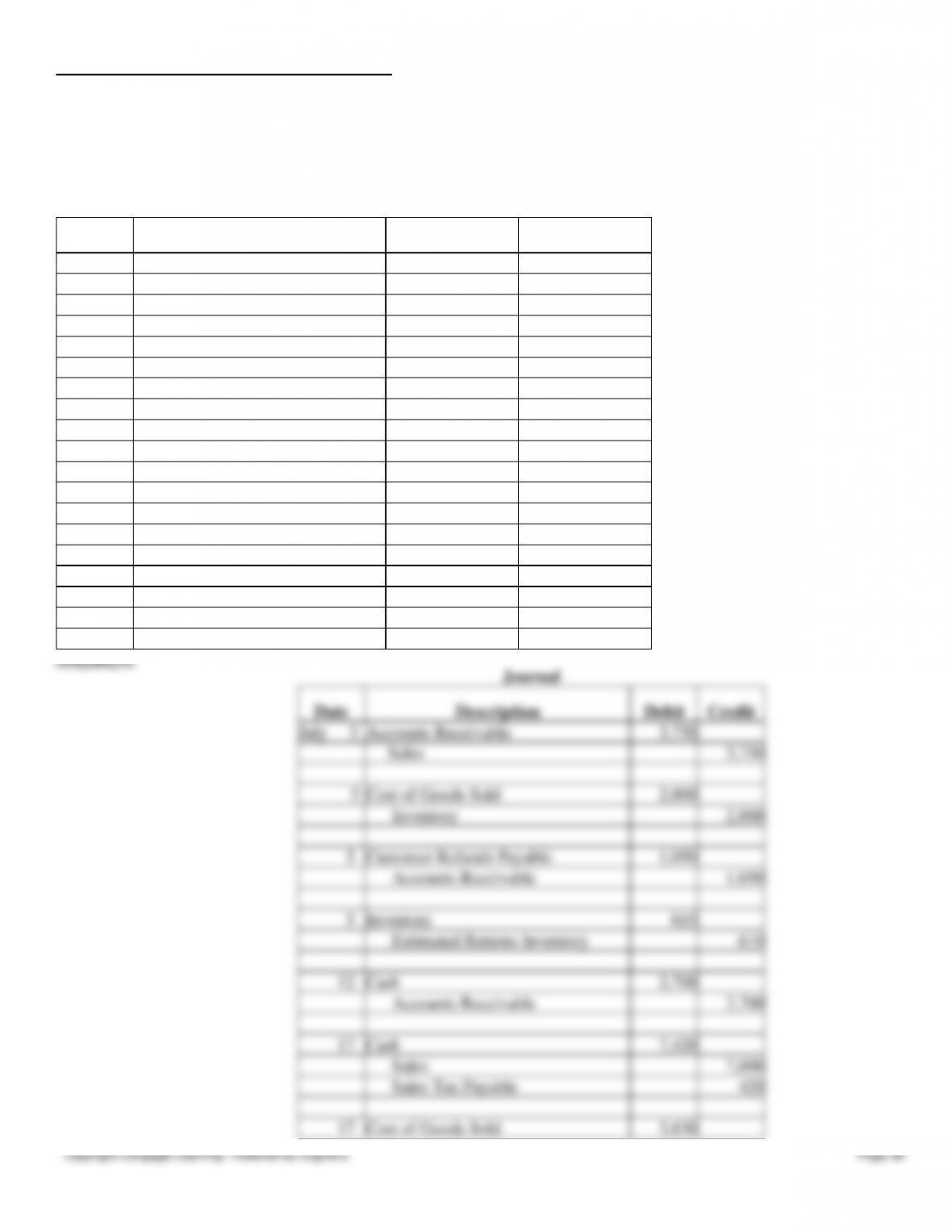
214. Journalize the following transactions assuming the perpetual inventory system:
July 3
Sold merchandise on account for $3,750 terms n/eom. The cost of the goods sold
was $2,000.
Chapter 05 – Accounting for Retail Businesses
Copyright Cengage Learning. Powered by Cognero.
Page 96
5
Issued credit memo for $1,050 for merchandise returned from sale on July 3.
The cost of the merchandise returned was $610.
12
Received check for the amount due for sale on July 3 less return on July 5.
17
Sold merchandise for $7,000 plus 6% sales tax to cash customers. The cost of the
goods sold was $3,830.
Date
Description
Debit
Credit
ANSWER:
Journal
Date
Description
Debit
Credit
July 3
Accounts Receivable
3,750
Sales
3,750
3
Cost of Goods Sold
2,000
Inventory
2,000
5
Customer Refunds Payable
1,050
Accounts Receivable
1,050
5
Inventory
610
Estimated Returns Inventory
610
12
Cash
2,700
Accounts Receivable
2,700
17
Cash
7,420
Sales
7,000
Sales Tax Payable
420
17
Cost of Goods Sold
3,830
Chapter 05 – Accounting for Retail Businesses
Copyright Cengage Learning. Powered by Cognero.
Page 99
ANSWER:
Cost of goods sold:
Inventory, June 1
$393,250
Cost of merchandise purchased:
Purchases
$1,579,600
Purchases returns and allowances
(81,200)
Purchases discounts
(16,500)
Net purchases
$1,481,900
Freight in
59,250
Total cost of merchandise purchased
1,541,150
Inventory available for sale
$1,934,400
Inventory, May 31
380,100
Cost of goods sold
$1,554,300
POINTS:
1
DIFFICULTY:
Bloom’s: Applying
Challenging
QUESTION TYPE:
Subjective Short Answer
HAS VARIABLES:
False
LEARNING OBJECTIVES:
FNMN.WAJO.19.05–04 – LO: 05–04
FNMN.WAJO.19.05–05 – LO: 05–05
ACCREDITING STANDARDS:
ACCT.ACBSP.APC.09 – Financial Statements
ACCT.AICPA.FN.03 – Measurement
BUSPROG: Analytic
DATE CREATED:
7/22/2017 6:19 PM
DATE MODIFIED:
10/16/2017 4:50 PM
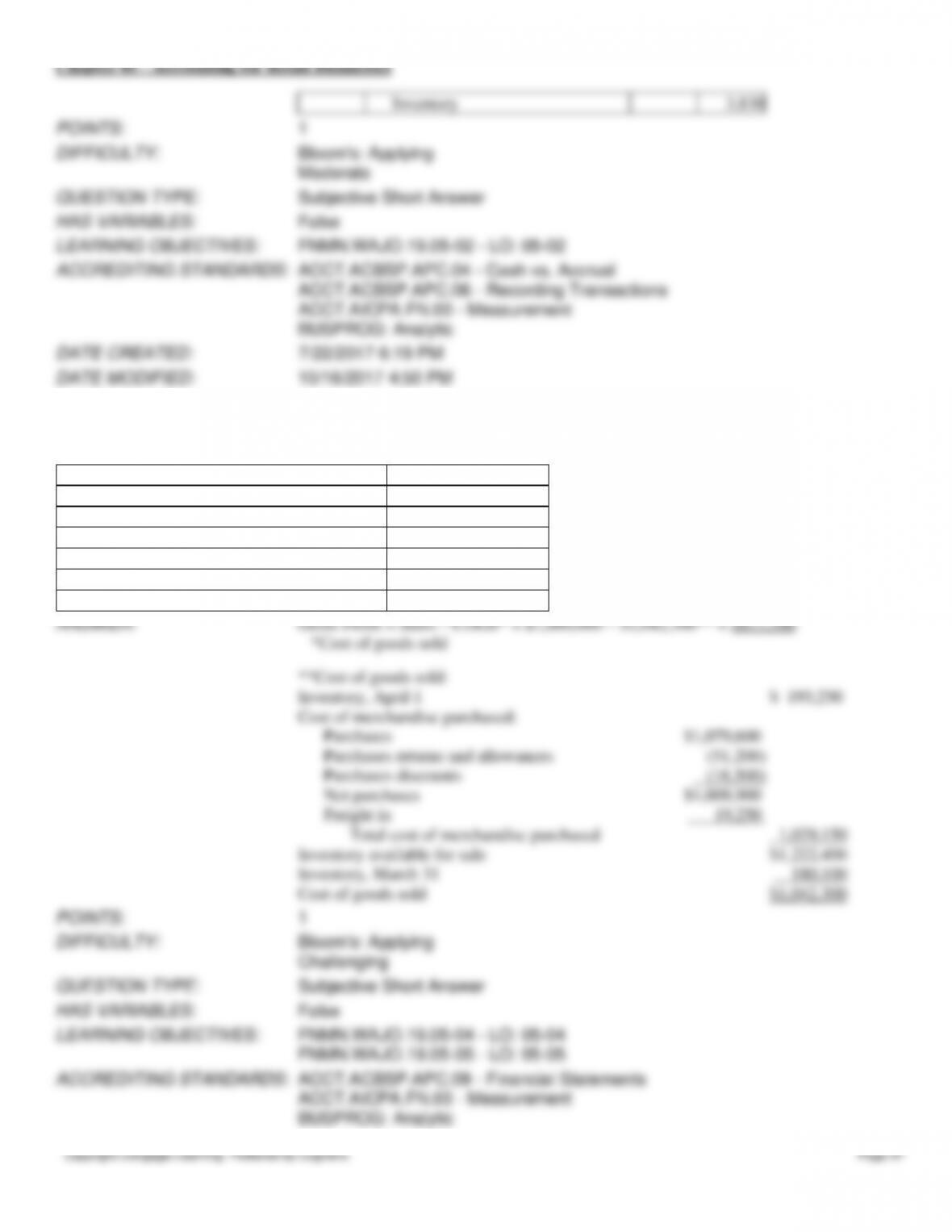
218. Using the following data taken from Payton Inc., which uses a periodic inventory system, determine the gross profit
to be reported on the income statement for the year ended May 31.
Inventory, June 1
$ 393,250
Inventory, May 31
380,100
Purchases
1,579,600
Purchases returns and allowances
81,200
Purchases discounts
16,500
Sales
2,060,000
Freight in
59,250
ANSWER:
Gross profit = Sales – COGS* = $2,060,000 – $1,554,300** = $505,700
*Cost of goods sold
**Cost of goods sold:
Inventory, June 1
$393,250
Purchases
$1,579,600
allowances
(81,200)
Purchases discounts
(16,500)
Net purchases
$1,481,900
Freight in
59,250
Total cost