Chapter 11 – Liabilities: Bonds Payable
Year 3
Oct. 1
Bonds Payable
1,000,000
Loss on Redemption of Bonds
40,000
Cash
1,040,000
POINTS:
1
Moderate
(c)
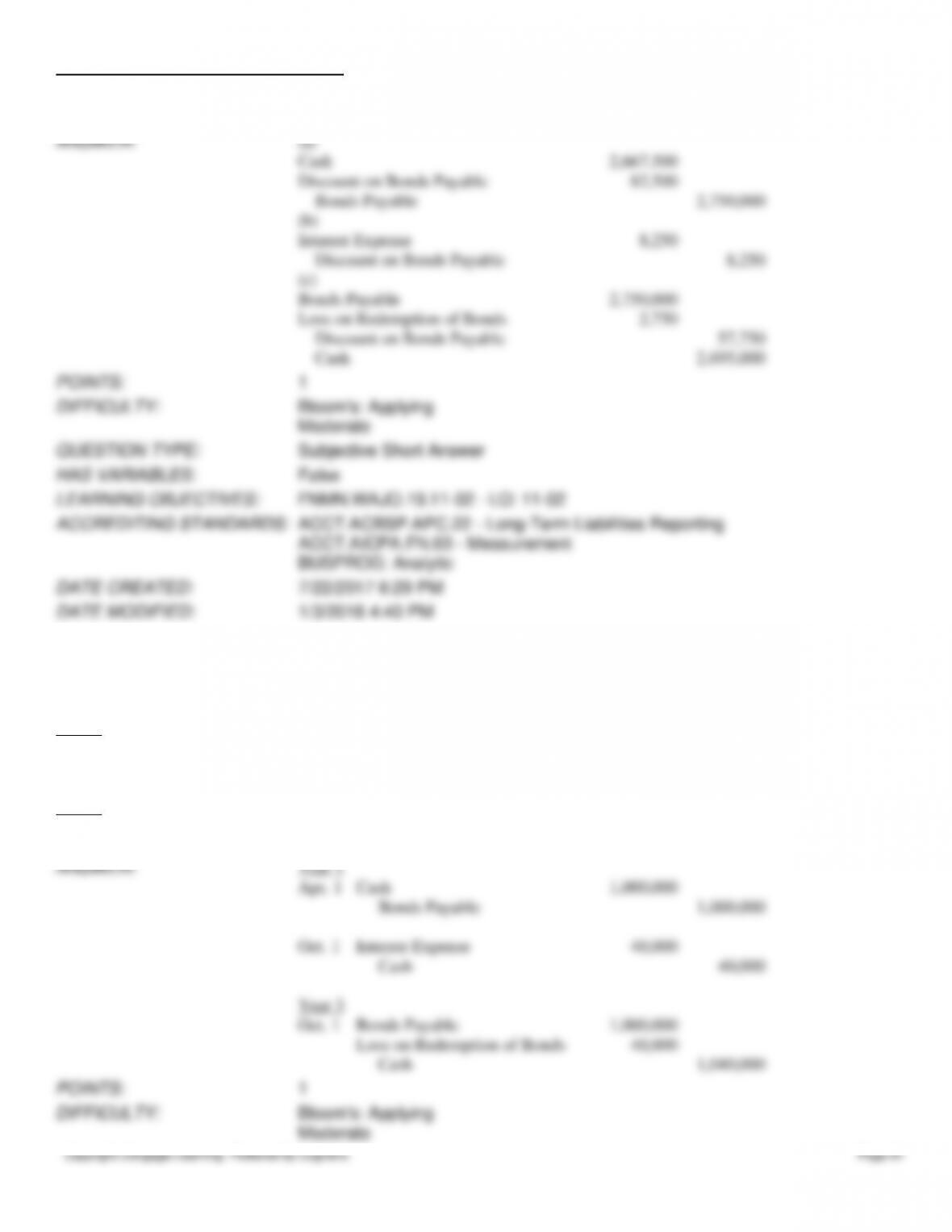
Called bonds at 98. Assume the bonds were carried at $2,692,250 at the time of the
redemption.
ANSWER:
(a)
Cash
2,667,500
Discount on Bonds Payable
82,500
Bonds Payable
2,750,000
(b)
Interest Expense
8,250
Discount on Bonds Payable
8,250
(c)
Bonds Payable
2,750,000
Loss on Redemption of Bonds
2,750
Discount on Bonds Payable
57,750
Cash
2,695,000
POINTS:
1
DIFFICULTY:
Bloom’s: Applying
Moderate
QUESTION TYPE:
Subjective Short Answer
HAS VARIABLES:
False
LEARNING OBJECTIVES:
FNMN.WAJO.19.11-02 – LO: 11–02
ACCREDITING STANDARDS:
ACCT.ACBSP.APC.22 – Long-Term Liabilities Reporting
ACCT.AICPA.FN.03 – Measurement
BUSPROG: Analytic
DATE CREATED:
7/22/2017 6:29 PM
DATE MODIFIED:
1/3/2018 4:40 PM
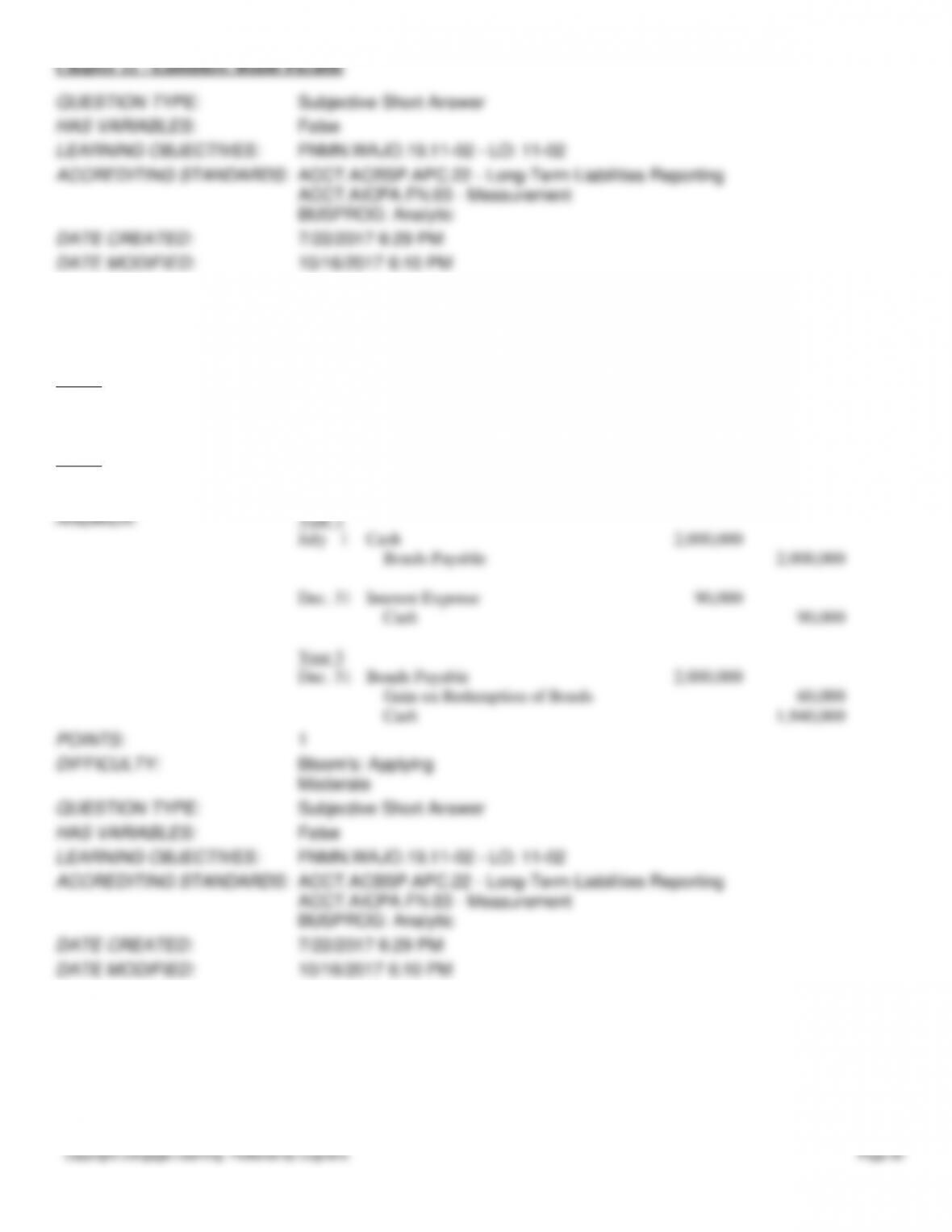
149. A company issued $1,000,000 of 30-year, 8% callable bonds on April 1, with interest payable on April 1 and October
1. The fiscal year of the company is the calendar year. Journalize the entries to record the following selected
transactions:
Year 1
Apr. 1
Issued the bonds for cash at their face amount.
Oct. 1
Paid the interest on the bonds.
Year 3
Oct. 1
Called the bond issue at 104, the rate provided in the bond indenture. (Omit entry for
payment of interest.)
ANSWER:
Year 1
Apr. 1
Cash
1,000,000
Bonds Payable
1,000,000
Oct. 1
Interest Expense
40,000
Cash
40,000
Chapter 11 – Liabilities: Bonds Payable
BUSPROG: Analytic
DATE CREATED:
7/22/2017 6:29 PM
DATE MODIFIED:
10/16/2017 6:10 PM
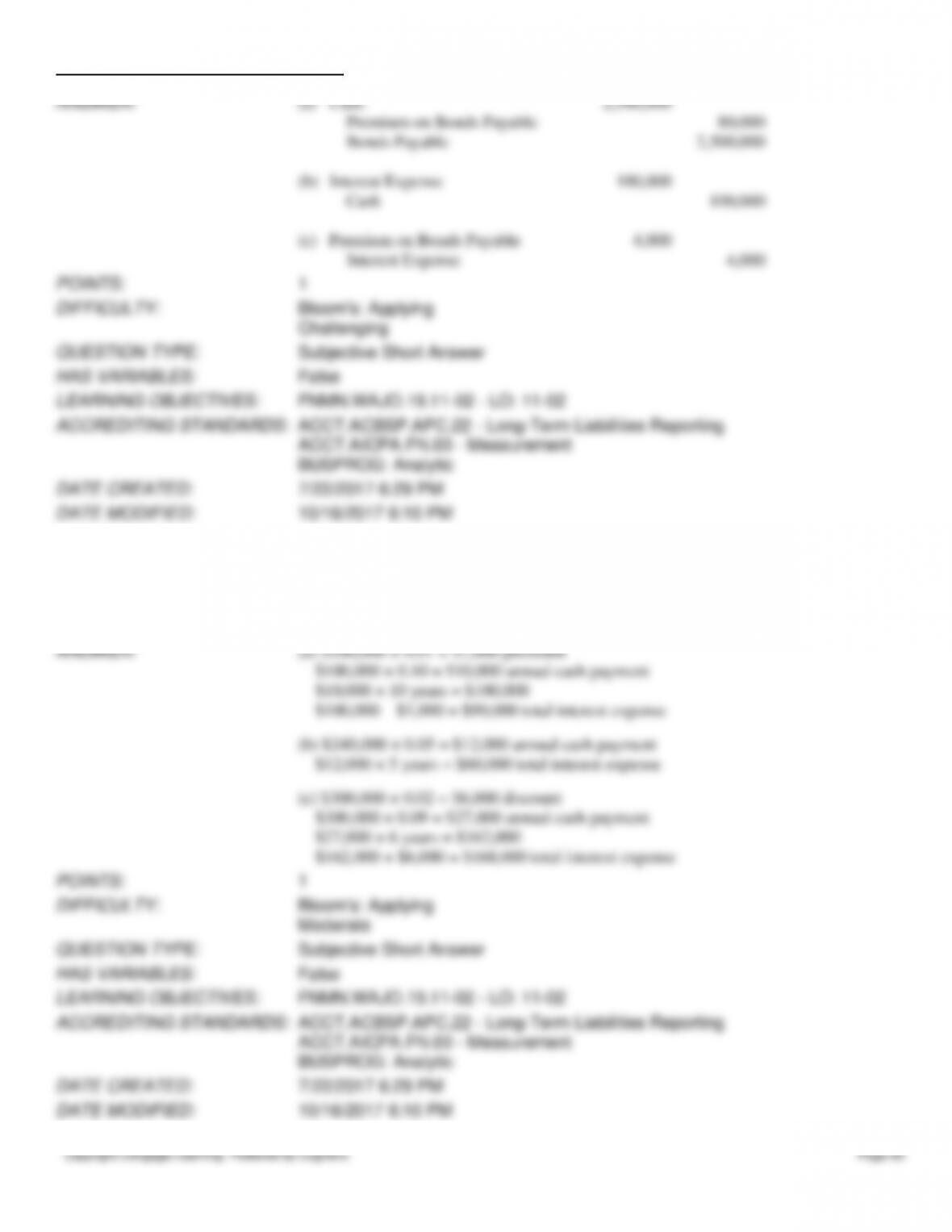
ANSWER:
(a)
Cash
2,580,000
Premium on Bonds Payable
80,000
Bonds Payable
2,500,000
(b)
Interest Expense
100,000
Cash
100,000
(c)
Premium on Bonds Payable
4,000
Interest Expense
4,000
POINTS:
1
DIFFICULTY:
Bloom’s: Applying
Challenging
QUESTION TYPE:
Subjective Short Answer
HAS VARIABLES:
False
LEARNING OBJECTIVES:
FNMN.WAJO.19.11-02 – LO: 11–02
ACCREDITING STANDARDS:
ACCT.ACBSP.APC.22 – Long-Term Liabilities Reporting
ACCT.AICPA.FN.03 – Measurement
BUSPROG: Analytic
DATE CREATED:
7/22/2017 6:29 PM
DATE MODIFIED:
10/16/2017 6:10 PM
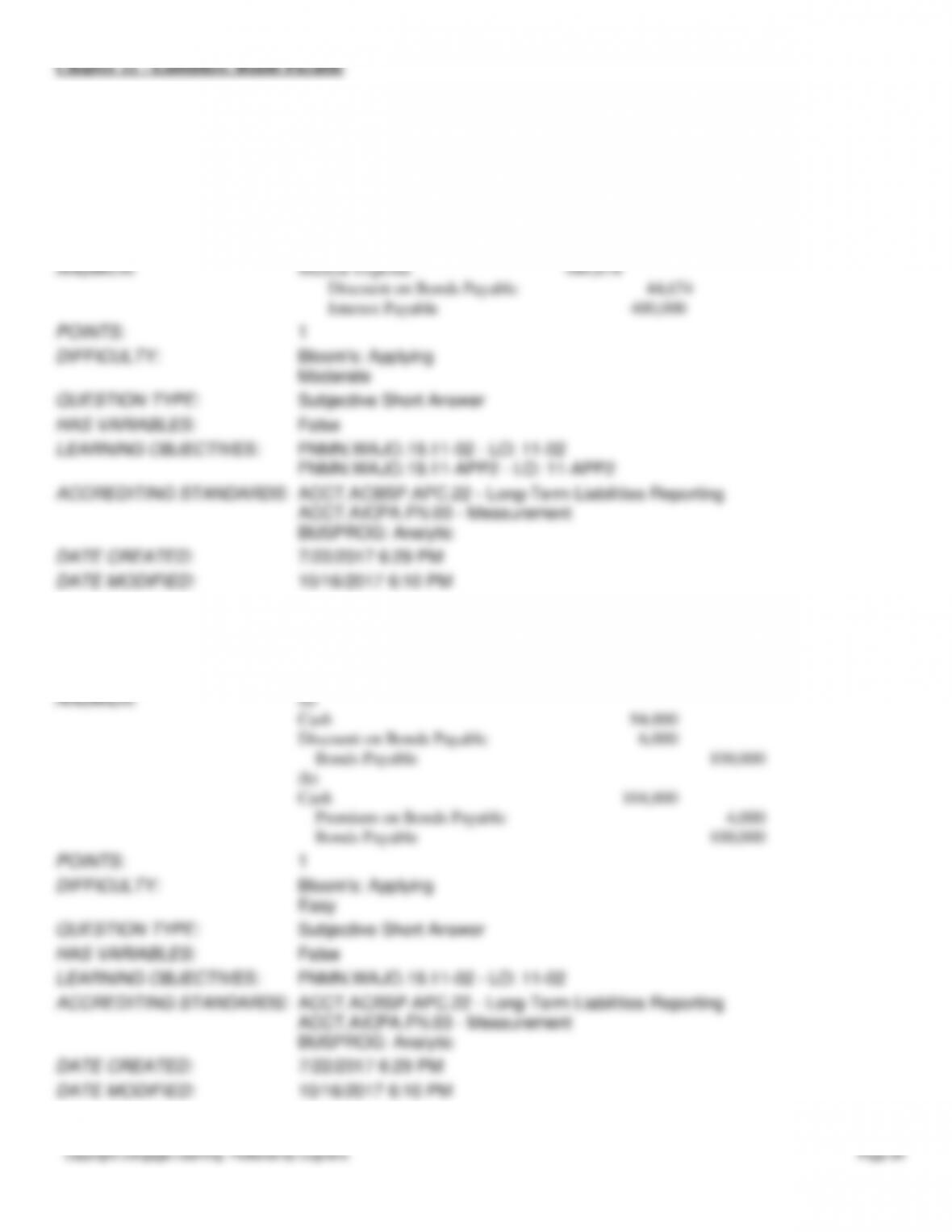
152. Calculate the total amount of interest expense over the life of the bonds for the following independent situations.
(a) $100,000 face value, 10%, 10-year bonds issued at 101.
(b) $240,000 face value, 5%, 5-year bonds issued at 100.
(c) $300,000 face value, 9%, 6-year bonds issued at 98.
ANSWER:
(a) $100,000 × 0.01 = $1,000 premium
$100,000 × 0.10 = $10,000 annual cash payment
$10,000 × 10 years = $100,000
$100,000 – $1,000 = $99,000 total interest expense
(b) $240,000 × 0.05 = $12,000 annual cash payment
$12,000 × 5 years = $60,000 total interest expense
(c) $300,000 × 0.02 = $6,000 discount
$300,000 × 0.09 = $27,000 annual cash payment
$27,000 × 6 years = $162,000
$162,000 + $6,000 = $168,000 total interest expense
POINTS:
1
DIFFICULTY:
Bloom’s: Applying
Moderate
QUESTION TYPE:
Subjective Short Answer
HAS VARIABLES:
False
LEARNING OBJECTIVES:
FNMN.WAJO.19.11-02 – LO: 11–02
Copyright Cengage Learning. Powered by Cognero.
Page 64
153. Given the following data, prepare the journal entry to record interest expense and any related amortization on
December 31 of the first year using the effective interest rate method. Assume interest is paid annually on January 1. The
bonds were issued on January 1 for $7,411,233.
Bonds payable, maturing in 10 years = $8,000,000
Contract interest rate = 5%
Market (effective) interest rate = 6%
Round answers to nearest dollar.
ANSWER:
Interest Expense 444,674
Discount on Bonds Payable 44,674
Interest Payable 400,000
POINTS:
1
DIFFICULTY:
Bloom’s: Applying
Moderate
QUESTION TYPE:
Subjective Short Answer
HAS VARIABLES:
False
LEARNING OBJECTIVES:
FNMN.WAJO.19.11-02 – LO: 11–02
FNMN.WAJO.19.11-APP2 – LO: 11–APP2
ACCREDITING STANDARDS:
ACCT.ACBSP.APC.22 – Long-Term Liabilities Reporting
ACCT.AICPA.FN.03 – Measurement
BUSPROG: Analytic
DATE CREATED:
7/22/2017 6:29 PM
DATE MODIFIED:
10/16/2017 6:10 PM
154.
(a)
Prepare the journal entry to issue $100,000 bonds that sold for $94,000.
(b)
Prepare the journal entry to issue $100,000 bonds that sold for $104,000.
ANSWER:
(a)
Cash
94,000
Discount on Bonds Payable
6,000
Bonds Payable
100,000
(b)
Cash
104,000
Premium on Bonds Payable
4,000
Bonds Payable
100,000
POINTS:
1
DIFFICULTY:
Bloom’s: Applying
Easy
QUESTION TYPE:
Subjective Short Answer
HAS VARIABLES:
False
LEARNING OBJECTIVES:
FNMN.WAJO.19.11-02 – LO: 11–02
ACCREDITING STANDARDS:
ACCT.ACBSP.APC.22 – Long-Term Liabilities Reporting
ACCT.AICPA.FN.03 – Measurement
BUSPROG: Analytic
DATE CREATED:
7/22/2017 6:29 PM
DATE MODIFIED:
10/16/2017 6:10 PM
155. Glover Corporation issued $2,000,000 of 7.5%, 6-year bonds dated March 1, with semiannual interest payments on
Chapter 11 – Liabilities: Bonds Payable
POINTS:
1
DIFFICULTY:
Bloom’s: Applying
September 1 and March 1. The bonds were issued on March 1, at 97. Glover’s year-end is December 31.
(a) Were the bonds issued at a premium, a discount, or at par?
(b) Was the market rate of interest higher, lower, or the same as the contract rate of interest?
(c) If the company uses the straight-line method of amortization, what is the amount of interest expense Glover
Corporation will show for the year ended December 31?
(d) What is the carrying value of the bonds on December 31?
ANSWER:
(a) The bonds were issued at a discount.
(b) The market rate of interest was higher than 7.5% since the bonds were issued at a
discount.
(c) $2,000,000 × 0.075 × 10/12 = $125,000 interest expense prior to amortization
$2,000,000 – $1,940,000 = $60,000 discount on bonds payable
$60,000/6 = $10,000 annual amortization of discount
$10,000 × 10/12 = $8,333 current year’s amortization of discount
$125,000 + $8,333 = $133,333
(d) $2,000,000 – $60,000 + $8,333 = $1,948,333
POINTS:
1
DIFFICULTY:
Bloom’s: Applying
Challenging
QUESTION TYPE:
Subjective Short Answer
HAS VARIABLES:
False
LEARNING OBJECTIVES:
FNMN.WAJO.19.11-02 – LO: 11–02
ACCREDITING STANDARDS:
ACCT.ACBSP.APC.22 – Long-Term Liabilities Reporting
ACCT.AICPA.FN.03 – Measurement
BUSPROG: Analytic
DATE CREATED:
7/22/2017 6:29 PM
DATE MODIFIED:
10/16/2017 6:10 PM
156. On January 1, Year 1, Kennard Co. issued $2,000,000, 5%, 10-year bonds, with interest payable on June 30
and December 31 to yield 6%. Use the following format and round figures to nearest dollar. The bonds were issued for
$1,851,234.
(a) Prepare an amortization schedule for Year 1 and Year 2 using the effective interest rate method.
Date Interest Paid Interest Expense Amortization Bond Carrying Amount
(b) Show how this bond would be reported on the balance sheet at December 31, Year 2.
ANSWER:
(a)
Date
Interest
Paid
Interest
Expense
Amortization
Bond
Carrying
Amount
1/1/Year 1
$1,851,234
6/30/Year 1
$50,000
$55,537
$5,537
1,856,771
12/31/Year 1
50,000
55,703
5,703
1,862,474
6/30/Year 2
50,000
55,874
5,874
1,868,348
12/31/Year 2
50,000
56,050
6,050
1,874,398
Copyright Cengage Learning. Powered by Cognero.
Page 69
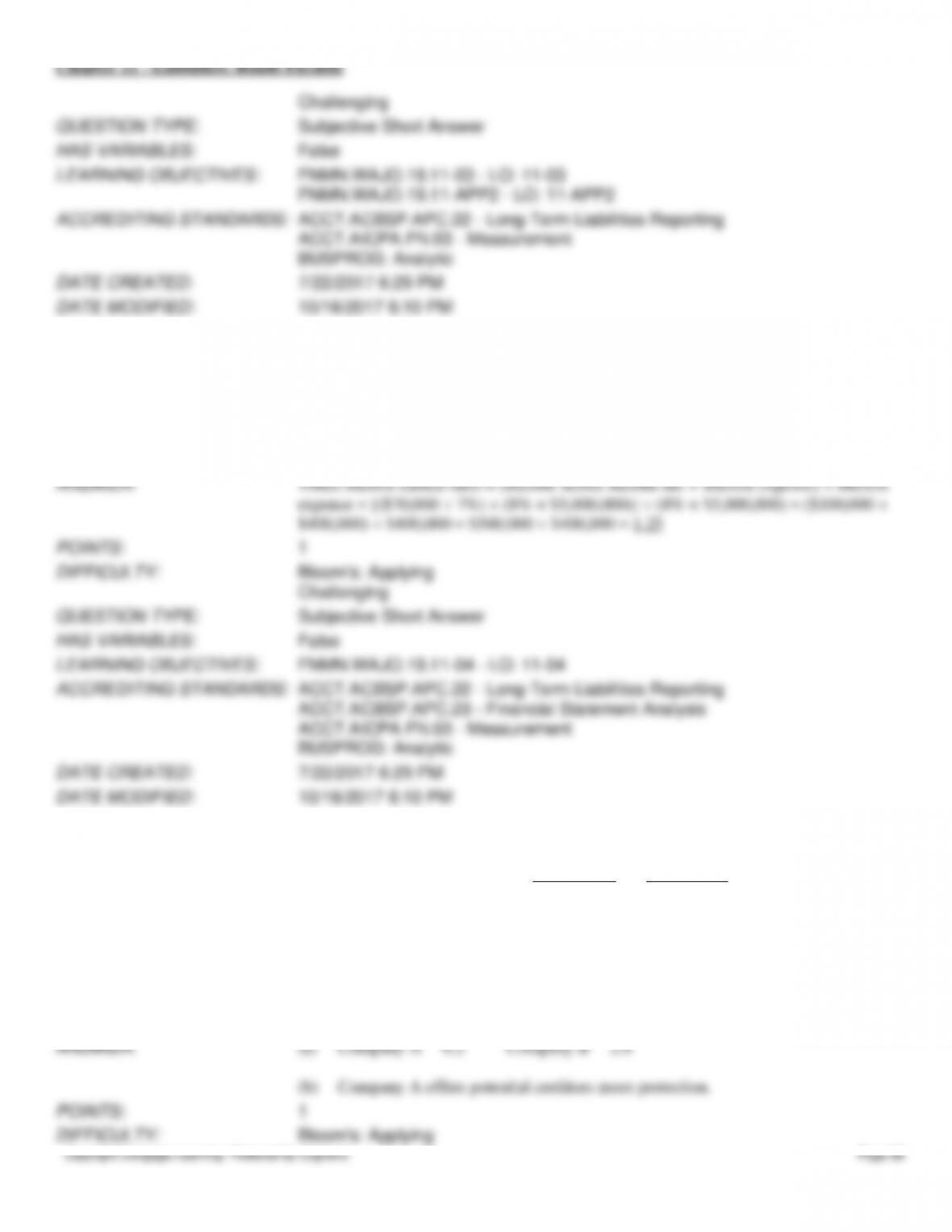
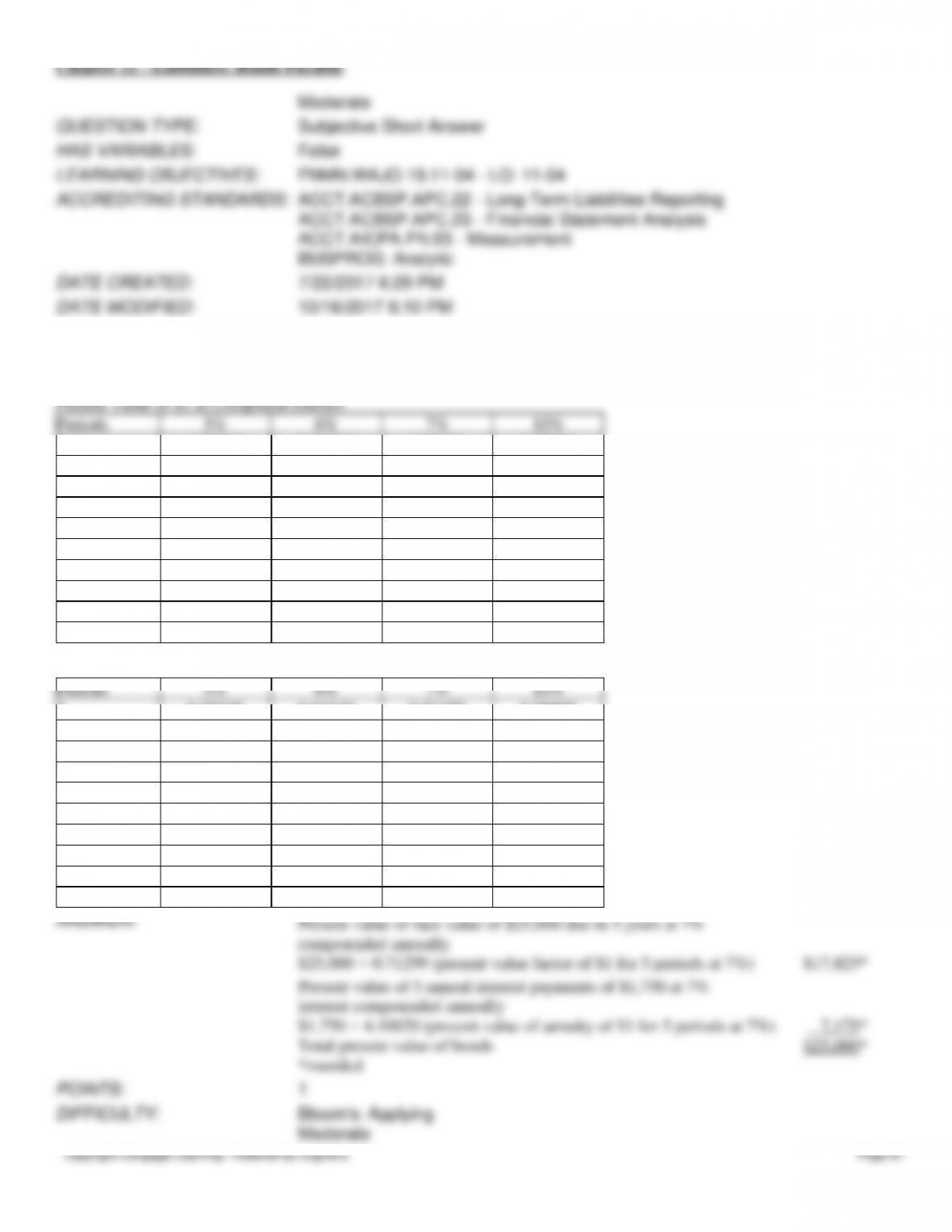
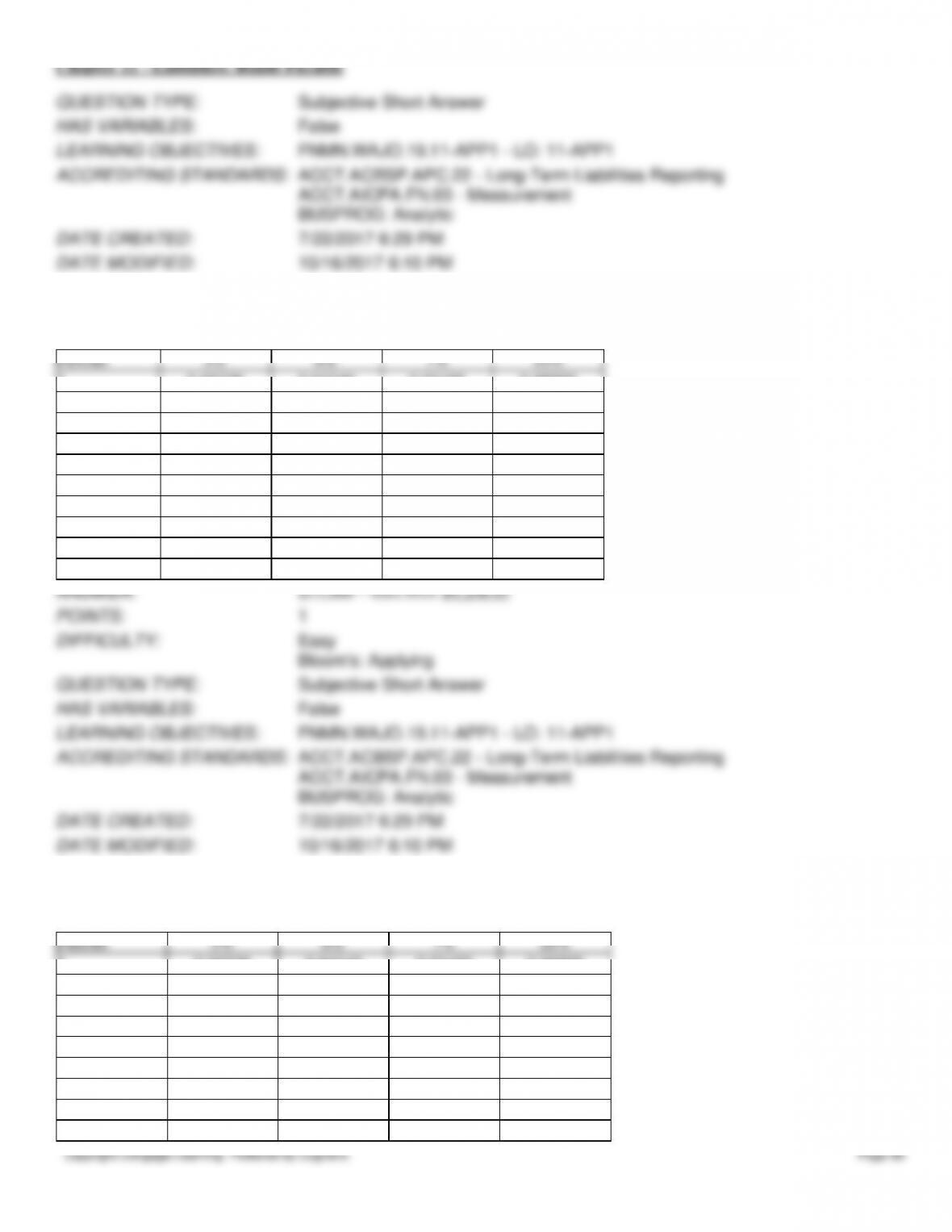
10
0.61391
0.55840
0.50835
0.38554
ANSWER:
$40,000 × 0.71299 = $28,519.60
POINTS:
1
DIFFICULTY:
Easy
Bloom’s: Applying
QUESTION TYPE:
Subjective Short Answer
HAS VARIABLES:
False
LEARNING OBJECTIVES:
FNMN.WAJO.19.11-APP1 – LO: 11–APP1
ACCREDITING STANDARDS:
ACCT.ACBSP.APC.22 – Long-Term Liabilities Reporting
ACCT.AICPA.FN.03 – Measurement
BUSPROG: Analytic
DATE CREATED:
7/22/2017 6:29 PM
DATE MODIFIED:
10/16/2017 6:10 PM
162. A company issued $1,000,000 of 30-year, 8% callable bonds on April 1, with interest payable on April 1 and October
1. The fiscal year of the company is the calendar year. What is the journal entry needed when the bonds are issued at face
value?
a.
debit Bonds Payable, credit Cash
b.
debit Cash and Discount on Bonds Payable, credit Bonds Payable
c.
debit Cash, credit Premium on Bonds Payable and Bonds Payable
d.
debit Cash, credit Bonds Payable
ANSWER:
d
POINTS:
1
DIFFICULTY:
Bloom’s: Applying
Moderate
QUESTION TYPE:
Multiple Choice
HAS VARIABLES:
False
LEARNING OBJECTIVES:
FNMN.WAJO.19.11-02 – LO: 11–02
ACCREDITING STANDARDS:
ACCT.ACBSP.APC.22 – Long-Term Liabilities Reporting
ACCT.AICPA.FN.03 – Measurement
BUSPROG – Analytic
DATE CREATED:
9/29/2017 6:52 PM
DATE MODIFIED:
10/16/2017 6:10 PM
163. A company issued $1,000,000 of 30-year, 8% callable bonds on April 1, with interest payable on April 1 and October
1. The fiscal year of the company is the calendar year. The bonds are called at the end of year 3 for 104. What is the
entry to record the redemption? (Assume the interest payment has been recorded separately.)
a.
Bonds Payable 1,000,000
Gain on Redemption of Bonds 40,000
Cash 1,040,000
b.
Bonds Payable 1,000,000
Loss on Redemption of Bonds 40,000
Cash 1,040,000
c.
Bonds Payable 1,000,000
Cash 1,000,000
d.
Bonds Payable 1,040,000
Cash 1,000,000
Chapter 11 – Liabilities: Bonds Payable
Copyright Cengage Learning. Powered by Cognero.
Page 70
Loss on Redemption of Bonds 40,000
ANSWER:
b
POINTS:
1
DIFFICULTY:
Bloom’s: Applying
Moderate
QUESTION TYPE:
Multiple Choice
HAS VARIABLES:
False
LEARNING OBJECTIVES:
FNMN.WAJO.19.11-02 – LO: 11–02
ACCREDITING STANDARDS:
ACCT.ACBSP.APC.22 – Long-Term Liabilities Reporting
ACCT.AICPA.FN.03 – Measurement
BUSPROG – Analytic
DATE CREATED:
9/29/2017 6:57 PM
DATE MODIFIED:
10/16/2017 6:10 PM
164. Luke Corp. issued $2,000,000 of 20-year, 9% callable bonds on July 1, Year 1, with interest payable on June 30 and
December 31. The fiscal year of the company is the calendar year. What is the entry to record the payment of interest on
December 31 in the year the bonds were issued?
a.
Interest Expense 180,000
Cash 180,000
b.
Interest Payable 90,000
Interest Expense 90,000
Cash 180,000
c.
Interest Expense 90,000
Cash 90,000
d.
Cash 90,000
Interest Expense 90,000
ANSWER:
c
POINTS:
1
DIFFICULTY:
Bloom’s: Applying
Moderate
QUESTION TYPE:
Multiple Choice
HAS VARIABLES:
False
LEARNING OBJECTIVES:
FNMN.WAJO.19.11-02 – LO: 11–02
ACCREDITING STANDARDS:
ACCT.ACBSP.APC.22 – Long-Term Liabilities Reporting
ACCT.AICPA.FN.03 – Measurement
BUSPROG – Analytic
DATE CREATED:
9/29/2017 7:01 PM
DATE MODIFIED:
10/16/2017 6:10 PM
165. Luke Corp. issued $2,000,000 of 20-year, 9% callable bonds on July 1, Year 1, with interest payable on June 30 and
December 31. The fiscal year of the company is the calendar year. What is the entry to record the calling of the bonds at
the end of year 5 at 97? (Assume interest for the period has been separately recorded.)
a.
Bonds Payable 2,000,000
Gain on Redemption of Bonds 60,000
Cash 1,940,000
b.
Bonds Payable 2,000,000
Gain on Redemption of Bonds 60,000