Chapter 10 – Liabilities: Current, Installment Notes, and Contingencies
Inventory
20,000
Equipment
50,000
Current portion of long-term debt
20,000
Accounts payable
12,000
Long-term debt
25,000
*These represent prepaid expenses and other non-quick current assets.
(a) Determine the quick ratio for both companies. Round to two decimal places.
(b) Interpret the quick ratio difference between the two companies.
ANSWER:
(a) Quick ratio = Quick assets/Current liabilities
Kolbie Co.:
Quick ratio = ($8,352 + $6,034 + $3,029)/$8,299 = 2.10
Newton Co.:
Quick ratio = ($8,546 + $752 + $5,152)/$16,791 = 0.86
(b)
It is clear that Kolbie’s short-term liquidity is stronger than
Newton’s. Kolbie’s quick ratio is 144% [(2.10 – 0.86)/0.86]
higher. Kolbie has a much stronger relative cash and short-term
investment position than does Newton. Kolbie’s cash and short-
term investments are over 71% of total current assets (173% of
current liabilities), compared to Newton’s 52% of total current
assets (55% of current liabilities). In addition, Newton’s relative
accounts payable position is larger than Kolbie’s, indicating the
possibility that Newton has longer supplier payment terms than
does Kolbie. A quick ratio of 2.10 for Kolbie suggests ample
flexibility to make strategic investments with its excess cash,
while a quick ratio of 0.86 for Newton indicates an efficient but
tight quick asset management policy.
POINTS:
1
DIFFICULTY:
Bloom’s: Applying
Challenging
QUESTION TYPE:
Subjective Short Answer
HAS VARIABLES:
False
LEARNING OBJECTIVES:
FNMN.WAJO.19.10-07 – LO: 10–07
ACCREDITING STANDARDS:
ACCT.ACBSP.APC.16 – Current Liabilities Reporting
ACCT.ACBSP.APC.23 – Financial Statement Analysis
ACCT.AICPA.FN.03 – Measurement
BUSPROG: Analytic
DATE CREATED:
7/22/2017 6:27 PM
DATE MODIFIED:
10/16/2017 5:43 PM
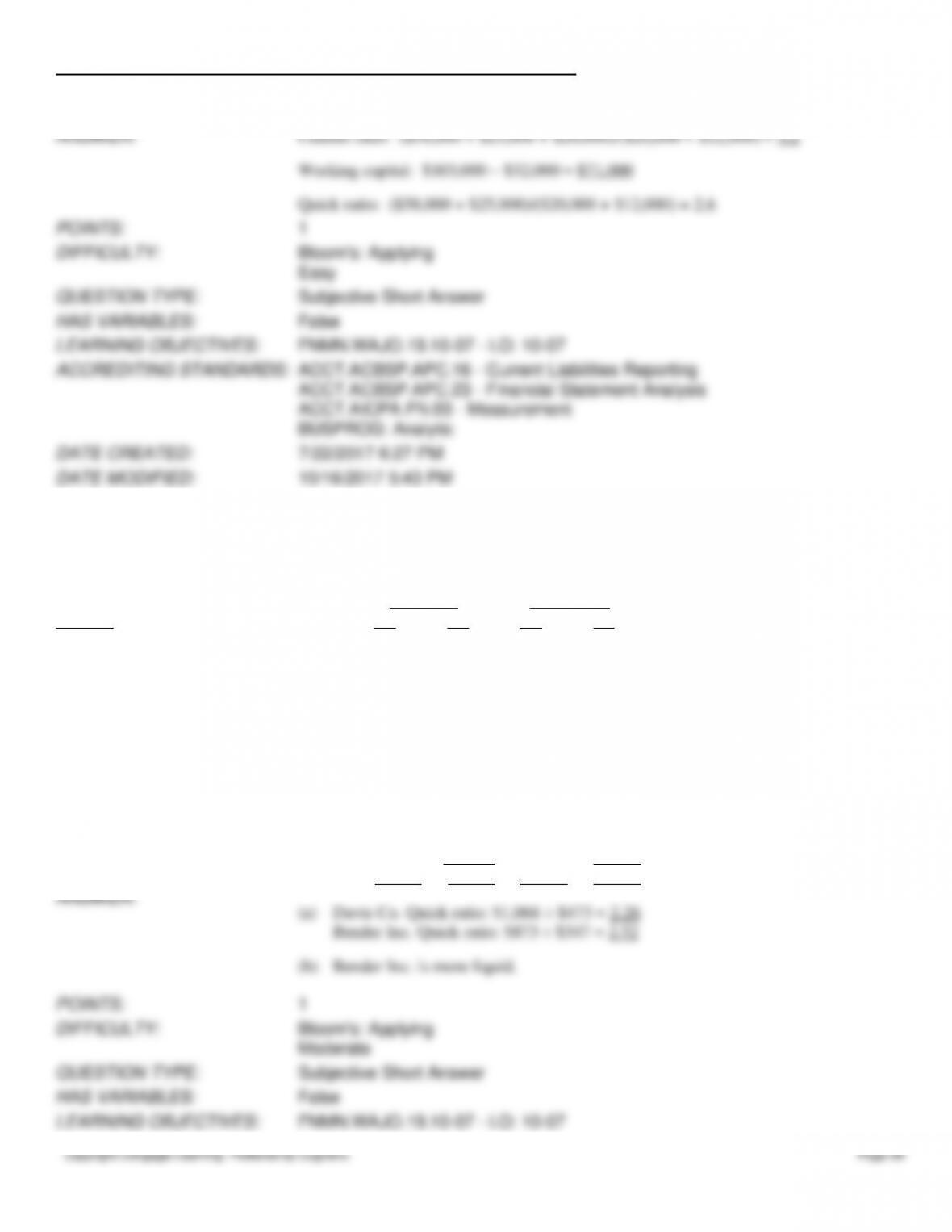
192. The Core Company had the following assets and liabilities as of December 31:
ASSETS
Cash
$58,000
Accounts receivable
25,000
Chapter 10 – Liabilities: Current, Installment Notes, and Contingencies
Calculate the current ratio, working capital, and quick ratio. Round ratios to one decimal place.
ANSWER:
Current ratio: ($58,000 + $25,000 + $20,000)/($20,000 + $12,000) = 3.2
Working capital: $103,000 – $32,000 = $71,000
Quick ratio: ($58,000 + $25,000)/($20,000 + $12,000) = 2.6
POINTS:
1
DIFFICULTY:
Bloom’s: Applying
Easy
QUESTION TYPE:
Subjective Short Answer
HAS VARIABLES:
False
LEARNING OBJECTIVES:
FNMN.WAJO.19.10-07 – LO: 10–07
ACCREDITING STANDARDS:
ACCT.ACBSP.APC.16 – Current Liabilities Reporting
ACCT.ACBSP.APC.23 – Financial Statement Analysis
ACCT.AICPA.FN.03 – Measurement
BUSPROG: Analytic
DATE CREATED:
7/22/2017 6:27 PM
DATE MODIFIED:
10/16/2017 5:43 PM
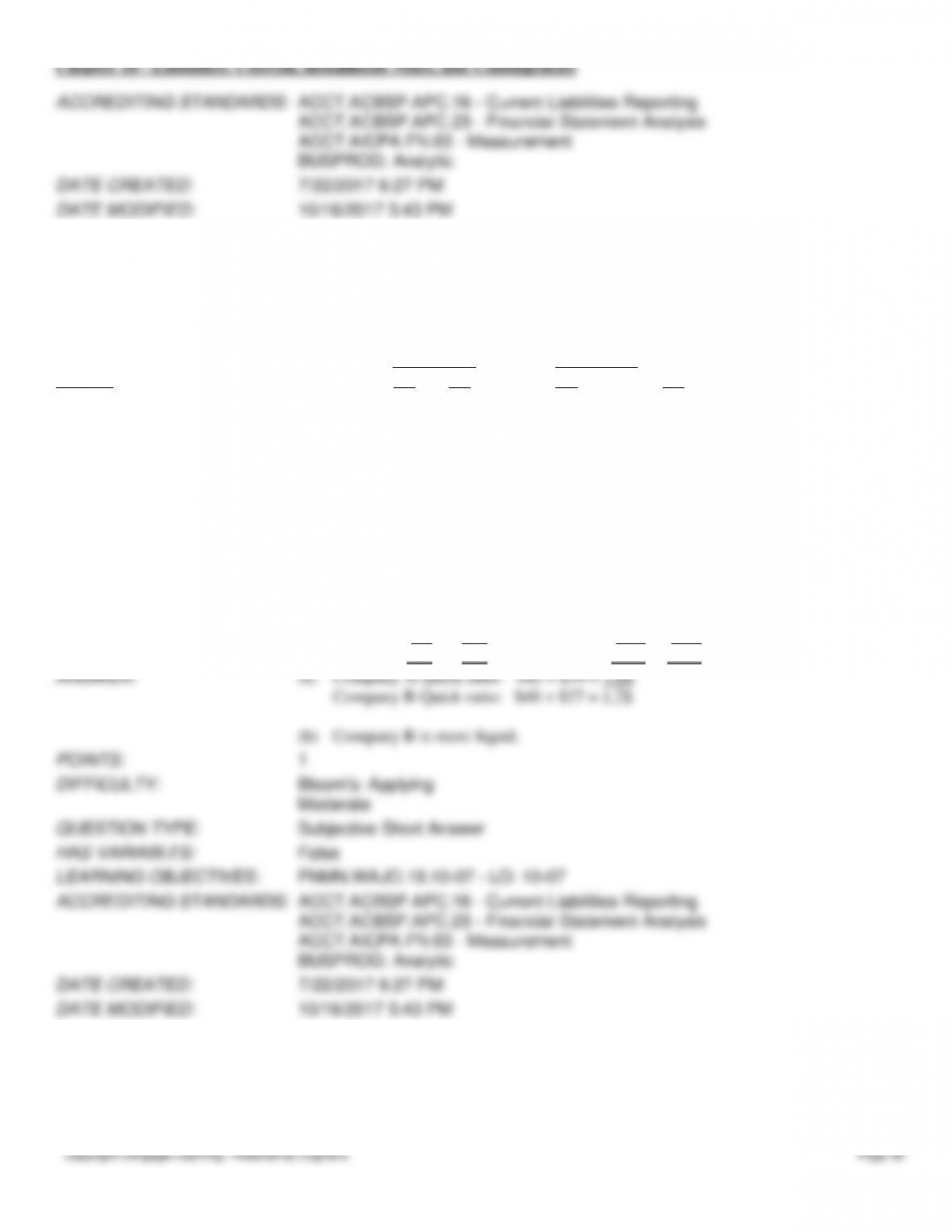
193. Use the following information and calculate the quick ratio for Davis Company and for Bender Inc.
(a)
Calculate the quick ratio for each company. Round ratios to two decimal places.
(b)
Comment on which one is more able to meet current liabilities.
Davis Co.
Bender Inc.
Account
Dr.
Cr.
Dr.
Cr.
Cash
$ 321
$ 425
Cash equivalents
88
95
Current notes receivable
56
46
Accounts receivable
603
307
Prepaid expenses
55
85
Inventory
714
898
Fixed assets
920
755
Accumulated depreciation—Fixed assets
$ 415
$ 225
Accounts payable
260
198
Current accrued liabilities
213
149
Mortgage payable
917
824
Capital
952
1,215
Total
$2,757
$2,757
$2,611
$2,611
ANSWER:
(a)
Davis Co. Quick ratio: $1,068 ÷ $473 = 2.26
Bender Inc. Quick ratio: $873 ÷ $347 = 2.52
(b)
Bender Inc. is more liquid.
POINTS:
1
DIFFICULTY:
Bloom’s: Applying
Moderate
QUESTION TYPE:
Subjective Short Answer
HAS VARIABLES:
False
LEARNING OBJECTIVES:
FNMN.WAJO.19.10-07 – LO: 10–07
Chapter 10 – Liabilities: Current, Installment Notes, and Contingencies
Copyright Cengage Learning. Powered by Cognero.
Page 91
when they come and go at lunchtime. The computer automatically calculates the hours worked for each employee. A clerk
prints out the time sheets, which are then approved by each employee’s supervisor and a manager. The manager rarely
finds any problems with the time sheets and frequently signs them without checking them carefully. Once the time sheets
are approved, the clerk sends the information to a payroll processor, who completes all the remaining payroll functions.
Employees’ money is direct-deposited into their accounts, and they receive a pay stub each week.
When management investigates, they discover that a supervisor had authorized additional overtime for two employees to
complete an important project. However, the supervisor had not obtained formal authorization for the overtime. The
authorization was given verbally by the plant manager. What internal control procedure would have avoided the extra
overtime expense?
ANSWER:
The supervisor should be required to obtain written authorization from the plant
manager before allowing employees to work overtime.
POINTS:
1
DIFFICULTY:
Bloom’s: Applying
Easy
QUESTION TYPE:
Subjective Short Answer
HAS VARIABLES:
False
LEARNING OBJECTIVES:
FNMN.WAJO.19.10-01 – LO: 10–01
ACCREDITING STANDARDS:
ACCT.ACBSP.APC.16 – Current Liabilities Reporting
ACCT.AICPA.FN.03 – Measurement
BUSPROG – Analytic
DATE CREATED:
10/2/2017 3:00 PM
DATE MODIFIED:
10/16/2017 5:43 PM
196. Wilson Cafeteria issues gift cards, which are very popular in the small town where the restaurant is located. In a
recent month, Wilson issued $4,000 in gift cards. Experience indicates that 80 percent of the cards will be redeemed
before they expire. What is the entry to record the estimated gift card expense?
a.
Gift Card Expense 3,200
Gift Card Payable 3,200
Expense for month
($4,000 × 80%)
b.
Gift Card Expense 4,000
Gift Card Payable 4,000
Expense for month
c.
Gift Card Payable 3,200
Gift Card Expense 3,200
Expense for month
($4,000 × 80%)
d.
Gift Card Payable 4,000
Gift Card Expense 4,000
Expense for month
ANSWER:
a
POINTS:
1
DIFFICULTY:
Bloom’s: Applying
Moderate
QUESTION TYPE:
Multiple Choice
HAS VARIABLES:
False
LEARNING OBJECTIVES:
FNMN.WAJO.19.10-05 – LO: 10–05
ACCREDITING STANDARDS:
ACCT.ACBSP.APC.16 – Current Liabilities Reporting