Chapter 9
© 2018 Cengage. All Rights Reserved. May not be scanned, copied or duplicated, or posted to a publicly accessible website, in whole or in part.
Page 78
Other noncurrent assets and liabilities 34.2 31.6
Net cash provided by operating activities $1,296.6 $1,047.1
186. Refer to the data for Valance & Company.
Required
(1) What current liabilities appearing on the balance sheet do not appear in the Operating Activities section of the
statement of cash flows? Why?
(2) What current liabilities appear in the Operating Activities category of Valance’s statement of cash flows? How does
the change for each year affect the cash flows from operating activities for that year?
187. Refer to the data for Valance & Company.
Required
(1) Give a possible explanation for each change in the liabilities listed in the cash flow statement. Do you think these
changes are beneficial for Valance? Why or why not?
(2) If there were a balance in the Dividends Payable account at the end of the year, would this appear in the Operating
Activities category of the cash flow statement? Why or why not?
© 2018 Cengage. All Rights Reserved. May not be scanned, copied or duplicated, or posted to a publicly accessible website, in whole or in part.
Page 80
188. Grain Company sells a product for $760. When the customer buys it, Grain provides a one-year warranty. Grain sold
1,500 products during 2017. Based on analysis of past warranty records, Grain estimates that repairs will average 6% of
1. Analyze the impact of the journal entry to record the estimated liability.
2. Assume that during 2017 products under warranty must be repaired using repair parts from inventory costing $49,600.
3. Assume that the balance of the Estimated Liabilities for Warranties account as of the beginning of 2017 was $1,700.
Calculate the balance of the account as of the end of 2017.
2.
To record actual warranty costs.
3.
Beginning balance $ 1,700
© 2018 Cengage. All Rights Reserved. May not be scanned, copied or duplicated, or posted to a publicly accessible website, in whole or in part.
Page 82
190. Review the note disclosure of legal matters.
Required
(1) If you were to make an entry for the lawsuit against the company, what monetary amount should be recorded? On
what did you base your decision with regard to the amount?
(2) Does the disclosure imply that the company is involved in only this litigation at this time?
(3) Why did this lawsuit arise? Do you believe it to be a reasonable one, or do you think that the plaintiff, has little
grounds for this lawsuit?
191. Riley Corporation manufactures and sells weedeaters. Riley provides all customers with a three-year warranty
guaranteeing to repair, free of charge, any defects reported during this time period. During the year, it sold 85,000
weedeaters for $225 each. Analysis of past warranty records indicates that 8% of all sales will be returned for repair
within the warranty period. Riley expects to incur expenditures of $15 to repair each weedeater. The account Estimated
Liability for Warranties had a balance of $115,000 on January 1. Riley incurred $90,000 in actual expenditures during the
year.
Required
Analyze the impact of all journal entries necessary to record the events related to the warranty transactions during the
year. Determine the adjusted ending balance in the Estimated Liability for Warranties account.
© 2018 Cengage. All Rights Reserved. May not be scanned, copied or duplicated, or posted to a publicly accessible website, in whole or in part.
Page 84
192. Below are three notes payable:
1. $30,000 4% 6 years
2. 30,000 6% 4 years
3. 30,000 8% 3 years
Required
Part 1. For each of the notes, calculate the simple interest due at the end of the term.
Part 2. Now assume that the interest on the notes is compounded annually. Calculate the amount of interest due at the end
of the term for each note.
Part 3. Finally, assume that the interest on the notes is compounded semiannually. Calculate the amount of interest due at
the end of the term for each note.
Part 4. What conclusion can you draw from a comparison of your results of each of the three scenarios?
1. Table 9-1 n = 6, i = 4%
Future Value = $30,000 × 1.265 = $37,950
2. Table 9-1 n = 4, i = 6%
Future Value = $30,000 × 1.262 = $37,860
3. Table 9-1 n = 3, i = 8%
Future Value = $30,000 × 1.260 = $37,800
1. Table 9-1 n = 12, i = 2%
Future Value = $30,000 × 1.268 = $38,040
2. Table 9-1 n = 8, i = 3%
© 2018 Cengage. All Rights Reserved. May not be scanned, copied or duplicated, or posted to a publicly accessible website, in whole or in part.
Page 86
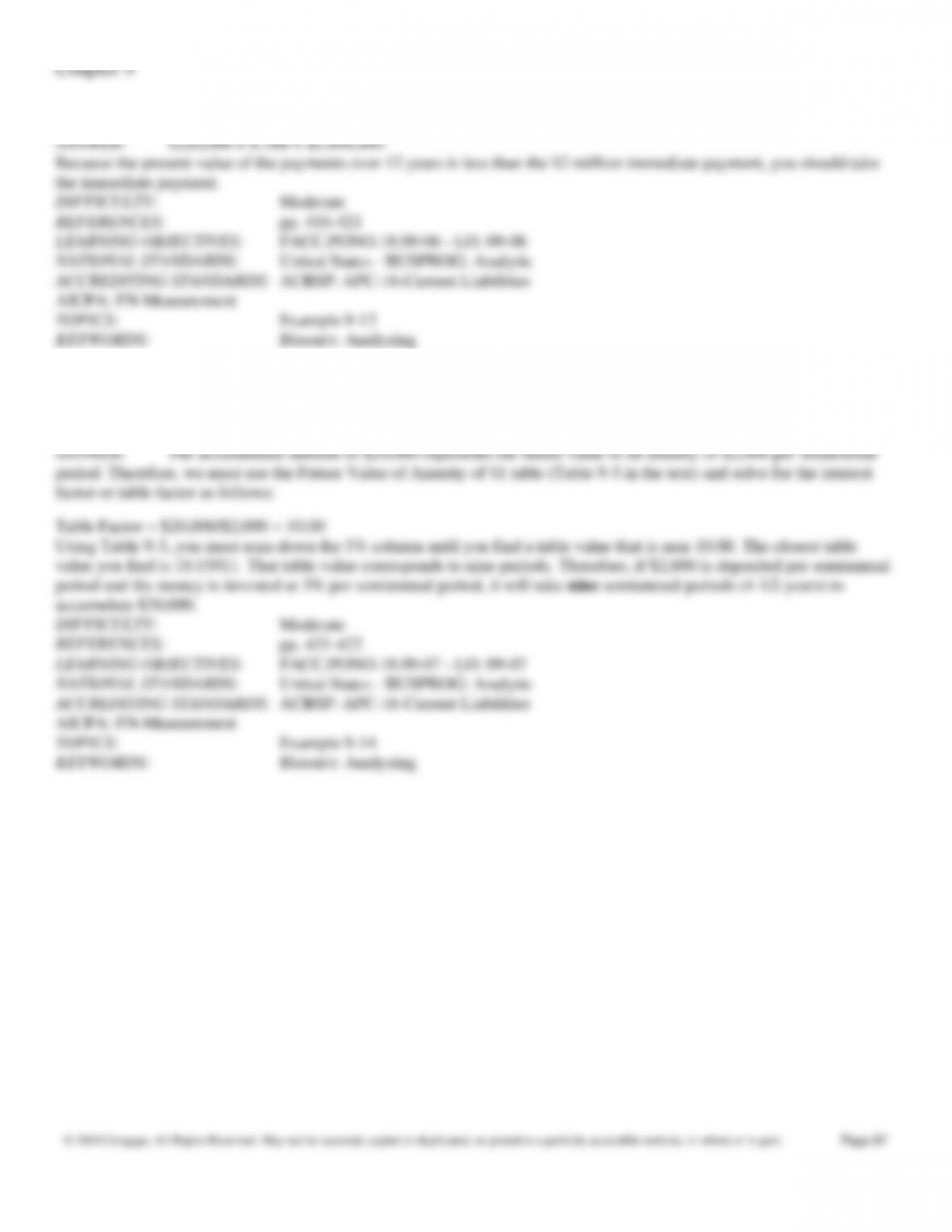
193. Tyson Trucking won a settlement in a lawsuit and was offered four different payment alternatives by the defendant’s
insurance company. The interest rate is 6%. Ignoring tax considerations, which of the following four alternatives has the
highest present value? Support your answer with the appropriate calculations.
I) $150,000 now
II) $45,000 per year for the next four years (payment made at the end of the year)
III) $5,000 now and then $20,000 per year for the next ten years (payment made at the end of the year)
IV) $5,000 now and then $5,000 per year for the next ten years (payment made at the end of the year) plus a lump-sum
payment of $200,000 at the end of the eleventh year
© 2018 Cengage. All Rights Reserved. May not be scanned, copied or duplicated, or posted to a publicly accessible website, in whole or in part.
Page 87
194. You just won the lottery. You can take your $2 million in a lump sum today, or you can receive $220,000 per year
over the next 12 years. Assuming a 6% interest rate, which would you prefer, ignoring tax considerations?
195. Assume that you want to accumulate $20,000 as a down payment on a home. You believe that you can save $2,000
per semiannual period, and your bank will pay interest of 6% per year, or 3% per semiannual period. How long will it take
you to accumulate the desired amount?
© 2018 Cengage. All Rights Reserved. May not be scanned, copied or duplicated, or posted to a publicly accessible website, in whole or in part.
Page 88
196. You just purchased an automobile for $19,450 and must decide how to pay for it. Your local bank has granted you a
five-year loan. Annual payments on the loan will be made at the end of each year and the amount of the loan payments,
which include principal and interest, is $5,000 per year. What interest rate is being charged on the loan?
197. Ashley Wilson’s grandparents want to give her some money when she graduates from high school. They have
offered Ashley the following three choices:
a. Receive $25,000 immediately. Assume that interest is compounded annually.
b. Receive $3,200 at the end of each six months for four years. Ashley will receive the first check in six months.
c. Receive $7,000 at the end of each year for four years. Assume that interest is compounded annually.
Required
Ashley wants to have money for a new car when she graduates from college in four years. Assuming an interest rate of
8%, what option should she choose to have the most money in four years? (Round your answers to the nearest dollar.)
© 2018 Cengage. All Rights Reserved. May not be scanned, copied or duplicated, or posted to a publicly accessible website, in whole or in part.
Page 89
198. Apply the time value of money in the following independent situations:
1. Jason Marx deposited $29,500 in the bank on January 1, 2000, at an interest rate of 12% compounded annually. How
2. June Cunningham deposited $54,200 in the bank on January 1, 2007. On January 2, 2017, this deposit has accumulated
to $106,611. Interest is compounded annually on the account. What rate of interest did June earn on the deposit?
2. $106,611/$54,200 = 1.967; future value of $1 for n = 10, i = 7%
199. Apply the time value of money in the following independent situations:
1. Margaret Carlson made a deposit in the bank on January 1, 2010. The bank pays interest at the rate of 8% compounded
annually. On January 1, 2017, the deposit has accumulated to $40,000. How much money did Margaret originally deposit
2. Claude Cooper deposited $15,600 in the bank on January 1 a few years ago. The bank pays an interest rate of 10%
compounded annually, and the deposit is now worth $40,420. For how many years has the deposit been invested?
2. $40,420/$15,600 = 2.591; future value of $1 for i = 10%, n = 10 years
© 2018 Cengage. All Rights Reserved. May not be scanned, copied or duplicated, or posted to a publicly accessible website, in whole or in part.
Page 91
201. Your friend, Sal Dunn, has started a new business, but has recently encountered a slight cash flow problem. He
obtains a $1,000 loan at 10% per year from a local bank, but would like to ask you about the terms. The bank has
deducted the interest in advance and he wants to know if 10% is his effective interest rate. How would you respond in an
email?
202. A firm’s year ends on December 31. Its tax is computed and submitted to the U.S. Treasury on March 15 of the
following year. When should the taxes be reported as a liability?
© 2018 Cengage. All Rights Reserved. May not be scanned, copied or duplicated, or posted to a publicly accessible website, in whole or in part.
Page 92
203. According to the text, almost all current liabilities appear in the Operating Activities category of the statement of
cash flows, but there are exceptions. Explain the exceptions and give an example.
204. Dallas Company uses the indirect method of preparing the statement of cash flows and has the following current
liabilities at the beginning of the period: Accounts Payable, $35,000; Taxes Payable, $15,000. At the end of the period, the
balances of the account are as follows: Accounts Payable, $25,000; Taxes Payable, $20,000. What amounts will appear in
the cash flow statement? In what category of the statement will they appear?
© 2018 Cengage. All Rights Reserved. May not be scanned, copied or duplicated, or posted to a publicly accessible website, in whole or in part.
Page 93
205. There are very important differences between U.S. and international standards regarding contingencies. Even the
terms used to refer to situations with unknown outcomes differ. Explain these differences.
206. What is the difference between simple interest and compound interest? Is the amount of interest higher or lower
when the interest is simple rather than compound?
© 2018 Cengage. All Rights Reserved. May not be scanned, copied or duplicated, or posted to a publicly accessible website, in whole or in part.
Page 94
207. The present value and future value concepts are applied to measure the amount of several accounts common in
accounting. What are some accounts that are valued in this manner?
208. Define the term annuity. Can the present value of an annuity be calculated as a series of single amounts? If so, how?
209. Assume that you know the total dollar amount of a loan and the amount of the monthly payments. How can you
determine the interest rate as a percentage of the loan?