Chapter 8
© 2018 Cengage. All Rights Reserved. May not be scanned, copied or duplicated, or posted to a publicly accessible website, in whole or in part.
Page 81
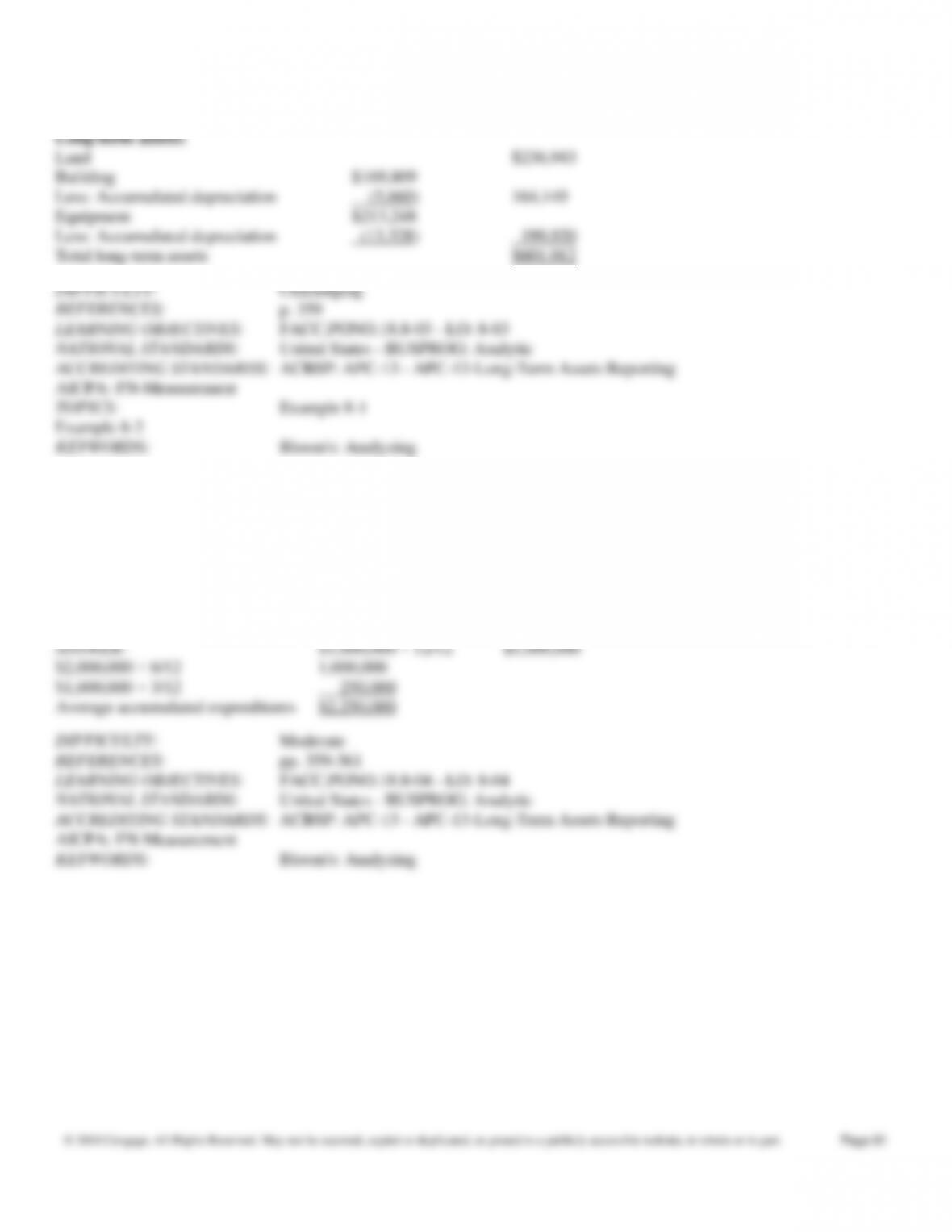
3. The assets would appear on the balance sheet as follows:
208. A company begins construction of an asset on January 1, 2017, and completes construction on December 1, 2017.
The company pays the following amounts related to construction:
January 1: $1,000,000
July 1: $2,000,000
October 1: $1,000,000
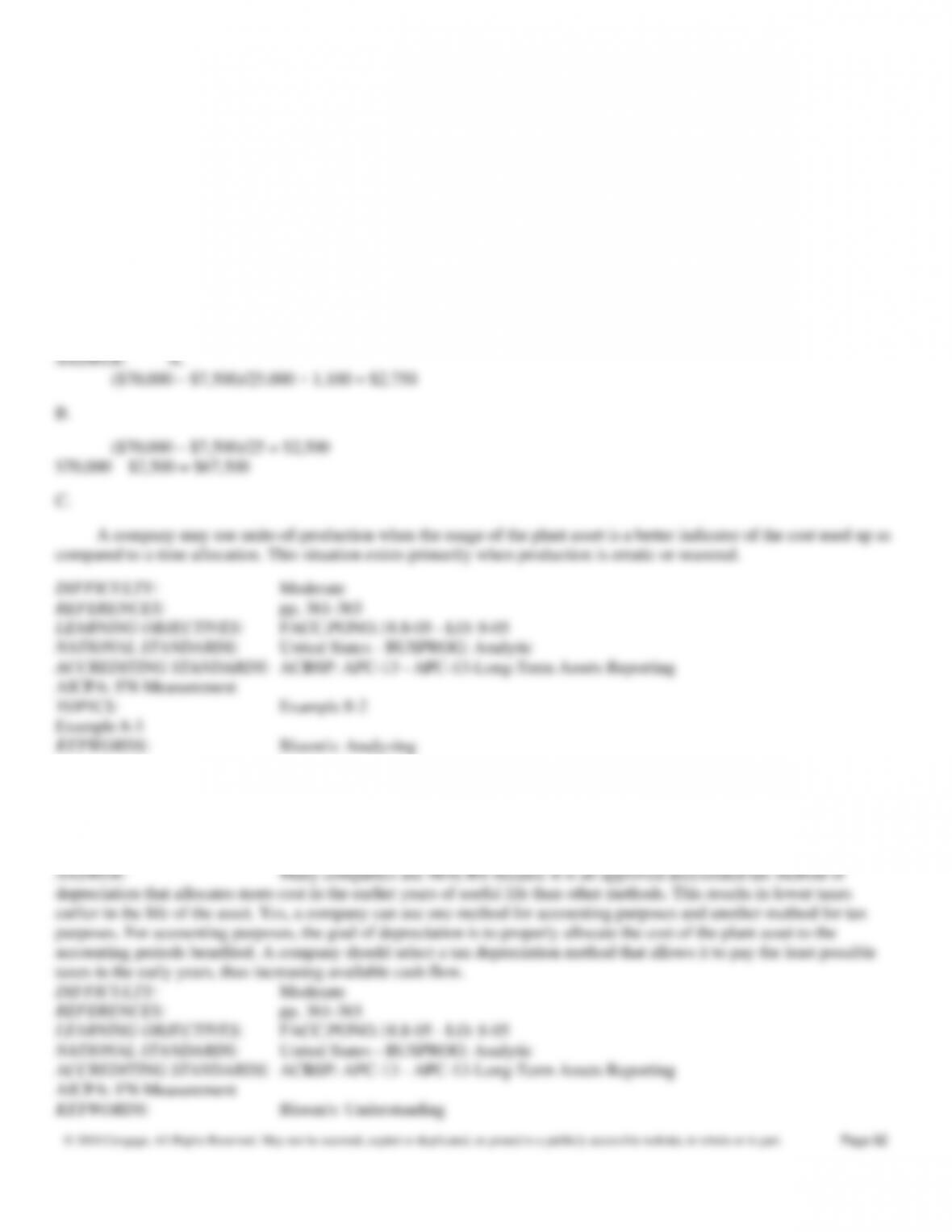
Calculate the average accumulated expenditures for the purpose of capitalizing interest.
Chapter 8
© 2018 Cengage. All Rights Reserved. May not be scanned, copied or duplicated, or posted to a publicly accessible website, in whole or in part.
Page 82
209. Boston Corp. purchased equipment with a cost of $70,000 at the beginning of 2017. The equipment has an estimated
life of 25 years or 25,000 units of product. The estimated residual value is $7,500. During 2017, 1,100 units of product
were produced with this machinery. Determine the following:
A.
Amount of total accumulated depreciation at December 31, 2017, using units-of-production depreciation
B.
Book value at the end of 2017 using straight-line depreciation
C.
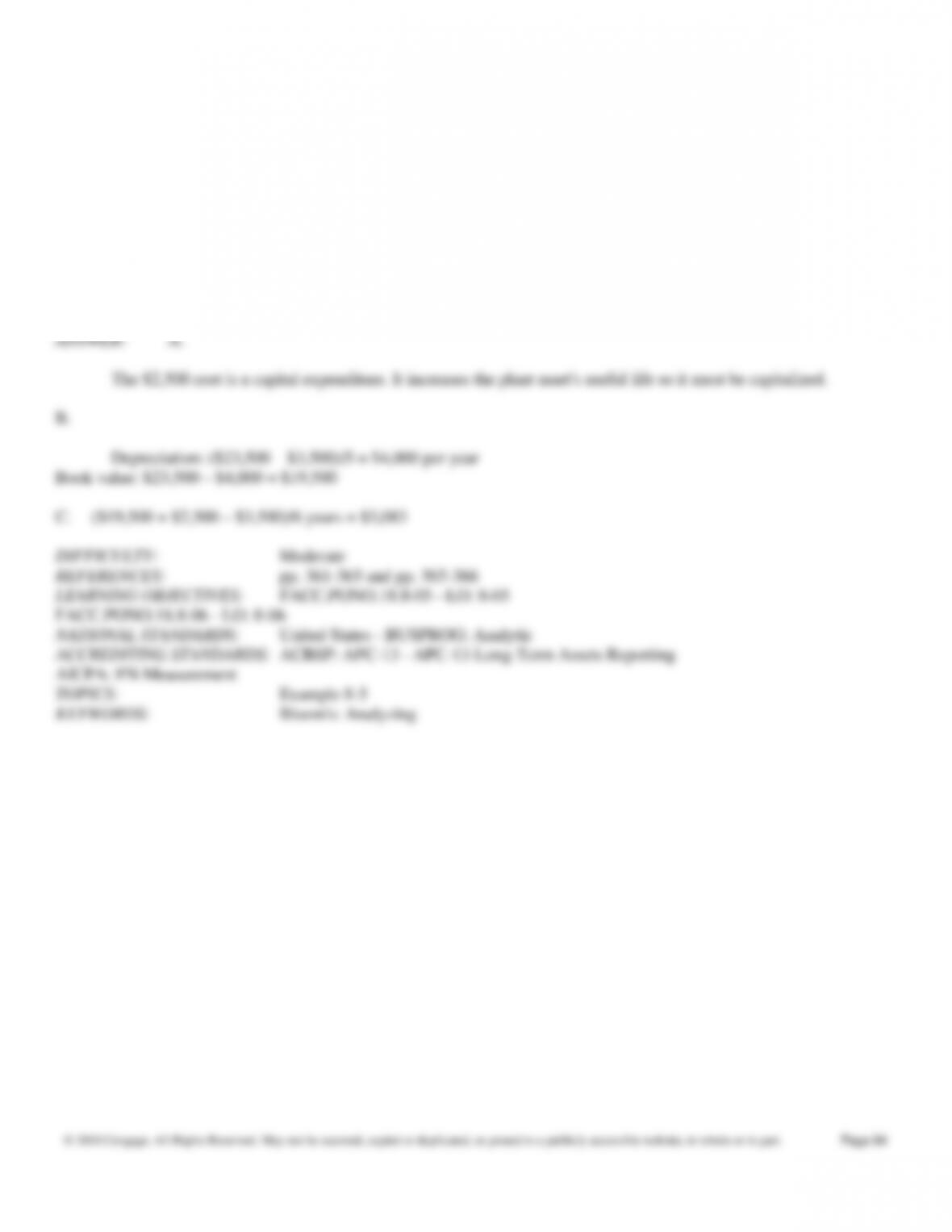
Why would the company choose units-of-production depreciation instead of straight-line?
210. Many companies use MACRS (Modified Accelerated Cost Recovery System) depreciation for tax purposes.
If a company uses MACRS for depreciation for tax purposes, can it use a different method for financial reporting?
Explain why or why not.

Chapter 8
© 2018 Cengage. All Rights Reserved. May not be scanned, copied or duplicated, or posted to a publicly accessible website, in whole or in part.
Page 83
Chapter 8
© 2018 Cengage. All Rights Reserved. May not be scanned, copied or duplicated, or posted to a publicly accessible website, in whole or in part.
Page 84
211. Daytona Beach Company purchased a car for a salesman for $23,500 at the beginning of 2017. The car had an
estimated life of five years, and an estimated residual value of $3,500. Daytona Beach used the straight-line depreciation
method. At the beginning of 2018, Daytona Beach incurred $2,500 to replace the car’s transmission. This resulted in a
two-year extension of the car’s useful life, but no change in the residual value.
A.
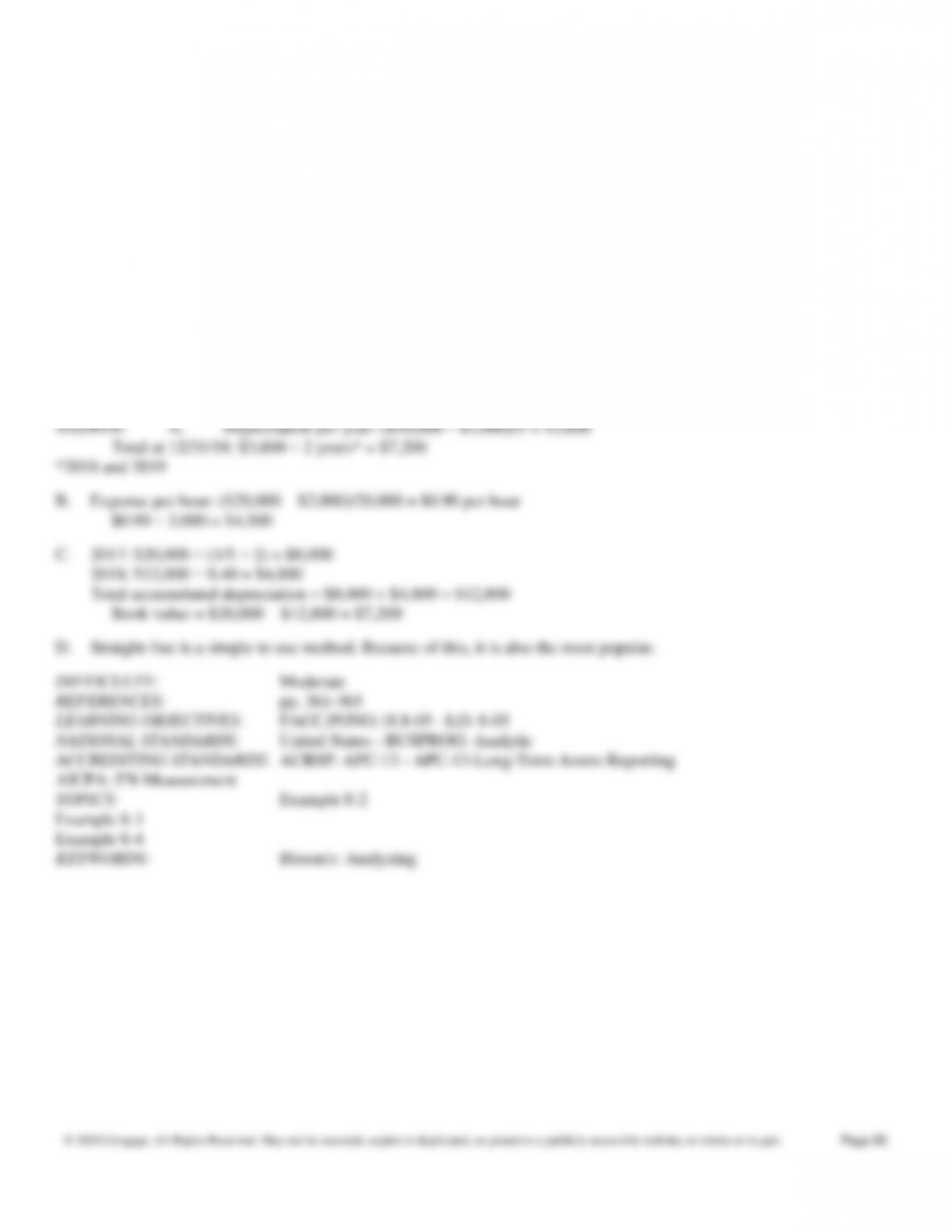
What type of cost is the $2,500? Explain.
B.
Calculate the book value of the car at the end of 2017.
C. Find the depreciation expense on the car for 2018.
Chapter 8
© 2018 Cengage. All Rights Reserved. May not be scanned, copied or duplicated, or posted to a publicly accessible website, in whole or in part.
Page 85
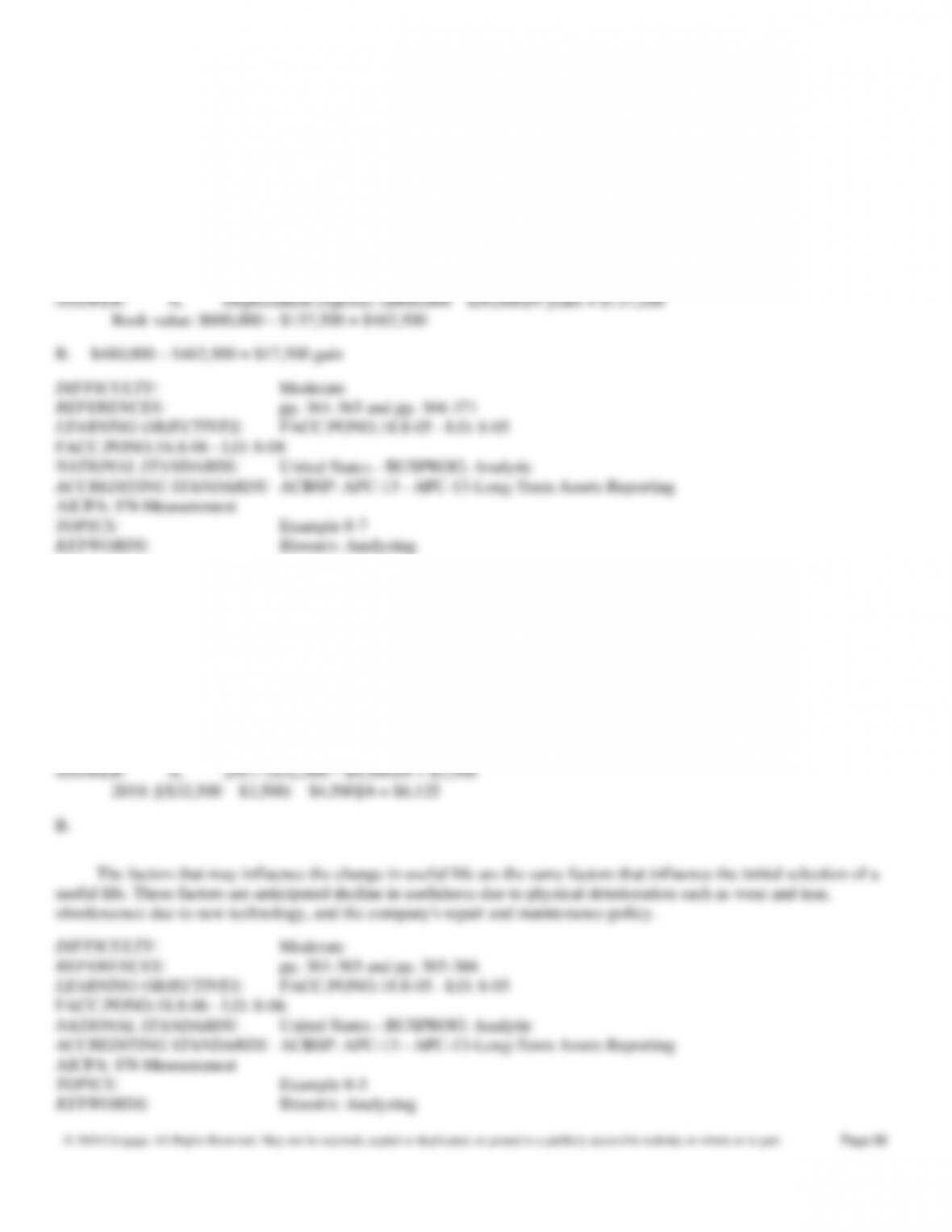
212. Moore, Inc. purchased slot machines at the beginning of 2017 for $20,000. The machines have an estimated residual
value of $2,000 and an estimated life of five years or 20,000 hours of operation. Moore is looking at alternative
depreciation methods for the equipment. Calculate the following:
A.
Accumulated depreciation at December 31, 2018, using the straight-line depreciation method.
B.
Depreciation expense for 2017 using the units-of-production depreciation method. Assume that the machines are
operated for 5,000 hours in 2017.
C.
Book value of the equipment at December 31, 2018, using the double-declining-balance depreciation method.
D. What are the advantages of using straight-line depreciation for financial reporting purposes?
Chapter 8
© 2018 Cengage. All Rights Reserved. May not be scanned, copied or duplicated, or posted to a publicly accessible website, in whole or in part.
Page 86
213. Dayton Ridge Co. purchased new trucks at the beginning of 2017 for $600,000. The trucks had an estimated life of
four years and an estimated residual value of $50,000. Dayton Ridge uses straight-line depreciation. At the beginning of
2018, Dayton Ridge sold the trucks for $480,000 and purchased new trucks for $700,000. Determine the following
amounts:
A.
Book value of the trucks at the end of 2017.
B.
Gain (loss) on the sale of the trucks at the beginning of 2018. (Indicate the amount and whether a gain or loss.)
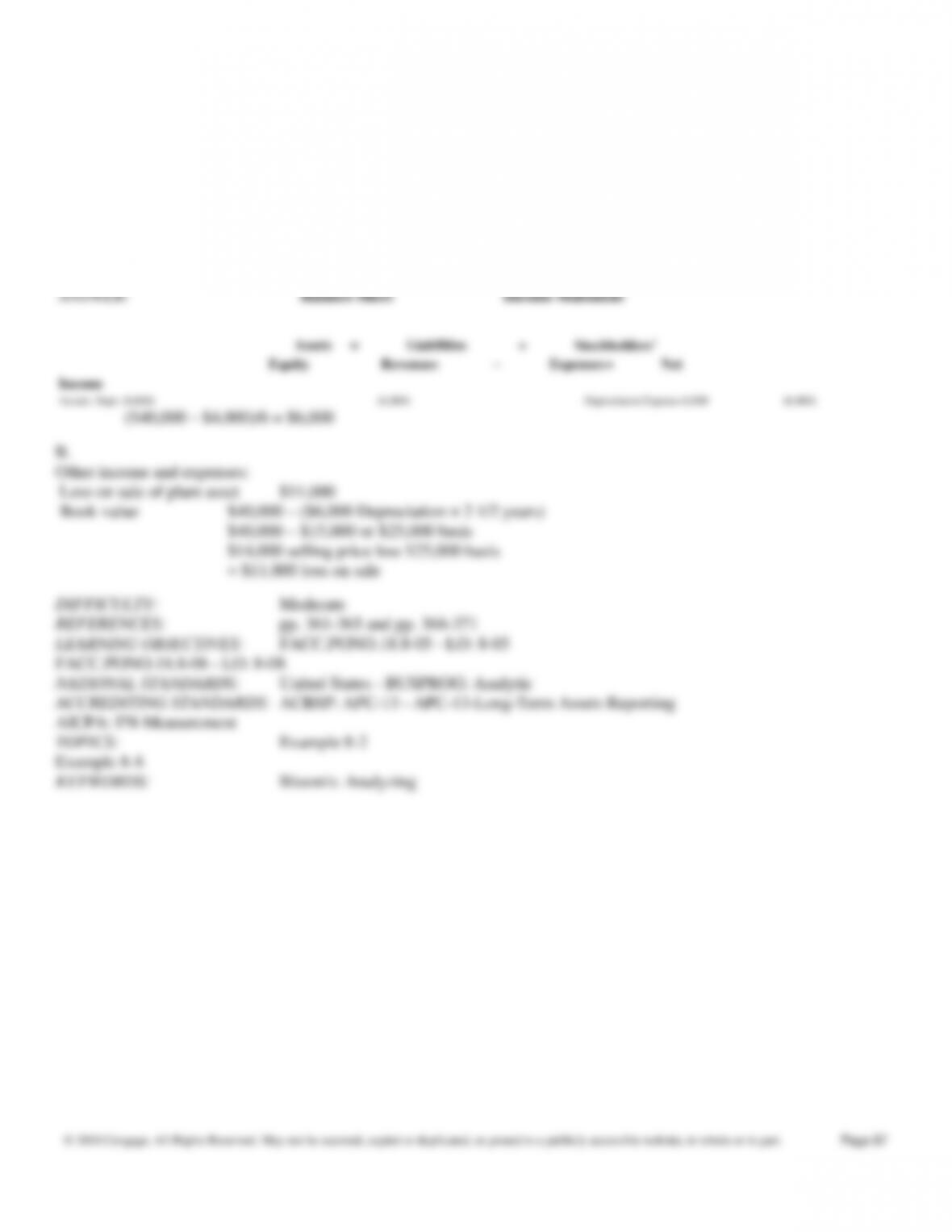
214. Foxrun, Inc. purchased a truck at the beginning of 2017 for $32,500. Foxrun decided to depreciate the truck over an
eight-year period using the straight-line method, and estimated its residual value to be $4,500. At the beginning of 2018,
Foxrun determined that a five-year life should have been used to depreciate the truck. The estimated residual value was
not affected by the revision in the asset’s life.
A.
Determine the amounts to be recorded as depreciation expense for 2017 and 2018.
B. What factors may have influenced Foxrun to change the useful life?
Chapter 8
© 2018 Cengage. All Rights Reserved. May not be scanned, copied or duplicated, or posted to a publicly accessible website, in whole or in part.
Page 87
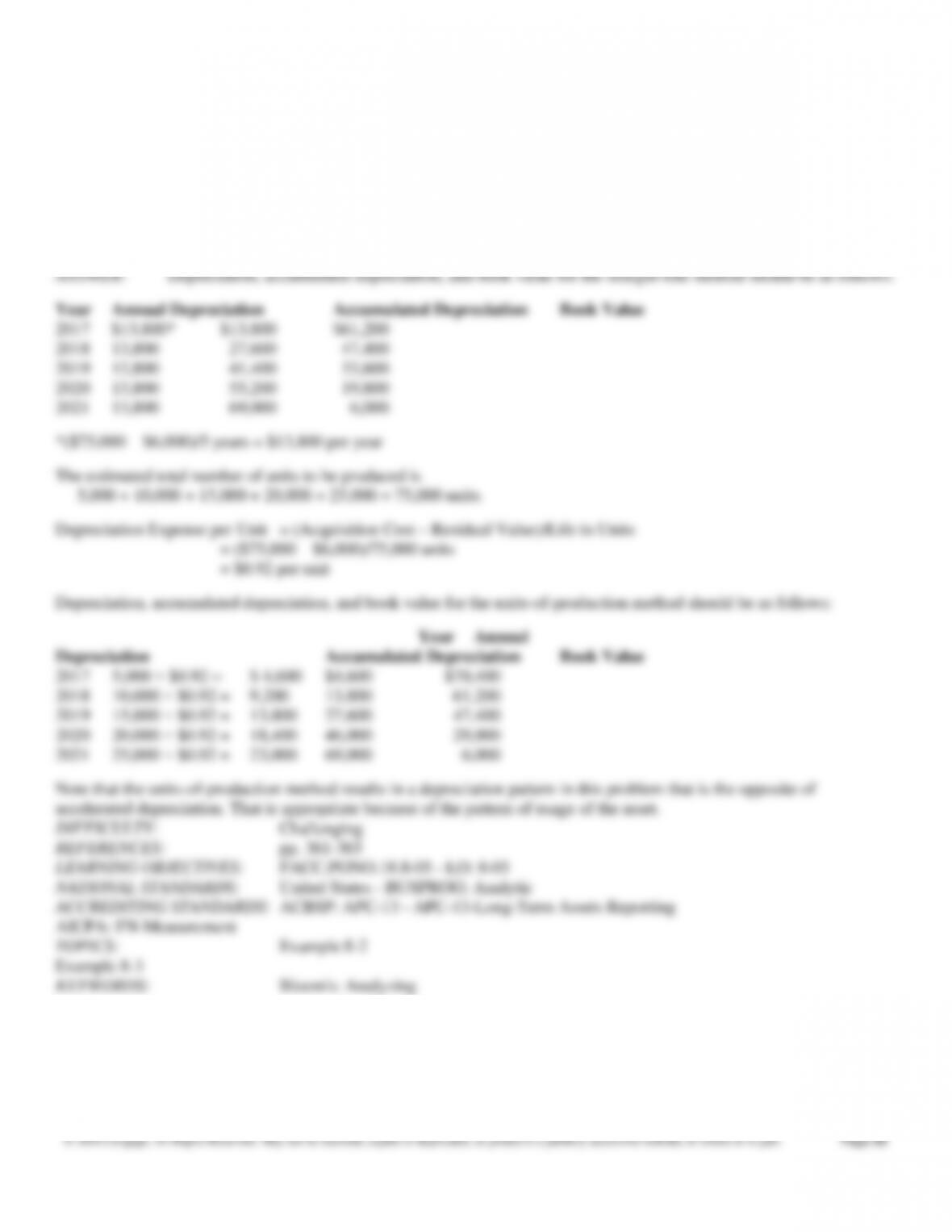
215. Craig Inc. purchased a truck on January 1, 2017 for $40,000. The truck had an estimated life of six years and an
estimated salvage value of $4,000. Craig uses the straight-line method to depreciate the asset. On July 1, 2019, the truck
was sold for $14,000 cash.
A.
Determine the effect on the accounting equation upon recording the depreciation for 2017.
B.
Show how the gain or loss on the sale of the asset would be reported on Craig Inc.’s income statement.
Chapter 8
© 2018 Cengage. All Rights Reserved. May not be scanned, copied or duplicated, or posted to a publicly accessible website, in whole or in part.
Page 88
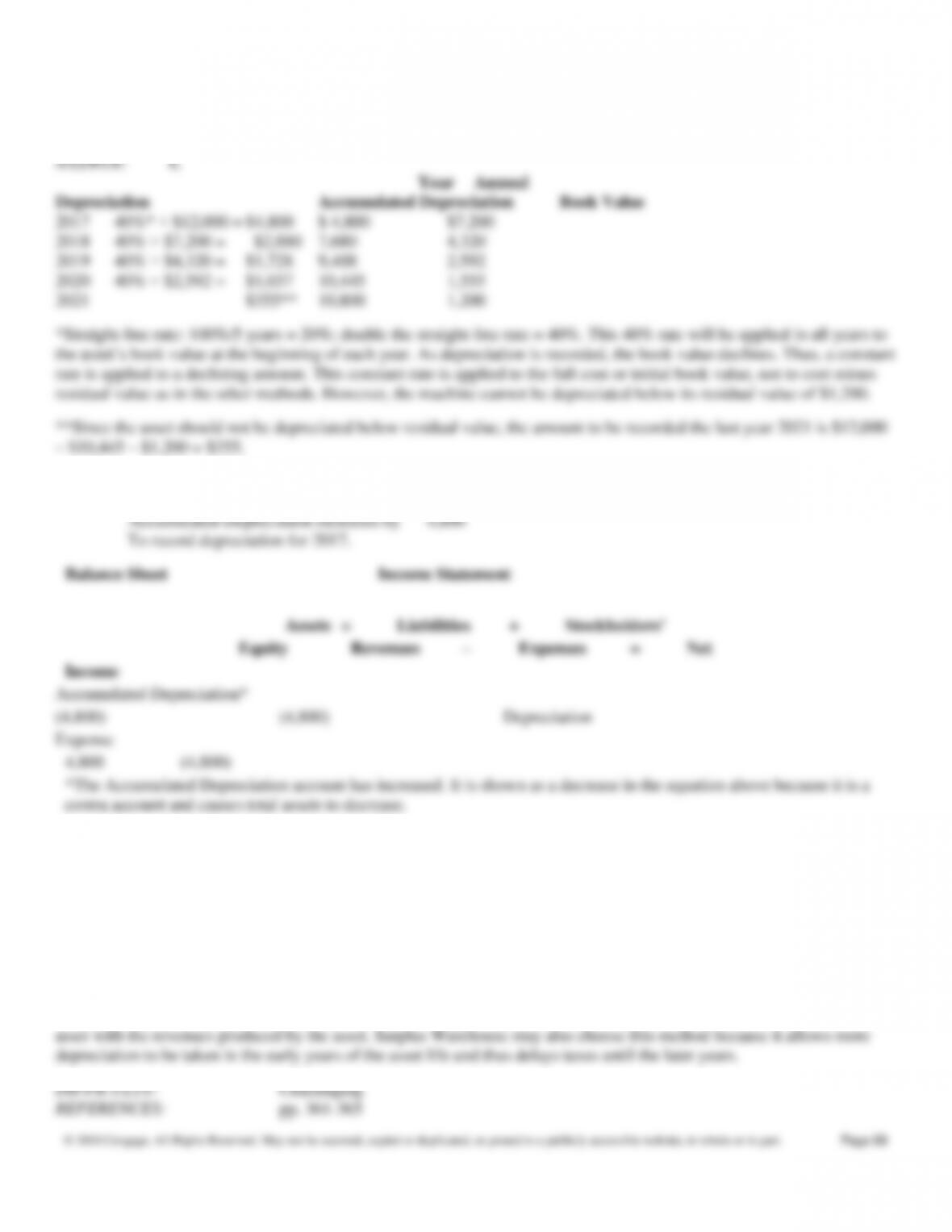
216. Assume that Alabama Company purchased factory equipment on January 1, 2017, for $75,000. The equipment has
an estimated life of five years and an estimated residual value of $6,000. Alabama’s accountant is considering whether to
use the straight-line or the units-of-production method to depreciate the asset. Because the company is beginning a new
production process, the equipment will be used to produce 5,000 units in 2017, but production subsequent to 2017 will
increase by 5,000 units each year.
Required
Calculate the depreciation expense, accumulated depreciation, and book value of the equipment under both methods for
each of the five years of its life. Would the units-of production method yield reasonable results in this situation? Explain.
217. Surplus Warehouse purchased a forklift on January 1, 2017, for $12,000. The forklift is expected to last for five years
and have a residual value of $1,200. Surplus Warehouse uses the double-declining-balance method for depreciation.
Required
Chapter 8
© 2018 Cengage. All Rights Reserved. May not be scanned, copied or duplicated, or posted to a publicly accessible website, in whole or in part.
Page 89
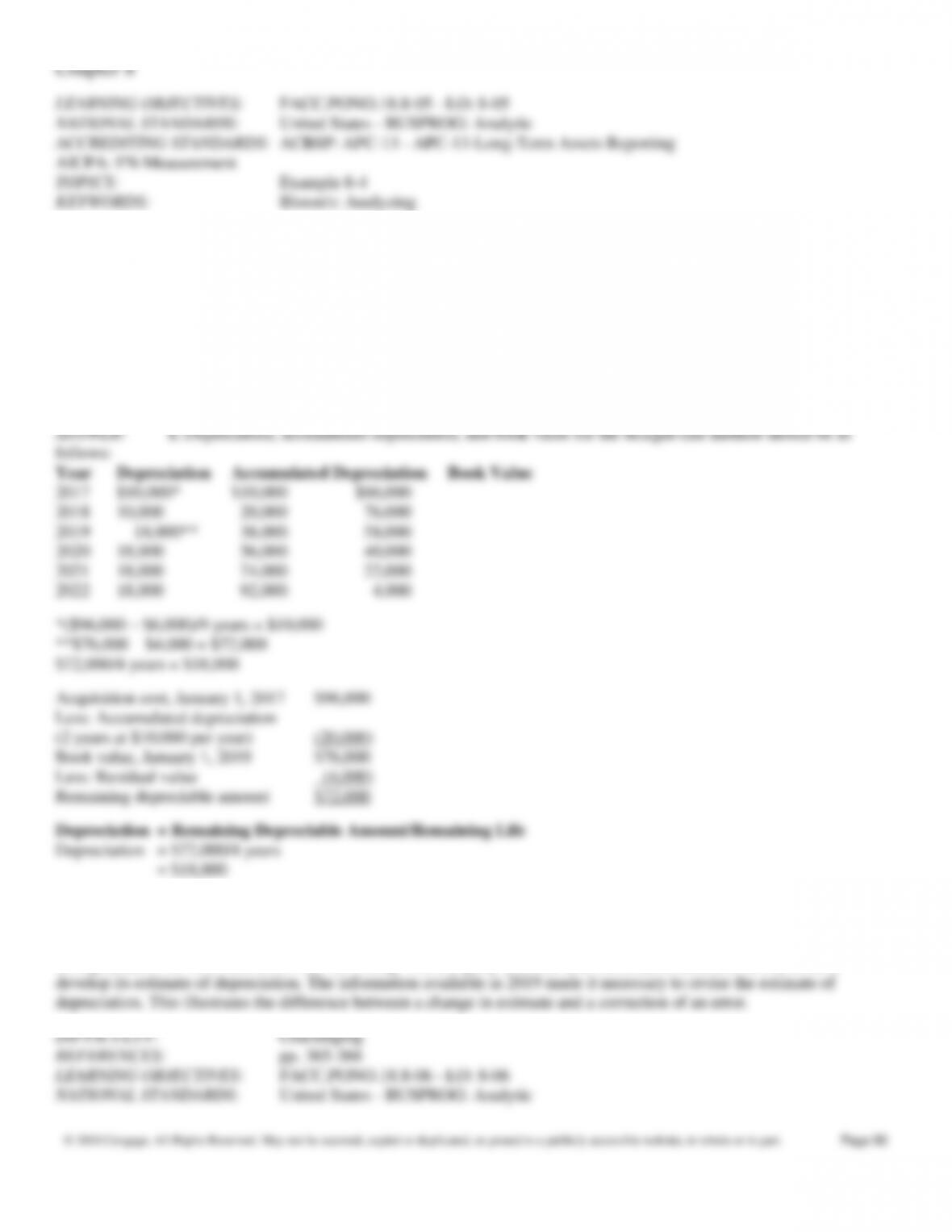
1. Calculate the depreciation expense, accumulated depreciation, and book value for each year of the forklift’s life.
2. Analyze the impact of the entry to record depreciation expense for 2017.
3. What factors may have influenced Surplus Warehouse to use the double-declining-balance method?
2.
Dec. 31 Depreciation Expense increases by 4,800
3. Surplus Warehouse may believe that the double-declining-balance method best matches the decline in usefulness of the
Chapter 8
© 2018 Cengage. All Rights Reserved. May not be scanned, copied or duplicated, or posted to a publicly accessible website, in whole or in part.
Page 92
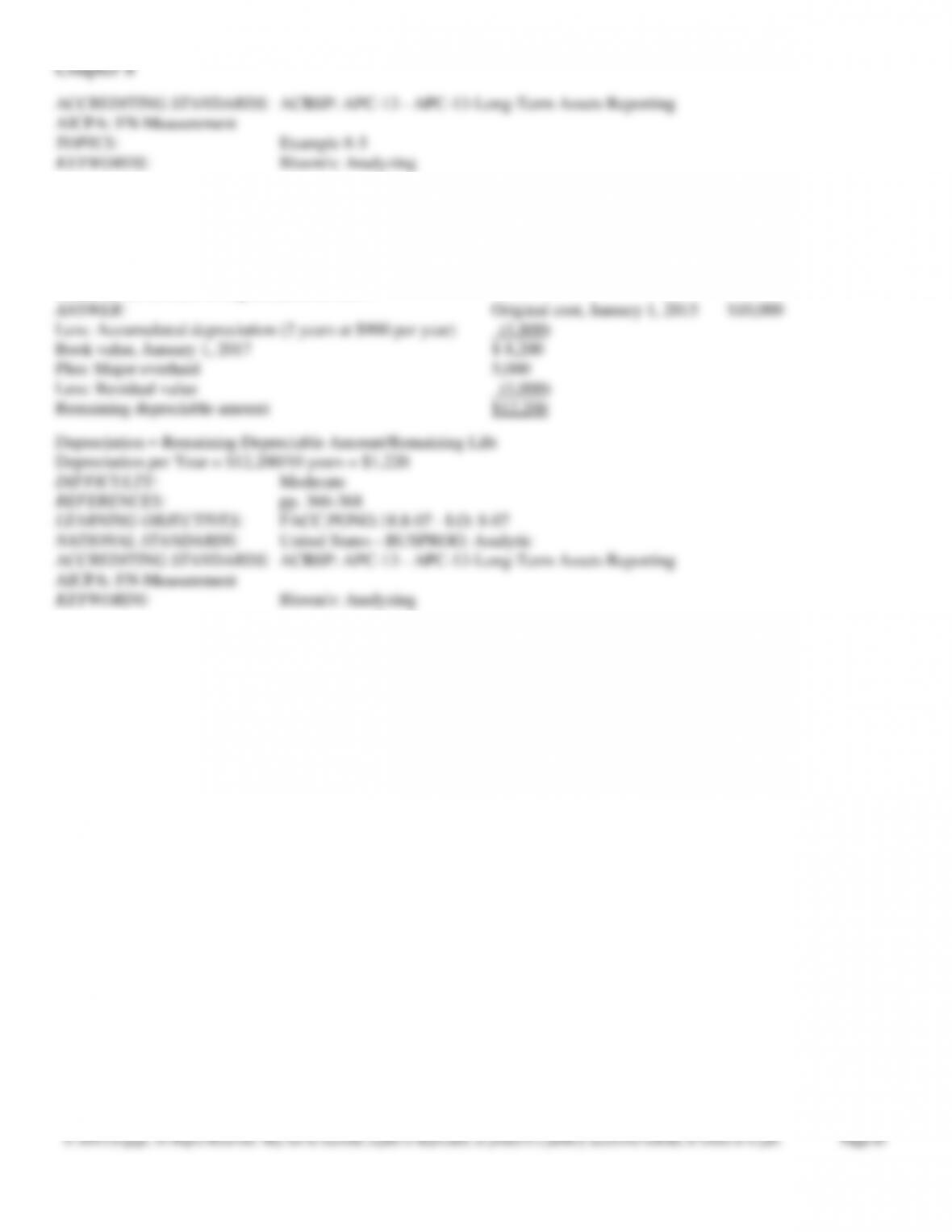
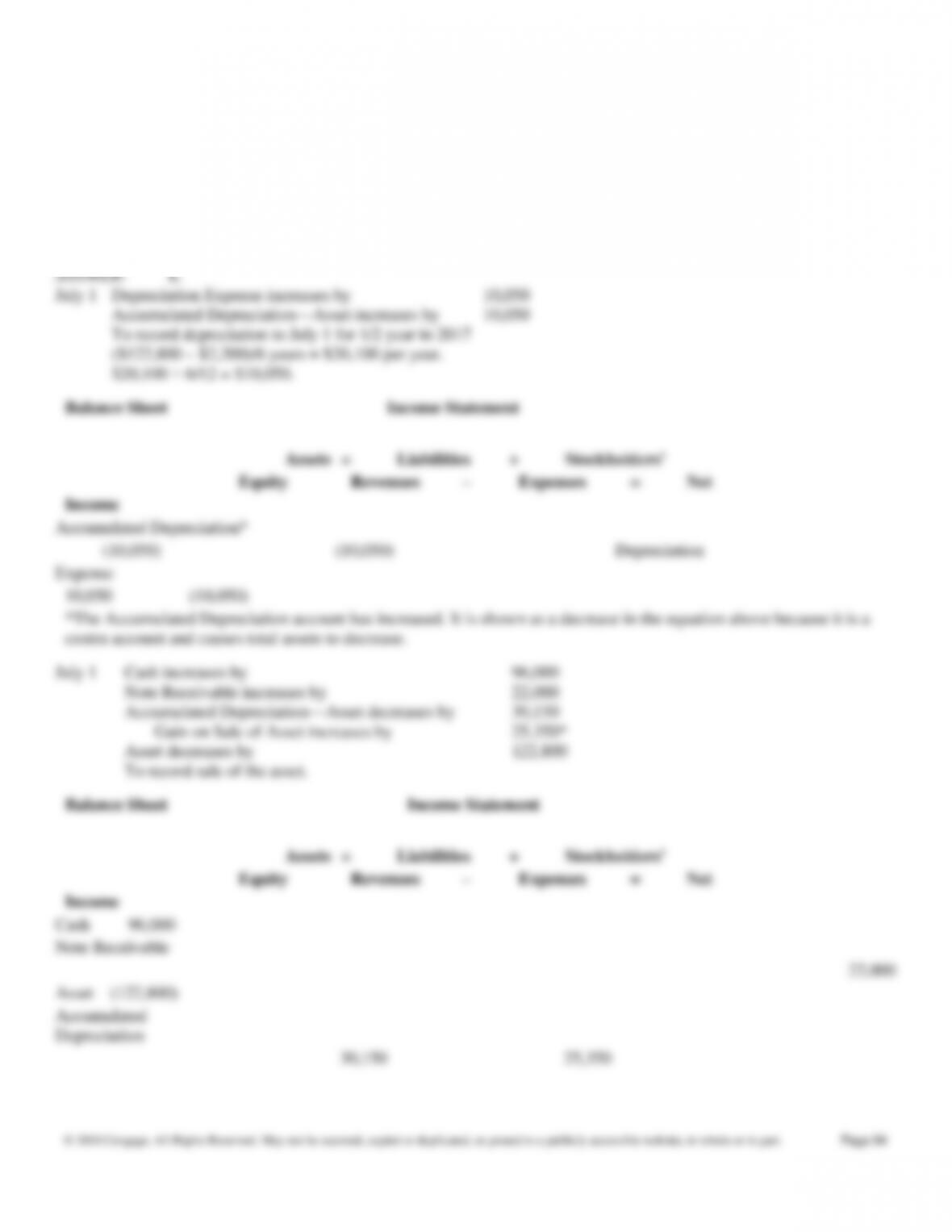
220. Assume that Rocket Company purchased an asset on January 1, 2015, for $62,400. The asset had an estimated life of
eight years and an estimated residual value of $8,000. The company used the straight-line method to depreciate the asset.
On July 1, 2017, the asset was sold for $52,000.
Required
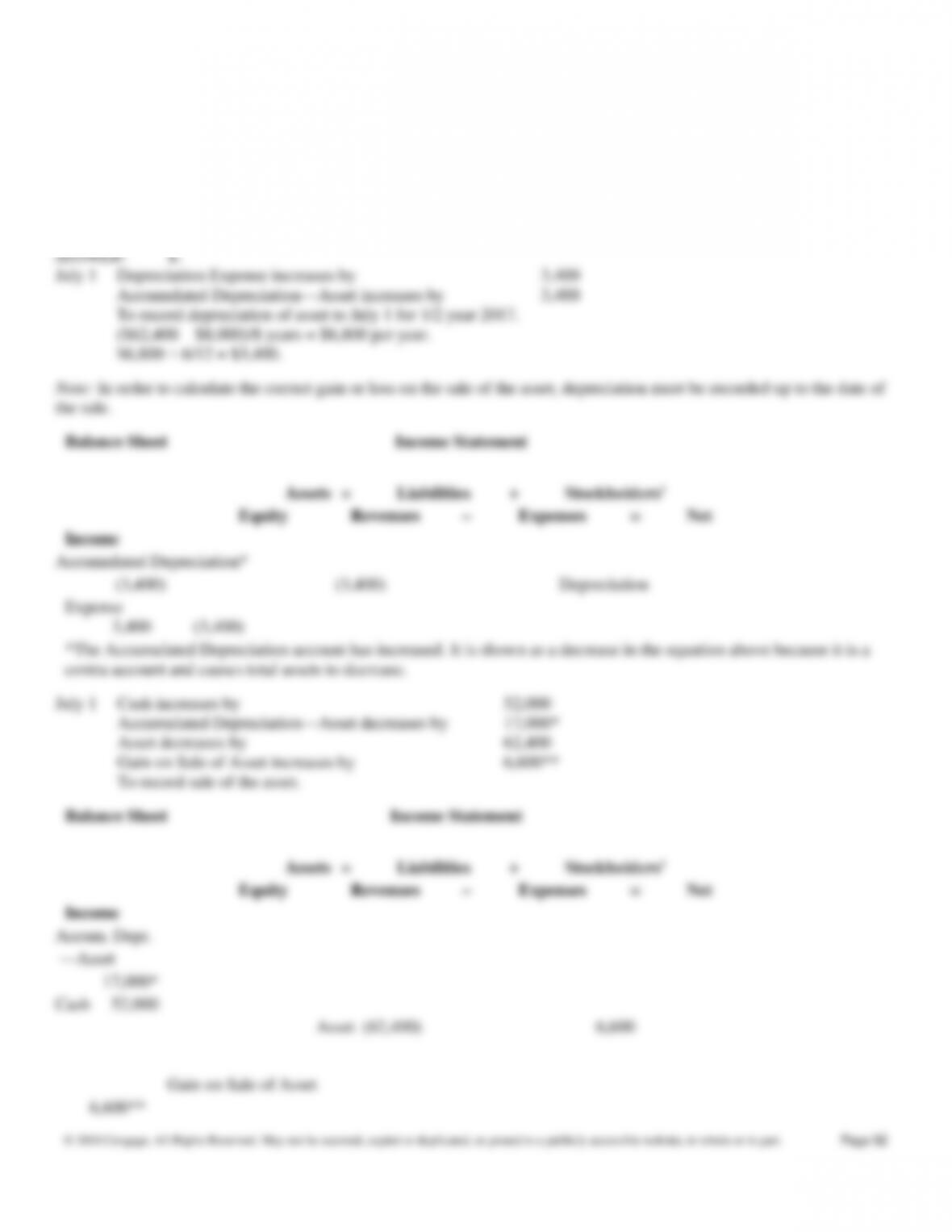
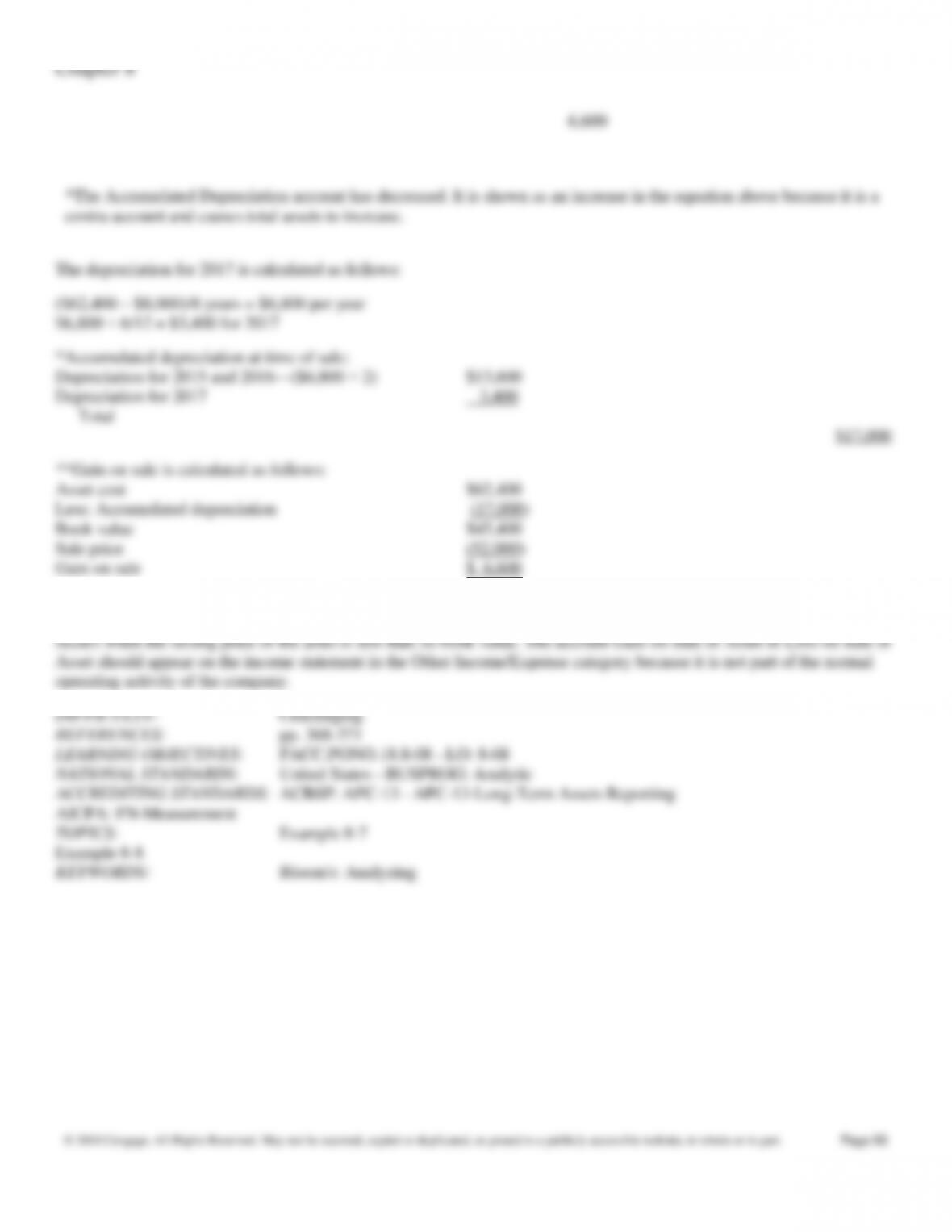
1. Analyze the impact of the transaction to record depreciation for 2017 and for all transactions necessary for the sale of
the asset.
2. How should the gain or loss on the sale of the asset be presented on the income statement?
Chapter 8
© 2018 Cengage. All Rights Reserved. May not be scanned, copied or duplicated, or posted to a publicly accessible website, in whole or in part.
Page 94
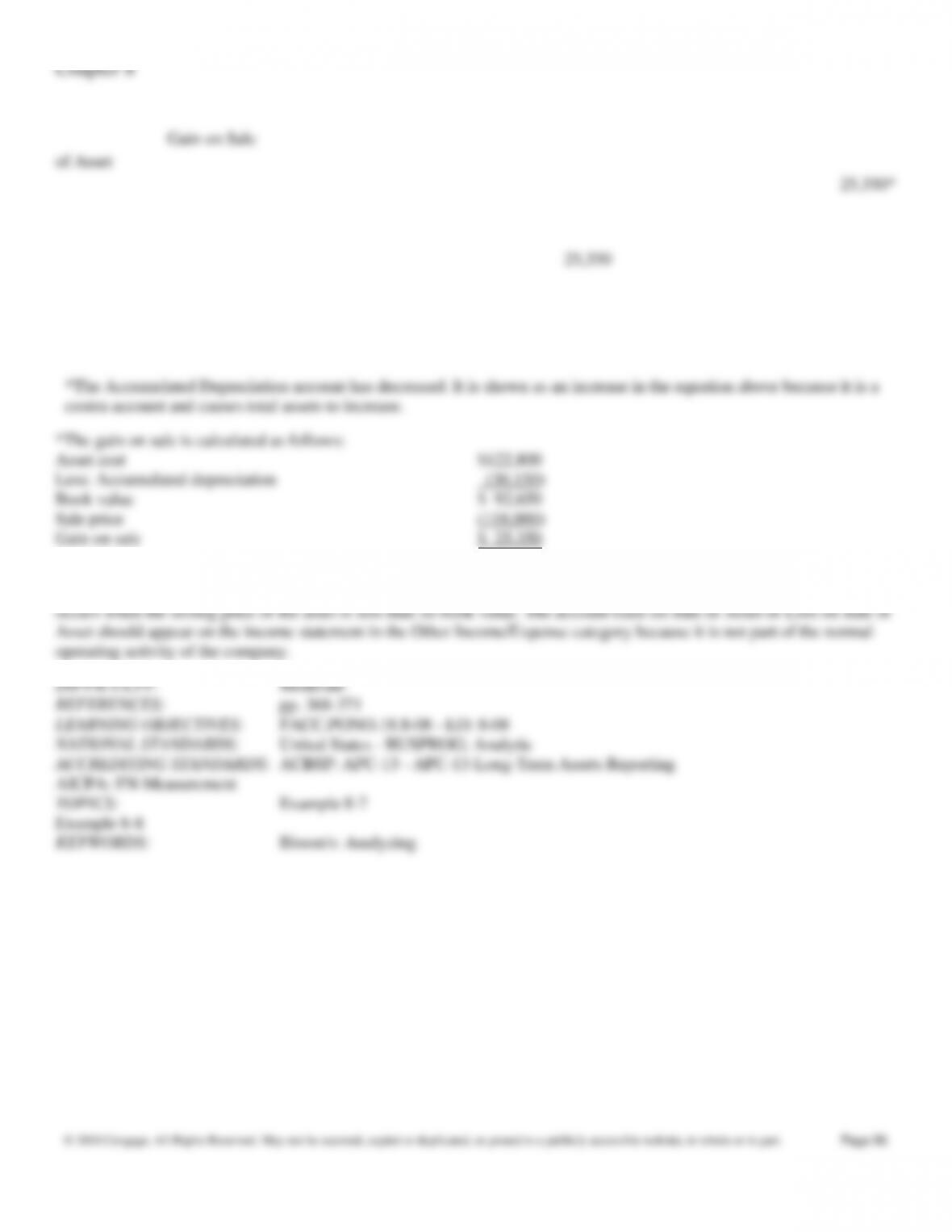
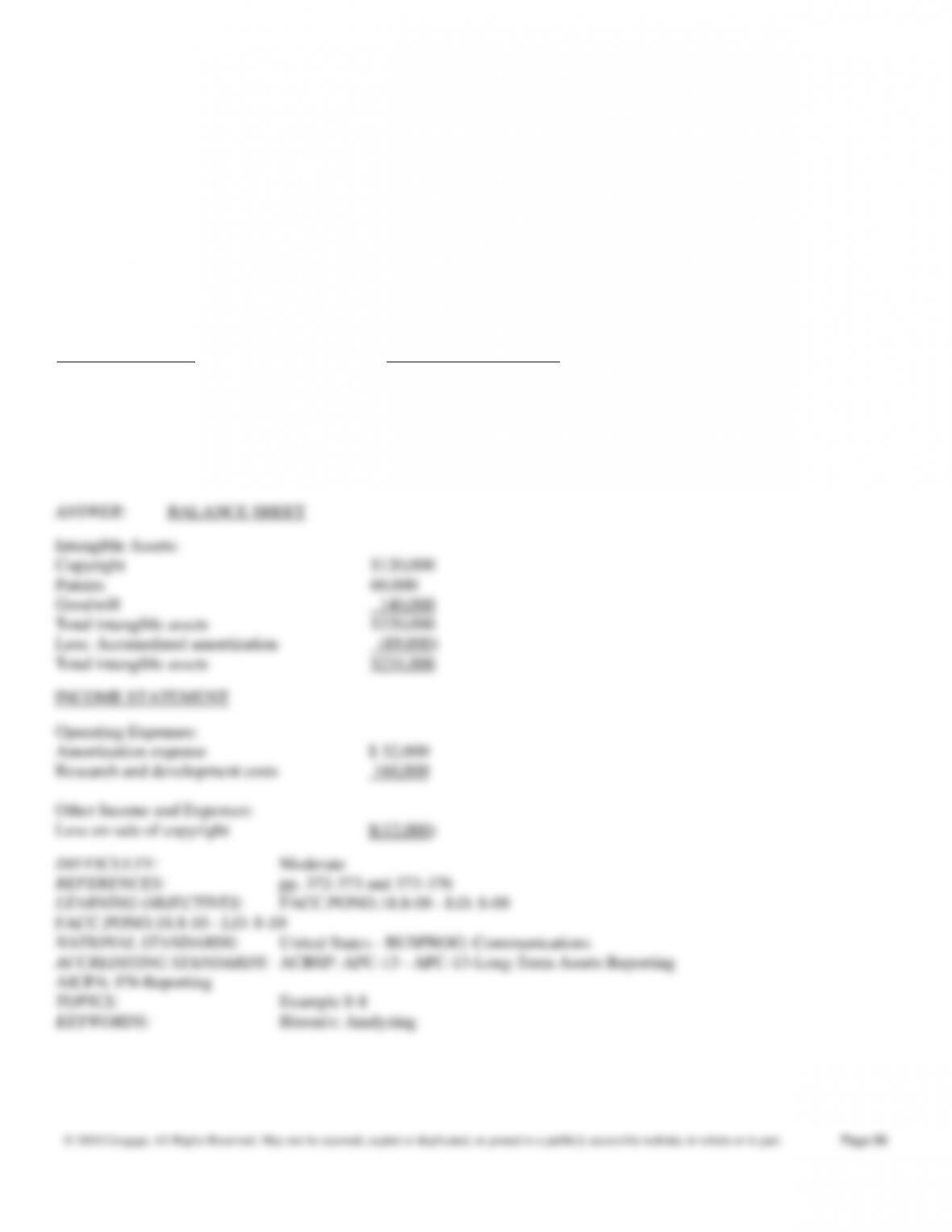
221. Assume that Halpern Company purchased an asset on January 1, 2016, for $122,800. The asset had an estimated life
of six years and an estimated residual value of $2,200. The company used the straight-line method to depreciate the asset.
Assume that Halpern Company sold the asset on July 1, 2017, and received $96,000 cash and a note for an additional
$22,000.
Required
1. Analyze the transaction needed to record depreciation for 2017 and for all transactions necessary for the sale of the
asset.
2. How should the gain or loss on the sale of the asset be presented on the income statement?
Chapter 8
© 2018 Cengage. All Rights Reserved. May not be scanned, copied or duplicated, or posted to a publicly accessible website, in whole or in part.
Page 96
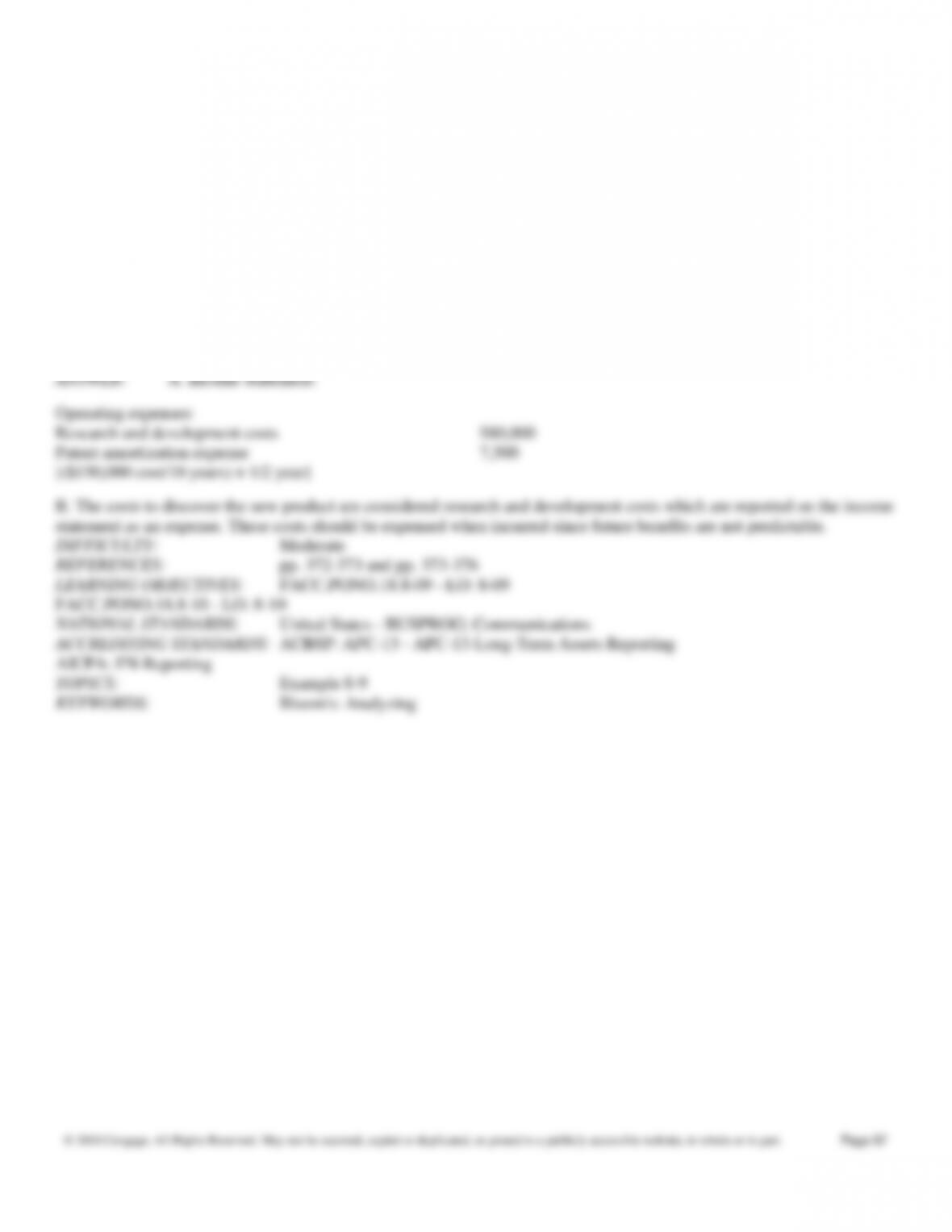
222. Below are several accounts and balances from the 2017 financial statements for Torrent, Inc. Prepare the Intangible
Asset section of the company’s balance sheet, as well as a partial income statement in the space provided below using the
accounts provided.
Amortization expense $ 32,000
Amortization since inception 89,000
Loss on sale of copyright 12,000
Copyright 120,000
Patents 60,000
Land 80,000
Goodwill 140,000
Research and development costs 160,000
BALANCE SHEET INCOME STATEMENT
Chapter 8
© 2018 Cengage. All Rights Reserved. May not be scanned, copied or duplicated, or posted to a publicly accessible website, in whole or in part.
Page 97
223. Given below are costs incurred by Bunker Company during 2017 and 2018. Bunker follows the policy of decreasing
the Intangible Asset account directly as amortized.
Research was conducted to discover a new product and costs of $200,000 in 2017 and $80,000 in 2018 were incurred.
After several months, a product was created and a patent secured for a cost of $150,000, effective as of July 1, 2018. The
company expects to have increased revenues of $500,000 over the next several years. The patent is expected to be useful
for the next ten years.
A.
Prepare a partial income statement for the year ended December 31, 2018.
B.
How should the $80,000 cost incurred in 2018 be reported on the financial statements?
Chapter 8
© 2018 Cengage. All Rights Reserved. May not be scanned, copied or duplicated, or posted to a publicly accessible website, in whole or in part.
Page 98
224. Wang Fitness Co. purchased a patent at the beginning of 2017 for $120,000. Economic benefits were expected for
only 12 years, but the patent’s legal life is 17 years. Also, during 2017, the company incurred research and development
costs of $50,000.
A. Determine the following amounts:
1. Research and development expense for 2017
2. Patent amortization expense for 2017
B. Prepare the Intangible Assets section of the balance sheet at December 31, 2017.
Chapter 8
© 2018 Cengage. All Rights Reserved. May not be scanned, copied or duplicated, or posted to a publicly accessible website, in whole or in part.
Page 99
225. Glitch Company incurred the following costs during 2017 and 2018:
a. Research and development costing $40,000 was conducted on a new product to sell in future years. A product was
successfully developed, and a patent for it was granted during 2017. Glitch is unsure of the period benefited by the
research, but believes the product will result in increased sales over the next five years.
b. Legal costs and application fees of $25,000 for the 20-year patent were incurred on January 1, 2017.
c. A patent infringement suit was successfully defended at a cost of $24,000. Assume that all costs were incurred on
January 1, 2018.
Required
Determine how the costs in (a) and (b) should be presented on Glitch’s financial statements as of December 31, 2017.
Also determine the amount of amortization of intangible assets that Glitch should record in 2017 and 2018.
Chapter 8
© 2018 Cengage. All Rights Reserved. May not be scanned, copied or duplicated, or posted to a publicly accessible website, in whole or in part.
Page 100
226. Several years ago, Laurel Company purchased a patent and has since been amortizing it on a straight-line basis over
its estimated useful life. The company’s comparative balance sheets contain the following items:
(In thousands) December 31, 2018 December 31, 2017
Patent, less accumulated amortization of
$70,000 (2018) and $52,500 (2017) $280,000 $297,500
A.
How much amortization expense was recorded during 2018?
B.
How is the amortization expense reported on the company’s statement of cash flows?
C.
How much was the original cost of the patent?
D.
How many years has the patent been amortized?