Chapter 7
Chapter 7
Chapter 7
© 2018 Cengage. All Rights Reserved. May not be scanned, copied or duplicated, or posted to a publicly accessible website, in whole or in part.
Page 23
61. See the data for Lynx Corp.
If Lynx Corp. uses the aging of accounts receivable approach to estimate its bad debts, what will be the net realizable
value of its accounts receivable after the adjustment for bad debts expense?
a. $140,000
b. $156,000
c. $167,000
d. $184,000
62. Allowance for Doubtful Accounts represents
a. cash set aside to make up for bad debts losses.
b. the amount of uncollectible accounts written off to date.
c. the difference between total sales made on credit and the amount collected from those credit sales.
d. the difference between the gross amount of accounts receivable and the net realizable value of accounts
receivable.
Chapter 7
© 2018 Cengage. All Rights Reserved. May not be scanned, copied or duplicated, or posted to a publicly accessible website, in whole or in part.
Page 24
63. Which of the following statements is true regarding the two allowance methods used to account for bad debts?
a. The percentage of net credit sales approach takes into account the existing balance in the Allowance for Doubtful
Accounts account.
b. The direct write-off method takes into account the existing balance in the Allowance for Doubtful Accounts
account.
c. The percentage of accounts receivable approach takes into account the existing balance in the Allowance for
Doubtful Accounts account.
d. The direct write-off method does a better job of matching revenues and expenses.
64. The following data concern Wang Corporation for 2017:
Credit sales during the year $1,600,000
Accounts receivable—December 31, 2017 235,000
Allowance for doubtful accounts—December 31, 2017 18,000
Bad debts expense for the year 11,000
What amount will Wang show on its year-end balance sheet for the net realizable value of its accounts receivable?
a. $253,000
b. $235,000
c. $224,000
d. $217,000
Chapter 7
© 2018 Cengage. All Rights Reserved. May not be scanned, copied or duplicated, or posted to a publicly accessible website, in whole or in part.
Page 25
65. What are the effects on the accounting equation when a company makes the adjustment to record bad debts expense
using the allowance method?
a. Assets and stockholders’ equity increase.
b. Assets and stockholders’ equity decrease.
c. Assets increase and stockholders’ equity decreases.
d. Assets decrease and stockholders’ equity increases.
66. When using the allowance method, what are the effects on the accounting equation when a company writes off a bad
debt?
a. Assets and stockholders’ equity increase.
b. Assets and stockholders’ equity decrease.
c. Assets increase and stockholders’ equity decreases.
d. There is no effect on overall assets or equity.
Chapter 7
© 2018 Cengage. All Rights Reserved. May not be scanned, copied or duplicated, or posted to a publicly accessible website, in whole or in part.
Page 26
Music Corporation
The data below are for Music Corporation for 2017.
Accounts receivable—January 1, 2017 $236,000
Credit sales during 2017 820,000
Collections from credit customers during 2017 590,000
Customer accounts written off as uncollectible during 2017 8,000
Allowance for doubtful accounts—January 1, 2017 8,700
Estimated uncollectible accounts based on an aging analysis 9,600
67. Refer to the data for Music Corporation.
What is the balance of Accounts Receivable at December 31, 2017?
a. $336,000
b. $448,400
c. $458,000
d. $466,000
68. Refer to the data for Music Corporation.
If the aging approach is used to estimate bad debts, what amount should be recorded as bad debts expense for 2017?
a. $8,000
b. $8,100
c. $8,700
d. $8,900
69. Refer to the data for Music Corporation.
If the aging approach is used to estimate bad debts, what is the balance in Allowance for Doubtful Accounts after the bad
debts expense adjustment?
a. $8,000
Chapter 7
© 2018 Cengage. All Rights Reserved. May not be scanned, copied or duplicated, or posted to a publicly accessible website, in whole or in part.
Page 27
b. $8,100
c. $8,900
d. $9,600
Benton Corporation
The data below are for Benton Corporation for 2017.
Accounts Receivable—January 1, 2017 $334,000
Credit sales during 2017 850,000
Collections from credit customers during 2017 725,000
Customer accounts written off as uncollectible during 2017 12,000
Allowance for doubtful accounts (credit balance)
(after write-off of uncollectible accounts)
1,700
Estimated uncollectible accounts based on an aging analysis 13,200
70. Refer to the data for Benton Corporation.
What is the balance of Accounts Receivable at December 31, 2017?
a. $209,000
b. $225,000
c. $447,000
d. $459,000
71. Refer to the data for Benton Corporation.
If the aging approach is used to estimate bad debts, what amount should be recorded as bad debts expense for 2017?
a. $2,900
b. $11,500
c. $23,500
d. $26,900
Chapter 7
© 2018 Cengage. All Rights Reserved. May not be scanned, copied or duplicated, or posted to a publicly accessible website, in whole or in part.
Page 29
Mellon Corporation
The data presented below are for Mellon Corporation for the year ended December 31, 2017:
Sales (100% on credit) $1,500,000
Sales returns 60,000
Accounts receivable (December 31, 2017) 250,000
Allowance for doubtful accounts (credit balance) (before adjustment at December 31, 2017
3,000
Estimated amount of uncollectible accounts based on an aging analysis 31,000
73. Refer to the data for Mellon Corporation.
If Mellon estimates its bad debts at 2% of net credit sales, what amount will be reported as bad debts expense for 2017?
a. $25,800
b. $27,000
c. $28,800
d. $30,000
74. Refer to the data for Mellon Corporation.
If Mellon uses 2% of net credit sales to estimate its bad debts, what will be the balance in the Allowance for Doubtful
Accounts account after the adjustment for bad debts?
a. $33,000
b. $31,800
c. $27,000
d. $25,800
75. Refer to the data for Mellon Corporation.
If Mellon uses the aging of accounts receivable approach to estimate its bad debts, what amount will be reported as bad
debts expense for 2017?
a. $28,000
b. $31,000
Chapter 7
© 2018 Cengage. All Rights Reserved. May not be scanned, copied or duplicated, or posted to a publicly accessible website, in whole or in part.
Page 30
c. $34,000
d. $50,000
76. Refer to the information for Mellon Corporation.
If Mellon uses the aging of accounts receivable approach to estimate its bad debts, what will be the net realizable value of
its accounts receivable after the adjustment for bad debts expense?
a. $216,000
b. $219,000
c. $222,000
d. $250,000
Chapter 7
© 2018 Cengage. All Rights Reserved. May not be scanned, copied or duplicated, or posted to a publicly accessible website, in whole or in part.
Page 31
77. On January 1, 2017, Accounts Receivable and Allowance for Uncollectible Accounts for Darius Company carried
balances of $20,000 and $550, respectively. During the year, the company reported $70,000 of credit sales. There were
$400 of receivables written off as uncollectible in 2017. Cash collections of receivables amounted to $74,700. The
company estimates that it will be unable to collect 5% of the year-end accounts receivable balance.
The amount of bad debts expense recognized in the 2017 income statement will be:
a. $545.
b. $595.
c. $745.
d. $795.
78. Assuming a company uses the allowance method, the entry to recognize the write-off of the specific uncollectible
accounts will
a. increase total assets and total equity.
b. increase total assets and decrease total equity.
c. decrease total assets and total equity.
d. not affect total assets or total equity.
Chapter 7
© 2018 Cengage. All Rights Reserved. May not be scanned, copied or duplicated, or posted to a publicly accessible website, in whole or in part.
Page 32
79. The entry required to recognize the bad debts expense for 2017 will
a. increase total assets and retained earnings.
b. decrease total assets and retained earnings.
c. decrease total assets and increase net income.
d. increase total assets and decrease net income.
80. Which one of the following is not an accurate statement regarding the direct write-off method of accounting for bad
debts?
a. The direct write-off method has some deficiencies when accounting for bad debts.
b. The direct write-off method ignores the possibility that partial collection of a company’s outstanding accounts
receivable may occur.
c. Under the direct write-off method, an expense is increased.
d. The allowance method for bad debts violates the matching principle, but the direct write-off method does not.
Chapter 7
© 2018 Cengage. All Rights Reserved. May not be scanned, copied or duplicated, or posted to a publicly accessible website, in whole or in part.
Page 33
81. On January 1, 2017, Accounts Receivable and Allowance for Uncollectible Accounts for Darius Company carried
balances of $20,000 and $550, respectively. During the year, the company reported $70,000 of credit sales. There were
$400 of receivables written off as uncollectible in 2017. Cash collections of receivables amounted to $74,700. The
company estimates that it will be unable to collect 5% of the year-end accounts receivable balance.
The net realizable value of receivables appearing on the 2017 balance sheet will amount to
a. $14,105.
b. $14,155.
c. $14,900.
d. $15,450.
82. On November 2, 2017, Quaint General Store concluded that a customer’s $400 account receivable was uncollectible
and that the account should be written off. What effect will this write-off have on Quaint’s 2017 net income and balance
sheet totals assuming the allowance method is used to account for bad debts?
a. Decrease in net income; decrease in total assets
b. Increase in net income; no effect on total assets
c. No effect on net income; decrease in total assets
d. No effect on net income; no effect on total assets
Chapter 7
© 2018 Cengage. All Rights Reserved. May not be scanned, copied or duplicated, or posted to a publicly accessible website, in whole or in part.
Page 34
83. What is the distinguishing characteristic between accounts receivable and notes receivable?
a. Accounts receivable are usually current assets, while notes receivable are usually long-term assets.
b. Accounts receivable require payment of interest if not paid within the usual credit terms.
c. Notes receivable result from credit sale transactions for merchandising companies, while accounts receivable result
from credit sale transactions for service companies.
d. Notes receivable result from a written promise to pay within a specified amount of time.
84. Where can the amounts needed to compute the accounts receivable turnover ratio be found?
a. The income statement
b. The balance sheet
c. The statement of cash flows
d. Both the income statement and balance sheet
85. What can a company try to improve its accounts receivable turnover ratio?
a. Lower its selling prices
b. Increase its sales force
c. Give customers credit terms of 2/10, n/30 rather than 1/10, n/30
d. Reduce the number of employees working in the credit department
86. During 2017, the accounts receivable turnover ratio for Cordner Company increased from 10 to 14 times per year.
Which one of the following statements is the most likely explanation for the change?
a. The company’s credit department has followed up with customers whose account balances are past due in order to
generate quicker collections.
b. The company has decreased sales to its most creditworthy customers.
c. The company has increased the amount of time customers have to pay their accounts before they are past due.
Chapter 7
© 2018 Cengage. All Rights Reserved. May not be scanned, copied or duplicated, or posted to a publicly accessible website, in whole or in part.
Page 35
d. The company has extended credit to more risky customers in order to increase sales.
87. Espat Corp. reported net sales (all on credit) of $1,600,000 and cost of goods sold of $1,100,000 for 2017. Its
beginning balance of Accounts Receivable was $150,000. The accounts receivable balance decreased by $10,000 during
2017. Rounded to two decimal places, what is Espat’s accounts receivable turnover ratio for 2017?
a. 7.59
b. 10.32
c. 10.67
d. 11.03
Chapter 7
© 2018 Cengage. All Rights Reserved. May not be scanned, copied or duplicated, or posted to a publicly accessible website, in whole or in part.
Page 36
88. Lasiter Corp. reported net credit sales of $2,000,000 and cost of goods sold of $1,400,000 for 2017. On January 1,
2017, accounts receivable was $250,000. Amounts owed by customers increased by $20,000 during 2017. Rounding to
two decimal places, what is Lasiter’s accounts receivable turnover ratio for 2017?
a. 8.33
b. 8.00
c. 7.69
d. 7.41
89. The party to a promissory note that agrees to repay money on the maturity date of the note is called the
a. lender.
b. maker of the note.
c. payee of the note.
d. recipient of the note.
90. How will the payee of the promissory note record the note on its books?
a. The promissory note will be recorded as an asset.
b. The promissory note will be recorded as a liability.
c. The promissory note will be recorded as revenue.
d. The promissory note will be recorded as an expense.
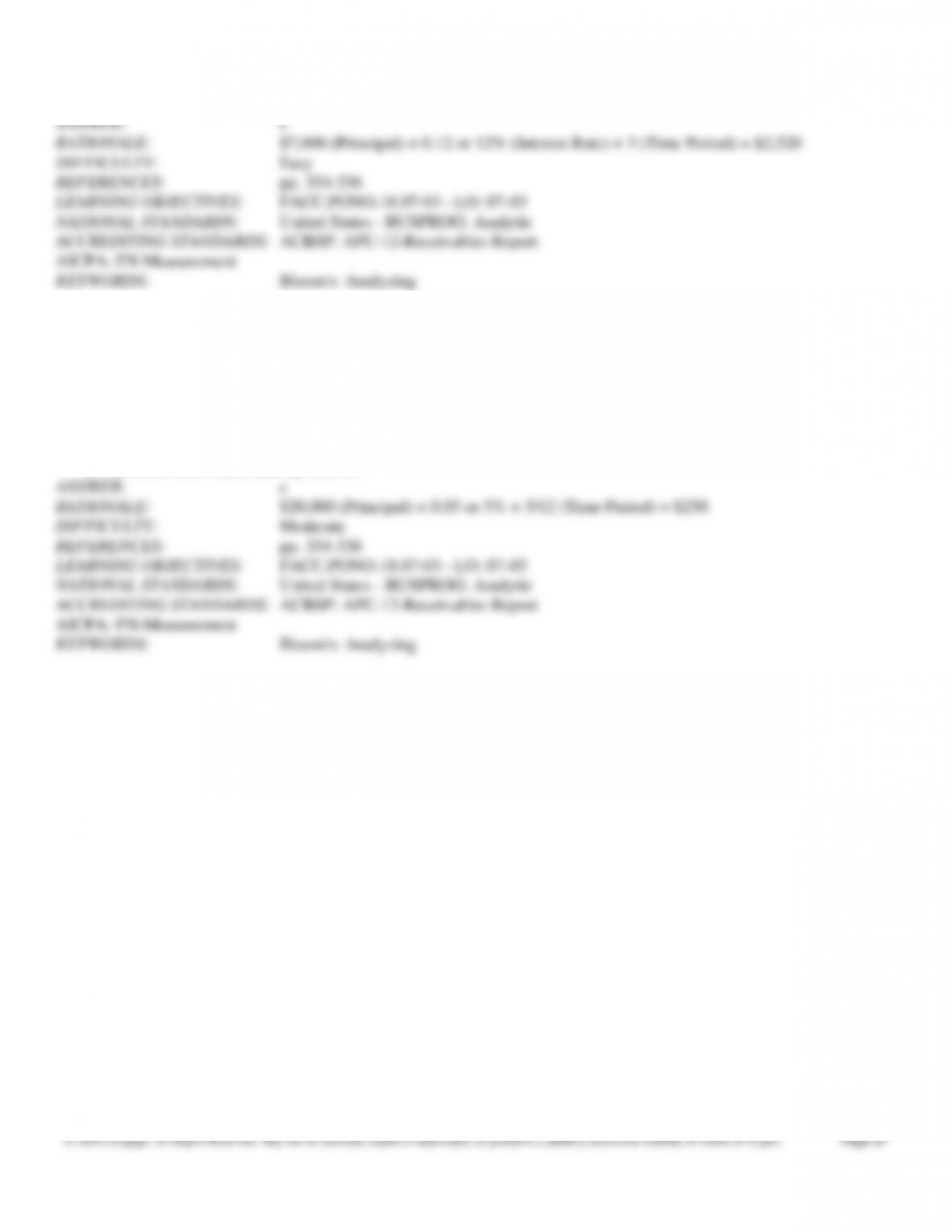
91. The total amount of interest calculated annually on a $7,000 promissory note payable for three years at 12% that is not
compounded is
a. $280.
b. $840.
c. $2,520.
Chapter 7
© 2018 Cengage. All Rights Reserved. May not be scanned, copied or duplicated, or posted to a publicly accessible website, in whole or in part.
Page 37
d. $8,260.
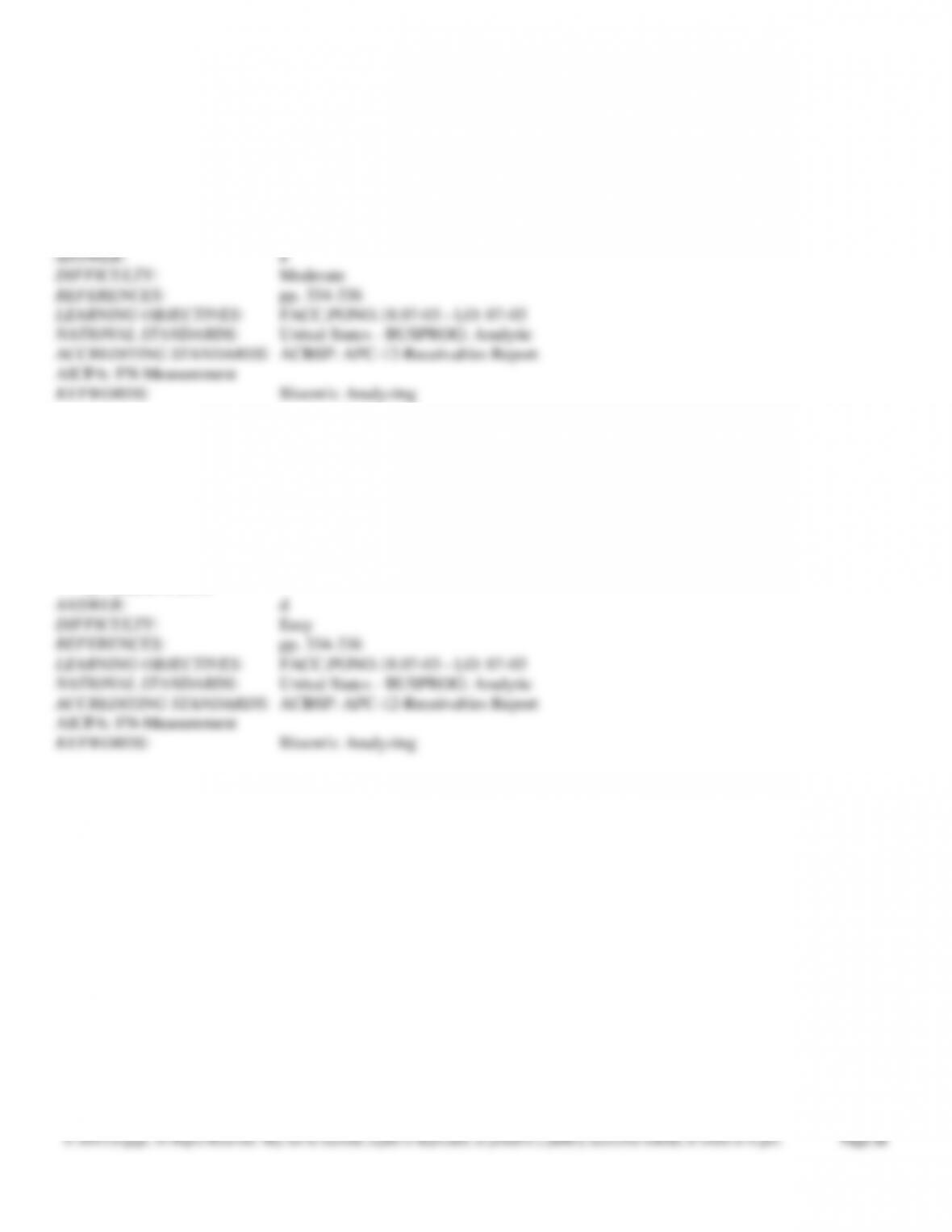
92. On July 1, 2017, Falcon Company received a $20,000 promissory note from Jordyn Company. The annual interest rate
is 5%. Principal and interest are paid in cash at the maturity date of June 30, 2018.
If Falcon’s fiscal year ends September 30, 2017, an adjustment is needed to
a. increase interest revenue by $1,000.
b. increase notes receivable by $250.
c. increase interest receivable by $250.
d. increase notes receivable by $1,000.
Chapter 7
© 2018 Cengage. All Rights Reserved. May not be scanned, copied or duplicated, or posted to a publicly accessible website, in whole or in part.
Page 38
93. On July 1, 2017, Falcon Company received a $20,000 promissory note for services from Jordyn Company. The annual
interest rate is 5%. Principal and interest are paid in cash at the maturity date of June 30, 2018.
The effect on Falcon’s financial statements on July 1, 2017, is which of the following?
a. Assets and stockholders’ equity increases.
b. Assets decrease and stockholders’ equity decreases.
c. Assets decrease.
d. There is no net change in assets.
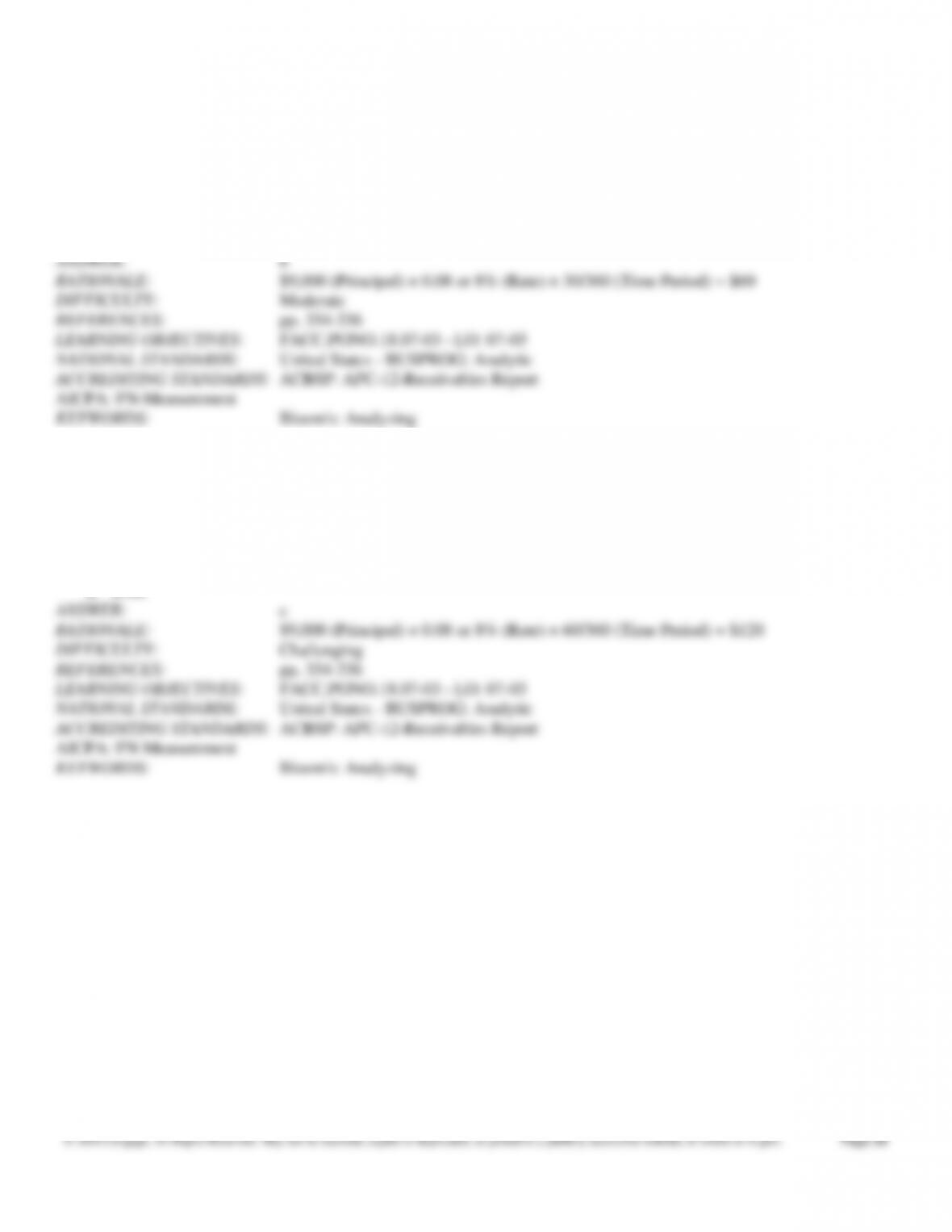
94. Utah Co. sold merchandise to Big Sky Corp. on December 1, 2017, for $9,000 and accepted a promissory note for
payment in the same amount. The note has a term of 90 days and a stated interest rate of 8%. Utah’s accounting period
ends on December 31.
What is the actual maturity date of the note?
a. December 31, 2017
b. January 29, 2018
c. February 28, 2018
d. March 1, 2018
Chapter 7
© 2018 Cengage. All Rights Reserved. May not be scanned, copied or duplicated, or posted to a publicly accessible website, in whole or in part.
Page 39
95. Utah Co. sold merchandise to Big Sky Corp. on December 1, 2017, for $9,000 and accepted a promissory note for
payment in the same amount. The note has a term of 90 days and a stated interest rate of 8%. Utah’s accounting period
ends on December 31. What amount should Utah recognize as interest revenue on December 31, 2017 (if a 360-day year
is assumed)?
a. $0
b. $60
c. $120
d. $180
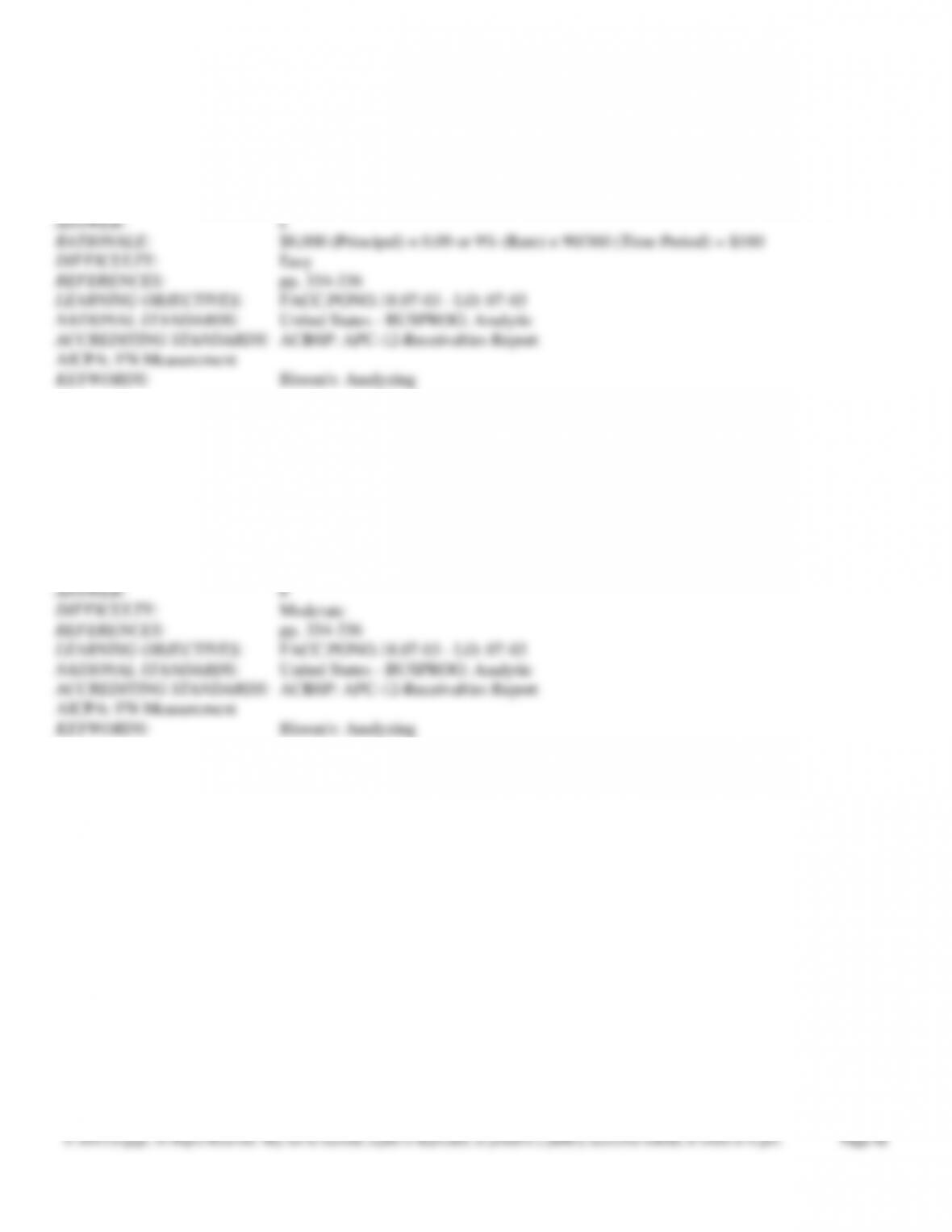
96. Utah Co. sold merchandise to Big Sky Corp. on December 1, 2017, for $9,000 and accepted a promissory note for
payment in the same amount. The note has a term of 90 days and a stated interest rate of 8%. Utah’s accounting period
ends on December 31. What amount should Utah recognize as interest revenue on the maturity date of the note?
a. $0
b. $60
c. $120
d. $180
Chapter 7
© 2018 Cengage. All Rights Reserved. May not be scanned, copied or duplicated, or posted to a publicly accessible website, in whole or in part.
Page 40
97. Genuine Parts received a promissory note from a customer on March 1, 2017. The face amount of the note is $8,000;
the terms are 90 days and 9% interest. What amount of interest will Genuine Parts receive when the note is paid?
a. $60
b. $90
c. $180
d. $720
98. Genuine Parts received a promissory note from a customer on March 1, 2017. The face amount of the note is $8,000;
the terms are 90 days and 9% interest. At the maturity date, the customer pays the amount due for the note and interest.
What entry is required on the books of Genuine Parts on the maturity date assuming none of the interest had already been
recognized?
a. Increase Cash, $8,000; and decrease Notes Receivable, $8,000
b. Increase Cash, $8,180; increase Interest Revenue, $180; and decrease Notes Receivable, $8,000
c. Increase Cash, $8,720; decrease Notes Receivable, $8,000; and increase Interest Revenue, $720
d. No entry required; the customer pays amount due to the bank