Chapter 5
© 2018 Cengage Learning. All Rights Reserved. May not be scanned, copied or duplicated, or posted to a publicly accessible website, in whole or in part.
Page 21
61. Which one of the following best explains the distinction between inventory and an operating asset?
a. ownership
b. intent
c. cost
d. purchase price
62. Which of the following accounts would not be found as an asset on the balance sheet of a manufacturer?
a. Raw Materials Inventory
b. Work in Process Inventory
c. Finished Goods Inventory
d. Merchandise Inventory
63. The account a manufacturer uses to record the cost of products completed and available for sale is called
a. Raw Materials Inventory.
b. Work in Process Inventory.
c. Finished Goods Inventory.
d. Merchandise Inventory.
Chapter 5
© 2018 Cengage Learning. All Rights Reserved. May not be scanned, copied or duplicated, or posted to a publicly accessible website, in whole or in part.
Page 22
64. Which of the following statements regarding inventory is true?
a. Wholesalers and retailers incur a single type of cost, the purchase price, of the inventory they sell.
b. It is not unusual for inventories to account for half the total assets of a manufacturer.
c. Wholesalers and retailers buy merchandise and transform the product before offering it to resale to customers.
d. The inventory of a manufacturer takes three distinct forms—direct materials, direct labor, and finished goods.
65. For what reason might retailers like Target select an accounting period that ends on or near the end of January?
a. The company originally started business operations on that date so it is required to use the date as fiscal year-end.
b. Business activity is in a slow period that is suited to the preparation of its financial statements at the end of the
year.
c. The company’s CPAs are attempting to spread out the workload.
d. The Internal Revenue Service requires merchandise companies to select such a date for their fiscal year.
66. Which one of the following would appear on the income statement of a merchandising company, but not on the
income statement of a service company?
a. Cost of goods sold
b. Selling and administrative expenses
c. Net sales
d. Income tax expense
67. Which one of the following is a common analytical tool used by merchandising companies, but not by service
companies?
a. Gross profit ratio
b. Earnings per share
c. Current ratio
d. Working capital
Chapter 5
© 2018 Cengage Learning. All Rights Reserved. May not be scanned, copied or duplicated, or posted to a publicly accessible website, in whole or in part.
Page 23
68. A customer returned damaged goods and was given an allowance. Which of the seller’s accounts decreases?
a. Purchase Returns
b. Accounts Receivable
c. Sales Returns
d. Sales Revenue
Chapter 5
© 2018 Cengage Learning. All Rights Reserved. May not be scanned, copied or duplicated, or posted to a publicly accessible website, in whole or in part.
Page 24
69. Travelli Co. sold merchandise to Trapani Co. on account, $17,000, terms 2/15, net 45. The cost of the merchandise
sold is $15,400. Travelli Co. issued an allowance for $1,750 for merchandise returned that originally cost $1,400. Trapani
Co. paid the invoice within the discount period. What is amount of net sales from the above transactions?
a. $17,000
b. $15,250
c. $14,945
d. None of these choices
70. A company using the periodic inventory system has the following account balances: Merchandise Inventory at the
beginning of the year, $3,600; Transportation-In, $650; Purchases, $10,700; Purchase Returns and Allowances, $1,950;
Purchase Discounts, $330. The cost of goods purchased is equal to
a. $12,670.
b. $9,070.
c. $8,420.
d. $17,230.
Chapter 5
© 2018 Cengage Learning. All Rights Reserved. May not be scanned, copied or duplicated, or posted to a publicly accessible website, in whole or in part.
Page 25
71. Using the following information, what is the amount of cost of goods sold?
Purchases $32,000
Merchandise inventory, September 1 5,700
Merchandise inventory, September 30 6,370
Purchase returns and allowances 1,200
Purchase discounts 960
Transportation-in 1,040
Sales 63,000
Sales returns and allowances 910
a. $26,900
b. $20,530
c. $28,130
d. $30,210
72. Which of the following statements regarding cost of goods available for sale is true?
a. Cost of goods available for sale is an expense account.
b. Cost of goods available for sale is added to beginning inventory to determine cost of purchases during the period.
c. Cost of goods available for sale is subtracted from net sales to arrive at the gross margin.
d. Cost of goods available for sale is a “pool” of costs to be distributed between what was sold and what was not
sold during a period.
Chapter 5
© 2018 Cengage Learning. All Rights Reserved. May not be scanned, copied or duplicated, or posted to a publicly accessible website, in whole or in part.
Page 26
73. Ending inventory is equal to the cost of merchandise on hand plus
a. merchandise in transit sold to customers FOB shipping point.
b. merchandise in transit sold to customers FOB destination point.
c. the cost of all inventory purchased during the period.
d. merchandise purchased in transit with terms FOB destination point.
Takenson Corp.
Takenson Corp. is a merchandising company that uses the periodic inventory system. Selected account balances are listed
below:
Sales $500,000
Purchases 225,000
Inventory (beginning) 16,000
Inventory (ending) 30,000
Operating expenses 148,000
Income tax expense 10,000
Retained earnings (beginning) 53,000
Dividends 15,000
74. Refer to the information for Takenson Corp.
Calculate the cost of goods sold
a. $275,000
b. $259,000
c. $241,000
d. $211,000
Chapter 5
© 2018 Cengage Learning. All Rights Reserved. May not be scanned, copied or duplicated, or posted to a publicly accessible website, in whole or in part.
Page 27
75. Refer to the information for Takenson Corp.
Calculate the gross profit.
a. $241,000
b. $275,000
c. $289,000
d. $425,000
76. Refer to the information for Takenson Corp.
Calculate net income.
a. $289,000
b. $141,000
c. $131,000
d. $116,000
Chapter 5
© 2018 Cengage Learning. All Rights Reserved. May not be scanned, copied or duplicated, or posted to a publicly accessible website, in whole or in part.
Page 28
George’s Department Store
George’s Department Store is a merchandising company that uses the periodic inventory system. Selected account
balances are listed below:
Sales $200,000
Purchases 90,000
Inventory (beginning) 23,000
Inventory (ending) 17,000
Purchase returns and allowances 3,000
Purchase discounts 7,000
Transportation-in 4,000
Sales discounts 8,000
Sales returns and allowances 5,000
77. Refer to the account information for George’s Department Store.
Calculate net sales.
a. $187,000
b. $192,000
c. $195,000
d. $200,000
Chapter 5
© 2018 Cengage Learning. All Rights Reserved. May not be scanned, copied or duplicated, or posted to a publicly accessible website, in whole or in part.
Page 29
78. Refer to the account information for George’s Department Store.
Calculate cost of goods purchased.
a. $ 84,000
b. $ 90,000
c. $ 103,000
d. $ 117,000
79. Refer to the account information for George’s Department Store.
Determine gross profit.
a. $93,000
b. $97,000
c. $103,000
d. None of these choices
Chapter 5
© 2018 Cengage Learning. All Rights Reserved. May not be scanned, copied or duplicated, or posted to a publicly accessible website, in whole or in part.
Page 30
80. Anthony’s Shoe Company uses a perpetual inventory system. The beginning balance in its Inventory account is
$1,500, and the ending balance is $1,000. Cost of goods sold is $6,500. What was the amount of inventory purchased
during the year?
a. $500
b. $6,000
c. $7,000
d. $7,500
81. What net effect is there on a retail store’s accounting equation when merchandise sold for a profit is returned by
customers?
a. Assets and stockholders’ equity decrease.
b. Assets and stockholders’ equity increase.
c. Assets decrease and liabilities increase.
d. Stockholders’ equity decreases and liabilities increase.
Chapter 5
© 2018 Cengage Learning. All Rights Reserved. May not be scanned, copied or duplicated, or posted to a publicly accessible website, in whole or in part.
Page 31
82. Vern Corp. sold merchandise to a customer on credit. The invoice amount was $2,000; the invoice date was June 10;
credit terms were 1/20, n/30. Which one of the following statements is true?
a. The customer can take a $20 discount if the invoice is paid on July 10.
b. The customer should pay $2,000 if the invoice is paid on July 9.
c. The customer must pay a $20 penalty if payment is made after July 9.
d. The customer must pay $2,020 if payment is made after June 20.
83. Grinn, Inc. offers terms of 2/10, n/30 to credit customers. Great Buy Corp. purchased 100 tile cutters with a list price
of $20 each on March 5, 2017, on account. If Great Buy Corp. pays the amount of the invoice for its purchase on March
14, 2017, how much cash will Grinn receive from Great Buy Corp.?
a. $1,764
b. $1,800
c. $1,960
d. $2,000
Chapter 5
© 2018 Cengage Learning. All Rights Reserved. May not be scanned, copied or duplicated, or posted to a publicly accessible website, in whole or in part.
Page 32
84. Floors, Inc. offers terms of 2/10, n/30 to credit customers. Tile Magic Corp. purchased 100 tile cutters with a list price
of $20 each on August 5, 2017, on account. Tile Magic Corp. paid the invoice on August 31, 2017. How much sales
discount will Floors recognize?
a. $0
b. $40
c. $200
d. $236
85. Blenham, Inc. sells merchandise on credit. If a customer pays its balance due within the discount period, what is the
effect of the payment on Blenham’s accounting equation?
a. Assets and stockholders’ equity decrease.
b. Assets and stockholders’ equity increase.
c. Assets decrease and liabilities increase.
d. Stockholders’ equity decreases and liabilities increase.
86. Blenham, Inc. sells merchandise on credit. If a customer pays its balance due after the discount period has passed,
what is the effect of the payment on Blenham’s accounting equation?
a. Assets and stockholders’ equity decrease.
b. Assets and stockholders’ equity increase.
c. Assets decrease and liabilities increase.
d. There is no net effect.
87. When an inventory system updates the Inventory account after each sale or purchase of merchandise, this is known as
a(n)
a. periodic system.
b. inventory costing system.
c. perpetual system.
Chapter 5
© 2018 Cengage Learning. All Rights Reserved. May not be scanned, copied or duplicated, or posted to a publicly accessible website, in whole or in part.
Page 33
d. accrual system.
88. Cost of goods sold is equal to the
a. total amount of merchandise purchased during the year.
b. cost of goods purchased plus transportation–in costs less ending inventory.
c. cost of goods purchased plus transportation-in costs plus beginning inventory minus purchase returns and
allowances and purchase discounts minus ending inventory.
d. cost of goods purchased plus transportation–in costs plus beginning inventory minus purchase returns and
allowances and purchase discounts.
89. The recognition of cost of goods sold as an expense in the same period that sales revenue is recognized from the sale
of merchandise is a good example of the
a. matching principle.
b. full disclosure principle.
c. revenue realization principle.
d. historical cost principle.
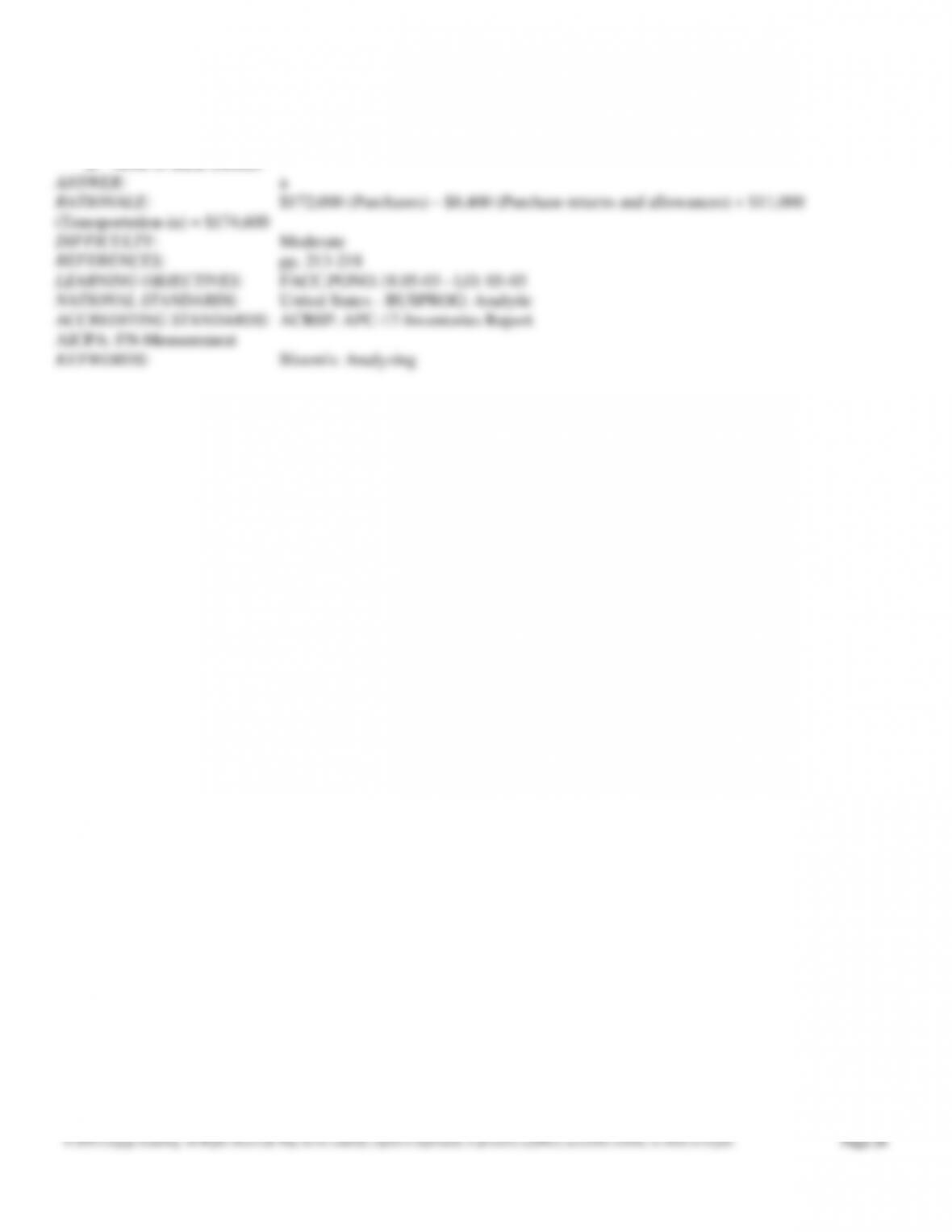
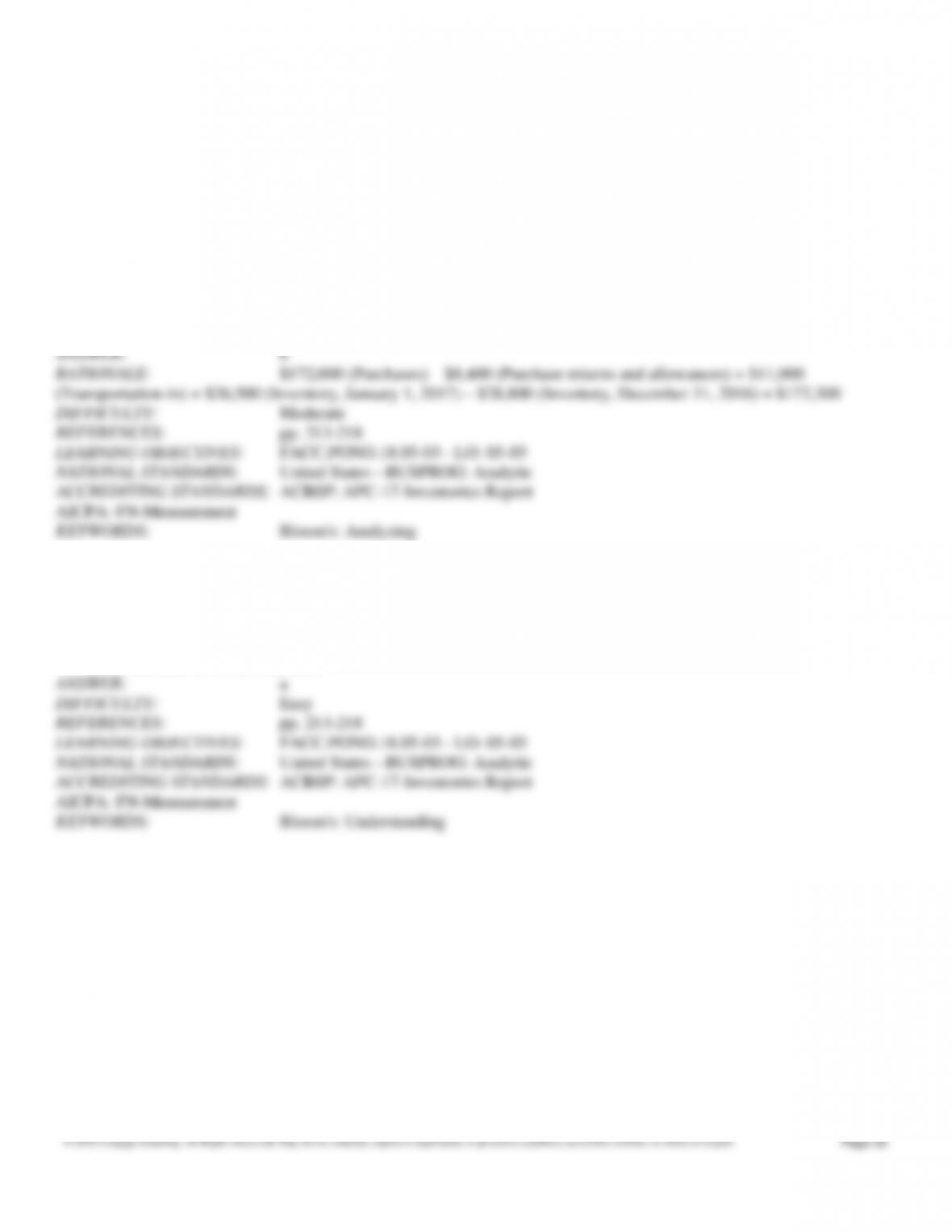
90. Goldman Inc.
The following is from Goldman Inc.’s 2017 income statement.
Purchases $172,000
Transportation-in 11,000
Inventory, January 1, 2017 26,500
Inventory, December 31, 2017 28,800
Purchase returns and allowances 8,400
How much will Goldman report as cost of goods purchased in its 2017 income statement?
Chapter 5
© 2018 Cengage Learning. All Rights Reserved. May not be scanned, copied or duplicated, or posted to a publicly accessible website, in whole or in part.
Page 34
a. $174,600
b. $183,000
c. $180,400
d. None of these choices
Chapter 5
© 2018 Cengage Learning. All Rights Reserved. May not be scanned, copied or duplicated, or posted to a publicly accessible website, in whole or in part.
Page 35
91. The following is from Goldman Inc.’s 2017 income statement.
Purchases $172,000
Transportation-In 11,000
Inventory, January 1, 2017 26,500
Inventory, December 31, 2017 28,800
Purchase Returns and Allowances 8,400
How much will Goldman report as its cost of goods sold in its 2016 income statement?
a. $161,500
b. $172,300
c. $161,300
d. None of these choices
92. In a periodic inventory system, the cost of purchases is recognized as
a. an integral part of the calculation of cost of goods sold.
b. the only part of the calculation of cost of goods sold.
c. an increase in the Inventory account.
d. an increase in an asset account.
Chapter 5
© 2018 Cengage Learning. All Rights Reserved. May not be scanned, copied or duplicated, or posted to a publicly accessible website, in whole or in part.
Page 36
93. Cost of goods sold is
a. purchases less beginning inventory plus ending inventory.
b. reported on the balance sheet in the Inventory account.
c. the cost of goods available for sale less ending inventory.
d. equal to the amount of inventory on hand at the end of the accounting period.
94. Which one of the following statements is not true?
a. The Inventory account is updated after every sale or purchase of merchandise under the perpetual inventory
system.
b. The Inventory account is updated only at the end of the accounting period under the periodic inventory system.
c. The Cost of Goods Sold account is updated after each sale of merchandise under the periodic inventory system.
d. The Purchases account is used only under the periodic inventory system.
Chapter 5
© 2018 Cengage Learning. All Rights Reserved. May not be scanned, copied or duplicated, or posted to a publicly accessible website, in whole or in part.
Page 37
95. Chamberlain Company buys designer clothing to sell in its retail stores. Since much of the merchandise comes from
Dallas and Europe, Chamberlain Company must pay freight charges to get the merchandise shipped in. Which of the
following statements is true?
a. Transportation-in, paid by Chamberlain Company, is added to the inventory account under the periodic system.
b. Transportation-in, paid by Chamberlain Company, is subtracted from purchases under the periodic system.
c. Freight charges are only paid by a buyer in a periodic system.
d. Transportation-in is added to net purchases to determine cost of goods purchased in a periodic system.
96. In order to determine inventory for its balance sheet, it is best for a company to count the inventory at the end of its
accounting period for
a. the periodic inventory system.
b. the perpetual inventory system.
c. both the periodic and perpetual inventory systems.
d. neither the periodic nor perpetual inventory systems.
97. Which of the following statements is true?
a. Inventory losses can be identified and controlled better under the perpetual system.
b. Inventory can only be sold at the end of an accounting period under the periodic system.
c. There is no difference in cost to implement a perpetual as compared to a periodic system.
d. The perpetual system eliminates the need for an annual inventory count.
98. Texas Inc. sold merchandise to Fagin Corp. on December 28, 2017, with shipping terms of FOB destination point.
Fagin Corp. received the merchandise on January 3, 2018. Which of the following statements is true?
a. Texas should record sales revenue on December 28, 2017.
b. Fagin Corp. should pay the transportation costs.
c. Fagin Corp. should include the merchandise in its inventory at December 31, 2017.
d. Fagin Corp. should record a liability for the purchase on January 3, 2018.
Chapter 5
© 2018 Cengage Learning. All Rights Reserved. May not be scanned, copied or duplicated, or posted to a publicly accessible website, in whole or in part.
Page 38
99. Park, Inc. purchased merchandise from Jay Zee Music Company on June 5, 2017. The goods were shipped the same
day. The merchandise’s selling price was $15,000. The credit terms were 1/10, n/30. The shipping terms were FOB
shipping point. Park received the merchandise on June 10, 2017. Park paid the amount due on June 13, 2017.
Park uses the periodic inventory system. What effect does recording the purchase of merchandise on June 5, 2017 have on
Park’s accounting equation?
a. Assets and liabilities increase.
b. Liabilities increase and stockholders’ equity decreases.
c. Assets and stockholders’ equity increase.
d. Liabilities and stockholders’ equity decrease.
Chapter 5
© 2018 Cengage Learning. All Rights Reserved. May not be scanned, copied or duplicated, or posted to a publicly accessible website, in whole or in part.
Page 39
100. Park, Inc. purchased merchandise from Jay Zee Music Company on June 5, 2017. The goods were shipped the same
day. The merchandise’s selling price was $15,000. The credit terms were 1/10, n/30. The shipping terms were FOB
shipping point. Park received the merchandise on June 10, 2017. Park paid the amount due on June 13, 2017.
If Park uses the periodic inventory system, the effect of recording the payment on June 13, 2017, will include a(n)
a. decrease to Purchases for $15,000.
b. increase to Inventory for $14,850.
c. decrease to Cash for $15,000.
d. decrease to Accounts Payable for $15,000.
101. Park, Inc. purchased merchandise from Jay Zee Music Company on June 5, 2017. The goods were shipped the same
day. The merchandise’s selling price was $15,000. The credit terms were 1/10, n/30. The shipping terms were FOB
shipping point. Park received the merchandise on June 10, 2017. Park paid the amount due on June 13, 2017.
When did title to the merchandise transfer from Jay Zee Music Company to Park?
a. June 5, 2017
b. June 10, 2017
c. June 13, 2017
d. Cannot be determined from the information provided
Chapter 5
© 2018 Cengage Learning. All Rights Reserved. May not be scanned, copied or duplicated, or posted to a publicly accessible website, in whole or in part.
Page 40
102. Park, Inc. purchased merchandise from Jay Zee Music Company on June 5, 2017. The goods were shipped the same
day. The merchandise’s selling price was $15,000. The credit terms were 1/10, n/30. The shipping terms were FOB
shipping point. Park received the merchandise on June 10, 2017. Park paid the amount due on June 13, 2017.
Who is responsible for payment of the transportation costs on the merchandise sold by Jay Zee Music to Park?
a. Jay Zee Music Company
b. Park, Inc.
c. Split equally between the two companies
d. Cannot be determined from the information provided
103. Herndon Corp. purchased merchandise on account from Likert Corp. on November 18, 2017. On November 21,
2017, Herndon returned damaged merchandise to Likert and was granted an adjustment on its account. Herndon uses the
periodic inventory system. What effect does the merchandise return have on Herndon’s accounting equation?
a. Assets and stockholders’ equity decrease.
b. Assets and liabilities decrease.
c. Liabilities decrease and stockholders’ equity increases.
d. Liabilities and stockholders’ equity decrease.