Chapter 2
© 2018 Cengage Learning. All Rights Reserved. May not be scanned, copied or duplicated, or posted to a publicly accessible website, in whole or in part.
Page 1
True / False
1. Financial statements are intended to tell the reader the value of a company.
a. True
b. False
2. Accountants are the main reason financial statements are prepared.
a. True
b. False
3. The SEC created the objectives of financial reporting.
a. True
b. False
© 2018 Cengage Learning. All Rights Reserved. May not be scanned, copied or duplicated, or posted to a publicly accessible website, in whole or in part.
Page 2
4. The purpose of financial reporting is to provide economic information to external decision makers only.
a. True
b. False
5. An objective of financial reporting is to reflect economic information concerning a company’s cash flows.
a. True
b. False
6. The concept of conservatism is the capacity of information to make a difference in a decision.
a. True
b. False
© 2018 Cengage Learning. All Rights Reserved. May not be scanned, copied or duplicated, or posted to a publicly accessible website, in whole or in part.
Page 3
7. There is a standard threshold for materiality set by the Financial Accounting Standards Board for all companies.
a. True
b. False
8. The lack of a common depreciation method makes it impossible to compare the performance of companies using
different methods.
a. True
b. False
9. The amount of a transaction may be immaterial by company standards but still be considered significant by financial
statement users.
a. True
b. False
© 2018 Cengage Learning. All Rights Reserved. May not be scanned, copied or duplicated, or posted to a publicly accessible website, in whole or in part.
Page 4
10. The quality of accounting information that allows a user to compare two or more accounting periods for a single
company is known as consistency.
a. True
b. False
11. Materiality deals with the insignificance of an error in accounting information.
a. True
b. False
12. The quality of accounting information that makes it comprehensible to those willing to spend the necessary time is
consistency.
a. True
b. False
© 2018 Cengage Learning. All Rights Reserved. May not be scanned, copied or duplicated, or posted to a publicly accessible website, in whole or in part.
Page 5
13. The quality of accounting information that allows a user to analyze two or more companies and look for similarities
and differences is known as understandability.
a. True
b. False
14. Most businesses have an operating cycle of greater than one year.
a. True
b. False
15. Current assets, other than cash, are expected to be sold or consumed beyond a company’s normal operating cycle.
a. True
b. False
© 2018 Cengage Learning. All Rights Reserved. May not be scanned, copied or duplicated, or posted to a publicly accessible website, in whole or in part.
Page 6
16. Obligations related to operating activities that will be paid within the company’s operating cycle must be reported as
current liabilities on a classified balance sheet.
a. True
b. False
17. The operating cycle for all businesses is one year.
a. True
b. False
18. A construction company that builds skyscrapers is likely to have an operating cycle longer than one year.
a. True
b. False
© 2018 Cengage Learning. All Rights Reserved. May not be scanned, copied or duplicated, or posted to a publicly accessible website, in whole or in part.
Page 7
19. Three common categories of long-term assets are: (1) property, plant, and equipment, (2) investments, and (3)
intangibles.
a. True
b. False
20. In the Stockholders’ Equity section of a classified balance sheet, a distinction is made between amounts invested by
owners and amounts accumulated from business earnings.
a. True
b. False
21. One primary purpose of a classified balance sheet is to help users evaluate the liquidity of a company.
a. True
b. False
© 2018 Cengage Learning. All Rights Reserved. May not be scanned, copied or duplicated, or posted to a publicly accessible website, in whole or in part.
Page 8
22. The current ratio is irrelevant in liquidity analysis for service companies because they do not have inventories among
their current assets.
a. True
b. False
23. An advantage of the current ratio is that it considers the makeup of the current assets.
a. True
b. False
24. The excess of current assets over current liabilities is referred to as working capital.
a. True
b. False
© 2018 Cengage Learning. All Rights Reserved. May not be scanned, copied or duplicated, or posted to a publicly accessible website, in whole or in part.
Page 9
25. A balance sheet shows cash, $75,000; marketable securities, $115,000; accounts receivable, $150,000; and $222,500
of inventories. Current liabilities are $225,000. The current ratio is 2.5 to 1.
a. True
b. False
26. If a firm has a current ratio of 2, the subsequent receipt of a 60-day note receivable to settle an open account will cause
the ratio to decrease.
a. True
b. False
27. The purchase of inventory for cash will cause the current ratio to decrease.
a. True
b. False
© 2018 Cengage Learning. All Rights Reserved. May not be scanned, copied or duplicated, or posted to a publicly accessible website, in whole or in part.
Page 10
28. Income from operations does not include interest revenue and interest expense because these items are considered to
be non-operating in nature.
a. True
b. False
29. Some analysts properly refer to a company’s profit margin as its return on assets.
a. True
b. False
30. Dividends declared and paid reduce a company’s retained earnings balance.
a. True
b. False
© 2018 Cengage Learning. All Rights Reserved. May not be scanned, copied or duplicated, or posted to a publicly accessible website, in whole or in part.
Page 11
31. Dividends paid appear on both the income statement and the statement of retained earnings.
a. True
b. False
32. The statement of cash flows, like the income statement, reports only operating activities of a company.
a. True
b. False
33. The primary responsibility for the preparation and integrity of the financial statements in an annual report belongs to
the company’s independent accountants (CPAs).
a. True
b. False
© 2018 Cengage Learning. All Rights Reserved. May not be scanned, copied or duplicated, or posted to a publicly accessible website, in whole or in part.
Page 12
34. Independent auditors (CPAs) render an opinion that the financial statements do or do not fairly present a company’s
financial position, operating results, and cash flows.
a. True
b. False
35. An independent auditor’s (CPA’s) report is a guarantee that the financial statements are free from fraud or material
error.
a. True
b. False
36. In the independent auditors’ report included with the annual report, management discusses the financial statements and
provides the shareholders with explanations for certain amounts reported in the statements.
a. True
b. False
© 2018 Cengage Learning. All Rights Reserved. May not be scanned, copied or duplicated, or posted to a publicly accessible website, in whole or in part.
Page 15
43. Relevant information can be quantitative or qualitative. In deciding whether to go to college part time or full time,
which of the following is a qualitative factor for a student?
a. The cost of tuition
b. The opportunity to make friends
c. The price of football tickets
d. “Good Student” discounts on auto insurance rates
44. The preparation of financial statements requires that the information be understandable
a. only to CPAs.
b. to those willing to spend the time to understand it.
c. only to those who take an accounting course.
d. only to financial analysts and brokers.
45. Jones, Inc., a manufacturer of tires, has given you its most recent annual report in an effort to obtain a sizable loan.
The company is very profitable and appears to have a sound financial position. Based on a report presented on prime-time
television last night, you are aware that Jones is a defendant in several lawsuits related to its defective tires that cause
vehicles to overturn. The information presented on television is an example of financial information that is
a. relevant.
b. consistent.
c. predictable.
d. comparable.
46. If an investor can use accounting information for two different companies to evaluate the types and amounts of
expenses, the information is said to have the quality of
a. comparability.
b. consistency.
c. neutrality.
Chapter 2
© 2018 Cengage Learning. All Rights Reserved. May not be scanned, copied or duplicated, or posted to a publicly accessible website, in whole or in part.
Page 16
d. understandability.
47. Jackson Transportation purchases many pieces of office furniture with an individual cost below $200 each. Jackson
chooses to account for these expenditures as expenses when acquired rather than reporting them as property, plant, and
equipment on its balance sheet. The company’s accountant and independent CPA agree that no accounting principle has
been violated. What accounting justification allows Jackson to expense the furniture?
a. Conservatism
b. Matching
c. Materiality
d. Verifiability
48. You are comparing three companies that use different depreciation methods. Which of the following would help you
the most in making a comparison of the companies?
a. The average earnings per share for the quarter
b. Prospective cash receipts
c. Claims to resources
d. Disclosure of accounting policies
49. Tavella Co. applies the consistency convention. What does this mean?
a. Tavella Co. uses the same names for all its expenses as its competitors.
b. Tavella Co. has selected certain accounting principles that can never be changed.
c. Tavella Co. applies the same accounting principles each accounting period.
d. Tavella Co. applies the same accounting principles as its competitors.
© 2018 Cengage Learning. All Rights Reserved. May not be scanned, copied or duplicated, or posted to a publicly accessible website, in whole or in part.
Page 18
53. Which of the following is a noncurrent asset?
a. Land
b. Accounts receivable
c. Cash
d. None of these are correct
54. Which of the following includes only current assets?
a. Accounts receivable, cash, inventory, office supplies
b. Cash, accounts payable, inventory, office supplies
c. Cash, land, accounts receivable, inventory
d. Accounts receivable, cash, furniture, office supplies
Chapter 2
© 2018 Cengage Learning. All Rights Reserved. May not be scanned, copied or duplicated, or posted to a publicly accessible website, in whole or in part.
Page 19
55. To determine the source of a company’s noncurrent assets, on which financial statement will you look?
a. Income statement only
b. Balance sheet only
c. Both the balance sheet and the income statement
d. Both the income statement and the statement of retained earnings
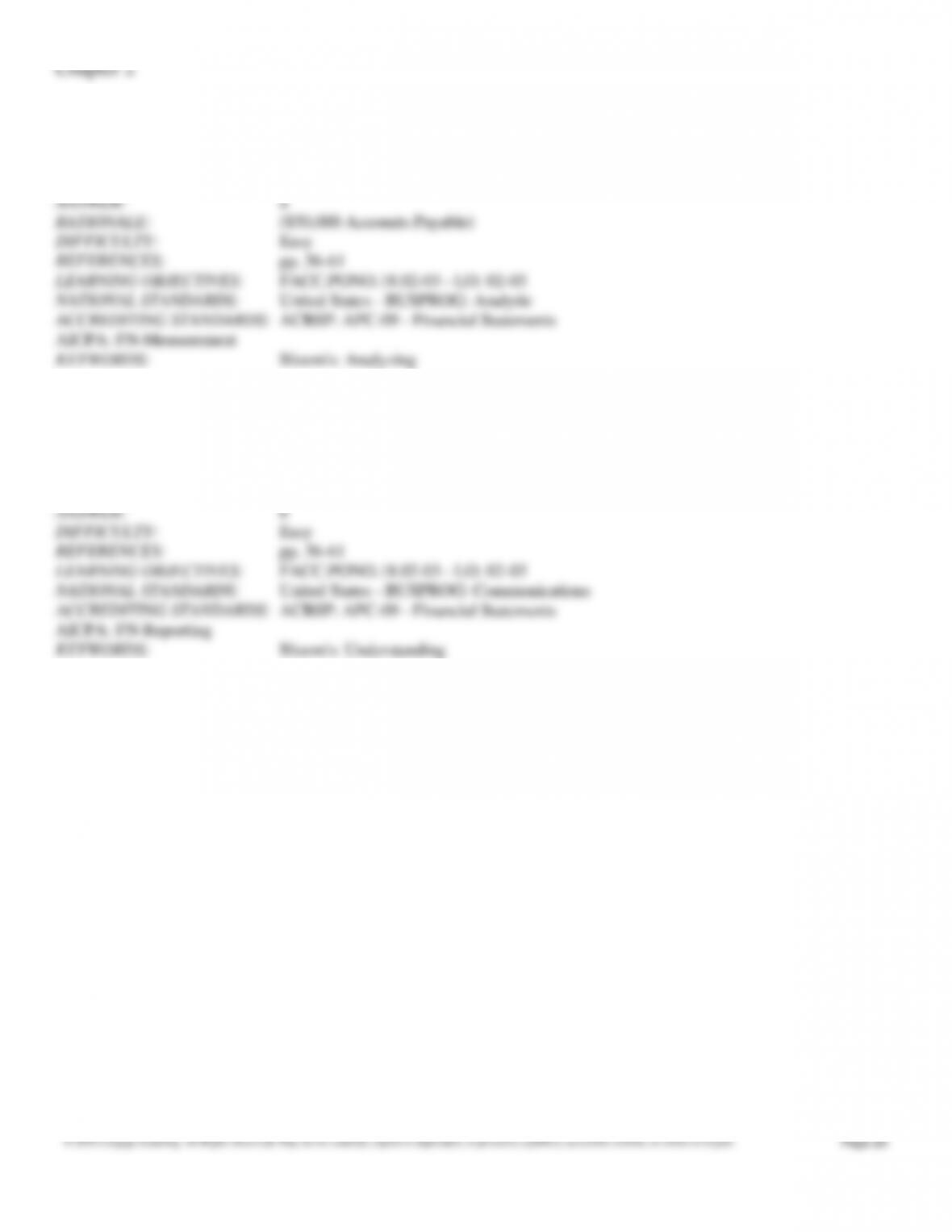
56. Read the information for Bevco Company. What are Bevco’ current assets?
a. $100,000
b. $165,000
c. $210,000
d. $240,000
© 2018 Cengage Learning. All Rights Reserved. May not be scanned, copied or duplicated, or posted to a publicly accessible website, in whole or in part.
Page 20
57. Read the information for Bevco Company. What are Bevco’ current liabilities?
a. $50,000
b. $125,000
c. $200,000
d. $230,000
58. Which one of the following items is reported as a current asset on a classified balance sheet?
a. Trucks
b. Accounts receivable
c. Land
d. Common stock