Page 36
148.
If a decision maker chooses an option that leaves him or her worse off than choosing
another available option, he or she is:
A)
using bounded rationality.
B)
basing the decision on risk aversion.
C)
making an irrational decision.
D)
making a rational decision.
149.
A decision maker who is irrational:
A)
chooses an option that makes him or her worse off, rather than choosing another
available option.
B)
chooses the option that makes him or her better off, rather than choosing another
available option.
C)
allocates income to maximize his or her satisfaction from consuming goods and
services.
D)
seeks to maximize business profit.
150.
The habit of mentally assigning dollars to different accounts so that some dollars are
worth more than others is:
A)
status quo bias.
B)
bounded rationality.
C)
loss aversion.
D)
mental accounting.
151.
If a person engages in mental accounting, he or she:
A)
is unwilling to recognize a loss and move on.
B)
values some dollars more than others.
C)
tends to avoid making decisions.
D)
tries to balance his or her bank account mentally, without writing anything down.
152.
A person who is oversensitive to loss and is unwilling to recognize the loss and move on
has:
A)
loss aversion.
B)
risk aversion.
C)
status quo bias.
D)
mental accounting.
Page 37
153.
A person with loss aversion:
A)
has a hard time recognizing losing investments and moving on.
B)
is likely to maximize total revenue rather than profit.
C)
is unlikely to ignore sunk costs.
D)
is more likely to use a credit card than to pay cash.
154.
The tendency to avoid making a decision is:
A)
status quo bias.
B)
bounded rationality.
C)
loss aversion.
D)
mental accounting.
155.
Which type of behavior is a systematic mistake that leads to irrational decisions?
A)
risk aversion
B)
bounded rationality
C)
maximizing profit rather than minimizing costs
D)
overconfidence
156.
Which type of behavior is NOT a common mistake that leads to irrational decisions?
A)
mental accounting
B)
loss aversion
C)
risk aversion
D)
misperceptions about opportunity costs
157.
Joshua is tired of school as well as his part-time job and decides on the spur of the
moment to take a weekend trip to Cabo San Lucas. He pays for it with his credit card,
rather than with money from his checking account. Which type of irrational behavior
does this BEST represent?
A)
status quo bias
B)
mental accounting
C)
loss aversion
D)
risk aversion
158.
Sally must submit a form to enroll in her company’s flexible medical benefits program.
Although she has been employed over a year, she has yet to complete the form. Which
type of irrational behavior does this represent?
A)
status quo bias
B)
mental accounting
C)
loss aversion
D)
risk aversion
Page 38
159.
If a star college quarterback turns down a multimillion-dollar offer from the NFL to
return for his senior year of college, he may be exhibiting:
A)
status quo bias.
B)
mental accounting.
C)
misperception of opportunity costs.
D)
risk aversion.
160.
Mary goes ahead and buys a new car because she expects to receive a 10% increase in
her salary next year. What type of behavior does this BEST represent?
A)
status quo bias
B)
overconfidence
C)
misperception of opportunity costs
D)
risk aversion
161.
Cindy just graduated from college and started working at a large accounting firm.
Although the firm will match her contributions to a retirement account, Cindy wants to
wait several years before participating since there are so many things she needs to buy
right now. What type of behavior does this represent?
A)
unrealistic expectations about the future
B)
loss aversion
C)
mental accounting
D)
risk aversion
162.
Lucy bought some stock 10 years ago that has been priced at half of her purchase price
for the past 5 years. However, Lucy refuses to sell the stock, thinking that, if she waits
long enough, she will recover her investment. What type of behavior does this
represent?
A)
mental accounting
B)
bounded rationality
C)
risk aversion
D)
loss aversion
163.
Most economic models:
A)
assume that people behave irrationally.
B)
assume that people behave rationally.
C)
assume that people are reluctant to learn from their mistakes.
D)
are useless because they use too many simplifying assumptions.
Page 39
164.
Because resources are scarce, the true cost of anything is its opportunity cost.
A)
True
B)
False
165.
Star athletes, singers, and actors often start their career very young, forgoing a college
education. This is an example of poor decision making since a college education
provides benefits that will be invaluable later in their lives.
A)
True
B)
False
166.
When making decisions, a person should consider only costs that actually involve an
explicit money outlay. This is because such costs actually have to be paid, whereas
implicit costs are only notional or hypothetical.
A)
True
B)
False
167.
Part of the explicit cost of owning a restaurant is rent paid for the kitchen equipment.
A)
True
B)
False
168.
It is not possible to earn an economic profit without also earning an accounting profit.
A)
True
B)
False
169.
Economic profits can be negative, even if accounting profits are positive.
A)
True
B)
False
170.
Accounting profit takes into account explicit costs, but economic profit does not.
A)
True
B)
False
171.
An “either–or” decision is a choice between two activities.
A)
True
B)
False
Page 40
172.
Marginal analysis should be used in “either–or” decisions.
A)
True
B)
False
173.
In cities, a mile of road lane may cost $30 million or more, while in rural areas a mile of
road lane may cost only $5 million. This means there should be more road lanes in rural
areas than in urban areas.
A)
True
B)
False
174.
If the marginal cost of any activity is constant at $4, then at the optimal quantity of the
activity, the marginal benefit will be $4.
A)
True
B)
False
175.
Anytime the marginal benefit of an activity is greater than zero, more activity should be
undertaken.
A)
True
B)
False
176.
The government should spend whatever amount is necessary to save a life.
A)
True
B)
False
177.
Since they have already paid for their tickets, it does not make economic sense for fans
to leave before a game is finished.
A)
True
B)
False
178.
A sunk cost should be ignored in decisions about future actions.
A)
True
B)
False
179.
Sara spends $25 for an all-day ticket to an amusement park. After one ride, it begins to
rain and she wishes she had never come. Since she has already paid for her ticket, she
should stay at the amusement park until it closes or she has wasted her $25.
A)
True
B)
False
Page 41
180.
Any expense that is not recoverable is considered a sunk cost.
A)
True
B)
False
181.
Samantha is an artist who operates her studio and gallery in town. She produces
watercolor paintings in the studio and sells them in the gallery. Give an example of an
explicit and an implicit cost that Samantha is likely to incur.
182.
Samantha quit her job teaching art at the high school and is now an artist who operates
her studio and gallery in town. She produces watercolor paintings in the studio and sells
them in the gallery. Last year at the high school, she was paid a salary of $25,000. In the
operation of her small business, she spent $30,000 on supplies, $15,000 on utilities, and
$15,000 on rent. Her equipment depreciated by $3,000. How much revenue must
Samantha receive so that she doesn’t regret quitting her job as a high school art teacher?
183.
Businesses employ resources in the production and sale of a good or service.
Accounting profit is typically used as a way of evaluating the success of a business, but
economists argue that economic profit is more relevant to determining whether a
business should continue to operate. What is the difference between these two measures
of profit? Explain why accounting profit is usually greater than economic profit.
184.
Some restaurants offer an all-you-can-eat buffet. Diners pay a flat fee to get a plate, and
then they can eat as much as they want. Use marginal analysis to explain why even the
hungriest of diners will eventually stop eating.
185.
(Table: Slices of Pizza) Use Table: Slices of Pizza. Complete the table and determine
how many slices you should eat.
Page 42
186.
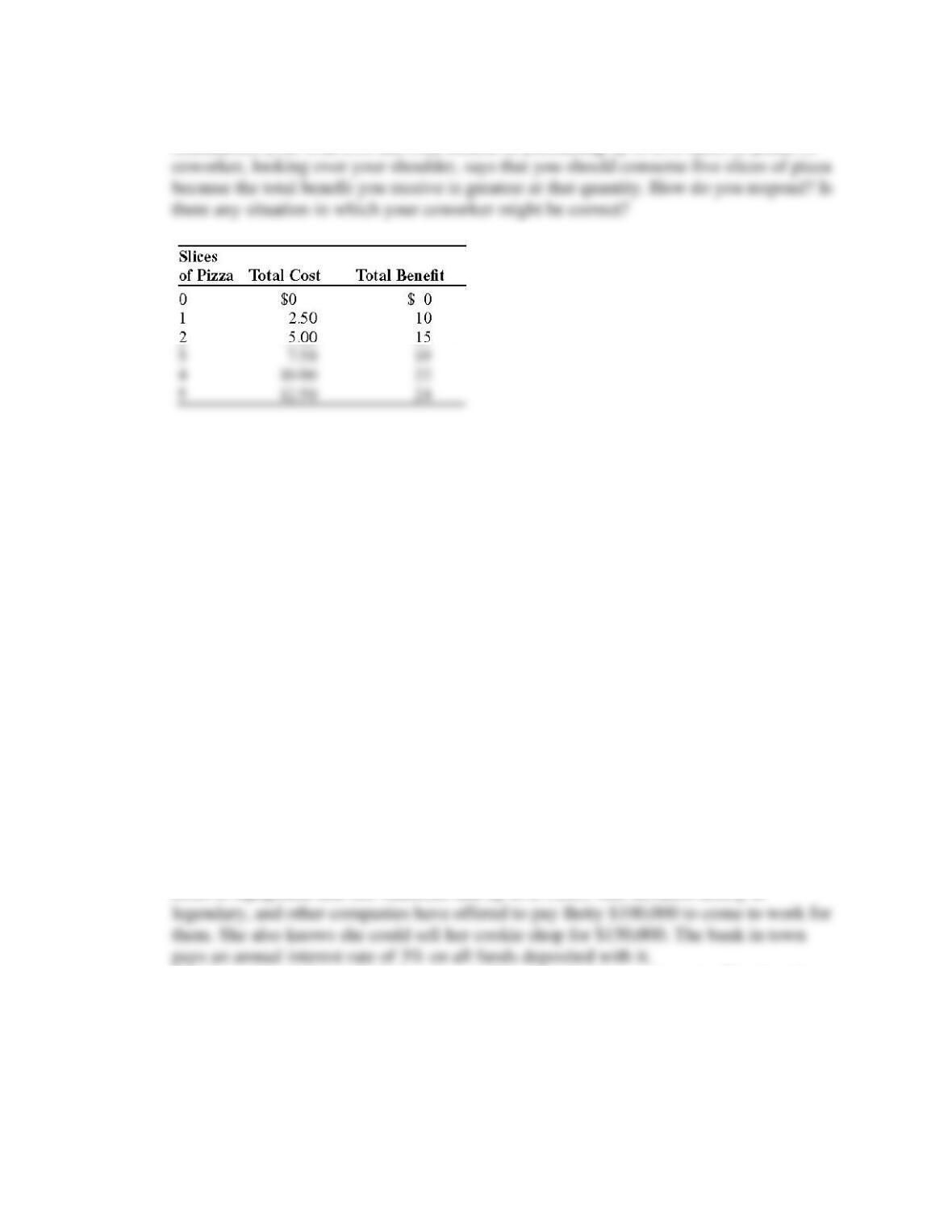
You can buy slices of pizza at $2.50 each, and you have drawn up a table that
summarizes your total cost and total benefit of purchasing up to five slices of pizza. A
coworker, looking over your shoulder, says that you should consume five slices of pizza
because the total benefit you receive is greatest at that quantity. How do you respond? Is
there any situation in which your coworker might be correct?
187.
You and a friend have each spent $8 on a movie ticket. Ten minutes into the movie, you
both decide that the movie is horrible. Your friend says that you should stay and watch
the rest of it because you “should get your money’s worth.” How do you respond?
188.
Economic profits are calculated by:
A)
taking the difference between total revenue and the sum of explicit and implicit
costs.
B)
taking the difference between total revenue and explicit costs only.
C)
taking the difference between the total revenue and implicit costs only.
D)
summing total revenue, explicit costs, and implicit costs.
189.
(Scenario: Betty’s Cookie Shop) Use Scenario: Betty’s Cookie Shop. Given the
information provided, Betty’s implicit costs are:
Scenario: Betty’s Cookie Shop
Betty runs a cookie shop where she sells cookies for $1 each. She employs five people,
each of whom worked a total of 500 hours last year; she paid them $10 per hour. Her
costs of equipment and raw materials add up to $75,000. Her business ability is
legendary, and other companies have offered to pay Betty $100,000 to come to work for
them. She also knows she could sell her cookie shop for $150,000. The bank in town
pays an annual interest rate of 3% on all funds deposited with it.
A)
her salary if she worked elsewhere and interest she forgoes by not selling her shop
and putting the money in the bank.
B)
the cost of labor, equipment, and raw materials.
C)
the revenue she receives from selling her cookies plus the cost of labor, equipment,
and raw materials.
D)
revenue she receives from selling her cookies and her labor costs.
Page 43
190.
(Scenario: Betty’s Cookie Shop) Use Scenario: Betty’s Cookie Shop. Betty’s explicit
costs are equal to:
Scenario: Betty’s Cookie Shop
Betty runs a cookie shop where she sells cookies for $1 each. She employs five people,
each of whom worked a total of 500 hours last year; she paid them $10 per hour. Her
costs of equipment and raw materials add up to $75,000. Her business ability is
legendary, and other companies have offered to pay Betty $100,000 to come to work for
them. She also knows she could sell her cookie shop for $150,000. The bank in town
pays an annual interest rate of 3% on all funds deposited with it.
A)
$100,000.
B)
$80,000.
C)
$250,000.
D)
$264,000.
191.
(Scenario: Betty’s Cookie Shop) Use Scenario: Betty’s Cookie Shop. Betty’s implicit and
explicit costs are equal to:
Scenario: Betty’s Cookie Shop
Betty runs a cookie shop where she sells cookies for $1 each. She employs five people,
each of whom worked a total of 500 hours last year; she paid them $10 per hour. Her
costs of equipment and raw materials add up to $75,000. Her business ability is
legendary, and other companies have offered to pay Betty $100,000 to come to work for
them. She also knows she could sell her cookie shop for $150,000. The bank in town
pays an annual interest rate of 3% on all funds deposited with it.
A)
$80,000.
B)
$184,500.
C)
$204,500.
D)
$100,000.
192.
(Scenario: Betty’s Cookie Shop) Use Scenario: Betty’s Cookie Shop. Betty is trying to
decide at what point she should stop selling cookies, and she knows she cannot change
the price of a cookie. She should stop selling cookies if her:
Scenario: Betty’s Cookie Shop
Betty runs a cookie shop where she sells cookies for $1 each. She employs five people,
each of whom worked a total of 500 hours last year; she paid them $10 per hour. Her
costs of equipment and raw materials add up to $75,000. Her business ability is
legendary, and other companies have offered to pay Betty $100,000 to come to work for
them. She also knows she could sell her cookie shop for $150,000. The bank in town
pays an annual interest rate of 3% on all funds deposited with it.
A)
economic profit is positive.
B)
explicit and implicit costs are less than her revenues.
C)
implicit costs are greater than her accounting profits.
D)
economic profit is equal to her accounting profit.
193.
If the marginal cost curve is upward sloping, as output increases, marginal costs will:
A)
increase.
B)
decrease.
C)
stay constant.
D)
become downward sloping.
194.
If marginal costs remain constant, the marginal cost curve is:
A)
vertical.
B)
horizontal.
C)
upward sloping from the origin.
D)
downward sloping.
195.
As George ate pizza during one recent outing, he found that he enjoyed each additional
slice less and less. This implies that his marginal benefit was:
A)
decreasing.
B)
increasing.
C)
constant.
D)
vertical.
196.
If marginal costs of production are greater than marginal benefits of production:
A)
costs will eventually decrease.
B)
too much of the good is being produced.
C)
more of the good should be produced.
D)
not all costs are being considered.
Page 45
197.
Firms will continue to produce if:
A)
the marginal benefits of producing an additional unit are greater than the marginal
costs of producing that unit.
B)
the marginal benefits of producing an additional unit are less than the marginal
costs of producing that unit.
C)
the marginal benefit of producing an additional unit is equal to the marginal cost of
producing that unit.
D)
the costs of producing the unit stay constant.
Use the following to answer questions 198-200:
198.
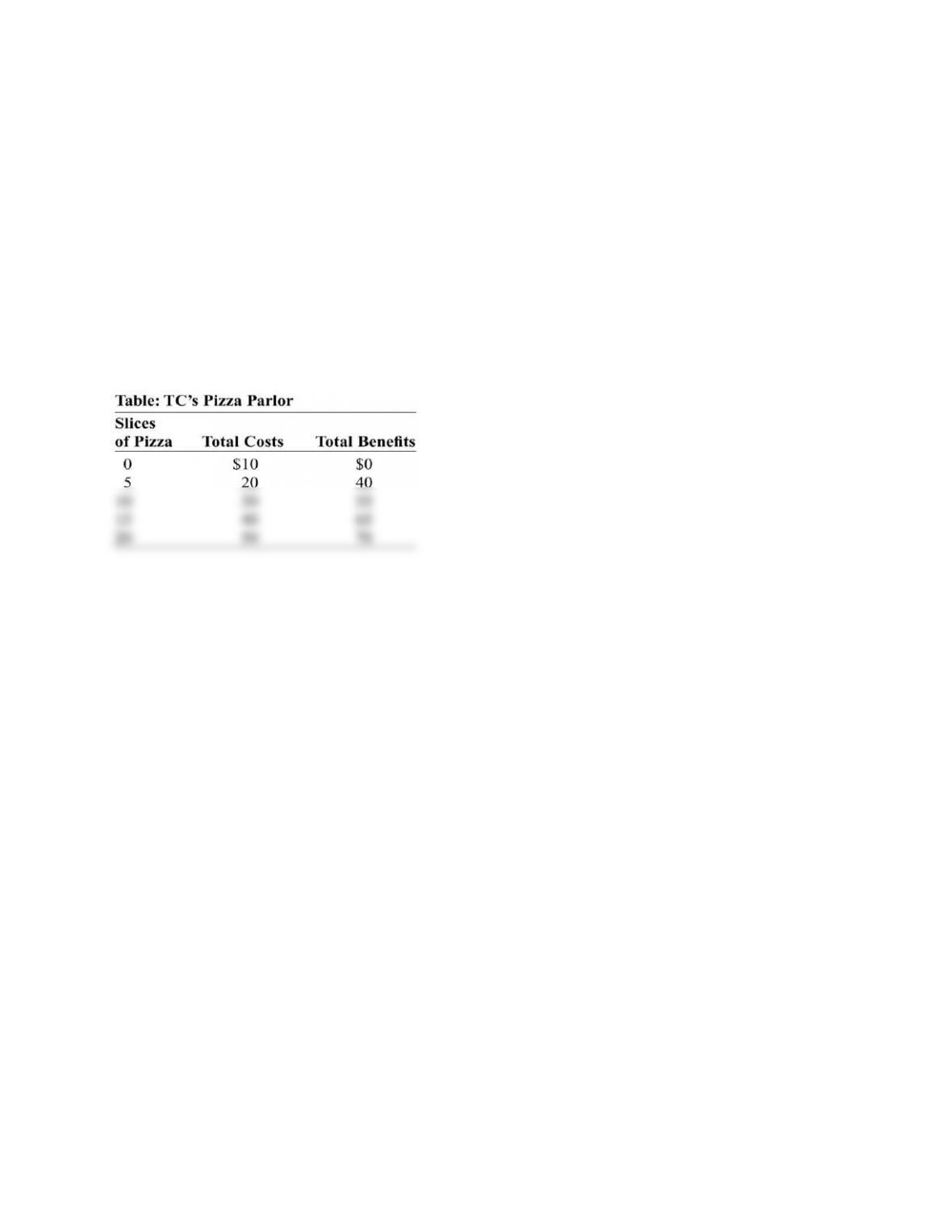
(Table: TC’s Pizza Parlor) Use Table: TC’s Pizza Parlor. Assume that marginal cost is
constant in the intervals of production. The marginal cost for pizza production:
A)
remains constant.
B)
increases, then decreases.
C)
increases.
D)
decreases.
199.
(Table: TC’s Pizza Parlor) Use Table: TC’s Pizza Parlor. Assume that the marginal
benefit is constant in intervals of production. Suppose five slices of pizza are being
produced. What is the marginal benefit of producing one more slice of pizza?
A)
$3
B)
$2
C)
$15
D)
$55
200.
(Table: TC’s Pizza Parlor) Use Table: TC’s Pizza Parlor. What is the optimal level of
production?
A)
5 slices
B)
10 slices
C)
15 slices
D)
20 slices
Page 46
Answer Key
Page 48
45.
B
46.
C
47.
C
48.
D
49.
C
50.
A
51.
C
52.
B
53.
D
54.
A
55.
B
56.
C
57.
A
58.
B
59.
B
60.
D
61.
D
62.
C
63.
A
64.
C
65.
C
66.
D
67.
C
68.
D
69.
A
70.
C
71.
D
72.
A
73.
B
74.
C
75.
D
76.
C
77.
A
78.
C
79.
B
80.
A
81.
C
82.
A
83.
C
84.
C
85.
A
86.
B
87.
C
88.
B
89.
A
90.
B
Page 49
91.
A
92.
B
93.
B
94.
C
95.
B
96.
C
97.
C
98.
B
99.
D
100.
A
101.
C
102.
A
103.
A
104.
C
105.
B
106.
D
107.
A
108.
B
109.
C
110.
C
111.
B
112.
B
113.
C
114.
D
115.
C
116.
D
117.
A
118.
B
119.
A
120.
D
121.
D
122.
C
123.
C
124.
D
125.
B
126.
A
127.
D
128.
C
129.
A
130.
B
131.
D
132.
A
133.
B
134.
D
135.
C
136.
B
Page 50
137.
C
138.
A
139.
C
140.
D
141.
A
142.
C
143.
B
144.
C
145.
D
146.
C
147.
A
148.
C
149.
A
150.
D
151.
B
152.
A
153.
A
154.
A
155.
D
156.
C
157.
B
158.
A
159.
C
160.
B
161.
A
162.
D
163.
B
164.
A
165.
B
166.
B
167.
A
168.
A
169.
A
170.
B
171.
A
172.
B
173.
B
174.
A
175.
B
176.
B
177.
B
178.
A
179.
B
180.
A
181.
182.
=
Page 51
183.
184.
185.
186.
187.
188.
A
189.
A
190.
A
191.
C
192.
C
193.
A
194.
B
195.
A
196.
B
197.
A
198.
A
199.
A
200.
C