Page 1
Name: __________________________ Date: _____________
1.
Jacquelyn is a student at a major state university. Which factor is NOT an explicit cost
of her attending college?
A)
Opportunity cost may be larger than monetary cost.
B)
Opportunity cost includes both explicit and implicit costs.
C)
The real or opportunity cost of something is what you must give up to get it.
D)
Opportunity cost is synonymous with explicit cost.
2.
Money that must be paid for the use of factors of production such as labor and capital is
an:
A)
explicit cost.
B)
accounting profit.
C)
implicit cost.
D)
economic profit.
3.
Costs that are included in the economic concept of cost but that are NOT explicit costs
are:
A)
outlay costs.
B)
accounting profits.
C)
implicit costs.
D)
economic profits.
4.
Expenses associated with factors of production may be _____ costs.
A)
implicit
B)
opportunity
C)
explicit
D)
implicit, opportunity, or explicit
5.
Accountants use only _____ costs in their computations.
A)
opportunity
B)
implicit
C)
explicit
D)
variable
Page 2
6.
You own a small deli that sells sandwiches, salads, and soup. Which factor is an implicit
cost of the business?
A)
wages paid to part-time employees
B)
the job offer you did not accept at a local catering service
C)
bread, meat, and vegetables used to produce the items on your menu
D)
your monthly utility bill
7.
The implicit cost of capital is:
A)
the expense associated with leasing machines.
B)
the expense associated with buying machines.
C)
the opportunity cost of capital used by a business.
D)
irrelevant for determining economic profit.
8.
Suppose the Chicago Cubs could rent out Wrigley Field (the field they play on) to local
youth leagues for $11,000 per month. The $11,000 per month is the _____ cost of
capital.
A)
implicit
B)
explicit
C)
direct
D)
total
9.
In central Florida, the demand for real estate has been increasing rapidly for years.
Therefore, the _____ cost of capital is _____ in central Florida’s orange groves.
A)
explicit; decreasing
B)
implicit; increasing
C)
implicit; decreasing
D)
explicit; increasing
10.
John’s accountant tells him that he made a profit of $43,002 running a pottery studio in
Orlando. John’s wife, an economist, claims John lost $43,002 running his pottery studio.
This means his wife is claiming that he incurred _____ in _____ costs.
A)
$86,004; implicit
B)
$43,002; implicit
C)
$43,002; explicit
D)
$86,004; explicit

Page 3
11.
Accounting profit differs from economic profit because:
A)
of differences in the manner in which revenue is calculated.
B)
economic costs include explicit costs, while accounting costs do not.
C)
accounting costs are generally higher than economic costs because accounting
costs include explicit and implicit costs, while economic costs include only explicit
costs.
D)
economic costs are generally higher than accounting costs because economic costs
include all opportunity costs, while accounting costs include explicit costs only.
12.
If the accounting profit for a firm is negative, the:
A)
economic profit must be positive.
B)
economic profit must be negative.
C)
firm should produce more.
D)
firm will not owe any taxes.
13.
Suppose a local hardware store has explicit costs of $2 million per year and implicit
costs of $44,000 per year. If the store earned an economic profit of $50,000 last year,
this means that the store’s accounting profit equaled:
A)
$94,000.
B)
$6,000.
C)
$2.05 million.
D)
$2.044 million.
14.
Part of the _____ associated with the Chicago Cubs baseball team is their batting cages
used in practice.
A)
labor
B)
land
C)
capital
D)
entrepreneurship
15.
For MOST firms, economic profit is:
A)
less than accounting profit.
B)
equal to accounting profit.
C)
greater than accounting profit.
D)
negative.

Page 4
16.
Profit computed without implicit costs is _____ profit.
A)
explicit
B)
accounting
C)
implicit
D)
economic
17.
The implicit cost of capital is:
A)
the explicit cost of capital that the firm might have used but didn’t need to.
B)
depreciation.
C)
the opportunity cost of the capital used by a business.
D)
the cost of human capital.
18.
Suppose a local floral shop has explicit costs of $200,000 per year and implicit costs of
$50,000 per year. If the store earned an economic profit of $50,000 last year, the store’s
accounting profit equaled:
A)
$10,000.
B)
$50,000.
C)
$100,000.
D)
$200,000.
19.
The dormitories of Eastland College are part of its:
A)
land.
B)
labor.
C)
capital.
D)
explicit costs.
20.
Suppose Eastland College does not have a summer program and could rent out the
campus to various summer sports camps for $100,000. The potential revenue of the
summer camps represents a(n):
A)
implicit cost of capital.
B)
explicit cost.
C)
total cost.
D)
sunk cost.
21.
The costs economists use in the concept of economic profit are:
A)
accounting costs.
B)
strictly dollar costs, not opportunity costs.
C)
only implicit costs.
D)
accounting costs and implicit costs (i.e., the value of the best opportunity forgone).
Page 5
22.
Economic profit is:
A)
less than accounting profit if implicit costs exist.
B)
always equal to accounting profit.
C)
greater than accounting profit if implicit costs exist.
D)
less than accounting profit if implicit costs are zero.
23.
Profit is the difference between _____ and _____.
A)
total sales; total revenues
B)
total profits; total costs
C)
total revenues; total costs
D)
marginal costs; marginal revenues
24.
Accountants use only _____ costs in their computations of short-run total cost.
A)
opportunity
B)
implicit
C)
explicit
D)
variable
25.
Which question BEST describes a “how much” decision?
A)
Should I drive to work or ride my bicycle?
B)
Should I rent a movie or watch a baseball game on television?
C)
Should I attend graduate school or immediately enter the labor force?
D)
Should I buy a third hot dog?
26.
An “either–or” decision entails:
A)
deciding how much of an activity to do.
B)
a choice between two activities.
C)
calculating marginal costs for each activity.
D)
calculating the marginal benefits for each activity.
27.
In making an “either–or” decision:
A)
choose the activity that results in the greater economic profit.
B)
choose the activity that results in the greater accounting profit.
C)
continue in an activity as long as the marginal cost is greater than the marginal
benefit.
D)
continue in an activity as long as the marginal cost is less than the marginal benefit.
Page 6
28.
Which statement describes an “either–or” decision?
A)
Allen must decide how many courses to take this semester.
B)
Sally must decide how many hours to spend studying for each of the four courses
that she is taking this semester.
C)
Chris must decide how many hours to work each week at his part-time job.
D)
Dylan must decide whether to major in economics or finance.
29.
Which statement describes a “how much” decision?
A)
Mary is trying to decide whether to go to work or go to college after she graduates
from high school next month.
B)
Andrea is trying to decide whether to go to graduate school in economics or go to
law school.
C)
Tim is trying to decide the amount of money to save each month to buy a new car
next year.
D)
Andy is trying to decide whether to take a prep course for the Law School
Admissions Test.
30.
You decide to quit your $60,000-per-year job as an information technology specialist
and illustrate children’s books. At the end of the first year of illustrating, you have
earned $20,000. You also spent $5,000 for paint and paper. Your economic profit in the
first year as an illustrator is:
A)
$15,000.
B)
$20,000.
C)
–$40,000.
D)
–$45,000.
31.
During its only year of operation, a firm collected $175,000 in revenue and spent
$50,000 on raw materials, labor, and utilities. The owners of the firm spent $100,000 of
their own money to build the firm’s factory (instead of buying bonds and earning a 10%
annual rate of return), which they sold at the end of the year for $100,000. The firm’s
economic profit is:
A)
$35,000.
B)
$125,000.
C)
$115,000.
D)
$25,000.

32.
Until recently, Rosemarie worked as an accountant, earning $30,000 annually. Then she
inherited a piece of commercial real estate that had been renting for $12,000 annually.
Rosemarie decided to leave her job and operate a Peruvian restaurant in the space she
inherited. At the end of the first year, her books showed total revenues of $260,000 and
total costs of $230,000 for food, utilities, cooks, and other supplies. Her economic profit
at the end of one year is:
A)
$230,000.
B)
$30,000.
C)
$0.
D)
–$12,000.
33.
George owns a dude ranch in Texas. He pays $32,000 per year in insurance, $408,000 in
wages, and $23,000 in supplies. He forgoes $32,000 per year he could make as a police
officer. His total revenue last year equaled $460,000. That means his economic _____
equaled _____.
A)
profit; $3,000
B)
losses; $3,000
C)
losses; $35,000
D)
profit; $35,000
34.
Bessie wants to calculate the accounting and economic profits of her cattle farm in
Nebraska. She pays $30,000 per year in overhead, $80,000 in wages, and $20,000 in
insurance. She forgoes $30,000 per year that she could make as a teacher. If her total
revenue equals $140,000, that means her accounting profit is _____ and her economic
profit is _____.
A)
$10,000; –$20,000
B)
$30,000; –$30,000
C)
–$10,000; –$10,000
D)
$60,000; $30,000

Page 8
35.
(Scenario: Accounting and Economic Profit) Use Scenario: Accounting and Economic
Profit. The accounting profit of Wang’s Wicker Furniture Store is:
Scenario: Accounting and Economic Profit
Rather than put the $100,000 that his grandmother left him in a mutual fund that earns
5% each year, Tommy Wang quit his job, which paid $60,000 per year, and started
Wang’s Wicker Furniture Store. He rented a showroom for $20,000 for the year,
purchased $60,000 in wicker furniture, and incurred costs of $40,000 for sales help and
advertising. In his first year, his revenue was $150,000.
A)
$200,000.
B)
$60,000.
C)
$30,000.
D)
$0.
36.
(Scenario: Accounting and Economic Profit) Use Scenario: Accounting and Economic
Profit. The implicit cost of capital for Wang’s Wicker Furniture Store is:
Scenario: Accounting and Economic Profit
Rather than put the $100,000 that his grandmother left him in a mutual fund that earns
5% each year, Tommy Wang quit his job, which paid $60,000 per year, and started
Wang’s Wicker Furniture Store. He rented a showroom for $20,000 for the year,
purchased $60,000 in wicker furniture, and incurred costs of $40,000 for sales help and
advertising. In his first year, his revenue was $150,000.
A)
$0.
B)
$2,000.
C)
$5,000.
D)
$50,000.

Page 9
37.
(Scenario: Accounting and Economic Profit) Use Scenario: Accounting and Economic
Profit. What is the opportunity cost of Wang’s $100,000 inheritance being used to start
his business?
Scenario: Accounting and Economic Profit
Rather than put the $100,000 that his grandmother left him in a mutual fund that earns
5% each year, Tommy Wang quit his job, which paid $60,000 per year, and started
Wang’s Wicker Furniture Store. He rented a showroom for $20,000 for the year,
purchased $60,000 in wicker furniture, and incurred costs of $40,000 for sales help and
advertising. In his first year, his revenue was $150,000.
A)
$0
B)
$5,000
C)
$10,000
D)
$100,000
38.
(Scenario: Accounting and Economic Profit) Use Scenario: Accounting and Economic
Profit. What is the implicit cost of Wang’s Wicker Furniture Store?
Scenario: Accounting and Economic Profit
Rather than put the $100,000 that his grandmother left him in a mutual fund that earns
5% each year, Tommy Wang quit his job, which paid $60,000 per year, and started
Wang’s Wicker Furniture Store. He rented a showroom for $20,000 for the year,
purchased $60,000 in wicker furniture, and incurred costs of $40,000 for sales help and
advertising. In his first year, his revenue was $150,000.
A)
$7,000
B)
$60,000
C)
$65,000
D)
$69,000
39.
(Scenario: Accounting and Economic Profit) Use Scenario: Accounting and Economic
Profit. The economic profit of Wang’s Wicker Furniture Store is:
Scenario: Accounting and Economic Profit
Rather than put the $100,000 that his grandmother left him in a mutual fund that earns
5% each year, Tommy Wang quit his job, which paid $60,000 per year, and started
Wang’s Wicker Furniture Store. He rented a showroom for $20,000 for the year,
purchased $60,000 in wicker furniture, and incurred costs of $40,000 for sales help and
advertising. In his first year, his revenue was $150,000.
A)
$67,000.
B)
$0.
C)
–$20,000.
D)
–$35,000.

40.
Andreas is a political consultant with his own firm. He travels the country and provides
campaign advice for political candidates. Last year, he earned $250,000 in revenue for
his services. He pays one employee $50,000 to manage the small office back home and
pays $30,000 on rent and utilities for that office. His accountant tells him that if he sold
all of the equipment, he could put that money in the bank and earn $3,000 in interest
next year. Andreas also has received an offer to teach political science at a college at a
salary of $100,000. Andreas’s accounting profit is equal to _____, and his economic
profit is equal to _____.
A)
$175,000; $67,000
B)
$170,000; $67,000
C)
$200,000; $72,000
D)
$170,000; $70,000
41.
The amount by which an additional unit of an activity increases total benefit is:
A)
net benefit.
B)
marginal benefit.
C)
marginal cost.
D)
utility.
42.
The amount by which an additional unit of an activity increases total cost is:
A)
net benefit.
B)
marginal benefit.
C)
negative benefit.
D)
marginal cost.
43.
In economics, a marginal value refers to:
A)
the value associated with an unimportant, or marginal, activity.
B)
a value entered as an explanatory item in the margin of a balance sheet or other
accounts.
C)
the value associated with one more unit of an activity.
D)
a value that is most appropriately identified in a footnote.
44.
In economic analysis, the principle of marginal analysis refers to:
A)
dividing large problems into smaller, more manageable ones.
B)
the notion that a group’s problems can be effectively analyzed by focusing on only
a small subsample of the group.
C)
the result that the optimal quantity of an activity is that at which marginal benefit is
equal to marginal cost.
D)
the result that the optimal quantity of an activity is that at which the net benefit of
the representative, or marginal, individual is maximized.
Page 11
45.
For which decision would marginal analysis be relevant?
A)
spending $1,000 on a summer vacation or on painting your house
B)
deciding how much to spend on a summer vacation
C)
buying a new car or a second-hand car
D)
eating dinner at home or going out to a restaurant for dinner
46.
Marginal analysis is relevant for:
A)
both “either–or” and “how much” decisions.
B)
only “either–or” decisions.
C)
only “how much” decisions.
D)
only situations involving the time value of money.
47.
A “how much” decision is BEST made by comparing the _____ of an action to the
_____ of that action.
A)
explicit costs; implicit costs
B)
accounting profit; economic profit
C)
marginal benefits; marginal costs
D)
present value; net present value
48.
Feng is thinking of mowing lawns over the summer. His friend Jason mows lawns, and
he says the marginal cost of mowing the fourth lawn in a day is $40. Feng thinks about
it and realizes that the total cost of mowing four lawns is:
A)
$160.
B)
$40.
C)
$80.
D)
not possible to determine from the information provided.
49.
Pauli’s Pizza offers one slice for $2, two slices for $3.50, three slices for $4.50, and four
slices for $5.00. The marginal cost of the third slice is:
A)
$4.50.
B)
$10.
C)
$1.
D)
$2.
50.
The _____ is the amount by which an additional unit of activity increases its total cost.
A)
marginal cost
B)
average cost
C)
average profit
D)
marginal benefit
Page 12
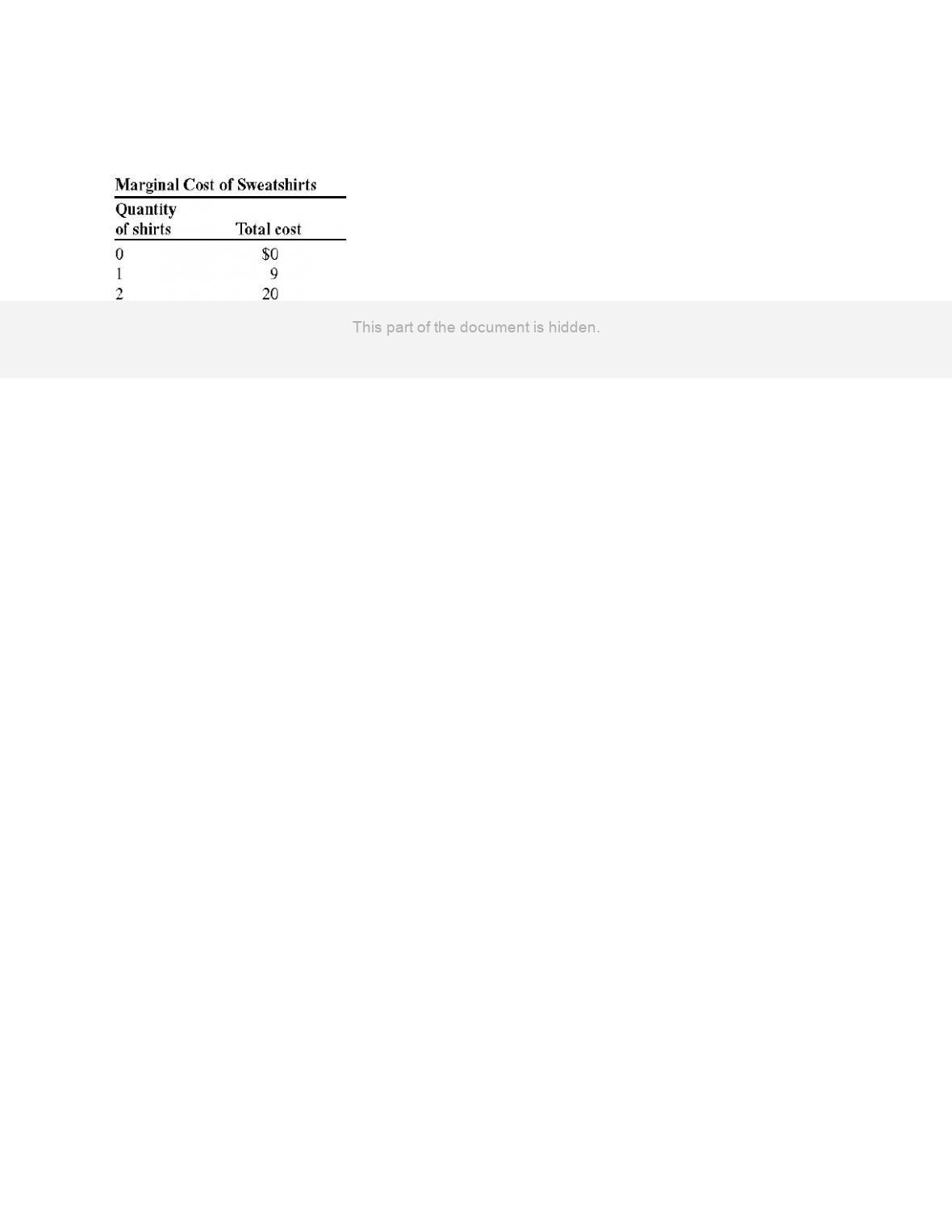
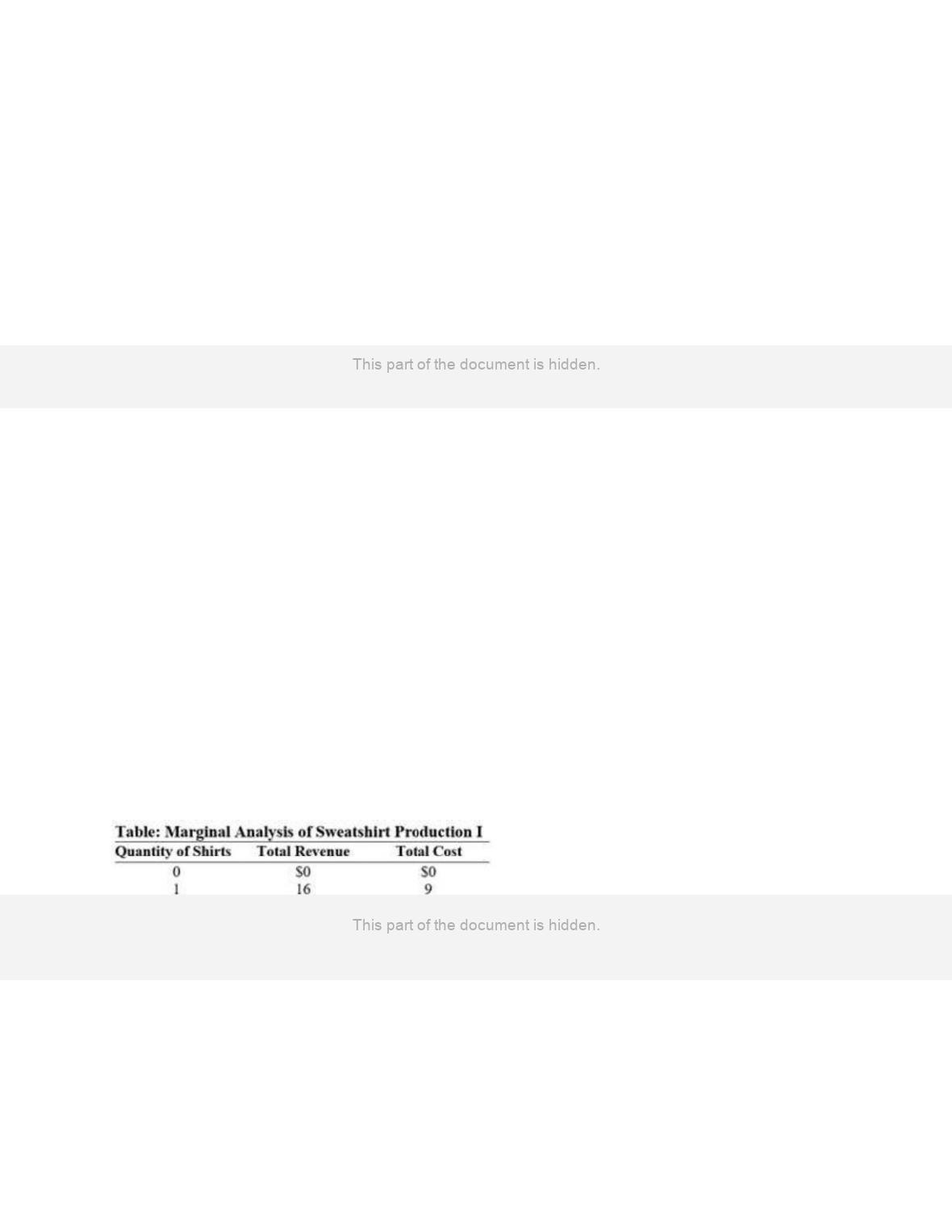
Use the following to answer questions 51-55:
51.
(Table: Marginal Cost of Sweatshirts) Use Table: Marginal Cost of Sweatshirts. The
marginal cost of the second sweatshirt is:
A)
$9.
B)
$20.
C)
$11.
D)
$29.
52.
(Table: Marginal Cost of Sweatshirts) Use Table: Marginal Cost of Sweatshirts. The
marginal cost of the third sweatshirt is:
A)
$33.
B)
$13.
C)
$11.
D)
$9.
53.
(Table: Marginal Cost of Sweatshirts) Use Table: Marginal Cost of Sweatshirts. The
marginal cost of the fourth sweatshirt is:
A)
$9.
B)
$20.
C)
$24.
D)
$15.
54.
(Table: Marginal Cost of Sweatshirts) Use Table: Marginal Cost of Sweatshirts. The
marginal cost of the fifth sweatshirt is:
A)
$17.
B)
$15.
C)
$13.
D)
$11.

Page 13
55.
(Table: Marginal Cost of Sweatshirts) Use Table: Marginal Cost of Sweatshirts. The
marginal cost of producing sweatshirts is an example of _____ marginal costs.
A)
decreasing
B)
increasing
C)
constant
D)
random
56.
Constant marginal costs occur when production of each individual unit costs:
A)
less than the previous one.
B)
more than the previous one.
C)
the same as the previous one.
D)
more than the next one.
57.
Learning effects often result in _____ marginal costs.
A)
decreasing
B)
increasing
C)
constant
D)
random
58.
Tara notices that studying for one hour after class increases her economics grade by 11
points. The second hour yields a 7-point gain, the third hour yields a 4-point gain, and
the fourth hour yields only a 1-point gain. This means that the marginal _____ of
studying decreases with study hours.
A)
cost
B)
benefit
C)
opportunity cost
D)
time
59.
Marginal benefit:
A)
is the subsidiary benefit from an activity; for example, the main benefit from
weight training is an increase in muscle mass, and the subsidiary or marginal
benefit might be a reduction in cholesterol.
B)
is the addition to total benefit due to undertaking one more unit of an activity.
C)
must be increasing if total benefit is increasing.
D)
normally increases as more of an activity is undertaken.
Page 14
60.
Wendy sells ice-making machines. She can sell six per week at a price of $2,000 per
machine. If she charges $2,100 per machine, she will sell only five per week. The
marginal benefit of selling the sixth ice-making machine is:
A)
$2,000.
B)
$2,100.
C)
$12,000.
D)
$1,500.
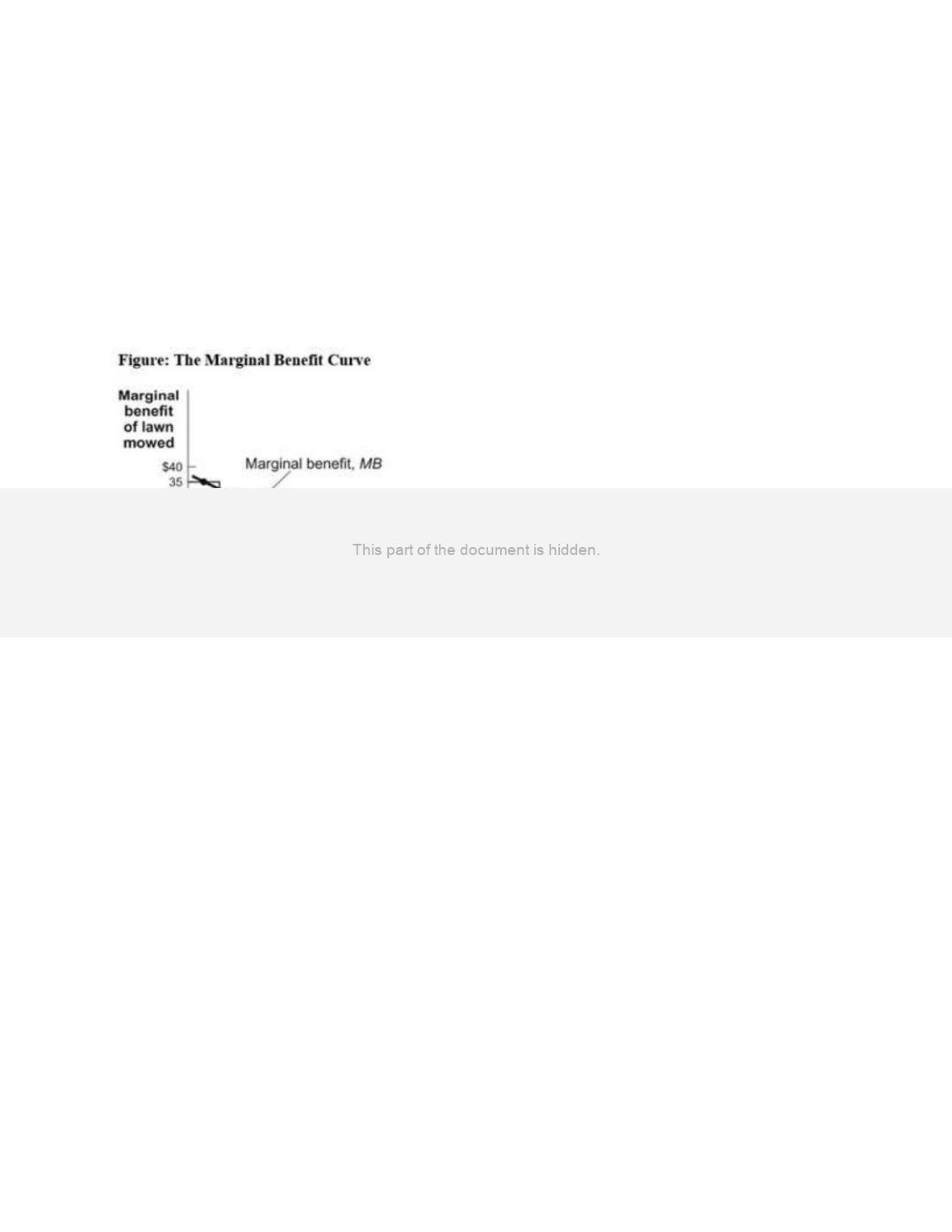
Use the following to answer questions 61-63:
61.
(Figure: The Marginal Benefit Curve) Use Figure: The Marginal Benefit Curve. The
total benefit of mowing four lawns is approximately:
A)
$25.
B)
$35.
C)
$80.
D)
$114.
62.
(Figure: The Marginal Benefit Curve) Use Figure: The Marginal Benefit Curve. The
total benefit of mowing six lawns is approximately:
A)
$19.
B)
$35.
C)
$154.
D)
$200.
Page 15
63.
(Figure: The Marginal Benefit Curve) Use Figure: The Marginal Benefit Curve. The
total benefit of mowing seven lawns is approximately:
A)
$172.
B)
$140.
C)
$60.
D)
$18.
64.
The _____ benefit is the amount by which an additional unit of an activity increases its
total benefit.
A)
average
B)
net
C)
marginal
D)
top
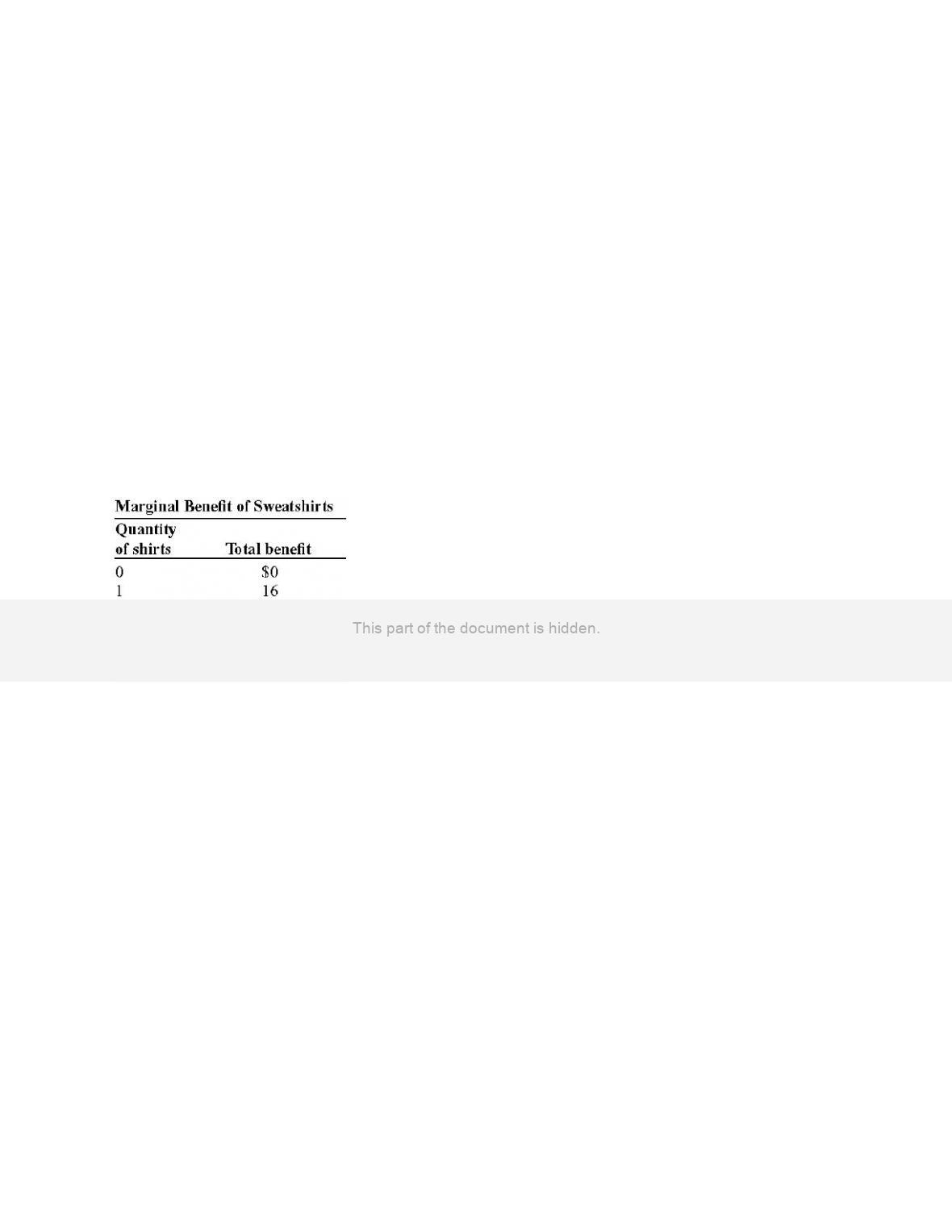
Use the following to answer questions 65-68:
65.
(Table: Marginal Benefit of Sweatshirts) Use Table: Marginal Benefit of Sweatshirts.
The marginal benefit of producing the second sweatshirt is:
A)
$31.
B)
$16.
C)
$15.
D)
$14.
66.
(Table: Marginal Benefit of Sweatshirts) Use Table: Marginal Benefit of Sweatshirts.
The marginal benefit of producing the third sweatshirt is:
A)
$31.
B)
$16.
C)
$15.
D)
$14.
Page 16
67.
(Table: Marginal Benefit of Sweatshirts) Use Table: Marginal Benefit of Sweatshirts.
The marginal benefit of producing the fourth sweatshirt is:
A)
$58.
B)
$14.
C)
$13.
D)
$12.
68.
(Table: Marginal Benefit of Sweatshirts) Use Table: Marginal Benefit of Sweatshirts.
The marginal benefit of producing the fifth sweatshirt is:
A)
$70.
B)
$14.
C)
$13.
D)
$12.
69.
Whenever marginal benefit is less than marginal cost, the decision maker should do
_____ of the activity.
A)
less
B)
that exact amount
C)
more
D)
none
70.
In general, when marginal benefit is greater than marginal cost, the decision maker
should do _____ of the activity.
A)
less
B)
that exact amount
C)
more
D)
none
71.
Some highways have one lane; others have two, three, or more. If each lane costs $10
million per mile, an economist assumes that the total benefit of a three-lane highway
must be _____ million per mile.
A)
less than $10
B)
$10 to $20
C)
$20 to $30
D)
$30 or more

Page 17
72.
While eating pizza, you discover that the marginal benefit of eating one more slice is
greater than the marginal cost of that slice. You conclude that:
A)
you will be better off if you eat one more slice.
B)
you will be no better off and no worse off if you eat one more slice.
C)
you will be worse off if you eat one more slice.
D)
the total cost of eating the pizza will be more than the total benefit of eating the
pizza.
73.
Joan loves sushi. Her first piece of sushi normally gives her a marginal benefit of $5.
Each additional piece yields a marginal benefit that declines by $0.25 per piece. If her
favorite sushi bar charges $2.75 per piece of sushi, how many pieces should she eat?
A)
8
B)
10
C)
5
D)
11
74.
Pauli’s Pizza offers one slice for $2, two slices for $3.50, three slices for $4.50, and four
slices for $5.00. Sal orders two slices. From this we know that Sal’s marginal benefit
from the second slice must be at least _____ and the marginal benefit from the third
slice must be less than _____.
A)
$3.50; $4.50
B)
$3.50; $1.00
C)
$1.50; $1.00
D)
$1.50; $4.50
75.
In economic analysis, at the optimal quantity of an activity:
A)
marginal benefit exceeds marginal cost by the greatest amount.
B)
total benefit equals total cost.
C)
marginal benefit equals total benefit.
D)
total benefit exceeds total cost by the greatest amount and marginal benefit equals
marginal cost.
76.
Werner installs custom sound systems in cars. If he installs seven systems per day, his
total costs are $300. If he installs eight systems per day, his total costs are $400. Werner
will install eight sound systems per day only if the eighth customer is willing to pay at
least:
A)
$300.
B)
$400.
C)
$100.
D)
$50.
Page 18
77.
Suppose Bob has a part-time business washing cars. He has washed nine cars on a given
day; the marginal benefit of washing the tenth car is $20 and the marginal cost is $12.
Bob should:
A)
wash the tenth car.
B)
not wash the tenth car.
C)
increase his marginal benefit.
D)
There is not enough information to decide.
78.
To maximize her grade in economics, Stacey should study until her:
A)
marginal cost of studying begins to increase.
B)
marginal benefit of studying begins to decrease.
C)
marginal benefit of studying equals her marginal cost of studying.
D)
marginal cost of studying reaches zero.
79.
According to the profit-maximizing principle of marginal analysis, if the marginal
benefit is _____ the marginal cost, _____.
A)
more than; an activity should be reduced
B)
less than; an activity should be reduced
C)
equal to; an activity should be reduced
D)
more than; net benefit is maximized
80.
According to the profit-maximizing principle of marginal analysis, if the marginal
benefit is _____ the marginal cost, _____.
A)
more than; an activity should be increased
B)
less than; an activity should be reduced
C)
equal to; an activity should be reduced
D)
more than; net benefit is maximized
81.
According to the profit-maximizing principle of marginal analysis, if the marginal
benefit is _____ the marginal cost, _____.
A)
more than; an activity should be reduced
B)
less than; an activity should be reduced
C)
equal to; an activity is being produced at the optimal quantity
D)
more than; net benefit is maximized
Page 19
82.
In economics, the assumption is that consumers and firms will make choices that
maximize the _____ of each activity.
A)
total profit
B)
total benefit
C)
sum of total benefit and total cost
D)
product of total benefit and total cost
83.
To maximize total profit from a particular activity, consumers and firms evaluate each
activity at the:
A)
average.
B)
top.
C)
margin.
D)
end.
84.
Total profit is maximized when marginal benefit _____ marginal cost.
A)
is more than
B)
is less than
C)
is equal to
D)
approaches
85.
In economics, maximization of the total profit of an activity occurs when:
A)
MB = MC.
B)
MB > MC.
C)
MB < MC.
D)
MB approaches MC.
86.
If at a given quantity _____, the decision maker should do _____ of the activity.
A)
MB < MC; that amount
B)
MB < MC; less
C)
MB > MC; less
D)
MB > MC; none
87.
If at a given quantity _____, the decision maker should do _____ of the activity.
A)
MB < MC; that amount
B)
MB < MC; more
C)
MB > MC; more
D)
MB > MC; none
Page 20
88.
If at a given quantity MB = MC, the decision maker should do _____ of the activity.
A)
less
B)
that amount
C)
more
D)
none
89.
If the marginal benefit received from consuming a good is equal to the marginal cost of
production:
A)
society’s well-being cannot be improved by changing production.
B)
society’s well-being can be improved if production decreases.
C)
society’s well-being can be improved if production increases.
D)
the market is producing too much of the good.
90.
If the marginal benefit received from consuming a good is less than the marginal cost of
production:
A)
society’s well-being can be improved if production increases.
B)
society’s well-being can be improved if production decreases.
C)
society’s well-being cannot be improved by changing production.
D)
the market is producing too little of the good.
91.
If the marginal benefit received from consuming a good is greater than the marginal cost
of production:
A)
society’s well-being can be improved if production increases.
B)
society’s well-being can be improved if production decreases.
C)
society’s well-being cannot be improved by changing production.
D)
the market is producing too much of the good.
Use the following to answer questions 92-93: