Page 56
234.
The United States and the European Union levy heavy import tariffs on agricultural
products, which hurt many poor farmers from the very poorest countries in the world.
A)
True
B)
False
235.
When a country joins the World Trade Organization, it gives up all of its ability to
determine its trade policy.
A)
True
B)
False
236.
Suppose in a single year, Brazil can produce 100 tons of beef or 1,000 boxes of tulips.
Suppose in the world market, one ton of beef costs eight boxes of tulips. Brazil will
import beef.
A)
True
B)
False
237.
Explain the difference between comparative advantage and absolute advantage.
Use the following to answer questions 238-240:
238.
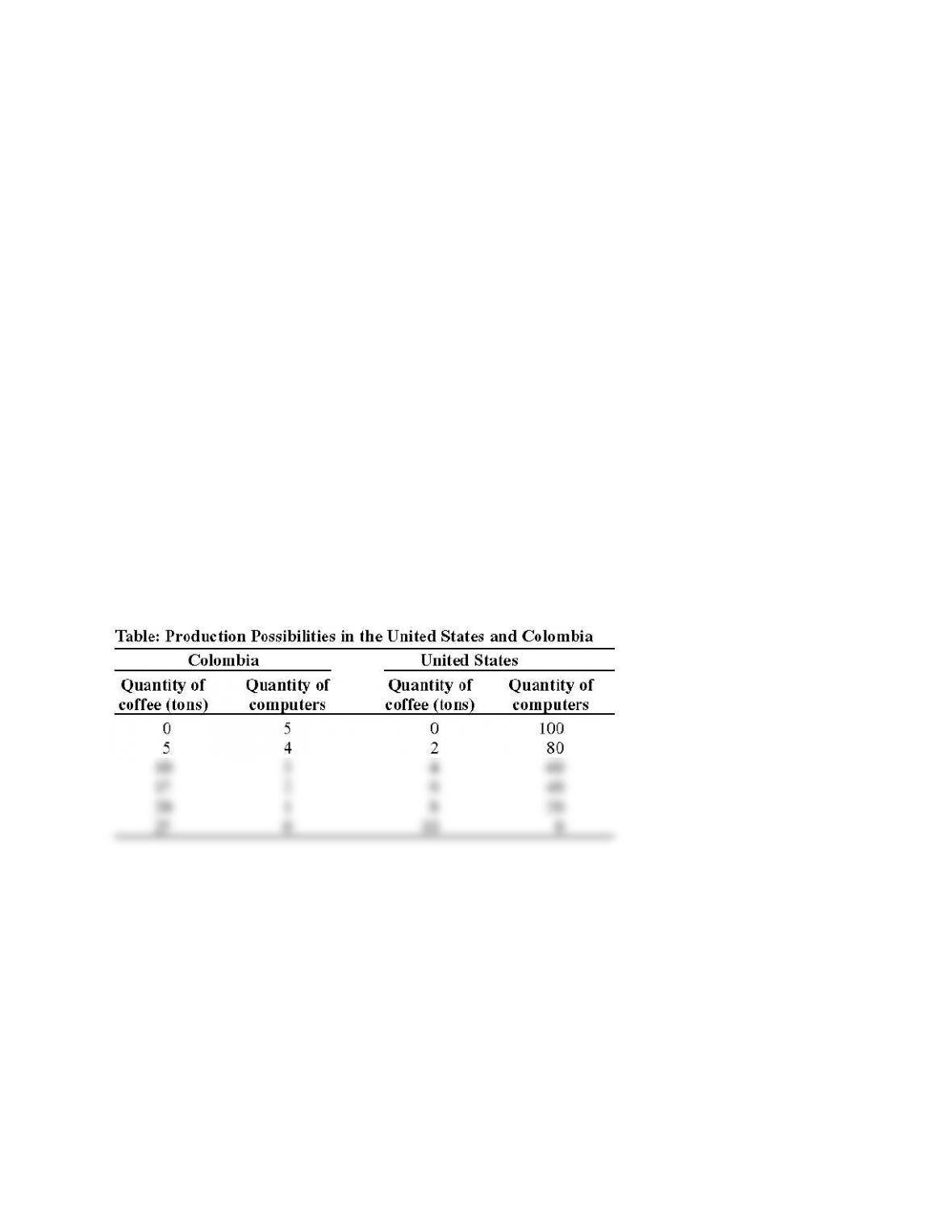
(Table: Production Possibilities in the United States and Colombia) Use Table:
Production Possibilities in the United States and Colombia. Which country should
export coffee and which country should export computers? Justify your answer.
239.
(Table: Production Possibilities in the United States and Colombia) Use Table:
Production Possibilities in the United States and Colombia. Suppose that, in autarky,
Colombia produces 10 tons of coffee and 3 computers. The United States produces 8
tons of coffee and 20 computers. Can specialization and trade increase global
production? Justify your answer.
240.
(Table: Production Possibilities in the United States and Colombia) Use Table:
Production Possibilities in the United States and Colombia. Suppose that each nation
specializes in producing the good in which it has the comparative advantage, and the
two nations agree to trade. A year later, we observe Colombia consuming 20 computers
and 20 tons of coffee, and we observe the United States consuming 80 computers and 5
tons of coffee. How many computers does the United States export? How many tons of
coffee does the United States import? If the world price of a computer is $500, what is
the world price of a ton of coffee? Justify your answers.
241.
If the world price of good X is lower than the domestic (autarky) price of that good, will
a nation be an exporter or importer of good X? How will the domestic market adjust the
price? Explain.
242.
Economists claim that opening up a market to imports leads to an increase in total
surplus but that trade makes winners and losers. How does this work?
243.
Suppose a nation has freely imported sugar at the world price PW for many years.
However, a new government administration decides to levy a tariff on imported sugar,
and the price rises to Pt. Most economists report that this has caused inefficiency. How?
Page 58
244.
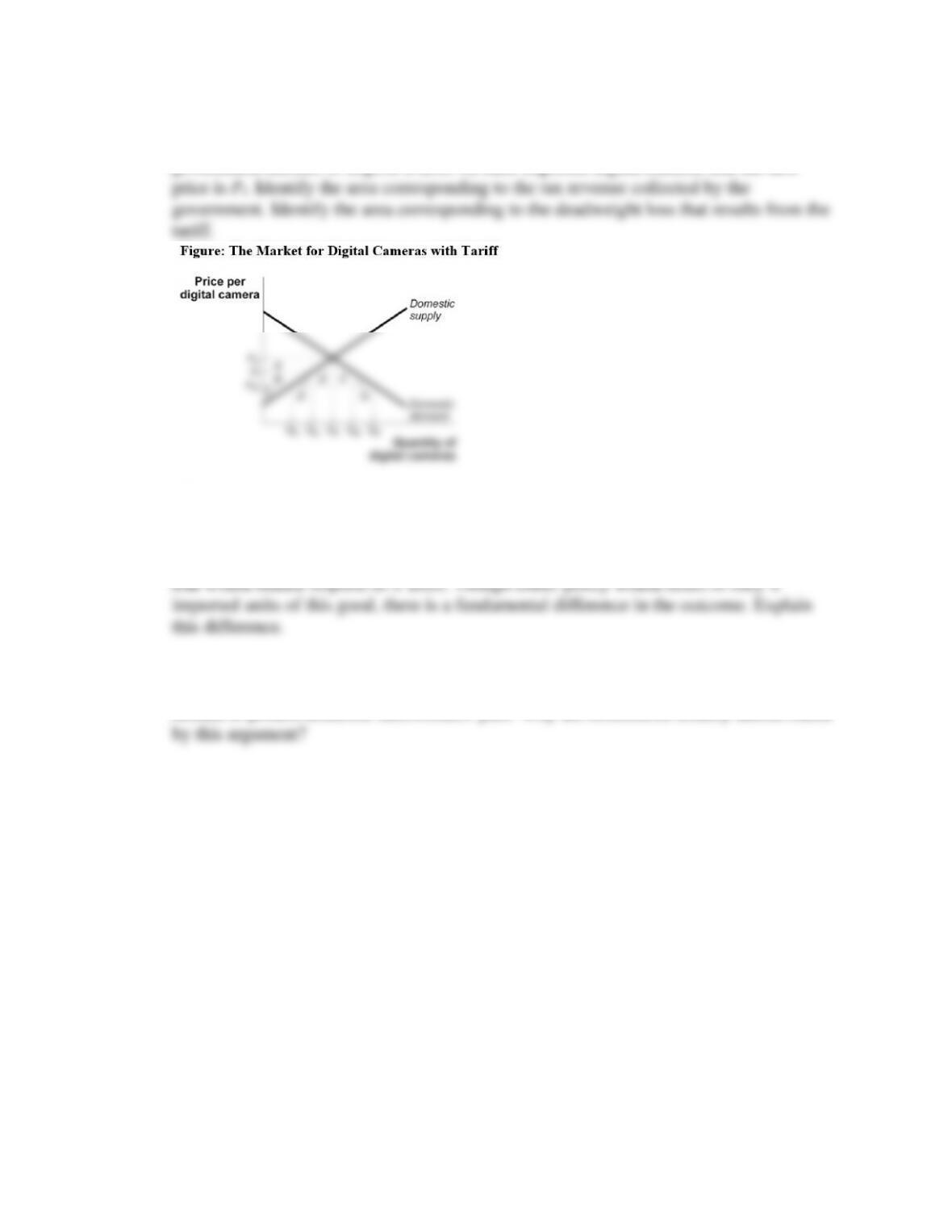
(Figure: The Market for Digital Cameras with Tariff) Use Figure: The Market for
Digital Cameras with Tariff. The domestic price is PA and the world price is PW. The
government decides to impose a tariff on each imported digital camera, and the new
price is Pt. Identify the area corresponding to the tax revenue collected by the
government. Identify the area corresponding to the deadweight loss that results from the
tariff.
245.
Suppose a nation is considering two alternative policies to protect a domestic industry
from world trade. The two policies are an import quota of X units and a per-unit tariff
that would reduce imports to X units. Though either policy would result in only X
imported units of this good, there is a fundamental difference in the outcome. Explain
this difference.
246.
Some advocates of trade protection in the domestic market for steel argue that it is
needed to protect domestic steelworkers’ jobs. Why are economists usually unconvinced
by this argument?
247.
Imports are good and services that are:
A)
sold outside of the country.
B)
domestically produced.
C)
purchased from another country.
D)
purchased inside the country.
If the opportunity cost of producing either of two goods in question is constant, the
production possibility frontier is:
A)
linear.
B)
concave to the origin.
C)
convex to the origin.
D)
upward-sloping.
Page 59
249.
In autarky, a country:
A)
trades with other countries based on comparative advantage.
B)
trades with other countries based on absolute advantage.
C)
does not trade with other countries.
D)
follows the Heckscher-Ohlin model of trade behavior.
250.
Comparative advantage in international trade:
A)
is used only by large countries.
B)
is used to determine whether trade will be beneficial to both countries involved.
C)
provides benefits to developed countries only.
D)
does not determine what goods countries should produce.
251.
Gains from trade will result if a country specializes in:
A)
all of its goods.
B)
the goods in which it has a comparative advantage.
C)
goods in which it has an absolute advantage.
D)
goods in which it has an absolute and comparative advantage.
252.
The belief that importing goods from low-wage countries will hurt the standard of living
of workers in the importing country is known as the:
A)
Heckscher-Ohlin theory.
B)
pauper labor fallacy.
C)
sweatshop labor fallacy.
D)
theory of absolute advantage.
253.
Workers in China earn low wages relative to world standards. A person who believes
trade must be bad for workers in China because of this adheres to the:
A)
sweatshop labor fallacy.
B)
Heckscher-Ohlin theory.
C)
pauper labor fallacy.
D)
theory of absolute advantage.
254.
Comparative advantage arises from:
A)
differences in climate, factor endowments, and technology.
B)
absolute advantage.
C)
countries engaging in autarkic behavior.
D)
an emphasis on export production.
Page 60
255.
The model suggesting that countries will specialize in producing the good that uses its
relatively abundant factor of production MOST intensively is referred to as the _____
model.
A)
Heckscher-Ohlin
B)
absolute advantage
C)
sweatshop labor
D)
pauper labor fallacy
256.
Countries that trade based on the Heckscher-Ohlin model will find that:
A)
their import goods tend to utilize their relatively scarce factors of production most
intensively.
B)
the goods they export tend to use their relatively scarce factors of production most
intensively.
C)
countries with a relative abundance of capital will export goods that use labor
intensively.
D)
the concept of absolute advantage determines which goods they should export and
import.
257.
A country that is relatively labor-abundant and relatively land-scarce opens to
international trade. As a result, it finds that wages _____ and rents _____.
A)
increase; decrease
B)
decrease; decrease
C)
decrease; increase
D)
increase; increase
Use the following to answer questions 258-263:
Page 61
258.
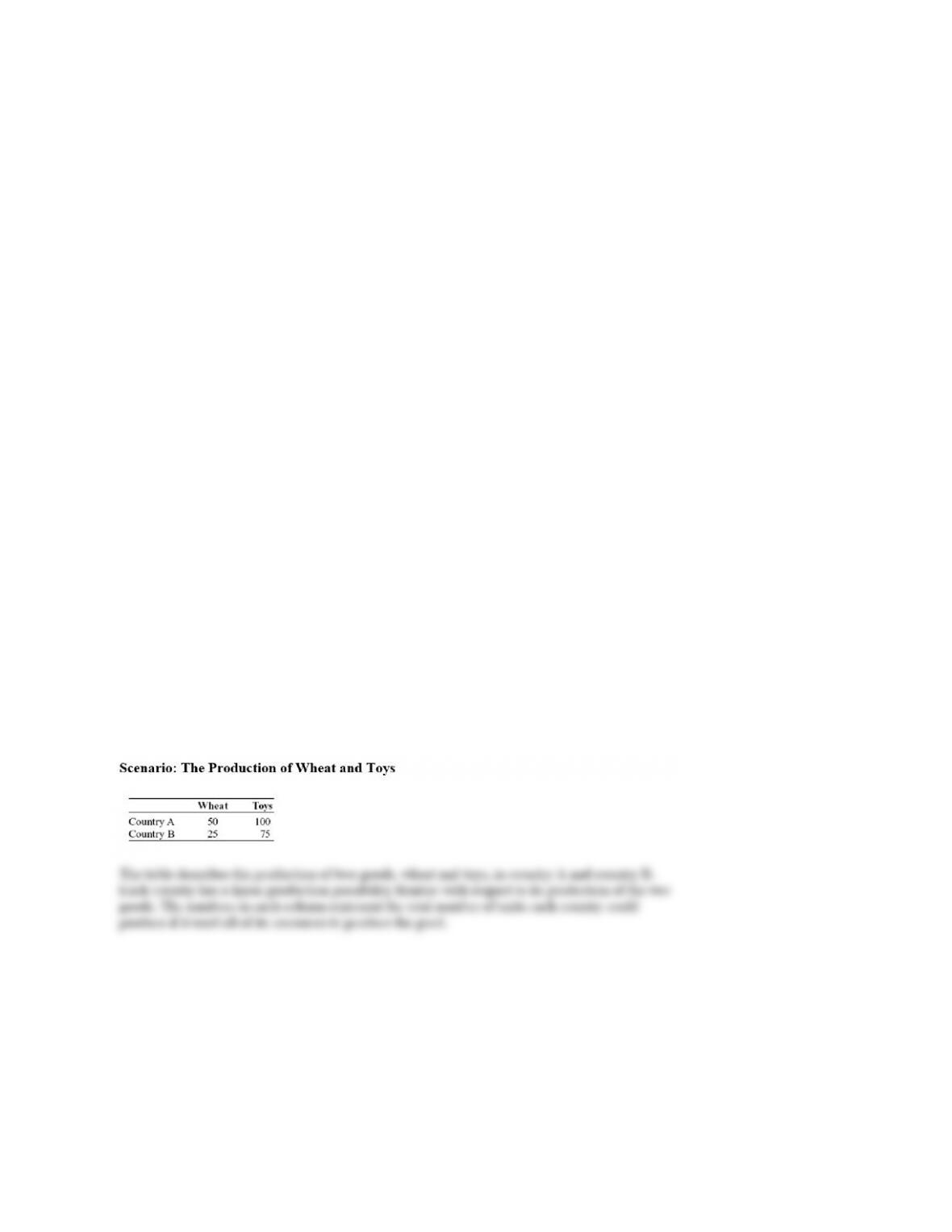
(Scenario: The Production of Wheat and Toys) Use Scenario: Production of Wheat and
Toys. Country A has an absolute advantage in _____ and a comparative advantage in
the production of _____.
A)
toys; wheat
B)
toys; toys
C)
wheat and toys; wheat
D)
neither good; toys
259.
(Scenario: The Production of Wheat and Toys) Use Scenario: Production of Wheat and
Toys. The opportunity cost of producing a unit of wheat in country B is:
A)
75 toys.
B)
3 toys.
C)
25 units of wheat.
D)
0.33 units of wheat.
260.
(Scenario: The Production of Wheat and Toys) Use Scenario: Production of Wheat and
Toys. If each country specializes in the good for which it has the comparative
advantage:
A)
country A will produce wheat and country B will produce toys.
B)
country A will produce both wheat and toys.
C)
country A will produce toys and country B will produce wheat.
D)
country B will produce both wheat and toys.
261.
(Scenario: The Production of Wheat and Toys) Use Scenario: Production of Wheat and
Toys. If each country specializes in the good for which it has the comparative
advantage, then the price of wheat in terms of toys will be:
A)
between two units of toys and one-third unit of toys.
B)
between two units of toys and three units of toys.
C)
three units of toys.
D)
between one-third unit of toys and one-half unit of toys.
262.
(Scenario: The Production of Wheat and Toys) Use Scenario: Production of Wheat and
Toys. If each country specializes completely in the good for which it has the
comparative advantage, which combination represents a maximum possible amount of
total production of the two goods, given the specialization?
A)
50 wheat and 100 toys
B)
50 wheat and 75 toys
C)
25 wheat and 75 toys
D)
100 toys and 25 wheat
Page 62
263.
(Scenario: The Production of Wheat and Toys) Use Scenario: Production of Wheat and
Toys. The opportunity cost of producing a unit of toys in country A is _____ unit(s) of
wheat.
A)
0.5
B)
1
C)
50
D)
100
264.
Advocates of trade barriers suggest that the barriers are needed for national security, job
creation, and to:
A)
protect producers who are just starting out so that they can become more
established.
B)
eliminate the need for governments to become involved in the trade discussions.
C)
enhance the comparative advantage nature of trade.
D)
increase tariff revenue for government.
Use the following to answer questions 265-268:
265.
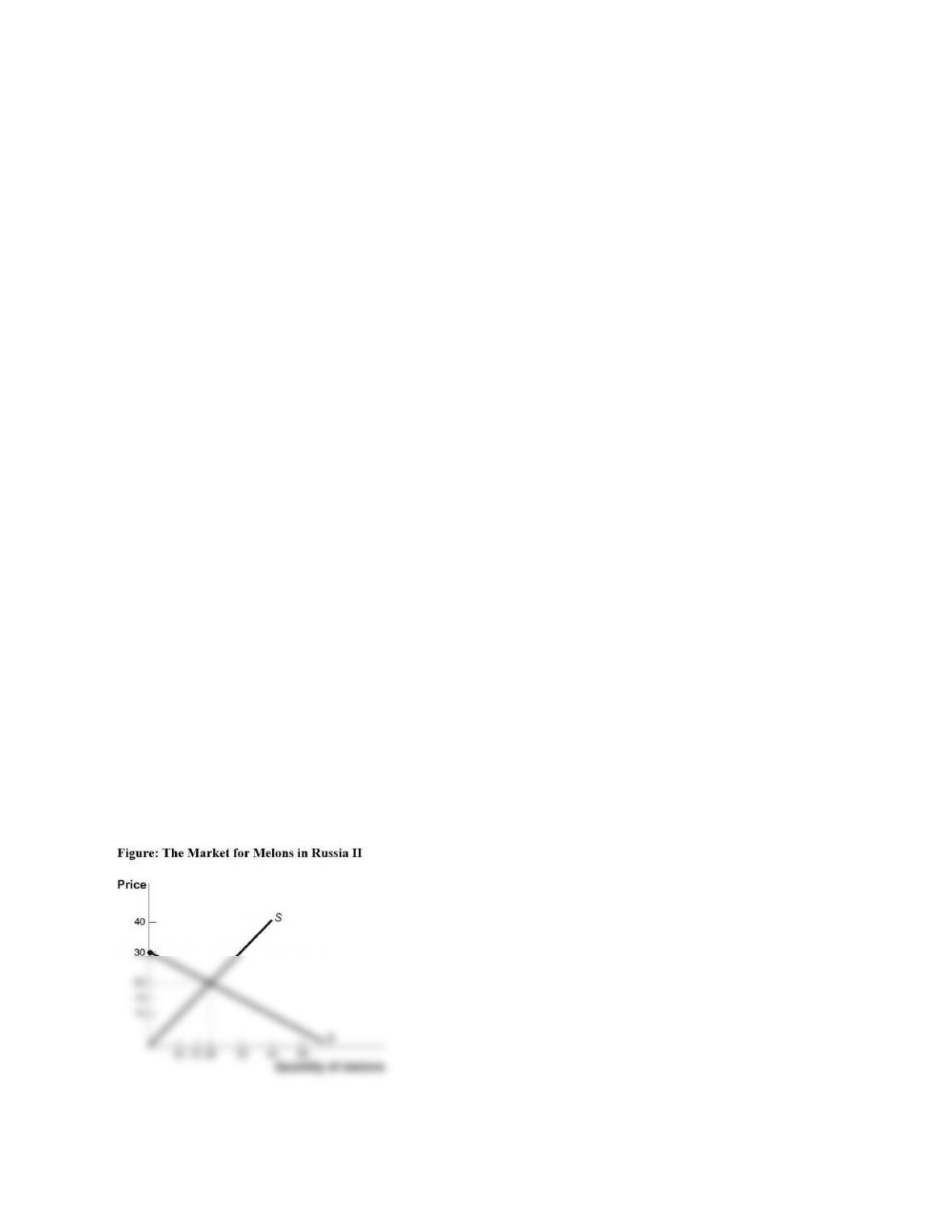
(Figure: The Markets for Melons in Russia) Use Figure: The Market for Melons in
Russia. Without trade, the country’s producer surplus will equal area _____, and
consumer surplus will equal area _____.
A)
ACJ; ABJ
B)
BCJ; ABJ
C)
ABJ; BCJ
D)
BJDK; ABJ
Page 63
266.
(Figure: The Markets for Melons in Russia) Use Figure: The Market for Melons in
Russia. If the world price of melons is equal to E, Russia will _____ of melons.
A)
import I – H
B)
export I – H
C)
import G – F
D)
export G – F
267.
(Figure: The Markets for Melons in Russia) Use Figure: The Market for Melons in
Russia. Suppose the world price of melons is D. Russia will _____ of melons.
A)
import I – H
B)
export I – H
C)
import G – F
D)
export G – F
268.
(Figure: The Markets for Melons in Russia) Use Figure: The Market for Melons in
Russia. If Russia is trading based on comparative advantage and the world price is D,
then Russia has _____ in the production of melons.
A)
a comparative advantage
B)
a comparative disadvantage
C)
an absolute advantage
D)
neither an absolute nor a comparative advantage
269.
The World Trade Organization:
A)
oversees trade agreements.
B)
is an example of a trade agreement.
C)
includes all nations.
D)
was established before World War II.
Use the following to answer questions 270-273:
Page 64
270.
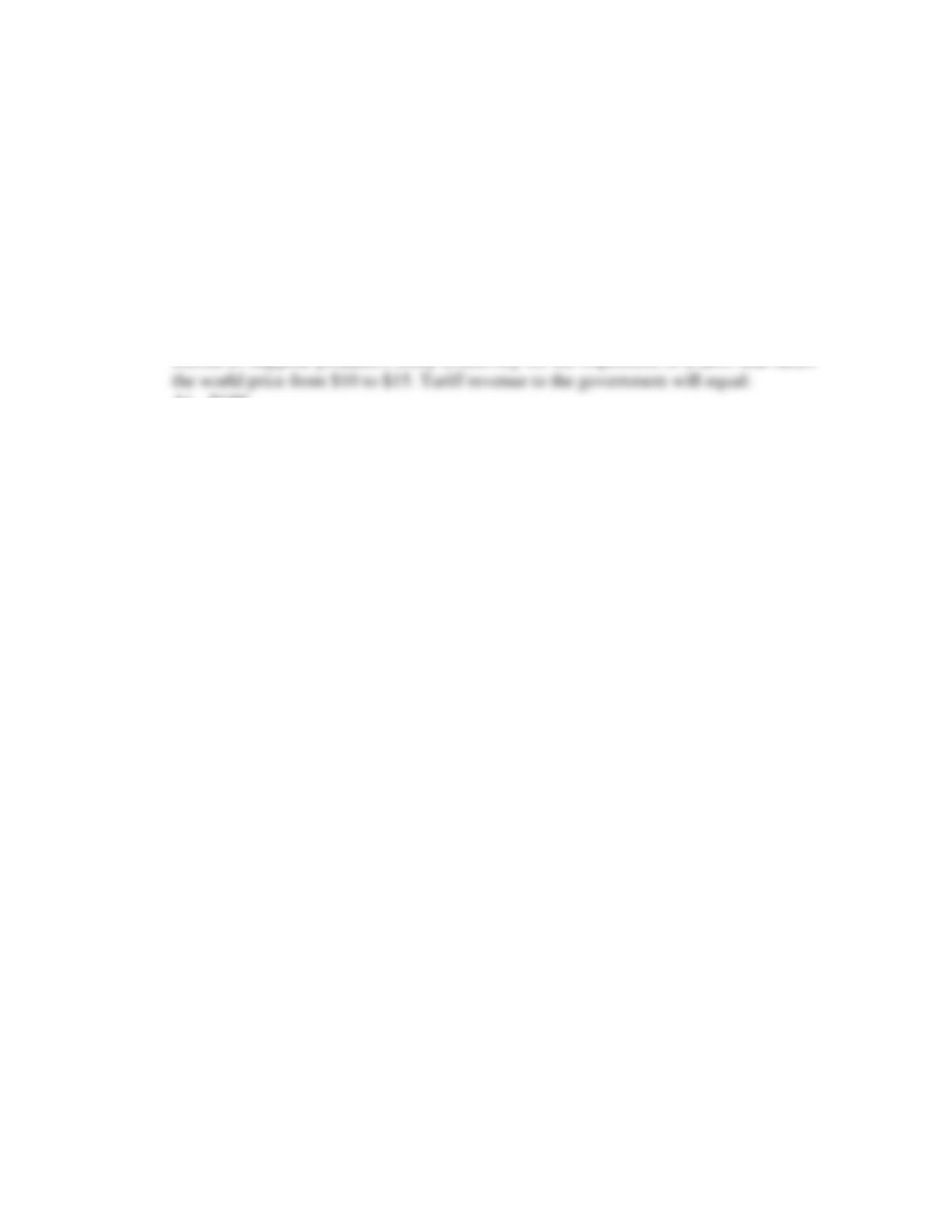
(Figure: The Markets for Melons in Russia II) Use Figure: The Market for Melons in
Russia II. Suppose Russia opens to trade and finds the world price to be $10. Russia
will:
A)
import 30 units of melons.
B)
export 30 units of melons.
C)
not find it beneficial to trade.
D)
import 40 units of melons.
271.
(Figure: The Markets for Melons in Russia II) Use Figure: The Market for Melons in
Russia II. Suppose producers lobby effectively for the imposition of a tariff that raises
the world price from $10 to $15. Tariff revenue to the government will equal:
A)
$150.
B)
$200.
C)
75.
D)
$5.
272.
(Figure: The Markets for Melons in Russia II) Use Figure: The Market for Melons in
Russia II. As a result of a tariff that raises the world price from $10 to $15, the country
has a deadweight loss equal to:
A)
$37.5
B)
$150.
C)
$50.
D)
$5.
273.
(Figure: The Markets for Melons in Russia II) Use Figure: The Market for Melons in
Russia II. If the world price is $10 and a tariff of $5 is imposed on this market, the
burden of the tariff will be borne by:
A)
both producers and consumers.
B)
consumers.
C)
producers.
D)
the government.
Answer Key
Page 66
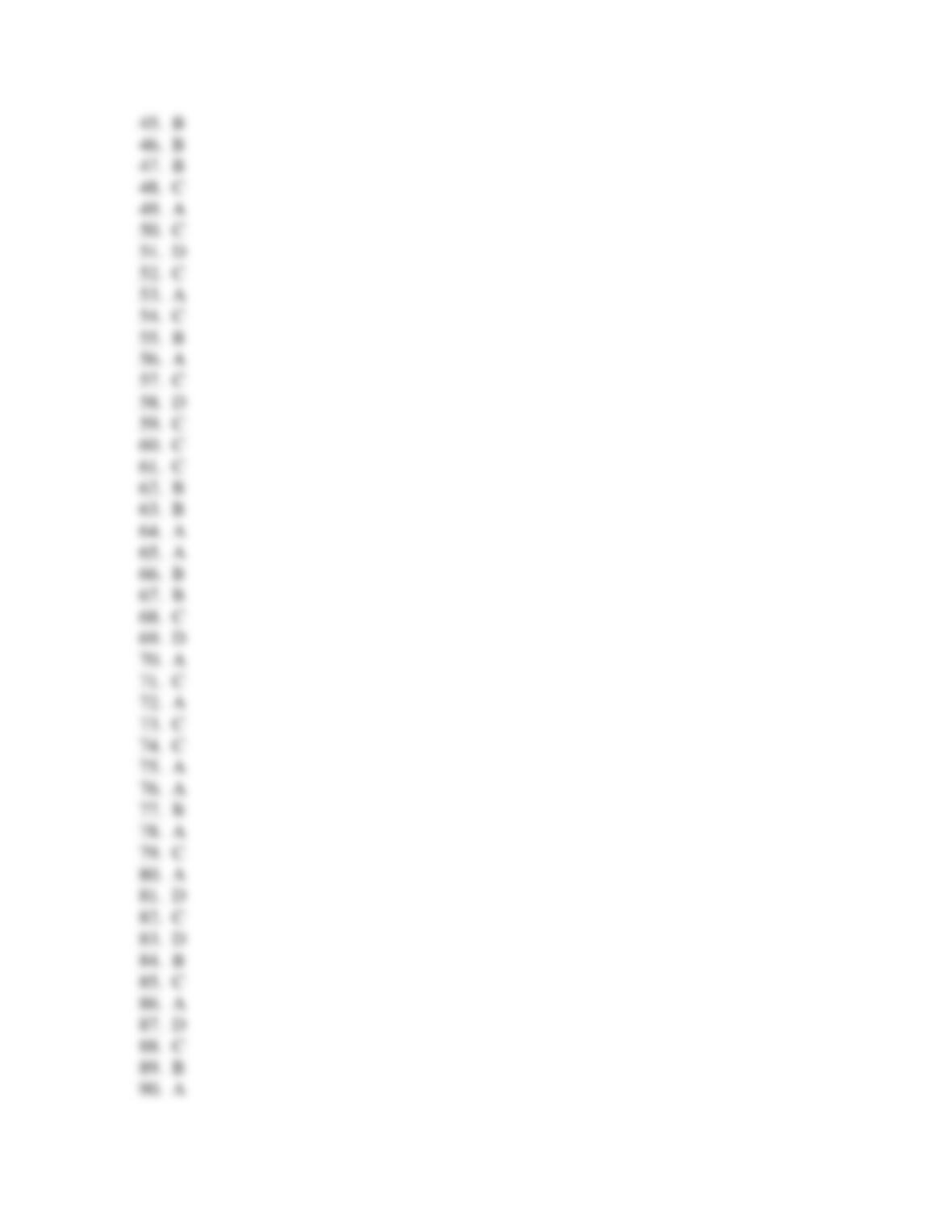
45.
B
46.
B
47.
B
48.
C
49.
A
50.
C
51.
D
52.
C
53.
A
54.
C
55.
B
56.
A
57.
C
58.
D
59.
C
60.
C
61.
C
62.
B
63.
B
64.
A
65.
A
66.
B
67.
B
68.
C
69.
D
70.
A
71.
C
72.
A
73.
C
74.
C
75.
A
76.
A
77.
B
78.
A
79.
C
80.
A
81.
D
82.
C
83.
D
84.
B
85.
C
86.
A
87.
D
88.
C
89.
B
90.
A
Page 67
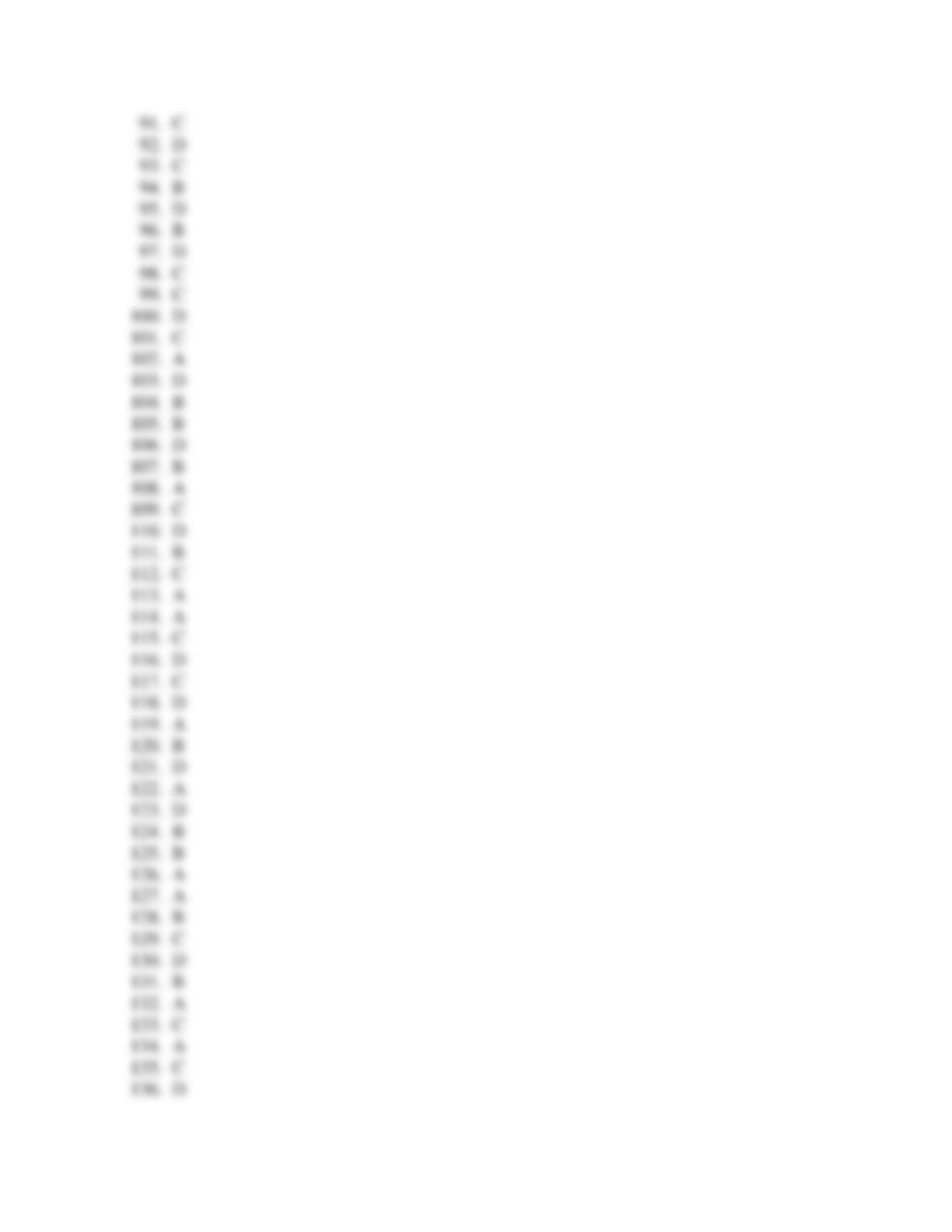
91.
C
92.
D
93.
C
94.
B
95.
D
96.
B
97.
D
98.
C
99.
C
100.
D
101.
C
102.
A
103.
D
104.
B
105.
B
106.
D
107.
B
108.
A
109.
C
110.
D
111.
B
112.
C
113.
A
114.
A
115.
C
116.
D
117.
C
118.
D
119.
A
120.
B
121.
D
122.
A
123.
D
124.
B
125.
B
126.
A
127.
A
128.
B
129.
C
130.
D
131.
B
132.
A
133.
C
134.
A
135.
C
136.
D
Page 68
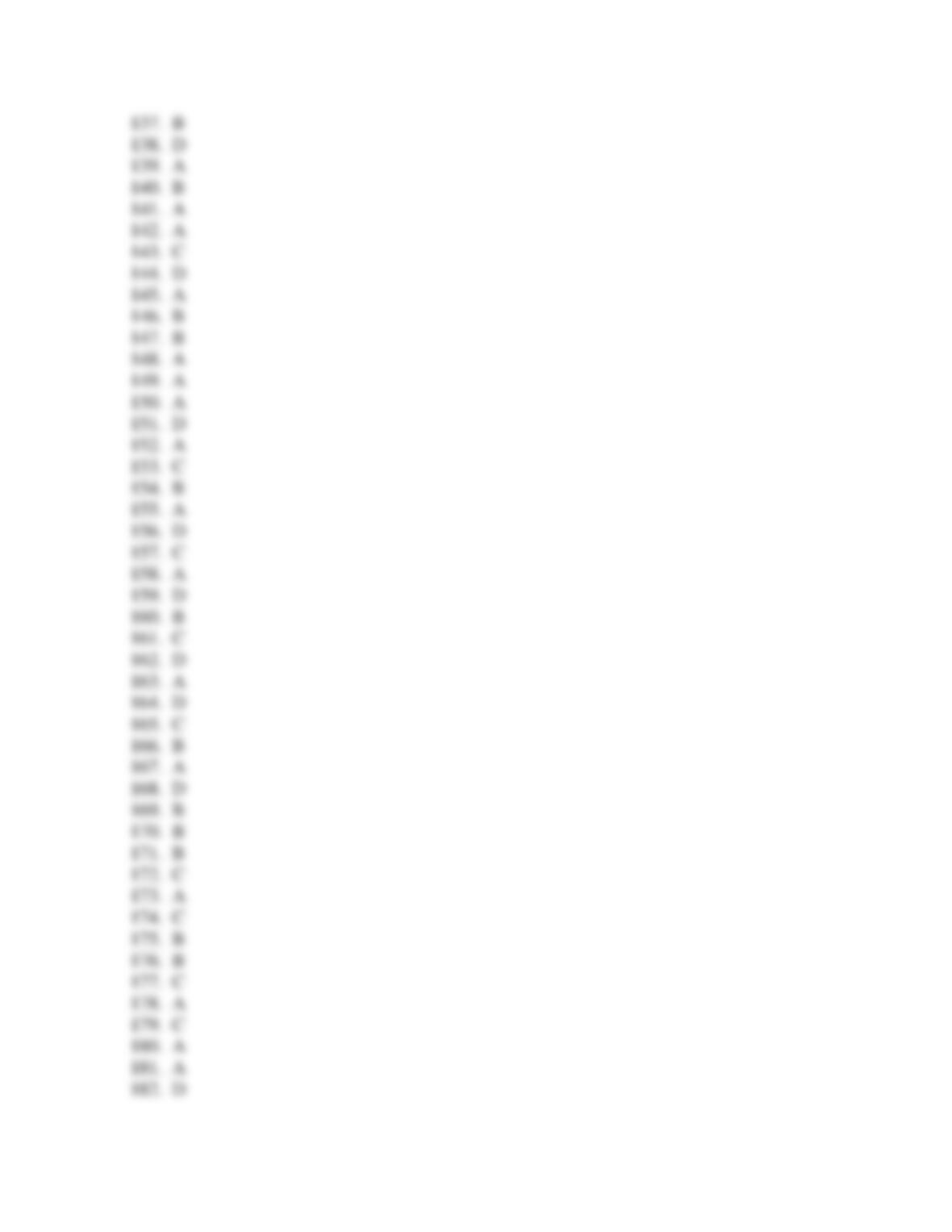
137.
B
138.
D
139.
A
140.
B
141.
A
142.
A
143.
C
144.
D
145.
A
146.
B
147.
B
148.
A
149.
A
150.
A
151.
D
152.
A
153.
C
154.
B
155.
A
156.
D
157.
C
158.
A
159.
D
160.
B
161.
C
162.
D
163.
A
164.
D
165.
C
166.
B
167.
A
168.
D
169.
B
170.
B
171.
B
172.
C
173.
A
174.
C
175.
B
176.
B
177.
C
178.
A
179.
C
180.
A
181.
A
182.
D
Page 69
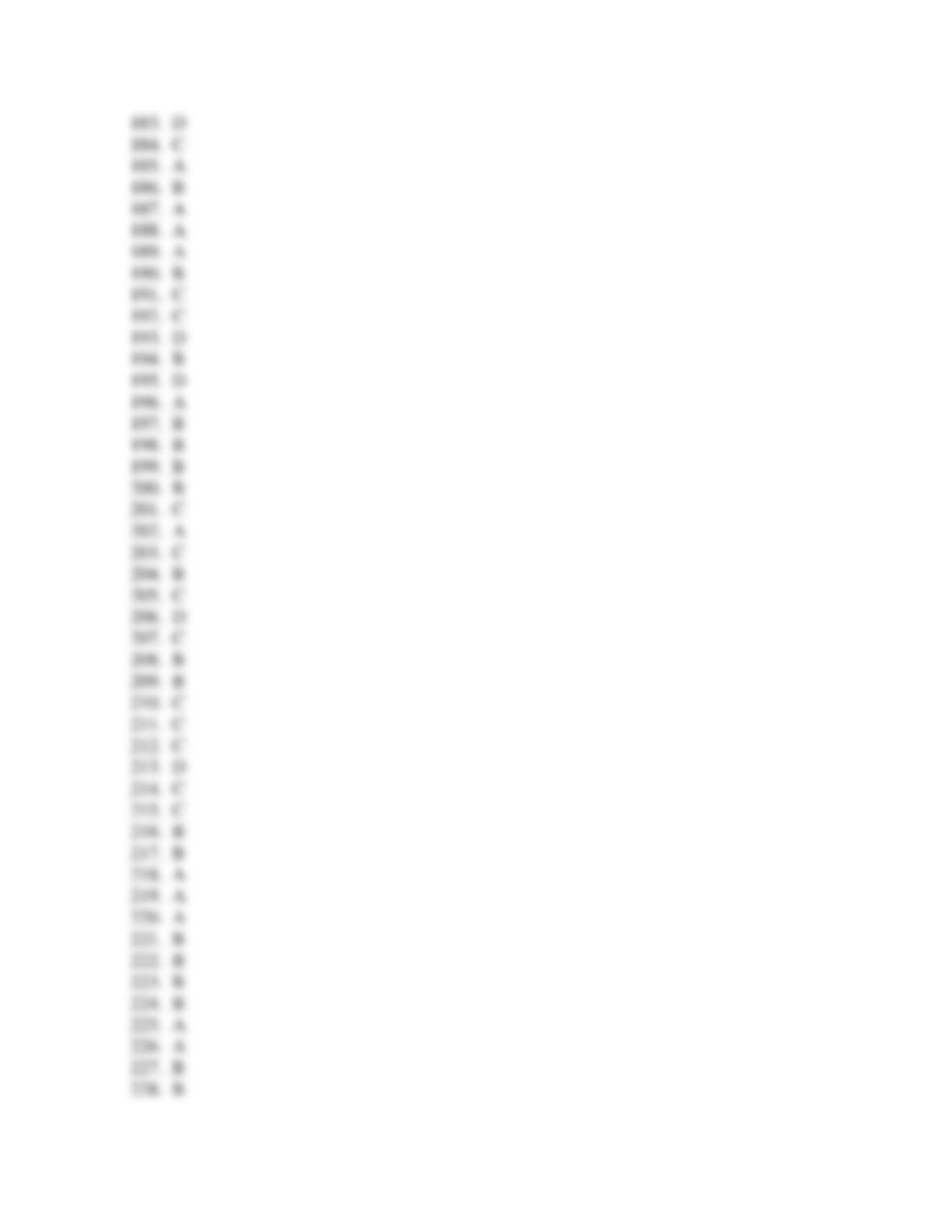
183.
D
184.
C
185.
A
186.
B
187.
A
188.
A
189.
A
190.
B
191.
C
192.
C
193.
D
194.
B
195.
D
196.
A
197.
B
198.
B
199.
B
200.
B
201.
C
202.
A
203.
C
204.
B
205.
C
206.
D
207.
C
208.
B
209.
B
210.
C
211.
C
212.
C
213.
D
214.
C
215.
C
216.
B
217.
B
218.
A
219.
A
220.
A
221.
B
222.
B
223.
B
224.
B
225.
A
226.
A
227.
B
228.
B
Page 70
229.
B
230.
B
231.
B
232.
B
233.
A
234.
A
235.
B
236.
A
237.
238.
239.
240.
241.
Because the world price of good X is a relative bargain, importers will find it profitable
to purchase good X at the world price and sell it at the higher domestic price. Greater
supply of good X in the domestic market will eventually drop the domestic price to the
world price, and importing will stop.
242.
243.
244.
245.
246.
247.
C
248.
A
249.
C
250.
B
251.
B
252.
B
253.
A
254.
A
255.
A
256.
A
257.
A
258.
C
259.
B
260.
A
261.
B
262.
B
263.
A
264.
A
265.
B
266.
A
267.
D
268.
A
269.
A
270.
A
271.
C

Page 71
272.
A
273.
B