Page 41
157.
(Figure: The Market for Laptops) Use Figure: The Market for Laptops. Assume that S
and D are the domestic supply and demand curves and the world price is PW. Identify
the area of government tax revenue when a tariff raises the domestic price from the
world price to PT.
A)
D + E + F
B)
D + F
C)
E
D)
B
158.
If the United States placed larger tariffs on all textiles, domestic _____ surplus would
_____.
A)
producer; increase
B)
consumer; increase
C)
total; increase
D)
producer; decrease
159.
An example of a tariff is a:
A)
limit on the total number of Honda automobiles imported from Japan.
B)
regulation specifying that each imported Honda automobile must meet certain
emission exhaust guidelines.
C)
tax of $500 on each Honda automobile produced in the United States.
D)
tax of 10% of the value of each Honda automobile imported from Japan.
160.
If Japan levies tariffs on U.S. goods entering Japan, this will tend to:
A)
benefit both Japanese and U.S. producers.
B)
damage U.S. producers and benefit Japanese producers.
C)
benefit U.S. producers and damage Japanese producers.
D)
damage both Japanese and U.S. producers.
161.
If a country imposes a tariff on imported shoes, we expect the domestic price of shoes to
_____, domestic consumption to _____, and domestic production to _____.
A)
fall; fall; fall
B)
fall; rise; fall
C)
rise; fall; rise
D)
rise; rise; fall
Page 42
Use the following to answer questions 162-165:
162.
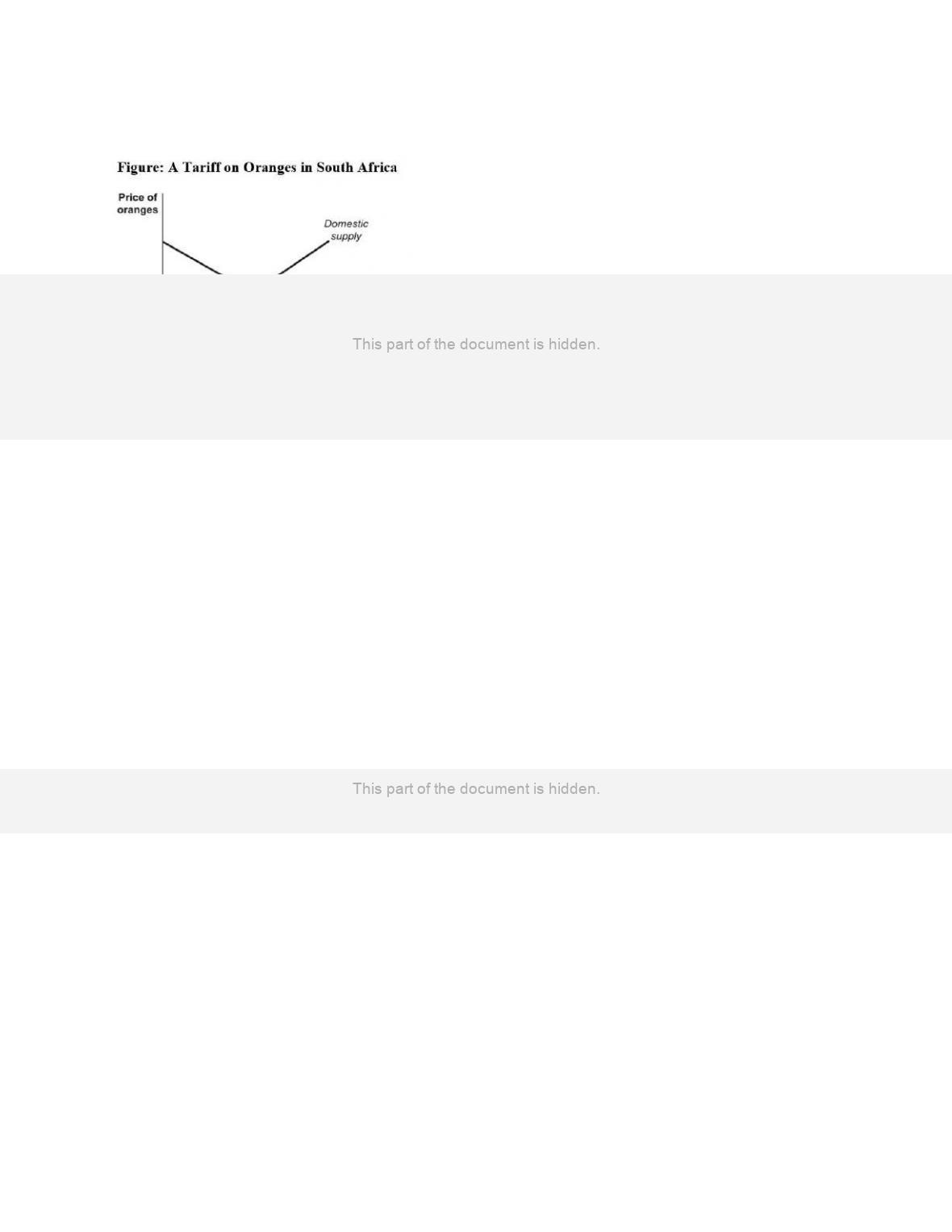
(Figure: A Tariff on Oranges in South Africa) Use Figure: A Tariff on Oranges in South
Africa. When the government imposes a tariff on imported oranges, the price of oranges
in South Africa rises from PW to PT and the volume of imports falls to:
A)
Q2 – Q1.
B)
C1 – C2.
C)
C1 – Q1.
D)
C2 – Q2.
163.
(Figure: A Tariff on Oranges in South Africa) Use Figure: A Tariff on Oranges in South
Africa. When the government imposes a tariff on imported oranges, the price of oranges
in South Africa rises from PW to PT and domestic consumer surplus _____ to _____.
A)
falls; F + L
B)
falls; F + G + I + J + K + L
C)
rises; F + L
D)
rises; F + G + I + J + K + L
164.
(Figure: A Tariff on Oranges in South Africa) Use Figure: A Tariff on Oranges in South
Africa. When the government imposes a tariff on imported oranges, the price of oranges
in South Africa rises from PW to PT and domestic producer surplus _____ to _____.
A)
falls; G + I
B)
falls; G + I + J + K
C)
rises; G + + J + K
D)
rises; G + H
Page 43
165.
(Figure: A Tariff on Oranges in South Africa) Use Figure: A Tariff on Oranges in South
Africa. When the government imposes a tariff on imported oranges, the price of oranges
in South Africa rises from PW to PT and there’s a net _____ to total surplus of _____.
A)
addition; I + J + K+ L
B)
addition; I + J + K
C)
reduction; I + K
D)
reduction; I + J + K + L
166.
A tariff imposed on Japanese imports into the United States tends to _____ U.S.
producers and _____ Japanese producers.
A)
penalize; benefit.
B)
benefit; penalize
C)
penalize; penalize
D)
benefit; benefit
167.
The United States places a tariff on imported Brazilian ethanol. The impact of this tariff
on the domestic ethanol market is a _____ domestic price, _____ consumer surplus, and
_____ producer surplus.
A)
higher; less; more
B)
lower; less; more
C)
higher; more; less
D)
higher; less; less
168.
A tariff _____ the price received by domestic producers and _____ the price paid by
domestic consumers.
A)
decreases; increases
B)
increases; decreases
C)
decreases; decreases
D)
increases; increases
169.
A tariff is MOST likely to _____ prices and _____ domestic consumption of the good or
service being protected.
A)
decrease; increase
B)
increase; decrease
C)
have no effect on; not change
D)
decrease; decrease

Page 44
170.
A tax on imported goods or services is a:
A)
quota.
B)
tariff.
C)
nontariff barrier.
D)
trade embargo.
171.
If Japan levies tariffs on U.S. goods entering Japan, this will tend in the short run to
_____ U.S. producers and _____ Japanese producers.
A)
benefit; benefit
B)
damage; benefit
C)
benefit; damage
D)
damage; damage
172.
Which item is an example of a tariff?
A)
a regulation specifying that each imported Yamaha motorcycle must meet certain
emission exhaust guidelines
B)
a limit on the total number of Yamaha motorcycles imported from Japan
C)
a tax of 5% of the value of each Yamaha motorcycle imported from Japan
D)
a tax of $250 on each Yamaha motorcycle produced in the United States
173.
In the importing country, the MOST likely effect of a tariff is to:
A)
raise the price and decrease the quantity demanded.
B)
raise the price and increase the quantity demanded.
C)
raise the price without affecting the quantity demanded.
D)
decrease the quantity supplied.
174.
If a country imposes a tariff on imported shoes, we expect the domestic price of shoes to
_____ and the quantity of shoes consumed in the domestic market to _____.
A)
fall; fall
B)
fall; rise
C)
rise; fall
D)
rise; rise
175.
If a country removes a tariff on imported shoes, we expect the domestic price of shoes
to _____ and the quantity of shoes consumed in the domestic market to _____.
A)
fall; fall
B)
fall; rise
C)
rise; fall
D)
rise; rise
Page 45
176.
If Canada imposes a tariff of $5 per bottle on French wine, the MOST likely effect will
be to raise the price of wine in Canada by:
A)
more than $5 per bottle.
B)
$5 per bottle.
C)
less than $5 per bottle and lower the price of wine in France by less than $5 per
bottle.
D)
less than $5 per bottle without affecting the price of wine in France.
177.
Assume that a tariff is imposed on Chinese imports into the United States. This tariff is
likely to _____ U.S. producers and _____ Chinese producers.
A)
penalize; penalize
B)
benefit; benefit
C)
benefit; penalize
D)
penalize; benefit
178.
A tariff imposed on U.S. imports into Japan tends to _____ U.S. producers and _____
Japanese producers.
A)
penalize; benefit
B)
benefit; penalize
C)
penalize; penalize
D)
benefit; benefit
179.
A tax on imports of foreign goods is called a(n):
A)
import quota.
B)
aubsidy.
C)
tariff.
D)
export restriction.
180.
A regulation that specifies the maximum amount of a good or service that may be
imported during a specified period is a(n):
A)
import quota.
B)
tariff.
C)
nontariff barrier.
D)
export quota.
Page 46
181.
An example of an import quota is a:
A)
limit on the total number of Honda automobiles imported from Japan.
B)
regulation specifying that each imported Honda automobile must meet certain
emission exhaust guidelines.
C)
tax of 10% of the value of each Honda automobile imported from Japan.
D)
subsidy from the Japanese government of $500 for each Honda automobile
imported into the United States.
182.
Assume that the United States imposes an import quota on Columbian coffee. Relative
to the equilibrium world price that would prevail in the absence of import quotas, it is
likely that the equilibrium price of coffee in the United States will _____ and the
equilibrium price of coffee in Columbia will _____.
A)
decrease; remain the same
B)
remain the same; increase
C)
increase; increase
D)
increase; decrease
183.
Assume that the United States imposes an import quota on Scottish wool suits. Relative
to the equilibrium price that would prevail in the absence of quotas, the equilibrium
price of suits in the United States will most likely _____ and the equilibrium price of
suits in Scotland will most likely _____.
A)
remain the same; decrease
B)
remain the same; increase
C)
increase; increase
D)
increase; decrease
184.
If the United States imposes an import quota on French wines, the result in the short run
is likely to be _____ profits for American wine producers and _____ profits for French
wine producers.
A)
lower; lower
B)
lower; higher
C)
higher; lower
D)
higher; higher
185.
A direct restriction on the quantity of an import is called a(n):
A)
import quota.
B)
tariff.
C)
import subsidy.
D)
import restriction.

Page 47
186.
If quota rents do not accrue to the government, then the net loss to the government from
an import quota is _____ the deadweight loss from an equivalent tariff.
A)
less than
B)
greater than
C)
equal to
D)
in the case of demand and supply both being elastic, less than
187.
In the case of U.S. trade protection, quota rents for the most important import licenses
are earned by:
A)
foreign governments.
B)
the U.S. government.
C)
U.S. producers of the good.
D)
importers who pay the highest price to get the licenses.
188.
Which item is an example of an import quota?
A)
a limit on the total number of shoes imported from Italy.
B)
regulations specifying that each imported toy from China must meet certain safety
guidelines.
C)
a tax of $100 on each Suzuki motorcycle produced in the United States.
D)
a tax of 10% of the value of each Suzuki motorcycle imported from Japan.
189.
Assume that the United States imposes an import quota on Italian shoes. Relative to the
equilibrium world price that would exist in the absence of import quotas, the
equilibrium price of shoes in the United States will most likely _____ and the
equilibrium price of shoes in Italy will most likely _____.
A)
increase; decrease
B)
decrease; remain the same
C)
decrease; increase
D)
increase; remain the same
190.
The MOST likely effects of tariffs and/or import quotas are to _____ prices and to
_____ consumption of the protected goods in the importing country.
A)
raise; raise
B)
raise; lower
C)
lower; raise
D)
lower; lower
Page 48
191.
The main difference between a tariff and an import quota is that:
A)
an import quota reduces imports more sharply than a tariff.
B)
a tariff will cause higher prices than an import quota.
C)
a tariff generates tax revenue, while an import quota generates rents to the license
holders.
D)
a tariff will cause lower prices than an import quota.
192.
Suppose the United States auctioned off all import quotas, the auctions were perfectly
competitive, and the government received the revenues from the auction. In this case,
the deadweight loss from a quota would be _____ the deadweight loss from an
equivalent tariff.
A)
less than
B)
greater than
C)
equal to
D)
in the case of demand being elastic, greater than
193.
If the United States removed the tariffs and quotas on sugar, in the U.S. market for
sugar:
A)
consumer surplus would not change.
B)
consumer surplus would decrease.
C)
total surplus would decrease.
D)
producer surplus would decrease.
194.
A tariff or quota will _____ prices and _____ the consumption of the protected goods in
the importing country.
A)
raise; increase
B)
raise; decrease
C)
lower; increase
D)
lower; decrease
195.
Tariffs and import quotas tend to:
A)
increase the quantity of imports as compared to free trade.
B)
generate government revenue.
C)
increase consumer surplus as compared to free trade.
D)
reduce total surplus as compared to free trade.
Page 49
196.
Which argument is one that is common for trade protection?
A)
national security
B)
increased efficiency
C)
increased profitability
D)
increased productivity
197.
The infant industry argument for trade protection states that:
A)
small, traditional industries such as handicrafts should be protected from foreign
competition or they would not be able to survive.
B)
new industries should be protected from foreign competition until they become
established.
C)
industries that provide day care for their employees’ children ought to be protected
from foreign competition.
D)
industries that produce products essential for the well-being of infants (e.g., the
baby food industry) ought to be protected since such products are essential for the
good health of future generations.
198.
In 2002, the steel industry argued that higher tariffs on steel were necessary to help fight
the war on terrorism. This is an example of the _____ argument.
A)
infant industry
B)
national security
C)
job creation
D)
predatory pricing
199.
According to the infant industry argument, import protection is needed because:
A)
foreign workers are often paid less than U.S. workers.
B)
it enables our protected industries to achieve technological efficiency and thus
become competitive with mature foreign industries.
C)
the nation’s security depends on a strong industrial base.
D)
it provides consumers with more and better goods in the long run.
200.
If the executives of the U.S. silicon chip industry lobby Congress for protection from
imports on the grounds that theirs is a new industry that needs time to develop
technological efficiency, they are using the _____ argument.
A)
environmental standards
B)
infant industry
C)
cheap foreign labor
D)
national security

Page 50
201.
If the executives of the U.S. silicon chip industry lobby Congress for protection from
imports on the grounds that the military should have an unrestricted domestic supply of
silicon chips, they are using the _____ argument.
A)
infant industry
B)
job creation
C)
national security
D)
model industry
202.
The job creation argument for protection against free trade is:
A)
that keeping out foreign imports allows the goods and services to be produced by
domestic workers.
B)
frequently put forward by economists.
C)
mostly that we need full employment to defend the security of the nation.
D)
that we need full employment to prevent currency depreciation.
203.
Many countries engage in trade protection by imposing import tariffs or quotas for at
least some goods. This is because:
A)
economists have established that such restrictions are welfare-improving for certain
categories of goods (such as raw materials).
B)
such restrictions tend to benefit consumers without harming producers.
C)
while such restrictions harm consumers, they benefit producers, who are usually a
more cohesive and politically influential group.
D)
while such restrictions harm consumers and benefit producers, the losses to
consumers are outweighed by the gains to producers.
204.
Import protections are often imposed because:
A)
import protections increase total surplus, even though some groups are harmed.
B)
groups representing import-competing industries are more cohesive than
consumers.
C)
benefits to producers outweigh the costs to the consumer.
D)
the loss in consumer surplus is usually quite small.
205.
The organization that oversees global trade negotiations and settles trade disputes
among its members is the:
A)
World Bank.
B)
European Union.
C)
World Trade Organization.
D)
North American Free Trade Agreement.
Page 51
206.
Which statement is NOT true about the World Trade Organization (WTO)?
A)
The WTO provides the framework for complex negotiations involved in major
international trade agreements.
B)
The WTO resolves disputes between member countries.
C)
The WTO is an international organization.
D)
The WTO is a direct enforcer of trade agreements.
207.
In which area does the United States significantly limit imports?
A)
computers
B)
aircraft
C)
sugar
D)
oil
208.
_____ oversees international trade agreements.
A)
NAFTA
B)
The World Trade Organization
C)
The European Union
D)
The Federal Reserve Bank
209.
The World Trade Organization:
A)
is the primary member of the North American Free Trade Agreement.
B)
resolves disputes between member nations arising from alleged violations of
previous agreements dealing with international trade.
C)
is a world government with its own army.
D)
lends money to developing countries.
210.
The World Trade Organization:
A)
assists importers and exporters in conducting their trade.
B)
works together with United Nations forces to enforce international decisions.
C)
organizes the negotiations involved in trade agreements and resolves disputes
among members.
D)
promotes trade by organizing educational conferences.
211.
Canada, Mexico, and the United States have:
A)
joined together and are operating in what is called a closed-trade area with respect
to the European Union.
B)
developed a currency similar to the euro.
C)
eliminated many trade barriers among themselves.
D)
reduced trade among themselves to protect jobs at home.
Page 52
212.
When a business hires people in other countries to perform various tasks, _____ has
occurred.
A)
comparative advantage
B)
globalization
C)
offshore outsourcing
D)
pauper labor
Use the following to answer questions 213-216:
213.
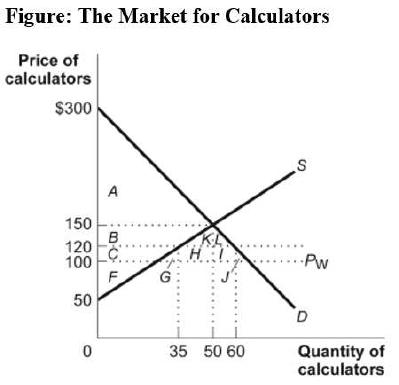
(Figure: The Market for Calculators) Use Figure: The Market for Calculators. Assume
that S and D represent the domestic demand and supply of calculators. The world price,
PW, equals $100. When the economy moves from autarky, under which the price is
$150, to free trade, consumer surplus rises by area _____ and producer surplus falls by
_____.
A)
B + K + L; B
B)
B + C + K + L; B + C + K + L
C)
B + C+ H + I + K + L; B + C + H + I
D)
B + C + G + H + I + J + K + L; B + C
214.
(Figure: The Market for Calculators) Use Figure: The Market for Calculators. Assume
that S and D represent the domestic demand and supply of calculators. The world price,
PW, equals $100. The government imposes a quota restricting imports to 25 calculators.
The domestic price rises to _____ and the quota rent is equal to area _____.
A)
$120; K + L
B)
$150; K + H + I + L
C)
$120; H + I
D)
$150; G + H + I + J
Page 53
215.
(Figure: The Market for Calculators) Use Figure: The Market for Calculators. Assume
that S and D represent the domestic demand and supply of calculators. The world price,
PW, equals $100. The government imposes a quota restricting imports to 25 calculators.
If import licenses are granted to foreigners, the net loss due to the import quota is equal
to area:
A)
K + L.
B)
G + J.
C)
G + H + I + J.
D)
G + H + I + J + K + L.
216.
(Figure: The Market for Calculators) Use Figure: The Market for Calculators. Assume
that S and D represent the domestic demand and supply of calculators. The world price,
PW, equals $100. The government imposes an import tariff of $20 per calculator.
Compared with the free trade situation, the tariff leads to a deadweight loss equal to
area:
A)
K + L.
B)
G + J.
C)
G + H + I + J.
D)
There is no deadweight loss, since the tariff revenue the government receives
offsets any losses.
217.
Although U.S. exports and imports have grown substantially in absolute terms since the
1960s, the share of exports and imports in total output has fallen significantly over the
past few decades.
A)
True
B)
False
218.
Relative to the size of their economy, many other countries engage in more foreign trade
than the United States.
A)
True
B)
False
219.
France and the United Kingdom both produce wine and cloth with constant opportunity
costs. If opportunity costs in the two countries are different and France has a
comparative advantage in wine production, then England MUST have a comparative
advantage in cloth production.
A)
True
B)
False
Page 54
220.
In autarky, the amount of a country’s production and consumption of a good must be
identical.
A)
True
B)
False
221.
International trade based on comparative advantage allows a country to produce outside
its production possibility frontier.
A)
True
B)
False
222.
The Ricardian model of international trade assumes that countries have the usual
bowed-out (concave to the origin) production possibility frontiers.
A)
True
B)
False
223.
If Indonesia has lower wage rates than India, trade between these two nations will make
India worse off.
A)
True
B)
False
224.
The Heckscher-Ohlin model cannot explain United States-Mexico trade since the United
States has more labor and more land than Mexico.
A)
True
B)
False
225.
Since the production of clothing is labor-intensive relative to the production of wheat
and China is labor-abundant relative to most countries, we expect China to export
clothing.
A)
True
B)
False
226.
Mexico has an abundance of unskilled labor and the United States has an abundance of
skilled labor. The Heckscher-Ohlin model implies that trade between the United States
and Mexico will lead to a decrease in the wages of unskilled labor in the United States
and an increase in the wages of skilled labor in the United States.
A)
True
B)
False
Page 55
227.
Exports increase producer surplus but decrease consumer surplus and total surplus.
A)
True
B)
False
228.
Evidence shows that increased international trade has increased the wages of unskilled
workers in the United States.
A)
True
B)
False
229.
Since labor is relatively scarce in Canada, free trade should cause the wages paid to
Canadian labor to rise.
A)
True
B)
False
230.
When a country moves from autarky to free international trade, consumers and
producers in the import and export sectors all gain (i.e., both consumer surplus and
producer surplus increase in both sectors).
A)
True
B)
False
231.
United States follows a policy of free trade, which is especially apparent for sugar and
textiles, in which all restrictions on international trade have been removed.
A)
True
B)
False
232.
Import tariffs always benefit domestic producers more than they hurt domestic
consumers.
A)
True
B)
False
233.
In practice much trade protection reflects the political influence of import-competing
producers.
A)
True
B)
False