Page 21
86.
(Figure: The Production Possibilities for Two Countries) Use Figure: The Production
Possibilities for Two Countries. Trade will NOT take place if 1 microchip trades for
_____ tire(s).
A)
0.25
B)
1
C)
1.5
D)
1.75
87.
(Figure: The Production Possibilities for Two Countries) Use Figure: The Production
Possibilities for Two Countries. If Indonesia and Malaysia trade 1 microchip for 1 tire,
the most that Indonesia can consume is _____ microchips and _____ tires, while the
most that Malaysia can consume is _____ microchips and _____ tires.
A)
300; 600; 800; 200
B)
200; 900; 600; 300
C)
1,200; 400; 800; 200
D)
600; 600; 1,000; 600
88.
(Figure: The Production Possibilities for Two Countries) Use Figure: The Production
Possibilities for Two Countries. If Indonesia and Malaysia trade 1 microchip for 1.5
tires, the most that Indonesia can consume is _____ microchips and _____ tires, while
the most that Malaysia can consume is _____ microchips and _____ tires.
A)
300; 600; 800; 200
B)
1,200; 400; 800; 200
C)
400; 600; 1,200; 600
D)
600; 600; 600; 600
89.
(Figure: The Production Possibilities for Two Countries) Use Figure: The Production
Possibilities for Two Countries. Indonesia has an absolute advantage in producing:
A)
microchips.
B)
tires.
C)
both microchips and tires.
D)
neither microchips nor tires.
90.
(Figure: The Production Possibilities for Two Countries) Use Figure: The Production
Possibilities for Two Countries. Malaysia has an absolute advantage in producing:
A)
microchips.
B)
tires.
C)
both microchips and tires.
D)
neither microchips nor tires.
Page 22
Use the following to answer questions 91-92:
91.
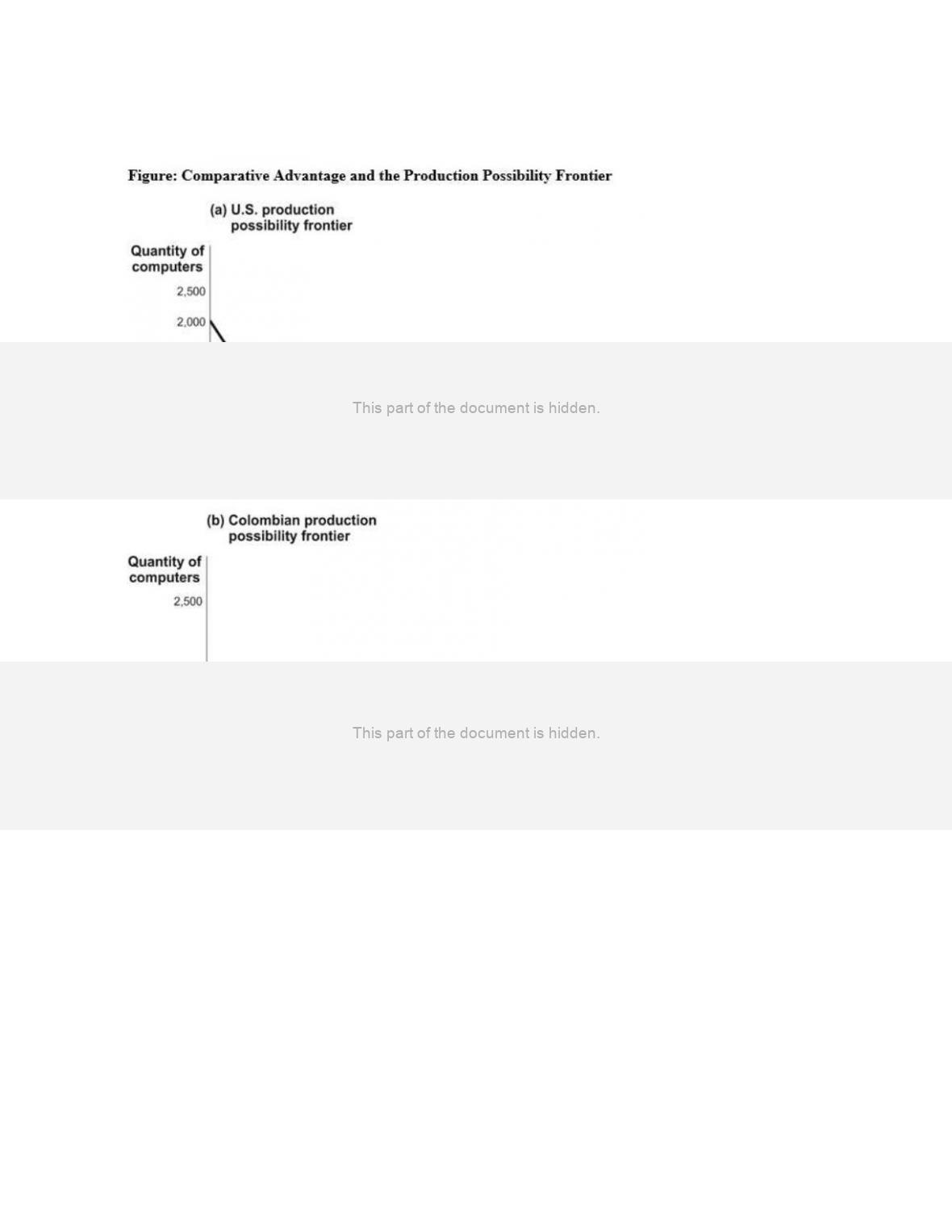
(Figure: Comparative Advantage and the Production Possibility Frontier) Use Figure:
Comparative Advantage and the Production Possibility Frontier. _____ has an absolute
advantage in the production of _____ and a comparative advantage in the production of
_____.
A)
The United States; computers; roses
B)
Colombia; computers; roses
C)
The United States; computers; computers
D)
Colombia; roses; computers
Page 23
92.
(Figure: Comparative Advantage and the Production Possibility Frontier) Use Figure:
Comparative Advantage and the Production Possibility Frontier. _____ has an absolute
advantage in the production of _____ and a comparative advantage in the production of
_____.
A)
The United States; computers; roses
B)
Colombia; computers; roses
C)
The United States; roses; computers
D)
Colombia; roses; roses
Use the following to answer questions 93-94:
93.
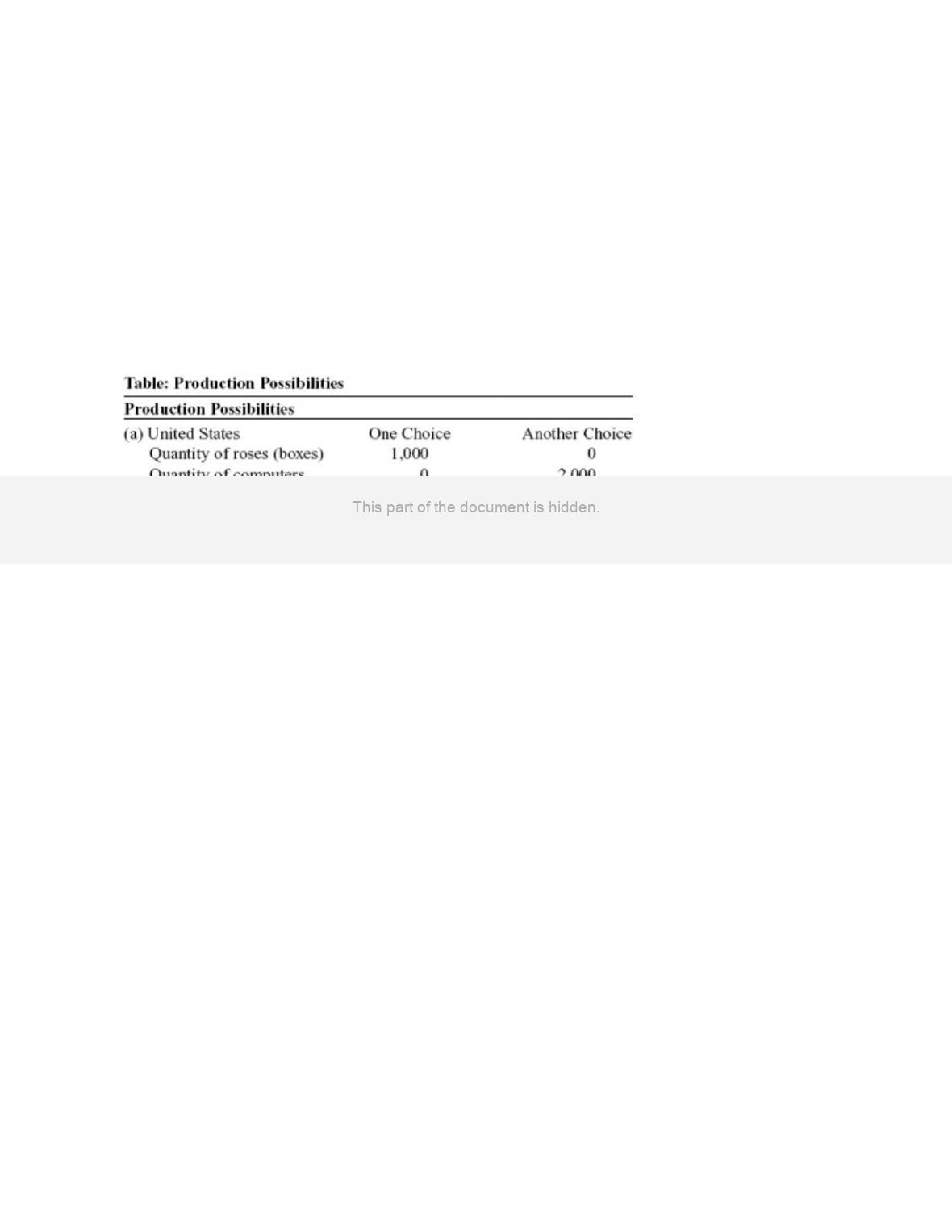
(Table: Production Possibilities) Use Table: Production Possibilities. The opportunity
cost of 1 computer for _____ is _____box (es) of roses.
A)
the United States; 2
B)
Colombia; 0.5
C)
the United States; 0.5
D)
Colombia; 1
94.
(Table: Production Possibilities) Use Table: Production Possibilities. The opportunity
cost of 1 computer for _____ is _____ box(es) of roses.
A)
the United States; 2
B)
Colombia; 2
C)
Colombia; 0.5
D)
the United States; 1
Page 24
95.
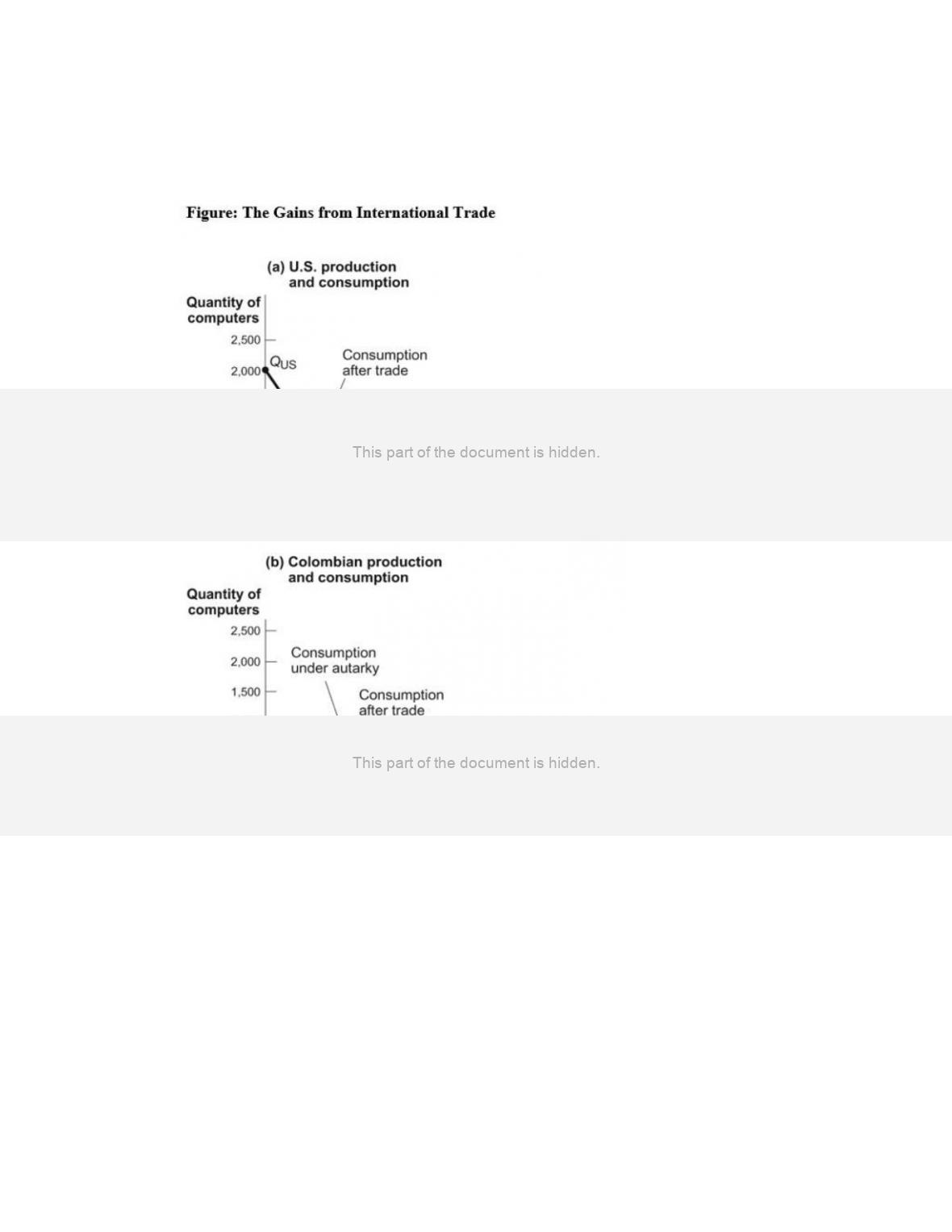
(Figure: The Gains from International Trade) Use Figure: The Gains from International
Trade. If each country specializes completely in the good for which it has a comparative
advantage, each country must trade _____ computer(s) for _____ box of roses to
consume at combination C
.
A)
1; 0.5
B)
2; 1
C)
0.5; 1
D)
1; 1
96.
An economy moves from autarky to free international trade. In the import sector,
consumer surplus _____, producer surplus _____, and the economy as a whole _____.
A)
rises; rises; gains
B)
rises; falls; gains
C)
falls; rises; gains
D)
rises; falls; loses
Page 25
Use the following to answer questions 97-100:
97.
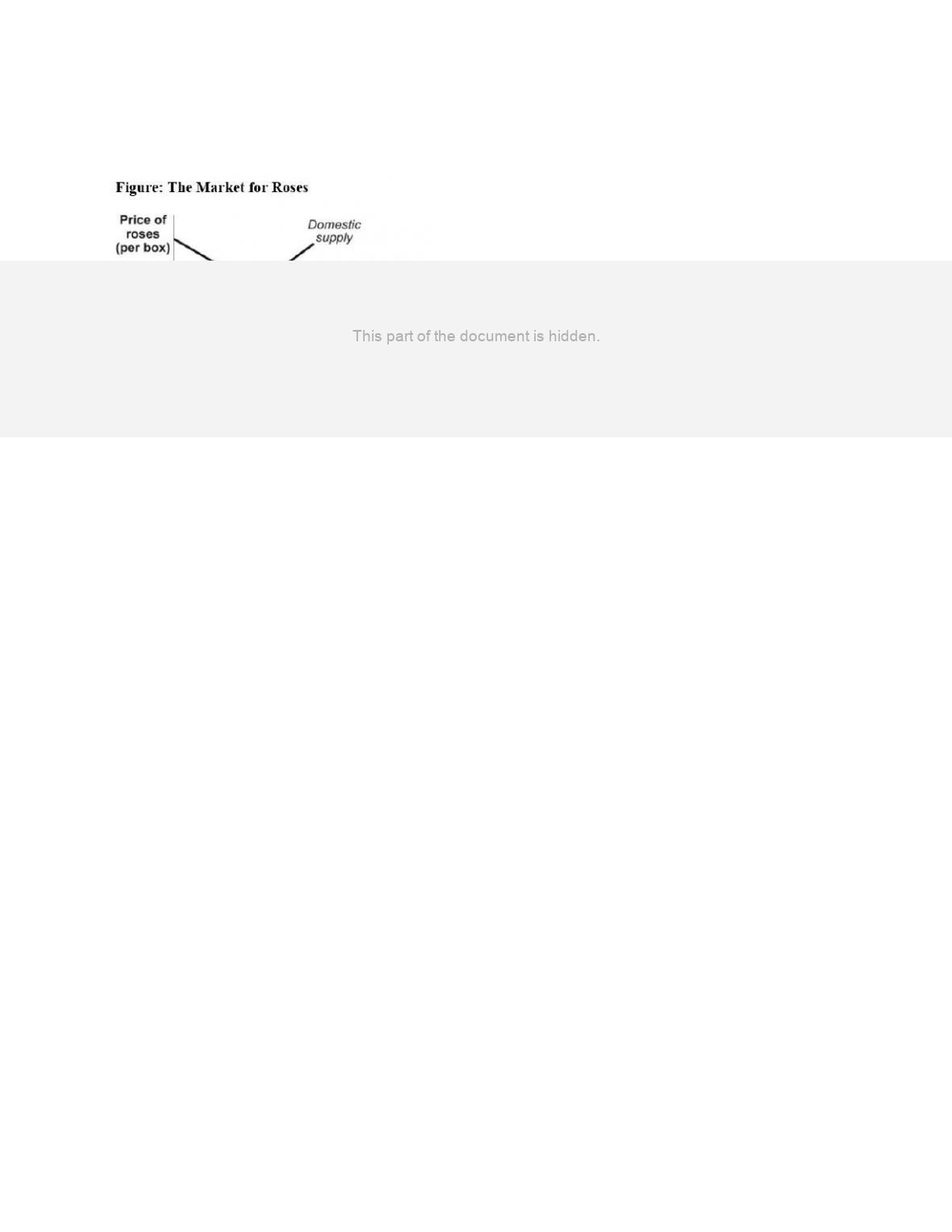
(Figure: The Market for Roses) Use Figure: The Market for Roses. Assume that PA is
the autarky price and PW is the world price. Consumer surplus without international
trade would be area:
A)
W + X + Y.
B)
Z.
C)
W + X + Z.
D)
W.
98.
(Figure: The Market for Roses) Use Figure: The Market for Roses. Assume that PA is
the autarky price and PW is the world price. Consumer surplus with international trade
would be area:
A)
W + X + Y.
B)
Z.
C)
W + X + Z.
D)
W.
99.
(Figure: The Market for Roses) Use Figure: The Market for Roses. Assume that PA is
the autarky price and PW is the world price. Producer surplus without international trade
would be area:
A)
X + Y + Z.
B)
W + X + Y.
C)
X + Y.
D)
Y.
Page 26
100.
(Figure: The Market for Roses) Use Figure: The Market for Roses. Assume that PA is
the autarky price and PW is the world price. Producer surplus with international trade
would be area:
A)
X + Y + Z.
B)
W + X + Y.
C)
X + Y.
D)
Y.
101.
If a nation imports a good when the economy is opened to trade, the domestic price of
the good will _____ and domestic consumption will _____.
A)
rise; rise
B)
rise; fall
C)
fall; rise
D)
fall; fall
Use the following to answer questions 102-105:
102.
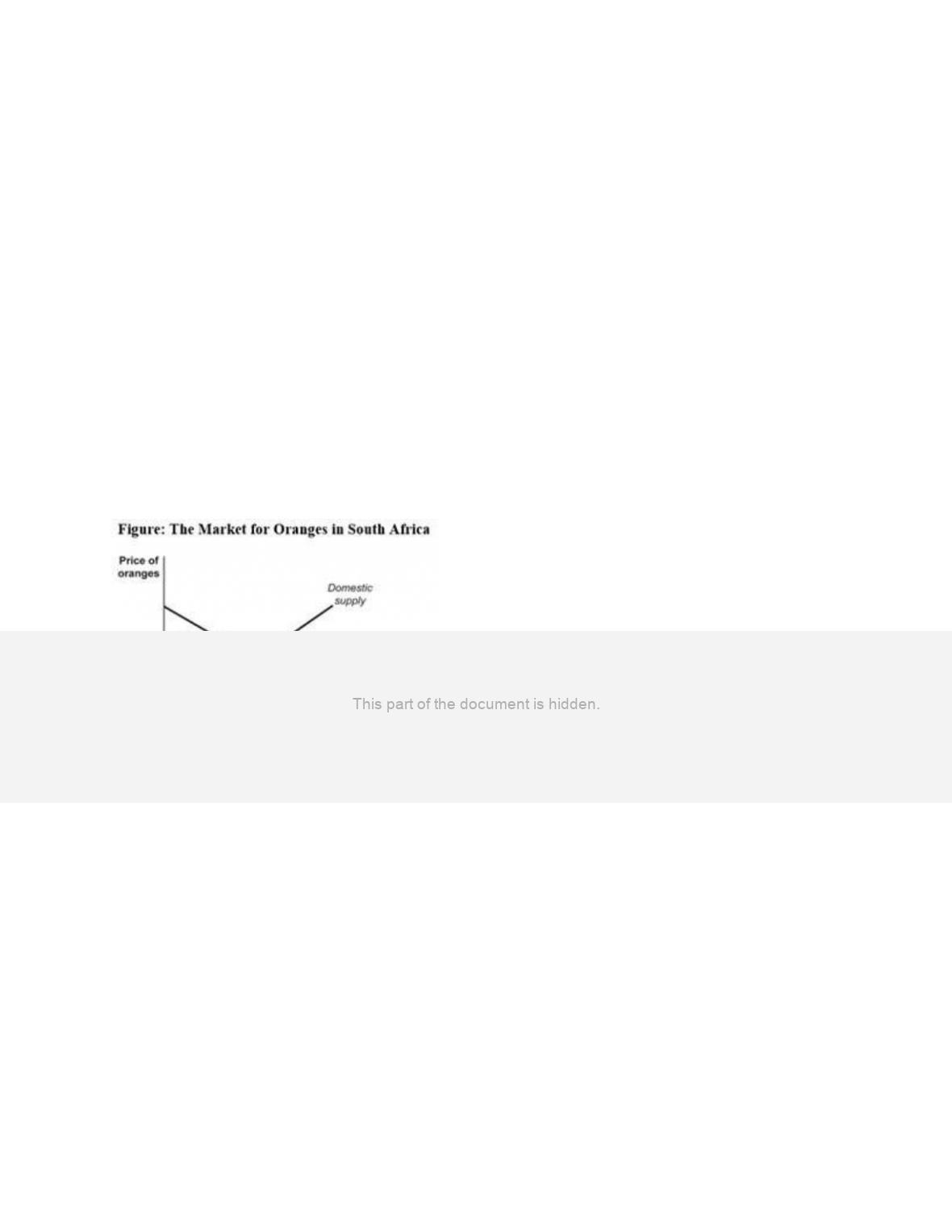
(Figure: The Market for Oranges in South Africa) Use Figure: The Market for Oranges
in South Africa. In autarky, the price of oranges in South Africa is P1. When the
economy is opened to trade, the price falls to PW. South Africa will _____ oranges, and
the volume of trade will equal _____.
A)
import; CT – QT
B)
export; CT – QT
C)
import; Q1 – QT
D)
export; CT – Q1

Page 27
103.
(Figure: The Market for Oranges in South Africa) Use Figure: The Market for Oranges
in South Africa. In autarky, the price of oranges in South Africa is P1. When the
economy is opened to trade, the price falls to PW and consumer surplus will _____ to
area _____.
A)
fall; M
B)
fall; M + N
C)
rise; M + N + O
D)
rise; M + N + O + P
104.
(Figure: The Market for Oranges in South Africa) Use Figure: The Market for Oranges
in South Africa. In autarky, the price of oranges in South Africa is P1. When the
economy is opened to trade, the price falls to PW and producer surplus will _____ to
area _____.
A)
fall; N + Q
B)
fall; Q
C)
rise; M + N + O + P
D)
rise; M + N + O + P + Q
105.
(Figure: The Market for Oranges in South Africa) Use Figure: The Market for Oranges
in South Africa. In autarky, the price of oranges in South Africa is P1. When the
economy is opened to trade, the price falls to PW and the change in total surplus is area:
A)
O.
B)
O + P.
C)
M + N + O + P.
D)
M + N + O + P + Q.
106.
The United States can produce wine domestically, but it can also import wine if the
world price is lower than the domestic price. If the United States imports wine,
consumer surplus will _____ by _____ the _____ in producer surplus; total surplus will
_____.
A)
increase; less than; decrease; decrease
B)
increase; the same amount as; decrease; stay constant
C)
decrease; less than; increase; increase
D)
increase; more than; decrease; increase
107.
Mexico produces lettuce but can also import it. If Mexico imports some lettuce:
A)
Mexico has a comparative advantage in lettuce production.
B)
the world price is lower than the domestic price.
C)
the price in Mexico will rise to equal the world price.
D)
the domestic quantity supplied will increase.
Page 28
Use the following to answer questions 108-110:
108.
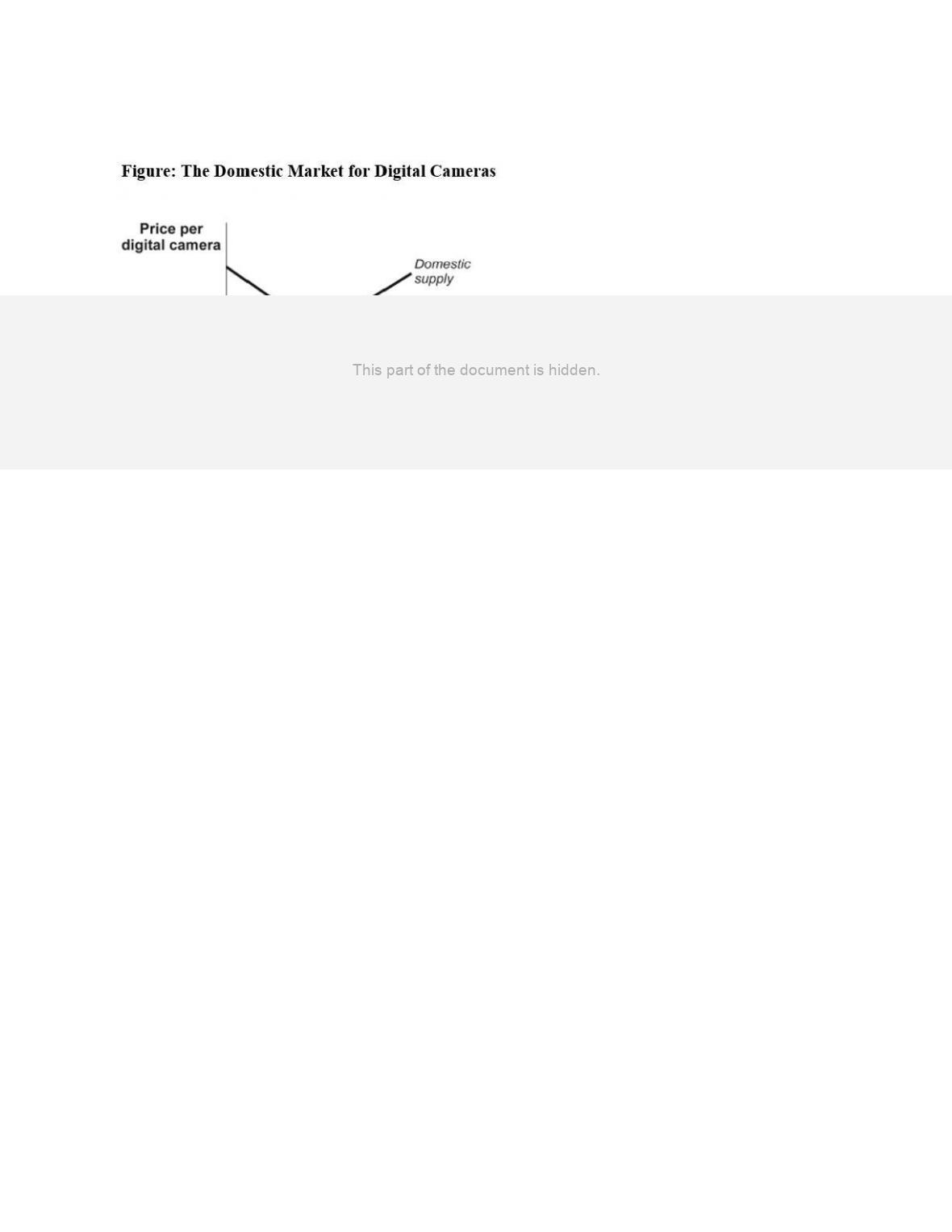
(Figure: Domestic Market for Digital Cameras) Use Figure: The Domestic Market for
Digital Cameras. Assume that PA is the autarky price and PW is the world price. Total
surplus before international trade is equal to the area:
A)
A + B + C.
B)
A + B.
C)
A + B – D – E.
D)
A.
109.
(Figure: Domestic Market for Digital Cameras) Use Figure: The Domestic Market for
Digital Cameras. Assume that PA is the autarky price and PW is the world price.
Consumer surplus after international trade is equal to the area:
A)
A.
B)
A + B.
C)
A + B + D + E.
D)
A + B + D + E – C.
110.
(Figure: Domestic Market for Digital Cameras) Use Figure: The Domestic Market for
Digital Cameras. Assume that PA is the autarky price and PW is the world price. Total
surplus after international trade _____ by the area _____.
A)
rises; B + D + E
B)
falls; C
C)
rises; C
D)
rises; D + E
Page 29
111.
A blockade at the border between the United States and Canada prevents the entry of all
lumber products to the United States from Canada. This blockade will:
A)
increase the consumer surplus for American lumber consumers.
B)
decrease the producer surplus for Canadian lumber producers.
C)
increase the total surplus for the American lumber market.
D)
increase the total surplus for the Canadian lumber market.
Use the following to answer questions 112-116:
112.
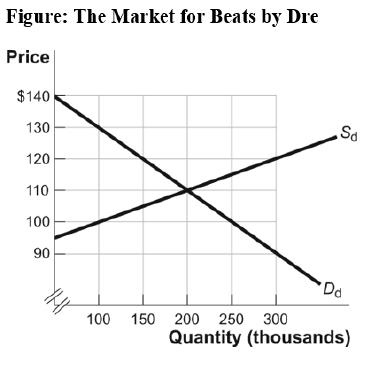
(Figure: The Market for Beats by Dre) Use Figure: The Market for Beats by Dre.
Assume that Sd represents the domestic supply curve and Dd represents the domestic
demand curve. In the market for Beats by Dre, the autarky price equals:
A)
$140.
B)
$120.
C)
$110.
D)
$100.
113.
(Figure: The Market for Beats by Dre) Use Figure: The Market for Beats by Dre.
Assume that Sd represents the domestic supply curve and Dd represents the domestic
demand curve. If the world price equals $100 and there is free trade, this country:
A)
will import 150,000 Beats by Dre.
B)
will export 150,000 Beats by Dre.
C)
has a domestic supply equal to 250,000 Beats by Dre.
D)
has a domestic demand equal to 100,000 Beats by Dre.
Page 30
114.
(Figure: The Market for Beats by Dre) Use Figure: The Market for Beats by Dre.
Assume that Sd represents the domestic supply curve and Dd represents the domestic
demand curve. If the world price equals $100 and there is free trade, domestic consumer
surplus _____ and domestic producer surplus _____ compared with autarky.
A)
increases; decreases
B)
increases; increases
C)
decreases; increases
D)
decreases; decreases
115.
(Figure: The Market for Beats by Dre) Use Figure: The Market for Beats by Dre.
Assume that Sd represents the domestic supply curve and Dd represents the domestic
demand curve. If the world price equals $100 and there is free trade, what is the gain in
consumer surplus?
A)
$5 million
B)
$2.5 million
C)
$2.25 million
D)
$750,000
116.
(Figure: The Market for Beats by Dre) Use Figure: The Market for Beats by Dre. If the
world price equals $100 and there is free trade, producer surplus:
A)
gains $1.5 million.
B)
gains $2 million.
C)
gains $750,000.
D)
falls.
Use the following to answer questions 117-119:
Page 31
117.
(Figure: The Market for iPhones) Use Figure: The Market for iPhones. Assume that PA
is the autarky price, PW is the world price, and D and S represent domestic demand and
supply, respectively. Consumer surplus in free trade equals the area:
A)
A.
B)
A + B + C.
C)
A + B + C + D.
D)
A + B.
118.
(Figure: The Market for iPhones) Use Figure: The Market for iPhones. Assume that PA
is the autarky price, PW is the world price, and D and S represent domestic demand and
supply, respectively. Producer surplus in free trade equals the area:
A)
B + C.
B)
B + C + D +E.
C)
B + E.
D)
E.
119.
(Figure: The Market for iPhones) Use Figure: The Market for iPhones. Assume that PA
is the autarky price, PW is the world price, and D and S represent domestic demand and
supply, respectively. The loss of producer surplus when the market moves from autarky
to free trade equals the area:
A)
B.
B)
B + C + D +E.
C)
B + C + D.
D)
E.
Use the following to answer questions 120-122:
Page 32
120.
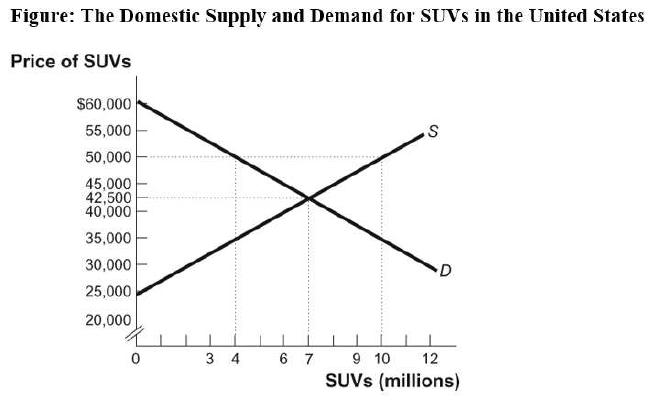
(Figure: The Domestic Supply and Demand for SUVs in the United States) Use Figure:
The Domestic Supply and Demand for SUVs in the United States. Suppose the world
price equals $50,000 and there is free trade. The United States would _____ SUVs.
A)
import 6 million
B)
export 6 million
C)
export 2 million
D)
import 2 million
121.
(Figure: The Domestic Supply and Demand for SUVs in the United States) Use Figure:
The Domestic Supply and Demand for SUVs in the United States. Suppose the world
price equals $50,000 and there is free trade. In the United States, consumer surplus
would _____ and producer surplus would _____.
A)
increase; decrease
B)
increase; increase
C)
decrease; decrease
D)
decrease; increase
122.
(Figure: The Domestic Supply and Demand for SUVs in the United States) Use Figure:
The Domestic Supply and Demand for SUVs in the United States. Suppose the world
price equals $50,000 and there is free trade. Calculate the loss of consumer surplus.
A)
$41,250 million
B)
$30,000 million
C)
$52,500 million
D)
$22,250 million
Use the following to answer questions 123-124:
Page 33
123.
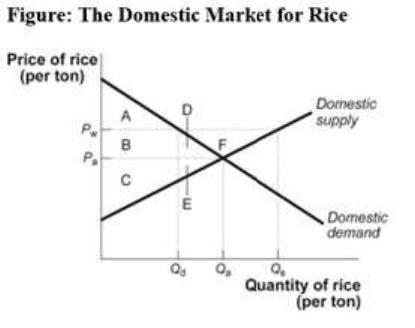
(Figure: The Domestic Market for Rice) Use Figure: The Domestic Market for Rice.
Assume that PA is the autarky price and PW is the world price. Before international trade,
consumer surplus is equal to the area:
A)
A.
B)
A + B.
C)
A + B + C.
D)
A + B + D.
124.
(Figure: The Domestic Market for Rice) Use Figure: The Domestic Market for Rice.
Assume that PA is the autarky price and PW is the world price. After international trade,
this nation will _____ a quantity of rice equal to _____.
A)
import; Qs – Qd
B)
export; Qs – Qd
C)
export; Qs – Qa
D)
import; Qa – Qd
125.
If a country’s price for wood furniture in the absence of trade is lower than the price
with trade, the country will likely:
A)
import wooden furniture.
B)
export wooden furniture.
C)
have absolute advantage in wooden furniture production.
D)
have a surplus of wooden furniture.
126.
If a country’s price in the absence of trade is lower than the price with trade, then the
domestic quantity supplied with trade is _____ the domestic quantity demanded.
A)
greater than
B)
less than
C)
equal to
D)
not comparable to
127.
If a country has the comparative advantage in producing cloth, in the market for cloth
the autarky price would be _____ the world price and the country would _____ cloth.
A)
less than; export
B)
greater than; export
C)
less than; import
D)
the same as; export
Page 34
128.
If a country has the comparative advantage in producing wooden furniture, then with
free trade:
A)
the country will import wooden furniture.
B)
producer surplus in the market for wooden furniture will increase.
C)
consumer surplus in the market for wooden furniture will increase.
D)
the domestic quantity supplied will be less than the domestic quantity demanded.
129.
Assume an economy moves from autarky to free international trade. In the export
sector, consumer surplus _____, producer surplus _____, and the economy as a whole
_____.
A)
rises; rises; gains
B)
rises; falls; gains
C)
falls; rises; gains
D)
falls; rises; loses
Use the following to answer questions 130-134:
130.
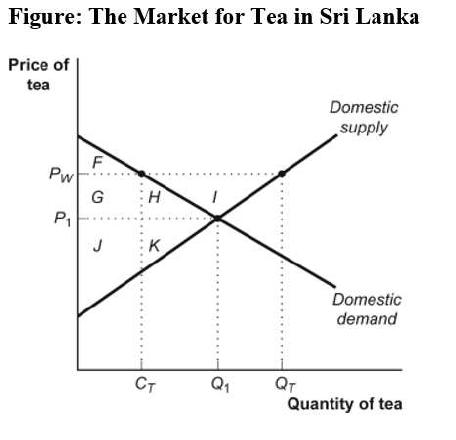
(Figure: The Market for Tea in Sri Lanka) Use Figure: The Market for Tea in Sri Lanka.
In autarky, the price is P1, consumer surplus equals _____ and producer surplus equals
_____.
A)
F + G + H + I; J + K
B)
F; G + H + I + J + K
C)
F + I; J + K
D)
F + G + H; J + K
Page 35
131.
(Figure: The Market for Tea in Sri Lanka) Use Figure: The Market for Tea in Sri Lanka.
In autarky, the price is P1. When the economy is opened to trade, the price rises to PW.
Sri Lanka will _____ tea and the volume of trade will equal _____.
A)
import; QT – CT
B)
export; QT – CT
C)
import; QT – Q1
D)
export; Q1 – CT
132.
(Figure: The Market for Tea in Sri Lanka) Use Figure: The Market for Tea in Sri Lanka.
In autarky, the price is P1. When the economy is opened to trade, the price rises to PW
and consumer surplus _____ to _____.
A)
falls; F
B)
falls; F + G
C)
rises; F + G + H + I
D)
rises; G + H + I
133.
(Figure: The Market for Tea in Sri Lanka) Use Figure: The Market for Tea in Sri Lanka.
In autarky, the price is P1. When the economy is opened to trade, the price rises to PW,
and producer surplus _____ to _____.
A)
falls; J + K
B)
falls; G + H + J + K
C)
rises; G + H + I + J + K
D)
rises; G + H + I
134.
(Figure: The Market for Tea in Sri Lanka) Use Figure: The Market for Tea in Sri Lanka.
In autarky, the price is P1. When the economy is opened to trade, the price rises to PW
and the change in total surplus is:
A)
I.
B)
G + H + I.
C)
G + H + I + J + K.
D)
F + G + H + I + J + K.
135.
When an economy moves from autarky to free international trade, for industries in the
export sector, consumer surplus _____, producer surplus _____, and the economy as a
whole _____.
A)
rises; rises; gains
B)
rises; falls; gains
C)
falls; rises; gains
D)
falls; rises; loses
Page 36
Use the following to answer questions 136-139:
136.
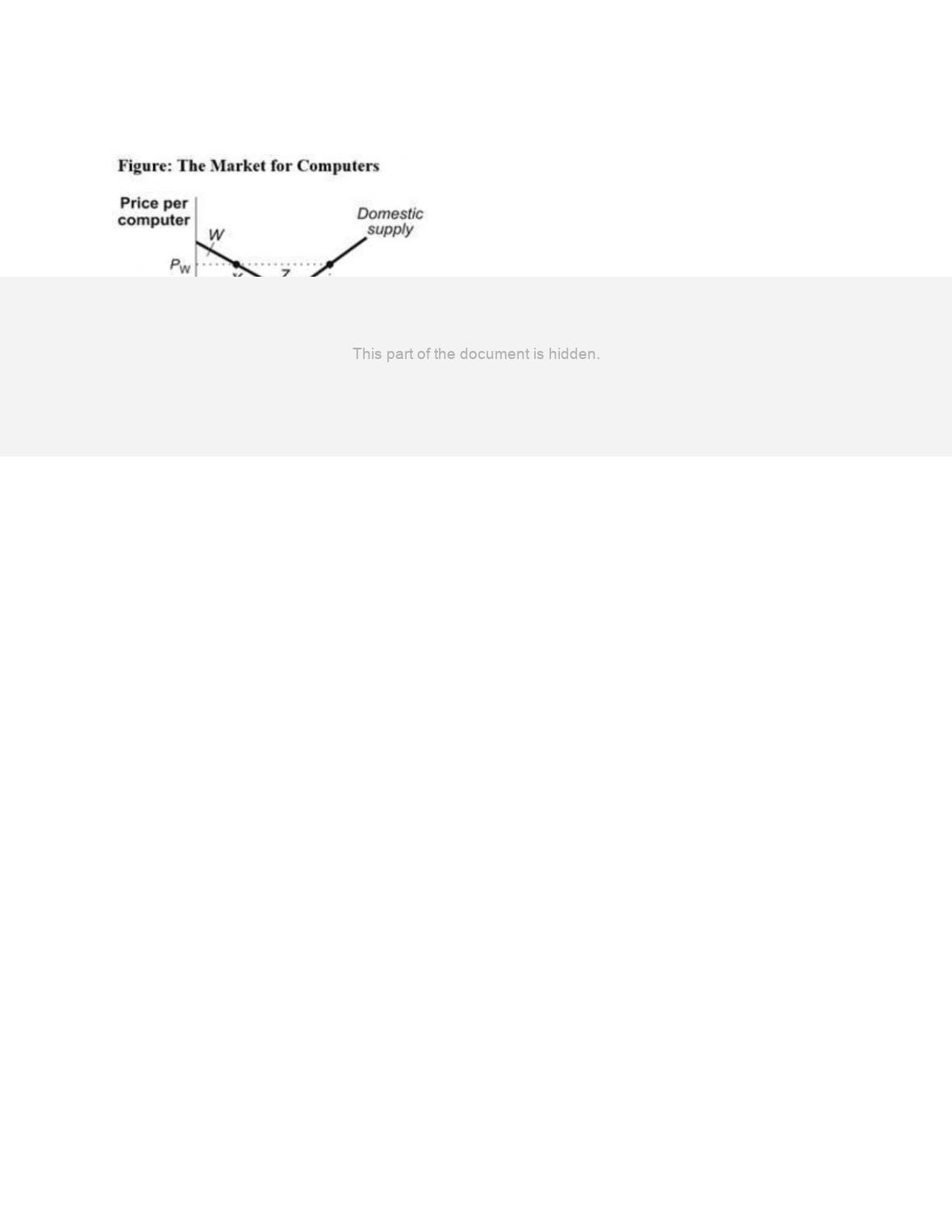
(Figure: The Market for Computers) Use Figure: The Market for Computers. Assume
that PA is the autarky price and PW is the world price. Consumer surplus without
international trade would be area:
A)
W + X + Y.
B)
W.
C)
Y.
D)
W + X.
137.
(Figure: The Market for Computers) Use Figure: The Market for Computers. Assume
that PA is the autarky price and PW is the world price. Consumer surplus with
international trade is area:
A)
W + X + Y.
B)
W.
C)
Y.
D)
W + X.
138.
(Figure: The Market for Computers) Use Figure: The Market for Computers. Assume
that PA is the autarky price and PW is the world price. Producer surplus without
international trade would be area:
A)
X + Y + Z.
B)
W + X + Y.
C)
X + Y.
D)
Y.
Page 37
139.
(Figure: The Market for Computers) Use Figure: The Market for Computers. Assume
that PA is the autarky price and PW is the world price. Producer surplus with
international trade would be area:
A)
X + Y + Z.
B)
W + X + Y.
C)
X + Y.
D)
Y.
140.
If a nation exports a good when the economy is opened to trade, relative to the autarky
price, the domestic price of the good will _____ and domestic consumption will _____.
A)
rise; rise
B)
rise; fall
C)
fall; rise
D)
fall; fall
141.
The effect of international trade on U.S. factor markets is to:
A)
increase the wage of highly educated workers.
B)
increase the wage of unskilled workers.
C)
decrease the wage of both highly educated workers and unskilled workers.
D)
increase the wage of both highly educated workers and unskilled workers.
142.
Since the United States imports a large quantity of textiles from Asia, the overall wages
of U.S. textile workers have _____, while the price of textiles in the United States has
_____.
A)
decreased; decreased
B)
increased; decreased
C)
decreased; increased
D)
increased; not changed
143.
If labor is abundant in South Africa but capital is scarce, when South Africa opens to
trade, the price of labor will _____ and the price of capital will _____.
A)
rise; rise
B)
fall; fall
C)
rise; fall
D)
fall; rise
Page 38
144.
If labor is scarce in Sri Lanka but capital is abundant, when Sri Lanka opens to trade,
the price of labor will _____ and the price of capital will _____.
A)
rise; rise
B)
fall; fall
C)
rise; fall
D)
fall; rise
145.
When a country exchanges goods with another country, in the short run:
A)
producers in the exporting industry may be better off.
B)
consumers of the imported good may be worse off.
C)
consumers of the exported good may be better off.
D)
producers in the importing industry are better off.
146.
In a single year, Argentina can raise 100 tons of beef or produce 1,000 boxes of tulips.
In the same growing season, Venezuela can raise 50 tons of beef or produce 750 boxes
of tulips. When the two countries begin trading beef for tulips, we expect the price of
beef in Argentina:
A)
to fall.
B)
to rise.
C)
to remain at the autarky price.
D)
to be 10 boxes of tulips.
147.
In a single year, Argentina can raise 100 tons of beef or produce 1,000 boxes of tulips.
In the same growing season, Venezuela can raise 50 tons of beef or produce 750 boxes
of tulips. When the two countries begin trading beef for tulips, we expect the total
surplus from beef consumption and production to:
A)
fall in Argentina.
B)
rise in Argentina.
C)
stay the same in Venezuela.
D)
either rise or fall in Venezuela.
148.
In a single year, Argentina can raise 100 tons of beef or produce 1,000 boxes of tulips.
In the same growing season, Venezuela can raise 50 tons of beef or produce 750 boxes
of tulips. When the two countries begin trading beef for tulips, we expect the price of
beef in Venezuela:
A)
to fall.
B)
to rise.
C)
to remain at the autarky price.
D)
to be 15 boxes of tulips.
Page 39
149.
In a single year, Argentina can raise 100 tons of beef or produce 1,000 boxes of tulips.
In the same growing season, Venezuela can raise 50 tons of beef or produce 750 boxes
of tulips. When the two countries begin trading beef for tulips, we expect the consumer
surplus from beef consumption to:
A)
fall in Argentina.
B)
rise in Argentina.
C)
stay the same in Argentina.
D)
either rise or fall in Argentina.
150.
When a market begins to engage in international trade:
A)
producers in the exporting industry may be better off.
B)
consumers of the imported good may be worse off.
C)
consumers of the exported good may be better off.
D)
producers in the importing industry are better off.
151.
If a market begins to engage in international trade, we can assume that:
A)
producers in the exporting industry may be worse off.
B)
consumers of the imported good may be worse off.
C)
consumers of the exported good may be better off.
D)
producers in the importing industry may be worse off.
152.
Compared with autarky, international trade leads to _____ domestic production in
exporting industries and _____ domestic production in import-competing industries.
A)
higher; lower
B)
higher; higher
C)
lower; higher
D)
lower; lower
153.
Policies that limit imports, usually to insulate domestic producers from foreign
competition, are known as:
A)
import-competing clauses.
B)
import reduction acts.
C)
trade protection.
D)
competition protection.
Page 40
154.
Restrictions on free international trade designed to insulate domestic industries from
competitive market forces that originate beyond the borders of the country are _____
policies.
A)
competitive
B)
protectionist
C)
free-trade
D)
antitrust
Use the following to answer questions 155-157:
155.
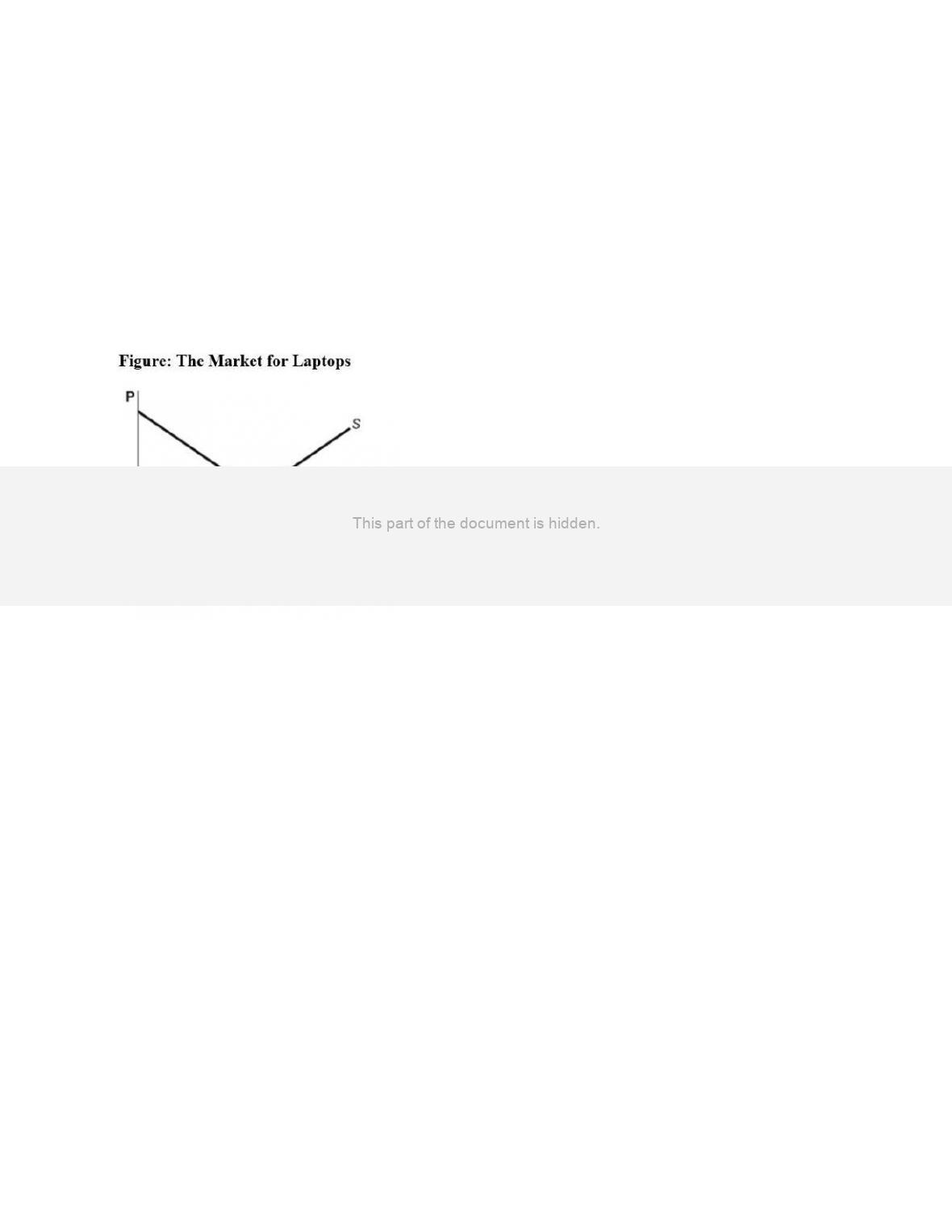
(Figure: The Market for Laptops) Use Figure: The Market for Laptops. Assume that S
and D are the domestic supply and demand curves and the world price is PW. Identify
the area of consumer surplus when a tariff raises the domestic price from the world price
to PT.
A)
A + B
B)
A + B + C + D + E + F
C)
A + C + G
D)
D + F
156.
(Figure: The Market for Laptops) Use Figure: The Market for Laptops. Assume that S
and D are the domestic supply and demand curves and the world price is PW. Identify
the area of deadweight loss when a tariff raises the domestic price from the world price
to PT.
A)
A + B
B)
C + D + E + F
C)
D + E + F
D)
D + F