Page 1
Name: __________________________ Date: _____________
1.
Goods and services purchased from abroad are _____, while goods and services sold
abroad are _____.
A)
always been positive.
B)
always been negative.
C)
shown an increase in exports as a ratio of world production since 2005.
D)
shown occasional declines but has generally remained positive.
2.
As measured by a percentage of the entire economic output:
A)
foreign trade is just as important for the United States as it is for most other
countries.
B)
foreign trade is more important for the United States than it is for most other
countries.
C)
foreign trade is less important for the United States than it is for many other
countries.
D)
the United States ranks highest in the world.
3.
France and England both produce wine and clothing with constant opportunity costs.
France will have a comparative advantage in wine production if:
A)
it can produce more wine than England.
B)
its labor productivity in wine production is greater than England’s.
C)
the absolute cost of producing wine is lower in France than in England.
D)
the opportunity cost of wine production is lower in France than in England.
4.
In a single year, the Netherlands can raise 100 tons of beef or produce 1,000 boxes of
tulips. In the same growing season, Belgium can raise 50 tons of beef or produce 750
boxes of tulips. From this information, we know that:
A)
the Netherlands has a comparative advantage in raising beef.
B)
the Netherlands has a comparative advantage in raising tulips.
C)
Belgium has a comparative advantage in raising beef.
D)
Belgium has an absolute advantage in raising beef.
5.
In a Ricardian model of international trade, the production possibility frontiers are
_____, indicating that the opportunity cost of increasing the production of one item
relative to another _____.
A)
convex; is constant
B)
concave; increases
C)
straight lines; is constant
D)
straight lines; decreases

Page 2
6.
France and England both produce wine and cloth with constant opportunity costs.
France can produce 150 barrels of wine if it produces no cloth or 100 bolts of cloth if it
produces no wine. England can produce 50 barrels of wine if it produces no cloth or 100
bolts of cloth if it produces no wine. Using this information, we can conclude that:
A)
France has a comparative advantage in cloth production.
B)
England has a comparative advantage in cloth production.
C)
France has a comparative advantage in both goods.
D)
mutually beneficial international trade is not possible.
7.
In a single year, the Netherlands can raise 100 tons of beef or produce 1,000 boxes of
tulips. In the same growing season, Belgium can raise 50 tons of beef or produce 750
boxes of tulips. In autarky, the opportunity cost of beef:
A)
is higher in the Netherlands than in Belgium.
B)
is lower in the Netherlands than in Belgium.
C)
is the same in the Netherlands as in Belgium.
D)
cannot be determined in either country.
8.
In a single year, the Netherlands can raise 100 tons of beef or produce 1,000 boxes of
tulips. In the same growing season, Belgium can raise 50 tons of beef or produce 750
boxes of tulips. In autarky, the opportunity cost of 1 ton of beef in the Netherlands is:
A)
100 tons of beef.
B)
1,000 boxes of tulips.
C)
10 boxes of tulips.
D)
0.1 box of tulips.
9.
Production possibility frontiers:
A)
illustrate the production choices available to an economy.
B)
assume full employment but not maximum efficiency.
C)
assume maximum efficiency but not full employment.
D)
are used to illustrate the law of decreasing opportunity costs.
10.
The absolute value of the slope of the production possibility frontier at any point:
A)
gives the autarky price of the good on the vertical axis.
B)
is found by dividing the horizontal change by a vertical change.
C)
gives the quantity of the good on the vertical axis that must be given up to produce
an additional unit of the good on the horizontal axis.
D)
gives the autarky price of the good on the horizontal axis relative to the autarky
price of the good on the vertical axis.
Page 3
11.
Britain must give up the production of 75 hats to produce 25 additional sweaters. The
opportunity cost of producing 3 hats is _____ sweater(s).
A)
1
B)
3
C)
22
D)
28
12.
Britain must give up the production of 75 hats to produce 25 additional sweaters. The
opportunity cost of producing 4 sweaters is _____ hats.
A)
4
B)
12
C)
71
D)
79
13.
The United States must give up the production of 500 bicycles to produce 20 additional
tractors. The opportunity cost of producing 100 bicycles is _____ tractor(s).
A)
1
B)
4
C)
25
D)
100
14.
The United States must give up the production of 500 bicycles to produce 20 additional
tractors. The opportunity cost of producing 5 tractors is _____ bicycles.
A)
5
B)
20
C)
100
D)
125
15.
On a production possibility frontier, opportunity cost is:
A)
the decrease in the output of one good when the output of the other good is
increased.
B)
the rate at which people are willing to exchange goods as determined by demand
and supply.
C)
the dollar cost of the good given up to get another good.
D)
independent of the slope of the curve.

Page 4
16.
(Table: The Production Possibilities for Cars and Leather Boots) Use Table: The
Production Possibilities for Cars and Leather Boots. Given the opportunity costs of
production:
A)
there is no basis for trade.
B)
Mexico should specialize in boots.
C)
the United States should specialize in cars.
D)
the United States should specialize in both goods, and Mexico should not produce
either good.
17.
(Table: The Production Possibilities for Cars and Leather Boots) Use Table: The
Production Possibilities for Cars and Leather Boots. The opportunity cost of producing
one car in Mexico is:
A)
500 pairs of leather boots.
B)
1,000 pairs of leather boots.
C)
different from the opportunity cost in the United States.
D)
2,000 pairs of leather boots, which is the same as in the United States.
18.
The _____ model analyzes trade under the assumption that opportunity costs are
constant and therefore production possibility frontiers are straight lines.
A)
pauper labor fallacy
B)
Ricardian
C)
Heckscher-Ohlin
D)
oligopoly
19.
If the opportunity costs of production are constant, then the production possibility
frontier is:
A)
bowed out from the origin.
B)
bowed in toward the origin.
C)
a straight line.
D)
circular.
20.
The term autarky refers to a situation when a country:
A)
trades goods and services based on the principle of comparative advantage.
B)
trades goods and services based on the principle of absolute advantage.
C)
trades goods and services based on the principle of Ricardian advantage.
D)
does not trade with other countries.

Page 5
21.
Japan must give up the production of 75 computers to produce 25 additional cellular
telephones. The opportunity cost of producing 3 computers is _____ cell phone(s).
A)
1
B)
3
C)
22
D)
28
22.
If Japan must give up the production of 75 computers to produce 25 additional cellular
telephones, the opportunity cost of producing 4 cellular telephones is _____ computers.
A)
4
B)
12
C)
71
D)
79
23.
The United States must give up the production of 300 motorcycles to produce 15
additional SUVs with the same resources. The opportunity cost of producing 100
motorcycles is _____ SUV(s).
A)
1
B)
5
C)
7
D)
15
24.
The United States must give up the production of 300 motorcycles to produce 20
additional SUVs with the same resources. In this case, the opportunity cost of producing
5 SUVs is ________ motorcycles.
A)
5
B)
20
C)
100
D)
75
Use the following to answer questions 25-30:

Page 6
25.
(Table: Production Possibilities for Machinery and Petroleum) Use Table: Production
Possibilities for Machinery and Petroleum. The opportunity cost of _____ is _____ in
the United States as (than) in Mexico.
A)
petroleum; less
B)
petroleum; more
C)
petroleum; the same
D)
machinery; the same
26.
(Table: Production Possibilities for Machinery and Petroleum) Use Table: Production
Possibilities for Machinery and Petroleum. The opportunity cost of _____ is _____ in
the United States as (than) in Mexico.
A)
machinery; more
B)
machinery; the same
C)
machinery; less
D)
petroleum; less
27.
(Table: Production Possibilities for Machinery and Petroleum) Use Table: Production
Possibilities for Machinery and Petroleum. In the United States the opportunity cost of
producing 40 units of machinery is _____ units of petroleum.
A)
80
B)
60
C)
40
D)
20
28.
(Table: Production Possibilities for Machinery and Petroleum) Use Table: Production
Possibilities for Machinery and Petroleum. The opportunity cost in the United States of
producing 30 units of petroleum is _____ units of machinery.
A)
60
B)
80
C)
100
D)
120
29.
(Table: Production Possibilities for Machinery and Petroleum) Use Table: Production
Possibilities for Machinery and Petroleum. The opportunity cost in Mexico of producing
10 units of machinery is _____ units of petroleum.
A)
30
B)
90
C)
180
D)
270
Page 7
30.
(Table: Production Possibilities for Machinery and Petroleum) Use Table: Production
Possibilities for Machinery and Petroleum. The opportunity cost in Mexico of producing
105 units of petroleum is _____ units of machinery.
A)
35
B)
70
C)
90
D)
160
31.
Countries that engage in trade will tend to specialize in goods in which they have a(n)
_____ and will _____ those goods.
A)
comparative advantage; import
B)
absolute advantage; export
C)
comparative advantage; export
D)
economic profit; import
32.
Taken collectively, people in nations that engage in international trade are NOT likely
to:
A)
consume more than they were able to consume in the absence of trade.
B)
raise their standards of living.
C)
gain from lower opportunity costs of production.
D)
be made worse off.
33.
In a single year, the Netherlands can raise 100 tons of beef or produce 1,000 boxes of
tulips. In the same growing season, Belgium can raise 50 tons of beef or produce 750
boxes of tulips. Trade will take place between these two countries if 1 ton of beef costs
_____ boxes of tulips.
A)
20
B)
5
C)
12
D)
8

Page 8
34.
France and England both produce wine and cloth with constant opportunity costs.
France can produce 150 barrels of wine if it produces no cloth or 100 bolts of cloth if it
produces no wine. England can produce 50 barrels of wine if it produces no cloth or 150
bolts of cloth if it produces no wine. When international trade takes place, each country
specializes completely in the production of the good in which it has a comparative
advantage: 1 barrel of wine exchanges for 1 bolt of cloth and France exports 50 units of
wine. We can conclude that France produces _____ units of wine and _____ units of
cloth and that France consumes _____ units of wine and _____ units of cloth.
A)
150; 100; 100; 100
B)
150; 0; 100; 50
C)
150; 0; 50; 50
D)
0; 100; 50; 50
35.
If the United States can produce 30 computers for every car it produces and Japan can
produce 15 computers for every car it produces, _____ has the _____ advantage in car
production.
A)
the United States; comparative
B)
Japan; comparative
C)
the United States; absolute
D)
Japan; absolute
36.
The United States can produce 30 computers for every car it produces, and Japan can
produce 15 computers for every car it produces. Based on this information, which
statement is INCORRECT?
A)
The United States should specialize in computer production.
B)
Japan has the comparative advantage in car production.
C)
There will be gains from trade if the United States exports computers to Japan.
D)
Japan has an absolute advantage in car production.
37.
The belief that trade must be bad for exporting countries because the foreign workers
are paid very low wages by our standards is the _____ fallacy.
A)
pauper labor
B)
sweatshop labor
C)
third-world country
D)
Nike

Page 9
38.
Saudi Arabia has a tremendous comparative advantage in petroleum. Which factor is a
source of this comparative advantage?
A)
mild temperatures
B)
large reserves of crude oil
C)
no opportunity cost associated with oil production
D)
high tariffs on oil from other nations
39.
Lower wages in China reflect _____ labor productivity in China than in the United
States. This means that if the United States moved high-tech industries to China, the
overall cost of production would be _____ in China than in the United States.
A)
lower; higher
B)
lower; lower
C)
higher; higher
D)
higher; lower
40.
According to the Heckscher-Ohlin model, Brazil will have a comparative advantage in
oranges if the factors that are _____ in the production of oranges are _____.
A)
intensive; abundant
B)
intensive; imported
C)
scarce; imported
D)
intensive; inexpensive
41.
China, which is labor-abundant, has a comparative advantage in clothing production,
which is labor-intensive. Which model explains this pattern of comparative advantage?
A)
the Ricardian model
B)
a model of increasing returns
C)
the Heckscher-Ohlin model
D)
a model of autarky
42.
Bangladesh exports shirts, the making of which is labor-intensive, to the United States.
The likely source of Bangladesh’s comparative advantage in shirts is:
A)
a hotter climate, which makes it possible to produce shirts outdoors, eliminating the
need for factory buildings and hence reducing costs.
B)
superior production technology.
C)
that, in comparison with the United States, Bangladesh is a labor-abundant country.
D)
the higher labor productivity in Bangladesh.

Page 10
43.
An urbanized country has 100 million workers living on 100 square miles of land. A
country that is principally rural has 1 million workers living on 10 square miles of land.
From this information we know that the urbanized country is _____ relative to the rural
country.
A)
land-abundant
B)
labor-abundant
C)
land-intensive
D)
labor-intensive
44.
Which trade pattern is BEST explained by increasing returns?
A)
Honduras exports bananas to the United States, and the United States exports
airplanes to Honduras.
B)
Pakistan exports clothing to the United States, and the United States exports
airplanes to Pakistan.
C)
Japan exports cars to the United States, and the United States exports airplanes to
Japan.
D)
Mexico exports beef to the United States, and the United States exports airplanes to
Mexico.
45.
If the _____ differ(s) between two countries, this suggests the possibility for mutually
advantageous trade.
A)
currency
B)
factor endowments
C)
exchange rate
D)
level of government spending for defense
46.
Chile has a comparative advantage over the United States in copper. Which factor is a
source of this comparative advantage?
A)
mild temperatures
B)
large deposits of copper ore
C)
no opportunity cost associated with copper production
D)
high tariffs on copper from other nations
47.
Mexico is relatively labor-abundant when compared with the United States. Therefore,
Mexico has a comparative advantage in _____ compared with the United States.
A)
all goods
B)
goods that are labor-intensive in production
C)
goods that are capital-intensive in production
D)
goods that are land-intensive in production

Page 11
48.
Which model states that nations that are abundant in a factor will have a comparative
advantage in a good whose production is intensive in that factor?
A)
the pauper labor fallacy model
B)
the Ricardian model
C)
the Heckscher-Ohlin model
D)
the oligopoly model
49.
Sri Lanka’s comparative advantage over the United States in textiles can be explained by
its:
A)
labor abundance.
B)
mild climate.
C)
advanced technology.
D)
increasing returns.
50.
Japan’s comparative advantage in automobiles can be attributed to:
A)
climate.
B)
factor endowments.
C)
technology.
D)
exchange rates.
51.
Both the United States and Canada produce automobiles and their components;
however, each particular model or component is produced in only one of the two
countries. Which factor explains this pattern of production and trade?
A)
differences in climate
B)
differences in factor endowments
C)
differences in technology
D)
the role of increasing returns
52.
Honduras exports clothing to the United States, and the United States exports bulldozers
to Honduras. Proponents of the Heckscher-Ohlin model would explain this pattern of
trade by stating that:
A)
Honduras has an advantage in the technology used in clothing production, while
the United States has an advantage in the technology used in bulldozer production.
B)
Honduras’s climate is more conducive to producing clothing, while the United
States’ climate is more conducive to producing bulldozers.
C)
Honduras has a relatively large endowment of factors of production for making
clothing, while the United States has a relatively large endowment of factors of
production for making bulldozers.
D)
Honduras has a factor intensity in capital and the United States has a factor
intensity in labor.
Page 12
53.
Which statement does NOT describe a source of comparative advantage?
A)
In general, France has absolute advantage over Italy in production of goods and
services.
B)
The United States’ technology for computer chip design is more advanced than
India’s.
C)
Hawaii has a more favorable climate to grow pineapple than does Italy.
D)
In the market for lumber, Canada has many more trees than does England.
Use the following to answer questions 54-58:
54.
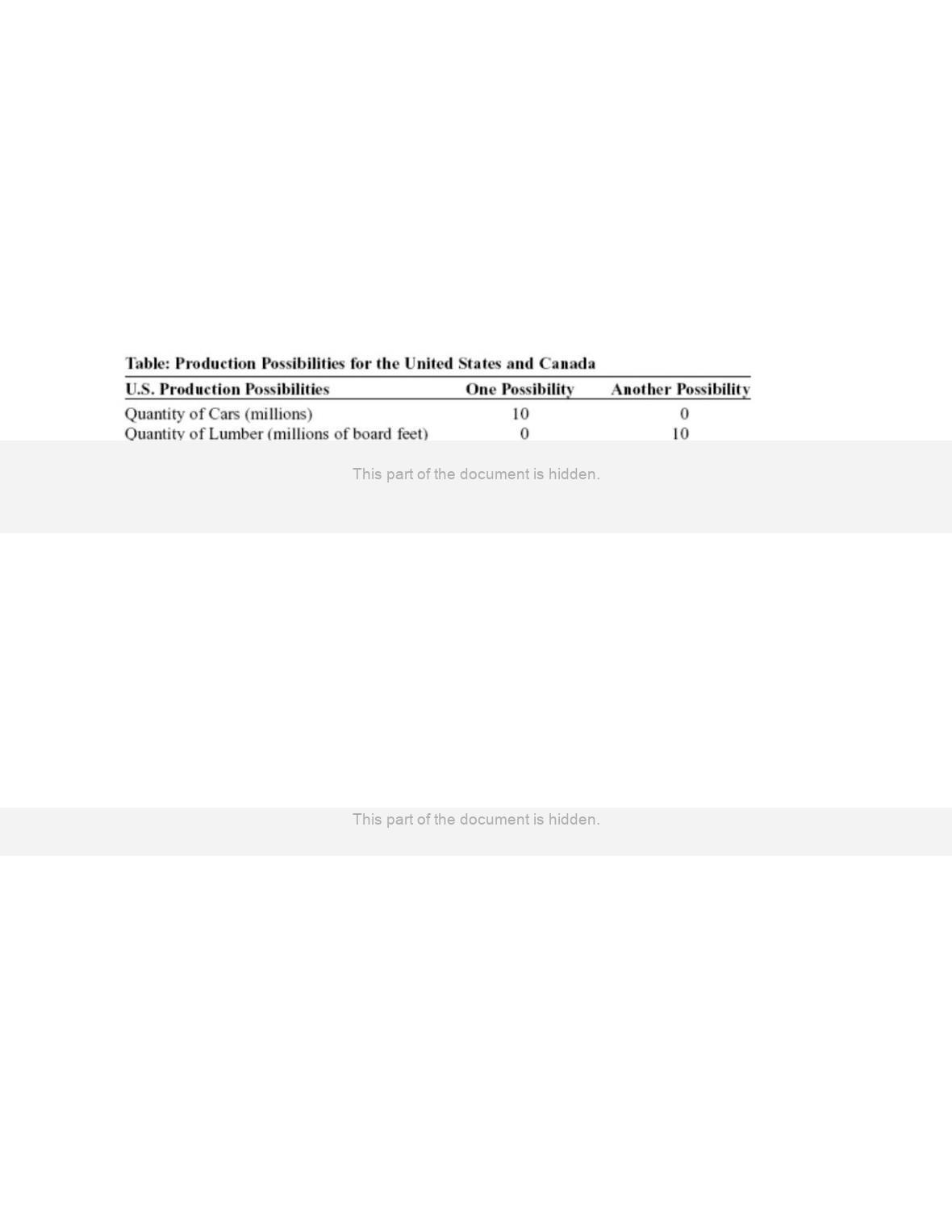
(Table: Production Possibilities for the United States and Canada) Use Table:
Production Possibilities for the United States and Canada. Both nations can produce cars
and lumber. In _____, the opportunity cost of _____ cars is _____ board feet of lumber.
A)
the United States; 1 million; 10 million
B)
the United States; 10 million; 1 million
C)
Canada; 1 million; 6 million
D)
Canada; 1 million; 166,000
55.
(Table: Production Possibilities for the United States and Canada) Use Table:
Production Possibilities for the United States and Canada. Both nations can produce cars
and lumber. If these nations trade, Canada has the comparative advantage in _____ and
should trade _____ to the United States in exchange for _____.
A)
cars; cars; lumber.
B)
lumber; lumber; cars
C)
lumber; cars; lumber
D)
cars; lumber; cars
Page 13
56.
(Table: Production Possibilities for the United States and Canada) Use Table:
Production Possibilities for the United States and Canada. Both nations can produce cars
and lumber. If these nations were to specialize and trade, the United States would
benefit from trade by exporting 1 million cars to Canada in exchange for _____ million
board feet of lumber.
A)
2
B)
0.5
C)
0.7
D)
1
57.
(Table: Production Possibilities for the United States and Canada) Use Table:
Production Possibilities for the United States and Canada. _____ has/have an absolute
advantage in producing cars.
A)
Both the United States and Canada
B)
Neither the United States nor Canada
C)
The United States
D)
Canada
58.
(Table: Production Possibilities for the United States and Canada) Use Table:
Production Possibilities for the United States and Canada. _____ has/have an absolute
advantage in producing lumber.
A)
Both the United States and Canada
B)
Neither the United States nor Canada
C)
The United States
D)
Canada
Use the following to answer questions 59-66:

59.
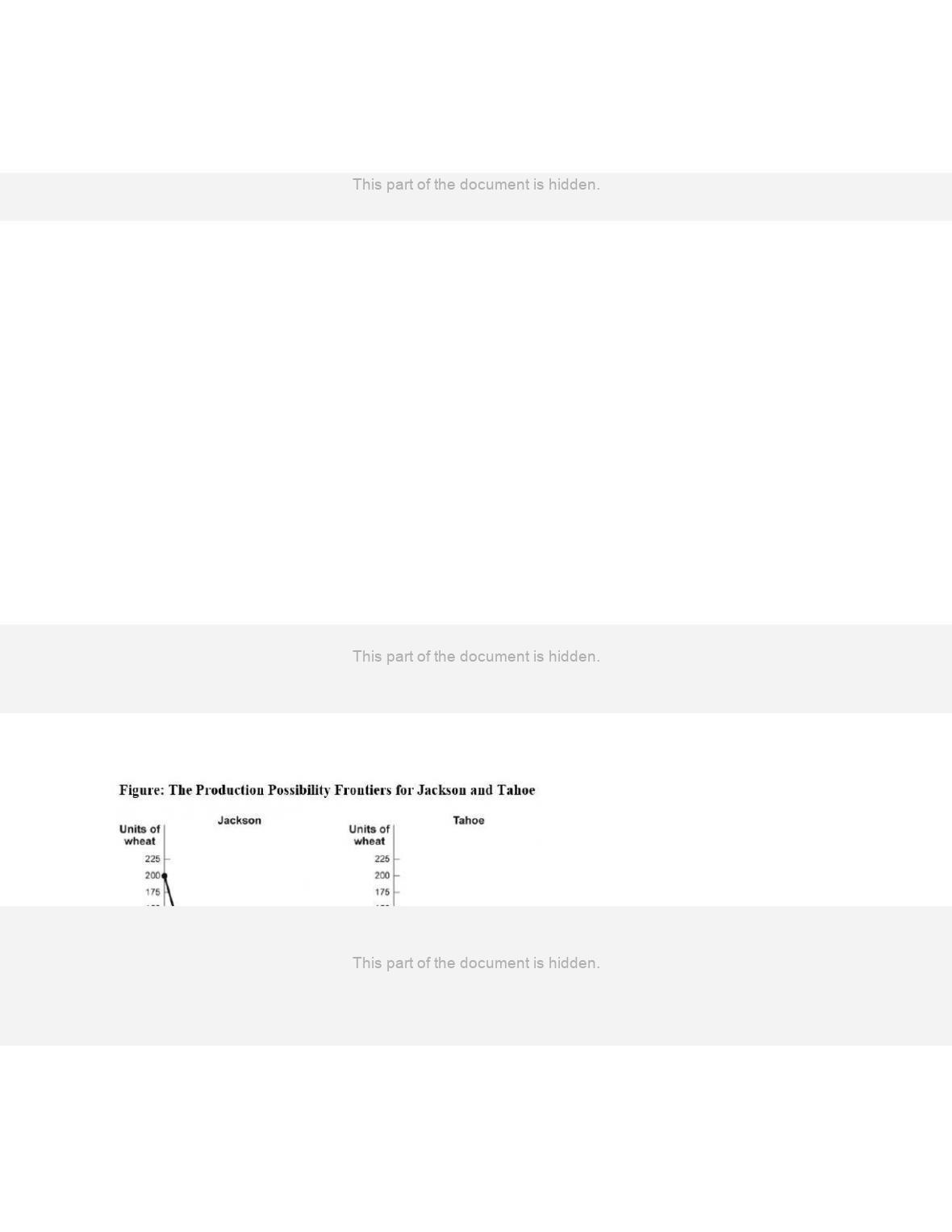
(Figure: The Production Possibility Frontiers for Jackson and Tahoe) Use Figure: The
Production Possibility Frontiers for Jackson and Tahoe. In autarky, Jackson produces
and consumes 30 head of cattle and 80 bushels of wheat, while Tahoe produces and
consumes 80 head of cattle and 60 bushels of wheat. _____ has a(n) _____ advantage in
the production of _____.
A)
Jackson; comparative; cattle
B)
Tahoe; comparative; wheat
C)
Jackson; comparative; wheat
D)
Jackson; absolute; cattle
60.
(Figure: The Production Possibility Frontiers for Jackson and Tahoe) Use Figure: The
Production Possibility Frontiers for Jackson and Tahoe. In autarky, Jackson produces
and consumes 30 head of cattle and 80 bushels of wheat, while Tahoe produces and
consumes 80 head of cattle and 60 bushels of wheat. With complete specialization
according to comparative advantage, the two nations’ combined production of wheat
will:
A)
remain constant.
B)
increase by 120 bushels.
C)
increase by 60 bushels.
D)
decrease by 60 bushels.
61.
(Figure: The Production Possibility Frontiers for Jackson and Tahoe) Use Figure The
Production Possibility Frontiers for Jackson and Tahoe. In autarky, Jackson produces
and consumes 30 head of cattle and 80 bushels of wheat, while Tahoe produces and
consumes 80 head of cattle and 60 bushels of wheat. If both nations specialize
completely in the good of their comparative advantage and Jackson exports 120 bushels
of wheat to Tahoe in exchange for 60 head of cattle, then the new consumption point for
Jackson after trade is _____ bushels of wheat and _____ head of cattle.
A)
120; 30
B)
120; 60
C)
80; 60
D)
200; 100

62.
(Figure: The Production Possibility Frontiers for Jackson and Tahoe) Use Figure: The
Production Possibility Frontiers for Jackson and Tahoe. In autarky, Jackson produces
and consumes 30 head of cattle and 80 bushels of wheat, while Tahoe produces and
consumes 80 head of cattle and 60 bushels of wheat. If the two countries engage in
international trade and specialize completely and if the price of 1 head of cattle equals
the price of 2 bushels of wheat, world production of cattle will:
A)
remain constant.
B)
increase by 90 head.
C)
increase by 120 head.
D)
decrease by 30 head.
63.
(Figure: The Production Possibility Frontiers for Jackson and Tahoe) Use Figure: The
Production Possibility Frontiers for Jackson and Tahoe. In autarky, Jackson produces
and consumes 30 head of cattle and 80 bushels of wheat, while Tahoe produces and
consumes 80 head of cattle and 60 bushels of wheat. Assume each nation specializes
completely, based on comparative advantage, and the price of 1 head of cattle equals the
price of 2 bushels of wheat. If Jackson exports 120 bushels of wheat to Tahoe, Tahoe
will export _____ head of cattle to Jackson.
A)
120
B)
60
C)
240
D)
200
64.
(Figure: The Production Possibility Frontiers for Jackson and Tahoe) Use Figure: The
Production Possibility Frontiers for Jackson and Tahoe. In autarky, Jackson produces
and consumes 30 head of cattle and 80 bushels of wheat, while Tahoe produces and
consumes 80 head of cattle and 60 bushels of wheat. Each nation specializes
completely, based on comparative advantage, and the price of 1 head of cattle equals the
price of 2 bushels of wheat. If Jackson exports 120 bushels of wheat to Tahoe, then the
new consumption point for Tahoe after trade is _____ bushels of wheat and _____ head
of cattle.
A)
120; 140
B)
120; 60
C)
60; 120
D)
400; 200

Page 16
65.
(Figure: The Production Possibility Frontiers for Jackson and Tahoe) Use Figure: The
Production Possibility Frontiers for Jackson and Tahoe. Jackson has an absolute
advantage in producing:
A)
wheat only.
B)
cattle only.
C)
both wheat and cattle.
D)
neither wheat nor cattle.
66.
(Figure: The Production Possibility Frontiers for Jackson and Tahoe) Use Figure: The
Production Possibility Frontiers for Jackson and Tahoe. Tahoe has an absolute
advantage in producing:
A)
wheat only.
B)
cattle only.
C)
both wheat and cattle.
D)
neither wheat nor cattle.
Use the following to answer questions 67-77:
67.
(Table: The Production Possibilities for Tractors and Crude Oil) Use Table: The
Production Possibilities for Tractors and Crude Oil. Which statement is TRUE?
A)
The opportunity cost of crude oil is lower in the United States than in Mexico.
B)
The opportunity cost of crude oil is higher in the United States than in Mexico.
C)
Crude oil costs are the same in the United States and in Mexico.
D)
Tractor costs are the same in the United States and in Mexico.
68.
(Table: The Production Possibilities for Tractors and Crude Oil) Use Table: The
Production Possibilities for Tractors and Crude Oil. The opportunity cost of _____ is
_____ in the United States as/than in Mexico.
A)
tractors; higher
B)
tractors; the same
C)
tractors; lower
D)
crude oil; lower

Page 17
69.
(Table: The Production Possibilities for Tractors and Crude Oil) Use Table: The
Production Possibilities for Tractors and Crude Oil. In the United States, the opportunity
cost of producing 40 tractors is _____ barrels of crude oil.
A)
80,000
B)
60,000
C)
40,000
D)
20,000
70.
(Table: The Production Possibilities for Tractors and Crude Oil) Use Table: The
Production Possibilities for Tractors and Crude Oil. In the United States, the opportunity
cost of producing 30,000 barrels of crude oil is _____ tractors.
A)
60
B)
80
C)
100
D)
120
71.
(Table: The Production Possibilities for Tractors and Crude Oil) Use Table: The
Production Possibilities for Tractors and Crude Oil. In Mexico, the opportunity cost of
producing 40 tractors is _____ barrels of crude oil.
A)
30,000
B)
90,000
C)
120,000
D)
270,000
72.
(Table: The Production Possibilities for Tractors and Crude Oil) Use Table: The
Production Possibilities for Tractors and Crude Oil. In Mexico, the opportunity cost of
producing 150,000 barrels of crude oil is _____ tractors.
A)
50
B)
70
C)
90
D)
160
73.
(Table: The Production Possibilities for Tractors and Crude Oil) Use Table: The
Production Possibilities for Tractors and Crude Oil. The United States has a
comparative advantage in _____, and Mexico has a comparative advantage in _____.
A)
both goods; neither good
B)
neither good; both goods
C)
tractors; crude oil
D)
crude oil; tractors

Page 18
74.
(Table: The Production Possibilities for Tractors and Crude Oil) Use Table: The
Production Possibilities for Tractors and Crude Oil. Both the United States and Mexico
will gain from trade if one tractor trades for _____ barrels of crude oil.
A)
5,000
B)
4,000
C)
1,000
D)
200
75.
(Table: The Production Possibilities for Tractors and Crude Oil) Use Table: The
Production Possibilities for Tractors and Crude Oil. Both the United States and Mexico
will gain from trade if one tractor trades for _____ barrels of oil.
A)
1,500
B)
4,500
C)
6,500
D)
8,500
76.
(Table: The Production Possibilities for Tractors and Crude Oil) Use Table: The
Production Possibilities for Tractors and Crude Oil. _____ has/have an absolute
advantage in producing tractors.
A)
The United States
B)
Mexico
C)
Both the United States and Mexico
D)
Neither the United States nor Mexico
77.
(Table: The Production Possibilities for Tractors and Crude Oil) Use Table: The
Production Possibilities for Tractors and Crude Oil. _____ has/have an absolute
advantage in producing crude oil.
A)
The United States
B)
Mexico
C)
Both the United States and Mexico
D)
Neither the United States nor Mexico
Page 19
Use the following to answer questions 78-90:
78.
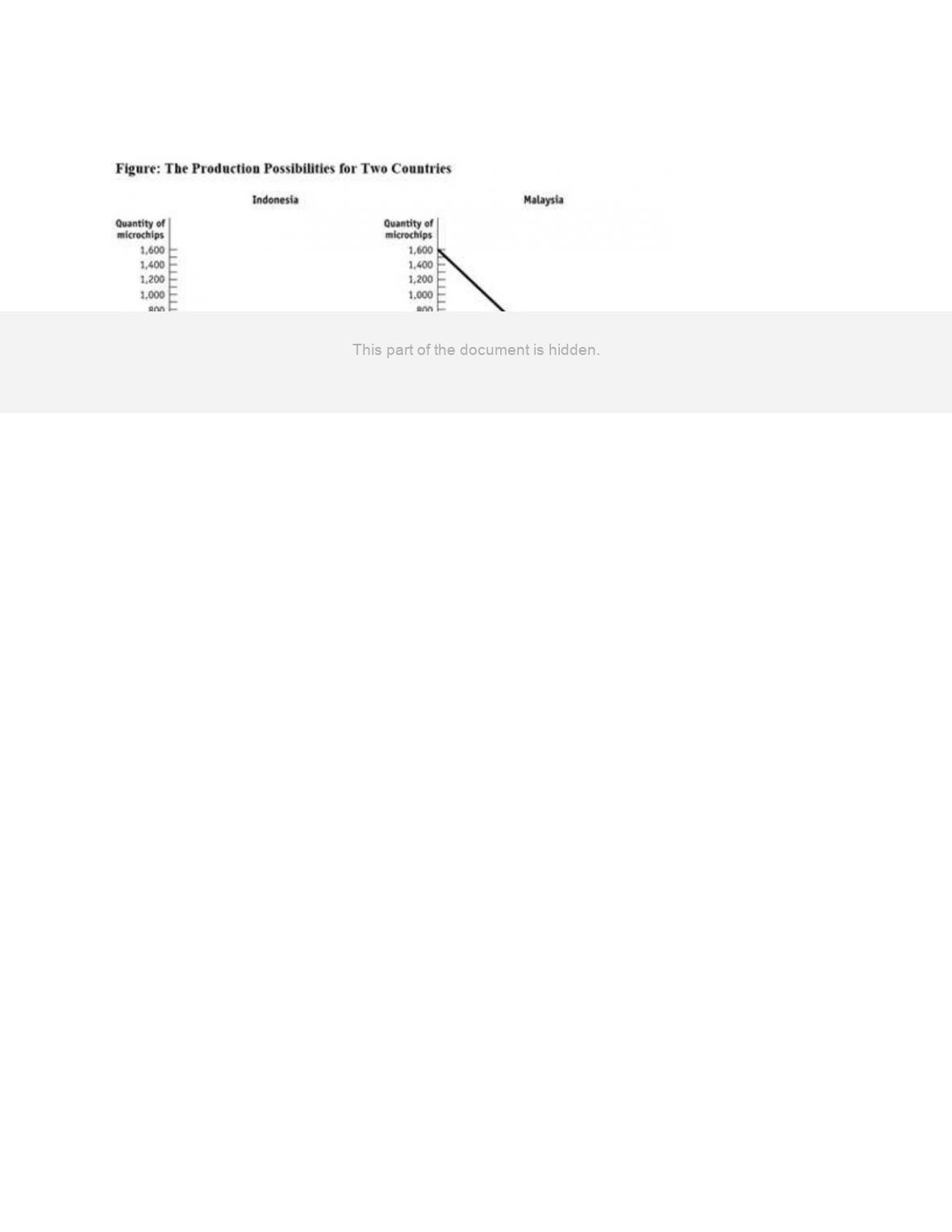
(Figure: The Production Possibilities for Two Countries) Use Figure: The Production
Possibilities for Two Countries. The opportunity cost of producing 1 tire in Indonesia is
_____ microchip(s), while the opportunity cost of producing 1 tire in Malaysia is _____
microchip(s).
A)
0.5; 2
B)
2; 1
C)
600; 800
D)
800; 1,200
79.
(Figure: The Production Possibilities for Two Countries) Use Figure: The Production
Possibilities for Two Countries. The opportunity cost of producing 1 microchip in
Indonesia is _____ tire(s).
A)
0.5
B)
1
C)
2
D)
6
80.
(Figure: The Production Possibilities for Two Countries) Use Figure: The Production
Possibilities for Two Countries. The opportunity cost of producing 1 microchip in
Malaysia is _____ tire(s).
A)
0.5
B)
1
C)
2
D)
6
Page 20
81.
(Figure: The Production Possibilities for Two Countries) Use Figure: The Production
Possibilities for Two Countries. Indonesia has a comparative advantage in producing
_____, while Malaysia has a comparative advantage in producing _____.
A)
both microchips and tires; neither good
B)
neither good; both microchips and tires
C)
microchips; tires
D)
tires; microchips
82.
(Figure: The Production Possibilities for Two Countries) Use Figure: The Production
Possibilities for Two Countries. If Indonesia and Malaysia specialize completely in the
production of the good of their comparative advantage, the two nations together will
produce _____ tires and _____ microchips.
A)
600; 800
B)
800; 1,200
C)
1,200; 1,600
D)
800; 600
83.
(Figure: The Production Possibilities for Two Countries) Use Figure: The Production
Possibilities for Two Countries. If Indonesia specializes completely in the production of
the good of its comparative advantage, it will produce:
A)
600 microchips.
B)
800 microchips.
C)
800 tires.
D)
1,200 tires.
84.
(Figure: The Production Possibilities for Two Countries) Use Figure: The Production
Possibilities for Two Countries. If Malaysia specializes completely in the production of
the good of its comparative advantage, it will produce:
A)
800 microchips.
B)
1,600 microchips.
C)
800 tires.
D)
1,200 tires.
85.
(Figure: The Production Possibilities for Two Countries) Use Figure: The Production
Possibilities for Two Countries. Both nations will gain from trade when 1 tire trades for
_____ microchip(s).
A)
0.33
B)
0.5
C)
1.5
D)
2