Page 55
267.
Producers in a particular market will bear the greater burden of an excise tax:
A)
the more price-elastic the demand is relative to supply.
B)
the less price-elastic demand is relative to supply.
C)
if demand has the same price elasticity as supply.
D)
regardless of the price elasticity of demand or supply.
268.
Consumers in a particular market will bear the greater burden of an excise tax:
A)
the more price-elastic supply is relative to demand.
B)
the less price-elastic supply is relative to demand.
C)
if supply has the same price elasticity as demand.
D)
regardless of the price elasticity of demand or supply.
269.
Suppose price elasticity of demand is relatively inelastic for good X. If the price
elasticity of supply for good X is elastic and an excise tax is imposed on good X, who
will bear the greater burden of the tax?
A)
consumers
B)
producers
C)
both consumers and producers equally
D)
government
270.
Suppose the price elasticity of demand is relatively elastic and the price elasticity of
supply is relatively inelastic in a specific market. If an excise tax is imposed on this
good, who will bear the greater burden of the tax?
A)
consumers
B)
producers
C)
both consumers and producers equally
D)
government
271.
When the imposition of an excise tax causes the quantity demanded and quantity
supplied to decrease relative to the no-tax equilibrium, this will result in:
A)
deadweight loss.
B)
increases in producer surplus.
C)
increases in consumer surplus.
D)
increases in both consumer and producer surplus.
Page 56
272.
Price elasticities of demand and supply will NOT play a major role in determining:
A)
the ability of policy makers to change consumption of a good via the imposition of
an excise tax.
B)
the deadweight loss arising from the imposition of an excise tax.
C)
the burden of the tax on consumers and producers.
D)
administrative costs of imposing an excise tax.
273.
Deadweight losses arising from an excise tax are greatest when demand:
A)
and supply are relatively inelastic.
B)
is relatively inelastic and supply is relatively elastic
C)
is relatively elastic and supply is relatively inelastic.
D)
and supply are relatively elastic.
274.
The ability-to-pay principle regarding taxes suggests that:
A)
the efficiency of a tax is the key feature in designing it.
B)
those who can afford it should bear the greater burden of the tax.
C)
those who benefit most from the tax should bear the greater burden of the tax.
D)
higher-income individuals should pay the same amount as lower-income
individuals.
275.
The benefits principle of taxation means individuals pay according to:
A)
whether and how much they use a good or service.
B)
benefits gained by society as a whole.
C)
benefits to government from having taxpayers.
D)
ability to pay.
Use the following to answer questions 276-279:
Page 57
276.
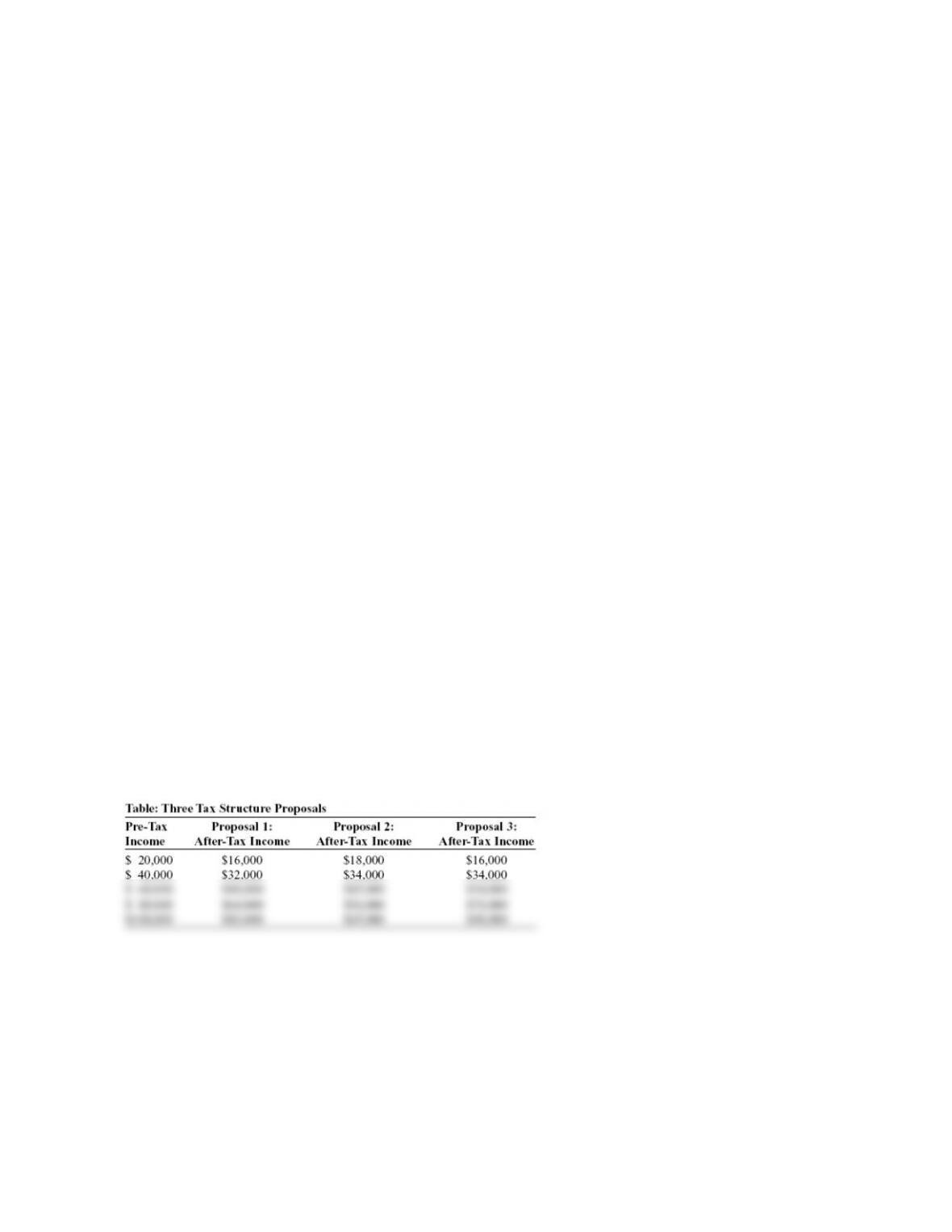
(Table: Three Tax Structure Proposals) Use Table: Three Tax Structure Proposals. A
regressive tax structure can be found in:
A)
proposal 1.
B)
proposal 2.
C)
proposal 3.
D)
all of the proposals.
277.
(Table: Three Tax Structure Proposals) Use Table: Three Tax Structure Proposals.
Policy makers interested in implementing a progressive tax structure would suggest
using:
A)
proposal 1.
B)
proposal 2.
C)
proposal 3.
D)
all of the proposals, since all are progressive.
278.
(Table: Three Tax Structure Proposals) Use Table: Three Tax Structure Proposals. If
one wished to use a proportional or flat tax structure, one should use proposal _____, in
which the percentage of income taxed is _____%.
A)
1; 20
B)
2; 10
C)
3; 20
D)
2; 20
279.
(Table: Three Tax Structure Proposals) Use Table: Three Tax Structure Proposals. What
percentage of income does an individual pay in taxes under proposal 3 if that
individual’s pretax income is $100,000?
A)
2%
B)
10%
C)
20%
D)
25%
280.
A regressive tax structure is one in which taxes:
A)
rise less than in proportion to income.
B)
rise more than in proportion to income.
C)
rise exactly in proportion to income.
D)
stay the same regardless of income changes.
Page 58
281.
The percentage of an increase in income that is taxed is:
A)
the marginal rate.
B)
a regressive tax.
C)
a flat tax.
D)
after tax.
282.
In the United States, taxes tend to be regressive at:
A)
federal, state, and local levels.
B)
federal and state levels.
C)
state and local levels.
D)
no levels of government.
283.
A cost(s) NOT associated with the imposition of a tax is/are:
A)
deadweight loss.
B)
administrative cost.
C)
revenues.
D)
equilibrium pricing.
Use the following to answer questions 284-290:
284.
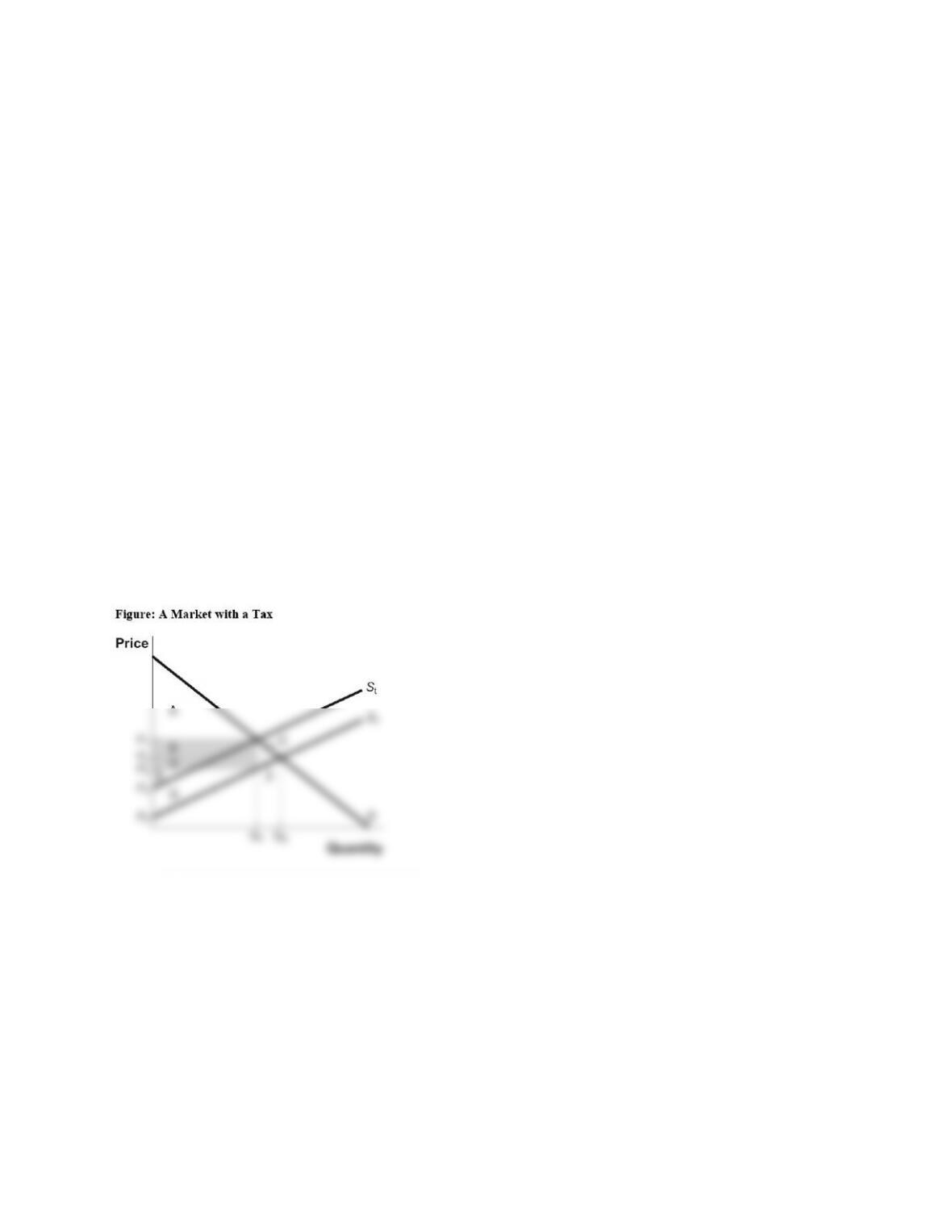
(Figure: A Market with a Tax) Use Figure: A Market with a Tax. The excise tax
imposed on this good is equal to:
A)
P1 – P2.
B)
P1 – P3
C)
P2 – P3.
D)
P1 – P5.
Page 59
285.
(Figure: A Market with a Tax) Use Figure: A Market with a Tax. Before the tax is
imposed, consumer surplus is equal to the areas:
A)
A + B + C + D + E.
B)
A + B + C.
C)
A + B + C + D + E + F.
D)
D + E + F.
286.
(Figure: A Market with a Tax) Use Figure: A Market with a Tax. Before the tax,
producer surplus is equal to the areas:
A)
A + B + C + D.
B)
D + E + F + G.
C)
A + B + C + D + E + F.
D)
A + B + C.
287.
(Figure: A Market with a Tax) Use Figure: A Market with a Tax. The tax revenue
collected by the government is equal to the area:
A)
(P1 – P3)Q1.
B)
(P1 – P5)Q2.
C)
(P2 – P3)Q1.
D)
(P1 – P2)Q2.
288.
(Figure: A Market with a Tax) Use Figure: A Market with a Tax. The transfer of
consumer surplus to the government is equal to the area:
A)
B.
B)
C.
C)
D.
D)
F.
289.
(Figure: A Market with a Tax) Use Figure: A Market with a Tax. The deadweight loss
arising from the imposition of this tax is equal to the areas:
A)
B + D
B)
D + E.
C)
B + C.
D)
C + F.

Page 60
290.
(Figure: A Market with a Tax) Use Figure: A Market with a Tax. The efficiency loss
resulting from this tax is:
A)
(P1 – P3)Q2.
B)
(P1 – P2)Q1
C)
0.5(P1 – P3)(Q2 – Q1).
D)
0.5(P1 – P3)Q1.
Use the following to answer questions 291-296:
291.
(Scenario: The Market for Good X) Use Scenario: The Market for Good X. If a $1 per
unit tax is imposed on this good, the new supply curve will be:
A)
P = 0.33Q + 1.
B)
P = 50 – 0.5Q
C)
P = 0.33Q – 1.
D)
P = 0.33Q + 1 + 50 – 0.5Q.
292.
(Scenario: The Market for Good X) Use Scenario: The Market for Good X. If a $1 per
unit tax is imposed, the price of good X will increase by (round all calculations to two
decimal places):
A)
$20.00.
B)
$0.60.
C)
$1.00.
D)
$1.50.
293.
(Scenario: The Market for Good X) Use Scenario: The Market for Good X. If a $1 per
unit tax is imposed, the deadweight loss associated with the tax will be equal to (round
all calculations to two decimal places):
A)
$1.00.
B)
$20.00.
C)
$0.50.
D)
$0.60.
Page 61
294.
(Scenario: The Market for Good X) Use Scenario: The Market for Good X. The tax
revenue collected by government from a $1 per unit tax will be (round all calculations to
two decimal places):
A)
$1.00.
B)
$59.04.
C)
$60.00.
D)
$60.50.
295.
(Scenario: The Market for Good X) Use Scenario: The Market for Good X. The per-unit
tax incidence on producers is equal to (round all calculations to two decimal places):
A)
$1.00.
B)
$0.40.
C)
$58.80.
D)
$60.00.
296.
(Scenario: The Market for Good X) Use Scenario: The Market for Good X. The per-unit
tax incidence on consumers is equal to (round all calculations to two decimal places):
A)
$1.00.
B)
$0.60.
C)
$58.80.
D)
$60.00.
Answer Key
Page 63
45.
C
46.
B
47.
A
48.
C
49.
B
50.
B
51.
A
52.
A
53.
B
54.
A
55.
D
56.
A
57.
D
58.
C
59.
D
60.
B
61.
D
62.
B
63.
C
64.
B
65.
D
66.
B
67.
D
68.
A
69.
A
70.
B
71.
A
72.
B
73.
B
74.
A
75.
B
76.
C
77.
B
78.
C
79.
C
80.
D
81.
B
82.
D
83.
A
84.
A
85.
B
86.
B
87.
A
88.
C
89.
A
90.
B
Page 64
91.
D
92.
B
93.
B
94.
A
95.
B
96.
D
97.
C
98.
B
99.
A
100.
B
101.
A
102.
B
103.
C
104.
C
105.
B
106.
B
107.
A
108.
A
109.
C
110.
A
111.
D
112.
A
113.
B
114.
A
115.
C
116.
A
117.
B
118.
C
119.
A
120.
B
121.
D
122.
D
123.
D
124.
A
125.
B
126.
D
127.
C
128.
A
129.
B
130.
A
131.
A
132.
C
133.
A
134.
A
135.
D
136.
B
Page 65
137.
A
138.
C
139.
B
140.
A
141.
A
142.
C
143.
C
144.
A
145.
C
146.
A
147.
A
148.
D
149.
A
150.
B
151.
C
152.
A
153.
B
154.
C
155.
A
156.
D
157.
C
158.
A
159.
D
160.
A
161.
B
162.
C
163.
A
164.
B
165.
B
166.
A
167.
B
168.
D
169.
A
170.
B
171.
C
172.
B
173.
C
174.
C
175.
A
176.
C
177.
C
178.
C
179.
A
180.
A
181.
B
182.
B
Page 66
183.
B
184.
D
185.
D
186.
D
187.
B
188.
C
189.
D
190.
B
191.
C
192.
A
193.
D
194.
D
195.
D
196.
B
197.
B
198.
C
199.
D
200.
C
201.
C
202.
D
203.
A
204.
B
205.
C
206.
D
207.
D
208.
A
209.
A
210.
B
211.
B
212.
D
213.
C
214.
A
215.
C
216.
D
217.
C
218.
B
219.
B
220.
C
221.
A
222.
D
223.
B
224.
D
225.
B
226.
A
227.
D
228.
C
Page 67
229.
D
230.
C
231.
A
232.
A
233.
A
234.
A
235.
B
236.
A
237.
A
238.
A
239.
A
240.
B
241.
B
242.
A
243.
A
244.
A
245.
B
246.
B
247.
A
248.
B
249.
A
250.
A
251.
B
252.
B
253.
A
254.
A
255.
B
256.
A
257.
258.
259.
260.
261.
262.
263.
264.
265.
266.
267.
A
268.
A
269.
A
270.
B
271.
A
272.
D
273.
D
274.
B
Page 68
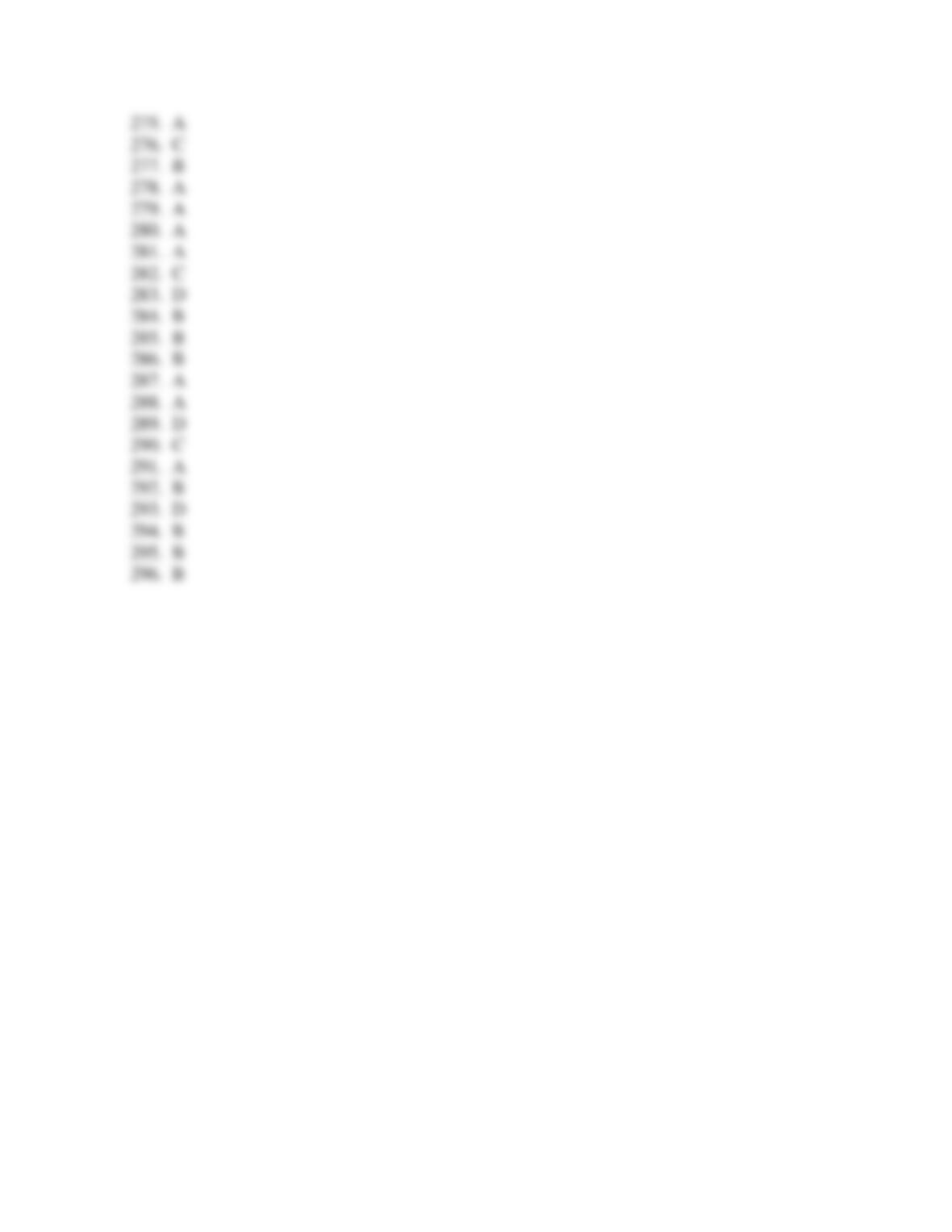
275.
A
276.
C
277.
B
278.
A
279.
A
280.
A
281.
A
282.
C
283.
D
284.
B
285.
B
286.
B
287.
A
288.
A
289.
D
290.
C
291.
A
292.
B
293.
D
294.
B
295.
B
296.
B