Page 41
192.
The two most important sources of federal revenue are the _____ taxes.
A)
FICA and personal income
B)
corporate income and FICA
C)
excise and personal income
D)
Social Security and excise
193.
_____ tax is NOT a major source of revenue for the federal government.
A)
Income
B)
FICA
C)
Profits
D)
Property
194.
Because of tax competition, state and local taxes tend to be _____; however, federal
taxes tend to be _____.
A)
regressive; regressive
B)
progressive; regressive
C)
progressive; progressive
D)
regressive; progressive
195.
A(n) _____ tax tends to encourage consumption and discourage saving and investing.
A)
consumption
B)
sales
C)
poll
D)
income
196.
_____ tax is NOT used in the United States.
A)
Property
B)
Value-added
C)
Profits
D)
Sales
197.
If personal income up to and including $25,000 is not taxed, income of $25,001 to
$50,000 is taxed at 10%, and income over $50,000 is taxed at 20%, then a family
earning an income of $75,000 will pay _____ in personal taxes.
A)
$6,000
B)
$7,500
C)
$11,250
D)
$15,000

Page 42
198.
If personal income up to and including $25,000 is not taxed, income of $25,001 to
$50,000 is taxed at 10%, and income over $50,000 is taxed at 20%, then a family
earning an income of $75,000 will pay a n AVERAGE tax rate of _____%.
A)
5
B)
7.5
C)
10
D)
20
199.
If personal income up to and including $25,000 is not taxed, income of $25,001 to
$50,000 is taxed at 10%, and income over $50,000 is taxed at 20%, then a family
earning an income of $75,000 will pay a marginal tax rate of _____%.
A)
5
B)
7.5
C)
10
D)
20
200.
If personal income up to and including $30,000 is not taxed, income of $30,001 to
$60,000 is taxed at 10%, and income over $60,000 is taxed at 25%, then a family
earning an income of $100,000 will pay _____ in personal taxes.
A)
$6,000
B)
$10,000
C)
$13,000
D)
$25,000
201.
If personal income up to and including $30,000 is not taxed, income of $30,001 to
$60,000 is taxed at 10%, and income over $60,000 is taxed at 25%, then a family
earning an income of $100,000 will pay a n AVERAGE tax rate of _____%.
A)
5
B)
10
C)
13
D)
25
202.
If personal income up to and including $30,000 is not taxed, income of $30,001 to
$60,000 is taxed at 10%, and income over $60,000 is taxed at 25%, then a family
earning an income of $100,000 will pay a marginal tax rate of _____%.
A)
5
B)
10
C)
13
D)
25
Page 43
Use the following to answer questions 203-212:
203.
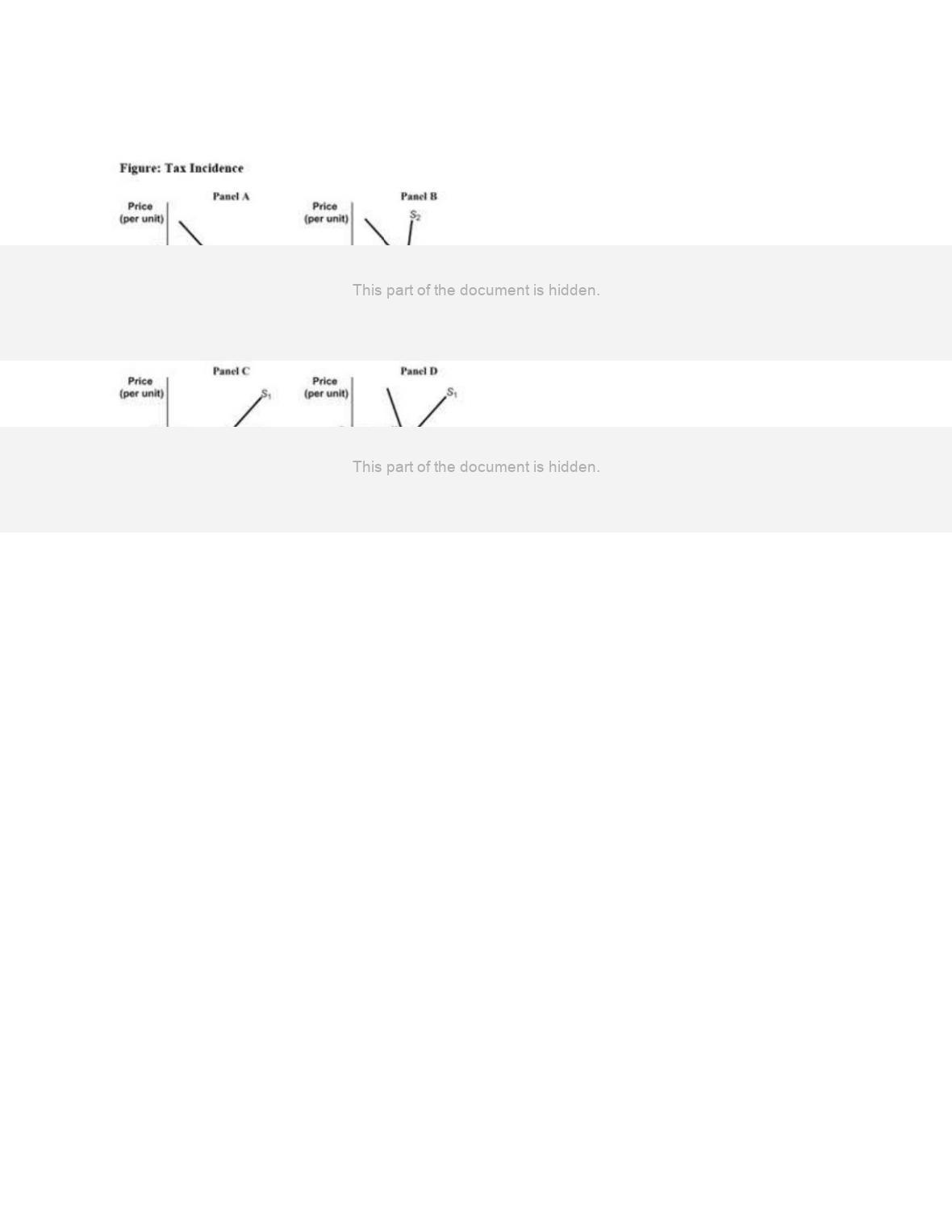
(Figure: Tax Incidence) Use Figure: Tax Incidence. All other things unchanged, when a
good or service is characterized by a relatively elastic supply, as shown in panel _____,
a greater share of the burden of an excise tax is borne by _____.
A)
A; buyers
B)
B; sellers
C)
B; buyers
D)
A; sellers
204.
(Figure: Tax Incidence) Use Figure: Tax Incidence. All other things unchanged, when a
good or service is characterized by a relatively inelastic supply, as shown in panel
_____, a greater share of the burden of an excise tax is borne by _____.
A)
A; buyers
B)
B; sellers
C)
A; sellers
D)
B; buyers
Page 44
205.
(Figure: Tax Incidence) Use Figure: Tax Incidence. All other things unchanged, when a
good or service is characterized by a relatively elastic demand, as shown in panel _____,
the greater share of the burden of an excise tax on it is borne by _____.
A)
D; buyers
B)
D; sellers
C)
C; sellers
D)
C; buyers
206.
(Figure: Tax Incidence) Use Figure: Tax Incidence. All other things unchanged, when a
good or service is characterized by a relatively inelastic demand, as shown in panel
_____, the greater share of the burden of an excise tax on it is borne by _____.
A)
C; buyers
B)
C; sellers
C)
D; sellers
D)
D; buyers
207.
(Figure: Tax Incidence) Use Figure: Tax Incidence. All other things unchanged, the
effect of an excise tax on gasoline in the short run is most likely illustrated by panel
_____, and the greater share of the burden of the excise tax (shown by the tax wedge in
each panel) is borne by _____.
A)
C; buyers
B)
D; sellers
C)
C; sellers
D)
D; buyers
208.
(Figure: Tax Incidence) Use Figure: Tax Incidence. All other things unchanged, the
effect of an excise tax on gasoline in the long run is most likely illustrated by panel
_____, and the greater share of the burden of the excise tax (shown by the tax wedge in
each panel) is borne by _____.
A)
A; buyers
B)
B; sellers
C)
B; buyers
D)
A; sellers
209.
(Figure: Tax Incidence) Use Figure: Tax Incidence. Based on the figure, the deadweight
loss of an excise tax is likely to be greater in panel _____ than in panel _____.
A)
C; D
B)
C; A
C)
D; A
D)
B; A
Page 45
210.
(Figure: Tax Incidence) Use Figure: Tax Incidence. Based on the figure, the deadweight
loss of an excise tax is likely to be greater in panel _____ than in panel _____.
A)
D; C
B)
A; B
C)
C; B
D)
B; A
211.
(Figure: Tax Incidence) Use Figure: Tax Incidence. Consumers are likely to bear more
of the burden of an excise tax in the situations illustrated by panels:
A)
A and B.
B)
A and D.
C)
B and D.
D)
B and C.
212.
(Figure: Tax Incidence) Use Figure: Tax Incidence. Producers are likely to bear more of
the burden of an excise tax in the situations illustrated by panels:
A)
A and B.
B)
A and C.
C)
B and D.
D)
B and C.
Use the following to answer questions 213-216:
Page 46
213.
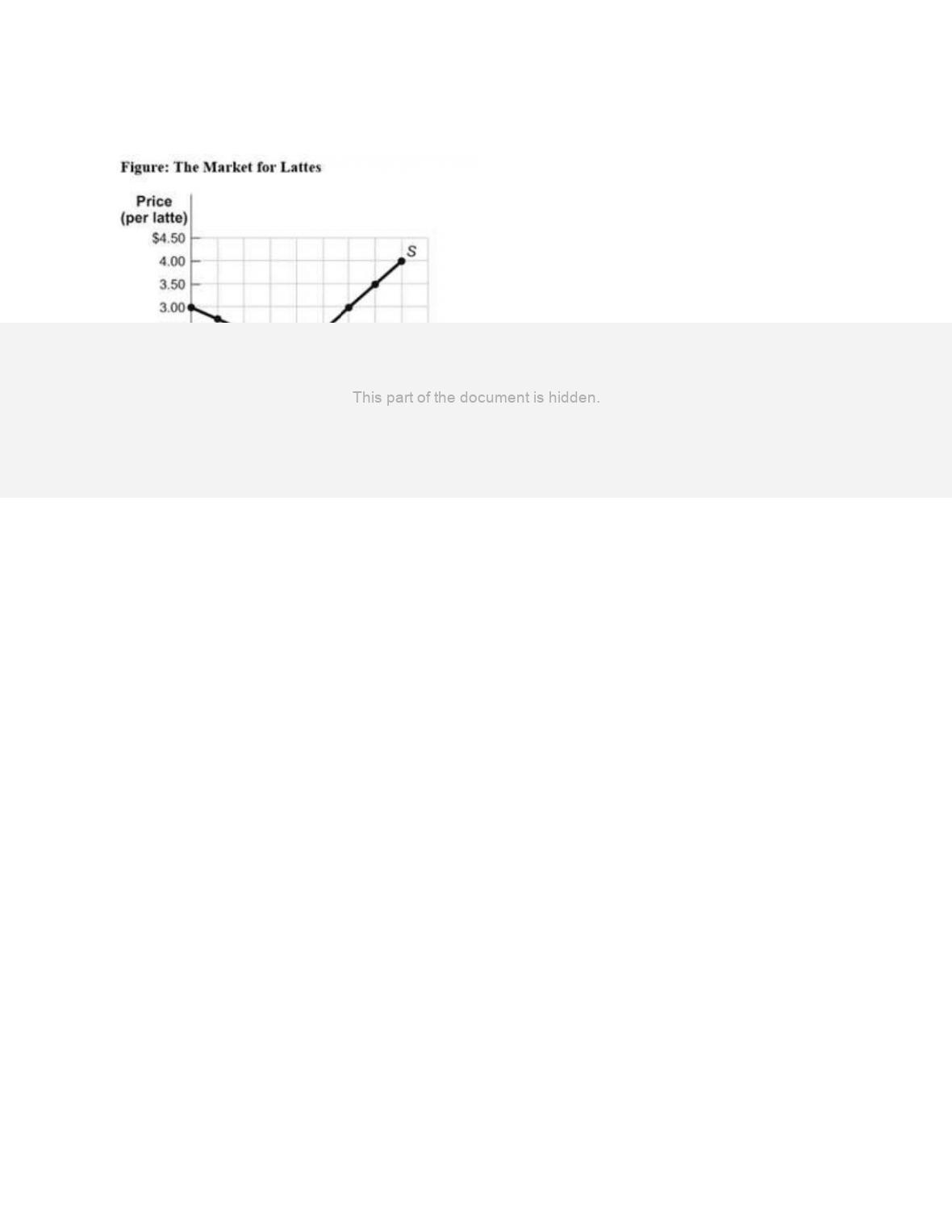
(Figure: The Gasoline Market) Use Figure: The Gasoline Market. The pretax
equilibrium price is $3, and the equilibrium quantity before tax is 20,000 gallons. An
excise tax has been levied on each gallon of gasoline supplied by producers. Based on
the graph, the incidence of the tax on suppliers is:
A)
$1.50.
B)
$1.
C)
$0.75.
D)
$15,000.
214.
(Figure: The Gasoline Market) Use Figure: The Gasoline Market. The pretax
equilibrium price is $3, and the equilibrium quantity before tax is 20,000 gallons. An
excise tax has been levied on each gallon of gasoline supplied by producers, shifting the
supply curve upward. What is the tax rate?
A)
$1.75 per gallon
B)
$1 per gallon
C)
$2.50
D)
$0.50
215.
(Figure: The Gasoline Market) Use Figure: The Gasoline Market. The pretax
equilibrium price is $3, and the equilibrium quantity before tax is 20,000 gallons. An
excise tax has been levied on each gallon of gasoline supplied by producers, shifting the
supply curve upward. The total tax revenue collected by the government is equal to:
A)
$1.50.
B)
$15,000.
C)
$26,250.
D)
$30,000.
216.
(Figure: The Gasoline Market) Use Figure: The Gasoline Market. The pretax
equilibrium price is $3, and the equilibrium quantity before tax is 20,000 gallons. An
excise tax has been levied on each gallon of gasoline, shifting the supply curve upward.
The deadweight loss from this tax is equal to:
A)
$1.50.
B)
$5,000.
C)
$15,000.
D)
$4,375.
Page 47
Use the following to answer questions 217-221:
217.
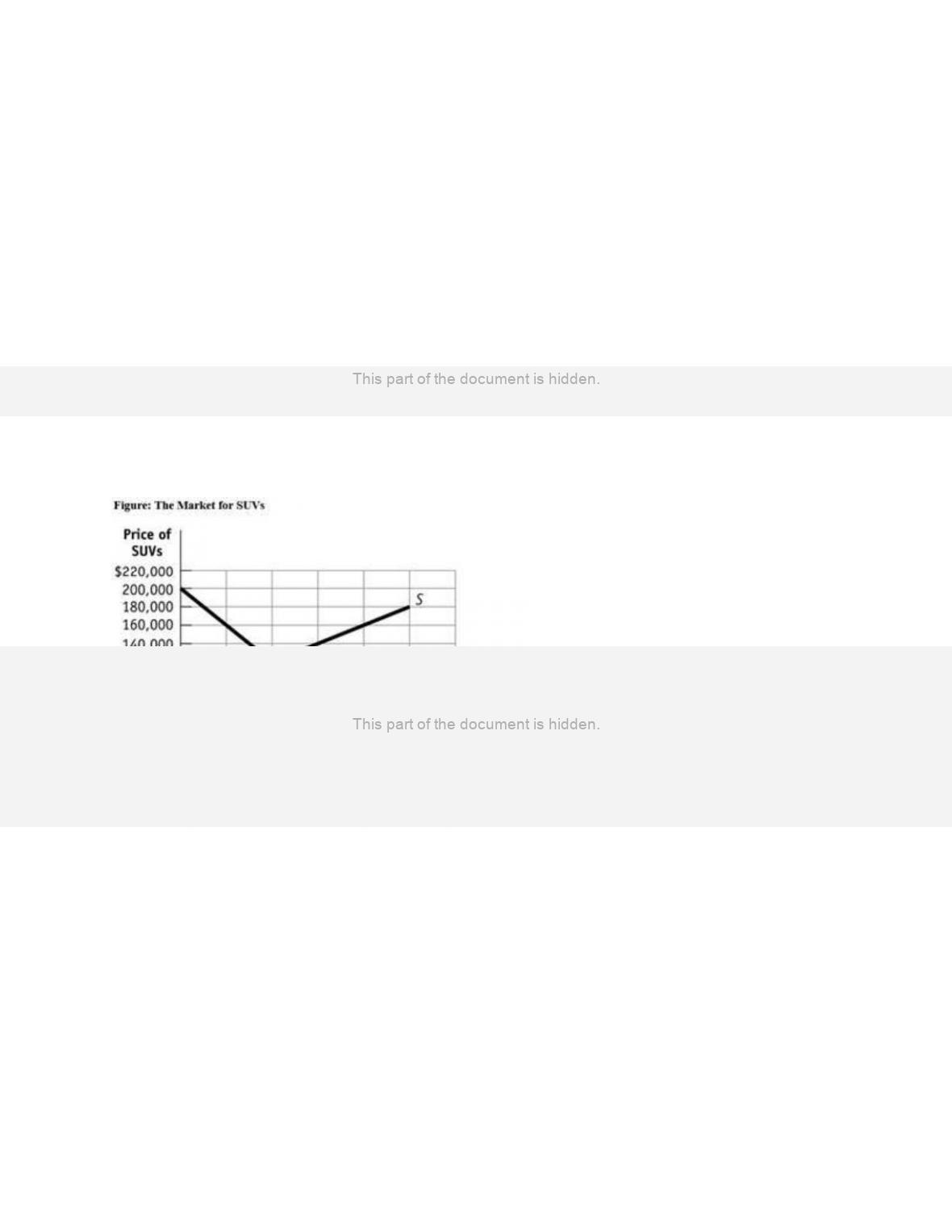
(Figure: The Market for Lattes) Use Figure: The Market for Lattes. If the government
assesses a tax of $0.75 on each latte, the price the consumer pays for a latte after the tax
will:
A)
increase from $2 to $2.75.
B)
increase from $2 to $2.50.
C)
increase from $2 to $2.25.
D)
change, but we cannot determine by how much.
218.
(Figure: The Market for Lattes) Use Figure: The Market for Lattes. If the government
assesses a tax of $0.75 on sellers of lattes, the price producers will receive for a latte
after the tax will:
A)
decrease from $2 to $1.75.
B)
decrease from $2 to $1.50.
C)
decrease from $2 to $1.25.
D)
change, but we cannot determine by how much.
219.
(Figure: The Market for Lattes) Use Figure: The Market for Lattes. If an excise tax of
$1.50 is assessed on each latte, government revenue will be:
A)
$400.
B)
$600.
C)
$800.
D)
$1,200.
Page 48
220.
(Figure: The Market for Lattes) Use Figure: The Market for Lattes. If an excise tax of
$2.25 is assessed on each latte, government revenue will be:
A)
$225.
B)
$400.
C)
$450.
D)
$1,800.
221.
(Figure: The Market for Lattes) Use Figure: The Market for Lattes. If the excise tax
increases from $1.50 to $2.25 per latte, government revenue will _____ by _____.
A)
decrease; $150
B)
decrease; $75
C)
increase; $150
D)
increase; $225
Use the following to answer questions 222-231:
222.
(Figure: The Market for SUVs) Use Figure: The Market for SUVs. If the government
imposes a $60,000 tax on SUVs and collects it from the consumers, the _____ curve
will shift _____ by _____.
A)
supply; upward; $30,000
B)
supply; upward; $60,000
C)
demand; downward; $30,000
D)
demand; downward; $60,000
Page 49
223.
(Figure: The Market for SUVs) Use Figure: The Market for SUVs.. A quota of _____
will bring about the same price and output in the market for SUVs as would an excise
tax of $30,000.
A)
2,000
B)
3,000
C)
4,000
D)
The answer is impossible to determine.
224.
(Figure: The Market for SUVs) Use Figure: The Market for SUVs.. A price _____ of
_____ will bring about the same price and output in the market for SUVs as would an
excise tax of $30,000.
A)
ceiling; $80,000
B)
ceiling; $100,000
C)
floor; $120,000
D)
floor; $140,000
225.
(Figure: The Market for SUVs) Use Figure: The Market for SUVs. If the government
imposes a $60,000 tax on SUVs (collected from the producers), consumers will pay
_____ of the tax and producers will pay _____.
A)
$30,000; $30,000
B)
$40,000; $20,000
C)
$20,000; $40,000
D)
$10,000; $50,000
226.
(Figure: The Market for SUVs) Use Figure: The Market for SUVs. A quota of _____
will bring about the same price and output in the market for yachts as would an excise
tax of $60,000.
A)
2,000
B)
3,000
C)
4,000
D)
The answer is impossible to determine.
227.
(Figure: The Market for SUVs) Use Figure: The Market for SUVs. A price _____ of
_____ will bring the about the same price and output in the market for SUVs as would
an excise tax of $60,000.
A)
ceiling; $80,000
B)
ceiling; $100,000
C)
floor; $100,000
D)
floor; $160,000

Page 50
228.
(Figure: The Market for SUVs) Use Figure: The Market for SUVs. If the government
imposes a $30,000 tax on SUVs and collects it from the SUV suppliers, the _____ curve
will shift _____ by _____.
A)
demand; downward; $15,000
B)
supply; upward; $15,000
C)
supply; upward; $30,000
D)
demand; downward; $30,000
229.
(Figure: The Market for SUVs) Use Figure: The Market for SUVs. If the government
imposes a $60,000 tax on SUVs (collected from the producers), the price of SUVs will
rise to _____ and the government will collect _____.
A)
$100,000; $120 million
B)
$120,000; $90 million
C)
$140,000; $90 million
D)
$160,000; $120 million
230.
(Figure: The Market for SUVs) Use Figure: The Market for SUVs. If the government
imposes a $30,000 tax on SUVs (collected from the producers), the price of SUVs will
rise to _____ and the government will collect _____.
A)
$100,000; $120 million
B)
$120,000; $90 million
C)
$140,000; $90 million
D)
$160,000; $120 million
231.
(Figure: The Market for SUVs) Use Figure: The Market for SUVs. If the government
imposes a $30,000 tax on SUVs (collected from the producers), consumers will pay
_____ of the tax and producers will pay _____.
A)
$20,000; $10,000
B)
$15,000; $15,000
C)
$10,000; $20,000
D)
$5,000; $25,000
232.
If the government wants to limit sales of a particular good, it may do so by imposing a
quota. However, the same reduction in sales may be achieved by an appropriately
chosen excise tax.
A)
True
B)
False
Page 51
233.
The price that buyers pay and the price that sellers receive in the presence of an excise
tax are unaffected by which of these groups officially pays the tax.
A)
True
B)
False
234.
In general, the incidence of an excise tax is shared between buyers and sellers.
A)
True
B)
False
235.
If the government imposes a $500 excise tax on SUVs and the demand curve for SUVs
is downward-sloping, suppliers of SUVs will simply raise the price by $500 and
consumers will bear the entire burden of the tax.
A)
True
B)
False
236.
If demand for a good is perfectly inelastic, then consumers will bear the entire burden of
an excise tax imposed on that good.
A)
True
B)
False
237.
The FICA tax falls most heavily on workers because the price elasticity of demand for
labor is greater than the price elasticity of supply of labor.
A)
True
B)
False
238.
Although employers and wage earners each pay 50% of the FICA tax, the tax reduces
wages to the extent that the incidence of the tax falls almost entirely on workers.
A)
True
B)
False
239.
The deadweight loss of an excise tax arises because the tax prevents some mutually
beneficial transactions.
A)
True
B)
False
Page 52
240.
The administrative costs of a tax include the costs incurred by the government in
collecting the tax (such as the costs of operating the Internal Revenue Service) but
exclude the costs incurred by individuals in paying the tax (such as accountants’ fees).
A)
True
B)
False
241.
Cigarette taxes have eliminated the wedge between the demand price for cigarettes and
the supply price of cigarettes.
A)
True
B)
False
242.
If the government imposes a per-unit tax on good Y and the supply of good Y is
perfectly inelastic, there will be no deadweight loss due to the tax.
A)
True
B)
False
243.
To minimize deadweight loss, excise taxes should be levied on goods with inelastic
demand and inelastic supply rather than goods with elastic demand and elastic supply.
A)
True
B)
False
244.
If demand is perfectly inelastic, the deadweight loss caused by a tax will be zero.
A)
True
B)
False
245.
The benefits principle says that taxes should be used to benefit the maximum number of
people.
A)
True
B)
False
246.
For a tax system to achieve equity, it must first achieve efficiency.
A)
True
B)
False
247.
An excise tax causes a loss in efficiency because taxes distort incentives.
A)
True
B)
False
Page 53
248.
Economic policies often involve trade-offs between efficiency and equity. Fortunately,
tax policy is an exception because it is easy to find taxes that are both efficient and fair.
A)
True
B)
False
249.
Lump-sum taxes promote economic efficiency but violate the ability–to-pay principle.
A)
True
B)
False
250.
The argument for progressive taxes is based on the ability-to-pay principle.
A)
True
B)
False
251.
A tax system achieves efficiency when it maximizes the amount of tax paid by the
wealthiest citizens.
A)
True
B)
False
252.
Tax structure refers to what a tax is levied on (e.g., income, property, profits), and tax
base refers to the base (or lowest) rate of taxation on a particular tax structure.
A)
True
B)
False
253.
If the marginal tax rate and the average tax rate are equal for all levels of income, then
the tax structure is proportional.
A)
True
B)
False
254.
Overall, the taxes collected by the federal government are progressive.
A)
True
B)
False
255.
In the United States, poor people and the middle class pay the largest share of income
taxes.
A)
True
B)
False

Page 54
256.
Tax cuts authorized between 2000 and 2004 tended to favor the rich, but the federal tax
system remains progressive overall. However, taxes at the state and local level are
regressive.
A)
True
B)
False
257.
Explain how an excise tax levied on suppliers affects the supply curve.
258.
A politician says that a tax on good X will not increase the price of good X paid by
consumers. Is there any way that this can be an accurate statement?
259.
Under what supply and demand conditions would an excise tax impose a large incidence
on suppliers and a small incidence on consumers? Explain how this works.
260.
What is the difference between a tax rate and a tax revenue?
261.
How is it that a higher tax rate can increase tax revenue in some cases but decrease it in
other cases? Relate this to the price elasticity of demand.
262.
How does an excise tax impose a cost on society?
263.
What supply and demand conditions cause zero deadweight loss when an excise tax is
imposed?
264.
Some highways and bridges have toll charges. Which principle of tax fairness does this
describe?
265.
Periodically cars and trucks must be relicensed. The licensing fees are a form of a tax.
Design a licensing tax that is regressive and one that is progressive.
266.
Suppose the supply of tobacco is elastic and the demand for tobacco is inelastic. If an
excise tax is levied on the suppliers of tobacco, will the incidence fall mostly on
consumers or mostly on producers? Will there be a large amount or small amount of
deadweight loss? Will tax revenue from the tobacco tax fall or rise?