Page 21
87.
(Figure: The Market for Hamburgers) Use Figure: The Market for Hamburgers. If the
market is originally in equilibrium and the government imposes an excise tax of $0.80
per unit of the good sold, consumer surplus will be reduced by:
A)
$175.
B)
$240.
C)
$105.
D)
$90.
88.
(Figure: The Market for Hamburgers) Use Figure: The Market for Hamburgers. If the
market is originally in equilibrium and the government imposes an excise tax of $0.80
per hamburger, producer surplus will be reduced by:
A)
$175.
B)
$240.
C)
$105.
D)
$90.
89.
(Figure: The Market for Hamburgers) Use Figure: The Market for Hamburgers. If the
market is originally in equilibrium and the government imposes an excise tax of $0.80
per unit of the good sold, the deadweight loss associated with the tax will be:
A)
$40.
B)
$240.
C)
$105.
D)
$90.
90.
(Figure: The Market for Hamburgers) Use Figure: The Market for Hamburgers. If the
market is originally in equilibrium and the government imposes an excise tax of $0.80
per unit of the good sold, the government’s revenue from the tax will be:
A)
$175.
B)
$240.
C)
$105.
D)
$90.
91.
When the government imposes an excise tax, the deadweight loss is caused by:
A)
equal the tax revenue paid to the government.
B)
be greater than the tax revenue paid to the government.
C)
be less than the tax revenue paid to the government.
D)
prevention of transactions because of the cost of the tax.
Page 22
92.
(Figure: The Market for Music Downloads) Use Figure: The Market for Music
Downloads. If the government imposes a tax of $3 in this market, the government will
receive tax revenue of:
A)
$20.
B)
$30.
C)
$60.
D)
$75.
93.
(Figure: The Market for Music Downloads) Use Figure: The Market for Music
Downloads. If the government imposes a tax of $3 in this market, the deadweight loss
will equal:
A)
$0.
B)
$22.50.
C)
$26.25.
D)
$52.50.
94.
A tax:
A)
generates tax revenue and causes deadweight loss.
B)
increases consumer and producer surplus.
C)
produces revenue for the government and increases total surplus.
D)
is always efficient.
Use the following to answer questions 95-101:
Page 23
95.
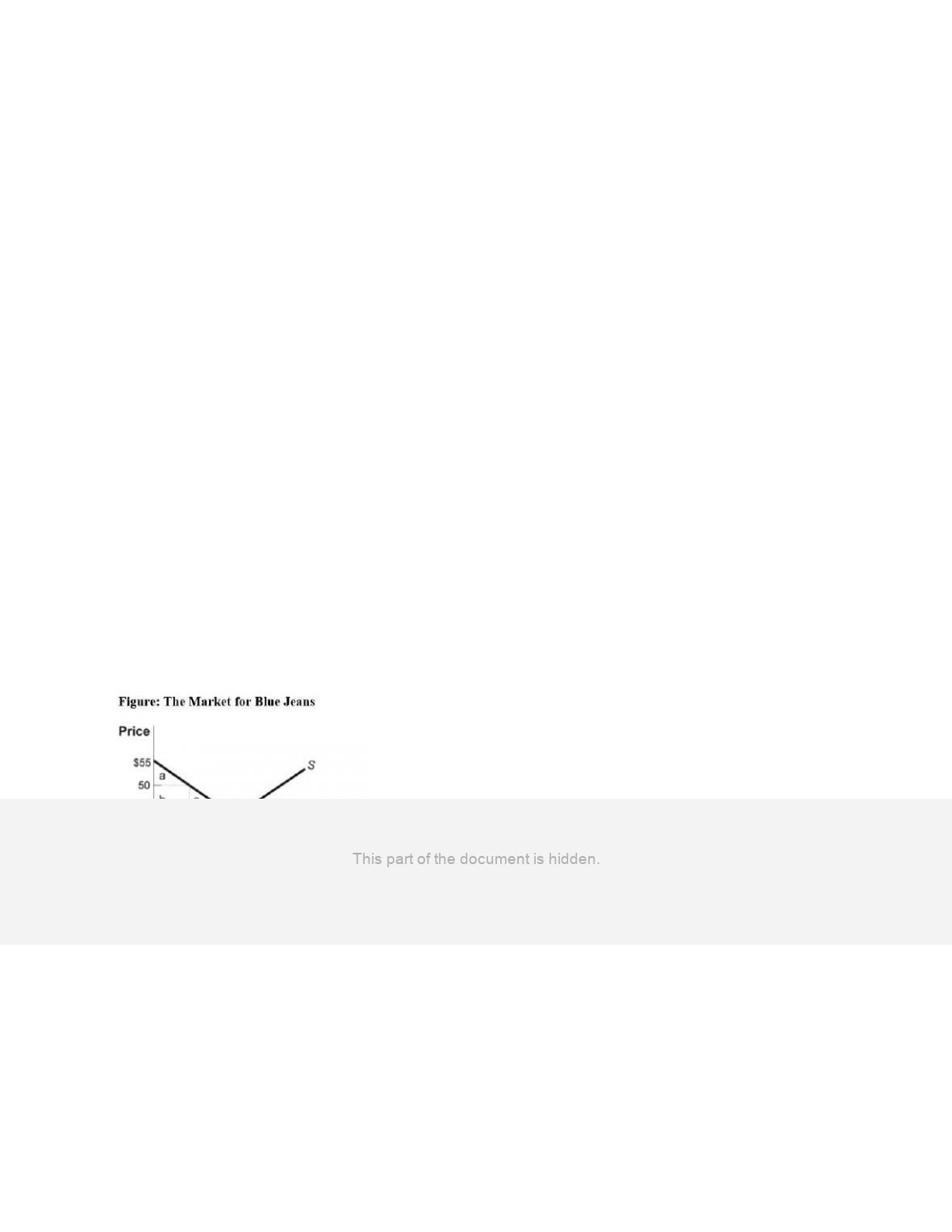
(Figure: The Market for Blue Jeans) Use Figure: The Market for Blue Jeans. The
government recently levied a $10 tax on the producers of blue jeans. What area or areas
in the graph identify tax revenue?
A)
a + b + c
B)
b + d
C)
c + e
D)
d + e + f
96.
(Figure: The Market for Blue Jeans) Use Figure: The Market for Blue Jeans. The
government recently levied a $10 tax on the producers of blue jeans. What area or areas
in the graph identify consumer and producer surplus after the tax was levied?
A)
a + b + c
B)
a + b + c + d + e + f
C)
d + e + f
D)
a + f
97.
(Figure: The Market for Blue Jeans) Use Figure: The Market for Blue Jeans. The
government recently levied a $10 tax on the producers of blue jeans. What area or areas
in the graph identify deadweight loss?
A)
a + b + c
B)
b + d
C)
c + e
D)
d + e + f
98.
(Figure: The Market for Blue Jeans) Use Figure: The Market for Blue Jeans. The
government recently levied a $10 tax on the producers of blue jeans. What area or areas
in the graph identify the loss of consumer surplus due to the tax?
A)
c
B)
b + c
C)
b
D)
a + b + c
99.
(Figure: The Market for Blue Jeans) Use Figure: The Market for Blue Jeans. The
government recently levied a $10 tax on the producers of blue jeans. What area or areas
in the graph identify the loss of producer surplus due to the tax?
A)
d + e
B)
e
C)
d
D)
d + e + f

Page 24
100.
(Figure: The Market for Blue Jeans) Use Figure: The Market for Blue Jeans. The
government recently levied a $10 tax on the producers of blue jeans. What is the
deadweight loss?
A)
$1,000
B)
$500
C)
$250
D)
$1,250
101.
(Figure: The Market for Blue Jeans) Use Figure: The Market for Blue Jeans. The
government recently levied a $10 tax on the producers of blue jeans. What is the tax
revenue?
A)
$1,000
B)
$500
C)
$4,000
D)
$5,000
102.
The two principles of tax fairness are:
A)
the minimize-distortions principle and the maximize-revenue principle.
B)
the benefits principle and the ability-to-pay principle.
C)
the proportional-tax principle and the ability-to-pay principle.
D)
the equity principle and the efficiency principle.
103.
The ability-to-pay principle says that:
A)
the amount of tax paid depends on the measure of value.
B)
those who benefit from public spending should bear the burden of the tax that pays
for that spending.
C)
those with greater ability to pay should pay more tax.
D)
those who benefit from the tax should pay the same percentage of the tax base as
those who do not benefit.
104.
A lump-sum tax, such as the fee for a driver’s license, does not take into consideration:
A)
efficiency.
B)
the benefits principle.
C)
the ability-to-pay principle.
D)
the tax base.

Page 25
105.
Which situation demonstrates the benefits principle?
A)
Employed workers pay taxes that are used to fund technical training programs.
B)
Revenue from the federal tax on gasoline is used to maintain and improve the
interstate highway system.
C)
Most of the revenue from property taxes is used to fund public schools. The taxes
are paid by all homeowners.
D)
Taxes on cigarettes are used to pay state employees’ salaries.
106.
The benefits principle says that:
A)
the amount of tax paid depends on the measure of value.
B)
those who benefit from public spending should bear the burden of the tax that pays
for that spending.
C)
those with greater ability to pay should pay more tax.
D)
those who benefit from the tax should pay the same percentage of the tax base as
those who do not benefit.
107.
Which tax reflects the ability-to-pay principle?
A)
the federal income tax
B)
the payroll tax
C)
a sales tax on food
D)
Social Security tax
108.
Criteria that economists use in selecting a tax system include:
A)
the ability to pay.
B)
employment status.
C)
consumer debt.
D)
the maximal deadweight loss.
109.
The _____ principle implies that people with _____ should pay more taxes.
A)
ability-to-pay; greater benefits received
B)
benefits; higher incomes
C)
ability-to-pay; higher incomes
D)
benefits; fewer benefits
110.
A principle suggesting that people with more income or wealth should pay more taxes is
the _____ principle.
A)
ability-to-pay
B)
regressive tax
C)
progressive tax
D)
benefits

Page 26
111.
Taxation according to the benefits principle is best illustrated in the United States by:
A)
personal income tax
B)
sales tax
C)
corporate income tax
D)
gasoline tax
112.
Paying a fee every time you use the municipal golf course is an example of the _____
principle.
A)
benefits
B)
ability-to-pay
C)
progressive tax
D)
regressive tax
113.
Taxation according to the ability-to-pay principle is best illustrated in the United States
by:
A)
sales taxes.
B)
income taxes.
C)
excise taxes.
D)
user fees.
114.
Since the terrorist attacks of September 11, 2001, the Federal Aviation Agency has
added a small security fee to every airplane ticket purchased. This is an example of:
A)
the benefits principle of tax fairness.
B)
a lump-sum tax.
C)
the ability-to-pay principle of tax fairness.
D)
a profits tax.
115.
According to the _____ principle, those who use public services should bear the burden
of the tax that pays for them.
A)
ability-to-pay
B)
tax fairness
C)
benefits
D)
spending
116.
According to the _____ principle, those who can afford it should pay higher tax.
A)
ability-to-pay
B)
tax fairness
C)
benefits
D)
affordability
Page 27
117.
Which tax BEST illustrates the benefits principle of tax fairness?
A)
The local city playground is funded through a tax on all citizens.
B)
Roads and highways are built and maintained through revenue from a tax on
gasoline.
C)
A property tax that is proportional to the value of the home is charged to
homeowners to fund primary and secondary education.
D)
A sales tax on food pays for police and fire protection.
118.
Which tax BEST illustrates the ability-to-pay principle of tax fairness?
A)
The local city playground is funded by a tax on all citizens.
B)
Roads and highways are built and maintained by revenue from a tax on gasoline.
C)
A property tax that is proportional to the value of the home is charged to
homeowners to fund primary and secondary education.
D)
A sales tax on food pays for police and fire protection.
119.
A principle suggesting that people with more income or wealth should pay more taxes is
the _____ principle.
A)
ability-to-pay
B)
proportional tax
C)
lump-sum tax
D)
benefits received
120.
Taxation according to the ability-to-pay principle is best illustrated in the United States
by _____ taxes.
A)
sales
B)
personal income
C)
excise
D)
gasoline
121.
Taxation according to the benefits-received principle is best illustrated by the _____ tax.
A)
income
B)
sales
C)
gift
D)
gasoline
Page 28
122.
You have to pay a fee every time you use your community swimming pool. This is an
example of the _____ principle.
A)
regressive tax
B)
ability-to-pay
C)
progressive tax
D)
benefits
123.
If tax efficiency is the only goal, a tax system should be designed to minimize its:
A)
burden.
B)
administrative costs.
C)
impact on the poor.
D)
burden and its administrative costs.
124.
A tax system achieves equity when:
A)
taxes are distributed fairly, however society may define fair.
B)
it minimizes the costs to the economy of tax collection.
C)
it is efficient.
D)
taxes are lump sum.
125.
A tax system achieves efficiency when:
A)
the right people actually bear the burden of taxes.
B)
it minimizes the costs to the economy of tax collection.
C)
the tax is fair.
D)
it is in equilibrium.
126.
If a tax system is poorly designed, it may be possible to increase:
A)
efficiency without sacrificing equity.
B)
equity while causing inefficiency.
C)
efficiency by sacrificing equity.
D)
equity without causing inefficiency or increase efficiency without sacrificing
equity.
127.
Suppose Congress passed a new tax system, such that all federal, state, and local taxes
were replaced with one tax: a tax of $14,000 for every person 18 and over. This new tax
system would clearly improve:
A)
tax equity.
B)
tax fairness.
C)
tax efficiency.
D)
government revenue.
Page 29
128.
A tax system _____ when it minimizes the direct and indirect costs to the economy of
tax collection.
A)
is efficient
B)
is equitable
C)
has no deadweight loss
D)
is in equilibrium
129.
A tax system _____ when taxes are distributed fairly.
A)
is efficient
B)
is equitable
C)
has no deadweight loss
D)
is in equilibrium
130.
If a tax system is designed to minimize the sum of its deadweight loss and its
administrative cost, its principal goal is:
A)
maximizing efficiency.
B)
maximizing equity.
C)
maximizing revenue.
D)
minimizing the tax burden.
131.
_____ tax does NOT distort incentives and is best at promoting economic efficiency.
A)
A lump-sum
B)
FICA
C)
A property
D)
An income
132.
If a tax system is well designed:
A)
it maximizes efficiency.
B)
it maximizes fairness.
C)
then efficiency can be improved only by making the system less fair.
D)
it maximizes efficiency and equity.
133.
Which statement is CORRECT?
A)
If the government can make the tax system fairer without sacrificing efficiency, it
should do so to maximize equity.
B)
If the government can make the tax system fairer without sacrificing efficiency,
then the existing tax system is perfectly designed.
C)
There is no trade-off between equity and efficiency in the tax system.
D)
If the government can make the tax system fairer without sacrificing efficiency, it
should seek to maximize equity at the expense of efficiency.
Page 30
134.
The richest 20% of families in the United States pay a much _____ share of total income
taxes collected and a _____ share of FICA taxes than their share of total income.
A)
higher; lower
B)
lower; higher
C)
higher; higher
D)
lower; lower
135.
The poorest 20% of families in the United States pay a _____ share of their total income
in taxes.
A)
very large
B)
somewhat large
C)
small
D)
negative
Use the following to answer questions 136-138:
136.
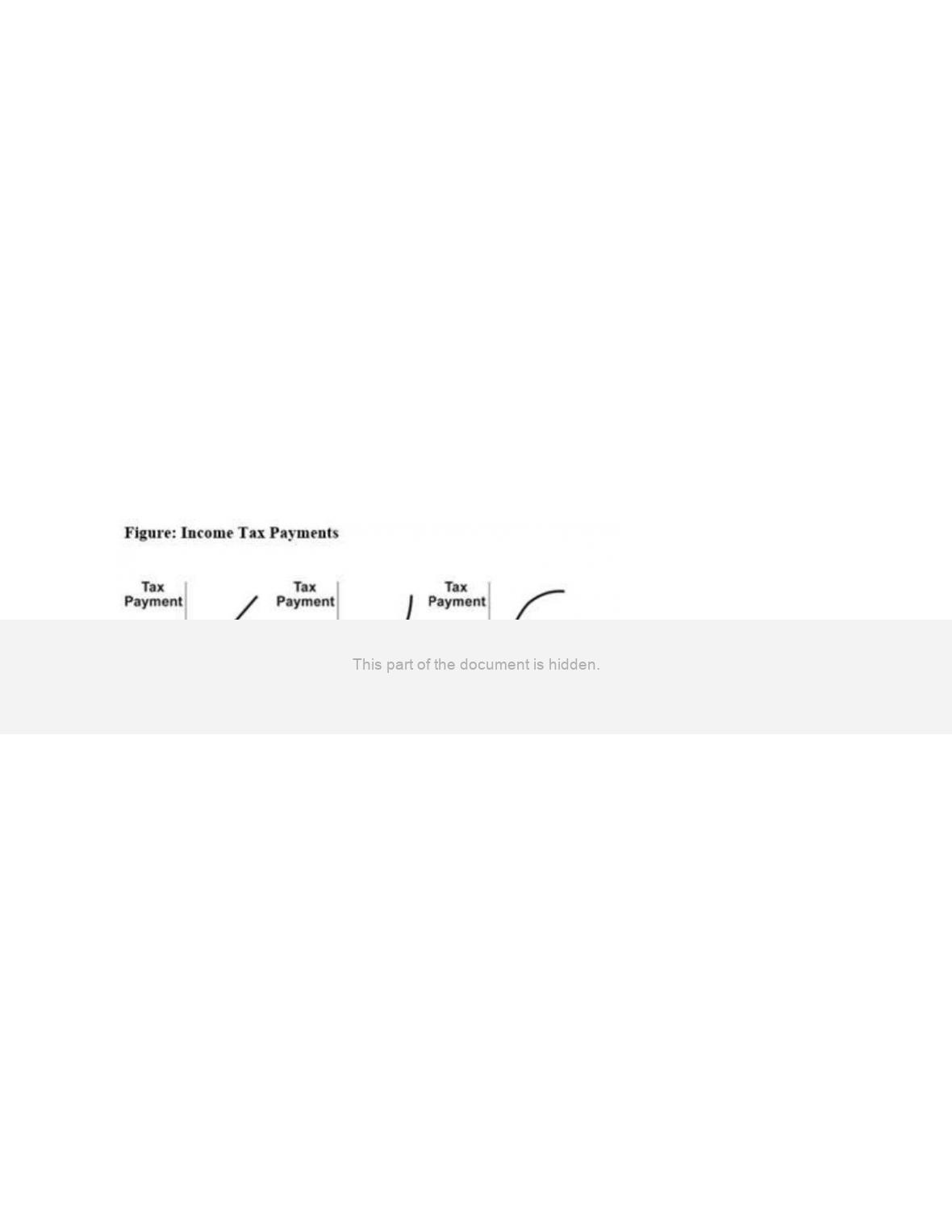
(Figure: Income Tax Payments) Use Figure: Income Tax Payments. Which panel or
panels BEST represent the effects of a progressive income tax?
A)
A
B)
B
C)
C
D)
A and B
137.
(Figure: Income Tax Payments) Use Figure: Income Tax Payments. Which panel or
panels BEST represent the effects of a proportional income tax?
A)
A
B)
B
C)
C
D)
A and B
Page 31
138.
(Figure: Income Tax Payments) Use Figure: Income Tax Payments. Which panel or
panels BEST represent the effects of a regressive income tax?
A)
A
B)
B
C)
C
D)
A and B
139.
Brianna and Jess must pay an income tax. Both Brianna and Jess pay $1,000 in taxes
each year, but Brianna earns $20,000 and Jess earns $10,000. From this information,
you can infer that this tax is:
A)
progressive.
B)
regressive.
C)
proportional.
D)
equitable.
140.
Suppose an income tax is levied on none of the first $1,000, 10% of the next $10,000,
and 20% of the remainder of earnings. This type of tax can be defined as:
A)
progressive.
B)
proportional.
C)
regressive.
D)
equitable.
141.
Suppose an income tax is levied on none of the first $1,000, 10% of the next $9,000,
and 20% of the remainder of earnings. How much tax would Miranda have to pay if she
earned $20,000?
A)
$2,900
B)
$5,000
C)
$4,900
D)
$3,000
142.
A _____ tax takes a larger share of the income of high-income taxpayers than of
low-income taxpayers.
A)
sales
B)
regressive
C)
progressive
D)
flat
Page 32
143.
A tax that rises less than in proportion to income is described as:
A)
progressive.
B)
proportional.
C)
regressive.
D)
structural.
144.
A progressive tax:
A)
takes a larger share of the income of high-income taxpayers than of low-income
taxpayers.
B)
takes a smaller share of the income of high-income taxpayers than of low-income
taxpayers.
C)
takes the same share of the income of high-income taxpayers as it does of
low-income taxpayers.
D)
has no deadweight loss.
145.
Suppose Governor Meridias decides to initiate a state income tax. The first $50,000 of
household income is tax-free, while any income above $50,000 is taxed at 10%. A
household earning $50,000 has a marginal tax rate of _____% and a tax rate of _____%.
A)
10; 10
B)
10; 0
C)
0; 0
D)
0; 10
146.
Suppose Governor Meridias decides to initiate a state income tax. The first $50,000 of
household income is tax-free, while any income above $50,000 is taxed at 10%. The
marginal tax rate for a household earning $75,000 is:
A)
greater than its average tax rate.
B)
less than its average tax rate.
C)
equal to its average tax rate.
D)
3.3%.
147.
If personal income up to and including $25,000 is not taxed, income of $25,001 to
$50,000 is taxed at 10%, and income over $50,000 is taxed at 25%, a family earning
$60,000 of income will pay _____ in personal taxes.
A)
$5,000
B)
$8,000
C)
$11,250
D)
$16,000
Page 33
148.
Paying a tax of $20 on an income of $100, a tax of $15 on an income of $200, and a tax
of $12 on an income of $300 is an example of a _____ tax.
A)
flat
B)
proportional
C)
progressive
D)
regressive
149.
A _____ tax takes a fixed percentage of income, regardless of the level of income.
A)
proportional
B)
benefits
C)
progressive
D)
regressive
150.
A tax of $10 on an income of $100, $20 on an income of $200, and $30 on an income of
$300 is:
A)
regressive.
B)
proportional.
C)
progressive.
D)
benefits.
151.
A tax that takes a higher percentage of income as income rises is:
A)
proportional.
B)
an ability tax.
C)
progressive.
D)
regressive.
152.
A tax of $10 on an income of $100, $25 on an income of $200, and $60 on an income of
$300 is:
A)
progressive.
B)
proportional.
C)
regressive.
D)
flat.
153.
A tax that takes a _____ percentage of income as income _____ is a _____ tax.
A)
lower; rises; progressive
B)
lower; rises; regressive
C)
higher; rises; proportional
D)
higher; falls; proportional
Page 34
154.
A tax is progressive if the tax payment is a:
A)
fixed percentage of income.
B)
lower percentage of income as income rises.
C)
higher percentage of income as income rises.
D)
higher percentage of income as income falls.
155.
_____ taxes are paid on wages.
A)
Income
B)
Profits
C)
Property
D)
Sales
156.
Annual _____ taxes are paid on the value of a home.
A)
income
B)
profits
C)
sales
D)
property
157.
_____ taxes are paid on the purchase of most consumption goods.
A)
Income
B)
Property
C)
Sales
D)
Wealth
158.
The government imposes a tax of $1,000 per household to fund a new public swimming
pool. This tax is:
A)
regressive.
B)
proportional.
C)
progressive.
D)
flat.
159.
A tax of $15 on an income of $200, $10 on an income of $300, and $8 on an income of
$400 is:
A)
constant-rate.
B)
proportional.
C)
progressive.
D)
regressive.
Page 35
160.
A tax that takes a _____ is _____.
A)
fixed percentage of income; proportional
B)
fixed percentage of income; a benefits tax
C)
a smaller share of high income than of low income; progressive
D)
larger share of high income than of low income; regressive
161.
A tax of $20 on an income of $200, $40 on an income of $400, and $50 on an income of
$500 is:
A)
regressive.
B)
proportional.
C)
progressive.
D)
inverse.
162.
A tax that takes a _____ percentage of income as income rises is _____.
A)
higher; proportional
B)
lower; an ability tax
C)
higher; progressive
D)
lower; a marginal tax
163.
A tax of $20 on an income of $200, $40 on an income of $300, and $80 on an income of
$400 is:
A)
progressive.
B)
proportional.
C)
regressive.
D)
constant-rate.
164.
A regressive tax:
A)
takes a higher percentage of income as income rises.
B)
rises less than in proportion to income.
C)
takes a fixed percentage of income regardless of the taxpayer’s level of income.
D)
takes a larger share of the income of high-income taxpayers than of low-income
taxpayers.
165.
A regressive tax takes a:
A)
fixed percentage of income.
B)
lower percentage of income as income rises.
C)
higher percentage of income as income rises.
D)
lower percentage of income as income falls.
Page 36
166.
The percentage of an increase in a taxpayer’s income that is taxed away is the _____
rate.
A)
marginal tax
B)
tax
C)
total tax
D)
lower tax
167.
If the marginal tax rate is higher than the average rate, the tax system is:
A)
proportional.
B)
progressive.
C)
constant.
D)
regressive.
168.
If the marginal tax rate is less than the average tax rate, the tax system is:
A)
proportional.
B)
progressive.
C)
digressive.
D)
regressive.
169.
If the marginal tax rate equals the average tax rate, the tax system is:
A)
proportional.
B)
progressive.
C)
digressive.
D)
regressive.
170.
In 2016, the Social Security (FICA) tax was levied only on incomes up to $118,500.
Which statement about this tax is CORRECT?
A)
A worker with an annual income of $50,000 and one with an annual income of
$100,000 paid the same dollar amount of FICA tax.
B)
A worker with an annual income of $200,000 and one with an annual income of
$118,500 paid the same dollar amount of FICA tax.
C)
The top 20% of income earners earned over 50% of total U.S. incomes in 2001,
and they paid approximately 60% of the total FICA taxes collected that year.
D)
The percentage of income paid in FICA taxes was the same for a worker with an
annual income of $50,000 and a worker with an annual income of $100,000.
Page 37
171.
Income tax rates are such that Mr. R. Hood earns $35,000 per year and pays $7,000 in
taxes, while Mr. G. Gisbourne earns $1 million per year and pays $200,000 in taxes.
This tax is:
A)
progressive.
B)
regressive.
C)
proportional.
D)
a lump-sum tax.
172.
An efficient way to finance the provision of city services such as street cleaning would
be to charge all city residents a lump-sum tax. Such a tax would be:
A)
progressive.
B)
regressive.
C)
proportional.
D)
This question can’t be answered without knowing the amount of the tax.
173.
Suppose Governor Meridias initiates a payroll tax of 10% on all income up to $50,000.
Any income above $50,000 is not taxed. This payroll tax will be:
A)
progressive.
B)
proportional.
C)
regressive.
D)
structural.
Use the following to answer questions 174-177:
174.
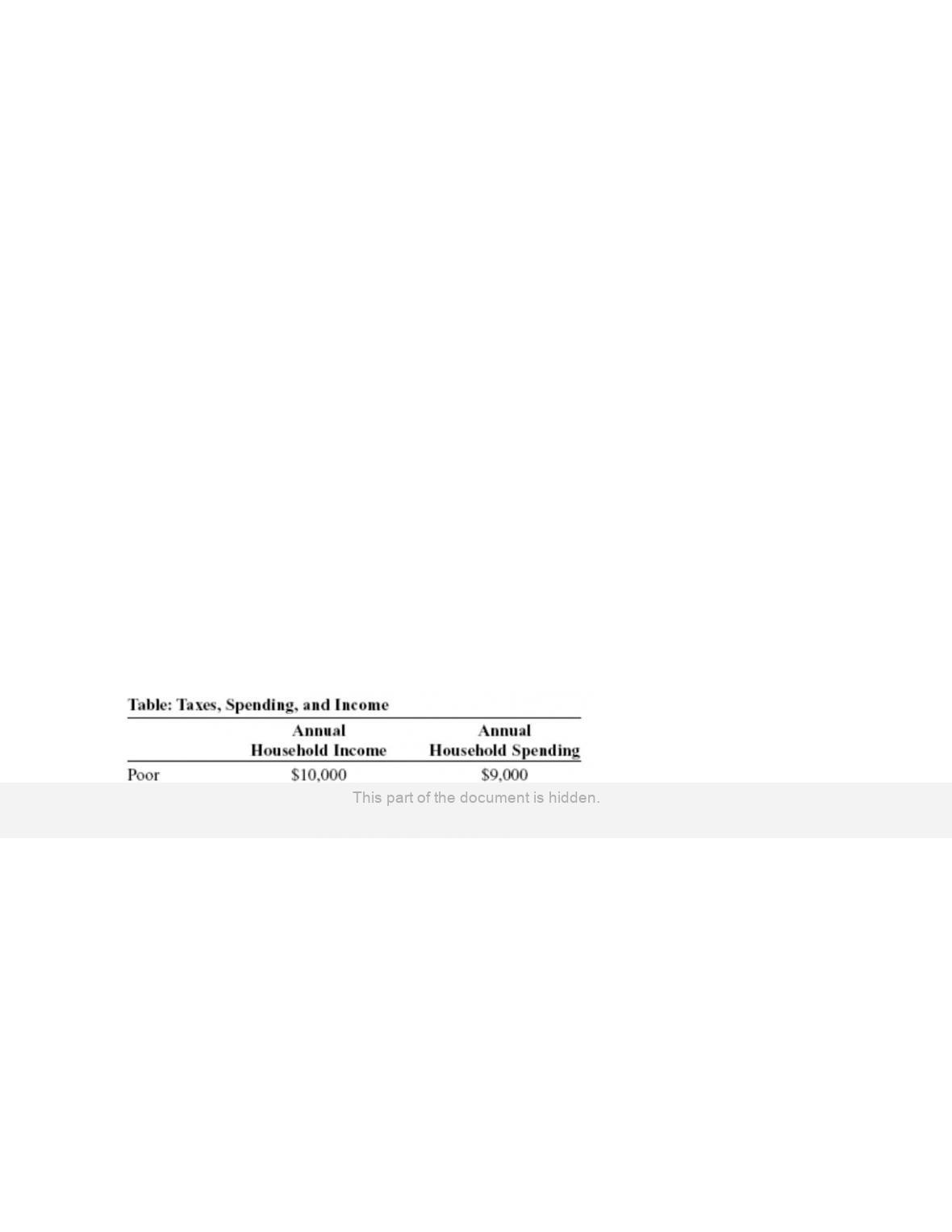
(Table: Taxes, Spending, and Income) Use Table: Taxes, Spending, and Income.
Suppose Governor Meridias decides to initiate a state tax of 5% on all sales. This tax
will be:
A)
progressive.
B)
proportional.
C)
regressive.
D)
structural.
Page 38
175.
(Table: Taxes, Spending, and Income) Use Table: Taxes, Spending, and Income.
Suppose Governor Meridias decides to initiate a state tax of 5% on all sales. A poor
household will spend _____% of its annual income on the sales tax, while a wealthy
household will spend _____% of its annual income.
A)
4.5; 4
B)
5; 5
C)
5; 3.5
D)
3.5; 4.5
176.
(Table: Taxes, Spending, and Income) Use Table: Taxes, Spending, and Income.
Suppose Governor Meridias decides to initiate a state income tax. The first $50,000 of
household income is tax-free, while any income above $50,000 is taxed at 10%. The tax
rate for a household earning $75,000 is _____%.
A)
10
B)
5
C)
3.3
D)
0
177.
(Table: Taxes, Spending, and Income) Use Table: Taxes, Spending, and Income.
Suppose Governor Meridias initiates a tax of 10% on all income up to $50,000. Income
above $50,000 is not taxed. An individual earning $75,000 will have a average tax rate
of _____%.
A)
10
B)
0
C)
6.67
D)
5
178.
If personal income up to and including $25,000 is not taxed, income of $25,001 to
$50,000 is taxed at 10%, and income over $50,000 is taxed at 25%, a family earning
income equal to $60,000 will pay a marginal tax rate of _____% and a average tax rate
of _____%.
A)
12.5; 25
B)
10; 15
C)
25; 8.3
D)
25; 25
179.
The _____ rate applies to an additional $1 of taxable income.
A)
marginal tax
B)
tax
C)
total tax
D)
lower tax
Page 39
180.
Eli has annual earnings of $100,000 and Molly has annual earnings of $50,000. Each
consumer goes to the mall and purchases a microwave oven for $100, and each pays an
additional 7%, or $7, in sales tax. This tax is:
A)
regressive.
B)
a wealth tax.
C)
progressive.
D)
a property tax.
181.
U.S. federal taxes are generally _____, while state and local taxes are generally _____.
A)
progressive; progressive
B)
progressive; regressive
C)
regressive; progressive
D)
regressive; regressive
182.
The U.S. income tax is _____, while the FICA tax is _____.
A)
progressive; progressive
B)
progressive; regressive
C)
regressive; progressive
D)
regressive; regressive
183.
The _____ rate on income represents the additional tax an individual pays if his or her
income goes up by $1. This rate has _____ since 2000.
A)
tax; increased
B)
marginal tax; decreased
C)
marginal tax; increased
D)
tax; decreased
184.
_____ and _____ taxes are the LARGEST sources of state and local government
revenue.
A)
Profit; sales
B)
Property; sales
C)
FICA; income
D)
Sales; income
185.
Sales taxes are considered to be:
A)
proportional.
B)
progressive.
C)
digressive.
D)
regressive.

Page 40
186.
FICA taxes are considered to be:
A)
proportional.
B)
progressive.
C)
flat.
D)
regressive.
187.
The evidence suggests that federal taxes in the U.S. economy are:
A)
regressive.
B)
progressive.
C)
higher than they’ve ever been before.
D)
proportional.
188.
The evidence suggests that taken collectively, taxes in the U.S. economy are:
A)
extremely regressive.
B)
extremely progressive.
C)
somewhat progressive.
D)
proportional.
189.
Sales taxes are considered to be:
A)
an unfair burden on wealthy people, who spend more money on goods subject to
sales tax.
B)
progressive.
C)
the most important source of revenue for the federal government.
D)
regressive.
190.
The structure of the U.S. federal income tax system reflects the _____ principle.
A)
efficiency
B)
ability-to-pay
C)
benefits
D)
lump-sum
191.
Which tax is the LARGEST source of federal government revenue?
A)
sales
B)
property
C)
individual income
D)
death