Page 1
Name: __________________________ Date: _____________
1.
Suppose the government imposes a $10 excise tax on the sale of sweaters by charging
suppliers $10 for each sweater sold. If the demand curve is downward-sloping and the
supply curve is upward-sloping:
A)
the price of sweaters will increase by $10.
B)
consumers of sweaters will bear the entire burden of the tax.
C)
the price of sweaters will increase by less than $10.
D)
the price of sweaters will decrease by $10.
2.
An excise tax that the government collects from the producers of a good:
A)
shifts the supply curve upward.
B)
reduces revenue for the government.
C)
has an effect similar to that of a tax subsidy.
D)
shifts the supply curve downward.
3.
Recently, the government considered adding an excise tax on CDs that can be used to
record music and CD players that can record discs. If this tax were enacted, the MOST
likely effect would be:
A)
that consumers would pay a higher price and producers would sell fewer of these
CDs and CD players than before the tax.
B)
no change in consumption or the prices paid by consumers of these CDs and CD
players.
C)
that consumers would pay a lower price and producers would receive a higher price
for these CDs and CD players than before the tax.
D)
an increase in economic activity due to the tax.
4.
If an excise tax is imposed on automobiles and collected from consumers, the:
A)
demand curve will shift downward by the amount of the tax.
B)
supply curve will shift upward by the amount of the tax.
C)
equilibrium quantity supplied will increase relative to the pretax level.
D)
equilibrium quantity demanded will increase relative to the pretax level.
5.
The incidence of a tax:
A)
is a measure of the revenue the government receives from it.
B)
refers to who writes the check to the government.
C)
refers to how much of the tax is actually paid by consumers and producers.
D)
is a measure of the deadweight loss from the tax.
Page 2
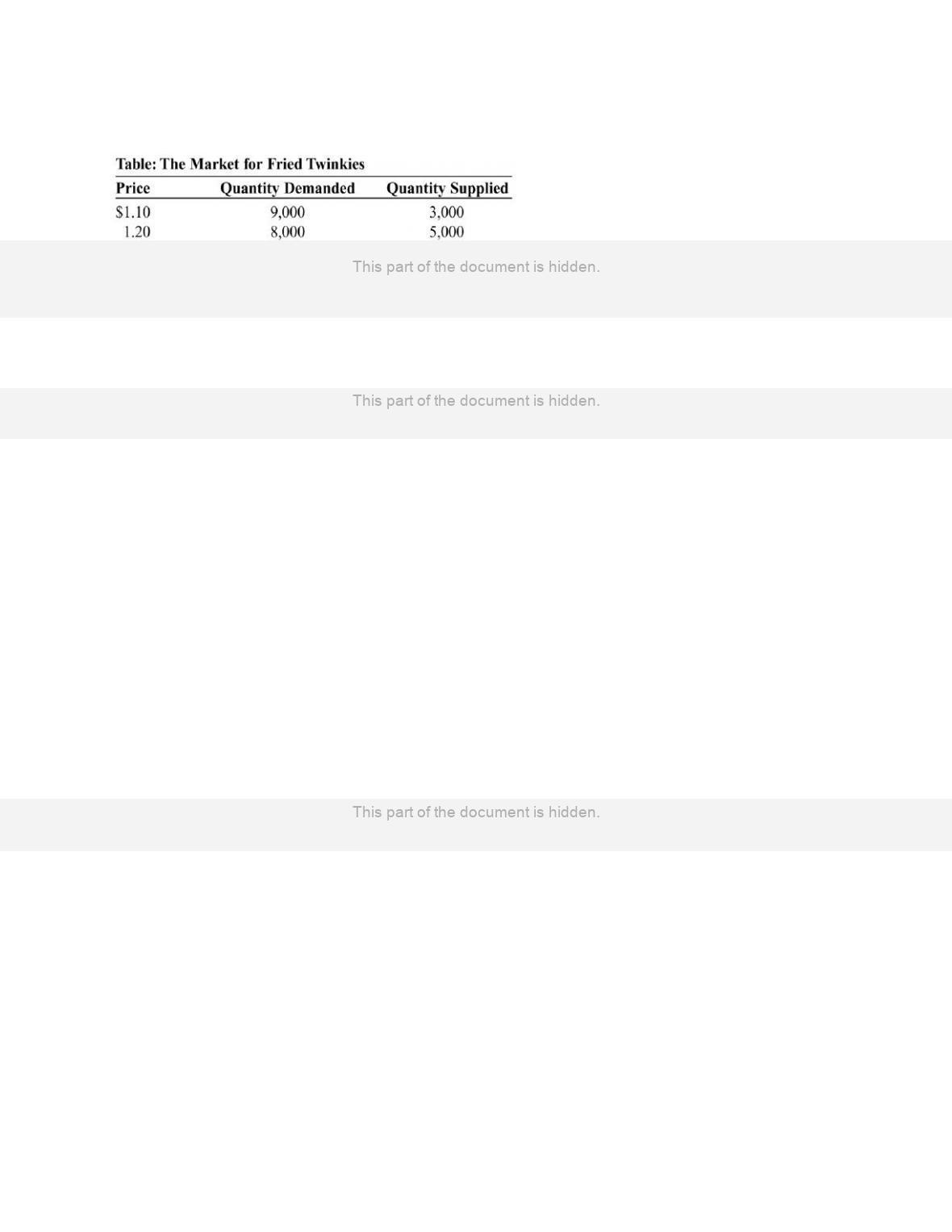
Use the following to answer questions 6-9:
6.
(Table: The Market for Fried Twinkies) Use Table: The Market for Fried Twinkies. The
government decides to tax fried Twinkies at a rate of $0.30 per Twinkie and collect that
tax from the producers. According to the table, consumers will pay _____ per Twinkie
and buy _____ Twinkies after the tax.
A)
$1.20; 8,000
B)
$1.30; 7,000
C)
$1.40; 6,000
D)
$1.50; 5,000
7.
(Table: The Market for Fried Twinkies) Use Table: The Market for Fried Twinkies. Of
the $0.30 tax per fried Twinkie, consumers actually pay _____, while producers actually
pay _____.
A)
$0.30; $0.00
B)
$0.15; $0.15
C)
$0.20; $0.10
D)
$0.00; $0.30
8.
(Table: The Market for Fried Twinkies) Use Table: The Market for Fried Twinkies. The
government decides to tax fried Twinkies at a rate of $0.30 per Twinkie and collect that
tax from the producers. After paying the tax, producers will receive _____ per Twinkie,
and they will sell _____ Twinkies after the tax.
A)
$1.10; 3,000
B)
$1.20; 5,000
C)
$1.30; 7,000
D)
$1.50; 5,000
9.
(Table: The Market for Fried Twinkies) Use Table: The Market for Fried Twinkies. As
a result of the $0.30 tax per fried Twinkie, the government will receive total tax revenue
of:
A)
$500.
B)
$1,000.
C)
$1,500.
D)
The total is impossible to calculate.
10.
(Figure: An Excise Tax) Use Figure: An Excise Tax. If an excise tax equal to $1.10 is
imposed on this good, then the price paid by consumers will:
A)
rise by $1.10.
B)
rise by $1.33.
C)
not rise.
D)
rise by $0.50.
11.
The burden of a tax on a good is said to fall completely on the consumers if the:
A)
price paid by consumers for the good declines by the amount of the tax.
B)
price paid by consumers for the good increases by the amount of the tax.
C)
price paid by consumers does not change.
D)
wages received by workers who produce the good increase by the amount of the
tax.
12.
The burden of a tax on a good is said to fall completely on the producers if the:
A)
price paid by consumers for the good declines by the amount of the tax.
B)
price paid by consumers for the good increases by the amount of the tax.
C)
price paid by consumers does not change.
D)
wages received by workers who produce the good increase by the amount of the
tax.
Page 4
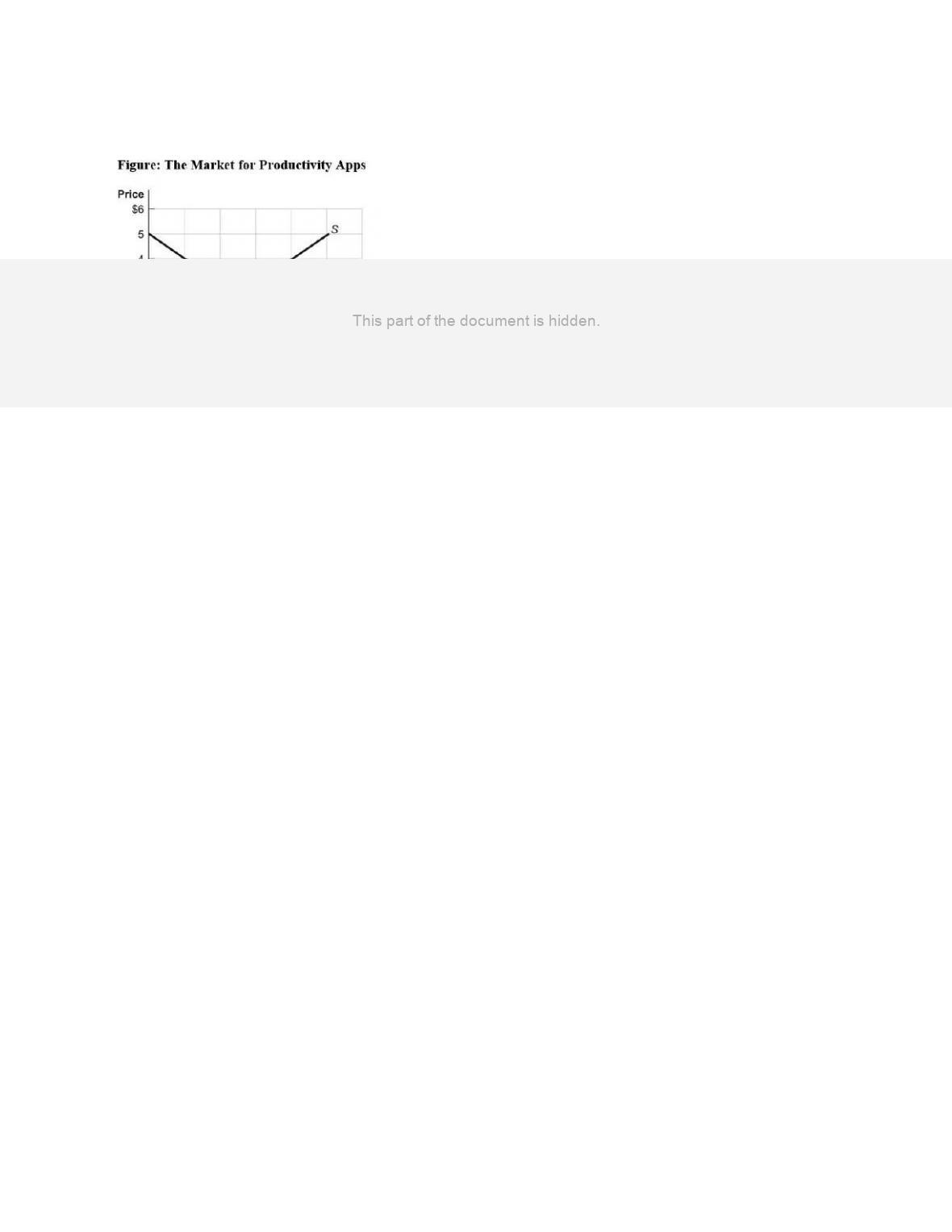
Use the following to answer questions 13-14:
13.
(Figure: The Market for Productivity Apps) Use Figure: The Market for Productivity
Apps. If the government imposes a tax of $1 in this market, consumers will pay _____
more per app and purchase _____ fewer apps.
A)
$1; 5
B)
$1; 25
C)
$0.50; 5
D)
$0.50; 20
14.
(Figure: The Market for Productivity Apps) Use Figure: The Market for Productivity
Apps. If the government imposes a tax of $1 in this market, producers will receive
_____ less per app and sell _____ fewer apps.
A)
$1; 5
B)
$1; 25
C)
$0.50; 5
D)
$0.50; 20
15.
If an excise tax is imposed on wine and collected from the consumers, the _____ curve
will shift _____ by the amount of the tax.
A)
demand; upward
B)
demand; downward
C)
supply; upward
D)
supply; downward

Page 5
16.
If an excise tax is imposed on beer and collected from the producers, the _____ curve
will shift _____ by the amount of the tax.
A)
demand; upward
B)
demand; downward
C)
supply; upward
D)
supply; downward
17.
Assuming a normal upward-sloping supply curve and downward-sloping demand curve,
if the government imposes a $5 excise tax on leather shoes and collects the tax from the
suppliers, the price of leather shoes will:
A)
increase by $5.
B)
increase by more than $5.
C)
increase by less than $5.
D)
increase, but we cannot determine by how much.
18.
If the government imposes a $5 excise tax on leather shoes and the price of leather shoes
increases by $2:
A)
the government will receive less tax revenue than anticipated.
B)
consumers are paying more of the tax than the producers.
C)
producers are paying more of the tax than are the consumers.
D)
the quantity of shoes sold will increase.
19.
If the government imposes a $5 excise tax on leather shoes and the price of leather shoes
does not change:
A)
the government will receive less tax revenue than anticipated.
B)
consumers are paying all of the tax.
C)
producers are paying all of the tax.
D)
consumers and producers are paying equal amounts of the tax.
20.
State governments levy excise taxes on alcohol because:
A)
they want to subsidize alcohol production.
B)
they want to encourage individuals to produce their own alcohol.
C)
it discourages drinking alcohol while raising revenue for the government.
D)
it is politically popular with religious groups.
21.
Tax incidence refers to:
A)
who writes the check to the government.
B)
who really pays the tax.
C)
the deadweight loss from the tax.
D)
the total revenue that the government collects from the tax.
Page 6
22.
An excise tax is levied on:
A)
each unit of a good or service that is sold.
B)
earnings.
C)
the ownership of real estate.
D)
the inheritance of assets.
23.
Prior to any taxes, the equilibrium price of gasoline is $3 per gallon. Then a
$1-per-gallon tax is levied. As a result, the price of gasoline rises to $3.75 per gallon.
The incidence of the $1 tax is _____ paid by consumers and _____ paid by producers.
A)
$0.25; $0.75
B)
$0.50; $0.50
C)
$0; $1.00
D)
$0.75; $0.25
24.
Which tax is an excise tax?
A)
a tax of $0.41 per gallon of gas
B)
a tax of 12.4% of your wages
C)
a tax on the value of your property
D)
a one-time local per capita tax of $50
25.
An excise tax is levied on suppliers. The incidence of the tax:
A)
is typically on the consumer more than the producer.
B)
is typically on the producer more than the consumer.
C)
is typically split equally between the producer and the consumer.
D)
cannot be determined without more information.
Page 7
26.
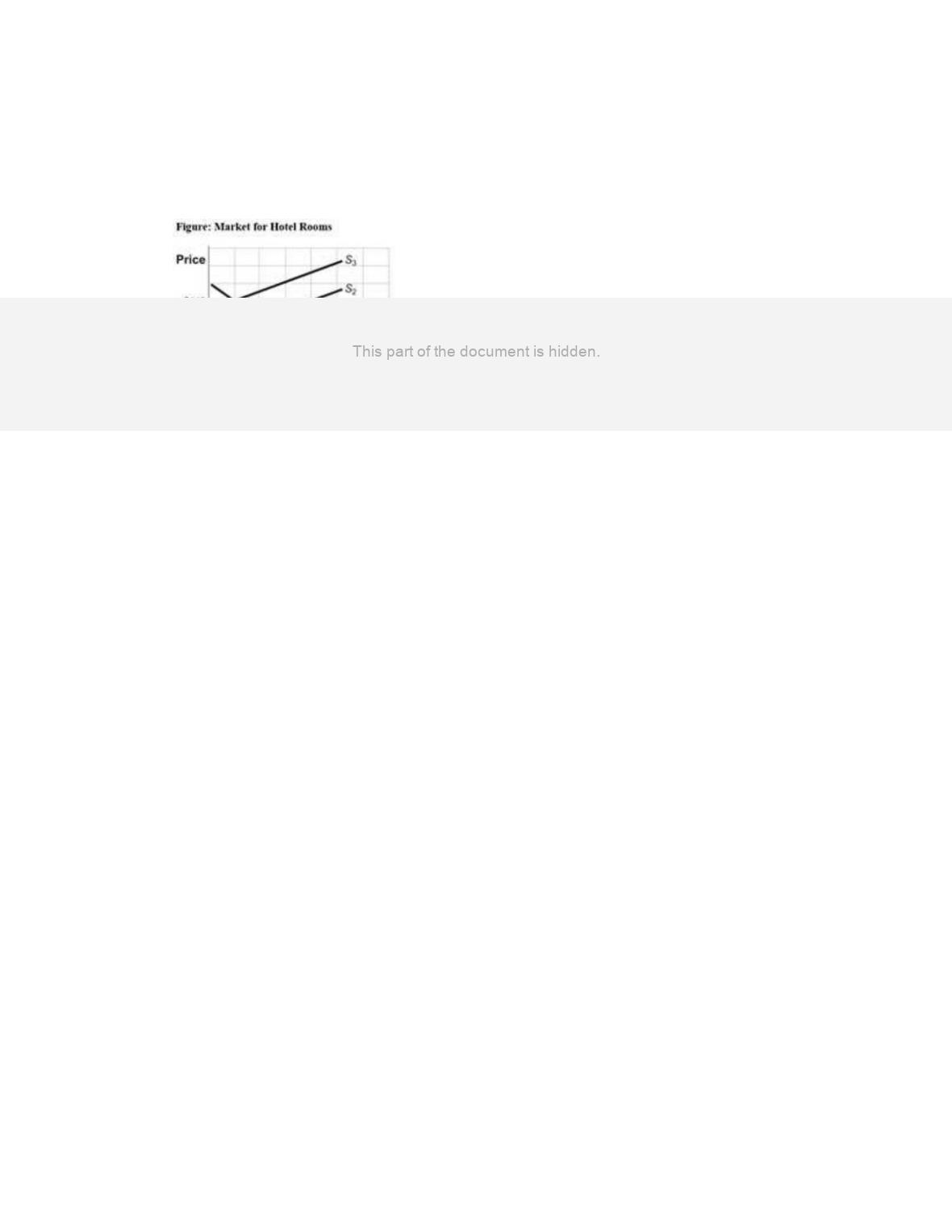
(Figure: The Market for Hotel Rooms) Use Figure: The Market for Hotel Rooms.
Suppose with no tax the equilibrium price is $110 and the equilibrium quantity is 250. If
the local government levies a tax of $30 per night on each hotel room rented, the new
equilibrium price will equal _____ and the new equilibrium quantity will equal _____.
A)
$140; 100
B)
$130; 150
C)
$120; 200
D)
$110; 250
27.
Taxes on the purchase of specific items such as gasoline, cigarettes, or alcoholic
beverages are called _____ taxes.
A)
personal income
B)
excise
C)
property
D)
sales
28.
Determining who bears the burden of the tax is a question about:
A)
tax incidence.
B)
externality analysis.
C)
public interest theory.
D)
public choice theory.
29.
Tax incidence analysis seeks to determine:
A)
who sends the tax payment to the government.
B)
who actually pays the tax.
C)
who ultimately gets the tax revenue.
D)
whether a tax is in the benefits-received category or the ability-to-pay category.

Page 8
30.
Determining who actually pays the cost imposed by a tax is the study of:
A)
public interest theory.
B)
rational choice theory.
C)
tax incidence.
D)
budget analysis.
31.
The burden of a tax on a good falls at least partially on consumers if the:
A)
price paid by consumers for the good declines.
B)
price paid by consumers for the good increases.
C)
wages received by workers who produce the good decline.
D)
wages received by workers who produce the good increase.
32.
Suppose the absolute value of the price elasticity of demand for yachts equals 4.04,
while the price elasticity of supply for yachts equals 0.22. If Congress reinstates a
luxury tax on yachts, who will pay more of the tax?
A)
Yacht builders will pay more.
B)
Yacht buyers will pay more.
C)
Yacht builders and buyers will pay equally.
D)
It’s impossible to tell without additional information.
33.
State governments levy excise taxes on cigarettes because:
A)
they want to subsidize tobacco farming.
B)
they want to discourage cigarette smuggling.
C)
it is an easy way to raise tax revenue while discouraging smoking.
D)
they want to minimize the tax burden on consumers.
34.
Suppose the government levies a $4 per month excise tax on cable TV. If the demand
for cable TV is relatively (but not perfectly) inelastic and the supply curve is relatively
(but not perfectly) elastic, then the price of cable TV will:
A)
increase by more than $4.
B)
increase by exactly $4.
C)
increase by less than $4.
D)
remain constant.
Page 9
35.
Suppose the government imposes a $4 per month excise tax on cable TV. If the demand
for cable TV is perfectly inelastic and the supply curve is elastic (but not perfectly
elastic), then the price of cable TV will:
A)
increase by more than $4.
B)
increase by exactly $4.
C)
increase by less than $4.
D)
remain constant.
36.
If the demand curve is downward-sloping and supply is perfectly elastic, then the
burden of an excise tax is:
A)
borne entirely by consumers.
B)
borne entirely by producers.
C)
shared by consumers and producers, with the burden falling mainly on consumers.
D)
shared by consumers and producers, with the burden falling mainly on producers.
37.
If demand is perfectly inelastic and the supply curve is upward-sloping, then the burden
of an excise tax is:
A)
borne entirely by consumers.
B)
borne entirely by producers.
C)
shared by consumers and producers, with the burden falling mainly on consumers.
D)
shared by consumers and producers, with the burden falling mainly on producers.
38.
As part of an anti-obesity program, the government levies an excise tax on high-fat
foods. We expect consumers to pay almost all of this tax if demand is _____ and supply
is _____.
A)
inelastic; inelastic
B)
inelastic; elastic
C)
elastic; elastic
D)
elastic; inelastic
39.
Suppose the government imposes a $10 per month tax on cell phone service. If the
demand curve for cell phone service is perfectly inelastic and the supply curve is
upward-sloping, the monthly price for cell phone service will increase by:
A)
$5.
B)
less than $10.
C)
$10.
D)
$0.
Page 10
40.
Suppose the government imposes a $9 per month tax on cell phone service. If the
demand curve for cell phone service is perfectly elastic and the supply curve is
upward-sloping, the monthly price for cell phone service will:
A)
increase by $4.50.
B)
increase by more than $9.
C)
increase by $9.
D)
not change.
41.
The price elasticity of demand for a particular cancer drug is zero and the price elasticity
of supply is 0.50. If a $1 excise tax is levied on producers, how much of this tax will
eventually be paid by consumers?
A)
$0
B)
$1
C)
$0.50
D)
$1.50
42.
The demand for food is very inelastic compared to the supply of food, so if a tax is
imposed on the consumers of food, the tax incidence:
A)
is typically on consumers more than producers.
B)
is typically on producers more than consumers.
C)
is typically split equally between consumers and producers.
D)
cannot be determined without more information.
43.
Demand for Gala apples is relatively elastic compared to the supply of Gala apples, so if
a tax is imposed on the consumers of Gala apples, the tax incidence:
A)
is typically on consumers more than producers.
B)
is typically on producers more than consumers.
C)
is typically split equally between consumers and producers.
D)
cannot be determined without more information.
44.
Economic analysis shows that workers pay _____ of the FICA.
A)
exactly half
B)
very little
C)
most
D)
none
Page 11
45.
When workers earn income, they and their employer pay equal portions of FICA (the
Federal Insurance Contributions Act). Which statement is TRUE?
A)
The worker and the employer each bear half of the burden (incidence) of the tax.
B)
The employer bears almost all of the burden of the tax.
C)
The worker bears almost all of the burden of the tax.
D)
It’s impossible to determine who bears the burden of the tax.
46.
By law, FICA (the Federal Insurance Contributions Act), a payroll tax, is collected
equally from employers and employees. In reality:
A)
the law works since the employers and the employees each bear half of the burden
of the tax.
B)
the employees bear almost all of the burden of the tax.
C)
the employers bear almost all of the burden of the tax.
D)
it’s impossible to determine who bears the burden of the tax.
Use the following to answer questions 47-48:
47.
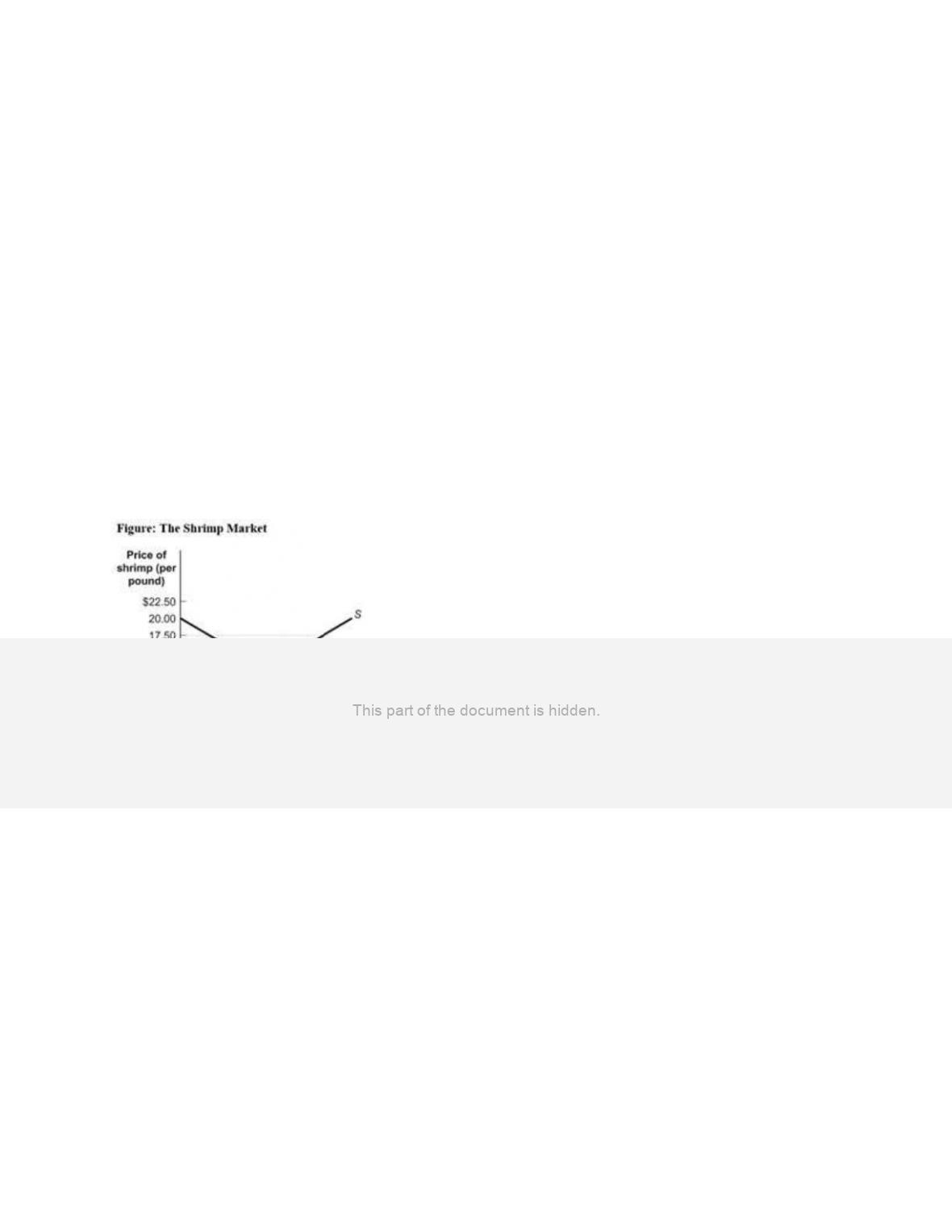
(Figure: The Shrimp Market) Use Figure: The Shrimp Market. If the government wants
to limit shrimp sales to 500 pounds, it can impose a _____ excise tax on sellers, and the
total tax revenue generated will be _____.
A)
$5; $2,500
B)
$7.50; $7,500
C)
$10; $2,500
D)
The answer cannot be determined from the information provided.
Page 12
48.
(Figure: The Shrimp Market) Use Figure: The Shrimp Market. If the government wants
to limit shrimp sales to 250 pounds, it can impose a _____ excise tax on sellers, and the
total tax revenue generated will be _____.
A)
$5; $2,500
B)
$7.50; $7,500
C)
$10; $2,500
D)
The answer cannot be determined from the information provided.
49.
A higher tax rate is more likely to increase tax revenue if the price elasticity of demand
is _____ and the price elasticity of supply is _____.
A)
high; high
B)
low; low
C)
low; high
D)
high; low
50.
The amount of tax levied per unit of good or service is called the tax:
A)
incidence.
B)
rate.
C)
revenue.
D)
surplus.
51.
A higher rate is MOST likely to decrease the amount of revenue that the government
collects from an excise tax if demand is _____ and supply is _____.
A)
elastic; elastic
B)
elastic; inelastic
C)
inelastic; elastic
D)
inelastic; inelastic
52.
If demand and supply are both very inelastic, a decrease in the rate of an excise tax will
likely:
A)
decrease government revenue.
B)
increase government revenue.
C)
not affect government revenue.
D)
make demand and supply both elastic.
Page 13
53.
If demand and supply are both very elastic, a decrease in the rate of an excise tax will
likely:
A)
decrease government revenue.
B)
increase government revenue.
C)
not affect government revenue.
D)
make demand and supply both inelastic.
54.
If the elasticity of demand is _____ and the elasticity of supply is _____, tax revenue is
likely to decrease if the tax rate is increased.
A)
3.3; 2.1
B)
3.3; 0.5
C)
0.2; 2.1
D)
0.2; 0.5
55.
If the elasticity of demand is _____ and the elasticity of supply is _____, tax revenue is
likely to increase if the tax rate is increased.
A)
3.3; 2.1
B)
3.3; 0.5
C)
0.2; 2.1
D)
0.2; 0.5
56.
If the United States removed all excise taxes on cigarettes, which effect would NOT
occur?
A)
a decrease in producer surplus
B)
an increase in producer surplus
C)
an increase in consumer surplus
D)
an increase in total surplus
57.
When the government imposes an excise tax in a market with a downward-sloping
demand curve and an upward-sloping supply curve:
A)
consumer surplus falls.
B)
producer surplus falls.
C)
a deadweight loss occurs.
D)
consumer surplus falls, producer surplus falls, and a deadweight loss occurs.
Page 14
58.
If the government removed the excise tax on gasoline, assuming that neither demand nor
supply is perfectly inelastic, which effect would NOT occur?
A)
an increase in consumer surplus
B)
an increase in producer surplus
C)
a decrease in producer surplus
D)
an increase in total surplus
59.
The deadweight loss from an excise tax comes about because:
A)
the number of transactions in the market is smaller than the no-tax equilibrium.
B)
some mutually beneficial transactions do not take place.
C)
a quota rent exists.
D)
the number of transactions in the market is reduced and some mutually beneficial
transactions do not take place.
60.
An excise tax causes inefficiency if the number of transactions in a market is reduced as
a result of the tax. Because the tax discourages mutually beneficial transactions, there is
a(n) _____ from a tax.
A)
quota rent
B)
deadweight loss
C)
increased consumer surplus
D)
increased producer surplus
61.
A tax leads to a(n) _____ in consumer surplus and a(n) _____ in producer surplus.
A)
increase; increase
B)
increase; decrease
C)
decrease; increase
D)
decrease; decrease
62.
The burden of a tax system comes from its:
A)
effect on elasticity.
B)
effect on marginal incentives.
C)
inequity.
D)
government revenue.
63.
Assume the same upward supply curve for each of the following goods. Considering
demand only, a tax on _____ would result in the LARGEST deadweight loss.
A)
gasoline
B)
medicine
C)
restaurant meals
D)
tobacco
Page 15
64.
If the government decides to impose a $700 tax on U.S. citizens vacationing abroad,
then the deadweight loss from this tax will be:
A)
relatively small.
B)
relatively large.
C)
zero.
D)
absorbed by foreign governments.
65.
The number of seats in a football stadium is fixed at 70,000. The city decides to impose
a tax of $10 per ticket. In response, the team management raises the ticket price from
$30 to $40 and still sells all 70,000 tickets. The tax caused a change in the consumer
surplus of _____, a change in the producer surplus of _____, and a deadweight loss of
_____.
A)
–$10; $0; $10
B)
–$700,000; $0; $700,000
C)
–$10; $0; $0
D)
–$700,000; $0; $0
66.
Excise taxes that raise the MOST revenue and cause the LEAST deadweight loss are
likely to be levied on goods for which demand is _____ and supply is _____.
A)
inelastic; elastic
B)
inelastic; inelastic
C)
elastic; inelastic
D)
elastic; elastic
67.
The governor wants to levy a $1 excise tax on a product but wants to minimize the
deadweight loss. The deadweight loss will be LEAST when the demand curve is _____
and the supply curve is _____.
A)
elastic; elastic
B)
elastic; inelastic
C)
inelastic; elastic
D)
inelastic; inelastic
68.
If the demand for luxury yachts is very elastic, then a yacht tax would lead to:
A)
a large deadweight loss.
B)
no deadweight loss.
C)
a small deadweight loss.
D)
a large amount of tax revenue but no deadweight loss.
Page 16
69.
If demand is downward-sloping and supply is upward-sloping, which statement about
the effects of an excise tax is INCORRECT?
A)
The lower the elasticity of supply relative to the elasticity of demand, the lower the
burden of the tax borne by suppliers.
B)
An excise tax causes a deadweight loss because consumer and producer surpluses
are reduced by more than the revenue the government collects.
C)
An excise tax drives a wedge between the price paid by consumers and the price
received by producers.
D)
An excise tax is inefficient because it distorts incentives at the margin for both
consumers and producers.
70.
If the government wants to minimize the deadweight loss from taxes, it should tax
goods for which the:
A)
price elasticity of demand is high.
B)
price elasticity of demand is low.
C)
price elasticity of supply is high.
D)
demand is high.
71.
If the government levies an excise tax in a market whose demand curve is perfectly
inelastic, the burden of the tax will fall completely on the _____, and the deadweight
loss will equal _____.
A)
consumers; zero
B)
producers; zero
C)
consumers; the tax revenue
D)
producers; the tax revenue
72.
If the government levies an excise tax in a market whose supply curve is perfectly
inelastic, the burden of the tax will fall completely on the _____, and the deadweight
loss will equal _____.
A)
consumers; zero
B)
producers; zero
C)
consumers; the tax revenue
D)
producers; the tax revenue
73.
If you want to reduce the inefficiency costs of taxation, you should devise taxes to fall
on goods for which the supply is _____ and the demand is _____.
A)
elastic; elastic
B)
inelastic; inelastic
C)
elastic; inelastic
D)
inelastic; elastic
Page 17
74.
If the main purpose of a tax is to decrease the amount of a harmful activity, such as
underage drinking, the government should impose it on harmful activities whose supply
is _____ and demand is _____.
A)
elastic; elastic
B)
inelastic; inelastic
C)
elastic; inelastic
D)
inelastic; elastic
75.
Given any downward-sloping demand curve for a good, the more price-elastic the
supply curve, the _____ equilibrium output will fall and the _____ will be the
deadweight loss when the government imposes an excise tax.
A)
more; smaller
B)
more; larger
C)
less; smaller
D)
less; larger
76.
Given any downward-sloping demand curve for a good, the more inelastic the supply
curve, the _____ equilibrium output will fall and the _____ will be the deadweight loss
when the government imposes an excise tax.
A)
more; smaller
B)
more; larger
C)
less; smaller
D)
less; larger
77.
Given any upward-sloping supply curve for a good, the more elastic the demand curve,
the _____ equilibrium output will fall and the _____ will be the deadweight loss when
the government imposes an excise tax.
A)
more; smaller
B)
more; larger
C)
less; smaller
D)
less; larger
78.
Given any upward-sloping supply curve for a good, the more inelastic the demand
curve, the _____ equilibrium output will fall and the _____ will be the deadweight loss
when the government imposes an excise tax.
A)
more; smaller
B)
more; larger
C)
less; smaller
D)
less; larger

Page 18
79.
An analysis of the effect of excise taxes on markets allows us to conclude that:
A)
when the price elasticity of supply is equal to zero, an excise tax falls entirely on
the consumers.
B)
when the price elasticity of demand is lower than the price elasticity of supply, an
excise tax falls mainly on the producers.
C)
whether the tax is levied on consumers or producers, the quantity sold will be the
same.
D)
when the price elasticity of demand is higher than the price elasticity of supply, an
excise tax falls mainly on the consumers.
80.
The deadweight loss from an excise tax is largest if demand is _____ and supply is
_____.
A)
elastic; inelastic
B)
inelastic; elastic
C)
inelastic; inelastic
D)
elastic; elastic
81.
If the demand for good X is perfectly inelastic and a tax is levied on the producers of
each unit:
A)
consumers pay the entire tax, and deadweight loss will occur because the
equilibrium quantity of good X falls.
B)
consumers pay the entire tax, and there is no deadweight loss because the
equilibrium quantity of good X remains constant.
C)
consumers and producers share the burden of the tax, and there is no deadweight
loss because the equilibrium quantity of good X remains constant.
D)
producers pay the entire tax, and deadweight loss will occur because the
equilibrium quantity of good X falls.
82.
To minimize deadweight loss, markets where demand is relatively _____ and supply is
relatively _____ should be taxed.
A)
elastic; inelastic
B)
elastic; elastic
C)
inelastic; elastic
D)
inelastic; inelastic
83.
If demand is inelastic, then deadweight loss will:
A)
be minimized if supply is also inelastic.
B)
be maximized if supply is also inelastic.
C)
decrease if demand becomes more elastic.
D)
increase if supply becomes more inelastic.
Page 19
Use the following to answer questions 84-86:
84.
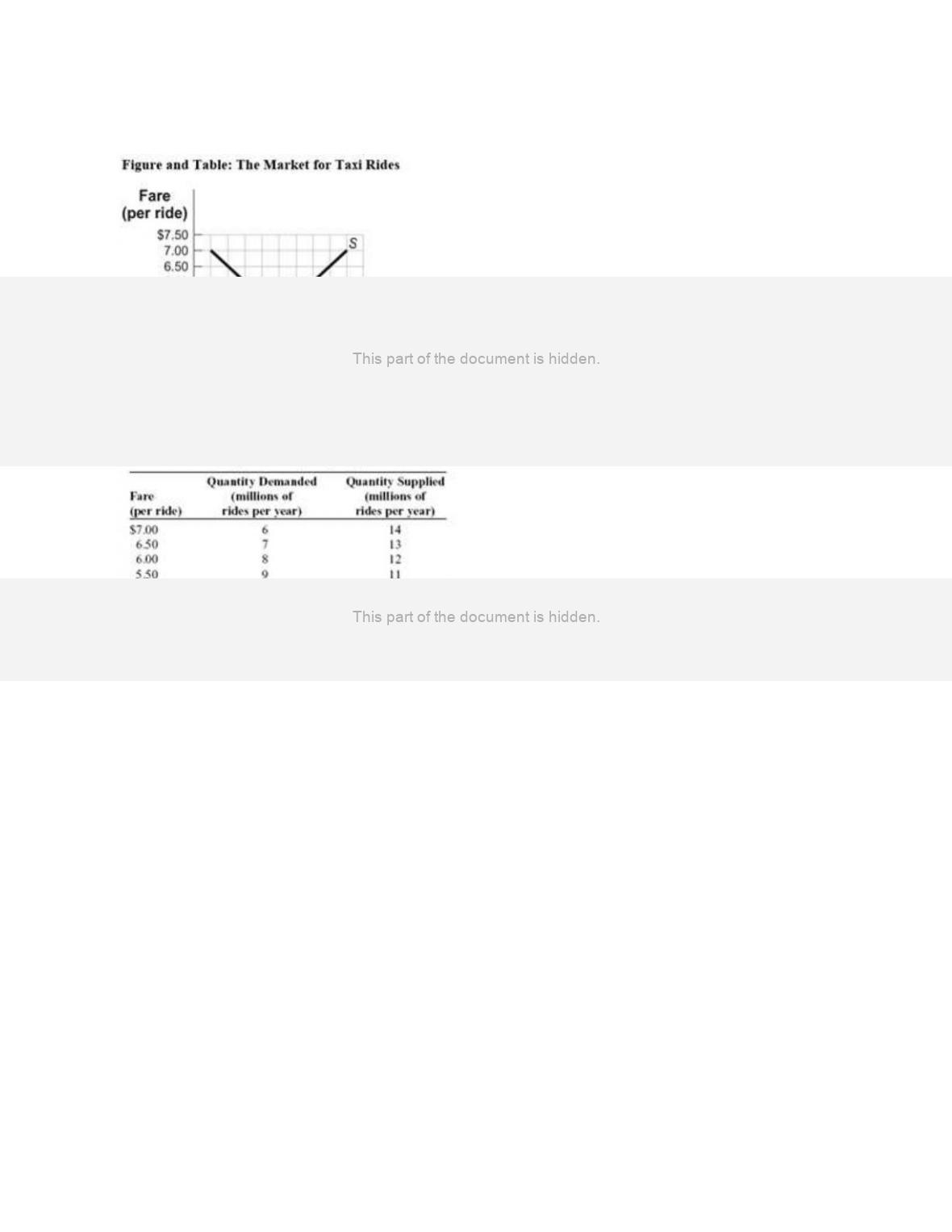
(Figure and Table: The Market for Taxi Rides) Use Figure and Table: The Market for
Taxi Rides. If the government imposes an excise tax of $1 per ride (causing the supply
curve to shift upward by that amount), then the government will collect tax revenues of
_____. However, the tax will cause a _____ deadweight loss to society.
A)
$9 million; $0.5 million
B)
$16 million; $1 million
C)
$45 million; $1 million
D)
$50 million; $0.5 million
85.
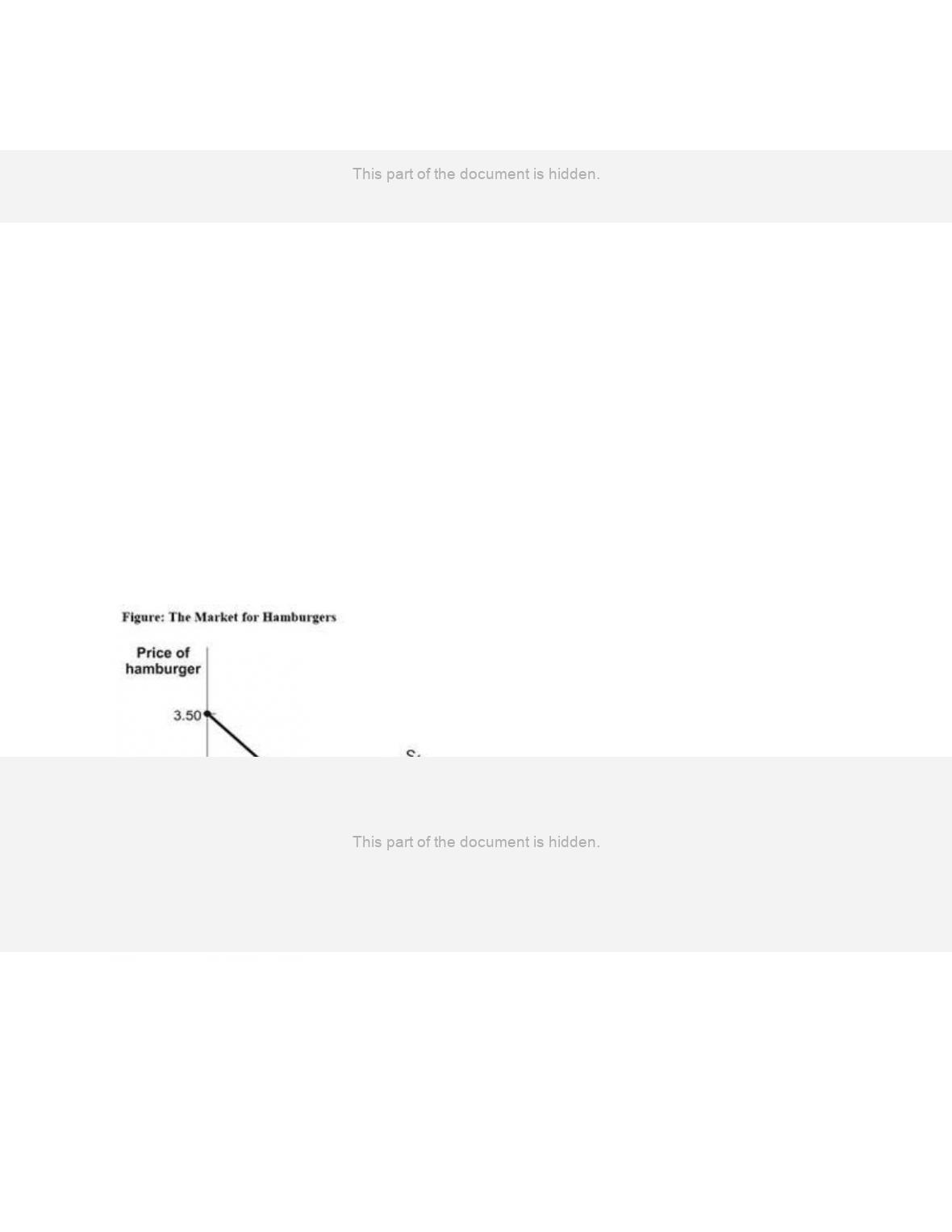
(Figure and Table: The Market for Taxi Rides) Use Figure and Table: The Market for
Taxi Rides. The figure represents a competitive market for taxi rides. If the government
imposes an excise tax of $2 per ride (causing the supply curve to shift upward by that
amount), then the government will collect tax revenues of _____, BUT the tax will
cause a _____ deadweight loss to society.
A)
$8 million; $1 million
B)
$16 million; $2 million
C)
$24 million; $4.5 million
D)
$48 million; $6 million
86.
(Figure and Table: The Market for Taxi Rides) Use Figure and Table: The Market for
Taxi Rides. If the government imposes an excise tax of $1 per ride (causing the supply
curve to shift upward by that amount), then people who ride taxis will pay _____ of
each $1 tax.
A)
$1
B)
$0.50
C)
$0.25
D)
$0.00
Use the following to answer questions 87-90: