Page 21
98.
If the quantity demanded of agricultural output is very unresponsive to a fall in price,
the demand for agricultural output is:
A)
price-elastic.
B)
price-inelastic.
C)
positively sloped.
D)
horizontal.
99.
Total revenue will decrease if the price goes _____ and demand is _____.
A)
up; perfectly price-inelastic
B)
up; price-inelastic
C)
down; price-elastic
D)
up; price-elastic
100.
If demand _____ and the University of Michigan increases the price of football tickets,
revenues will increase.
A)
is price-inelastic
B)
is price-elastic
C)
has price elasticity equal to 1
D)
is perfectly price-elastic
Use the following to answer questions 101-102:
101.
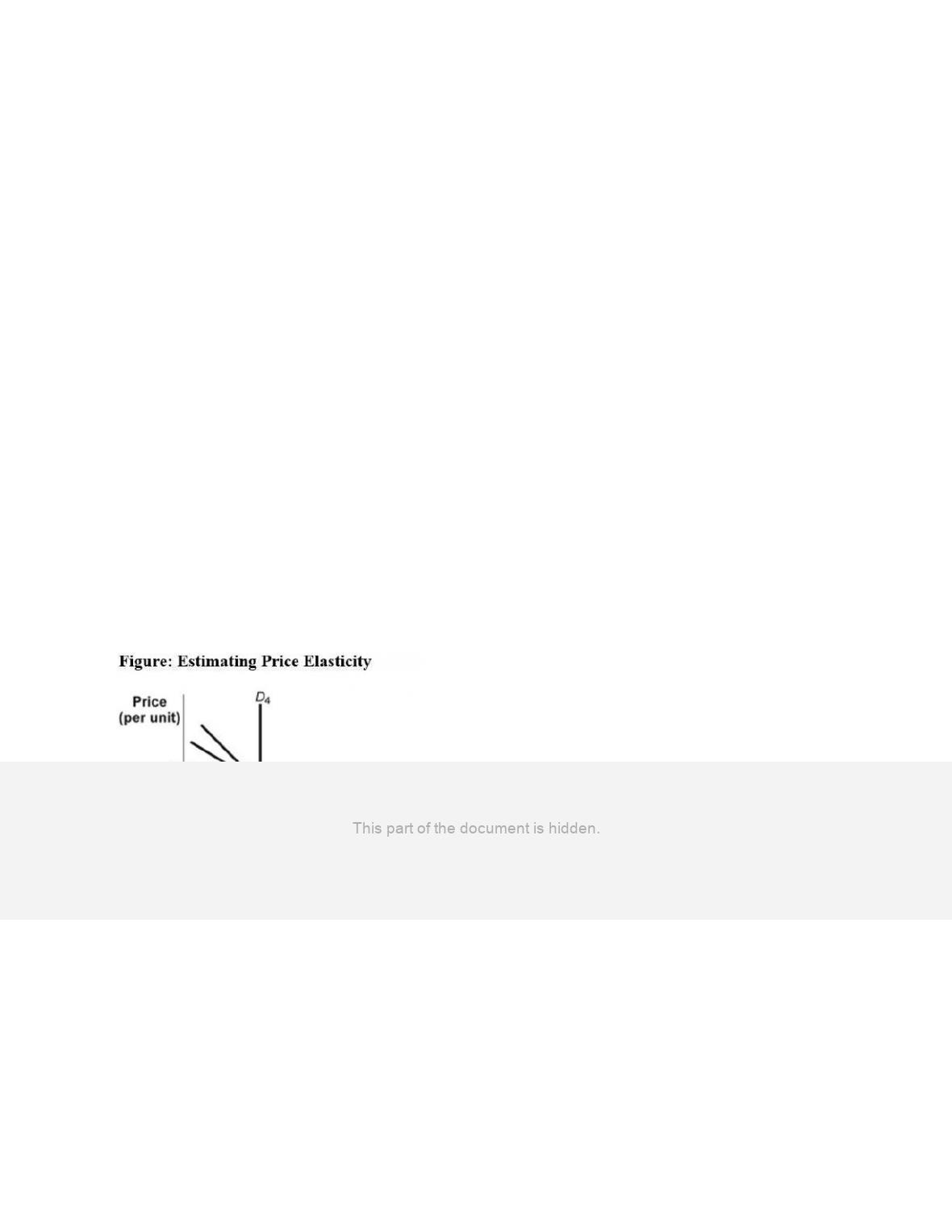
(Figure: Estimating Price Elasticity) Use Figure: Estimating Price Elasticity. Between
the two prices, P1 and P2, which demand curve has the LOWEST price elasticity?
A)
D1
B)
D2
C)
D3
D)
D4
Page 22
102.
(Figure: Estimating Price Elasticity) Use Figure: Estimating Price Elasticity. Between
the two prices, P1 and P2, which demand curve has the HIGHEST price elasticity?
A)
D1
B)
D2
C)
D3
D)
D4
103.
The price elasticity of demand along a demand curve with a constant slope:
A)
is equal to the slope.
B)
is greater than the slope.
C)
is less than the slope.
D)
increases in absolute value as the price rises.
104.
The price elasticity of demand along a demand curve with a constant slope:
A)
is equal to the slope.
B)
is greater than the slope.
C)
is less than the slope.
D)
decreases in absolute value as quantity demanded rises.
105.
On a linear demand curve:
A)
demand is elastic at high prices.
B)
demand is inelastic at high prices.
C)
elasticity is the same at all points on the demand curve.
D)
demand is elastic at low prices.
106.
A linear demand curve has:
A)
a constant price elasticity of demand.
B)
a price elasticity of demand equal to one at all prices.
C)
a calculated price elasticity of demand that is positive.
D)
both elastic and inelastic price elasticities of demand.
107.
On a linear demand curve, the price elasticity of demand at very high prices will be:
A)
price-inelastic.
B)
price-elastic.
C)
price unit-elastic.
D)
perfectly price-inelastic.

Page 23
108.
On a linear demand curve, demand at very low prices will be:
A)
price-inelastic.
B)
price-elastic.
C)
price unit-elastic.
D)
perfectly price-elastic.
109.
As you move down a linear demand curve, the price elasticity of demand will:
A)
increase.
B)
decrease.
C)
increase and then decrease.
D)
decrease and then increase.
110.
The demand for strawberry ice cream tends to be relatively price-elastic because:
A)
for most people, there are many close substitutes for strawberry ice cream.
B)
it costs so little.
C)
it has to be consumed very quickly.
D)
it is only popular in the summer.
111.
Which factor does NOT determine the price elasticity of demand?
A)
the number of available substitutes
B)
the time available to adjust to price changes
C)
the proportion of the budget spent on the item
D)
the slope of the supply curve
112.
If a good is a necessity with few substitutes, all others things equal, then demand will
tend to:
A)
be more price-elastic.
B)
be less price-elastic.
C)
have price elasticity equal to 1.
D)
be the same as that of a luxury good.
113.
If a good has a price-inelastic demand, then which statement is NOT likely to be
characteristic of this good?
A)
It is a necessity and is relatively small proportion of the household budget.
B)
It has many substitutes.
C)
Consumers spend a small percentage of their income on it.
D)
Consumers do not have much time to adjust to market changes.

Page 24
114.
There are several close substitutes for Bayer aspirin but fewer substitutes for a complete
medical examination. Therefore, all other things equal, you would expect the demand
for:
A)
medical examinations to be more price-elastic than is the demand for Bayer aspirin.
B)
Bayer aspirin to be more price-elastic than is the demand for medical examinations.
C)
Bayer aspirin to be more perfectly price-inelastic.
D)
the two to be equally price-elastic.
115.
If the price of emergency visits to the doctor rose, we would expect:
A)
a large decline in the number of emergency visits to the doctor.
B)
only a slight decline in the number of emergency visits to the doctor.
C)
the number of emergency visits to the doctor to increase.
D)
the total income of doctors to fall dramatically.
116.
If someone did not regard health care as very important, often using home remedies and
other substitutes, his or her demand curve for health care would most likely be more
_____ than that of other people.
A)
price-elastic
B)
price-inelastic
C)
upward-sloping
D)
bowed-out
117.
The price elasticity of demand for a good will tend to be larger:
A)
the longer the time available to adjust to price changes.
B)
the fewer number of substitute goods available.
C)
if it is a staple.
D)
if it is relatively inexpensive.
118.
Determining the price elasticity of demand does NOT involve:
A)
the slope of the supply curve.
B)
the proportion of the budget spent on the item.
C)
time available to adjust to price changes.
D)
the number of available substitutes.
119.
If a good is a necessity with few substitutes, then demand will tend to:
A)
be relatively price-elastic.
B)
be relatively price-inelastic.
C)
have price elasticity equal to 1.
D)
be the same as that of a luxury good.

Page 25
120.
If a good is a luxury item that looms large in the household budget, then demand will
tend to:
A)
be relatively price-elastic.
B)
be relatively price-inelastic.
C)
have price elasticity equal to 1.
D)
be the same as that of a necessity.
121.
An important determinant of the price elasticity of demand is:
A)
time available to adjust to price changes.
B)
the price of related goods.
C)
the level of technology.
D)
the quantity of the good supplied.
122.
An important determinant of the price elasticity of demand is the:
A)
price of related goods.
B)
level of technology.
C)
availability of substitutes.
D)
quantity of the good supplied.
123.
Other things being equal, the price elasticity of demand for a product will be lower:
A)
if many substitutes are available.
B)
if it is a large part of the consumer’s budget.
C)
in the long run than in the short run.
D)
if there are few or no substitutes available.
124.
There are several close substitutes for Quaker State oil but fewer substitutes for a
complete checkup of your car’s engine. We can expect the demand for:
A)
Quaker State oil to be more price-inelastic than is demand for engine checkups.
B)
the two to be equally price-elastic.
C)
car checkups to be more price-elastic than is demand for Quaker State oil.
D)
Quaker State oil to be more price-elastic than is demand for engine checkups.
125.
An important determinant of the price elasticity of demand is the:
A)
proportion of the household budget spent on the good.
B)
level of technology.
C)
quantity of the good supplied.
D)
extent of government regulation.
Page 26
126.
A newspaper typically consumes a smaller fraction of a consumer’s budget than a home
entertainment system. Therefore, you would expect the demand for:
A)
a home entertainment system to be more price-elastic.
B)
a home entertainment system to be more price-inelastic.
C)
newspapers to be more price-elastic.
D)
the two to be equally price-elastic.
127.
The demand for textbooks is price-inelastic. Which statement would explain this
phenomenon?
A)
Many alternative textbooks can be used as substitutes.
B)
Students have a lot of time to adjust to price changes.
C)
Textbook purchases consume a large portion of most students’ income.
D)
Textbooks are a necessity for most students.
128.
After you graduate from college, you open a business selling computers. Many other
businesses in your city sell similar but not identical computers. Based on this
information, the price elasticity of demand for the computers that your business sells
will be:
A)
1.
B)
0.
C)
highly elastic.
D)
highly inelastic.
129.
The price elasticity of demand for a good such as water is likely to be very low because:
A)
the price is a small percentage of most budgets.
B)
water has some good substitutes.
C)
water is considered a luxury.
D)
the share of income spent on water is large.
130.
The price elasticity of a good will tend to be larger:
A)
the longer the relevant time period for behavior change.
B)
the fewer the number of substitute goods available.
C)
if it is a staple or necessity with few substitutes.
D)
if the share of income spent on the good is small.
131.
Which good is likely to have the LARGEST price elasticity of demand?
A)
a bicycle
B)
a mountain bike
C)
a Cannondale mountain bike
D)
a green Cannondale mountain bike

Page 27
132.
A good is likely to have an inelastic demand curve if the:
A)
consumer has significant time to respond to the price change.
B)
good has few available substitutes.
C)
good is a luxury.
D)
good accounts for a large share of consumer income.
133.
We predict the long-run price elasticity of demand for gasoline to be _____ the
short-run price elasticity of demand for it.
A)
less than
B)
larger than
C)
equal to
D)
not comparable to
134.
If a good is very inexpensive but is a necessity, you predict that demand for the good:
A)
is price-elastic.
B)
is price-inelastic.
C)
is price unit-elastic.
D)
has indeterminable price elasticity.
135.
In general, we predict demand for Gala apples to be:
A)
price-elastic.
B)
price-inelastic.
C)
perfectly price-elastic.
D)
perfectly price-inelastic.
136.
The cross-price elasticity of electricity with respect to the price of natural gas has been
estimated as being equal to 0.2. This implies that:
A)
natural gas and electricity are both normal goods.
B)
electricity and natural gas are complements.
C)
electricity and natural gas are substitutes.
D)
one of the two goods is inferior and the other is normal, but we need additional
information to determine which of them is normal.
137.
For which goods is the cross-price elasticity of demand MOST likely a large positive
number?
A)
hockey pucks and hockey sticks
B)
DVDs and milk
C)
french fries and onion rings
D)
all of these because the cross-price elasticity is always a positive number

Page 28
138.
Suppose the cross-price elasticity of demand for butter and margarine is equal to 0.96
but the cross-price elasticity for water and lemons is –0.13. This means that butter and
margarine are _____, while water and lemons are _____.
A)
complements; substitutes
B)
substitutes; complements
C)
inelastic goods; elastic goods
D)
elastic goods; complements
139.
Suppose the cross-price elasticity between demand for Chipotle burritos and the price of
Qdoba burritos is 0.8. If Qdoba increases the price of its burritos by 10%:
A)
Chipotle will sell 10% more burritos.
B)
Chipotle will sell 8% more burritos.
C)
Chipotle will sell 8% fewer burritos.
D)
We cannot tell what will happen to Chipotle, but Qdoba will sell 8% fewer
burritos.
140.
Suppose the price of cereal rose by 25% and the quantity of milk sold decreased by
50%. We know that the:
A)
cross-price elasticity between cereal and milk is –2.
B)
cross-price elasticity between cereal and milk is –0.5.
C)
price elasticity of demand for milk is 2.
D)
cross-price elasticity of demand between cereal and milk is 2.
141.
If two goods are substitutes, their cross-price elasticity of demand should be:
A)
less than 0.
B)
negative but almost equal to 0.
C)
equal to 0.
D)
greater than 0.
142.
If two goods are complements, their cross-price elasticity of demand is:
A)
less than 0.
B)
equal to 0.
C)
positive but almost equal to 0.
D)
greater than 0.
Page 29
143.
If the price of chocolate-covered peanuts increases and the demand for strawberry
licorice twists increases, this indicates that these two goods are _____ goods.
A)
complementary
B)
normal
C)
inferior
D)
substitute
144.
The pair of items that is likely to have the LARGEST positive cross-price elasticity of
demand is:
A)
coffee and tea.
B)
skis and ski boots.
C)
pizza and pepperoni.
D)
milk and cookies.
145.
The cross-price elasticity of demand of complementary goods is:
A)
less than 0.
B)
equal to 0.
C)
greater than 0.
D)
between 0 and 1.
146.
If the price of chocolate-covered peanuts increases and the demand for
strawberry-flavored soft drinks decreases, this indicates that these two goods are _____
goods.
A)
unrelated
B)
complementary
C)
inferior
D)
substitute
147.
The pair of items that is MOST likely to have a negative cross-price elasticity of
demand is:
A)
aspirin and hamburgers.
B)
hot dogs and mustard.
C)
margarine and butter.
D)
ketchup and coffee.
Page 30
148.
If your purchases of good A increase from 9 units per year to 11 units per year when the
price of good B increases from $8 to $12, all other things equal, for you, good A and
good B are considered _____ goods.
A)
inferior
B)
luxury
C)
substitute
D)
complementary
149.
If your purchases of good A decrease from 11 units per year to 9 units per year when the
price of good B increases from $8 to $12, all other things equal, for you, good A and
good B are considered _____ goods.
A)
inferior
B)
luxury
C)
substitute
D)
complementary
150.
If your purchases of good A remain constant at 9 units per year when the price of good
B increases from $8 to $12, all other things equal, for you, shoes and shirts are
considered _____ goods.
A)
inferior
B)
unrelated
C)
substitute
D)
complementary
151.
The cross-price elasticity of demand for Coke with respect to the price of Pepsi has been
estimated to be 0.61. If the price of Pepsi falls by 10%, all other things unchanged, the
quantity demanded of Coke will:
A)
decrease by less than 6.1%.
B)
decrease by 6.1%.
C)
not change because many people prefer Coke to Pepsi.
D)
increase.
152.
Suppose that the cross-price elasticity of demand for Mountain Dew with respect to the
price of Coke is 0.7. This implies that the two goods are:
A)
substitutes.
B)
complements.
C)
inferior.
D)
normal.
Page 31
153.
Which pair of goods is MOST likely to have a cross-price elasticity of demand that is
greater than zero?
A)
shoes and shoelaces
B)
apples and bananas
C)
pancakes and bacon
D)
gasoline and cars
154.
If you know the cross-price elasticity between two goods is positive, then it suggests
that the two goods are:
A)
substitutes.
B)
complements.
C)
normal goods.
D)
inferior goods.
155.
Raina consumes 100% more mechanical pencils when the price of felt-tip pens increases
by 50%. For Raina, pencils and pens are _____, and the cross-price elasticity of demand
is _____.
A)
complements; 0.5
B)
substitutes; –0.5
C)
complements; 2
D)
substitutes; 2
156.
Goods are _____ when the cross-price elasticity of demand is positive and _____ when
the cross-price elasticity of demand is negative.
A)
substitutes; complements
B)
complements; substitutes
C)
elastic; inelastic
D)
inelastic; elastic
157.
The percentage change in quantity demanded of one good or service divided by the
percentage change in the price of a related good or service is the _____ of demand.
A)
price elasticity
B)
quantity elasticity
C)
income elasticity
D)
cross-price elasticity
Page 32
158.
If two goods are substitutes, their cross-price elasticity of demand is:
A)
less than 0.
B)
greater than 0.
C)
equal to 0.
D)
impossible to determine without more information.
159.
If two goods are complements, their cross-price elasticity of demand is:
A)
less than 0.
B)
equal to 0.
C)
greater than 0.
D)
impossible to determine without more information.
160.
The cross-price elasticity of demand of substitute goods is:
A)
less than 0.
B)
greater than 0.
C)
equal to 0.
D)
impossible to determine without more information.
161.
Since the demand for cashews increases as the price of walnuts increases, we can
assume that these two goods are:
A)
unrelated.
B)
superior.
C)
inferior.
D)
substitutes.
162.
The pair of items that is likely to have the HIGHEST cross-price elasticity of demand is:
A)
baseball and baseball glove.
B)
spaghetti and meatballs.
C)
coffee and tea.
D)
peanut butter and jelly.
163.
If two goods are complementary, we can assume that the cross-price elasticity of
demand for these goods is:
A)
greater than 1 .
B)
equal to 0.
C)
less than 0.
D)
impossible to determine without more information.
Page 33
164.
The price of pretzels increases and the demand for tortilla chips decreases, so we can
assume that these two goods are:
A)
unrelated.
B)
inferior.
C)
complementary.
D)
substitutes.
165.
The pair of items that is MOST likely to have a negative cross-price elasticity of
demand is:
A)
cashews and peanuts.
B)
hamburgers and ketchup.
C)
coffee and tea.
D)
mustard and aspirin.
166.
The percent change in quantity demanded of a good divided by the percent change in
income, all other things unchanged, is the _____ elasticity of demand.
A)
price
B)
quantity
C)
income
D)
cross-price
167.
If the income elasticity of demand for a good is positive, the good is said to be:
A)
inferior.
B)
a substitute.
C)
normal.
D)
positive.
168.
The income elasticity of demand of a normal good is always:
A)
greater than 0.
B)
less than 0.
C)
equal to 0.
D)
impossible to determine without more information about the type of good in
question.
169.
If your income increases and your consumption of bagels increases, other things equal,
bagels are considered a(n) _____ good.
A)
negative
B)
positive
C)
inferior
D)
normal

Page 34
170.
If the income elasticity of demand for a good is negative, the good is said to be:
A)
inferior.
B)
negative.
C)
positive.
D)
normal.
171.
If your purchases of shoes increase from 9 pairs per year to 11 pairs per year when your
income increases from $19,000 to $21,000 a year, other things equal, for you, shoes are
considered a(n) _____ good.
A)
normal
B)
inferior
C)
complementary
D)
substitute
172.
If your purchases of shoes decrease from 11 pairs per year to 9 pairs per year when your
income increases from $19,000 to $21,000 a year, other things equal, for you, shoes are
considered a(n) _____ good.
A)
normal
B)
inferior
C)
complementary
D)
substitute
173.
The income elasticity of demand for peaches has been estimated to be 1.43. If income
grows by 15%, all other things unchanged, total revenue will:
A)
rise.
B)
fall.
C)
remain unchanged.
D)
The information is insufficient to answer the question.
174.
The income elasticity of demand for eggs has been estimated to be 0.57. If income
grows by 5% in a period, all other things unchanged, demand will:
A)
increase by more than 5.7%.
B)
increase by about 2.9%.
C)
decrease by more than 5.7%.
D)
decrease by less than 5.7%.

Page 35
175.
Eric’s income increased from $40,000 to $50,000 per year. Eric’s consumption of tickets
to pro football games increased from two to four per year. By the midpoint formula, his
income elasticity of demand for pro football game tickets is equal to _____, and football
game tickets are _____ goods.
A)
–0.33; inferior
B)
+0.67; normal
C)
–3; inferior
D)
+3; normal
176.
Nico rents 10% more DVDs when his income increases by 20%. Based on this
information, we know that DVDs:
A)
are a normal good.
B)
are an inferior good.
C)
have many substitutes.
D)
have come down in price.
177.
If the income elasticity for hybrid cars is positive:
A)
there are many substitutes for hybrid cars.
B)
there are few substitutes for hybrid cars.
C)
hybrid cars are a normal good.
D)
hybrid cars are an inferior good.
178.
Kayla and Jada are roommates in New York City. Both Kayla and Jada recently
received raises. Kayla now purchases more mp3 albums online than before, but Jada
buys fewer. Kayla behaves as if mp3 albums are _____ goods, and Jada’s income
elasticity of demand for mp3 albums is _____.
A)
normal; positive
B)
normal; negative
C)
inferior; positive
D)
inferior; negative
179.
When Joe’s income is $100 per week, he spends $20 per week on pizza. When his
income rises to $110 per week, he spends $25 per week on pizza. If the price of pizza
remained constant during this time, this information implies that, for Joe:
A)
pizza is a normal good.
B)
pizza is an inferior good.
C)
pizza is a substitute good.
D)
demand for pizza is price-elastic.
Page 36
180.
Suppose you manage a convenience mart and are in charge of ordering products, but the
home office sets the prices. In your area, the income elasticity of demand for peanut
butter is –0.5. Because of local factory closings, you expect local incomes to decrease
by 20% on average in the next month. As a result, you should stock _____ peanut
butter.
A)
20% more
B)
5% more
C)
10% more
D)
10% less
Use the following to answer questions 181-184:
181.
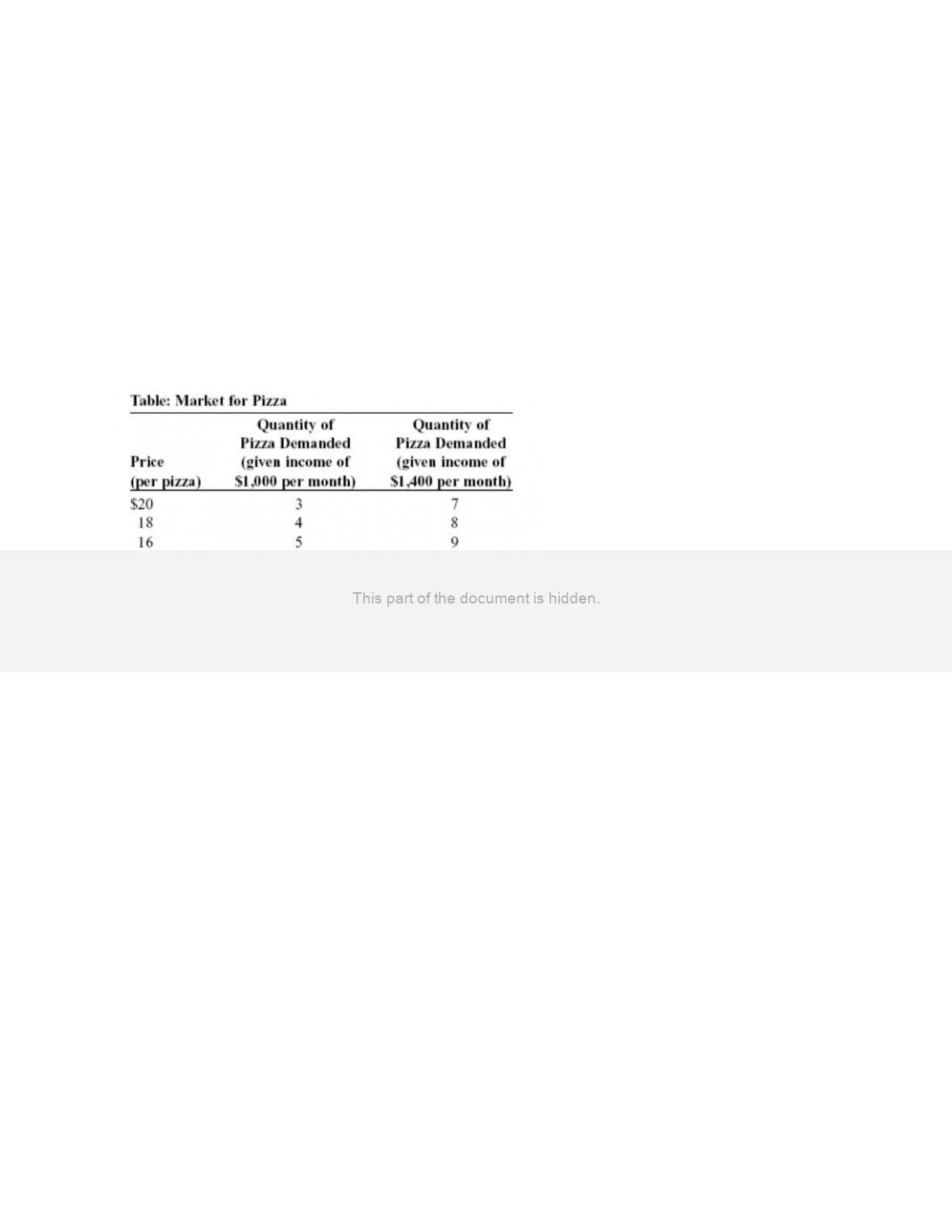
(Table: Market for Pizza) When income changes from $1,000 to $1,400 per month, the
income elasticity of demand for pizza, by the midpoint method, at a price of $14 per
pizza is:
A)
–1.
B)
1.
C)
1.25.
D)
1.5.
182.
(Table: Market for Pizza) If income changes from $1,000 to $1,400 per month, by the
midpoint method, the income elasticity of demand at a price of $10 per pizza is:
A)
1.2.
B)
–1.2.
C)
0.825.
D)
0.40.

Page 37
183.
(Table: Market for Pizza) If income changes from $1,000 to $1,400 per month, by the
midpoint method, the income elasticity of demand at a price of $18 per pizza is:
A)
0.33.
B)
0.50.
C)
0.95.
D)
2.
184.
(Table: Market for Pizza) Look at the table Market for Pizza and use the midpoint
method. The price elasticity of demand for pizza between $14 and $12 per pizza when
income is $1,000 per month is:
A)
0.6.
B)
1.
C)
1.6.
D)
2.
185.
Which statement is TRUE?
A)
When the income elasticity of demand is positive, the good is inferior.
B)
When the income elasticity of demand is negative, the good is normal.
C)
Income elasticity of demand measures how much the quantity demanded of a good
is affected by changes in consumers’ incomes.
D)
Income elasticity of demand measures the effect of the change in one good’s price
on the quantity demanded of the other good.
186.
If the income elasticity of demand for a good is _____, the good is said to be _____.
A)
positive; inferior
B)
negative; a substitute
C)
positive; normal
D)
positive; positive
187.
For a good to be considered normal, the _____ elasticity of demand must be _____.
A)
income; between 1 and 0
B)
cross-price; less than 0
C)
cross-price; equal to 0
D)
income; greater than 0

Page 38
188.
If your income increases and your consumption of a good increases, for you, that good
is considered:
A)
negative.
B)
positive.
C)
inferior.
D)
normal.
189.
If the income elasticity of demand for a good is _____, the good is said to be _____.
A)
negative; inferior
B)
negative; negative
C)
positive; positive
D)
negative; normal
190.
The income elasticity of demand of an inferior good:
A)
is less than 0.
B)
is equal to 0.
C)
is greater than 0.
D)
cannot be determined.
191.
Assume that as your income increases, your consumption of burgers increases. We can
assume that you consider burgers a(n) _____ good.
A)
negative
B)
positive
C)
inferior
D)
normal
192.
The consumption of a(n) _____ good increases when income decreases.
A)
substitute
B)
complementary
C)
normal
D)
inferior
193.
The income elasticity of demand measures:
A)
how much the quantity demanded changes in response to a price change.
B)
how much a consumer can buy at given income levels.
C)
how much consumer purchasing power is affected when prices change.
D)
how the quantity demanded of a good changes in response to changes in income.
Page 39
194.
If an increase in income leads to a decrease in the demand for a good, then the good is
said to be:
A)
normal.
B)
a luxury.
C)
inferior.
D)
a staple.
195.
If an increase in income leads to an increase in the demand for a good, then the good is
said to be:
A)
normal.
B)
a luxury.
C)
inferior.
D)
a staple.
196.
For a normal good, the income elasticity of demand will be:
A)
negative.
B)
positive.
C)
zero.
D)
determined by the direction of the change in income.
197.
For an inferior good, the income elasticity of demand will be:
A)
negative.
B)
positive.
C)
zero.
D)
determined by the direction of the change in income.
Use the following to answer questions 198-203:
Page 40
198.
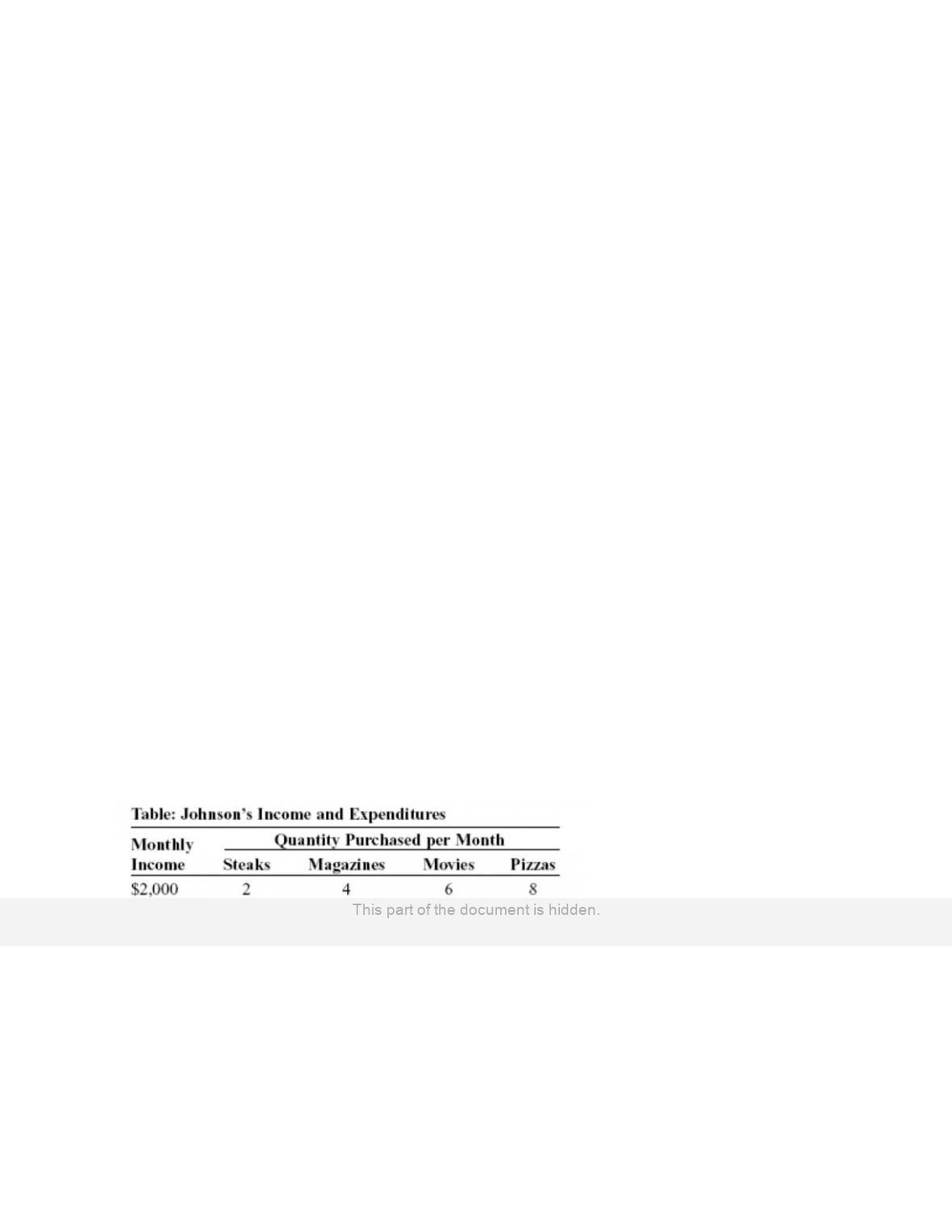
(Table: Johnson’s Income and Expenditures) Use Table: Johnson’s Income and
Expenditures. Johnson’s income elasticity of demand for steaks is:
A)
greater than 1.
B)
1.
C)
between 0 and 1.
D)
0.
199.
(Table: Johnson’s Income and Expenditures) Use Table: Johnson’s Income and
Expenditures. Johnson’s income elasticity of demand for magazines is:
A)
negative.
B)
0.
C)
between 0 and 1.
D)
1.
200.
(Table: Johnson’s Income and Expenditures) Use Table: Johnson’s Income and
Expenditures. For Johnson, magazines are a(n) _____ good.
A)
negative
B)
inferior
C)
normal
D)
neutral
201.
(Table: Johnson’s Income and Expenditures) Use Table: Johnson’s Income and
Expenditures. By the midpoint method, Johnson’s income elasticity of demand for
movies is:
A)
infinite.
B)
1.
C)
0.
D)
–1.
202.
(Table: Johnson’s Income and Expenditures) Use Table: Johnson’s Income and
Expenditures. By the midpoint method, Johnson’s income elasticity of demand for
pizzas is:
A)
–1.4.
B)
approximately –0.7.
C)
0.
D)
approximately 0.7.