Page 1
Name: __________________________ Date: _____________
1.
The price elasticity of demand measures the responsiveness of the change in the:
A)
quantity demanded to a change in the price.
B)
price to a change in the quantity demanded.
C)
slope of the demand curve to a change in the price.
D)
slope of the demand curve to a change in the quantity demanded.
2.
When the price goes down, the quantity demanded goes up. The price elasticity of
demand measures:
A)
how much the price goes down.
B)
how much the equilibrium price goes up.
C)
the responsiveness of the price change to an income change.
D)
the responsiveness of the quantity change to the price change.
3.
If the price of a good increases by 20% and the quantity demanded changes by 15%,
then the price elasticity of demand is equal to:
A)
0.75.
B)
approximately 0.33.
C)
approximately 1.33.
D)
1.
4.
The price elasticity of demand is computed as the percentage change in the _____
divided by the percentage change in _____.
A)
quantity demanded; the quantity supplied
B)
price; the quantity demanded
C)
quantity demanded; income
D)
quantity demanded; the price
5.
The price of gasoline rises 5% and the quantity of gasoline purchased falls 1%. The
price elasticity of demand is equal to _____, and demand is described as _____.
A)
0.2; inelastic
B)
5; inelastic
C)
0.2; elastic
D)
5; elastic
Page 2
6.
The ratio of the percentage change in quantity demanded to the percentage change in
price is the _____ elasticity of demand.
A)
price
B)
quantity
C)
income
D)
cross-price
7.
The price elasticity of demand measures the:
A)
responsiveness of the change in quantity demanded to a change in price.
B)
change in price versus a change in quantity demanded.
C)
responsiveness of the change in the slope of the demand curve to a change in price.
D)
change in the slope of the demand curve versus a change in the quantity demanded.
8.
The price elasticity of demand is measured by _____ the percentage change in _____
the percentage change in _____.
A)
dividing; price by; quantity demanded
B)
dividing; quantity demanded by; price
C)
subtracting; price from; quantity demanded
D)
adding; price to; quantity demanded
9.
For a normal demand curve, the price elasticity of demand will:
A)
always be positive.
B)
always be greater than 1.
C)
usually be equal to 1.
D)
always be negative.
10.
The price elasticity of demand can be found by:
A)
examining only the slope of the demand curve.
B)
measuring absolute changes in price and quantity demanded.
C)
comparing the percentage change in quantity demanded to the percentage change
in price.
D)
knowing that when price changes, quantity demanded goes in the opposite
direction.
11.
If the price of a good increases by 15% and quantity demanded changes by 20%, then
the price elasticity of demand is equal to:
A)
0.75.
B)
approximately 0.33.
C)
approximately 1.33.
D)
1.
Page 3
12.
The price elasticity of demand measures the:
A)
responsiveness of quantity demanded to a change in price.
B)
responsiveness of price to a change in quantity demanded.
C)
extent to which prices are flexible and respond to market forces.
D)
responsiveness of demand when price is held constant and demand increases or
decreases.
13.
Suppose the price of gasoline increases 10% and quantity of gasoline demanded in
Orlando drops 5% per day. Demand for gasoline in Orlando is:
A)
price elastic.
B)
price inelastic.
C)
price unit-elastic.
D)
perfectly price inelastic.
14.
If the estimated price elasticity of demand for foreign travel is 4:
A)
a 20% decrease in the price of foreign travel will increase quantity demanded by
80%.
B)
the demand for foreign travel is inelastic.
C)
a 10% increase in the price of foreign travel will increase quantity demanded by
40%.
D)
a 20% increase in the price of foreign travel will increase quantity demanded by
80%.
15.
Egg producers know that the price elasticity of demand for eggs is 0.1. If they want to
increase sales by 5%, they will have to lower price by:
A)
0.1%.
B)
1%.
C)
5%.
D)
50%.
16.
Gas prices recently increased by 25%. In response, purchases of gasoline decreased by
5%. According to this finding, the price elasticity of demand for gas is:
A)
5.
B)
2.
C)
0.2.
D)
0.5.

Page 4
17.
The only producer of chocolate bunnies in the world, Choco’s Bunny Company, recently
expanded its production capacity from 1,000 to 2,000 bunnies per day. If the price
elasticity of demand for bunnies is 3.33, by how much will the company have to reduce
its price to sell the additional 1,000 bunnies (by the midpoint method)?
A)
2.5%
B)
25%
C)
125%
D)
20%
18.
The Cozy Chair Company believes it can sell 200 chairs at $200 per chair or 300 chairs
at $150 per chair. Using the midpoint formula, what do they think is the price elasticity
of demand?
A)
2.5.
B)
1.4.
C)
0.7.
D)
0.5.
19.
The publisher of an economics textbook finds that, when the book’s price is lowered
from $70 to $60, sales rise from 10,000 to 15,000. By the midpoint method, the price
elasticity of demand is:
A)
500.
B)
50.
C)
3.5.
D)
2.6.
20.
Suppose at $10 the quantity demanded is 100. When the price falls to $8, the quantity
demanded increases to 130. The price elasticity of demand between $10 and $8, by the
midpoint method, is approximately:
A)
1.17.
B)
1.50.
C)
0.85.
D)
1.00.
21.
Use of the midpoint method to calculate the price elasticity of demand eliminates the
problem of computing:
A)
different elasticities, depending on whether price decreases or increases.
B)
different elasticities because price and quantity are inversely related on the demand
curve.
C)
total revenue when price falls and demand is inelastic.
D)
total revenue when price falls and demand is elastic.
Page 5
22.
A men’s tie store sold an average of 30 ties per day at $5 per tie but sold 50 of the same
ties per day at $3 per tie. The price elasticity of demand, by the midpoint method, is:
A)
greater than zero but less than 1.
B)
equal to 1.
C)
greater than 1 but less than 3.
D)
greater than 3.
23.
A men’s tie store sold an average of 30 ties per day at $5 per tie. The same store sold 60
of the same ties per day at $3 per tie. In this case, the price elasticity of demand (by the
midpoint method) is:
A)
greater than zero but less than 1.
B)
equal to 1.
C)
greater than 1 but less than 3.
D)
greater than 3.
24.
A shirt manufacturer sold 10 dozen shirts per day at $4 per shirt but sold 15 dozen shirts
per day at $3 per shirt. The price elasticity of demand (by the midpoint method) is:
A)
greater than zero but less than 1.
B)
equal to 1.
C)
greater than 1 but less than 3.
D)
greater than 3.
25.
If the price of chocolate-covered peanuts decreases from $1.10 to $0.90 and the quantity
demanded increases from 190 bags to 210 bags, then the price elasticity of demand (by
the midpoint method) is:
A)
0.
B)
0.5.
C)
1.
D)
2.
26.
If the price of chocolate-covered peanuts decreases from $1.10 to $0.90 and the quantity
demanded increases from 180 bags to 220 bags, then the price elasticity of demand (by
the midpoint method) is:
A)
0.
B)
0.5.
C)
1.
D)
2.
Page 6
27.
If the price of chocolate-covered peanuts decreases from $1.05 to $0.95 and the quantity
demanded increases from 180 bags to 220 bags, then the price elasticity of demand (by
the midpoint method) is:
A)
0.5.
B)
1.
C)
2.
D)
greater than 2.
28.
If the price of chocolate-covered peanuts decreases from $1.10 to $0.90 and the quantity
demanded does not change, then the price elasticity of demand (by the midpoint
method) is:
A)
0.
B)
0.5.
C)
1.
D)
2.
29.
If the price of chocolate-covered peanuts decreases from $1.10 to $0.95 and the quantity
demanded increases from 190 bags to 215 bags, then the price elasticity of demand (by
the midpoint method) is:
A)
1.25.
B)
0.52.
C)
0.84.
D)
2.
30.
If the price of chocolate-covered peanuts decreases from $2.00 to $1.55 and the quantity
demanded increases from 180 bags to 220 bags, then the price elasticity of demand (by
the midpoint method) is:
A)
0.
B)
0.50.
C)
0.79.
D)
2.
31.
If the price of chocolate-covered peanuts decreases from $1.15 to $1.05 and the quantity
demanded increases from 190 bags to 220 bags, then the price elasticity of demand (by
the midpoint method) is:
A)
0.5.
B)
1.
C)
2.
D)
between 1 and 2.
Page 7
32.
If the price of chocolate-covered peanuts decreases from $1.15 to $0.90 and the quantity
demanded increases from 0 bags to 400 bags, then the price elasticity of demand (by the
midpoint method) is:
A)
0.5.
B)
1.
C)
2.
D)
greater than 2.
33.
The price of notebooks is $5, and at that price consumers demand 12 notebooks. If the
price rises to $7, consumers will decrease quantity demanded to 4 notebooks. Using the
midpoint formula, what is the price elasticity of demand for notebooks?
A)
0.33
B)
3
C)
0.17
D)
6
34.
When the price of pencils decreases from $3 to $1, the quantity demanded increases
from 100 to 200 pencils. By the midpoint method, the price elasticity of demand equals:
A)
0.17.
B)
0.5.
C)
0.67.
D)
1.5.
35.
If the price of tacos increases from $1 to $2 and customers decrease their consumption
from 10 tacos to 8 tacos, what is the price elasticity of demand (by the midpoint
method)?
A)
1.5
B)
1
C)
0.33
D)
0.5
36.
If the price of burritos increases from $4 to $6 and customers decrease their
consumption from 20 to 10 burritos, what is the price elasticity of demand (by the
midpoint method)?
A)
1.67
B)
0.67
C)
3
D)
2
Page 8
37.
Suppose at $10 the quantity demanded is 100. When the price falls to $8, the quantity
demanded increases to 130. The price elasticity of demand (using the midpoint formula)
between $10 and $8 is approximately:
A)
1.17.
B)
1.50.
C)
0.85.
D)
1.00.
Use the following to answer questions 38-45:
38.
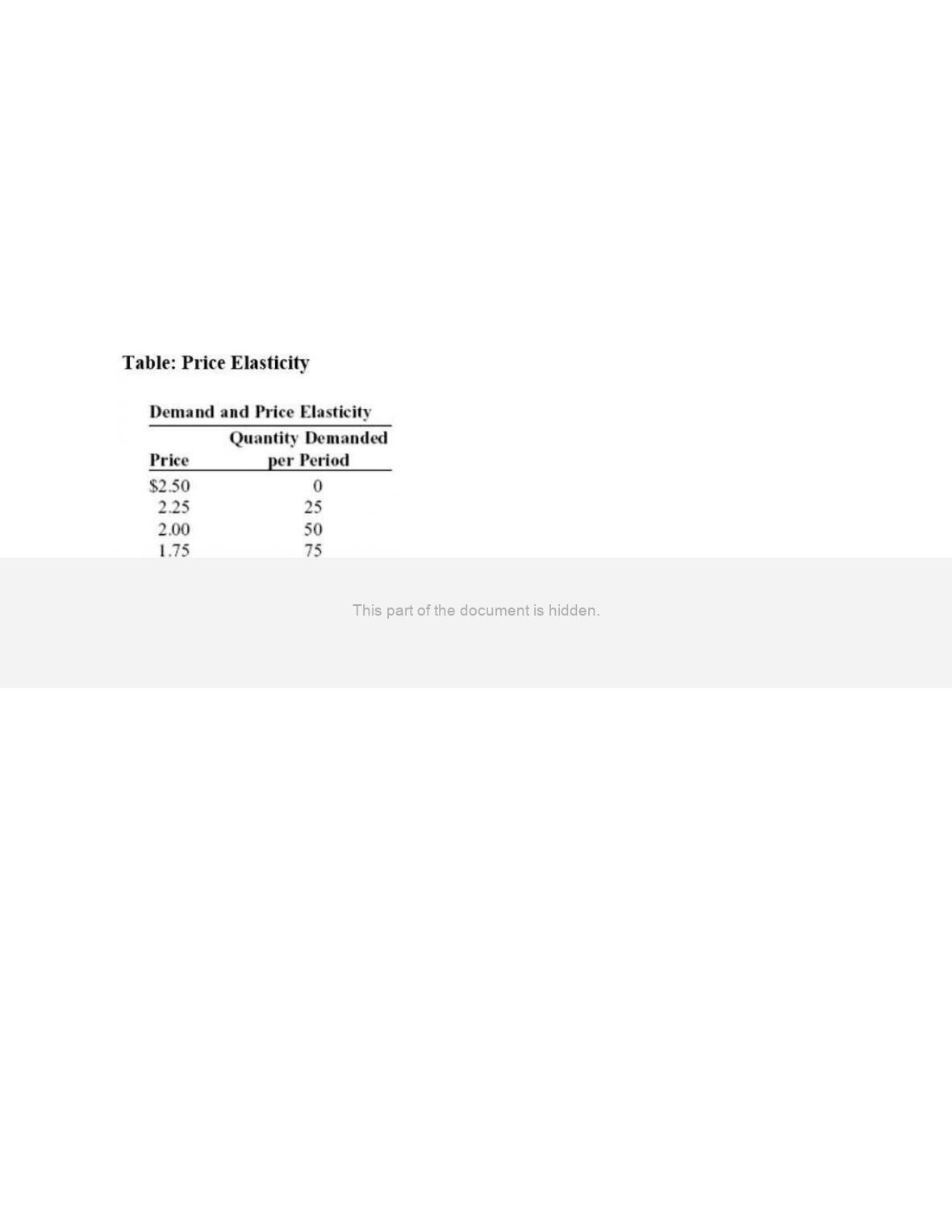
(Table: Price Elasticity) Use Table: Price Elasticity. What is the price elasticity of
demand (using the midpoint formula) between $2.50 and $2.25?
A)
9
B)
19
C)
119
D)
0.5
39.
(Table: Price Elasticity) Use Table: Price Elasticity. What is the price elasticity of
demand (using the midpoint formula) between $2.25 and $2.00?
A)
4.00
B)
5.67
C)
9.00
D)
17.60
Page 9
40.
(Table: Price Elasticity) Use Table: Price Elasticity. What is the price elasticity of
demand (using the midpoint formula) between $2.00 and $1.75?
A)
2.33
B)
3.00
C)
4.00
D)
0.125
41.
(Table: Price Elasticity) Use Table: Price Elasticity. What is the price elasticity of
demand (using the midpoint formula) between $1.75 and $1.50?
A)
0.42
B)
1.50
C)
1.86
D)
0.08
42.
(Table: Price Elasticity) Use Table: Price Elasticity. What is the price elasticity of
demand (using the midpoint formula) between $1.50 and $1.25?
A)
1.00
B)
1.22
C)
1.50
D)
1.75
43.
(Table: Price Elasticity) Use Table: Price Elasticity. What is the price elasticity of
demand (using the midpoint formula) between $1.25 and $1.00?
A)
0.60
B)
0.82
C)
1.00
D)
1.60
44.
(Table: Price Elasticity) Use Table: Price Elasticity. What is the price elasticity of
demand (using the midpoint formula) between $1.00 and $0.75?
A)
0.54
B)
0.66
C)
0.75
D)
1.00
Page 10
45.
(Table: Price Elasticity) Use Table: Price Elasticity. What is the price elasticity of
demand (using the midpoint formula) between $0.75 and $0.50?
A)
0.25
B)
0.33
C)
0.43
D)
0.52
46.
Each month Jacquelyn spends exactly $50 on ice cream, regardless of the price of each
container. Jacquelyn’s price elasticity of demand for ice cream is:
A)
0.
B)
1.
C)
greater than 1.
D)
less than 1 but greater than 0.
47.
Each month Jessica buys exactly 15 Big Macs, regardless of the price. Jessica’s price
elasticity of demand for Big Macs is:
A)
0.
B)
1.
C)
greater than 1.
D)
less than 1 but greater than 0.
48.
Suppose the price elasticity of demand for cheeseburgers equals 0.37. This means the
overall demand for cheeseburgers is:
A)
price elastic.
B)
price inelastic.
C)
price unit-elastic.
D)
perfectly price inelastic.
49.
The price elasticity of demand for skiing lessons in New Hampshire is over 1. This
means that the demand is _____ in New Hampshire.
A)
price elastic
B)
price inelastic
C)
price unit-elastic.
D)
perfectly price elastic

Page 11
50.
A restaurant manager has estimated that the price elasticity of demand for meals is 2. If
the restaurant increases menu prices by 5%, she can expect the number of meals sold to
decrease by _____ and total revenue to _____.
A)
10%; increase
B)
5%; stay constant
C)
10%; fall
D)
2.5%; fall
51.
You manage a nightclub, and lately revenues have been disappointing. Your bouncer
suggests that raising drink prices will increase revenues, but your bartender suggests
that decreasing drink prices will increase revenues. You aren’t sure who is right, but you
do know that your bouncer thinks the demand for drinks is _____ and your bartender
thinks the demand for drinks is _____.
A)
elastic; inelastic
B)
inelastic; elastic
C)
elastic; elastic
D)
inelastic; inelastic
52.
A perfectly price-inelastic demand curve is:
A)
horizontal.
B)
downward sloping.
C)
upward sloping.
D)
vertical.
53.
A major state university in the South recently raised tuition by 12%. An economics
professor at this university asked his students, “How many of you will transfer to
another university because of the increase in tuition?” One student in about 300 said that
he or she would transfer. Based on this information, the price elasticity of demand for
education at this university is:
A)
1.
B)
highly elastic.
C)
highly inelastic.
D)
0.
54.
A rancher in Oklahoma decides to raise the price of her beef by 19% over the prevailing
market price. If the demand for beef is perfectly elastic, this rancher’s quantity
demanded will:
A)
fall to 0.
B)
not change.
C)
fall slightly.
D)
increase slightly.
Page 12
55.
Sonik, a wireless phone company, tested the effect of a price reduction for text
messaging. It lowered prices from $0.08 to $0.04 per message and found that the
number of messages sent tripled. This means that the:
A)
demand for text messaging is inelastic in this price range.
B)
demand curve for text messaging shifted to the right.
C)
supply curve for text messaging shifted to the left.
D)
demand for text messaging is elastic in this price range.
56.
Sometimes airlines raise ticket prices as the flight departure date approaches in the hope
of increasing revenue on the assumption that consumer demand is:
A)
steady in its price elasticity as departure time approaches.
B)
less price-elastic as departure time approaches.
C)
always unit elastic.
D)
very sensitive to price changes as the time of departure approaches.
57.
The university president believes that increasing student tuition by 5% will increase
revenues. If the president is correct that revenues will increase, then the tuition increase
will _____ the number of students enrolling by _____%.
A)
reduce; less than 5
B)
reduce; more than 5
C)
increase; exactly 5
D)
increase; less than 5
58.
The university hopes to raise more revenue by increasing parking fees. This plan will
work only if:
A)
the price effect is larger than the quantity effect.
B)
the price effect is smaller than the quantity effect.
C)
the price effect and quantity effect are the same.
D)
there is no price or quantity effect.
59.
Suppose the price elasticity of demand for fishing lures equals 1.5 in South Carolina and
0.63 in Alabama. To increase revenue, fishing lure manufacturers should:
A)
lower prices in each state.
B)
raise prices in each state.
C)
lower prices in South Carolina and raise prices in Alabama.
D)
leave prices unchanged in South Carolina and raise prices in Alabama.
Page 13
60.
Total revenue is:
A)
total sales less total cost.
B)
the price of a good times the quantity of the good that is sold.
C)
the price effect times the quantity effect.
D)
the price of a good divided by the amount of the good sold.
61.
When the price of chocolate-covered peanuts decreases from $1.10 to $0.95, the
quantity demanded increases from 190 bags to 215 bags. If the price is $1.10, total
revenue is _____, and if the price is $0.95, total revenue is _____.
A)
$209; $204.25
B)
$209; $236.50
C)
$236.50; $209
D)
$180.50; $209
62.
When the price of chocolate-covered peanuts decreases from $1.10 to $0.95, the
quantity demanded increases from 190 bags to 215 bags. In this price range, the demand
for chocolate covered peanuts is _____, and total revenue will _____ when price
decreases.
A)
elastic; increase
B)
elastic; decrease
C)
inelastic; increase
D)
inelastic; decrease
63.
When the price of chocolate-covered peanuts increases from $1.55 to $2.00, the quantity
demanded decreases from 220 to 180. If the price is $1.55, total revenue is _____, and if
the price is $2.00, total revenue is _____.
A)
$360; $440
B)
$341; $279
C)
$440; $279
D)
$341; $360
64.
When the price of chocolate-covered peanuts increases from $1.55 to $2.00, the quantity
demanded decreases from 220 to 160. In this price range, the demand for
chocolate-covered peanuts is _____, and total revenue will _____ when the price
increases.
A)
elastic; increase
B)
elastic; decrease
C)
inelastic; increase
D)
inelastic; decrease

Page 14
65.
Suppose the price of barley increases by 16.53%. If breweries buy 3.28% less barley
after the price increase, the total revenue for barley producers will _____ because the
_____ effect is greater than the _____ effect.
A)
decrease; quantity; price
B)
increase; price; quantity
C)
not change; quantity; price
D)
increase; quantity; price
66.
If demand is elastic, the _____ effect dominates the _____ effect, and a(n) _____ in
price will cause total revenue to rise.
A)
price; quantity; decrease
B)
price; quantity; increase
C)
quantity; price; increase.
D)
quantity; price; decrease
67.
Suppose the price elasticity of demand for oranges is 1.8. If a fall frost destroys
one-third of the nation’s orange crop, how will that affect total revenue from oranges, all
other things unchanged?
A)
Total revenue will rise.
B)
Total revenue will fall.
C)
Total revenue will remain unchanged.
D)
The information is insufficient to answer the question.
68.
The price elasticity of demand for gasoline in the short run has been estimated to be 0.4.
If a war in the Middle East causes the price of oil (from which gasoline is made) to
increase, how will that affect total revenue from gasoline in the short run, all other
things unchanged?
A)
Quantity demanded will stay the same; total revenue will fall.
B)
Quantity demanded will decrease; total revenue will rise.
C)
Total revenue will remain unchanged.
D)
Quantity demanded will not change; total revenue will rise.
69.
The price elasticity of demand for lettuce has been estimated to be 2.58. If an insect
infestation destroys 10% of the nation’s lettuce crop, how will that affect total revenue
from lettuce, all other things unchanged?
A)
Total revenue will remain unchanged.
B)
Total revenue will fall.
C)
Total revenue will rise.
D)
The information is insufficient to answer the question.
Page 15
70.
The price elasticity of demand for fresh tomatoes has been estimated to be 2.22. If a new
insecticide and fertilizer treatment yields a 20% increase in the nation’s fresh tomato
crop, how will that affect total revenue from fresh tomatoes, all other things unchanged?
A)
Total revenue will remain unchanged.
B)
Total revenue will fall.
C)
Total revenue will rise.
D)
The information is insufficient to answer the question.
71.
Which statement is NOT true regarding a price-elastic demand curve?
A)
Total revenue increases when the price falls.
B)
The absolute value of the price elasticity is a fraction greater than 0 but less than 1.
C)
The absolute value of the price elasticity is greater than 1.
D)
The percent changes in the quantity demanded exceed the percent changes in the
price for any small change in price.
72.
The demand for agricultural output is price inelastic. This means that if farmers, taken
collectively, have a bumper crop, they will have _____ prices, _____ quantities sold,
and _____ incomes.
A)
lower; greater; lower
B)
lower; greater; higher
C)
lower; lower; lower
D)
higher; higher; higher
73.
When a public transit system (such as a subway or bus line) raises its fares, its total
revenue may increase. This suggests that demand is:
A)
unstable.
B)
price-inelastic.
C)
price-elastic.
D)
price unit-elastic.
74.
If a university decreases the price of tickets to football games to collect more revenue, it
is assuming that the demand for tickets is:
A)
unstable.
B)
price-inelastic.
C)
price-elastic.
D)
price unit-elastic.
Page 16
75.
If the demand for golf is price-inelastic and your local public golf course increases the
greens fees for using the course, you expect:
A)
a decrease in total revenue received by the course.
B)
an increase in total revenue received by the course.
C)
an increase in the amount of golf played on the course.
D)
no change in the amount of golf played on the course.
76.
If the demand for golf is unit-price elastic and your local public golf course increases
the greens fees for using the course, you expect:
A)
a decrease in total revenue received by the course.
B)
an increase in total revenue received by the course.
C)
a decrease in the amount of golf played on the course.
D)
no change in the amount of golf played on the course.
Use the following to answer questions 77-79:
77.
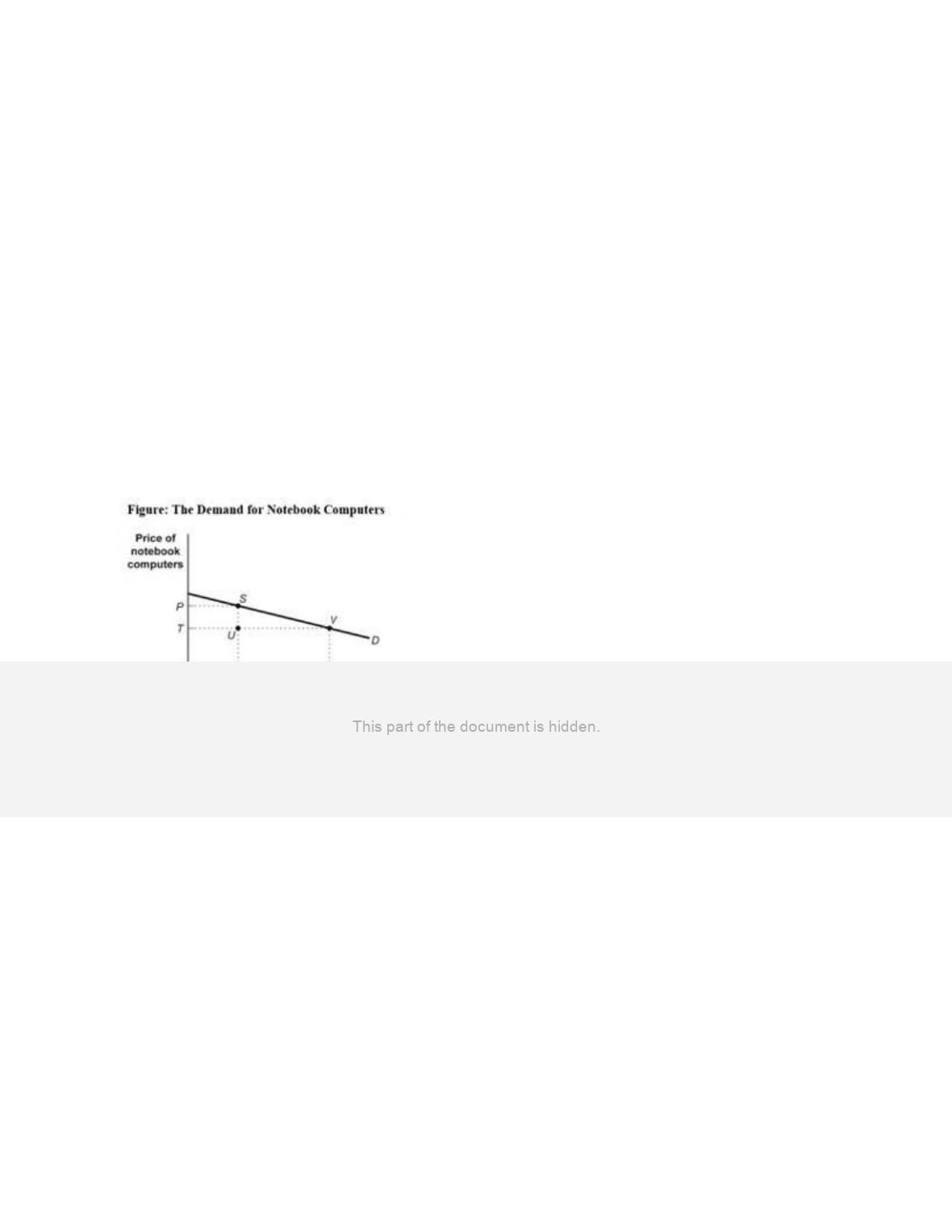
(Figure: Demand for Notebook Computers) Use Figure: The Demand for Notebook
Computers. The change in total revenue resulting from a change in price from P to T
suggests that demand is:
A)
inelastic.
B)
price-elastic.
C)
price-inelastic.
D)
price unit-elastic.
Page 17
78.
(Figure: Demand for Notebook Computers) Use Figure: The Demand for Notebook
Computers. Total revenue at point S equals the:
A)
distance 0P.
B)
distance MS.
C)
area 0TUM.
D)
area 0PSM.
79.
(Figure: Demand for Notebook Computers) Use Figure: The Demand for Notebook
Computers. Total revenue at point V equals the:
A)
area 0TVN.
B)
area 0PSVN.
C)
distance 0T.
D)
distance NV.
80.
If a change in price causes total revenue to change in the same direction, we can
conclude that the demand is:
A)
price inelastic.
B)
price elastic.
C)
price unit-elastic.
D)
zero elastic.
81.
There is one gas station in a small rural town. The owner of the station claims that he
will sell the same quantity of gas no matter how high or low the price. If he is correct in
this assertion, the demand curve for gas at his station must be _____, with a price
elasticity of _____.
A)
vertical; zero
B)
vertical; infinity
C)
horizontal; zero
D)
horizontal; infinity
82.
Demand for vegetables at a small farmers’ market is steady, but the supply of vegetables
has decreased because of a drought. This is good news for farmers if demand is _____
and the _____ effect outweighs the _____ effect.
A)
inelastic; price; quantity
B)
elastic; price; quantity
C)
inelastic; output; price
D)
elastic; output; price
Page 18
83.
In the market for computers, if the demand curve is elastic and the price of a computer
decreases, we expect total revenue to _____. If the demand curve is inelastic and the
price of a computer decreases, we expect total revenue to _____.
A)
increase; decrease
B)
increase; increase
C)
decrease; increase
D)
decrease; decrease
84.
If a 20% price increase generates a 20% decrease in quantity demanded, then this is a(n)
_____ response.
A)
inelastic
B)
elastic
C)
unit-elastic
D)
perfectly elastic
85.
If an increase in the price of cotton increases total revenue, then the price effect is _____
the quantity effect.
A)
equal to
B)
stronger than
C)
weaker than
D)
not comparable to
86.
After a price decrease, the quantity effect tends to:
A)
decrease total revenue.
B)
increase total revenue.
C)
make the price effect stronger.
D)
make the price effect weaker.
87.
Yovanka has diabetes, and she will pay any amount of money for insulin. What is the
BEST characterization of Yovanka’s demand for insulin?
A)
price-inelastic
B)
price-elastic
C)
perfectly price-inelastic
D)
perfectly price-elastic
88.
When demand is _____, a rise in price leads to a(n) _____ in total revenue.
A)
perfectly inelastic; decrease
B)
perfectly elastic; increase
C)
inelastic; increase
D)
elastic; increase
Page 19
Use the following to answer questions 89-90:
89.
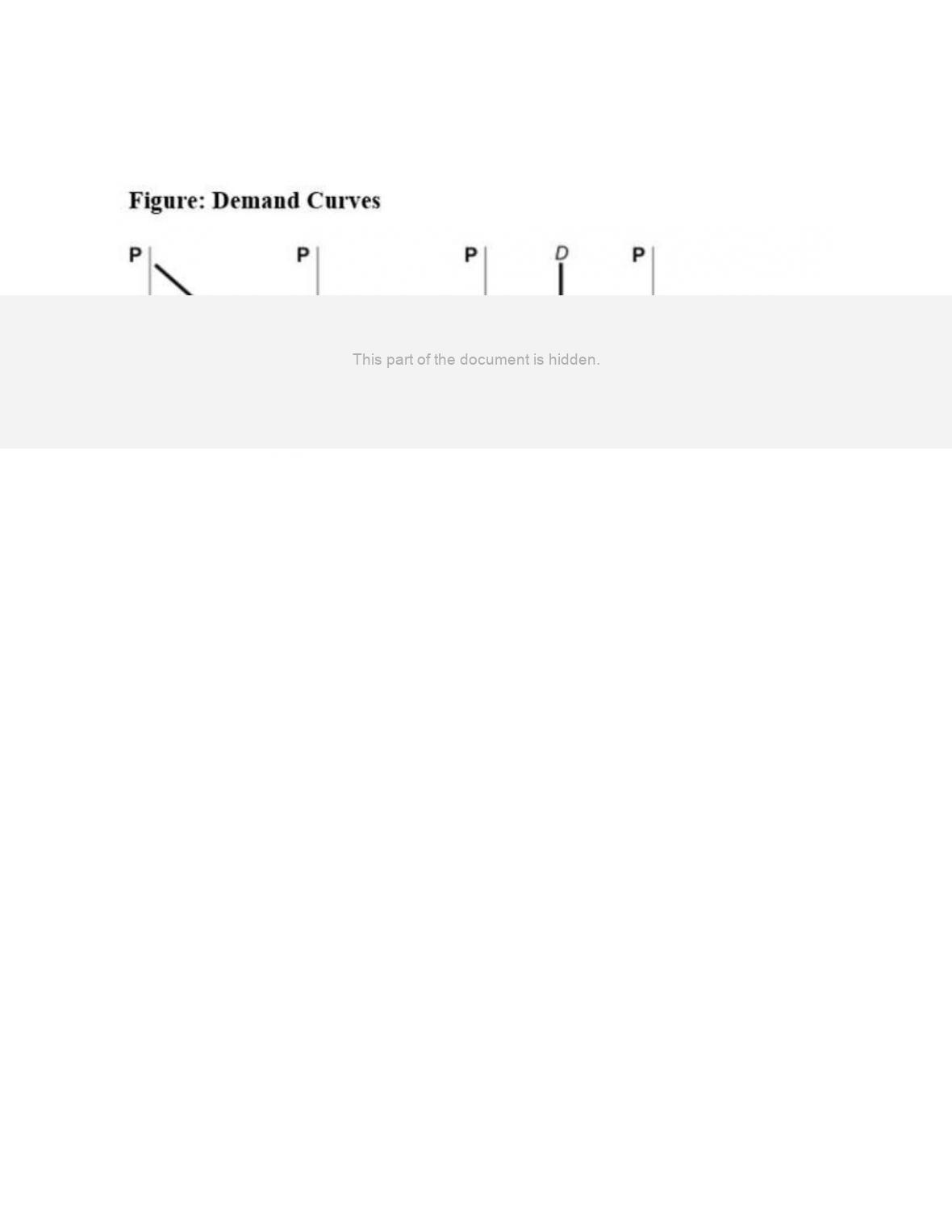
(Figure: Demand Curves) Use Figure: Demand Curves. Which graph shows a perfectly
elastic demand curve?
A)
A
B)
B
C)
C
D)
D
90.
(Figure: Demand Curves) Use Figure: Demand Curves. Which graph shows a perfectly
inelastic demand curve?
A)
A
B)
B
C)
C
D)
D
91.
Suppose that an increase in the price of a good leads to an increase in total revenue.
Ignoring other factors (like supply), at its current price the good must be:
A)
price-inelastic.
B)
price-elastic.
C)
perfectly price-elastic.
D)
inferior.
Page 20
92.
When the percentage change in quantity demanded is larger than the percentage change
in price, demand is said to be:
A)
price-inelastic.
B)
price unit-elastic.
C)
price-elastic.
D)
perfectly price-inelastic.
93.
If the price elasticity of demand is calculated to be 0.75, then demand is:
A)
price-inelastic.
B)
price-elastic.
C)
price unit-elastic.
D)
positively sloped.
94.
If the price elasticity of demand is found to be 6, then demand is:
A)
price-inelastic.
B)
price-elastic.
C)
price unit-elastic.
D)
horizontal.
95.
If the price of a good increases by 15% and the quantity demanded falls by 20%,
demand is:
A)
price-elastic.
B)
price-inelastic.
C)
price unit-elastic.
D)
normal.
96.
If total revenue goes up when the price falls, demand is said to:
A)
be price-inelastic.
B)
be price unit-elastic.
C)
be price-elastic.
D)
have positive price elasticity.
97.
If total revenue goes down when the price falls, demand is said to:
A)
be price-inelastic.
B)
be price unit-elastic.
C)
be price-elastic.
D)
have positive price elasticity.