Page 41
136.
(Table: The Market for Taxi Rides) Use Table: The Market for Taxi Rides. If a
government quota limit at 6 million rides is imposed, the quota rent accruing to the
owner of a taxi medallion will be _____ per ride, but there will be a total missed
opportunity (inefficiency) to consumers and producers of _____ million rides.
A)
$1; 1
B)
$2; 2
C)
$3; 3
D)
$4; 4
137.
(Table: The Market for Taxi Rides) Use Table: The Market for Taxi Rides. If a
government quota limit at 9 million rides is imposed, the quota rent that will accrue to
the owner of a taxi medallion will be _____ per ride, but there will be a total missed
opportunity (inefficiency) to consumers and producers of _____ million rides.
A)
$1; 1
B)
$2; 2
C)
$3; 3
D)
$4; 4
138.
(Table: The Market for Taxi Rides) Use Table: The Market for Taxi Rides. If a
government quota limit at 7 million rides is imposed on this market, the quota rent that
will accrue to the owner of a taxi medallion will be _____ per ride, but there will be a
total missed opportunity (inefficiency) to consumers and producers of _____ million
rides.
A)
$1; 1
B)
$2; 2
C)
$3; 3
D)
$4; 4
139.
If the government imposes a limit on sales of a good or service by licensing the right to
sell a given quantity of the good, the difference between the demand and supply price is:
A)
the quota rent.
B)
the equilibrium price.
C)
the quota price.
D)
deadweight loss.
140.
The difference between the demand price and the supply price at the quota limit is:
A)
the quota rent.
B)
the rent received by landlords who own rent-controlled apartments.
C)
the opportunity cost of using or buying a good, subject to an import quota.
D)
usually large enough to cause a surplus.
Page 42
141.
Assuming that U.S. and French wines are substitutes in consumption, if the U.S.
government imposes a quota on the amount of French wine allowed into the United
States and the quota is set at a quantity below equilibrium, the price of French wine in
the United States will _____ while the price of the U.S.-produced wine will _____.
A)
increase; increase
B)
increase; decrease
C)
decrease; increase
D)
decrease; decrease
142.
The upper limit on the quantity of a good that can be bought and sold is the:
A)
quota limit.
B)
price ceiling.
C)
price floor.
D)
tariff.
143.
Quota limits that are less than the market equilibrium quantity cause:
A)
the demand price to be above the supply price.
B)
the quantity demanded to be more than the quantity supplied.
C)
the quantity demanded to be less than the quantity supplied.
D)
the demand price to be equal to the supply price.
144.
Suppose the United States removes its sugar quotas and the market price of sugar drops.
Since sugar is an input in candy, in the candy bar market, we would expect consumer
surplus to:
A)
increase.
B)
decrease.
C)
not change.
D)
Consumer surplus cannot be determined without information about the size of the
quota.
145.
Which statement about the undesirable side effects of a quantity control is NOT correct?
A)
Quantity controls do not lead to deadweight loss.
B)
Some mutually beneficial transactions do not occur because of quantity controls.
C)
Quantity controls provide incentives for illegal activities.
D)
Quantity controls cause a wedge between the demand price and supply price.
Page 43
146.
If a quota is set above the equilibrium quantity, there will be:
A)
incentives for illegal activities.
B)
missed opportunities in the form of mutually beneficial transactions that don’t
occur.
C)
a supply price for the quantity transacted that exceeds the demand price of the
quantity transacted.
D)
no immediate effect.
147.
Quantity controls set below the equilibrium quantity do NOT cause:
A)
incentives for illegal activities.
B)
missed opportunities in the form of mutually beneficial transactions that don’t
occur.
C)
the supply price of the quantity transacted to exceed the demand price of the
quantity transacted.
D)
quota rents.
148.
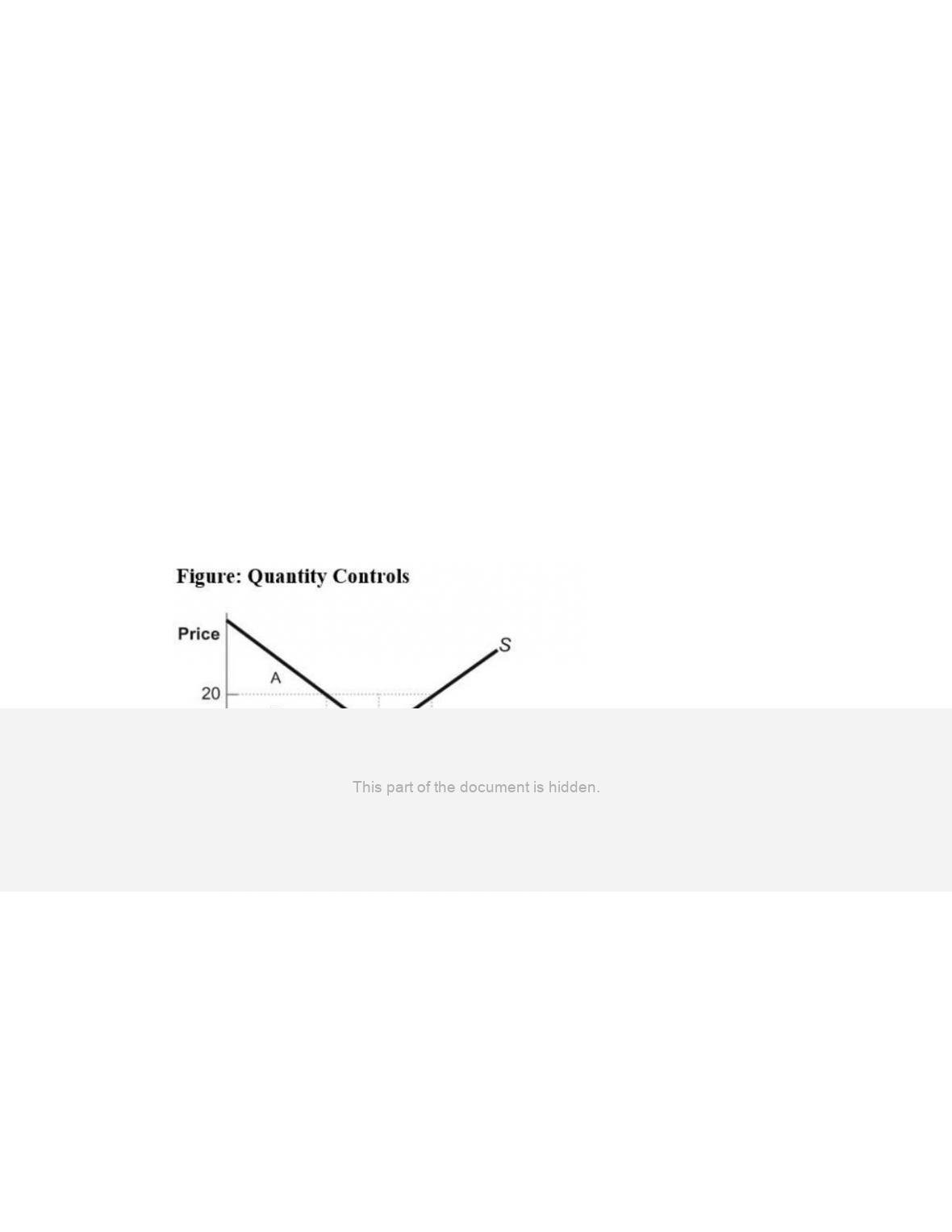
(Figure: Quantity Controls) Use Figure: Quantity Controls. If the government decides to
restrict the quantity sold to 100, which statement is FALSE?
A)
Total surplus will fall by areas C and E.
B)
The market is not at the free-market equilibrium.
C)
Consumer surplus is maximized.
D)
Some mutually beneficial transactions have been eliminated.
Page 44
Use the following to answer questions 149-150:
149.
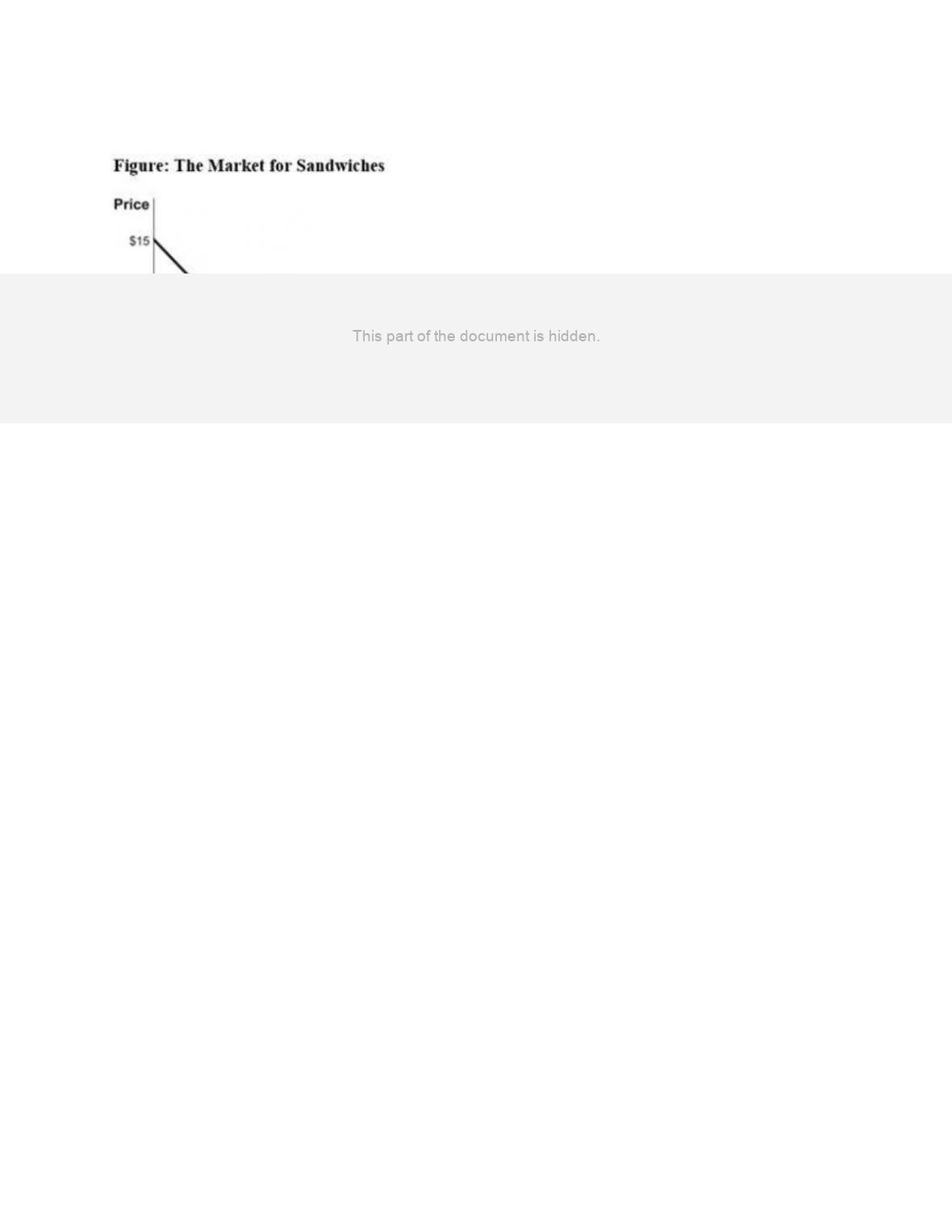
(Figure: The Market for Sandwiches) Use Figure: The Market for Sandwiches. How
much total surplus would be lost if there were a quota of eight sandwiches that could be
legally exchanged?
A)
$3
B)
$24
C)
$27
D)
$30
150.
(Figure: The Market for Sandwiches) Use Figure: The Market for Sandwiches. Suppose
a price floor is set at $7. At this price, consumer surplus is equal to _____ and producer
surplus is equal to _____.
A)
$64; $40
B)
$64; $24
C)
$32; $24
D)
$32; $40
151.
A binding price ceiling will cause a persistent _____, and a binding price floor will
cause a persistent _____.
A)
surplus; surplus
B)
shortage; surplus
C)
shortage; shortage
D)
surplus; shortage
Page 45
Use the following to answer questions 152-155:
152.
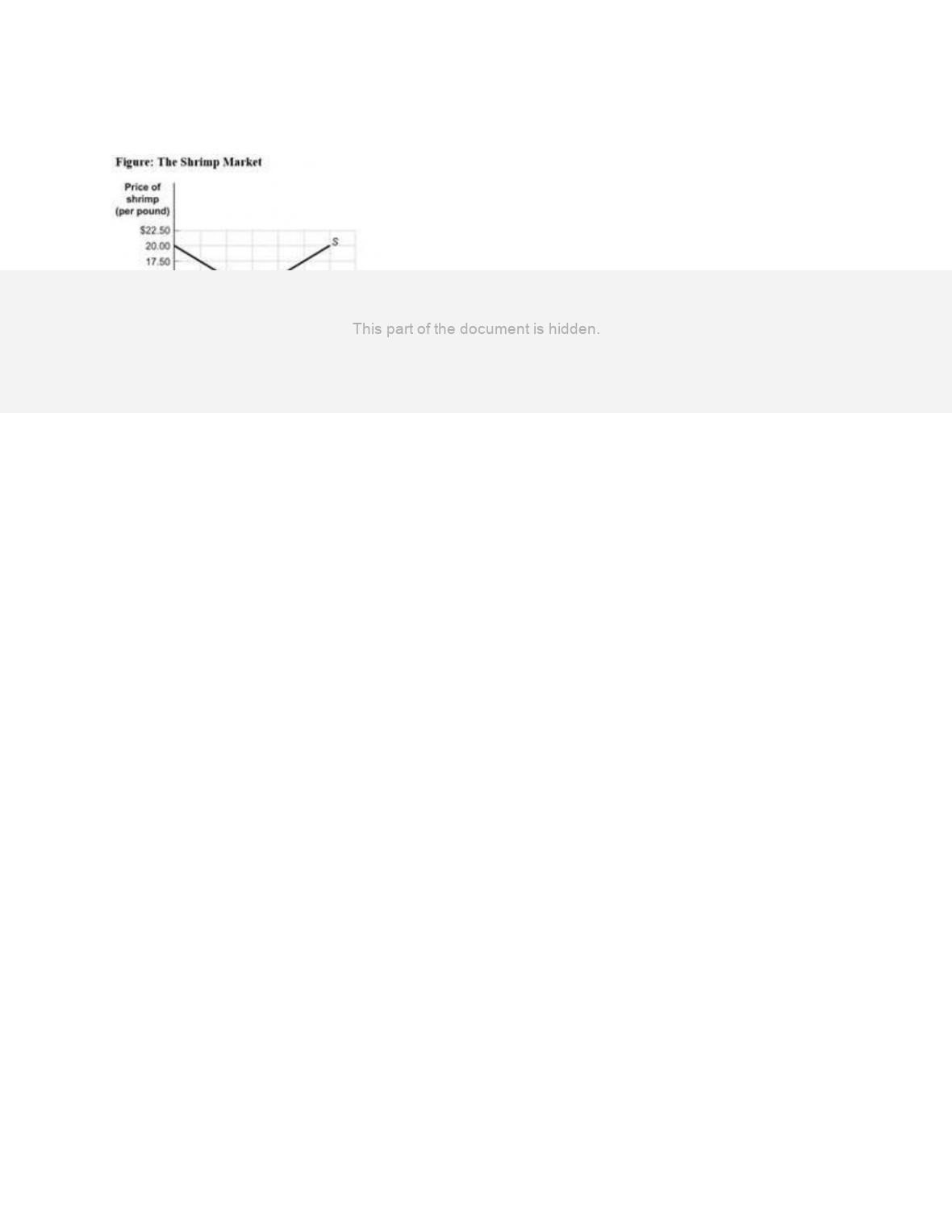
(Figure: The Shrimp Market) Use Figure: The Shrimp Market. If the government
imposes a quota limiting sales of shrimp to 500 pounds, the quota rent per pound is:
A)
$15.
B)
$10.
C)
$5.
D)
The quota rent cannot be determined from the information provided.
153.
(Figure: The Shrimp Market) Use Figure: The Shrimp Market. If the government
imposes a quota limiting sales of shrimp to 250 pounds, the quota rent per pound is:
A)
$17.50.
B)
$10.
C)
$7.50.
D)
$0.
154.
(Figure: The Shrimp Market) Use Figure: The Shrimp Market. If the government
imposes a quota limiting sales of shrimp to 1,000 pounds, the quota rent per pound is:
A)
$15.
B)
$10.
C)
$5.
D)
$0.
Page 46
155.
(Figure: The Shrimp Market) Use Figure: The Shrimp Market. If the government
imposes a quota limiting sales of shrimp to 250 pounds, it will have the same effect on
transactions as a price floor of:
A)
$17.50
B)
$10
C)
$7.50
D)
The answer cannot be determined from the information provided.
156.
The market for salmon is in equilibrium. A binding price ceiling, a binding price floor,
and a quota limit below the market equilibrium in this market would all cause:
A)
deadweight loss arising from a quantity exchanged that is less than the equilibrium
quantity.
B)
a supply price that exceeds a demand price.
C)
revenue collected by the government on each unit of salmon harvested.
D)
deadweight loss arising from a transfer of surplus from consumers to producers.
157.
Price controls are always set below the market equilibrium price.
A)
True
B)
False
158.
Suppose Congress imposes a price ceiling of $5 per ATM transaction. If the average
market-clearing price for an ATM transaction is $2, the price ceiling will not be binding
in this instance.
A)
True
B)
False
159.
A rent ceiling must be set above the equilibrium rent to be binding.
A)
True
B)
False
160.
A price ceiling benefits all consumers.
A)
True
B)
False
161.
Critics of the pharmaceutical industry often argue that price ceilings should be imposed
on drug manufacturers. If this happened, the quality of drugs would improve.
A)
True
B)
False
Page 47
162.
Suppose the state of Mississippi sets a price floor in the market for cotton. If the floor is
set below the market-clearing price of cotton, the floor will cause a surplus of cotton.
A)
True
B)
False
163.
To dispose of the unwanted surplus resulting from agricultural price floors, the
European Union pays exporters to sell products at a loss overseas.
A)
True
B)
False
164.
Economic models predict that a binding minimum wage will generally cause increased
unemployment for low-skilled workers.
A)
True
B)
False
165.
If the state of Minnesota established a price floor in the market for pumpkins that was
double the current market-clearing price, this would lead to an inefficient number of
pumpkins sold in Minnesota.
A)
True
B)
False
166.
When transatlantic airfares were set artificially high by an international treaty, airlines
offered customers an inefficiently high quality of service.
A)
True
B)
False
167.
Licenses allowing taxis to operate issued by New York City in the 1930s are called
medallions.
A)
True
B)
False
168.
In New York City there are more than 100,000 licensed taxicabs.
A)
True
B)
False
Page 48
169.
Although they cost more than $200,000 when they were issued in the 1930s, the New
York taxicab medallions are relatively inexpensive today, selling for around $3,000.
A)
True
B)
False
170.
Quantity controls usually take the form of price ceilings or price floors established by
the government.
A)
True
B)
False
171.
A limit on the amount of a foreign currency people are allowed to buy is an example of
a quota.
A)
True
B)
False
172.
A quota is the minimum amount of some good that can be bought and sold in the
market.
A)
True
B)
False
173.
Quotas, price ceilings, and price floors are all types of quantity controls that the
government may impose.
A)
True
B)
False
174.
The National Football League does not license quarterbacks. This means that the free
market determines the standards that an aspiring quarterback must achieve.
A)
True
B)
False
175.
The demand price of a given quantity of doughnuts is the price at which consumers will
demand that quantity. The supply price for a given quantity is the price at which
doughnut producers will supply that quantity.
A)
True
B)
False
Page 49
176.
The American Medical Association licenses doctors. This licensing has probably led to
lower earnings for doctors over time.
A)
True
B)
False
177.
If the demand curve for clams is downward sloping, a quota that is set below the
equilibrium quantity will result in a demand price that is lower than the equilibrium
price.
A)
True
B)
False
178.
If the supply curve for clams is upward sloping, a quota that is set below the equilibrium
quantity will result in a supply price that is lower than the equilibrium price.
A)
True
B)
False
179.
If the demand curve for clams is downward sloping, a quota that is set below the
equilibrium quantity will decrease the price that consumers pay for clams.
A)
True
B)
False
180.
If the demand curve for clams is downward sloping and the supply curve is upward
sloping, a quota that is set above the equilibrium quantity will have no immediate effect
on the market.
A)
True
B)
False
181.
If the demand curve for clams is downward sloping and the supply curve is upward
sloping, a quota that is set below the equilibrium quantity will result in a supply price
higher than the demand price.
A)
True
B)
False
182.
A quota rent for tuna is the difference between the demand price and the supply price if
a quota limit is imposed in the tuna market.
A)
True
B)
False
Page 50
183.
Theoretically, the quota rent for a New York taxicab owner is equal to the market price
of the license that allows him to drive the cab.
A)
True
B)
False
184.
Deadweight loss is the lost gains associated with transactions that do not occur because
of market intervention, such as a quota.
A)
True
B)
False
185.
Quotas are more effective than price controls because, unlike price controls, quotas do
not cause deadweight loss.
A)
True
B)
False
186.
The quota rent is the same thing as deadweight loss.
A)
True
B)
False
187.
The quota rent is the result of a supply price that is above the demand price.
A)
True
B)
False
188.
A quota below the equilibrium quantity in the market for shrimp will cause inefficiency
because mutually beneficial transactions will not occur.
A)
True
B)
False
189.
How does an effective price ceiling affect the quantity demanded and the quantity
supplied in a competitive market?
190.
Suppose the market price of wheat is $7 a bushel and a price ceiling is set at $9 a bushel.
What is the impact of this price ceiling?
Page 51
191.
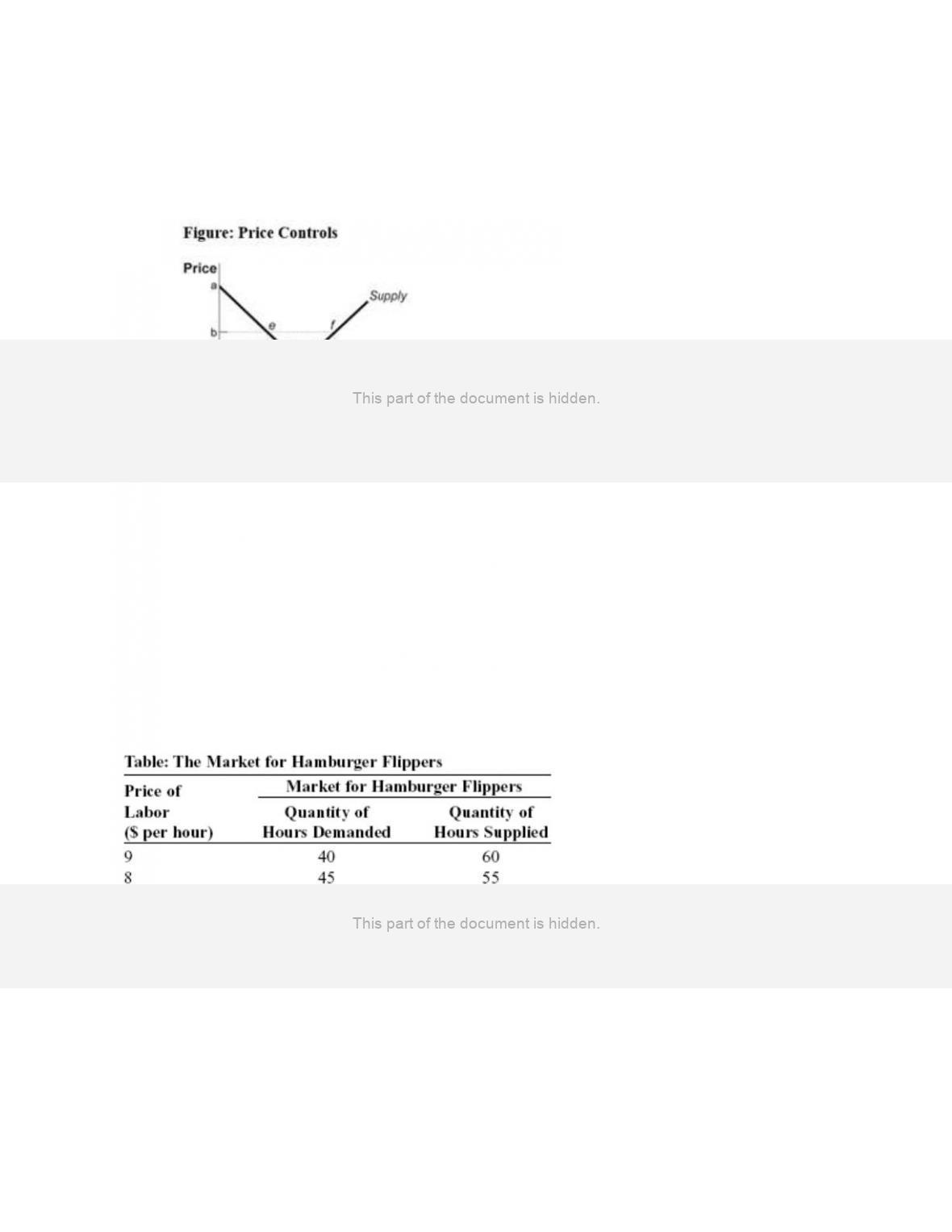
(Figure: Price Control) Use Figure: Price Controls. A price ceiling has been imposed at
price = d. Identify the areas that correspond to the consumer surplus, producer surplus,
and deadweight loss with this price control. In addition, identify the area representing
lost producer surplus that has been transferred to consumers as a result of this policy.
192.
How do binding price ceilings encourage black markets?
193.
How does a binding price ceiling cause deadweight loss in the market?
194.
How could a minimum wage cause an incentive for illegal hiring practices?
Use the following to answer questions 195-196:
195.
(Table: The Market for Hamburger Flippers) Use Table: The Market for Hamburger
Flippers. If the minimum wage in this market is $8, what is the effect on the market?
Who are the winners and losers?