Page 21
77.
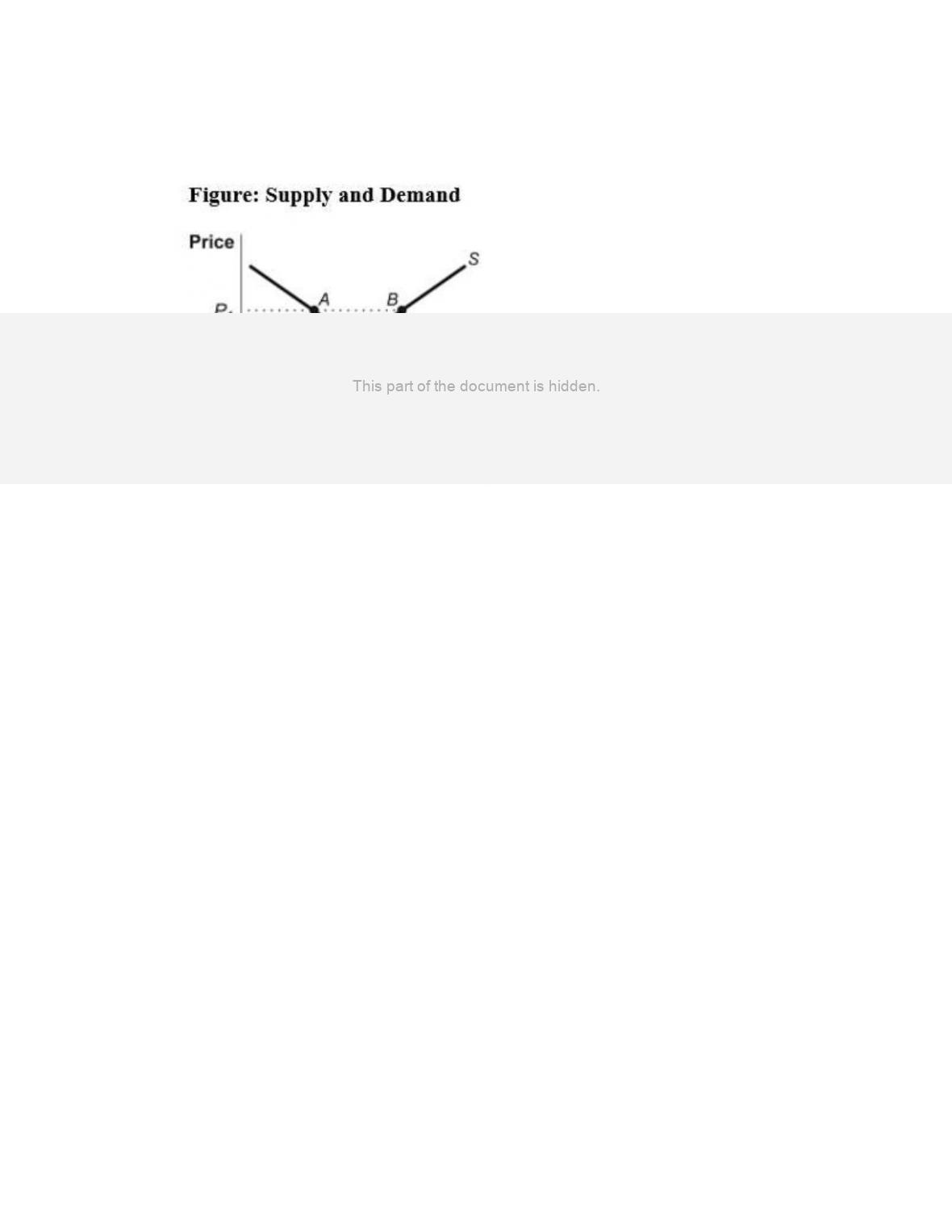
(Figure: Supply and Demand) Use Figure: Supply and Demand. A binding price floor is
represented by:
A)
P1.
B)
P2.
C)
P3.
D)
point C.
78.
All else equal, if a price floor above the equilibrium is imposed on a market and the
government buys the surplus, consumer surplus will _____ and producer surplus will
_____.
A)
fall; rise
B)
fall; fall
C)
rise; fall
D)
rise; rise
Page 22
Use the following to answer questions 79-81:
79.
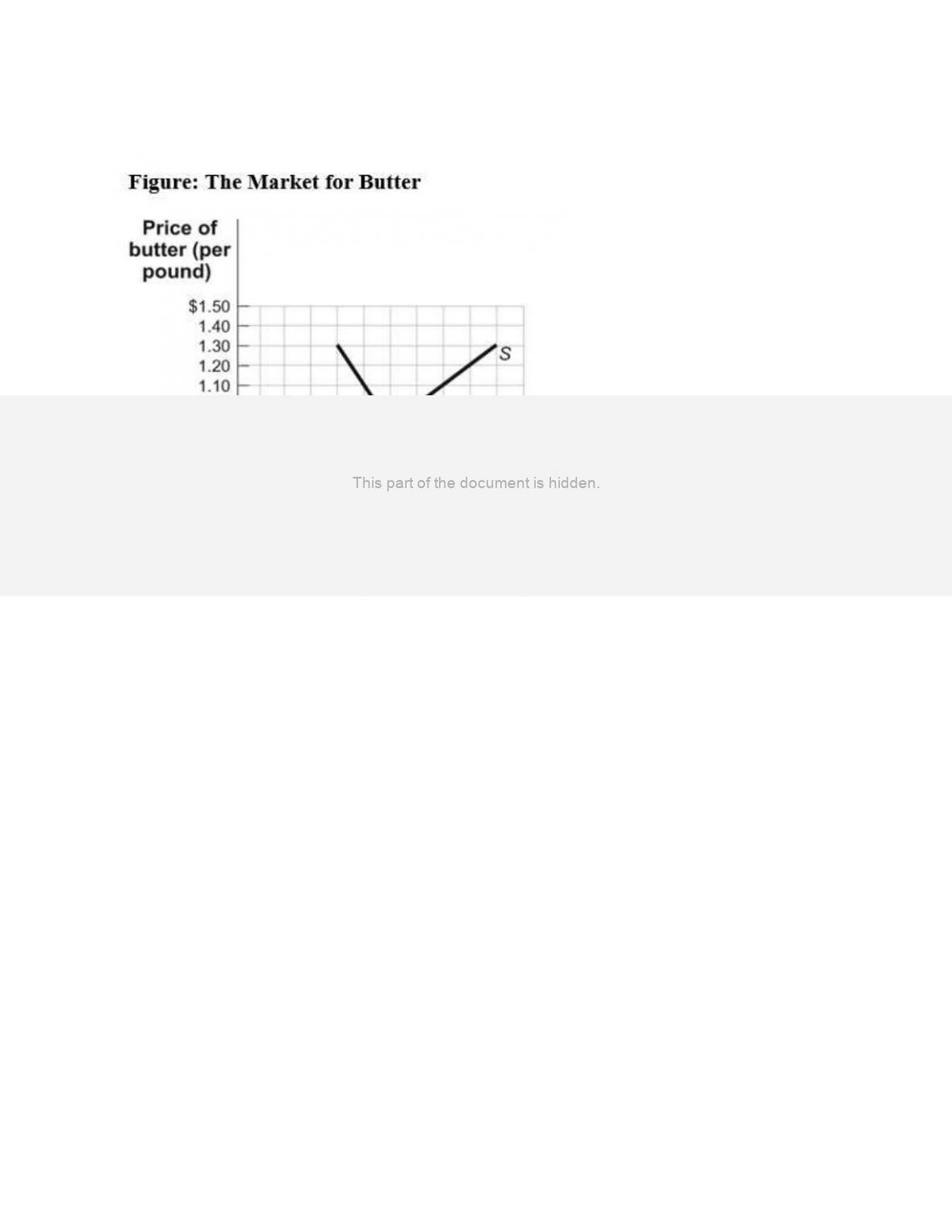
(Figure: The Market for Butter) Use Figure: The Market for Butter. If a government
price floor of $1.30 is imposed on this market, an inefficiency will result in the form of
a _____ of _____ million pounds of butter.
A)
surplus; 4.5
B)
surplus; 6.0
C)
shortage; 6.0
D)
shortage; 4.5
80.
(Figure: The Market for Butter) Use Figure: The Market for Butter. If a government
price floor of $1.20 is imposed on this market, an inefficiency will result in the form of
a _____ of _____ million pounds of butter.
A)
surplus; 4.5
B)
shortage; 4.5
C)
surplus; 1.5
D)
shortage; 1.5
Page 23
81.
(Figure: The Market for Butter) Use Figure: The Market for Butter. If a government
price floor of $1.10 is imposed on this market, an inefficiency will result in the form of
a _____ of _____ million pounds of butter.
A)
surplus; 4.5
B)
shortage; 4.5
C)
surplus; 3
D)
shortage; 1.5
82.
Which statement is a reason for governments imposing or maintaining price controls?
A)
Some consumers and producers can benefit from price controls.
B)
Price controls prevent the deadweight loss that occurs when the market is in
equilibrium.
C)
The government earns revenue from price controls.
D)
Price controls improve the efficiency of the market.
83.
The most likely reason that the government would implement a _____ is because it feels
that the price is too low for _____.
A)
price ceiling; consumers
B)
price floor; consumers
C)
price ceiling; producers
D)
price floor; producers
84.
To be binding, a price floor must be set:
A)
lower than the equilibrium price.
B)
higher than the equilibrium price.
C)
so that quantity demanded exceeds quantity supplied.
D)
lower than the equilibrium price and so that quantity demanded exceeds quantity
supplied.
85.
When the minimum wage increases, which outcome is MOST likely?
A)
Unemployment among skilled workers decreases.
B)
Fewer workers are willing to work off the books.
C)
Skilled workers will outnumber unskilled workers.
D)
Unemployment among unskilled workers increases.
Page 24
86.
Farmers in developing countries want the United States to reduce the subsidies that it
gives to U.S. farmers because subsidized agricultural products from the United States:
A)
lead to agricultural surpluses and lower prices for farmers in developing countries.
B)
raise the world price of agricultural products.
C)
have led to a global shortage of agricultural products.
D)
have led to an increase in the demand for agricultural products from the developing
world.
87.
When the government removes a binding price floor:
A)
quantity demanded will decrease and quantity supplied will increase.
B)
quantity demanded will increase and quantity supplied will decrease.
C)
excess demand will develop.
D)
excess supply will develop.
88.
A minimum price set above the equilibrium price is a:
A)
demand price.
B)
supply price.
C)
binding price floor.
D)
binding price ceiling.
89.
Suppose the government sets a price floor below the current price of a good. This price
floor will:
A)
result in an excess supply of the good.
B)
result in an excess demand for the good.
C)
have no immediate effect on the price of the good.
D)
increase the quantity supplied of the good.
Page 25
90.
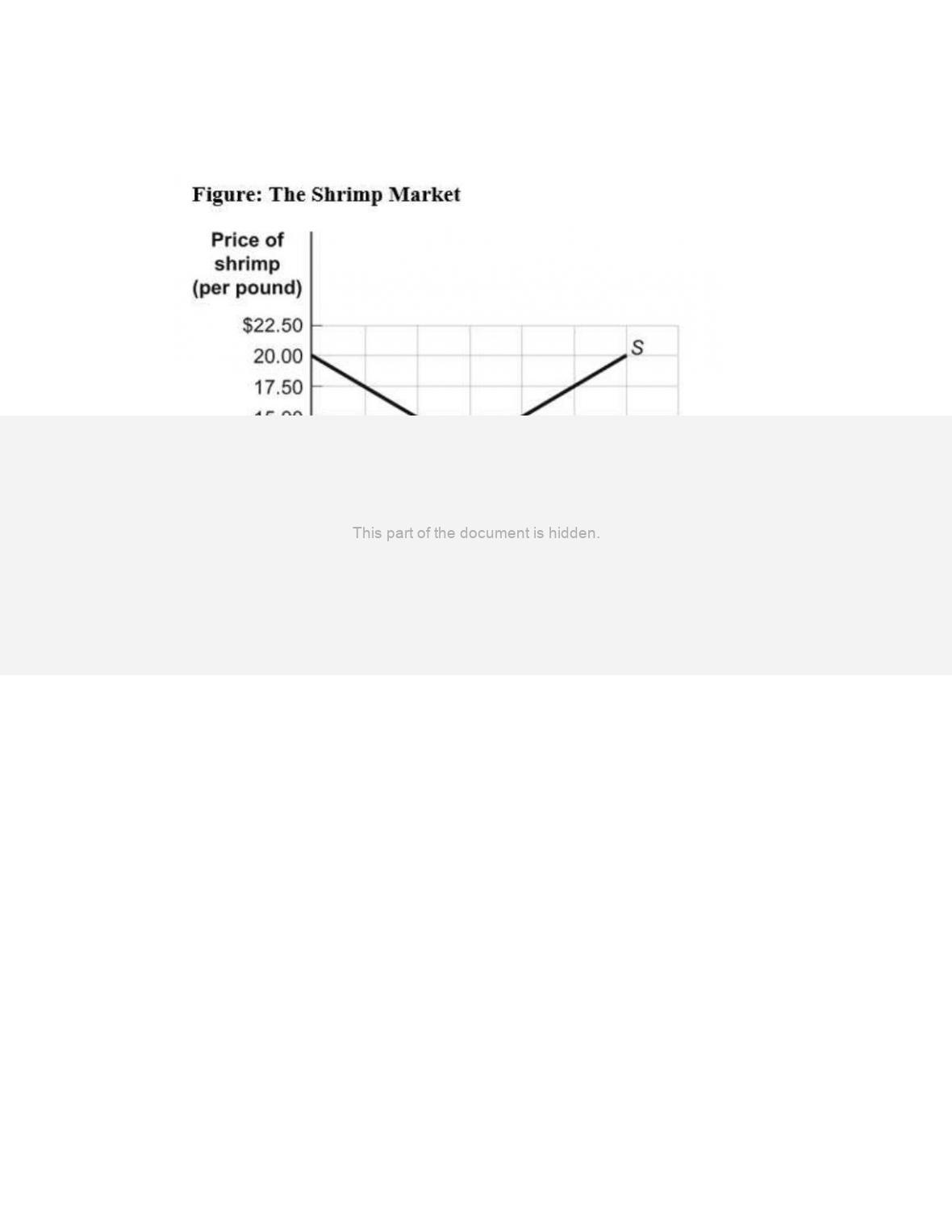
(Figure: The Shrimp Market) Use Figure: The Shrimp Market. If the government wants
to limit shrimp sales to 500 pounds, it can impose a price:
A)
floor of $20.
B)
floor of $10.
C)
ceiling of $5.
D)
floor of $15.
91.
Which example would be considered a price floor?
A)
a rent-controlled apartment
B)
a maximum legal price that could be charged for gasoline during a time of war
C)
the minimum wage
D)
a government decree that capped the price of bottled water in the aftermath of a
devastating hurricane
Page 26
92.
The likely result of a binding price floor is a _____ of the good at a price _____ the
equilibrium price.
A)
surplus; above
B)
shortage; below
C)
surplus; below
D)
shortage; above
93.
If the minimum wage is a binding price floor:
A)
those who want to work will outnumber the jobs available.
B)
the market-clearing equilibrium wage will increase.
C)
there will be a job for everyone who is willing to work.
D)
business owners will hire more workers.
Page 27
94.
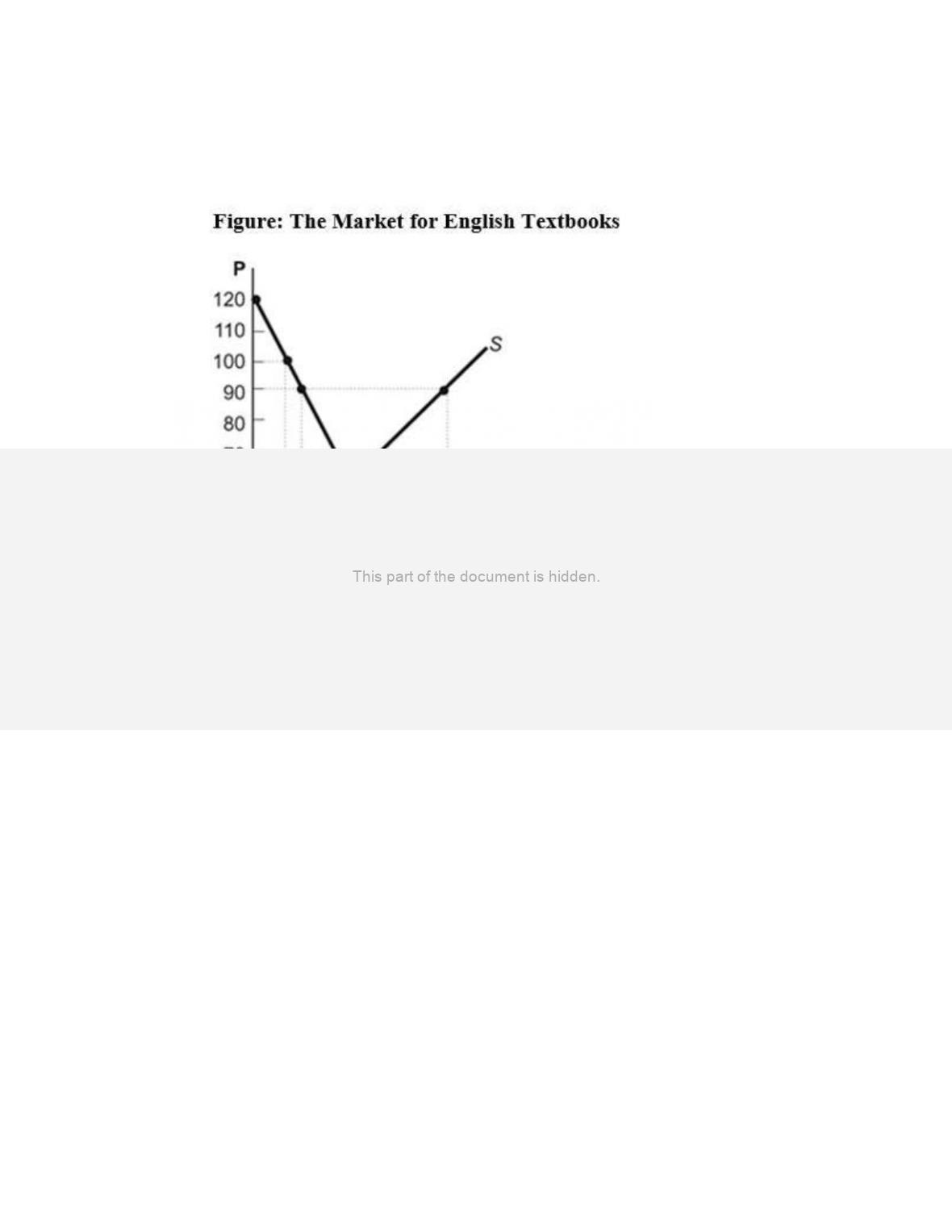
(Figure: The Market for English Textbooks) Use Figure: The Market for English
Textbooks. With a binding price floor at $90, the market outcome would be a _____ of
_____ textbooks.
A)
surplus; 45
B)
surplus; 30
C)
shortage; 45
D)
shortage; 30
Page 28
95.
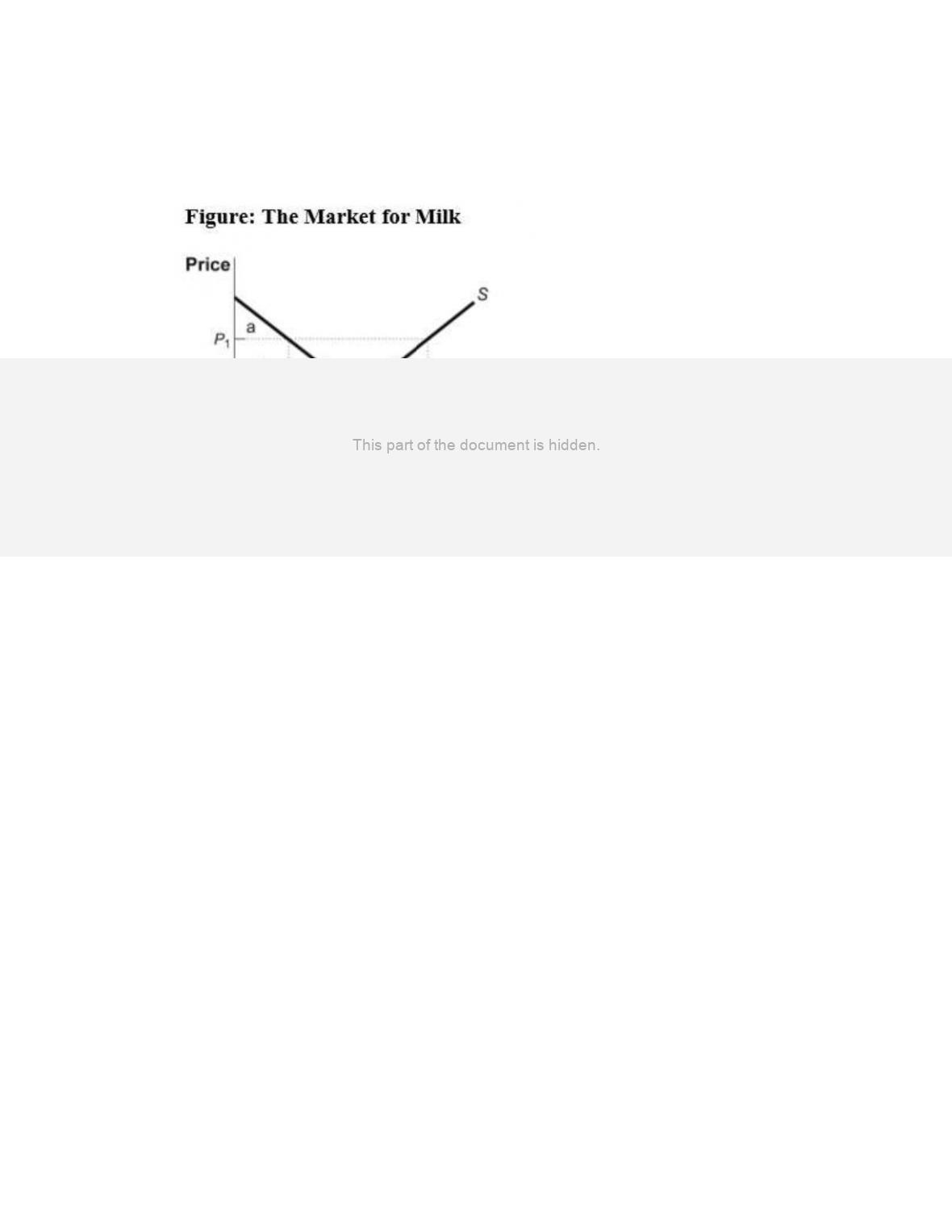
(Figure: The Market for Milk) Use Figure: The Market for Milk. With a binding price
floor, the price could be equal to _____, consumers would demand _____, and
producers would supply _____.
A)
P1; Q1; Q3
B)
P2; Q2; Q2
C)
P1; Q3; Q1
D)
P3; Q3; Q1
Page 29
96.
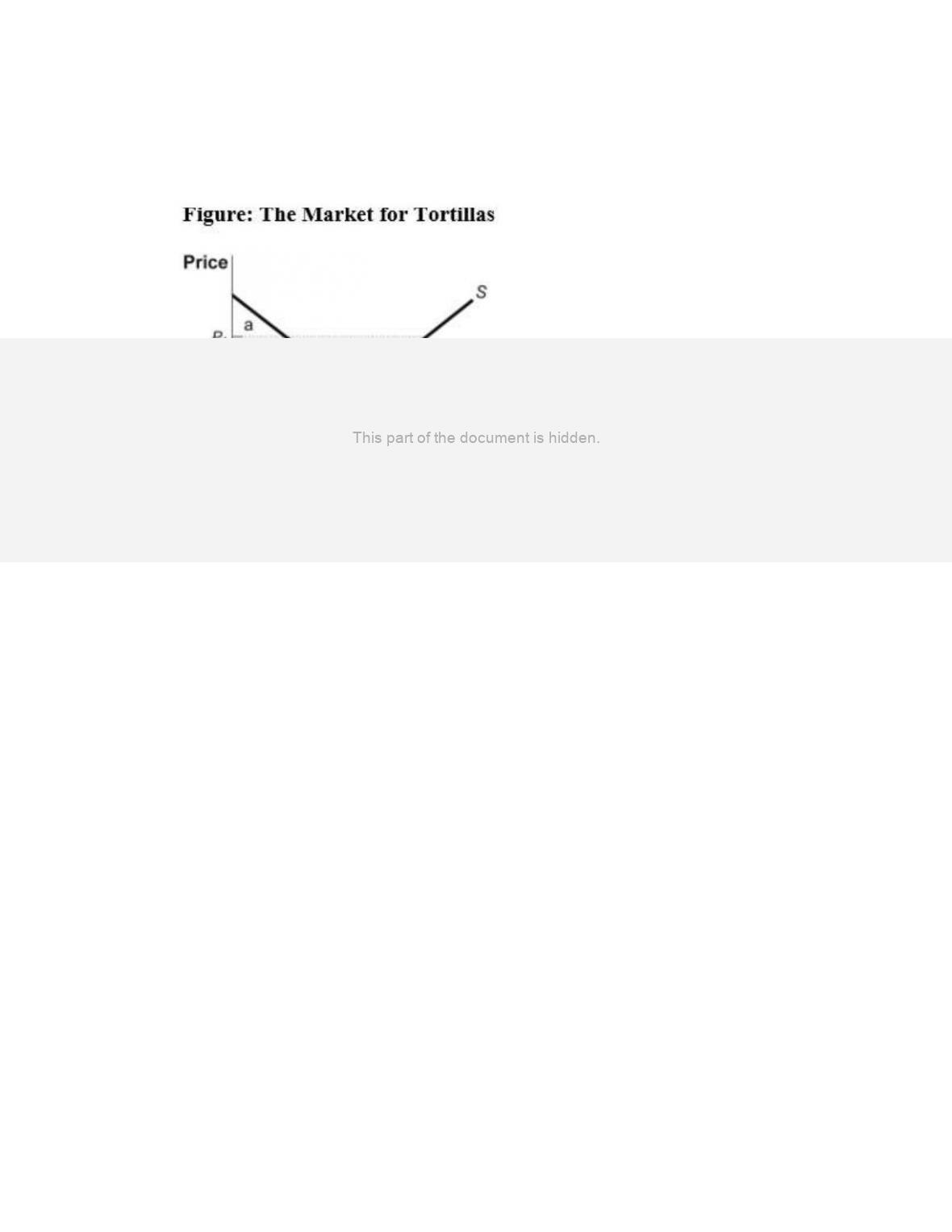
(Figure: The Market for Tortillas) Use Figure: The Market for Tortillas. With a
nonbinding price floor, the price could be equal to _____, consumers would demand
_____, and producers would supply _____.
A)
P1; Q1; Q3
B)
P2; Q2; Q2
C)
P1; Q3; Q1
D)
P3; Q2; Q1
Page 30
97.
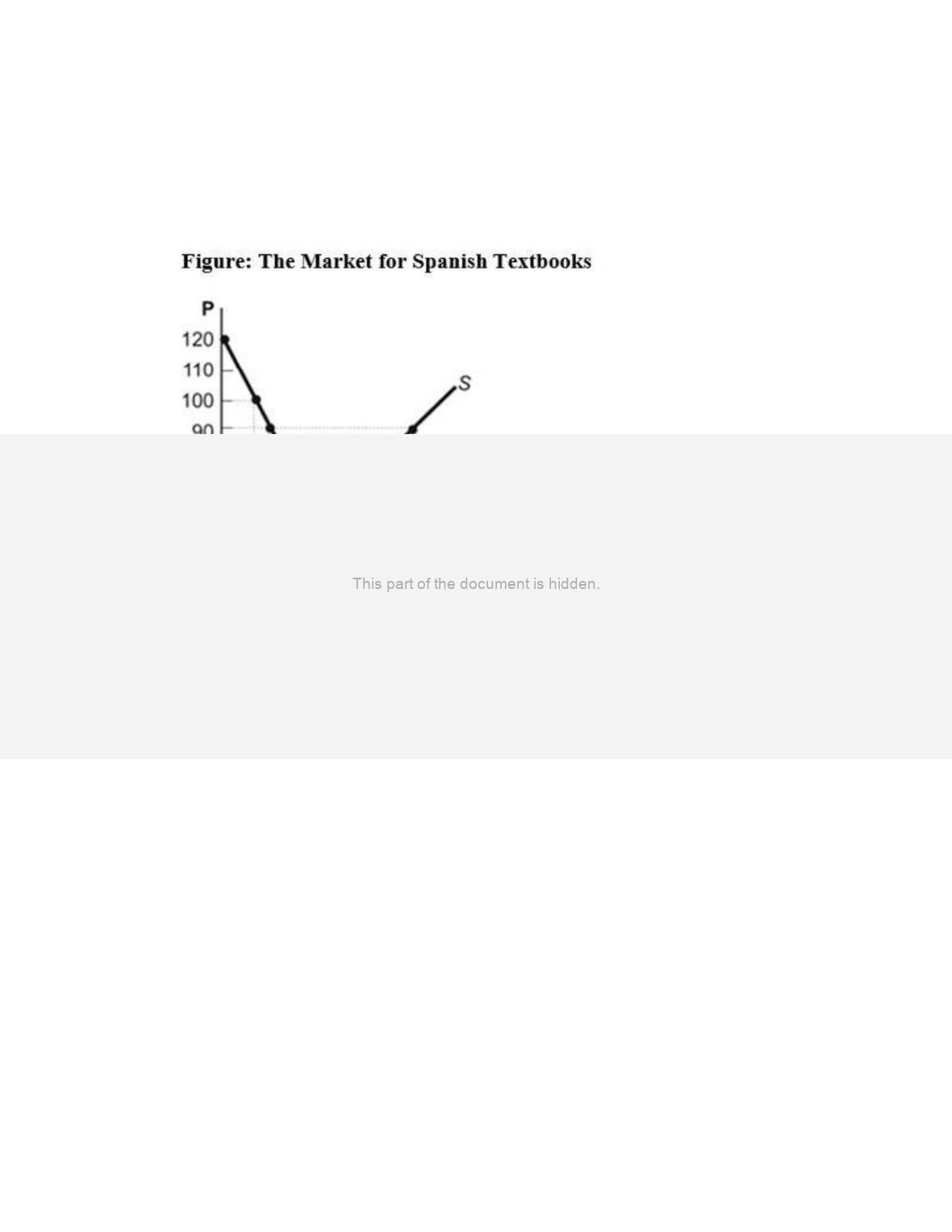
(Figure: The Market for Spanish Textbooks) Use Figure: The Market for Spanish
Textbooks. Suppose the government believes the producers of Spanish textbooks are not
profitable, and it wants to make sure textbook producers are profitable. It could impose
a control called a price _____, and for it to be binding, one possible price would be
_____.
A)
floor; $90
B)
floor; $40
C)
ceiling; $40
D)
ceiling; $90
98.
A binding price floor is a _____ price set _____ the equilibrium price.
A)
minimum; at
B)
maximum; below
C)
minimum; above
D)
maximum; above
Page 31
99.
A binding price floor in the market for wheat:
A)
increases the price paid by consumers.
B)
decreases the price paid by consumers.
C)
decreases the price received by farmers.
D)
does not change the price received by farmers.
100.
A minimum price that the government guarantees farmers will receive for a particular
crop is a(n):
A)
price ceiling.
B)
price floor (or price support).
C)
deficiency price.
D)
export subsidy.
Use the following to answer questions 101-102:
101.
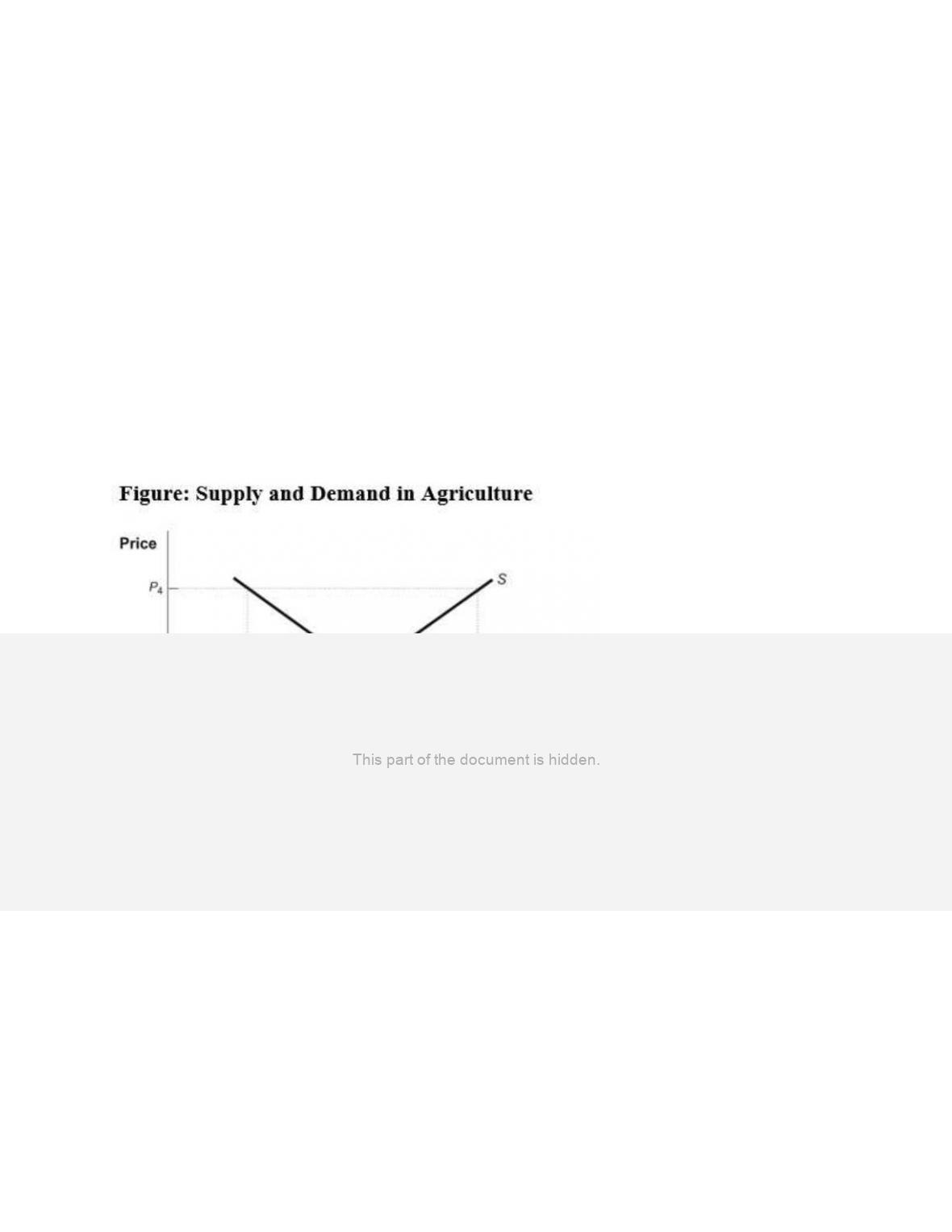
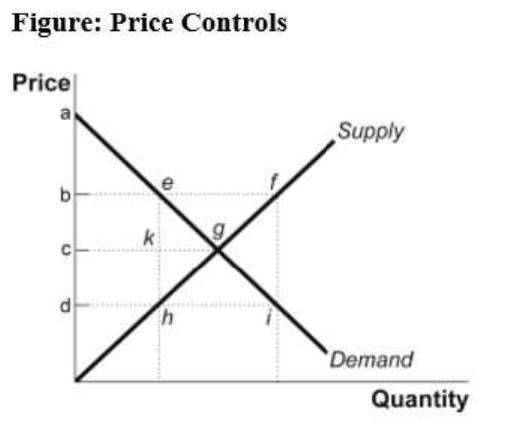
(Figure: Supply and Demand in Agriculture) Use Figure: Supply and Demand in
Agriculture. The government could help increase some farmers’ income by setting a
price _____ at _____, causing a _____ of _____.
A)
floor; P4; surplus; Q3 – Q0
B)
floor; P2; surplus; Q2 – Q0
C)
ceiling; P4; surplus; Q2 – Q1
D)
floor; P1; shortage; Q3 – Q0
Page 32
102.
(Figure: Supply and Demand in Agriculture) Use Figure: Supply and Demand in
Agriculture. If a price floor at P4 is set to help improve farm incomes and the
government wants to assure farmers that their output will be purchased, the government
must purchase an amount of output equal to:
A)
Q3 – Q0.
B)
Q3 – Q1.
C)
Q2 – Q1.
D)
Q1 – Q3.
103.
An agricultural market price support policy establishes a binding price floor, which:
A)
decreases the price paid by consumers.
B)
does not change the price paid by consumers.
C)
increases the price received by farmers.
D)
decreases the price received by farmers.
Use the following to answer questions 104-106:
104.
(Figure: Price Controls) Use Figure: Price Controls. An effective price floor would be at
price _____ and a _____ would result from the difference between points _____.
A)
c; surplus; f and e
B)
b; surplus; f and e
C)
d; shortage; i and h
D)
b; shortage; f and e
Page 33
105.
(Figure: Price Controls) Use Figure: Price Controls. The consumer surplus lost to a price
floor at point b is equal to the area:
A)
abe.
B)
egh.
C)
bcge.
D)
bcke.
106.
(Figure: Price Controls) Use Figure: Price Controls. A price floor has been set at point
b. The area of deadweight loss that results from this price floor is:
A)
egh.
B)
ghi.
C)
fgi.
D)
efg.
107.
The persistent unwanted surplus that results from a binding price floor causes
inefficiencies that do NOT include:
A)
inefficiently low quality.
B)
inefficient allocation of sales among sellers.
C)
wasted resources.
D)
the temptation to break the law by selling below the legal price.
108.
A binding price floor causes:
A)
a shortage in the market.
B)
a surplus in the market.
C)
an efficient use of resources.
D)
equilibrium.
109.
Suppose that a binding price floor is in place in a particular market. If the market is
deregulated and the price floor is removed:
A)
the quantity demanded will decrease.
B)
excess demand will develop.
C)
the quality of the good supplied will likely decrease.
D)
quantity supplied will increase.
110.
One of the consequences of the minimum wage has been:
A)
decreased unemployment for low-skill workers.
B)
workers offering to work off the books for less than the minimum wage.
C)
lower production costs for small businesses.
D)
increased employment for high-skill workers.

Page 34
111.
Price controls:
A)
always increase economic efficiency.
B)
always lead to more equitable results.
C)
can result in inequitable outcomes.
D)
are always set below the equilibrium price.
112.
Producers may supply a good with inefficiently high quality if the government imposes
a:
A)
price ceiling set above the equilibrium price.
B)
price floor set below the equilibrium price.
C)
binding price floor.
D)
binding price ceiling.
113.
In Europe, the minimum wage has led to:
A)
lower unemployment, especially among young workers.
B)
a proliferation of large companies in Italy.
C)
widespread evasion of the minimum wage law in the black market for labor.
D)
European governments hiring the surplus of workers.
114.
A binding price floor is likely to cause deadweight loss because:
A)
buyers incur additional search costs looking for the scarce good.
B)
the quantity of the good transacted is less than the equilibrium quantity transacted.
C)
a black market emerges and the good sells at prices above the price floor.
D)
some buyers who want to buy at the controlled price are unable to find a seller
willing to sell at that price.
115.
Which inefficiency is NOT caused by price floors?
A)
inefficiently low quality
B)
inefficient allocation of sales among sellers
C)
wasted resources
D)
illegal activity
Page 35
Use the following to answer questions 116-117:
116.
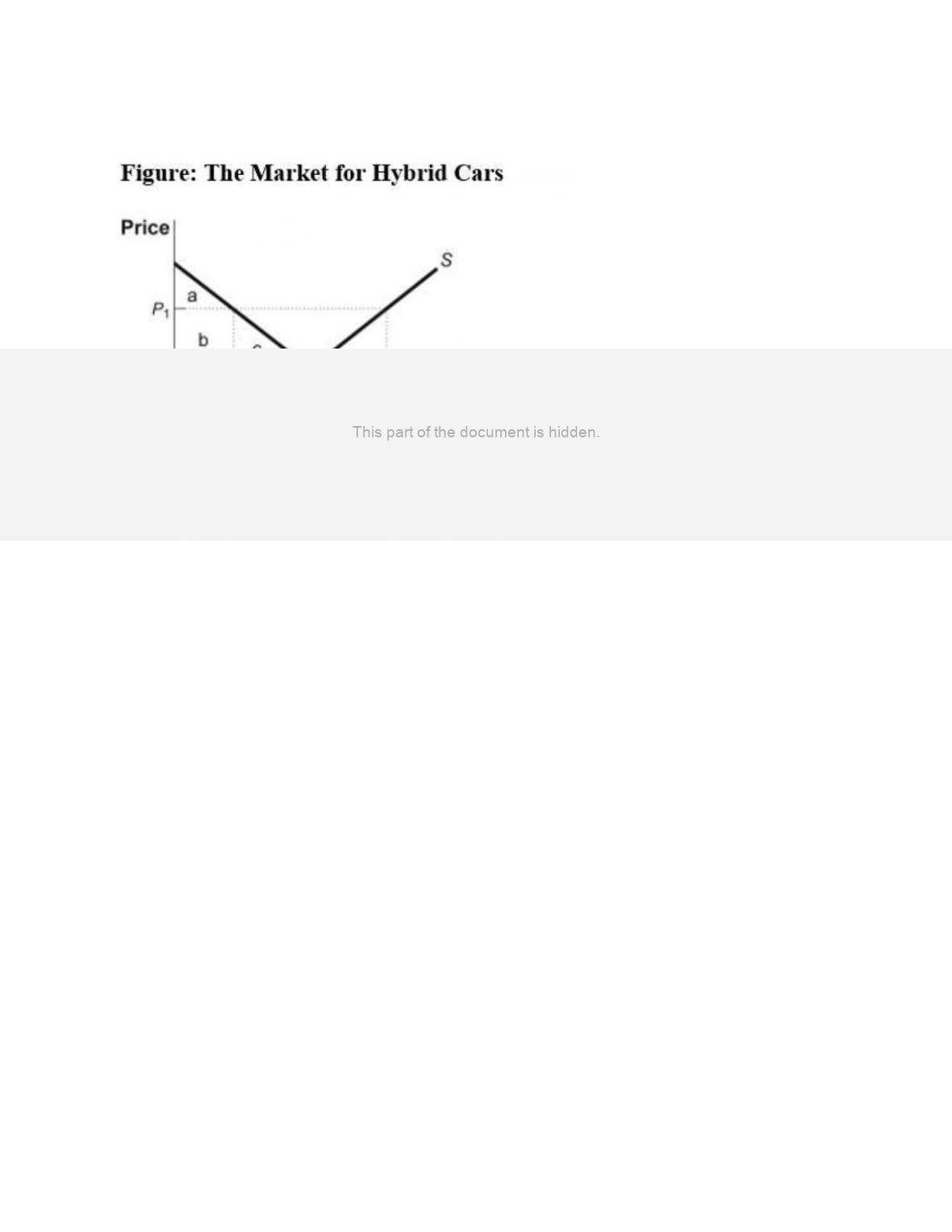
(Figure: The Market for Hybrid Cars) Use Figure: The Market for Hybrid Cars. What
area represents consumer surplus if there is a binding price floor at P1?
A)
a
B)
a + b
C)
a + b + c
D)
a + b + d
117.
(Figure: The Market for Hybrid Cars) Use Figure: The Market for Hybrid Cars. What
area represents deadweight loss if there is a binding price floor at P1?
A)
a + b + c
B)
b + c + d + e
C)
c + e
D)
c
118.
The system of taxicab medallions in New York City is an example of a:
A)
price subsidy.
B)
nonbinding price ceiling.
C)
price floor.
D)
quantity control.
Page 36
119.
When the government policy is to regulate the quantity of a good that can be bought and
sold rather than the price at which it is transacted, it uses a:
A)
quota.
B)
price control.
C)
price ceiling.
D)
price floor.
120.
In economic markets, a quota is a(n):
A)
lower limit on quantity.
B)
upper limit on quantity.
C)
maximum price.
D)
minimum price.
121.
The total amount of the good that can be transacted under a quantity control is called
the:
A)
ceiling price.
B)
demand price.
C)
quota limit.
D)
supply price.
122.
Which example is a quantity control?
A)
the Medicare reimbursement schedule for physicians
B)
the minimum wage
C)
unemployment insurance
D)
limits on the number of red snappers that can be caught in the Gulf of Mexico
123.
The purpose of medallions issued in New York City in the 1930s was to:
A)
limit the number of people who used the subway during rush hour.
B)
ensure that taxicabs met standards of safety and cleanliness.
C)
give the owner the right to buy and sell securities on the New York Stock
Exchange.
D)
encourage citizens to buy their own cars.
124.
Typically, the government limits the quantity of a good that can be bought and sold by:
A)
licensing the suppliers.
B)
setting a price floor below the equilibrium price.
C)
maintaining the equilibrium price regardless of changes in demand and supply.
D)
setting a price ceiling above the equilibrium price.
Page 37
125.
Which example is a quota?
A)
rent controls in New York City
B)
property taxes on beachfront property in Florida
C)
limits on the number of bushels of clams that can be caught in New Jersey
D)
the maximum reimbursement that insurance will pay for a medical procedure
126.
The amount that consumers are willing to pay for the quota limit quantity is the:
A)
demand price.
B)
supply price.
C)
quota rent.
D)
price ceiling.
127.
The amount for which suppliers are willing to supply the quota limit quantity is the:
A)
demand price.
B)
supply price.
C)
quota rent.
D)
price floor.
128.
The difference between the demand price and the supply price at the quota limit amount
is the:
A)
demand price.
B)
supply price.
C)
quota rent.
D)
price floor.
129.
When the government imposes a quota on sales of a good or service, it usually licenses
the right to sell a given quantity of the good. The market price of the license is equal to
the:
A)
demand price of the good.
B)
wedge that represents the difference between the demand price and the supply
price.
C)
supply price of the good.
D)
equilibrium price of the good.
Page 38
130.
If New York City had no medallion system for taxicabs, assuming that the supply curve
of taxicab rides is upward sloping and the demand curve for taxicab rides is downward
sloping, economic theory would predict that the price of a taxicab ride would:
A)
increase because of the higher safety hazards.
B)
not change from its current level.
C)
decrease.
D)
increase, but only slightly.
131.
Suppose the U.S. government imposes a binding quota on the number of Japanese-made
cars allowed into the United States. Assuming that Japanese-made cars and U.S.-made
cars are substitutes in consumption, we would expect the price of Japanese cars to
_____ and the price of U.S.-made cars to _____.
A)
increase; increase
B)
increase; decrease
C)
decrease; increase
D)
decrease; decrease
132.
The quota rent is the:
A)
difference between the demand price and the supply price at the quota limit.
B)
rent received by landlords who own rent-controlled apartments.
C)
opportunity cost of using a quota-controlled service or of buying a good that is
subject to an import quota.
D)
minimum rent that the owner of a building must receive before he or she is willing
to rent out the building.
Page 39
133.
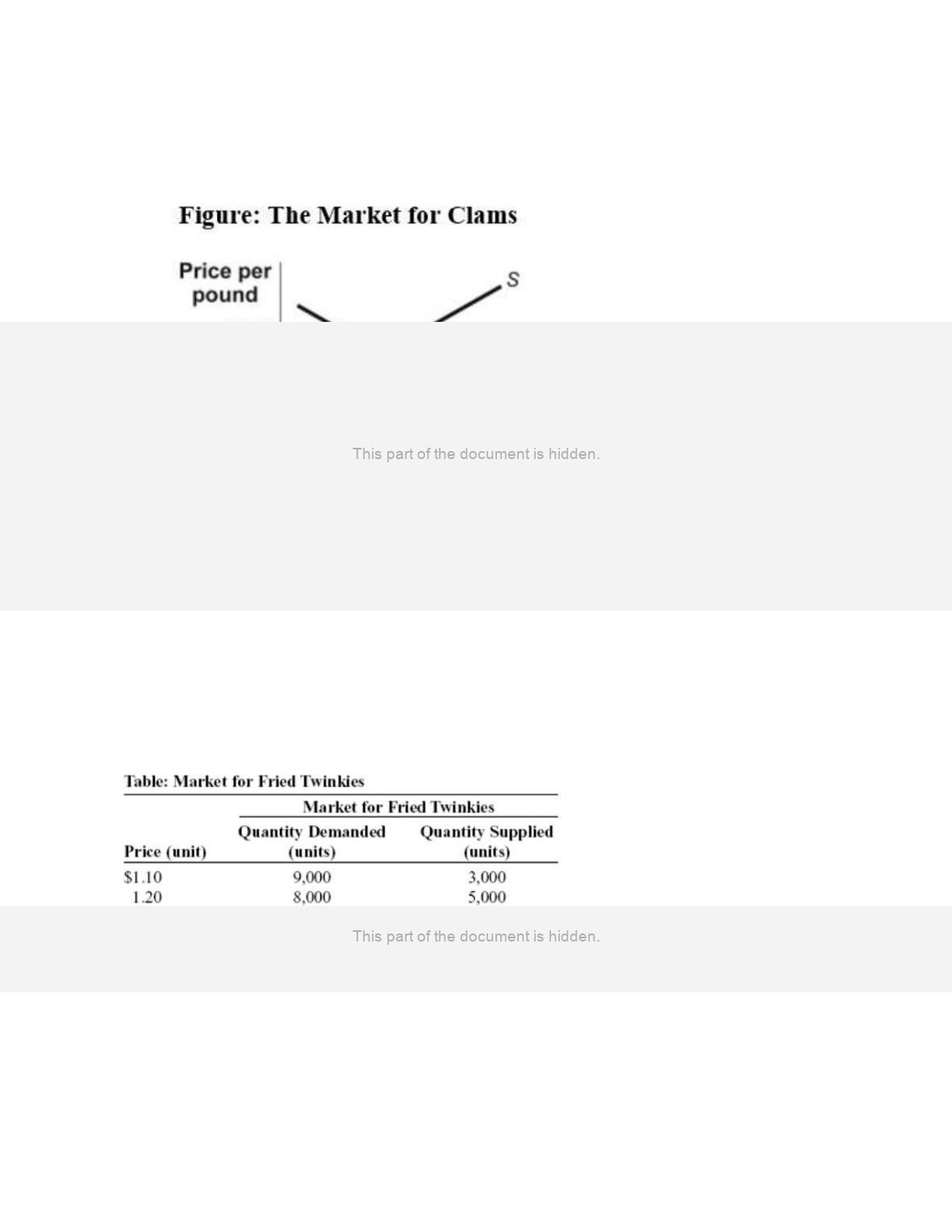
(Figure: The Market for Clams) Use Figure: The Market for Clams. The government
imposes a quota limiting sales of clams to 1,000 pounds. According to the figure, the
quota rent per pound in this case is:
A)
$7.50.
B)
$5.00.
C)
$2.50.
D)
The quota rent cannot be determined from the information provided.
Use the following to answer questions 134-135:
Page 40
134.
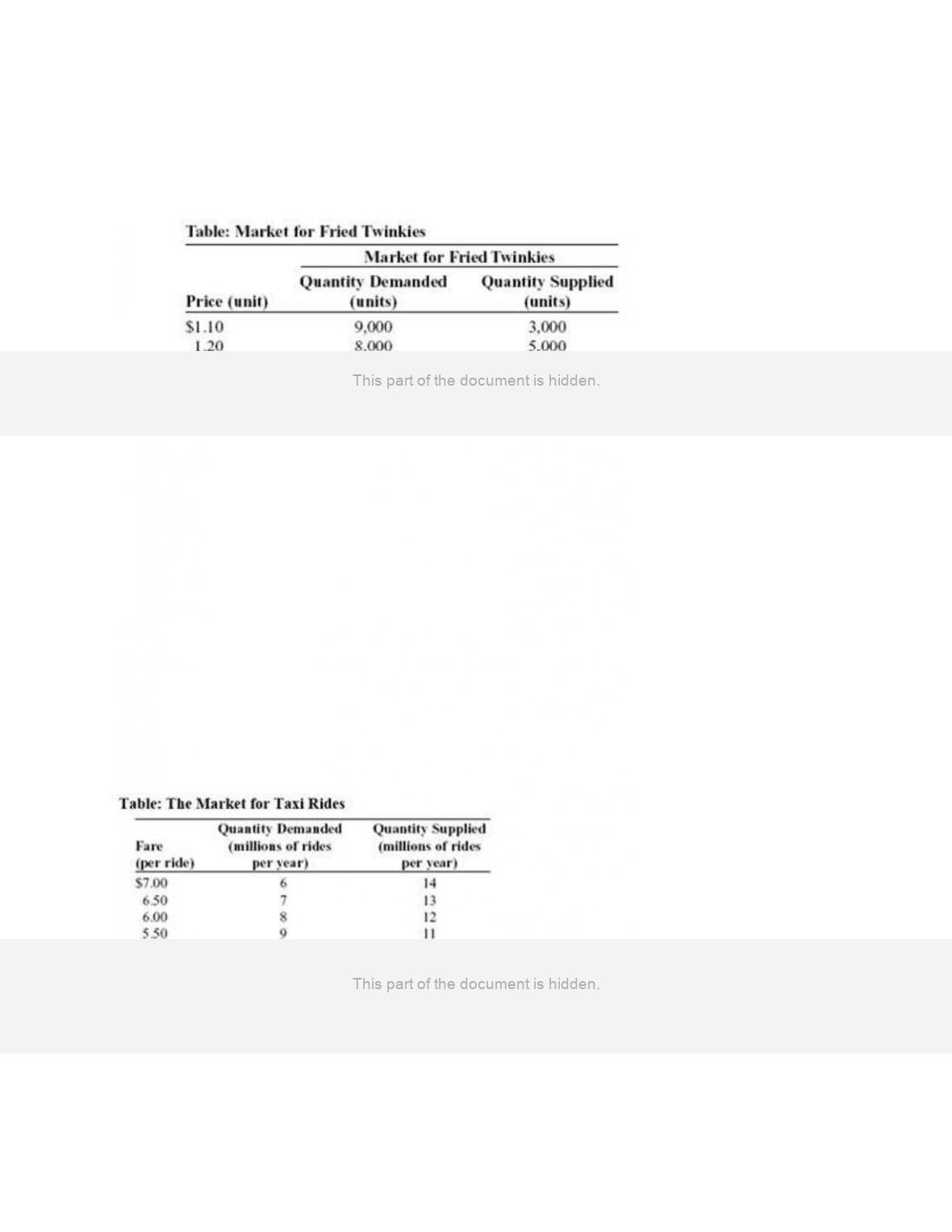
(Table: Market for Fried Twinkies) Use Table: Market for Fried Twinkies. Suppose the
government decides to reduce fried Twinkie consumption as part of a war on obesity.
After careful study, the government decides to impose a quota of 5,000 on production of
fried Twinkies this year. What price will producers charge if they obey the quota law?
A)
$1.20
B)
$1.30
C)
$1.50
D)
The answer cannot be determined with this information.
135.
(Table: Market for Fried Twinkies) Use Table: Market for Fried Twinkies. If the
government imposes a quota of 5,000 on the fried Twinkie market, the quota rent per
fried Twinkie will be:
A)
$1.20.
B)
$0.30.
C)
$1.50.
D)
$1.00.
Use the following to answer questions 136-138: