Page 1
Name: __________________________ Date: _____________
1.
A price control is:
A)
control of the price of a good by the firm that produces it.
B)
a legal restriction on how high or low a price in a market may go.
C)
an upper limit on the quantity of some good that can be bought or sold.
D)
a tax on the sale of a good that controls the market price.
Use the following to answer questions 2-10:
2.
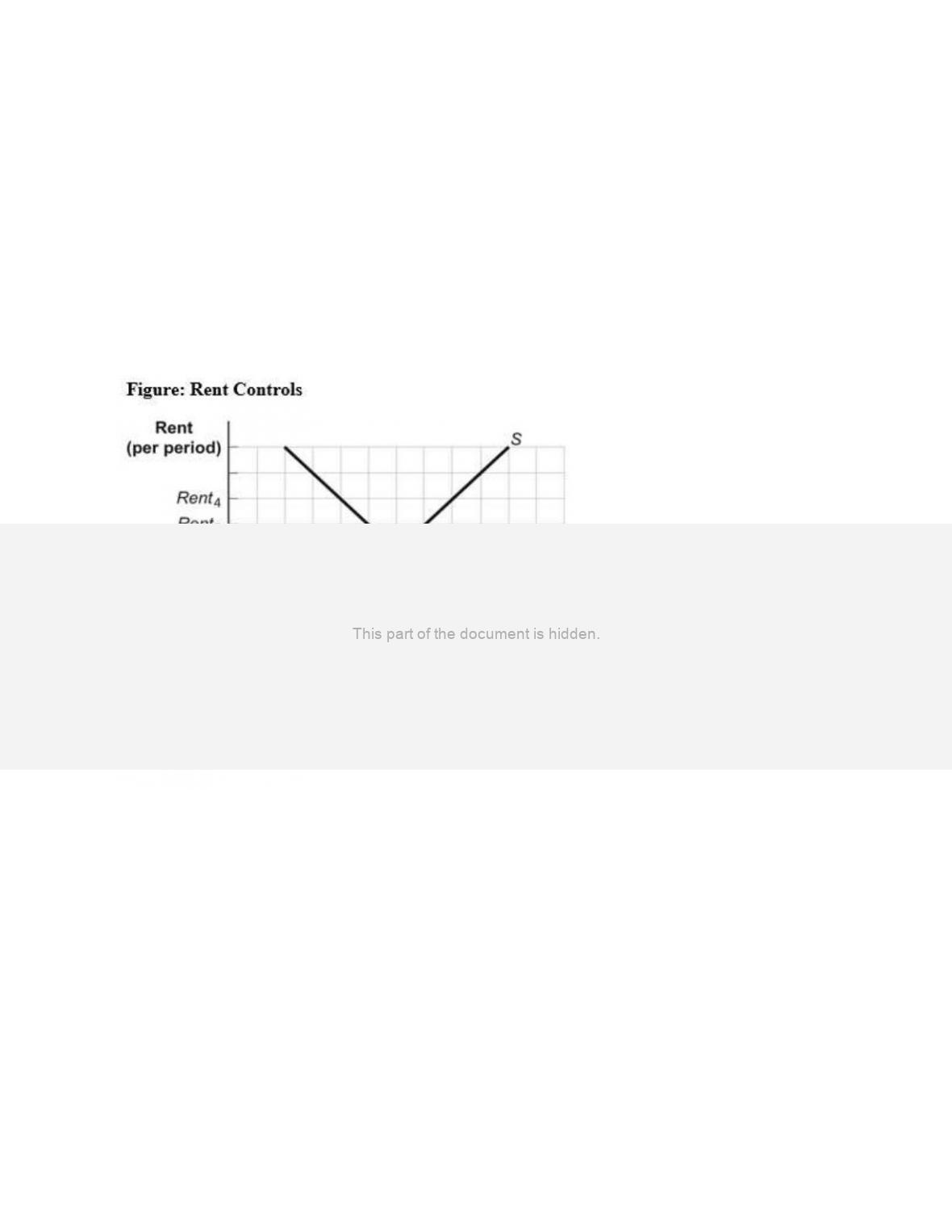
(Figure: Rent Controls) Use Figure: Rent Controls. Without rent controls, the
equilibrium quantity is:
A)
Q4.
B)
Q1.
C)
Q2.
D)
Q3.

Page 2
3.
(Figure: Rent Controls) Use Figure: Rent Controls. Suppose that rent controls are
imposed. If the government wanted a rent control ceiling to be effective immediately,
what is one possible price to set?
A)
Rent3
B)
Rent4
C)
Rent1
D)
Rent2
4.
(Figure: Rent Controls) Use Figure: Rent Controls. If rent controls are set at Rent0,
renters would be willing to pay a price at least as high as:
A)
Rent4 for Q0 units.
B)
Rent4 for Q1 units.
C)
Rent3 for Q1 units.
D)
No one would be willing to pay a higher actual price than Rent0.
5.
(Figure: Rent Controls) Use Figure: Rent Controls. Without rent controls, the
equilibrium rent is:
A)
Rent4.
B)
Rent1.
C)
Rent2.
D)
Rent3.
6.
(Figure: Rent Controls) Use Figure: Rent Controls. If rent controls are imposed and the
government wants them to be immediately effective, they will most likely be set at
either _____ or _____.
A)
Rent0; Rent1
B)
Rent1; Rent3
C)
Rent3; Rent4
D)
Rent2; Rent4
7.
(Figure: Rent Controls) Use Figure: Rent Controls. If rent controls are set at Rent0:
A)
the shortage of rental units is the distance Q1 – Q3.
B)
some renters will be willing to pay a price as high as Rent4 for Q0 units.
C)
no one will have to pay a higher actual price than Rent0, nor will anyone be willing
to do so.
D)
there will be a surplus of rental units.
Page 3
8.
(Figure: Rent Controls) Use Figure: Rent Controls. If rent controls are set at Rent1:
A)
the shortage of rental units is the distance Q3 – Q1.
B)
some renters will be willing to pay a price as high as Rent4 for Q1 units.
C)
no one will have to pay a higher actual price than Rent0, nor will anyone be willing
to do so.
D)
there will be a surplus of rental units, but it is impossible to tell how large the
surplus is based on the information provided.
9.
(Figure: Rent Controls) Use Figure: Rent Controls. If rent controls are set at Rent3:
A)
the shortage of rental units is the distance Q3 – Q1.
B)
some renters will be willing to pay a price as high as Rent4 for Q3 units.
C)
no one will have to pay a higher actual price than Rent0, nor will anyone be willing
to do so.
D)
rent will remain at Rent2.
10.
(Figure: Rent Controls) Use Figure: Rent Controls. If rent controls are set at Rent1:
A)
rental apartments may be of inefficiently low quality.
B)
there will be an efficient allocation of rentals.
C)
some landlords may break the law by renting below the mandated price.
D)
new apartments will be constructed.
11.
The market for apples is in equilibrium at a price of $0.50 per pound. If the government
imposes a price floor in the market at a price of $0.40 per pound:
A)
quantity demanded will decrease.
B)
quantity supplied will increase.
C)
there will be a shortage of apples.
D)
the price floor will not affect the market price or output.
12.
A binding price ceiling is usually designed to:
A)
keep prices below the equilibrium level.
B)
increase the quality of the good.
C)
prevent shortages.
D)
increase efficiency.
Page 4
13.
Rapidly increasing health costs have been a major political concern since at least 1992.
Suppose the government sets the maximum price for a normal doctor visit at $20 to
control rising health costs but the current market price is $40. What is MOST likely to
happen?
A)
More people will try to visit the doctor, but there will be fewer doctors willing to
see patients at that price.
B)
The same number of people will try to visit the doctor, and the same number of
doctors are willing to see patients at that price.
C)
More people will be able to see the doctor, since the price is lower.
D)
Fewer people will try to see the doctor, and fewer doctors are willing to see
patients at that price.
14.
The government decides to impose a price ceiling on a good because it thinks the
market-determined price is too high. If the government imposes the price ceiling below
the equilibrium price:
A)
consumers will respond to the lower price and wish to purchase more of the good
than at the equilibrium price.
B)
producers will respond to the lower price and offer more units for sale.
C)
consumers will be able to purchase more of the good after the price ceiling is
imposed.
D)
it will not be binding.
15.
The government imposes a price ceiling below the equilibrium price. The price ceiling
will cause:
A)
demand to decrease.
B)
supply to increase.
C)
a shortage of the good.
D)
an increase in the quality of the good.
16.
Suppose the NFL wants to give the “common fan” the opportunity to attend the Super
Bowl, so it sets Super Bowl prices “low”—let’s say they set ticket prices for a regular
seat at Super Bowl LI to cost just $400. People who have tickets, however, can turn
around and sell them online for $1,500 or more. If there are no transaction costs for fans
with tickets to sell them, the true cost to a fan of attending Super Bowl LI is:
A)
at most $400.
B)
at least $1,500.
C)
the monetary price paid to obtain the ticket.
D)
$1,100 less than the opportunity cost of a ticket.
Page 5
17.
Rent controls set a price ceiling below the equilibrium price, and therefore:
A)
quantity supplied exceeds the quantity demanded.
B)
quantity demanded exceeds the quantity supplied.
C)
a surplus of rental units will result.
D)
all poor people will be helped.
18.
A price ceiling will have NO immediate effect if:
A)
it is set above the equilibrium price.
B)
the equilibrium price is above the price ceiling.
C)
it is set below the equilibrium price.
D)
it creates a shortage.
Use the following to answer questions 19-23:
19.
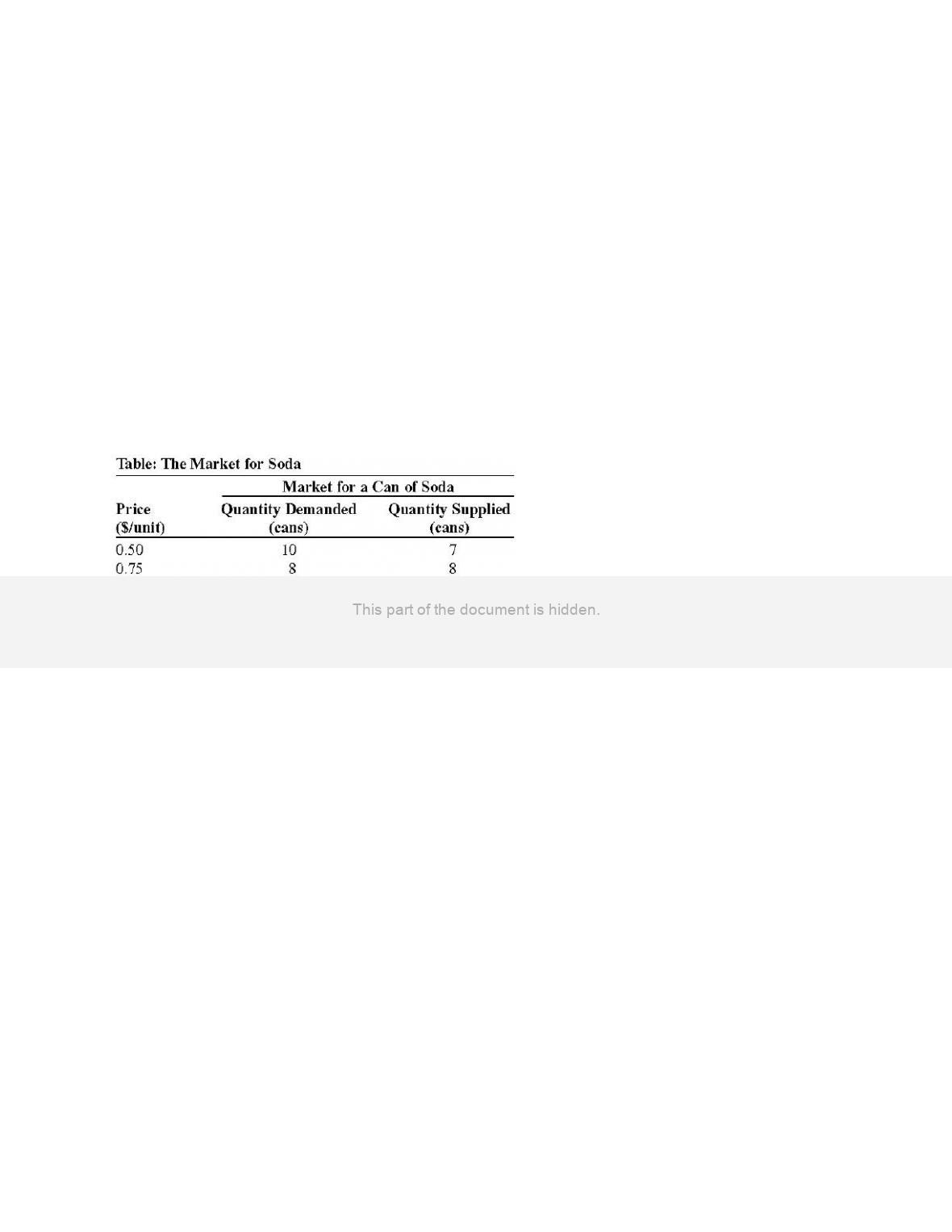
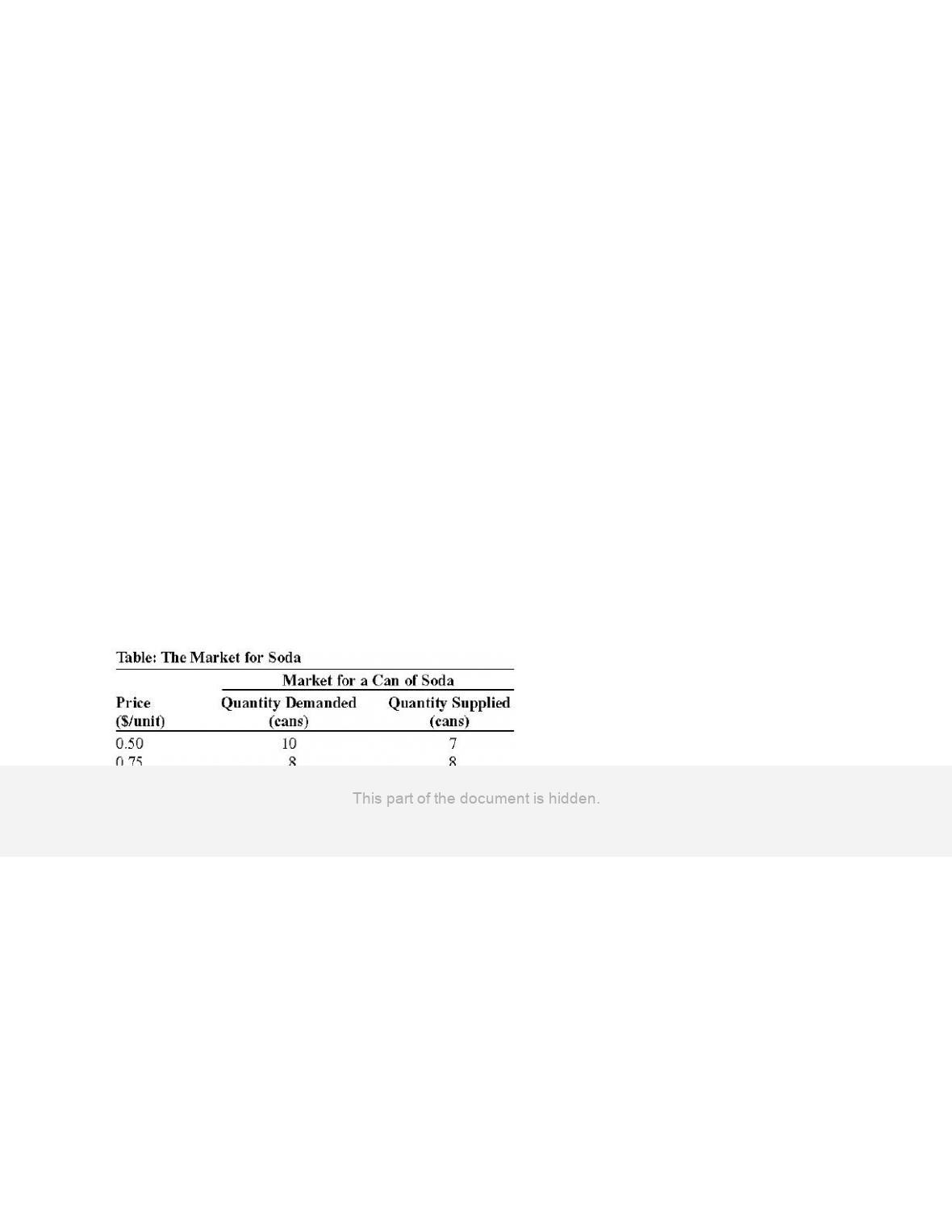
(Table: The Market for Soda) Use Table: The Market for Soda. If the government does
NOT impose a price control, the price of a can of soda will equal:
A)
$0.50.
B)
$0.75.
C)
$1.00.
D)
$1.25.
20.
(Table: The Market for Soda) Use Table: The Market for Soda. If the government
imposes a price ceiling of $0.50 per can of soda, the quantity of soda demanded will be
_____ cans.
A)
10
B)
8
C)
6
D)
4
Page 6
21.
(Table: The Market for Soda) Use Table: The Market for Soda. If the government
imposes a price ceiling of $0.50 per can of soda, there will be:
A)
a shortage of 2 cans.
B)
a shortage of 3 cans.
C)
a surplus of 3 cans.
D)
equilibrium in the market for soda.
22.
(Table: The Market for Soda) Use Table: The Market for Soda. If the government
imposes a price ceiling of $1 per can of soda, the quantity of soda supplied will be
_____ cans.
A)
7
B)
8
C)
9
D)
10
23.
(Table: The Market for Soda) Use Table: The Market for Soda. If the government
imposes a price ceiling of $1 per can of soda, the quantity of soda demanded will be
_____ cans.
A)
10
B)
8
C)
6
D)
4
Use the following to answer question 24:
Page 7
24.
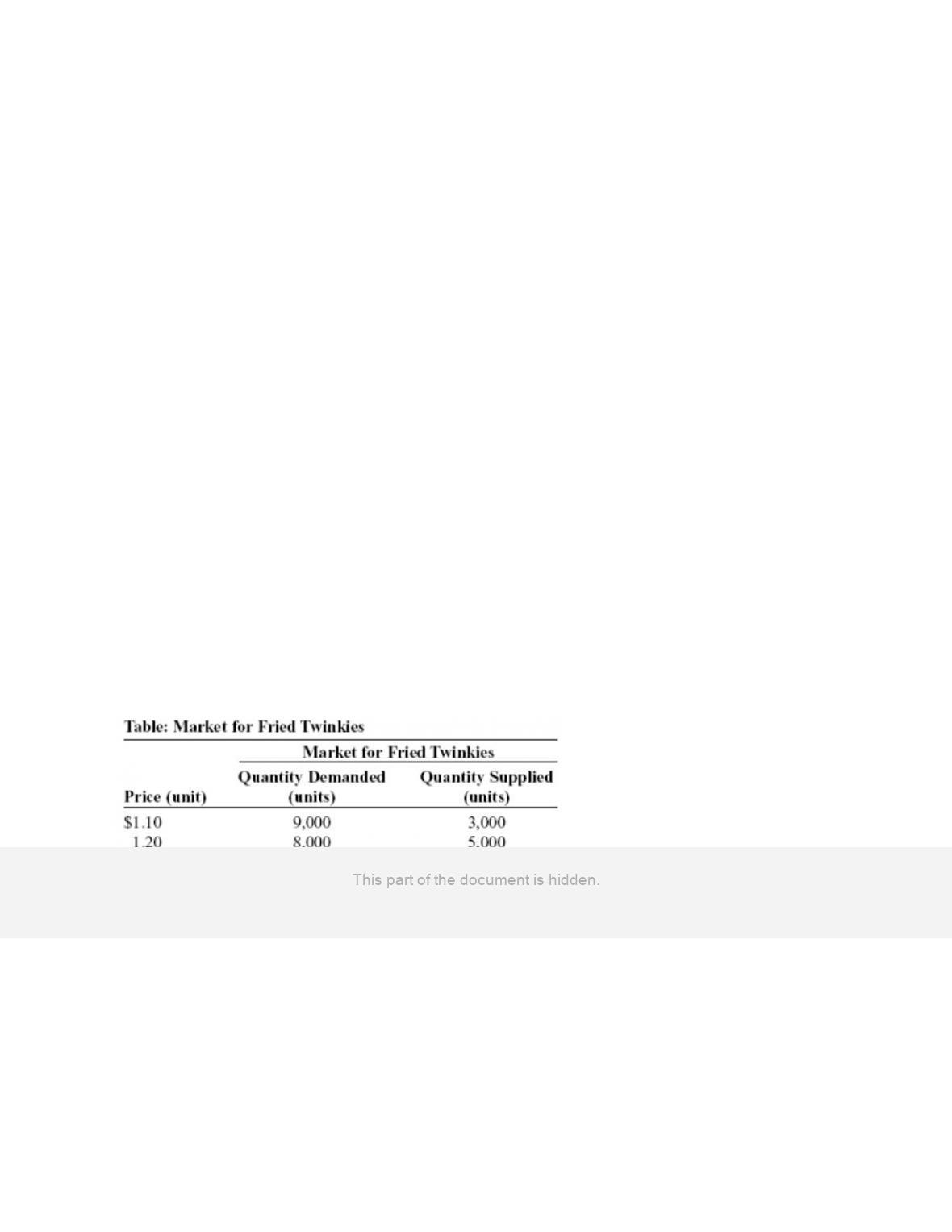
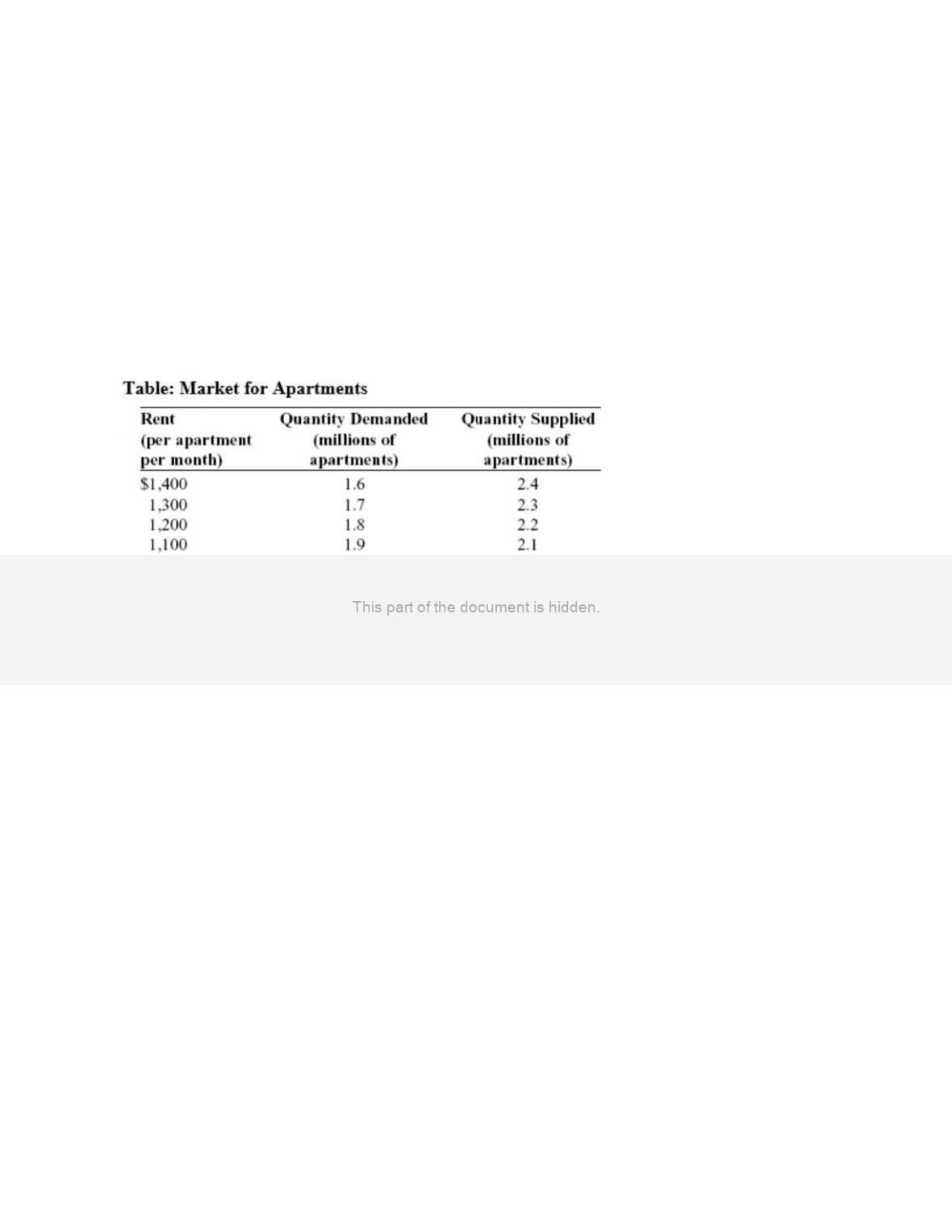
(Table: Market for Fried Twinkies) Use Table: Market for Fried Twinkies. In response
to popular anger over the high price of fried Twinkies and the extreme wealth of fried
Twinkie producers, the government imposes a price ceiling of $1.20 per fried Twinkie.
From this table, the price ceiling causes a _____ fried Twinkies.
A)
shortage of 3,000
B)
shortage of 5,000
C)
surplus of 8,000
D)
surplus of 3,000
Use the following to answer questions 25-27:
25.
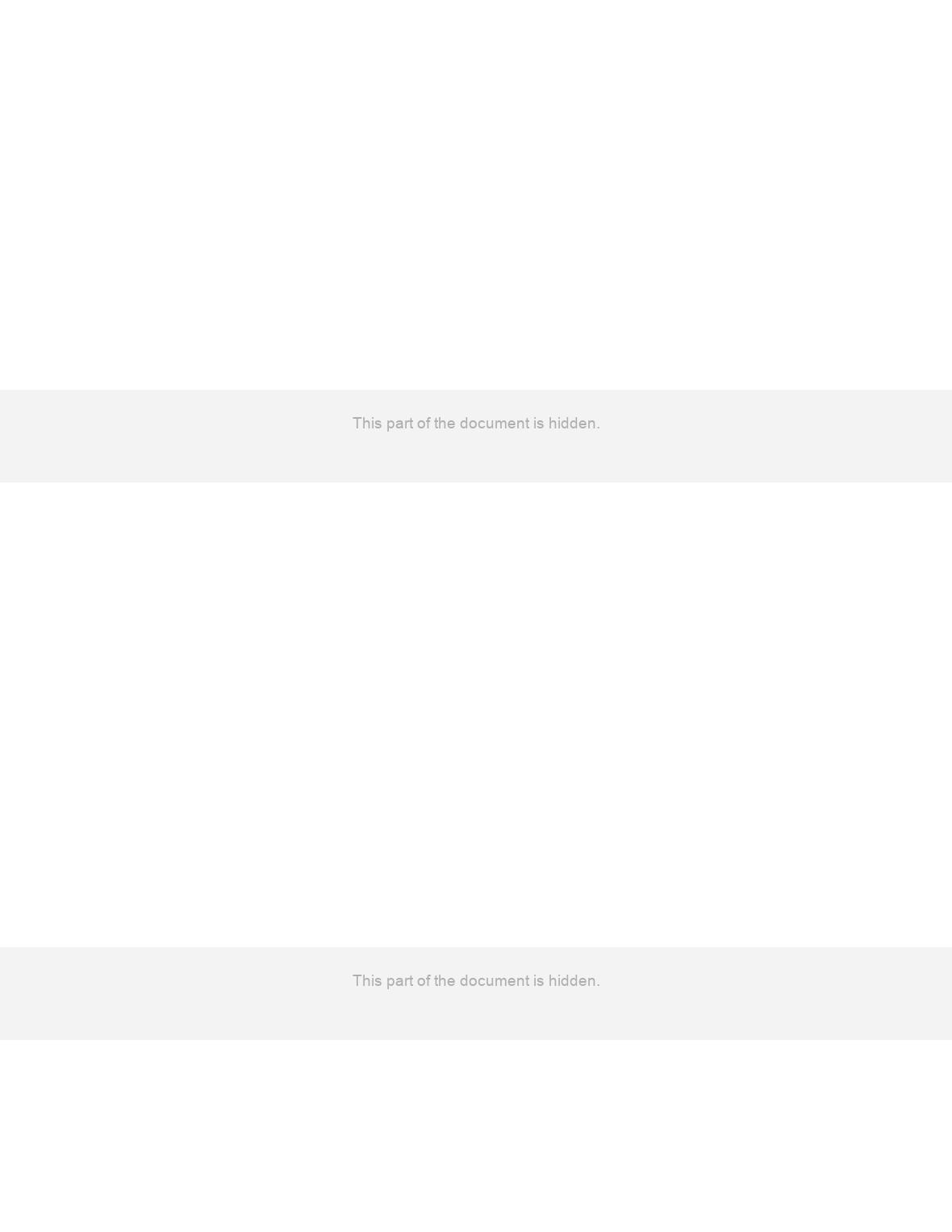
(Table: Market for Apartments) Use Table: Market for Apartments. If a price ceiling of
$700 is imposed on this market, the result will be an inefficiency in the form of a _____
million apartments.
A)
surplus of 0.6
B)
shortage of 0.6
C)
surplus of 0.2
D)
shortage of 0.2
26.
(Table: Market for Apartments) Use Table: Market for Apartments. If a price ceiling of
$900 is imposed on this market, the result will be an inefficiency in the form of a _____
million apartments.
A)
surplus of 0.6
B)
shortage of 0.6
C)
surplus of 0.2
D)
shortage of 0.2
Page 8
27.
(Table: Market for Apartments) Use Table: Market for Apartments. If a government
price ceiling of $600 is imposed on this market, the result will be an inefficiency in the
form of a _____ million apartments.
A)
surplus of 0.6
B)
surplus of 0.8
C)
shortage of 0.8
D)
shortage of 0.6
28.
Suppose the Jamaican government sets coffee prices at $1 per pound when the market
price is $10 per pound. The government’s actions will:
A)
improve efficiency since the low prices will force producers to find cheaper
production methods.
B)
result in coffee surpluses, even in a coffee-rich country.
C)
cause coffee shortages, even in a coffee-rich country.
D)
improve equality between rich and poor since the poor can now afford coffee.
29.
Suppose that the average cost of a doctor visit is $100. If the government imposes a
price ceiling of $50 on the cost of a doctor visit, there will be:
A)
an excess supply of doctor visits.
B)
an excess demand for doctor visits.
C)
an increase in the equilibrium number of doctor visits.
D)
no change in the number of doctor visits.
30.
The most likely reason that the government implements a price _____ is because it feels
the price is too high for _____.
A)
ceiling; consumers
B)
floor; consumers
C)
ceiling; producers
D)
floor; producers
31.
The government decides to impose a price ceiling on a good because it thinks the
market-determined price is too high. If it imposes the price ceiling above the
equilibrium price:
A)
consumers will respond to the higher price and therefore wish to purchase less of
the good than at the equilibrium price.
B)
producers will respond to the higher price and therefore offer fewer units for sale.
C)
consumers will purchase less of the good after the price ceiling is imposed.
D)
neither producers nor consumers will change their behavior.

Page 9
32.
The market for apples is in equilibrium at a price of $0.50 per pound. If the government
imposes a price ceiling in the market at $0.40 per pound:
A)
quantity demanded will decrease.
B)
quantity supplied will increase.
C)
there will be a shortage of the good.
D)
the price ceiling will not affect the market price or output.
33.
To be binding, a price ceiling must be set at a price _____ the equilibrium price.
A)
lower than
B)
higher than
C)
the same as
D)
Any price ceiling is binding.
34.
A maximum price set below the equilibrium price is a:
A)
demand price.
B)
supply price.
C)
price floor.
D)
price ceiling.
35.
A price ceiling is:
A)
a maximum price sellers are allowed to charge for a good or service.
B)
the difference between the quantity supplied and quantity demanded.
C)
a minimum price buyers are required to pay for a good or service.
D)
the deadweight loss caused by an inefficiently low quantity.
Page 10
36.
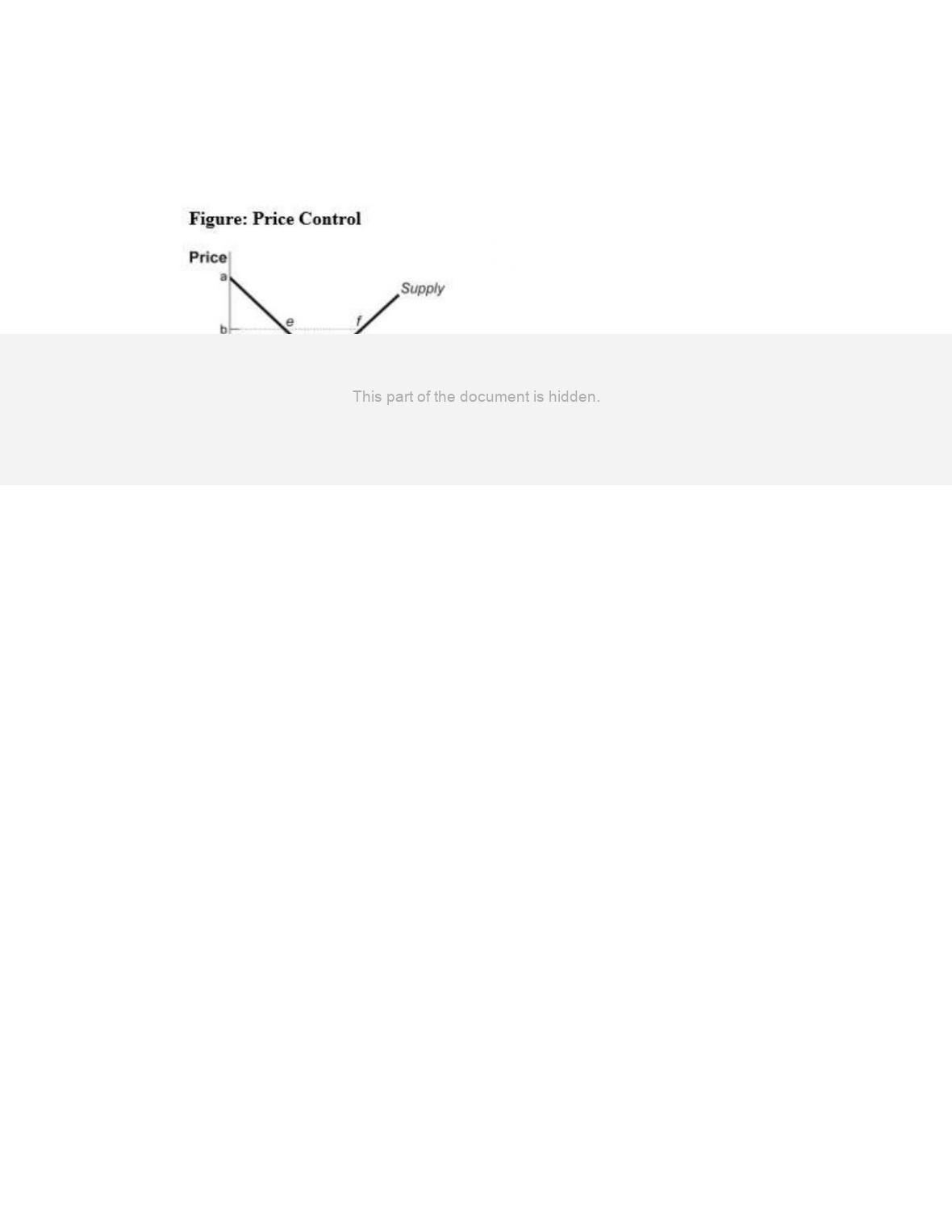
(Figure: Price Control) Use Figure: Price Control. One effective price ceiling would be
the price indicated at point _____, and there would be a _____ equal to the difference
between points _____.
A)
b; surplus; f and e
B)
b; shortage; f and e
C)
d; shortage; i and h
D)
d; surplus; e and h
37.
The dictator of a small country restricts the price of cars to an amount less than or equal
to $1,200 (a price below the equilibrium price for cars). Such a policy would set a:
A)
price floor.
B)
price ceiling.
C)
quota.
D)
tariff.
38.
A student organization forms on your college campus to protest the high rent for
apartments near campus. This organization is planning a meeting with the dean and the
president of the college. Which choice BEST describes one policy the student
organization might fight for?
A)
a laissez faire policy
B)
a price floor
C)
a price ceiling
D)
a quantity control
39.
Hugo Chávez was the president of Venezuela. Venezuela is a major producer of oil
products, which remain a critical component of Venezuela’s economy. Suppose
President Chávez wanted to increase his popularity with the citizens of Venezuela and
enacted a government policy to reduce the price of gasoline sold at state-owned gas
stations to 50% of the previous price. This policy is called a:
A)
laissez faire policy.
B)
price floor.
C)
price ceiling.
D)
quota.
40.
Hugo Chávez was the president of Venezuela. Venezuela is a major producer of oil
products, which remain a critical component of Venezuela’s economy. Suppose
President Chávez wanted to increase his popularity with the citizens of Venezuela and
enacted a government policy to reduce the price of gasoline sold at state-owned gas
stations to 50% of the previous price. Assuming a downward-sloping demand curve for
gasoline, in theory, this policy would result in a quantity of gasoline demanded that is
_____ the quantity of gasoline supplied.
A)
equal to
B)
greater than
C)
less than
D)
greater than or equal to
Page 12
41.
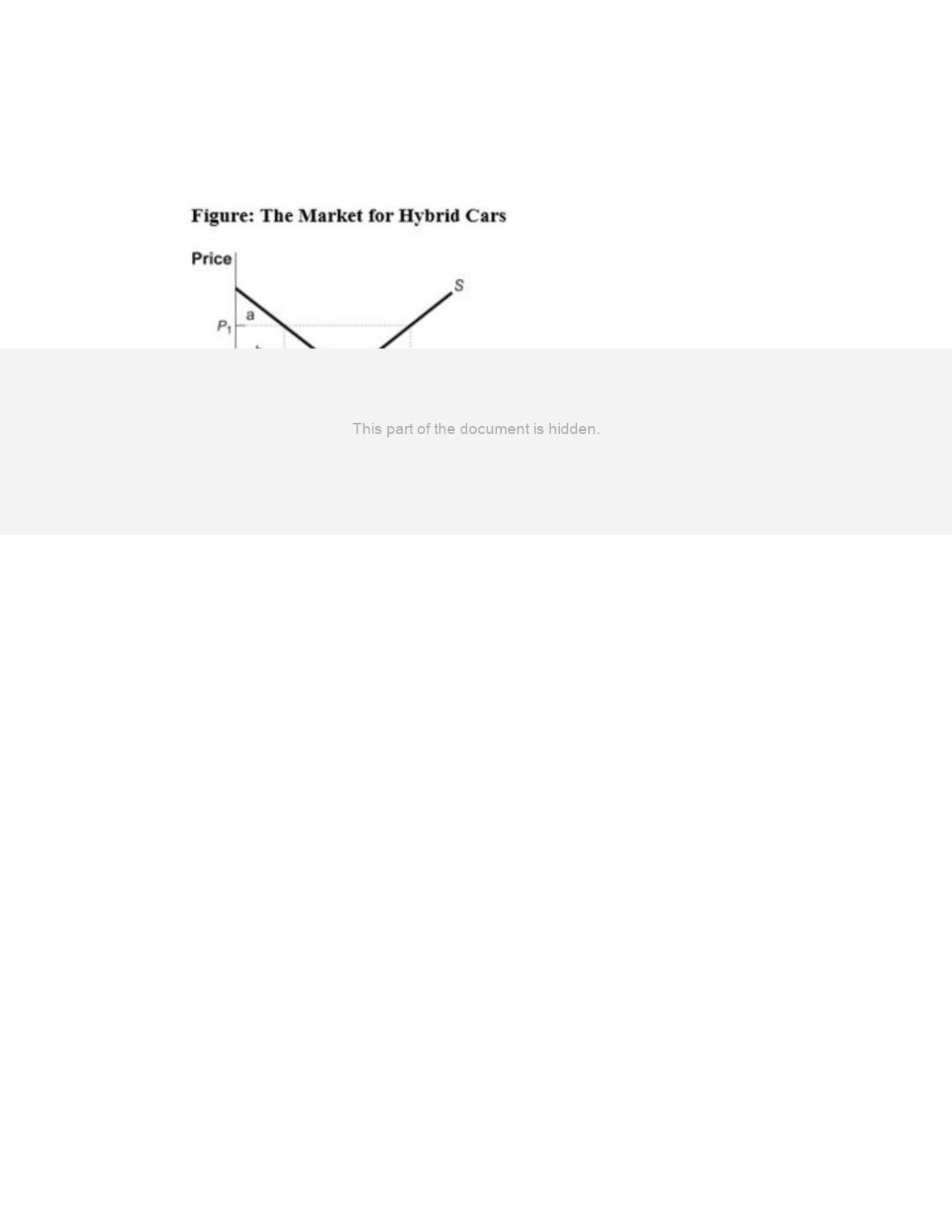
(Figure: The Market for Hybrid Cars) Use Figure: The Market for Hybrid Cars. If there
were a binding price ceiling in the market for hybrid cars, one possible price would be
equal to _____; consumers would demand _____; and producers would supply _____.
A)
P1; Q1; Q3
B)
P2; Q2; Q2
C)
P1; Q3; Q1
D)
P3; Q3; Q1
Page 13
Use the following to answer questions 42-43:
42.
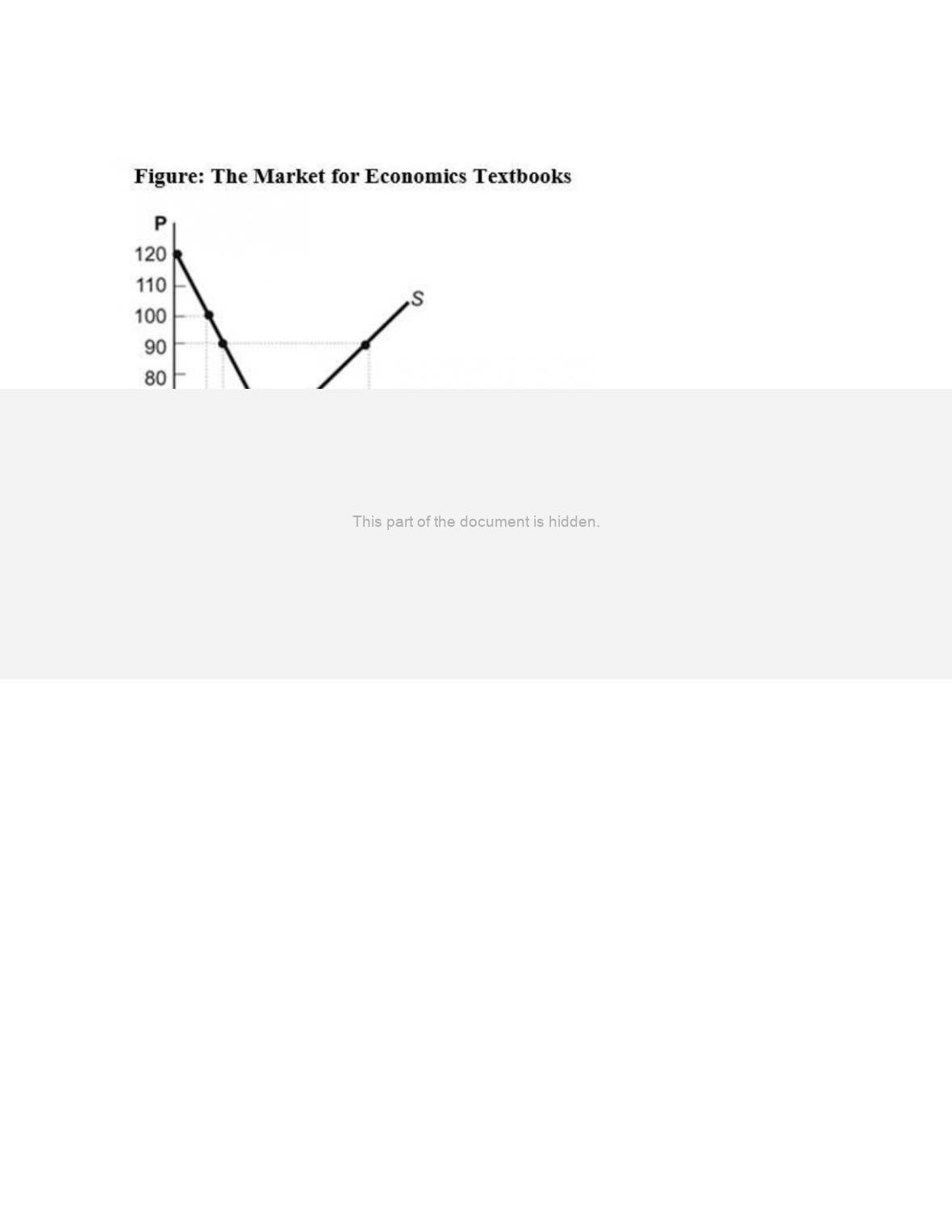
(Figure: The Market for Economics Textbooks) Use Figure: The Market for Economics
Textbooks. Suppose the government believes textbooks are too expensive and it wants
to make sure textbooks are affordable to more students. This type of price control is
called a price _____, and one possible binding price control would be _____.
A)
floor; $100
B)
floor; $40
C)
ceiling; $40
D)
ceiling; $100
43.
(Figure: The Market for Economics Textbooks) Use Figure: The Market for Economics
Textbooks. At a price ceiling of $40, the market outcome would be a _____ of _____
textbooks.
A)
surplus; 30
B)
surplus; 10
C)
shortage; 30
D)
shortage; 10
Page 14
44.
When price controls take the form of maximum prices set below the equilibrium price,
they are:
A)
illegal.
B)
equal to the demand price.
C)
price floors.
D)
price ceilings.
45.
A maximum price legislated by the government is called:
A)
a price support.
B)
a price floor.
C)
a price ceiling.
D)
the parity price.
46.
A persistent shortage may occur if:
A)
the government imposes a price ceiling below the equilibrium price.
B)
the government imposes a price floor below the equilibrium price.
C)
demand keeps falling.
D)
supply shifts rightward.
47.
If the government sets out to help low-income people by establishing a maximum
amount that can be paid for rent:
A)
a price floor has been set, and a shortage of rental units may occur.
B)
a price ceiling has been set, and a shortage of rental units may occur.
C)
in the long run, more rental units will appear.
D)
the quality of rental units will be inefficiently high.
48.
Rent controls usually set a price ceiling below the equilibrium price, and therefore:
A)
quantity supplied exceeds the quantity demanded.
B)
quantity demanded exceeds the quantity supplied.
C)
a surplus of rental units will result.
D)
all low-income recipients will clearly be helped.
49.
A price ceiling will not have an immediate effect if:
A)
it is set above the equilibrium price.
B)
the equilibrium price is above the price ceiling.
C)
it is set below the equilibrium price.
D)
it creates a shortage.
Page 15
50.
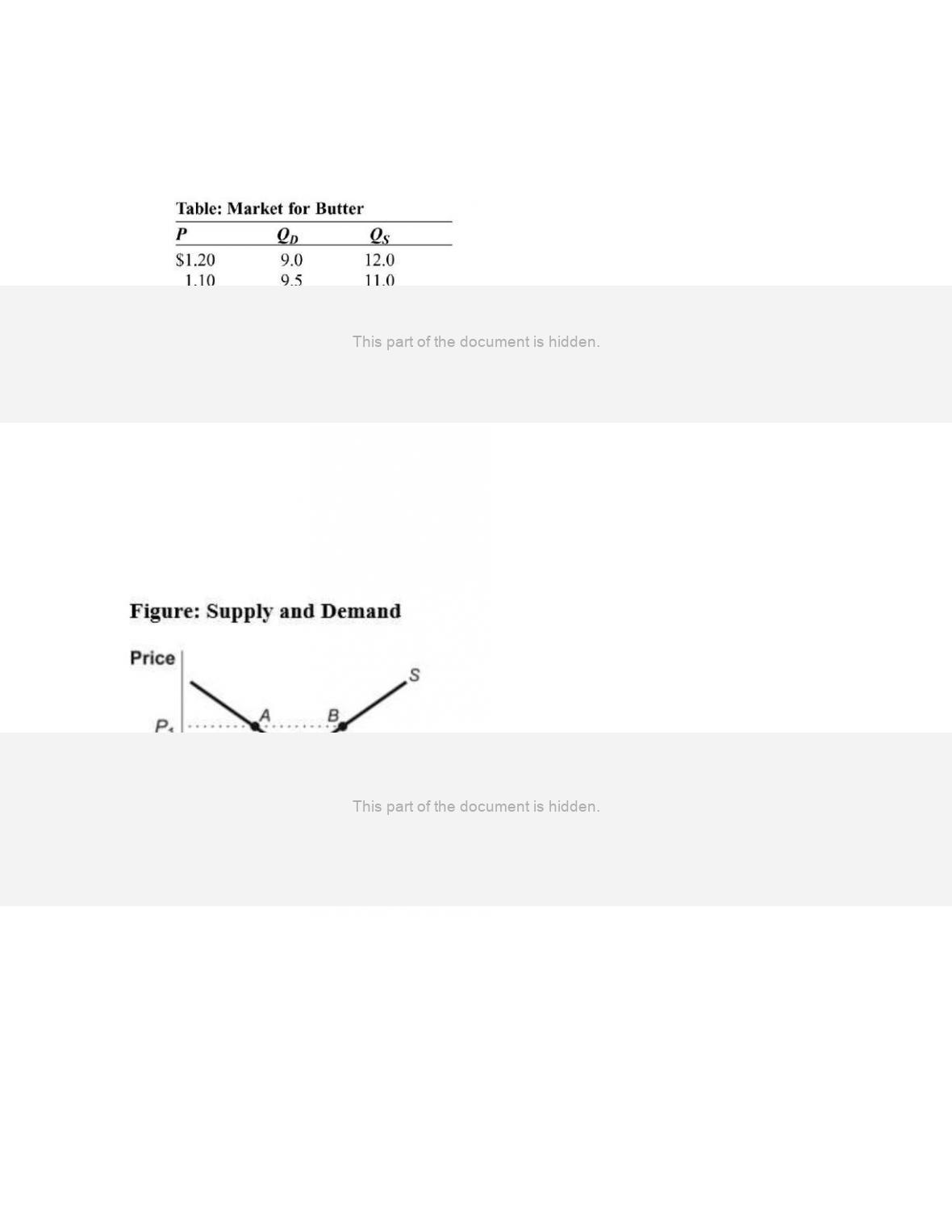
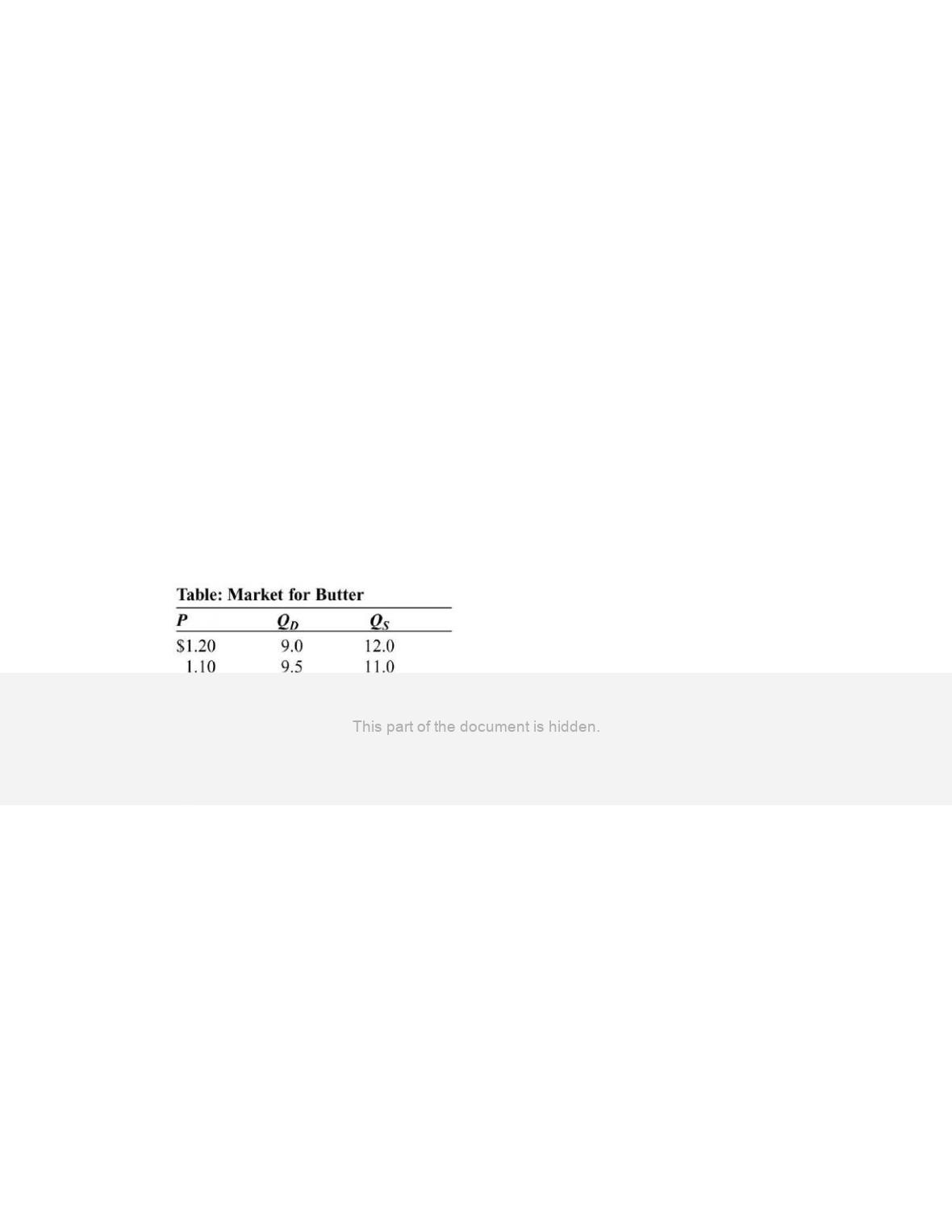
(Table: Market for Butter) Use Table: Market for Butter. If the government imposes a
price ceiling of $0.90 per pound of butter, the quantity of butter actually purchased will
be _____ million pounds.
A)
10.5
B)
9.0
C)
1.5
D)
10.0
Use the following to answer questions 51-53:
51.
(Figure: Supply and Demand) Use Figure: Supply and Demand. A price ceiling of P1
causes:
A)
a shortage equal to the distance AB.
B)
a surplus equal to the distance AB.
C)
a shortage equal to the distance DE.
D)
no change to the market.
Page 16
52.
(Figure: Supply and Demand) Use Figure: Supply and Demand. A price ceiling of P3
causes:
A)
a shortage equal to the distance AB.
B)
a surplus equal to the distance AB.
C)
a shortage equal to the distance DE.
D)
no change to the market.
53.
(Figure: Supply and Demand) Use Figure: Supply and Demand. A binding price ceiling
is represented by:
A)
the price P1.
B)
the price P2.
C)
the price P3.
D)
point C.
54.
The Atlanta Symphony wants to make sure that its concerts are affordable for all
residents of Atlanta and therefore prices all of its tickets at $25. However, outside
Symphony Hall, people can sell the same tickets for $75 or more. The true cost to the
concertgoer of a ticket to the symphony is at least:
A)
$25.
B)
$50.
C)
$75.
D)
$100.
55.
Producers will sometimes lower the quality of a good when the government imposes:
A)
any price control.
B)
an excise tax.
C)
a binding price floor.
D)
a binding price ceiling.
56.
If the government imposes binding rent control:
A)
rent will be set above the equilibrium price.
B)
it may result in some landlords leaving the business because they cannot cover
costs.
C)
it will lead to rental units being higher in quality because landlords are guaranteed
a high price.
D)
it will cause a surplus of housing.
Page 17
57.
Price ceilings will impose costs on society because they:
A)
will eliminate long waiting lines.
B)
may result in black markets, where prices are lower than the market-determined
price would be.
C)
lead to a smaller quantity offered on the market.
D)
help businesses instead of consumers.
58.
By definition, in a black market, goods or services are bought and sold:
A)
at night.
B)
without any information about quality.
C)
without any information about price.
D)
illegally.
59.
When a tenant in a rent-controlled apartment sublets the apartment to another renter at a
rent higher than the price ceiling:
A)
it is inefficient.
B)
the transaction takes place on a black market.
C)
there is an increase in quantity demanded.
D)
there is a decrease in quantity demanded.
60.
Black markets may develop as a result of price controls because:
A)
price controls increase efficiency.
B)
quantity demanded equals quantity supplied at the mandated price.
C)
price controls offer subsidies for market transactions.
D)
individuals can profit by illegal exchanges.
61.
Which example would be considered a black market transaction?
A)
a tenant in a rent-controlled apartment subletting at a higher rent
B)
the purchase of an inferior radio at a department store
C)
waiting in line during the gasoline shortages of the 1970s
D)
the oil market
62.
In a(n) _____ market, goods or services are bought and sold illegally.
A)
black
B)
uncontrolled
C)
unregulated
D)
unproductive
Page 18
63.
One of the ways rent control is inefficient is that it leads to:
A)
higher-quality apartments.
B)
high opportunity costs associated with wasted time searching for apartments.
C)
markets that maximize total surplus.
D)
the construction of more apartments.
64.
Rent controls in New York City do NOT cause:
A)
inefficiently low-quality apartments.
B)
wasted resources resulting from the opportunity cost of time associated with trying
to find an apartment.
C)
black markets.
D)
an increase in the quantity supplied of rent-controlled apartments.
65.
Price controls encourage black markets because:
A)
they eliminate opportunity costs.
B)
individuals can profit by illegal exchanges.
C)
they create too much efficiency.
D)
they create too much equity.
66.
Suppose the government of the oil-rich country Saudi Arabia sets gasoline prices at
$0.25 per gallon when the market price is $1.50. The Saudi government’s actions will:
A)
improve efficiency since the low prices will force producers to find cheaper
production methods.
B)
result in gasoline surpluses even in an oil-rich country.
C)
cause gasoline shortages even in an oil-rich country.
D)
necessarily improve equality between rich and poor since the poor can now afford
gasoline.
67.
A price ceiling below the equilibrium price is likely to result in a persistent _____, a
transfer of surplus from _____, and _____ deadweight loss.
A)
surplus; producers to some consumers; some
B)
shortage; producers to some consumers; some
C)
shortage; some consumers to producers; no
D)
surplus; some consumers to producers; some
68.
A binding rent-control price ceiling does NOT result in:
A)
inefficiently low transaction costs.
B)
wasted resources of consumers caused by time spent searching for the good.
C)
inefficient allocation of the good to consumers.
D)
inefficiently high quality of the good being sold.
Page 19
69.
Which inefficiency is NOT caused by binding price ceilings?
A)
inefficient allocation to consumers
B)
wasted resources
C)
potential illegal activity
D)
inefficient allocation of sales among sellers
70.
Economists in general agree that rent controls are:
A)
an efficient and equitable way to help low-income families.
B)
an inefficient but sometimes effective way to help low-income families.
C)
an efficient method of dealing with the shortages caused by price ceilings.
D)
the only way to solve the problem of poverty.
71.
Governments continue to impose price controls. Which statement is NOT a valid reason
for this?
A)
Some people do benefit from such price controls.
B)
People fear that prices will change dramatically if the price controls are removed.
C)
It is politically expedient to enact regulations that benefit influential voting groups.
D)
Price controls are always effective.
Use the following to answer question 72:
72.
(Table: The Market for Soda) Use Table: The Market for Soda. If the government
imposes a price floor of $1 per can of soda, there will be:
A)
a shortage of two cans.
B)
a shortage of three cans.
C)
a surplus of three cans.
D)
equilibrium in the market for soda.
Page 20
73.
West African cotton farmers are very upset about the subsidies the U.S. government
pays to American cotton farmers. One reason for this could be that subsidized cotton
from the United States:
A)
leads to cotton surpluses in the United States and lower prices for West African
farmers on world markets.
B)
raises the world price of cotton.
C)
has led to a global shortage of cotton.
D)
has led to an increase in the demand for West African cotton.
74.
The United States and the European Union impose price floors on many agricultural
products. These price floors lead to unwanted surpluses. To deal with a surplus:
A)
the U.S. government typically pays farmers to produce as much as possible.
B)
the U.S. government in some cases has destroyed the surplus production.
C)
the European Union pays farm exporters to sell products for a profit overseas.
D)
the U.S. government holds auctions to sell the surplus to the highest bidder.
75.
(Table: Market for Butter) Use Figure: Market for Butter. If the government imposes a
price floor of $0.90 per pound of butter, the quantity of butter actually purchased will be
_____ million pounds.
A)
10.5
B)
9.0
C)
1.5
D)
10.0
76.
Suppose the government sets a price floor of $2.85 per bushel on corn when the current
price is $2.55. This price floor will:
A)
cause a surplus of corn.
B)
cause a shortage of corn.
C)
have no immediate effect on the price of corn.
D)
increase the supply of corn.