Page 55
Use the following to answer questions 210-211:
210.
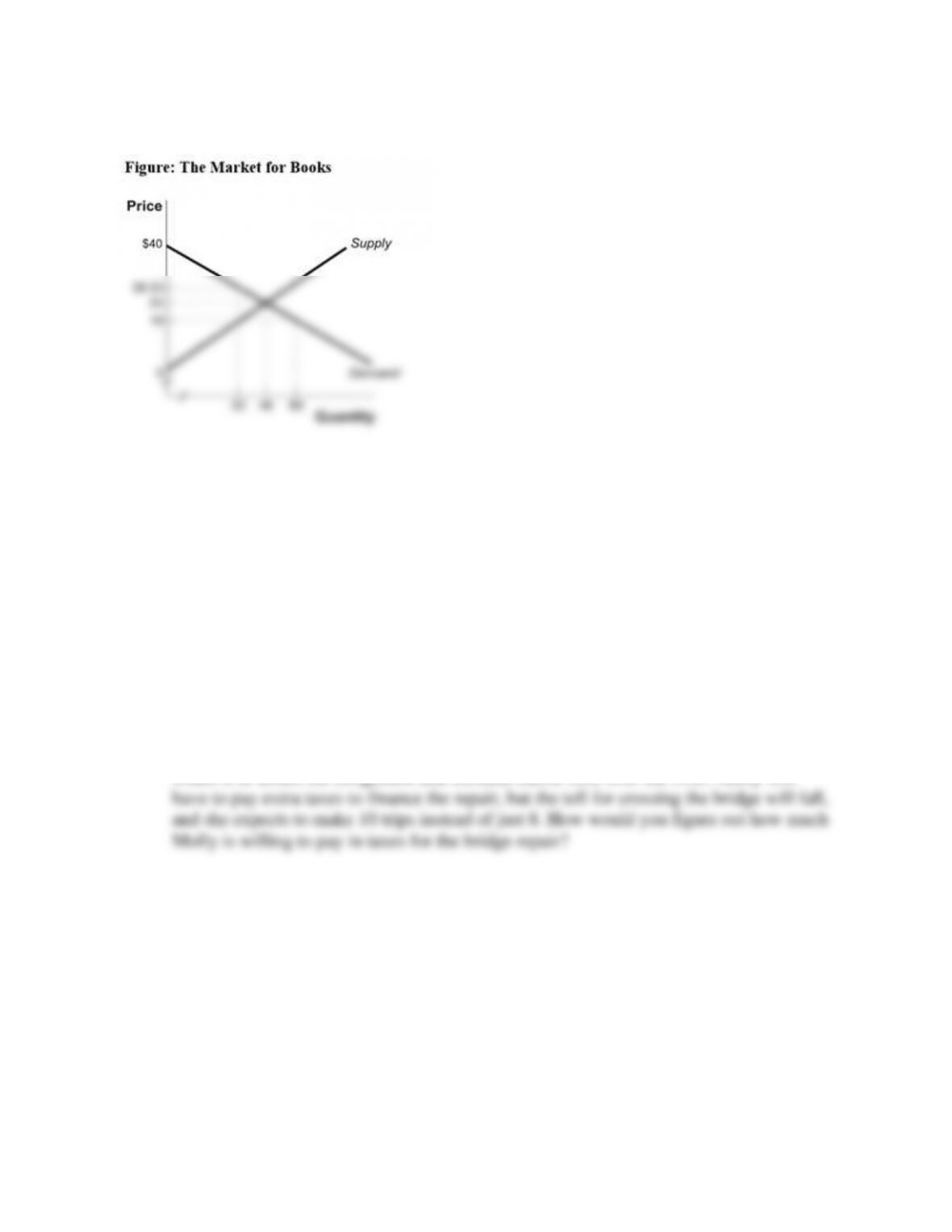
(Figure: The Market for Books) Look at the figure The Market for Books. At the
equilibrium price of $24, find the total surplus in the market for books.
211.
(Figure: Market for Books) Look at the figure The Market for Books. Suppose the price
is temporarily $18. Do consumers gain or lose from this price, and by how much? Do
producers gain or lose from this price control, and by how much? How is total surplus
affected?
212.
Molly must drive across a bridge over a river eight times each week. Because the bridge
is narrow and traffic is congested, Molly’s willingness to pay for the eighth and final
weekly trip is $0.50. Now the governor has promised to refurbish this old bridge and
widen it to lessen the congestion and increase traffic flow over the river. Molly will
have to pay extra taxes to finance the repair, but the toll for crossing the bridge will fall,
and she expects to make 10 trips instead of just 8. How would you figure out how much
Molly is willing to pay in taxes for the bridge repair?
Page 56
Use the following to answer questions 213-215:
213.
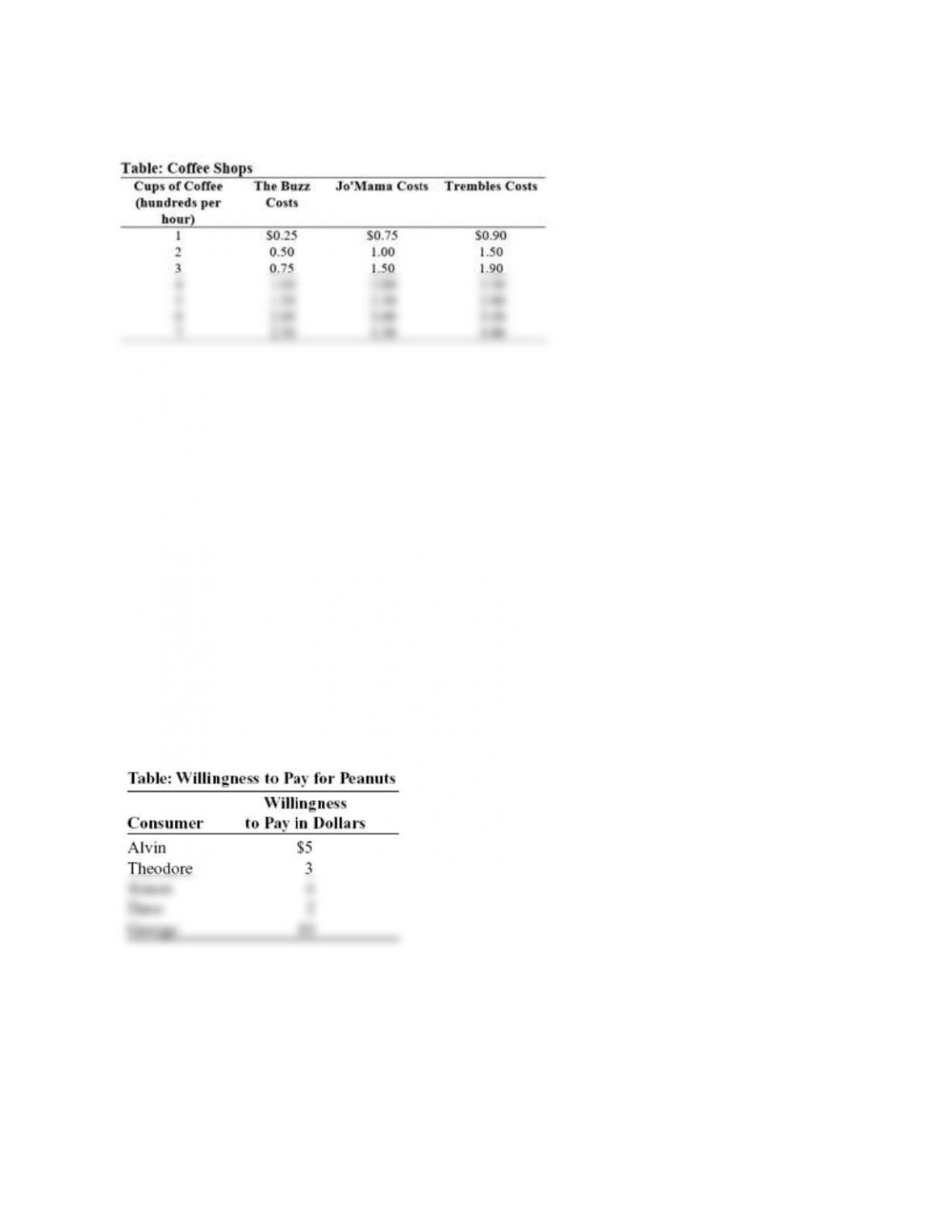
(Table: Coffee Shops) Use Table: Coffee Shops. The three coffee shops in a small town
supply cups of coffee at slightly different costs. Use the table to construct the supply
schedule for coffee at prices of $0, $1, $2, and $3.
214.
(Table: Coffee Shops) Use Table: Coffee Shops. If the price of coffee is $1.75, how
many cups will be supplied and how much producer surplus will be earned by coffee
shops in the town?
215.
(Table: Coffee Shops) Use Table: Coffee Shops. Assume the price of coffee is $1.75.
Show how total producer surplus decreases at any number of cups that differs from the
equilibrium (price is $1.75 and quantity is 10 cups).
Use the following to answer questions 216-220:
Page 57
216.
(Table: Willingness to Pay for Peanuts) Using the table Willingness to Pay for Peanuts,
if the price of a bag of peanuts is $4, what is the value of George’s consumer surplus?
A)
$4
B)
$3
C)
$6
D)
$10
217.
(Table: Willingness to Pay for Peanuts) Using the table Willingness to Pay for Peanuts,
if the price of a bag of peanuts is $6, what is the total value of consumer surplus?
A)
$4
B)
$3
C)
$6
D)
$10
218.
(Table: Willingness to Pay for Peanuts) Using the table Willingness to Pay for Peanuts,
if the price of a bag of peanuts is $9, who will purchase a bag?
A)
George only
B)
all of the consumers
C)
Dave only
D)
Alvin and Theodore only
219.
(Table: Willingness to Pay for Peanuts) Using the table Willingness to Pay for Peanuts,
if the price of a bag of peanuts is $3, the total value of consumer surplus is equal to:
A)
$12.
B)
$26.
C)
$10.
D)
$21.
220.
(Table: Willingness to Pay for Peanuts) Using the table Willingness to Pay for Peanuts,
if the price of a bag of peanuts is $2, _____ would purchase a bag.
A)
all of the consumers.
B)
everyone except Dave.
C)
everyone except George.
D)
no one.
Page 58
221.
Suppose the market demand for TV remotes is given by the equation Qd = 100 – 2P,
where P is the price and Qd is the number of TV remotes. If the market price of TV
remotes is $40, then the quantity demanded equals _____ and the value of consumer
surplus is _____.
A)
20; $100
B)
100; $20
C)
40; $200
D)
2; $40
222.
Suppose the market demand curve for TV remotes is given by the equation Qd = 100 –
2P, where P is the price and Qd is the number of TV remotes demanded. If the market
price of TV remotes is $10, then the quantity demanded equals _____ and the value of
consumer surplus is _____.
A)
20; $100
B)
80; $200
C)
80; $1,600
D)
20; $1,600
223.
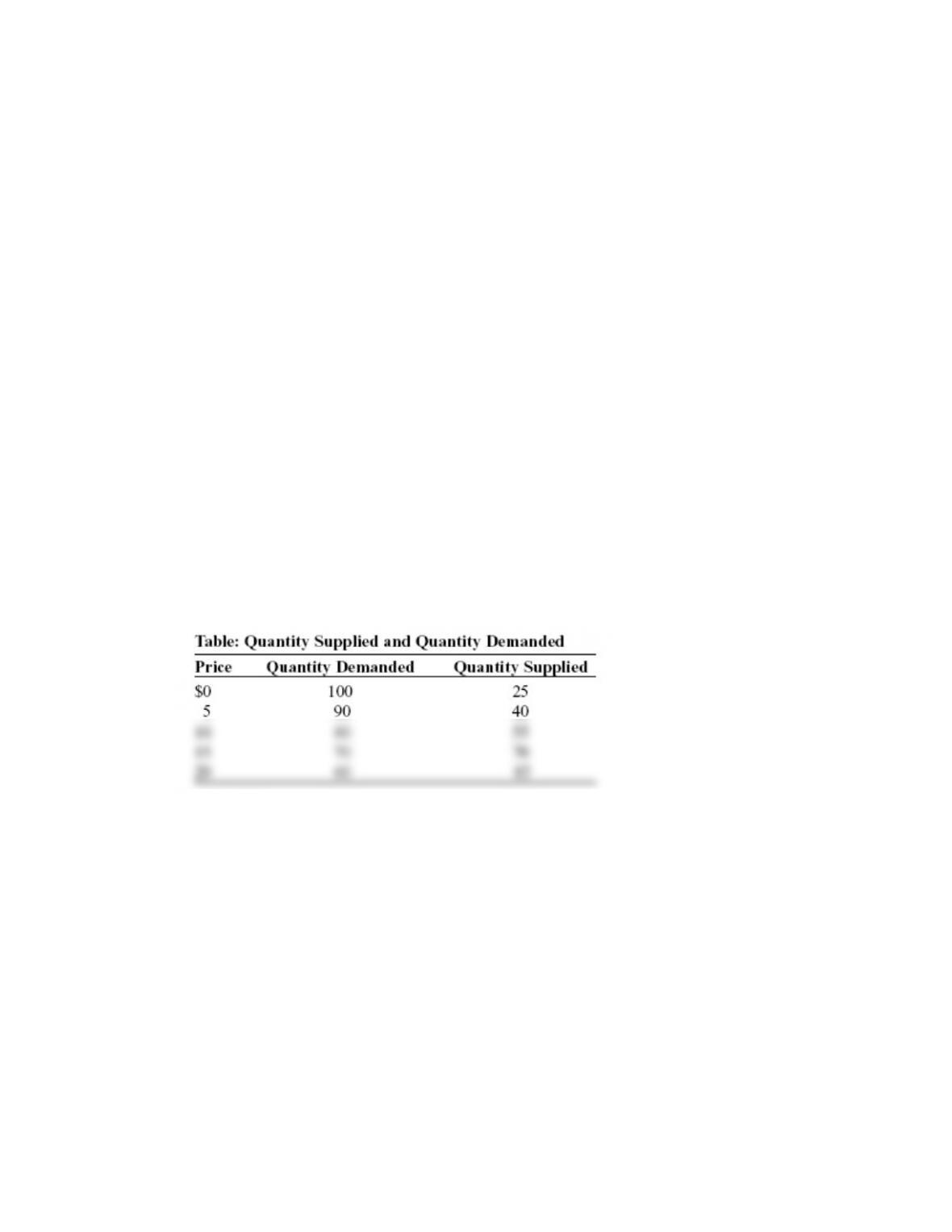
(Table: Quantity Supplied and Quantity Demanded) Using the table Quantity Supplied
and Quantity Demanded, if this market is in equilibrium and the demand and supply
curves are linear, then the value of consumer surplus is:
A)
$1,225.
B)
$2,450.
C)
$4,900.
D)
$1,500.
224.
Christine has a linear demand curve for candy. If she wants to see her consumer surplus
_____, she would like to see a(n) _____ in the market price of candy.
A)
increase; decrease
B)
increase; increase
C)
decrease; decrease
D)
not change; decrease
Page 59
225.
Along a straight-line downward-sloping demand curve, a decrease in the market price of
a good:
A)
will cause no change in consumer surplus.
B)
will increase consumer surplus.
C)
will decrease consumer surplus.
D)
may either decrease or increase consumer surplus.
Use the following to answer questions 226-230:
226.
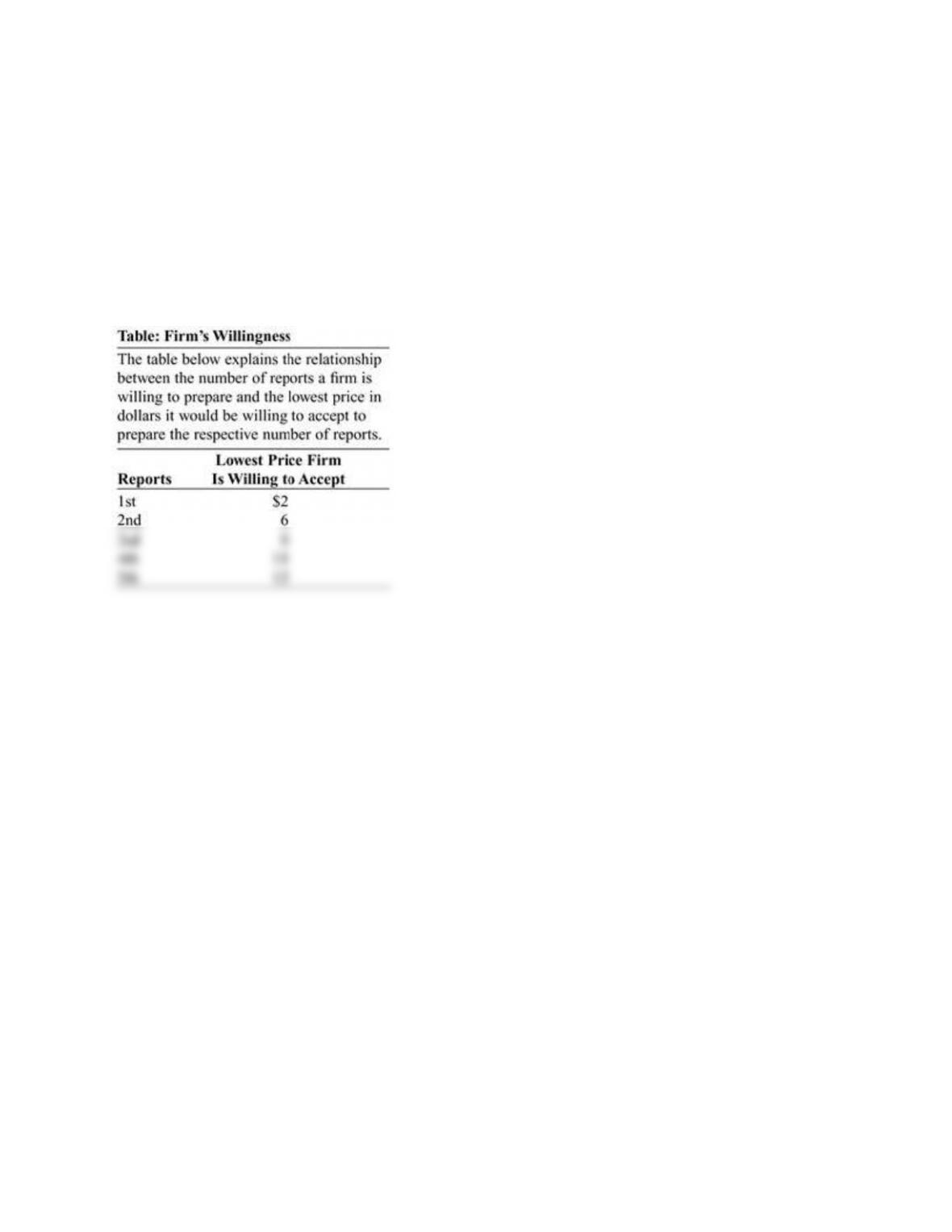
(Table: Firm’s Willingness) The table Firm’s Willingness explains the relation between
the number of reports a firm is willing to produce and the lowest price it is willing to
accept to prepare those reports. If the price of a report is $11, what is the value of
producer surplus for this firm?
A)
$11
B)
$17
C)
$27
D)
$40
227.
(Table: Firm’s Willingness) The table Firm’s Willingness explains the relation between
the number of reports a firm is willing to produce and the lowest price it is willing to
accept to prepare those reports. If the price of a report is $12, what is the value of
producer surplus for the firm?
A)
$27
B)
$21
C)
$16
D)
$42
Page 60
228.
(Table: Firm’s Willingness) The table Firm’s Willingness explains the relation between
the number of reports a firm is willing to produce and the lowest price it is willing to
accept to prepare those reports. If the price of a report is $6, how many reports will be
produced?
A)
five
B)
four
C)
three
D)
two
229.
(Table: Firm’s Willingness) The table Firm’s Willingness explains the relation between
the number of reports a firm is willing to produce and the lowest price it is willing to
accept to prepare those reports. Which market price would result in four reports being
produced?
A)
$2
B)
$6
C)
$8
D)
$12
230.
(Table: Firm’s Willingness) The table Firm’s Willingness explains the relation between
the number of reports a firm is willing to produce and the lowest price it is willing to
accept to prepare those reports. If the price of reports is $15, how many reports will the
firm produce, and what will the producer surplus be?
A)
one; $0
B)
three; $23
C)
five; $0
D)
five; $33
231.
Well-functioning markets allow:
A)
mutually beneficial trades to take place.
B)
consumers to gain at the expense of producers.
C)
producers to reap greater benefits, since they have greater power in the market.
D)
property rights to be unnecessary components of effective distribution.
Page 61
Use the following to answer questions 232-234:
232.
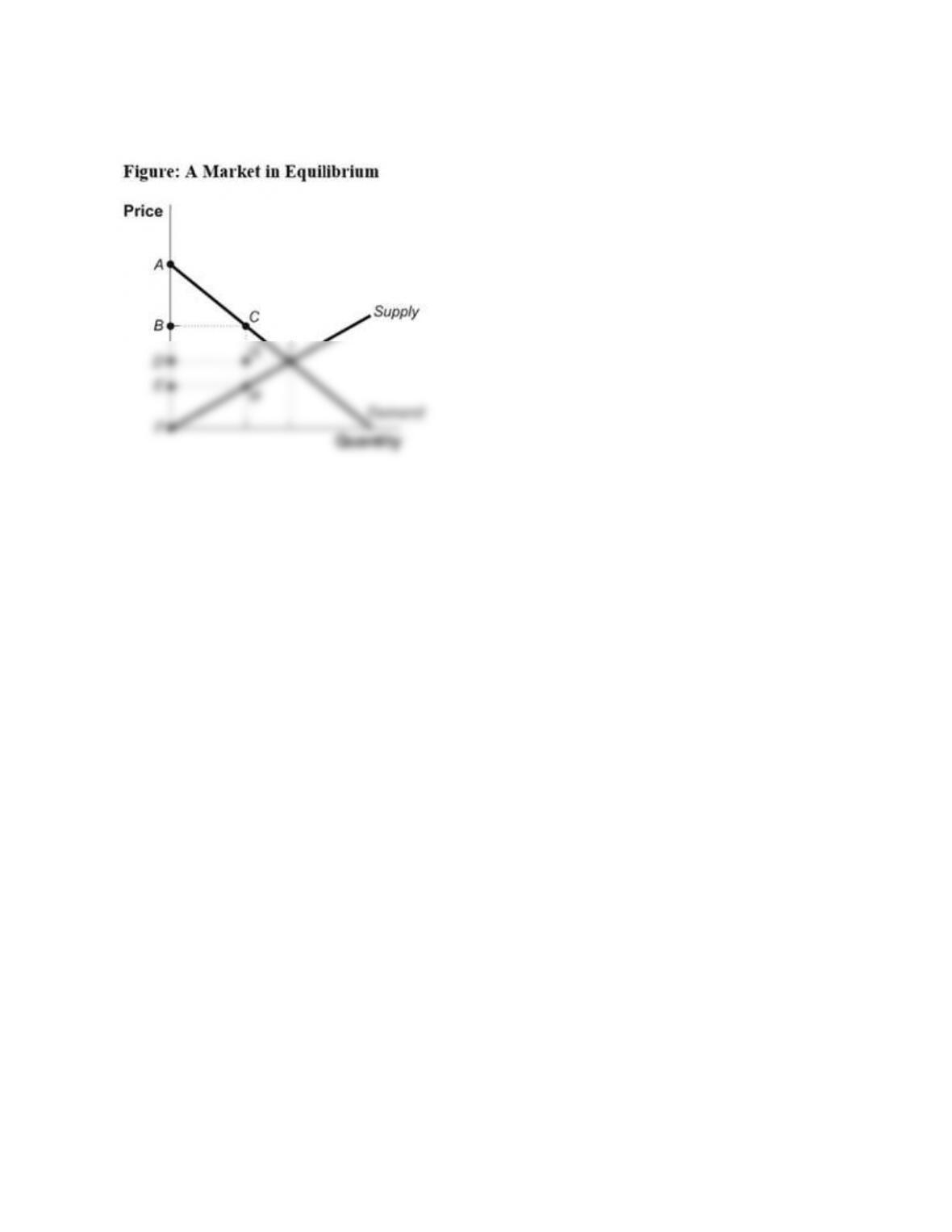
(Figure: A Market in Equilibrium) Look at the figure A Market in Equilibrium. At the
equilibrium price, this market’s consumer surplus is equal to the area:
A)
ABC.
B)
ADI.
C)
DIF.
D)
EHF.
233.
(Figure: A Market in Equilibrium) Look at the figure A Market in Equilibrium. At the
equilibrium price, this market’s producer surplus is equal to the area:
A)
ADI.
B)
EHF.
C)
AIF.
D)
DIF.
234.
(Figure: A Market in Equilibrium) Look at the figure A Market in Equilibrium. At the
equilibrium price, this market’s total producer and consumer surplus equals the area:
A)
BCDG.
B)
AIF.
C)
DIF.
D)
ADI.
Page 62
235.
Suppose purchases do not occur because the value of the good to the potential seller
exceeds the value to a potential consumer. This situation will occur in:
A)
a market dominated by government regulation.
B)
well-functioning markets.
C)
a market made up of many buyers and sellers.
D)
a centralized market system.
236.
Markets work because they allocate sales to the sellers who are willing and able to
produce the good at the lowest cost. This statement shows how markets maximize:
A)
producer surplus.
B)
consumer surplus.
C)
total surplus.
D)
deadweight loss.
237.
Well-defined property rights:
A)
can allow for mutually beneficial trades.
B)
will result in government regulation.
C)
often result in more market failures.
D)
lead to more centralized decision making.
238.
Economic signals:
A)
result in shortages and surpluses.
B)
interfere with the trades that can be mutually beneficial.
C)
guide decision makers in their transactions in the marketplace.
D)
never provide adequate information to consumers.
239.
Which statement(s) is/are TRUE about market failures?
I. They arise when property rights are clearly defined.
II. They arise when information is available to all decision makers.
III. They arise when external costs are not considered in production decisions by
producers.
A)
I
B)
I and II
C)
III
D)
I, II, and III
Answer Key
Page 64
45.
A
46.
A
47.
B
48.
C
49.
D
50.
A
51.
B
52.
C
53.
C
54.
B
55.
C
56.
D
57.
D
58.
A
59.
D
60.
D
61.
B
62.
C
63.
A
64.
D
65.
C
66.
C
67.
A
68.
B
69.
A
70.
B
71.
B
72.
C
73.
B
74.
B
75.
D
76.
A
77.
D
78.
A
79.
C
80.
B
81.
A
82.
C
83.
A
84.
D
85.
B
86.
A
87.
D
88.
B
89.
A
90.
D
Page 65
91.
B
92.
A
93.
B
94.
A
95.
B
96.
B
97.
B
98.
D
99.
D
100.
B
101.
D
102.
A
103.
C
104.
A
105.
C
106.
C
107.
D
108.
B
109.
A
110.
C
111.
D
112.
C
113.
D
114.
D
115.
D
116.
A
117.
B
118.
B
119.
B
120.
C
121.
D
122.
D
123.
B
124.
A
125.
D
126.
D
127.
D
128.
B
129.
A
130.
C
131.
D
132.
C
133.
B
134.
D
135.
C
136.
A
Page 66
137.
C
138.
C
139.
D
140.
B
141.
C
142.
A
143.
B
144.
C
145.
D
146.
C
147.
D
148.
D
149.
C
150.
C
151.
C
152.
A
153.
A
154.
B
155.
B
156.
C
157.
B
158.
C
159.
D
160.
D
161.
A
162.
B
163.
B
164.
B
165.
C
166.
D
167.
A
168.
D
169.
B
170.
A
171.
B
172.
B
173.
B
174.
A
175.
B
176.
A
177.
B
178.
A
179.
B
180.
A
181.
B
182.
B
Page 67
183.
A
184.
A
185.
B
186.
B
187.
B
188.
B
189.
A
190.
A
191.
A
192.
B
193.
A
194.
B
195.
B
196.
A
197.
A
198.
B
199.
B
200.
A
201.
B
202.
A
203.
B
204.
A
205.
B
206.
207.
208.
209.
210.
211.
212.
213.
214.
215.
216.
C
217.
A
218.
A
219.
A
220.
A
221.
A
222.
C
223.
A
224.
A
225.
B
226.
B
227.
B
228.
D

Page 68
229.
D
230.
D
231.
A
232.
B
233.
D
234.
B
235.
B
236.
A
237.
A
238.
C
239.
C