
141.
(Table: Pumpkin Market) There are two consumers, Andy and Ben, in the market for
pumpkins. Their willingness to pay for each pumpkin is shown in the table Pumpkin
Market. There are two producers of pumpkins, Cindy and Diane, and their costs are also
shown. The equilibrium price for pumpkins is $8 and the equilibrium quantity is 5. At
the equilibrium price and quantity, Ben buys _____ pumpkins, and his consumer surplus
is _____.
A)
four; $2
B)
three; $6
C)
two; $4
D)
one; $3
142.
(Table: Pumpkin Market) There are two consumers, Andy and Ben, in the market for
pumpkins. Their willingness to pay for each pumpkin is shown in the table Pumpkin
Market. There are two producers of pumpkins, Cindy and Diane, and their costs are also
shown. The equilibrium price for pumpkins is $8 and the equilibrium quantity is 5. At
the equilibrium price and quantity, total consumer surplus is:
A)
$10.
B)
$8.
C)
$6.
D)
$0.
143.
(Table: Pumpkin Market) There are two consumers, Andy and Ben, in the market for
pumpkins. Their willingness to pay for each pumpkin is shown in the table Pumpkin
Market. There are two producers of pumpkins, Cindy and Diane, and their costs are also
shown. The equilibrium price for pumpkins is $8 and the equilibrium quantity is 5. At
the equilibrium price and quantity, Cindy sells _____ pumpkins, and her producer
surplus is _____.
A)
four; $2
B)
three; $8
C)
two; $3
D)
one; $5
144.
(Table: Pumpkin Market) There are two consumers, Andy and Ben, in the market for
pumpkins. Their willingness to pay for each pumpkin is shown in the table Pumpkin
Market. There are two producers of pumpkins, Cindy and Diane, and their costs are also
shown. The equilibrium price for pumpkins is $8 and the equilibrium quantity is 5. At
the equilibrium price and quantity, Diane sells _____ pumpkins, and her producer
surplus is _____.
A)
four; $11
B)
three; $8
C)
two; $6
D)
one; $4

Page 42
145.
(Table: Pumpkin Market) There are two consumers, Andy and Ben, in the market for
pumpkins. Their willingness to pay for each pumpkin is shown in the table Pumpkin
Market. There are two producers of pumpkins, Cindy and Diane, and their costs are also
shown. The equilibrium price for pumpkins is $8 and the equilibrium quantity is 5. At
the equilibrium price and quantity, total producer surplus is:
A)
$0.
B)
$8.
C)
$11.
D)
$14.
146.
(Table: Pumpkin Market) There are two consumers, Andy and Ben, in the market for
pumpkins. Their willingness to pay for each pumpkin is shown in the table Pumpkin
Market. There are two producers of pumpkins, Cindy and Diane, and their costs are also
shown. The equilibrium price for pumpkins is $8 and the equilibrium quantity is 5. At
the equilibrium price and quantity, total surplus is:
A)
$40.
B)
$36.
C)
$24.
D)
$8.
147.
(Table: Pumpkin Market) There are two consumers, Andy and Ben, in the market for
pumpkins. Their willingness to pay for each pumpkin is shown in the table Pumpkin
Market. There are two producers of pumpkins, Cindy and Diane, and their costs are also
shown. The equilibrium price for pumpkins is $8 and the equilibrium quantity is 5. If
Andy consumes one more pumpkin and Ben consumes one fewer pumpkin than in
equilibrium, total surplus will _____ by _____.
A)
increase; $17
B)
increase; $15
C)
decrease; $8
D)
decrease; $3
148.
(Table: Pumpkin Market) There are two consumers, Andy and Ben, in the market for
pumpkins. Their willingness to pay for each pumpkin is shown in the table Pumpkin
Market. There are two producers of pumpkins, Cindy and Diane, and their costs are also
shown. The equilibrium price for pumpkins is $8 and the equilibrium quantity is 5. If
Andy consumes one fewer pumpkin and Ben consumes one more pumpkin than in
equilibrium, total surplus will _____ by _____.
A)
increase; $17
B)
increase; $15
C)
decrease; $8
D)
decrease; $1

Page 43
149.
(Table: Pumpkin Market) There are two consumers, Andy and Ben, in the market for
pumpkins. Their willingness to pay for each pumpkin is shown in the table Pumpkin
Market. There are two producers of pumpkins, Cindy and Diane, and their costs are also
shown. The equilibrium price for pumpkins is $8 and the equilibrium quantity is 5. If
Cindy sells one more pumpkin and Diane sells one fewer pumpkin than in equilibrium,
total surplus will _____ by _____.
A)
increase; $16
B)
increase; $14
C)
decrease; $4
D)
decrease; $2
150.
(Table: Pumpkin Market) There are two consumers, Andy and Ben, in the market for
pumpkins. Their willingness to pay for each pumpkin is shown in the table Pumpkin
Market. There are two producers of pumpkins, Cindy and Diane, and their costs are also
shown. The equilibrium price for pumpkins is $8 and the equilibrium quantity is 5. If
Cindy sells one fewer pumpkin and Diane sells one more pumpkin than in equilibrium,
total surplus will _____ by _____.
A)
increase; $16
B)
increase; $14
C)
decrease; $1
D)
decrease; $2
151.
Which statement is TRUE concerning the relationship between efficiency and equity?
A)
Policies designed to increase efficiency will also increase equity.
B)
Policies designed to increase equity will also increase efficiency.
C)
Policies designed to increase efficiency may decrease equity.
D)
There is no trade-off between efficiency and equity if policies are fair.
152.
If there is an increase in demand (parallel shift of demand to the right), assuming a
positively sloped supply curve and a negatively sloped demand curve, total surplus:
A)
will increase.
B)
will decrease.
C)
will remain the same.
D)
may change, but we can’t tell how.
Page 44
153.
If there is an increase in supply, assuming a positively sloped supply curve and a
negatively sloped demand curve, total surplus:
A)
will increase.
B)
will decrease.
C)
will remain the same.
D)
may change, but we can’t tell how.
154.
If there is a decrease in demand (parallel shift of demand to the right), assuming a
positively sloped supply curve and a negatively sloped demand curve, total surplus:
A)
will increase.
B)
will decrease.
C)
will remain the same.
D)
may change, but we can’t tell how.
155.
If there is a decrease in supply (parallel shift of demand to the right), assuming a
positively sloped supply curve and a negatively sloped demand curve, total surplus:
A)
will increase.
B)
will decrease.
C)
will remain the same.
D)
may change, but we can’t tell how.
156.
If total surplus falls, there may have been a(n) _____ in demand or a(n) _____ in supply.
A)
increase; decrease
B)
increase; increase
C)
decrease; decrease
D)
decrease; increase
157.
If total surplus rises, there may have been a(n) _____ in demand or a(n) _____ in
supply.
A)
increase; decrease
B)
increase; increase
C)
decrease; decrease
D)
decrease; increase
Page 45
Use the following to answer questions 158-160:
158.
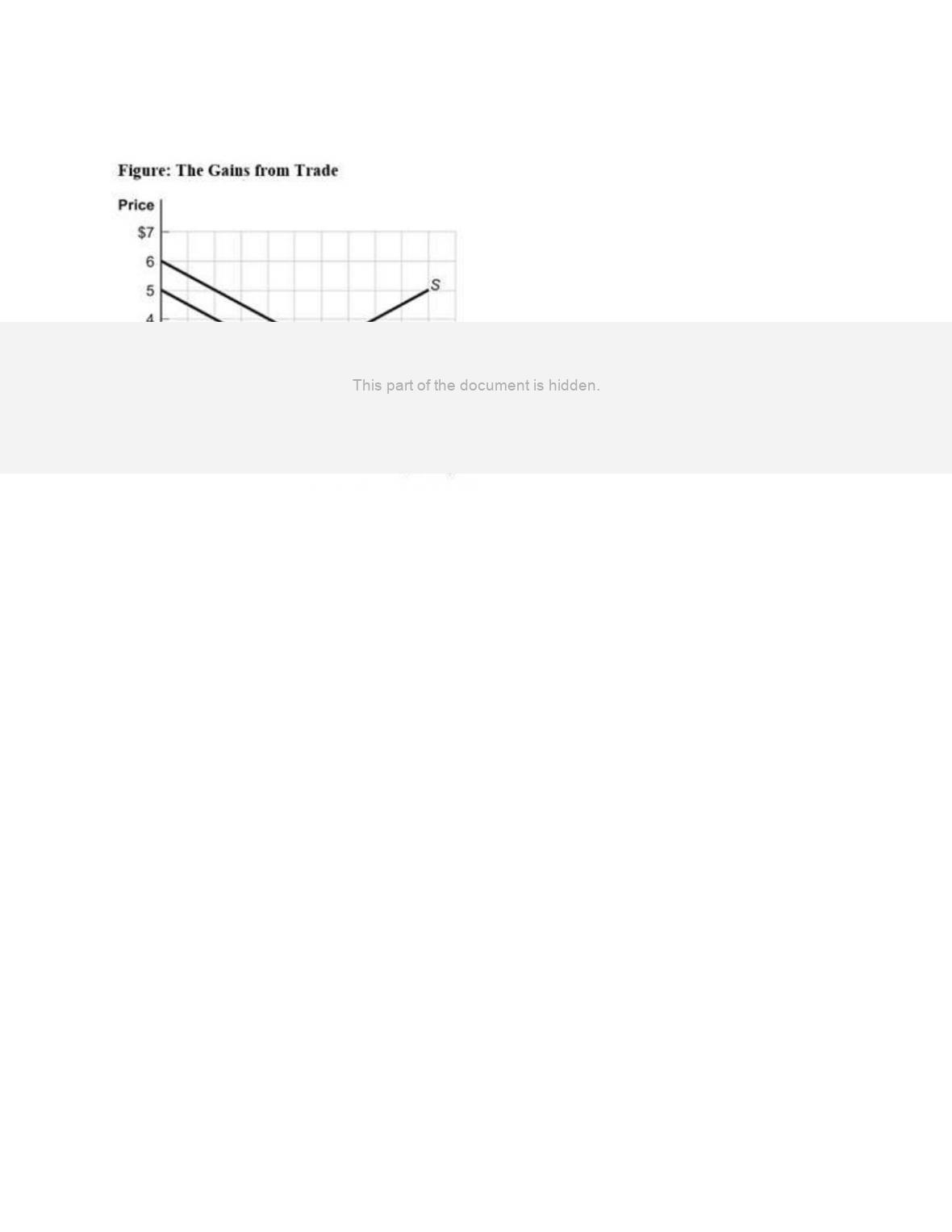
(Figure: The Gains from Trade) Look at the figure The Gains from Trade. What is the
total surplus in this market when the demand curve is D1 and the market is in
equilibrium?
A)
$25.00
B)
$31.25
C)
$62.50
D)
$90.00
159.
(Figure: The Gains from Trade) Look at the figure The Gains from Trade. What is the
total surplus in this market when the demand curve is D2 and the market is in
equilibrium?
A)
$31.25
B)
$45.00
C)
$62.50
D)
$90.00
160.
(Figure: The Gains from Trade) Look at the figure The Gains from Trade. When
demand increases from D1 to D2, equilibrium total surplus:
A)
decreases by $10.00.
B)
increases by $12.75.
C)
decreases by $15.00.
D)
increases by $27.50.

Page 46
161.
Coffee and tea are substitutes in consumption. If there is an increase in the price of
coffee, assuming a positively sloped supply curve and a negatively sloped demand
curve, total surplus in the tea market:
A)
will increase.
B)
will decrease.
C)
will not change.
D)
may change, but we cannot determine the change without more information.
162.
If a frost destroys much of the grapefruit crop, assuming a positively sloped supply
curve and a negatively sloped demand curve, total surplus in the grapefruit market:
A)
will increase.
B)
will decrease.
C)
will not change.
D)
may change, but we cannot determine the change without more information.
163.
If the price is above the equilibrium price in the market for grapefruit, assuming a
positively sloped supply curve and a negatively sloped demand curve, total surplus:
A)
will be greater than if price were at equilibrium.
B)
will be less than if price were at equilibrium.
C)
will be the same as if price were at equilibrium.
D)
may be different than if price were at equilibrium, but we cannot determine this
without more information.
164.
If the price is below the equilibrium price in the market for grapefruit, assuming a
positively sloped supply curve and a negatively sloped demand curve, total surplus:
A)
will be greater than if price were at equilibrium.
B)
will be less than if price were at equilibrium.
C)
will be the same as if price were at equilibrium.
D)
may be different than if price were at equilibrium, but we cannot determine this
without more information.
165.
Suppose a competitive market has a downward-sloping demand curve and a horizontal
supply curve. If the supply curve shifts downward, equilibrium price will _____,
equilibrium quantity will _____, consumer surplus will _____, and producer surplus
will _____.
A)
decrease; increase; increase; decrease
B)
decrease; decrease; increase; not change
C)
decrease; increase; increase; not change
D)
decrease; increase; not change; increase
Page 47
Use the following to answer questions 166-168:
166.
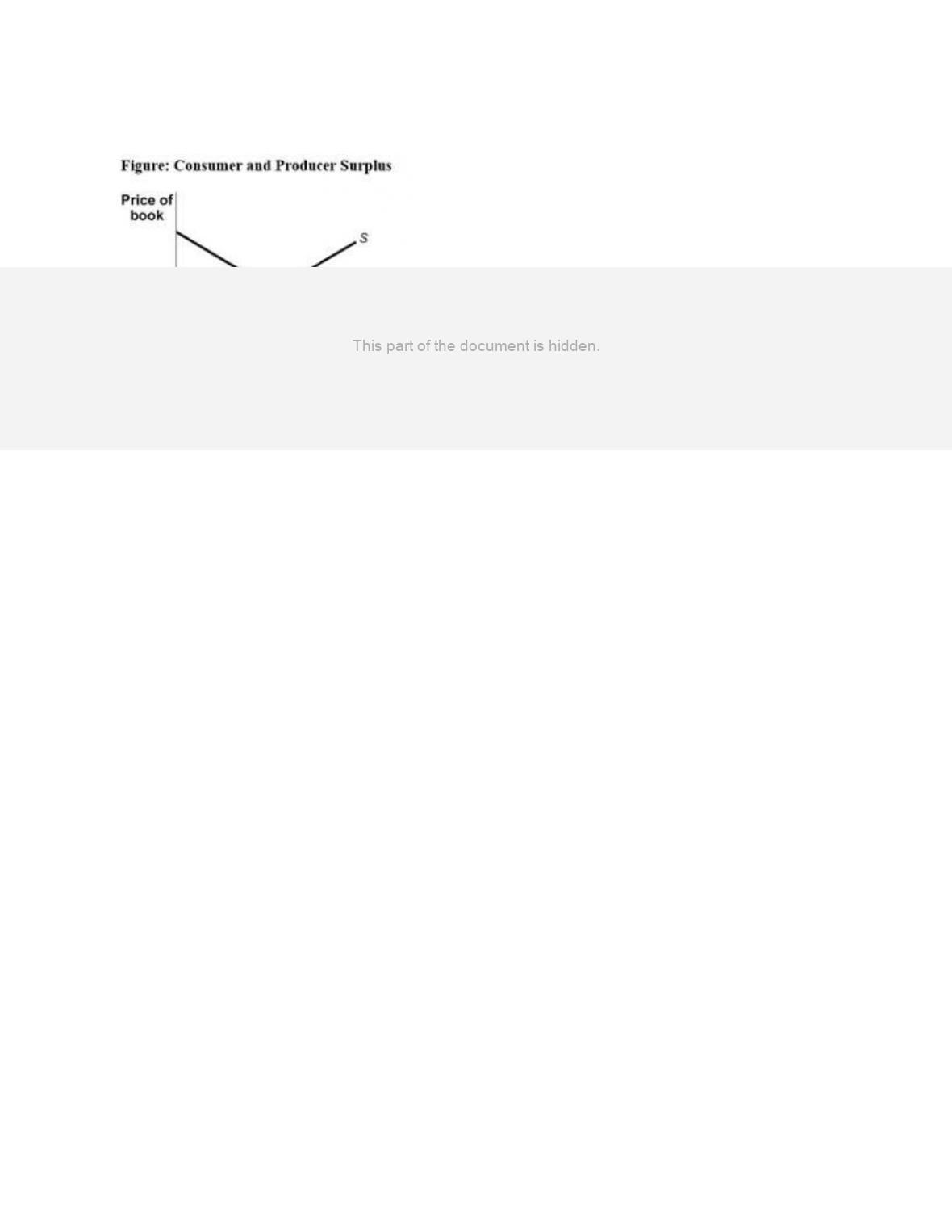
(Figure: Consumer and Producer Surplus) Look at the figure Consumer and Producer
Surplus. If the price is held above equilibrium, consumer surplus will be _____ if the
market were in equilibrium and total surplus will be _____ if the market were in
equilibrium.
A)
greater than; less than
B)
less than; the same as
C)
greater than; the same as
D)
less than; less than
167.
(Figure: Consumer and Producer Surplus) Look at the figure Consumer and Producer
Surplus. If the price is held below equilibrium, producer surplus will be _____ if the
market were in equilibrium and total surplus will be _____ if the market were in
equilibrium.
A)
less than; less than
B)
greater than; the same as
C)
less than; the same as
D)
greater than; less than
168.
(Figure: Consumer and Producer Surplus) Look at the figure Consumer and Producer
Surplus. An increase in supply will:
A)
increase consumer surplus.
B)
will have no impact on consumer surplus
C)
decrease consumer surplus
D)
not enough information to determine the impact on consumer surplus
Page 48
169.
Peanut butter is an inferior good. If there is an increase in income, total surplus in the
peanut butter market:
A)
will increase.
B)
will decrease.
C)
will not change.
D)
may change, but we cannot determine the change without more information.
170.
If the technology of producing peanuts improves, total surplus in the peanut butter
market:
A)
will increase.
B)
will decrease.
C)
will not change.
D)
may change, but we cannot determine the change without more information.
171.
A consumer’s willingness to pay for a surfboard is the minimum price at which he or she
would buy the surfboard.
A)
True
B)
False
172.
Gehrig is willing to pay $90 for a cap made of raccoon skin. Suppose he finds such a
cap for $71 on eBay. If Gehrig buys the cap for $71, he will have an individual
consumer surplus of $71.
A)
True
B)
False
173.
Consumer surplus is the amount buyers actually pay for a good minus the maximum
amount they are willing to pay for it.
A)
True
B)
False
174.
One way to measure the gain to consumers from a drug that has the potential to reduce
obesity is to measure what people are willing to pay for the good and subtract the
amount they have to pay.
A)
True
B)
False
Page 49
175.
If the cost of soybeans (the major ingredient in tofu) decreases, consumer surplus in the
market for tofu will decrease.
A)
True
B)
False
176.
Floyd’s cost of selling haircuts is the lowest price at which he is willing to sell haircuts.
A)
True
B)
False
177.
For calculating producer surplus, it is important to distinguish between the minimum
price at which a seller is willing to sell a good and the seller’s cost.
A)
True
B)
False
178.
Producer surplus is the amount sellers receive from the sale of a good minus the
minimum amount they are willing to accept for supplying the good.
A)
True
B)
False
179.
All else equal, when the supply curve shifts left, the producer surplus increases.
A)
True
B)
False
180.
Assuming that gasoline and cars are complements in consumption, if the price of
gasoline rises, the producer surplus of auto manufacturers decreases.
A)
True
B)
False
181.
The total surplus generated in the market for blackberries is the total net gain to
consumers in that market.
A)
True
B)
False
182.
Total surplus is the excess of consumer surplus over producer surplus.
A)
True
B)
False
Page 50
183.
The gains from trade are the reason that consumers and producers are better off
participating in a market economy than they would be if each tried to be self-sufficient.
A)
True
B)
False
184.
Total surplus shows the total benefit to society from production and consumption of a
good.
A)
True
B)
False
185.
Total surplus in a market is the excess of the number of consumers above the optimum
number.
A)
True
B)
False
186.
Total surplus in a market is the number of extra consumers and producers that are not
needed for the market to come to an equilibrium price and quantity.
A)
True
B)
False
187.
When there is a positive amount of total surplus in a market, it means that the cost of
producing the good is zero.
A)
True
B)
False
188.
If the market for smartphones is initially in equilibrium at a price of $250 and
consumption is reallocated so that Amanda, who values a phone at $300, is required to
give it to Brent, who values a phone at $225, total surplus in the smartphone market will
increase.
A)
True
B)
False
189.
If the market for tickets to the World Series is in equilibrium but owners of tickets who
would have sold their tickets are not allowed to sell, while fans who would not sell their
tickets are required to sell, total surplus would decrease.
A)
True
B)
False
Page 51
190.
If the market for concert tickets is in equilibrium and the fire marshal tries to reduce the
number of tickets sold, all other things equal, total surplus will decrease.
A)
True
B)
False
191.
Efficiency exists when there is no way to make someone better off without making
someone else worse off.
A)
True
B)
False
192.
Prices above equilibrium on agricultural products like milk exist to maximize the
consumer surplus.
A)
True
B)
False
193.
There is a trade-off between equity and efficiency in that policies designed to promote
equity often come at the cost of decreased efficiency.
A)
True
B)
False
194.
Policies designed to promote efficiency will never decrease equity; however, policies
designed to promote equity will usually decrease efficiency.
A)
True
B)
False
195.
Efficiency deals with helping society decide what its goals should be.
A)
True
B)
False
196.
Efficiency addresses the best way to achieve a goal once it has been determined.
A)
True
B)
False
197.
Property rights and the role of prices as economic signals are two features that make
markets function effectively.
A)
True
B)
False
Page 52
198.
If property rights are restricted by government regulation, many more mutually
beneficial transactions will occur.
A)
True
B)
False
199.
Property rights benefit sellers of goods much more than they benefit consumers.
A)
True
B)
False
200.
Prices are important economic signals because they convey information about how
much consumers are willing to pay for a good and how much it costs sellers to produce
a good.
A)
True
B)
False
201.
Prices are important economic signals because they convey information about how
much producers are willing to pay for a good and how much it costs consumers to
produce a good.
A)
True
B)
False
202.
Market failure occurs when a market fails to produce efficient outcomes for society.
A)
True
B)
False
203.
When a monopolist prevents mutually beneficial trades from occurring, total surplus
increases.
A)
True
B)
False
204.
Externalities occur when the welfare of others not involved in the production or
consumption of a good or service are affected in ways that markets don’t take into
account on their own.
A)
True
B)
False
Page 53
205.
A price below the equilibrium price will cause a reduction in consumer surplus.
A)
True
B)
False
Use the following to answer questions 206-207:
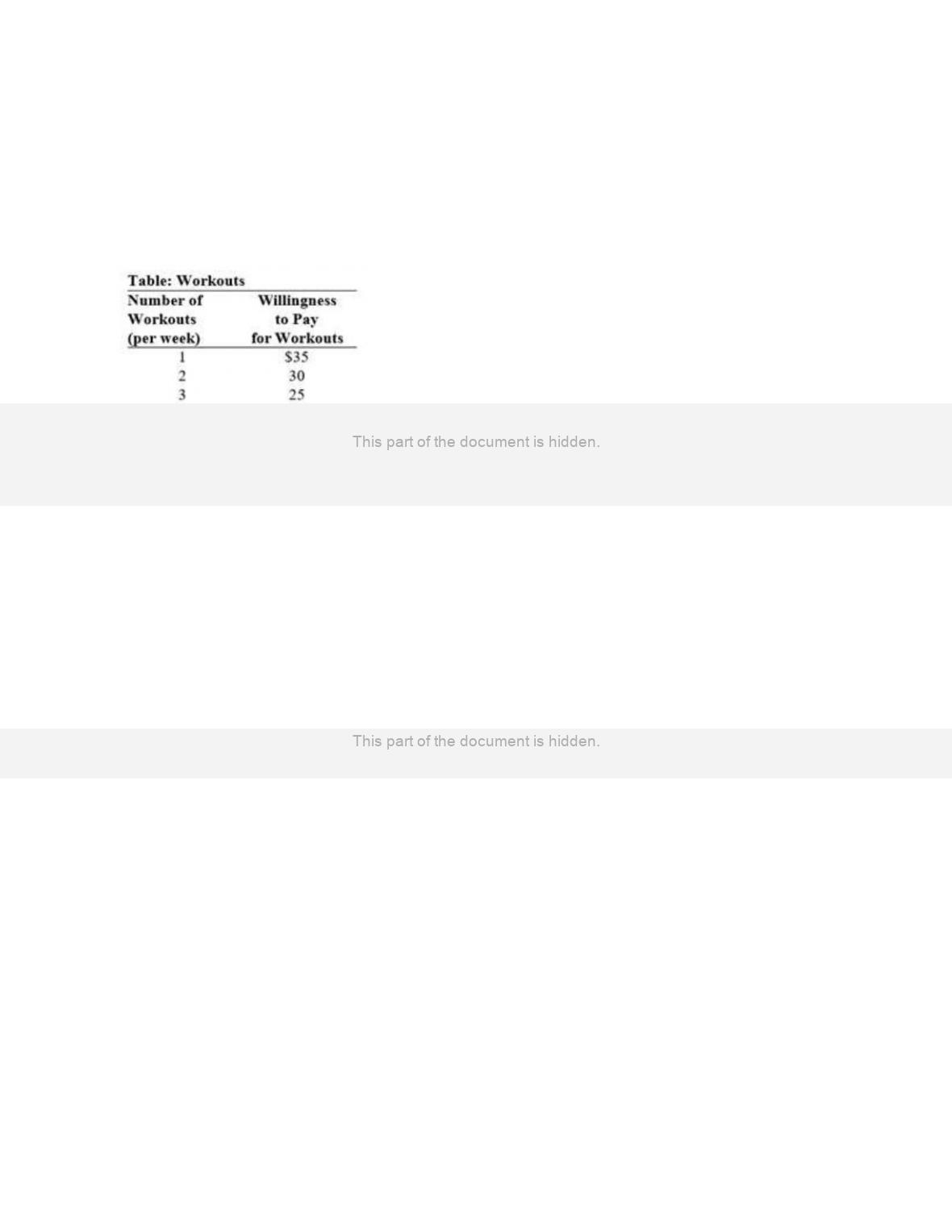
206.
(Table: Workouts) Use Table: Workouts. Several times each week Eli works out at a
health club, but because he is not a member, he pays $10 each time he uses the club
facilities. How many times per week will Eli use the health club for a workout, and how
much consumer surplus does he receive?
207.
(Table: Workouts) Use Table: Workouts. Suppose that Eli receives an offer from the
club for a weekly membership fee of $50 that allows him to use the club as much as he
wants. Assuming Eli joins the club, how many times will Eli use the club per week, and
how much consumer surplus will he receive?
Page 54
Use the following to answer questions 208-209:
208.
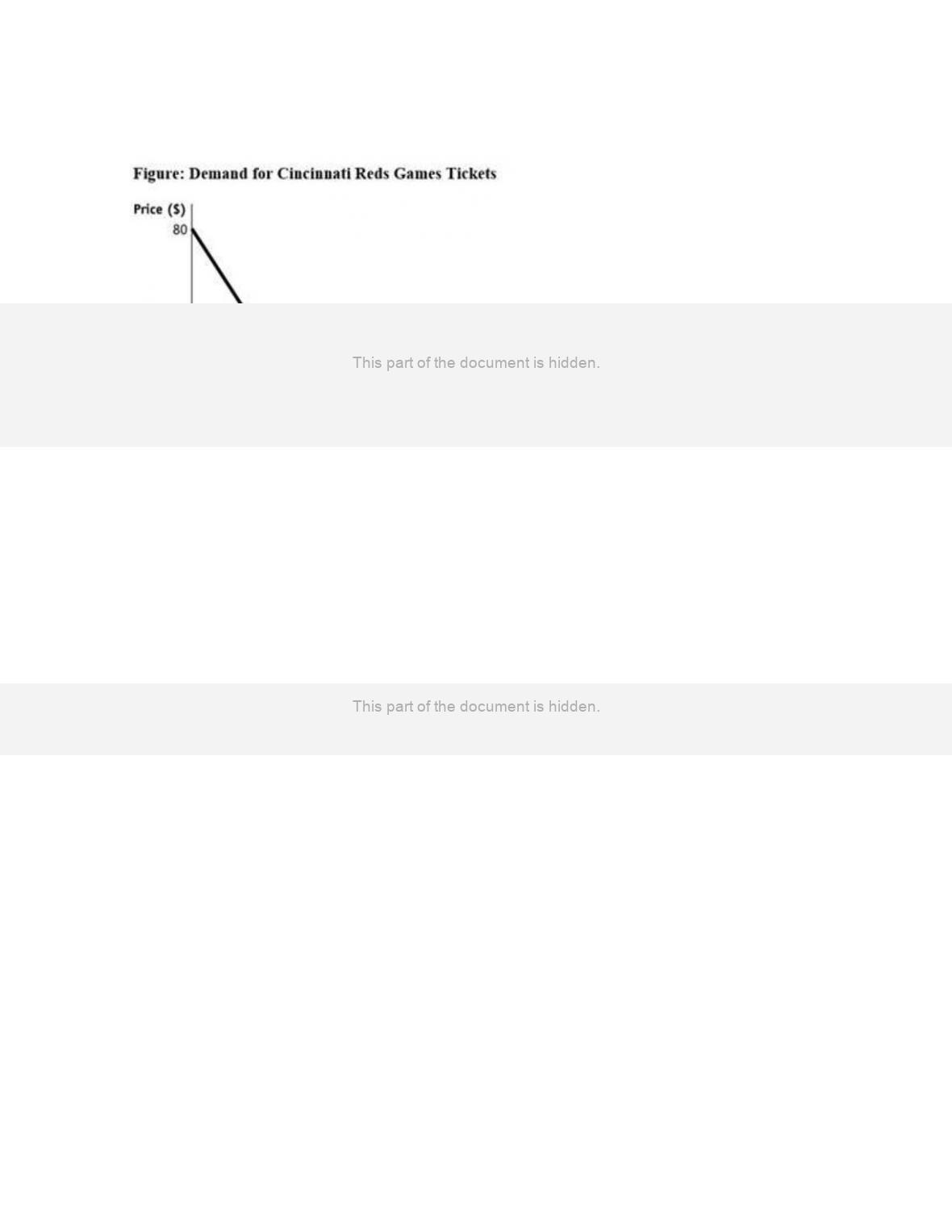
(Figure: Demand for Cincinnati Reds Games Tickets) The figure Demand for Cincinnati
Red Games Tickets represents Jeff’s annual demand for tickets to Cincinnati Reds
baseball games. At $20, Jeff will purchase five tickets. How much consumer surplus
does Jeff receive?
209.
(Figure: Demand for Cincinnati Reds Games Tickets) The figure Demand for Cincinnati
Red Games Tickets represents Jeff’s annual demand for tickets to Cincinnati Reds
baseball games. Suppose the Reds required all fans to purchase a $12 parking pass for
each game. This effectively raises the price of a ticket to $32, and Jeff will decrease his
quantity demanded for Reds baseball by one ticket this year. How much consumer
surplus has Jeff lost?