Page 41
197.
If a government wants to increase the value of its currency in foreign exchange markets,
it can:
A)
use contractionary monetary policy.
B)
use expansionary monetary policy.
C)
decrease interest rates.
D)
sell its currency.
198.
Which method would NOT maintain a fixed exchange rate?
A)
trading currency in the foreign exchange market
B)
changing monetary policy to shift the supply and demand curves for its own
currency
C)
implementing foreign exchange controls
D)
passing a law requiring that the exchange rate remain fixed
199.
If a government fixes the exchange rate so as to generate a surplus of the domestic
currency, the exchange rate (U.S. dollars per unit of the other currency) will tend to
_____. To maintain the fixed exchange rate, the government must _____ the domestic
currency.
A)
fall; increase the international demand for
B)
rise; increase the international demand for
C)
fall; decrease the international demand for
D)
fall; increase the domestic supply of
200.
Assume that the foreign exchange market is trading the domestic currency at a rate (U.S.
dollars per unit of the domestic currency) above the rate fixed by the government. To
maintain the fixed exchange rate, the government must:
A)
decrease foreign exchange reserves.
B)
lower the domestic interest rate.
C)
facilitate the domestic purchase of foreign financial assets.
D)
raise the domestic interest rate.
201.
A depreciation of a currency below the exchange rate fixed by its government
CANNOT be countered by:
A)
decreasing capital flows out of the country.
B)
limiting the domestic purchase of foreign financial assets.
C)
decreasing capital flows into the country.
D)
decreasing foreign exchange reserves.
Page 42
202.
To fix its exchange rate, a government can use:
A)
competition.
B)
exchange market intervention.
C)
speculation.
D)
arbitrage.
Use the following to answer questions 203-204:
203.
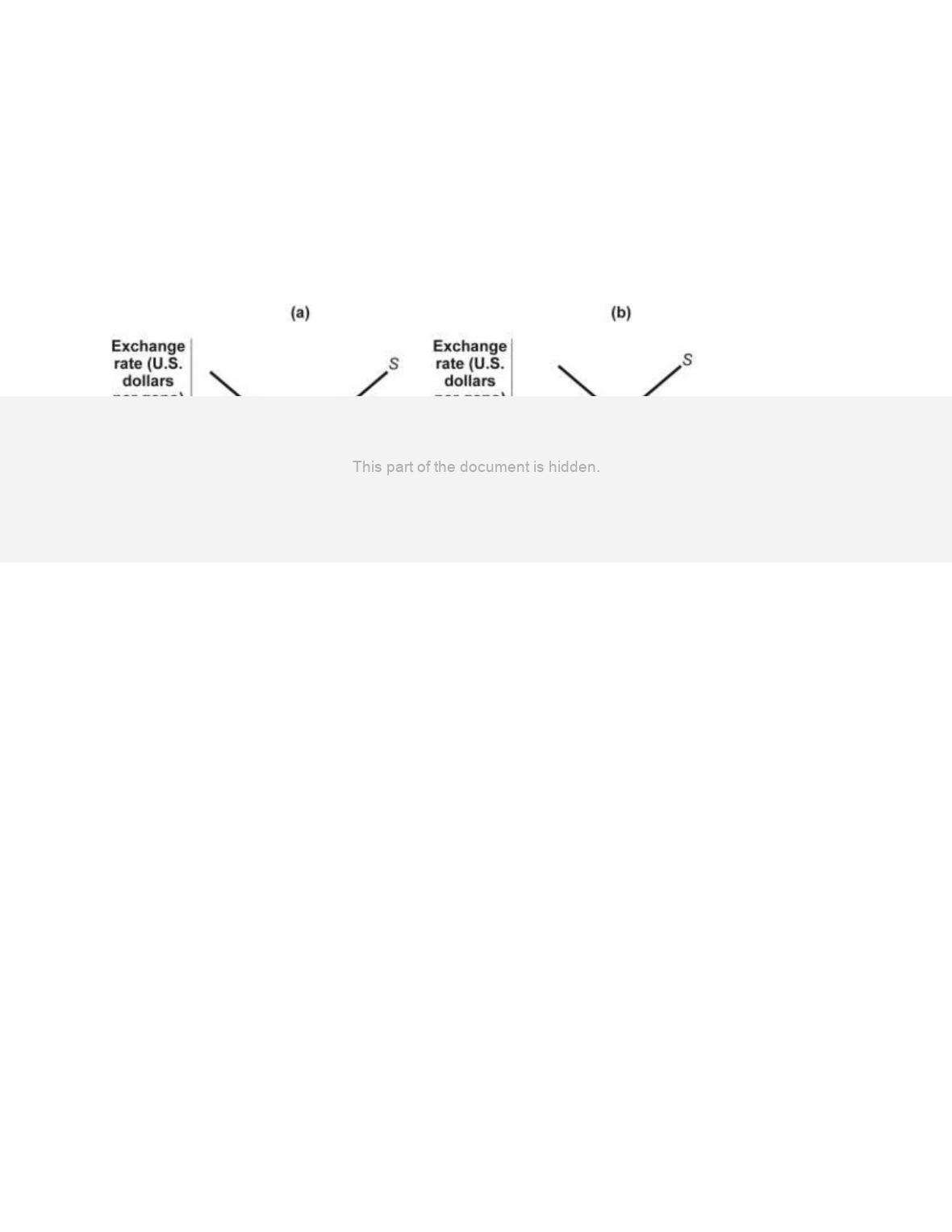
(Figure: Exchange Market Intervention) Refer to panel (a) in Figure: Exchange Market
Intervention. Which approach could the Genovian government use to raise the value of
the geno above its present equilibrium exchange rate and into the target range?
A)
use its own currency to buy U.S. dollars
B)
shift the demand for genos to the right by raising interest rates in Genovia
C)
eliminate the exchange controls that limit the right of Genovian citizens to buy
U.S. dollars
D)
tighten the exchange controls that limit purchases of U.S. dollars by Genovian
citizens
204.
(Figure: Exchange Market Intervention) Refer to panel (b) in Figure: Exchange Market
Intervention. Which approach could the Genovian government use to decrease the value
of the geno below its present equilibrium exchange rate and into the target range?
A)
use its own currency to buy U.S. dollars
B)
shift the demand for genos to the right by increasing interest rates in Genovia
C)
eliminate exchange controls that limit the right of Genovian citizens to sell foreign
currency
D)
tighten the exchange controls that limit purchases of U.S. dollars by Genovian
citizens
Page 43
205.
Foreign exchange controls are:
A)
fixed exchange rates.
B)
a government licensing system that limits the amount of foreign currency an
individual can buy.
C)
floating exchange rates.
D)
international limits on exchange rates.
206.
When countries seek to maintain fixed exchange rates through intervention, their
governments or central banks:
A)
never have to intervene in currency markets because the exchange rate is fixed.
B)
may have to stop printing domestic currency.
C)
must buy domestic currency when foreign demand for it increases.
D)
must sell domestic currency when foreign demand for it increases.
207.
A country wants to maintain a fixed exchange rate with the dollar, but at the current
exchange rate its currency is in excess. Which policy can the country NOT adopt to
maintain its exchange rate?
A)
Buy domestic currency and sell U.S. dollars in the foreign exchange market.
B)
Sell domestic currency and buy U.S. dollars in the foreign exchange market.
C)
Impose foreign exchange controls.
D)
Contract the money supply to raise domestic interest rates.
208.
“Foreign exchange controls” refers to the:
A)
fixed exchange rate system maintained by a country.
B)
restrictions imposed by a country on the amount of foreign exchange that its central
bank can hold.
C)
system of a common currency used by several countries, such as the euro.
D)
licensing systems that limit the rights of individuals to buy foreign currency.
209.
A floating exchange rate:
A)
retains the ability of monetary policy to help stabilize the economy.
B)
reduces the ability of monetary policy to stabilize the economy.
C)
reduces the uncertainty faced by business firms.
D)
makes foreign goods easier to price.
210.
One of the advantages of adopting a fixed exchange rate system is that it:
A)
reduces uncertainty.
B)
reduces the need for fiscal policy.
C)
increases the strength of monetary policy.
D)
does not require the country to maintain any large foreign exchange reserve.
Page 44
211.
One limitation of maintaining a fixed exchange rate system is that:
A)
it subjects the country’s exchange rate to wide fluctuations in the foreign exchange
market.
B)
it provides an incentive for the country to change its inflation policy frequently.
C)
the country may not be able to use monetary policy to achieve other goals, such as
full employment.
D)
it leads to wide fluctuations in the growth rate.
212.
The advantage of a fixed exchange rate is that it:
A)
leaves monetary policy available for macroeconomic stabilization.
B)
eliminates the possibility of the twin deficits.
C)
eliminates uncertainty about the value of a currency.
D)
tends to create trade surpluses.
213.
Which statement is NOT true of a fixed exchange rate system?
A)
It is good for business.
B)
Foreign exchange reserves are costly.
C)
It keeps a country from using inflationary policies.
D)
It makes pursuing domestic macroeconomic objectives easier.
214.
A major drawback of a floating exchange rate is the:
A)
opportunity cost associated with the accumulation of foreign exchange reserves.
B)
uncertainty about the value of goods traded internationally.
C)
increased discipline on monetary policy.
D)
distorted incentives for the normal flow of imports and exports.
215.
Major drawbacks of a fixed exchange rate do NOT include:
A)
exchange controls must be imposed at the cost of administrative red tape and
corruption.
B)
resources must be diverted to the accumulation of large foreign exchange reserves.
C)
monetary policy cannot be used to stabilize output and the inflation rate.
D)
commerce among countries is more uncertain and riskier.
216.
With a fixed exchange rate regime, monetary policy is:
A)
fully flexible.
B)
limited in its ability to shift aggregate demand to the right.
C)
limited in its ability to shift aggregate supply to the right.
D)
independent of exchange rate issues.
Page 45
217.
The Bretton Woods monetary system:
A)
was abandoned by the United States in 1996.
B)
broke down in 1971.
C)
was abandoned by the United States, but the dollar is still backed by gold.
D)
remains in effect today.
218.
The Bretton Woods agreement called for:
A)
each currency’s value to be flexible relative to other currencies.
B)
maintaining fixed exchange rates by government intervention.
C)
most nations to adopt the euro as their official currency.
D)
what amounted to a floating exchange rate.
219.
The result of the meeting of representatives of the Allied Nations at Bretton Woods,
New Hampshire, in 1944 was:
A)
the North American Free Trade Agreement.
B)
a system of floating exchange rates.
C)
a system of fixed exchange rates.
D)
the Treaty of Ghent.
220.
After the Bretton Woods agreement broke down in 1971, the United States and most
industrialized countries adopted:
A)
the euro.
B)
the bitcoin.
C)
a system of fixed exchange rates.
D)
a system of floating exchange rates.
221.
Why did China add $2 trillion to its foreign exchange reserves between early 2009 and
early 2014?
A)
to encourage free trade between all nations
B)
to keep the yuan from depreciating
C)
to keep the yuan from appreciating
D)
to slow down the growth of the Chinese economy
222.
China’s exchange rate policy:
A)
led to current account deficits in the early 2000s.
B)
led to the supply of yuan exceeding the demand for yuan.
C)
is floating rate policy.
D)
is a fixed rate policy.
Page 46
223.
The primary economic disadvantage of adopting the euro for Britain is:
A)
the loss of the ability to conduct an independent monetary policy.
B)
the loss of national pride.
C)
a decrease in international trade and growth of GDP.
D)
the risk of a higher rate of unemployment.
224.
Which country did NOT adopt the euro?
I. Britain
II. Switzerland
III. Sweden
A)
I only
B)
II only
C)
III only
D)
I, II, and III
225.
Which argument was made in favor of Britain’s adopting the euro?
I. Using the same currency as many other European countries would expand trade and
increase productivity.
II. Using the euro would increase the effectiveness of monetary policy.
A)
I only
B)
II only
C)
I and II
D)
neither I nor II
226.
Which argument was made against Britain’s adopting the euro?
I. Using the same currency as many other European countries would discourage trade
and decrease productivity.
II. Using the euro would decrease the effectiveness of monetary policy.
A)
I only
B)
II only
C)
I and II
D)
neither I nor II
227.
The euro was established in:
A)
1865.
B)
1933.
C)
1999.
D)
2008.
Page 47
228.
Devaluation of a currency occurs under _____ exchange rates when the price of the
domestic currency in terms of foreign currency _____.
A)
flexible; falls
B)
flexible; rises
C)
fixed; falls
D)
fixed; rises
229.
In terms of foreign currency, a revaluation makes:
A)
domestic goods cheaper relative to foreign goods.
B)
both domestic and foreign goods less expensive.
C)
both domestic and foreign goods more expensive.
D)
domestic goods more expensive relative to foreign goods.
230.
Which statement regarding exchange rate intervention is FALSE?
A)
A devaluation can be used to increase exports and reduce imports.
B)
A devaluation can be used to eliminate a recessionary gap.
C)
A revaluation can be used to eliminate a recessionary gap.
D)
Devaluations and revaluations can be used to eliminate shortages or surpluses in
the foreign exchange market.
231.
When the Mexican government changes the fixed rate of pesos per U.S. dollar from 1.5
to 3.0, the peso is _____. When the equilibrium exchange rate of U.S. dollars per euro
changes from 1.15 to 1.30, the euro is _____.
A)
revaluated; appreciated
B)
appreciated; devaluated
C)
devaluated; appreciated
D)
appreciated; revaluated
232.
A revaluation _____ exports and _____ imports.
A)
increases; decreases
B)
decreases; increases
C)
increases; increases
D)
decreases; decreases
233.
Under fixed exchange rates, a devaluation:
A)
decreases aggregate demand.
B)
increases aggregate demand.
C)
decreases aggregate supply.
D)
increases aggregate supply.
Page 48
234.
Under fixed exchange rates, a revaluation decreases aggregate demand by:
A)
increasing exports.
B)
reducing imports.
C)
causing a financial account deficit.
D)
decreasing exports.
235.
Devaluation is reduction in the:
A)
value of a currency due to inflation.
B)
value of a currency in a floating exchange rate system.
C)
value of a currency in a fixed exchange rate system.
D)
rate of inflation of a country.
236.
Which country switched from fixed to floating exchange rates?
I. Britain
II. Argentina
A)
I only
B)
II only
C)
I and II
D)
neither I nor II
237.
A reduction in the value of a currency that is set under a fixed exchange rate regime is
a(n):
A)
depreciation.
B)
devaluation.
C)
appreciation.
D)
revaluation.
238.
An increase in the value of a currency that is set under a fixed exchange rate regime is
a(n):
A)
depreciation.
B)
devaluation.
C)
appreciation.
D)
revaluation.
239.
A reduction in the value of a currency that is determined under a floating exchange rate
regime is a(n):
A)
depreciation.
B)
devaluation.
C)
appreciation.
D)
revaluation.
Page 49
240.
An increase in the value of a currency that is determined under a floating exchange rate
regime is a(n):
A)
depreciation.
B)
devaluation.
C)
appreciation.
D)
revaluation.
241.
The Venezuelan bolivar trades at a fixed exchange rate. If Venezuela uses monetary
policy to change the exchange rate of the bolivar from $0.16 to $0.20, the bolivar has:
A)
depreciated.
B)
been devalued.
C)
appreciated.
D)
been revalued.
242.
The Danish krone is a fixed exchange rate currency. If Denmark intervenes in the
foreign exchange market to change the krone from $0.18 to $0.15, the krone has:
A)
depreciated.
B)
been devalued.
C)
appreciated.
D)
been revalued.
243.
The pound sterling floats. If its exchange rate changes from $1.68 to $1.75, the pound
has:
A)
depreciated.
B)
been devalued.
C)
appreciated.
D)
been revalued.
244.
The pound sterling floats. If the exchange rate for the pound changes from $1.68 to
$1.60, the pound has:
A)
depreciated.
B)
been devalued.
C)
appreciated.
D)
been revalued.
Page 50
245.
A devaluation will make exports _____expensive and imports _____ expensive.
A)
more; more
B)
more; less
C)
less; less
D)
less; more
246.
A revaluation will make exports _____expensive and imports _____ expensive.
A)
more; more
B)
more; less
C)
less; less
D)
less; more
247.
After a devaluation, all other things equal, exports will likely _____ and imports will
likely _____.
A)
increase; increase
B)
decrease; decrease
C)
increase; decrease
D)
decrease; increase
248.
After a revaluation, all other things equal, exports will likely _____ and imports will
likely _____.
A)
increase; increase
B)
decrease; decrease
C)
increase; decrease
D)
decrease; increase
249.
After a devaluation, all other things equal, a country’s balance of payments on the
current account will likely:
A)
increase.
B)
decrease.
C)
remain the same.
D)
fluctuate randomly.
250.
After a revaluation, all other things equal, a country’s balance of payments on the
current account will likely:
A)
increase.
B)
decrease.
C)
remain the same.
D)
fluctuate randomly.
Page 51
251.
A devaluation can help reduce a(n) _____ gap.
I. inflationary
II. deflationary
A)
I only
B)
II only
C)
I and II
D)
neither I nor II
252.
A revaluation can help reduce a(n) _____ gap.
I. inflationary
II. deflationary
A)
I only
B)
II only
C)
I and II
D)
neither I nor II
253.
A revaluation can help reduce _____ of domestic currency.
I. shortages
II. surpluses
A)
I only
B)
II only
C)
I and II
D)
neither I nor II
254.
A devaluation can help reduce _____ of domestic currency.
I. shortages
II. surpluses
A)
I only
B)
II only
C)
I and II
D)
neither I nor II
255.
The 2001 devaluation of the Argentine peso did NOT:
A)
promote Argentine exports.
B)
help close a recessionary gap.
C)
reduce the deficit of the current account.
D)
help close an inflationary gap.

Page 52
256.
A decrease in U.S. interest rates causes the dollar to _____ and aggregate demand to
_____.
A)
depreciate; increase
B)
depreciate; decrease
C)
appreciate; increase
D)
appreciate; decrease
257.
An increase in U.S. interest rates causes a decrease in aggregate demand by _____
investment spending, _____ the dollar, and _____.
A)
increasing; appreciating; increasing imports
B)
decreasing; appreciating; increasing imports
C)
increasing; depreciating; increasing exports
D)
decreasing; depreciating; decreasing exports
258.
With a floating exchange rate:
A)
monetary policy is ineffective.
B)
monetary policy is not independent.
C)
a central bank can use an independent monetary policy.
D)
an independent fiscal policy cannot be used.
259.
Expansionary monetary policy in the United States causes U.S. interest rates to _____
and the dollar to _____.
A)
rise; appreciate
B)
rise; depreciate
C)
fall; appreciate
D)
fall; depreciate
260.
Suppose that a country has floated its currency and the central bank sets an
expansionary monetary policy. Which outcome is likely to occur?
A)
Interest rates will fall and capital will flow in.
B)
Interest rates will rise and capital will flow out.
C)
Interest rates will fall and capital will flow out.
D)
Its exchange rate will appreciate.
Page 53
261.
Suppose that a country has floated its currency and the central bank sets a contractionary
monetary policy. Which outcome is likely to occur?
A)
The country’s currency will depreciate.
B)
Interest rates will rise, the currency will appreciate, and any inflationary gap will
shrink.
C)
Interest rates will fall, which will reduce aggregate demand.
D)
Net exports will be larger.
262.
A reduction in the interest rate has _____ impact on aggregate demand with _____
exchange rates than with _____ exchange rates.
A)
a smaller; floating; fixed
B)
a larger; floating; fixed
C)
the same; fixed; floating
D)
the same; floating; fixed
263.
Under a floating exchange rate regime, raising the interest rate does NOT:
A)
increase foreign imports.
B)
reduce capital outflows.
C)
increase domestic investment spending.
D)
reduce domestic exports.
264.
The difference between a fixed and a floating exchange rate regime is that with a _____
rate system, the _____, whereas with a _____ rate system it does not.
A)
fixed; central bank retains its ability to use independent monetary policy; floating
B)
floating; central bank retains its ability to use independent monetary policy; fixed
C)
fixed; government can use independent fiscal policy; floating
D)
floating; government can use independent fiscal policy; fixed
265.
If a country with floating exchange rates uses an expansionary monetary policy, the
domestic interest rate _____, demand for the domestic currency _____, supply of the
domestic currency _____, and the effect on the exchange rate is _____.
A)
falls; falls; rises; ambiguous
B)
rises; rises; falls; an increase
C)
falls; falls; rises; a decrease
D)
falls; remains unchanged; rises; a decrease
Page 54
266.
If a country with a floating exchange rate follows a contractionary monetary policy,
with everything else remaining unchanged, it leads to a(n) _____ in interest rates and
a(n) _____ in the currency.
A)
increase; depreciation
B)
decrease; appreciation
C)
decrease; depreciation
D)
increase; appreciation
267.
All else equal, if the Federal Reserve decreases the money supply, interest rates will
_____ and the dollar will _____ against other currencies.
A)
increase; depreciate
B)
decrease; depreciate
C)
decrease; appreciate
D)
increase; appreciate
268.
If the United States is in a recessionary gap, the appropriate policy is to _____ the
money supply to _____ interest rates.
A)
increase; increase
B)
increase; decrease
C)
decrease; increase
D)
decrease; decrease
269.
When the interest rate in the United States decreases as a result of expansionary
monetary policy, investment spending _____ and consumption _____ .
A)
increases; increases
B)
increases; decreases
C)
decreases; increases
D)
decreases; decreases
270.
As a result of expansionary monetary policy, lower U.S. interest rates will result in a(n)
_____ in the demand for dollars and a(n) _____ in the supply of dollars.
A)
increase; increase
B)
increase; decrease
C)
decrease; increase
D)
decrease; decrease
Page 55
271.
Expansionary monetary policy in the United States will cause the dollar to:
A)
appreciate.
B)
be revalued.
C)
depreciate.
D)
be devalued.
272.
When the dollar depreciates, exports _____ and imports _____ .
A)
increase; increase
B)
increase; decrease
C)
decrease; increase
D)
decrease; decrease
273.
A depreciated dollar will cause aggregate demand to:
A)
increase.
B)
decrease.
C)
remain constant.
D)
fluctuate randomly.
274.
If the United States is in an inflationary gap, the appropriate policy is to _____ the
money supply to _____ interest rates.
A)
increase; increase
B)
increase; decrease
C)
decrease; increase
D)
decrease; decrease
275.
When the interest rate in the United States increases as a result of contractionary
monetary policy, investment spending _____ and consumption _____ .
A)
increases; increases
B)
increases; decreases
C)
decreases; increases
D)
decreases; decreases
276.
As a result of contractionary monetary policy, higher U.S. interest rates will result in
a(n) _____ in the demand for dollars and a(n) _____ in the supply of dollars.
A)
increase; increase
B)
increase; decrease
C)
decrease; increase
D)
decrease; decrease
Page 56
277.
Contractionary monetary policy in the United States will cause the dollar to:
A)
appreciate.
B)
be revalued.
C)
depreciate.
D)
be devalued.
278.
When the dollar appreciates, exports will _____ and imports will _____ .
A)
increase; increase
B)
increase; decrease
C)
decrease; increase
D)
decrease; decrease
279.
An appreciated dollar will cause aggregate demand to:
A)
increase.
B)
decrease.
C)
remain constant.
D)
fluctuate randomly.
280.
Countries A and B are important trading partners. Country A is in a recession. Country
B will be better insulated from the recession originating in country A if country _____
has a _____ exchange rate system.
A)
B; fixed
B)
B; floating
C)
A; fixed
D)
A; floating
281.
China has fixed the exchange rate between the yuan and the U.S. dollar. Therefore, a
recession in China _____ U.S. _____ to China more than if the exchange rate floated.
A)
raises; exports
B)
reduces; imports
C)
raises; imports
D)
reduces; exports
282.
Adopting a floating exchange rate regime:
A)
makes the domestic economy less susceptible to business cycles abroad.
B)
limits the use of monetary policy to stabilize the economy.
C)
makes the domestic economy more susceptible to business cycles abroad.
D)
commits the country to maintaining low inflation rates.
Page 57
283.
An advantage to floating exchange rates is that they help:
A)
insulate countries from currency fluctuations.
B)
insulate countries from recessions starting in other countries.
C)
keep exports from replacing domestic jobs.
D)
keep export prices down.
284.
Which statement is TRUE?
A)
The financial account balance is the negative of the current account balance.
B)
A country’s balance on current account will be less than its balance on financial
account if exchange rates are allowed to float freely.
C)
If the market for a nation’s currency is in equilibrium, a financial account surplus
necessarily means a current account surplus.
D)
Exchange rates don’t affect either financial accounts or current accounts.
285.
All other things unchanged, an increase in the value of the dollar against the euro _____
U.S. net exports and shifts the aggregate demand curve to the _____.
A)
increases; right
B)
decreases; right
C)
increases; left
D)
decreases; left
286.
All other things unchanged, a decrease in the value of the dollar against the euro _____
U.S. net exports and shifts the aggregate demand curve to the _____.
A)
increases; right
B)
decreases; right
C)
increases; left
D)
decreases; left
287.
According to the principle of purchasing power parity, the 2001 devaluation of the
Argentine peso:
A)
increased the inflation rate in Argentina relative to the inflation rate in the United
States.
B)
made Argentine imports from the United States cheaper.
C)
decreased the inflation rate in Argentina relative to the inflation rate in the United
States.
D)
had no impact on the Argentine inflation rate.
Page 58
288.
A country’s balance of payments on financial account is the difference between the
country’s sales of assets to foreigners and its purchases of assets from foreigners during
a given period.
A)
True
B)
False
289.
The value of accounting services purchased by clients in China is included in the
merchandise trade balance.
A)
True
B)
False
290.
Included in the financial account is the income U.S. residents earn on assets owned in
other countries.
A)
True
B)
False
291.
A change in the U.S. balance of payments on financial account generates an equal and
opposite reaction in the balance of payments on current account.
A)
True
B)
False
292.
If the current account is in surplus, the financial account must also be in surplus.
A)
True
B)
False
293.
Toyota’s factory in San Antonio is an example of direct foreign investment.
A)
True
B)
False
294.
Countries with government budget surpluses are likely to have capital inflows, all other
things equal.
A)
True
B)
False
295.
The exchange rate ensures that the balance of payments really does balance.
A)
True
B)
False
Page 59
296.
The exchange rate is determined in the commodities markets.
A)
True
B)
False
297.
When a currency becomes more valuable in terms of other currencies, it appreciates.
A)
True
B)
False
298.
When a currency becomes more valuable in terms of other currencies, it depreciates.
A)
True
B)
False
299.
If the exchange rate for the euro is $1.38, $1 exchanges for €0.7246.
A)
True
B)
False
300.
If the exchange rate for the yen is $0.009784, $1 exchanges for ¥9.784.
A)
True
B)
False
301.
If the euro depreciates, then a Mediterranean cruise will be cheaper for U.S. tourists.
A)
True
B)
False
302.
If the euro depreciates, then a Chevrolet will be cheaper for Italians.
A)
True
B)
False
303.
If the exchange rate for the U.S. dollar changes from $1.25 per euro to $1.50 per euro,
then the dollar depreciates.
A)
True
B)
False
304.
If the dollar value of the pound falls, then the dollar has depreciated.
A)
True
B)
False
Page 60
305.
In the foreign exchange market for dollars and pounds, the demand for dollars is also the
supply of pounds.
A)
True
B)
False
306.
Demand for pounds sterling in the foreign exchange market might come from people in
Britain who want to buy U.S. goods, services, and assets.
A)
True
B)
False
307.
The supply of pounds sterling in the foreign exchange market might come from people
in Britain who want to buy U.S. goods, services, and assets.
A)
True
B)
False
308.
If a country’s currency appreciates, all other things equal, its exports and imports will
increase.
A)
True
B)
False
309.
If a country’s currency appreciates, all other things equal, its exports will decrease and
its imports will increase.
A)
True
B)
False
310.
If the United States receives increased capital inflows from Europe, the dollar will
depreciate.
A)
True
B)
False
311.
If the dollar appreciates because of a capital inflow from Asia, the balance on the U.S.
financial account will increase and the balance on the current account will decrease.
A)
True
B)
False
312.
Real exchange rates are those that are recognized by the International Monetary Fund.
A)
True
B)
False