Page 21
102.
When a currency appreciates, the prices of its exports to other countries will:
A)
increase.
B)
decrease.
C)
remain constant.
D)
fluctuate randomly.
103.
When a currency depreciates, the prices of its exports to other countries will:
A)
increase.
B)
decrease.
C)
remain constant.
D)
fluctuate randomly.
104.
When a currency appreciates, the prices of its imports from other countries will:
A)
increase.
B)
decrease.
C)
remain constant.
D)
fluctuate randomly.
105.
When a currency depreciates, the prices of its imports from other countries will:
A)
increase.
B)
decrease.
C)
remain constant.
D)
fluctuate randomly.
106.
If the pound sterling appreciates against the dollar:
A)
British imports and exports have become more expensive.
B)
U.S. imports and exports have become more expensive.
C)
British imports and exports have become less expensive.
D)
British exports have become more expensive but the price of U.S. exports to
Britain has fallen.
107.
When the value of the euro changes from $1.30 to $1.20, it follows that:
A)
European Union imports from the United States increase.
B)
U.S. exports to the European Union increase.
C)
U.S. imports from the European Union increase.
D)
European Union exports to the United States decrease.
Page 22
108.
When the dollar appreciates relative to the Canadian dollar:
A)
Canadian goods become more expensive in the United States.
B)
U.S. goods become more expensive in Canada.
C)
U.S. residents tend to buy more from Canada, since the United States has a weak
currency.
D)
the United States sells more goods to Canada.
109.
When the U.S. dollar price of a foreign currency rises:
A)
it becomes cheaper for foreigners to buy U.S. goods.
B)
it becomes cheaper to buy foreign goods in the United States.
C)
foreign goods go down in price.
D)
we need fewer dollars to buy the foreign currency.
110.
If the U.S. dollar appreciates, we do NOT expect that:
A)
Americans will buy more foreign currency.
B)
Americans will buy more goods from abroad.
C)
U.S. exports to other countries will decline.
D)
Americans will buy fewer goods from abroad.
111.
Suppose that the United States and European Union are the only trading partners in the
world. If interest rates in the United States are significantly lower than those in the
European Union, we would expect the:
A)
supply of the dollar to fall, appreciating the dollar.
B)
demand for the dollar to fall, depreciating the dollar.
C)
supply of euros to increase, depreciating the euro.
D)
demand for euros to decrease, depreciating the euro.
112.
Suppose that the United States and European Union are the only trading partners in the
world. If the United States lowers import restrictions from the European Union, we
would expect the:
A)
demand for euros to increase, appreciating the euro.
B)
demand for the dollar to increase, appreciating the dollar.
C)
supply of dollars to increase, appreciating the dollar.
D)
supply of euros to increase, depreciating the euro.
Page 23
113.
Suppose that the United States and European Union are the only trading partners in the
world. If the European Union imposes some import tariffs on U.S. goods, we would
expect the:
A)
supply of the euro to decrease, depreciating the euro.
B)
demand for the dollar to decrease, depreciating the dollar.
C)
demand for the dollar to increase, appreciating the dollar.
D)
supply of the dollar to decrease, depreciating the dollar.
Use the following to answer questions 114-118:
114.
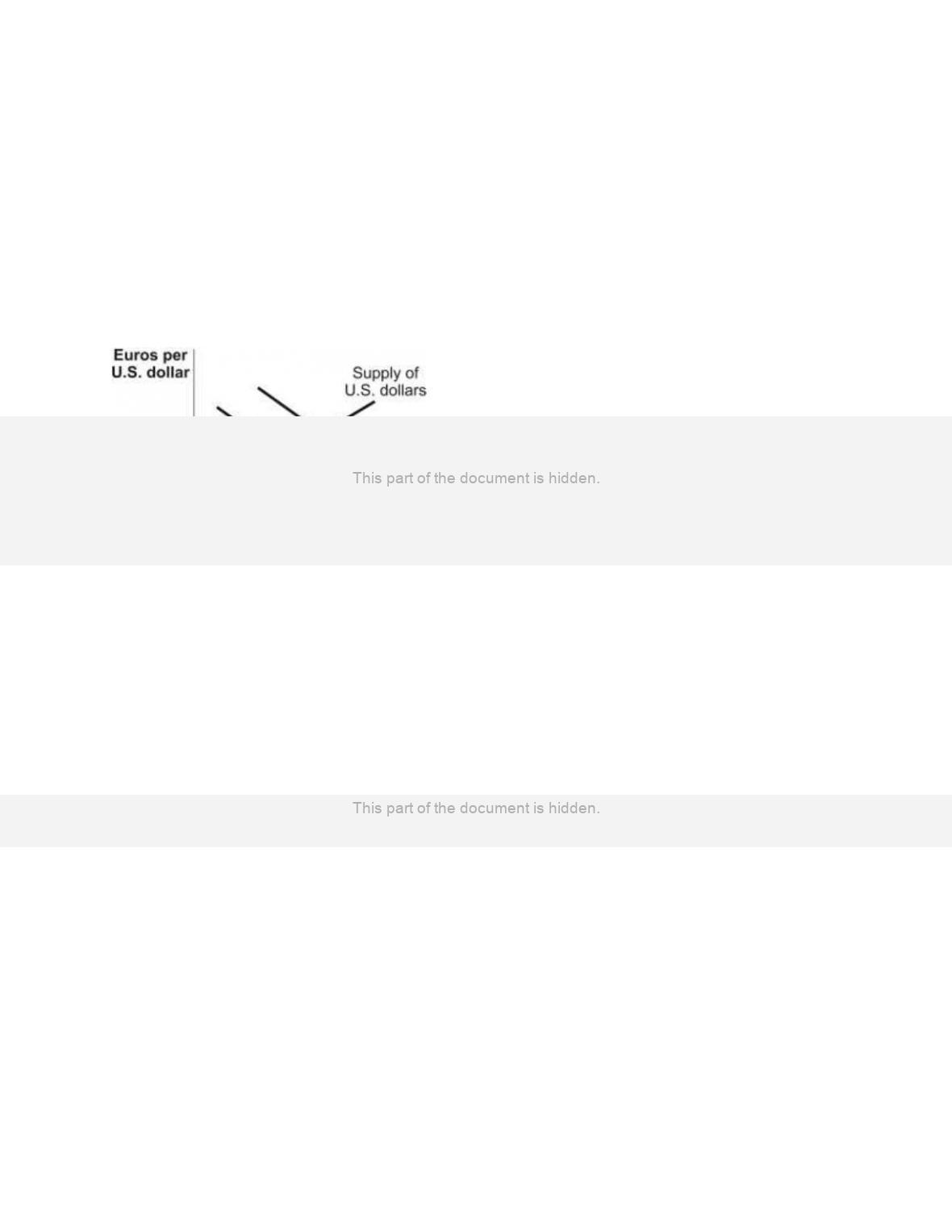
(Figure: Change in the Demand for U.S. Dollars) Refer to Figure: Change in the
Demand for U.S. Dollars. The change from D1 to D2 will occur, all other things being
equal, if the:
A)
supply of euros decreases.
B)
demand for euros increases.
C)
demand for euros decreases.
D)
demand for dollars increases.
115.
(Figure: Change in the Demand for U.S. Dollars) Refer to Figure: Change in the
Demand for U.S. Dollars. The change from D1 to D2 will occur, all other things being
equal, if:
A)
interest rates are higher in Europe.
B)
interest rates are higher in the United States.
C)
interest rates in the United States and Europe are equal.
D)
inflation is higher in Europe.

Page 24
116.
(Figure: Change in the Demand for U.S. Dollars) Refer to Figure: Change in the
Demand for U.S. Dollars. A flow of capital from Europe to the United States would
cause a movement in this foreign exchange market that is best represented by the shift
from:
A)
D2 to D1.
B)
E2 to E1.
C)
D1 to D2.
D)
E1 to E2.
117.
(Figure: Change in the Demand for U.S. Dollars) Refer to Figure: Change in the
Demand for U.S. Dollars. A movement from E1 to E2 in this foreign exchange market
would cause Americans to purchase _____ goods and services from Europe.
A)
the same amount of
B)
fewer
C)
more
D)
The answer cannot be determined from the information provided.
118.
(Figure: Change in the Demand for U.S. Dollars) Refer to Figure: Change in the
Demand for U.S. Dollars. A movement from E2 to E1 in this foreign exchange market
would cause Americans to purchase _____ goods and services from Europe.
A)
the same amount of
B)
less
C)
more
D)
The answer cannot be determined from the information provided.
119.
As the balance of payments in the financial account_____, the balance of payments on
current account increases and the U.S. dollar _____.
A)
increases; depreciates
B)
decreases; depreciates
C)
increases; appreciates
D)
decreases; appreciates
120.
All other things being equal, if the economy of Europe expands rapidly and this
increases tourism dramatically in the United States, the:
A)
euro will appreciate.
B)
U.S. dollar will appreciate.
C)
demand for the dollar will fall.
D)
supply of the euro will fall.
Page 25
121.
If Europeans begin to view the United States as a more attractive investment
opportunity, the outcome will be a(n) _____ of the dollar, which will _____.
A)
depreciation; raise U.S. exports
B)
appreciation; discourage Europeans from buying U.S. goods and services
C)
depreciation; lower U.S. exports
D)
depreciation; persuade Europeans to buy more U.S. products
122.
In the foreign exchange market, when the demand for the euro increases, the
equilibrium U.S. dollar price of the euro _____ and the U.S. dollar _____.
A)
rises; appreciates
B)
falls; depreciates
C)
falls; appreciates
D)
rises; depreciates
123.
In the foreign exchange market, an increase in the rate of return available in the
eurozone, all other things equal, will shift the _____ curve for the _____ to the _____,
and the euro will _____.
A)
demand; euro; right; appreciate
B)
supply; euro; right; depreciate
C)
demand; euro; left; depreciate
D)
demand; U.S. dollar; right; appreciate
124.
If the supply of U.S. dollars in Britain increases, what does NOT occur?
A)
The dollar depreciates against the pound.
B)
The pound sterling appreciates against the dollar.
C)
The dollar price of the pound increases.
D)
The dollar appreciates.
125.
If the demand for pounds sterling in the United States rises, then the:
A)
U.S. dollar appreciates.
B)
pound sterling price of the U.S. dollar increases.
C)
U.S. dollar price of the pound sterling increases.
D)
pound depreciates.
Page 26
126.
Suppose that interest rates rise in the United States. We expect capital _____ to/from the
United States and the U.S. dollar price of foreign currencies to _____, all other things
equal.
A)
outflows; fall
B)
outflows; rise
C)
inflows; fall
D)
inflows; rise
127.
If foreign countries are increasing their demand for U.S. financial assets, then we can
expect the U.S. dollar to _____ and the current account balance to _____, all other
things equal.
A)
appreciate; increase
B)
appreciate; decrease
C)
depreciate; increase
D)
depreciate; decrease
128.
If the U.S. dollar appreciates relative to currencies in other countries, then U.S. imports
will _____ and exports will _____.
A)
increase; increase
B)
decrease; decrease
C)
decrease; increase
D)
increase; decrease
129.
If the U.S. dollar depreciates relative to currencies in other countries, then U.S. imports
will _____ and exports will _____.
A)
increase; increase
B)
decrease; decrease
C)
decrease; increase
D)
increase; decrease
130.
Consider the demand for and the supply of the U.S. dollar. The exchange rate is
measured in terms of yen per dollar. If the demand for the U.S. dollar decreases, which
statement would NOT be true?
A)
The demand curve for dollars will shift to the left.
B)
The Japanese will buy more U.S. goods.
C)
Americans will buy more Japanese goods.
D)
The exchange rate of yen per U.S. dollar will fall.
Page 27
131.
The Japanese will NOT demand U.S. dollars to:
A)
buy real estate in New York City.
B)
buy a GM car in Japan.
C)
see a Hollywood movie in Tokyo.
D)
invest in Japanese stocks.
132.
If Japanese buyers demand more U.S. dollars, then the dollar will _____, the yen will
_____, the U.S. balance of payments on current account will _____, and the U.S.
balance of payments on financial account will _____.
A)
appreciate; depreciate; rise; fall
B)
depreciate; appreciate; rise; fall
C)
appreciate; depreciate; rise; rise
D)
appreciate; depreciate; fall; rise
133.
If a country’s currency appreciates, all other things equal, exports _____ and imports
_____.
A)
increase; increase
B)
increase; decrease
C)
decrease; increase
D)
decrease; decrease
134.
If a country’s currency depreciates, all other things equal, exports _____ and imports
_____.
A)
increase; increase
B)
increase; decrease
C)
decrease; increase
D)
decrease; decrease
135.
Which group would demand dollars in the foreign exchange market?
I. Americans who want to buy U.S. goods, services, and assets
II. Americans who want to buy European goods, services, and assets
III. Europeans who want to buy U.S. goods, services, and assets
A)
I only
B)
II only
C)
III only
D)
I, II, and III
Page 28
136.
Which group would supply dollars in the foreign exchange market?
I. Americans who want to buy U.S. goods, services, and assets
II. Americans who want to buy European goods, services, and assets
III. Europeans who want to buy U.S. goods, services, and assets
A)
I only
B)
II only
C)
III only
D)
I, II, and III
137.
Which group would demand euros in the foreign exchange market?
I. Americans who want to buy U.S. goods, services, and assets
II. Americans who want to buy European goods, services, and assets
III. Europeans who want to buy U.S. goods, services, and assets
A)
I only
B)
II only
C)
III only
D)
I, II, and III
138.
Which group would supply euros in the foreign exchange market?
I. Americans who want to buy U.S. goods, services, and assets
II. Americans who want to buy European goods, services, and assets
III. Europeans who want to buy U.S. goods, services, and assets
A)
I only
B)
II only
C)
III only
D)
I, II, and III
139.
If the exchange rate is 8 yuan per U.S. dollar, the U.S. price index is 145, and the
Chinese price index is 206, the real exchange rate is _____ yuan.
A)
11.36
B)
7.62
C)
5.63
D)
0.08
140.
If the exchange rate is ¥200 per U.S. dollar, the U.S. price level is 120, and the Japanese
price level is 600, then the real exchange rate is:
A)
¥1.
B)
¥40.
C)
¥1,000.
D)
¥2,400.
Page 29
141.
If the exchange rate is $1.50 per euro, the U.S. price level is 180, and the eurozone price
level is 120, then the real exchange rate per euro is:
A)
$1.
B)
$1.50.
C)
$2.40.
D)
$1.20.
142.
Between 1993 and 2013, the Mexican peso fell against the U.S. dollar by almost
three-fourths of its original value. However, economists have concluded that this did not
result in a corresponding fall in the price of Mexican products expressed in dollars.
What explains this apparent paradox?
A)
Interest rates in the United States were increasing.
B)
Inflation in the United States was moving up steadily.
C)
The inflation rate in Mexico over that same period was higher than that of the
United States.
D)
The real exchange rate had fallen.
143.
Suppose that the yen falls from ¥800 to ¥1,200 to the dollar and the price level in Japan
increases by 50% but there is no change in the price level in the United States. Which
statement is TRUE?
A)
The nominal exchange rate of the yen has appreciated against the dollar.
B)
The nominal exchange rate of the dollar has depreciated against the yen.
C)
The real exchange rate has decreased.
D)
The real exchange rate has remained unchanged.
144.
Suppose that the U.S. dollar depreciates nominally against the Mexican peso by 5%.
The price level in the United States increases by 7%, but Mexico’s price level does not
change. From this we can conclude that:
A)
U.S. goods became cheaper relative to Mexican goods.
B)
U.S. goods became more expensive relative to Mexican goods.
C)
there was no change in the real exchange rate.
D)
the real exchange rate for the United States depreciated.
145.
The real exchange rate between the U.S. dollar and the Canadian dollar will remain
constant if an increase in the value of the U.S. dollar against the Canadian dollar is
offset by:
A)
inflation in the United States.
B)
inflation in Canada.
C)
worldwide deflation.
D)
inflation in the United States and in Canada.
Page 30
146.
The current account responds to changes in:
A)
the nominal exchange rate.
B)
the real exchange rate.
C)
the interest rate.
D)
both the nominal and real exchange rates.
147.
If the Chinese government wants to keep the real and nominal exchange rates between
the yuan and the U.S. dollar fixed at 8 yuan per dollar without government intervention
in the foreign exchange market, the _____ rate in China must be _____ that in the
United States.
A)
inflation; equal to
B)
interest; higher than
C)
inflation; constantly lower than
D)
inflation; constantly higher than
148.
The real exchange rate between the U.S. dollar and the Indian rupee is the:
A)
exchange rate between the dollar and the rupee.
B)
exchange rate between the dollar and the rupee divided by the price level in India.
C)
amount of Indian rupees per dollar multiplied by the relative price levels in the
United States and India.
D)
official exchange rate between the dollar and the rupee quoted by the banks in the
United States and India.
149.
Scenario: Exchange Rate between the United States and India
Suppose that initially the nominal exchange rate was 40 rupees per dollar but it is now
50 rupees per dollar. If the nominal exchange rate is 50 rupees per dollar and the
inflation rate in India is 25%, while the aggregate price level has remained unchanged in
the United States, the real exchange rate between the U.S. dollar and the Indian rupee:
A)
remains unchanged at 40.
B)
remains unchanged at 50.
C)
increases from 40 to 50.
D)
increases by more than 25%.
150.
Scenario: Exchange Rate between the United States and India
Suppose that initially the nominal exchange rate was 40 rupees per dollar but it is now
50 rupees per dollar. The real exchange rate will change by the greatest amount when
the U.S. inflation rate is _____ and the Indian inflation rate is _____.
A)
zero; zero
B)
5%; 2%
C)
2%; 12%
D)
5%; 5%
Page 31
151.
Scenario: Purchasing Power Parity
A car costs $30,000 in the United States and the exchange rate is $1 = £0.50. The same
car costs £12,000 in Britain. What is the purchasing power parity of the pound?
A)
$5
B)
$2.50
C)
$1.25
D)
$0.80
152.
Scenario: Purchasing Power Parity
A car costs $30,000 in the United States and the exchange rate is $1 = £0.50. The same
car costs £12,000 in Britain. To have purchasing power parity, the pound must:
A)
appreciate.
B)
depreciate.
C)
remain constant.
D)
be purchased in foreign exchange markets.
153.
Scenario: Purchasing Power Parity
A car costs $30,000 in the United States and the exchange rate is $1 = £0.50. The same
car costs £12,000 in Britain. For there to be purchasing power parity, the nominal
exchange rate for the dollar must be:
A)
£2.
B)
£1.25.
C)
£1.
D)
£0.40.
154.
According to the principle of purchasing power parity, if a 20-ml bottle of Diet Coke
costs €0.80 in Paris, £0.50 in London, and $1.10 in Chicago, the exchange rate between
the:
A)
euro and the pound should be €0.40 = £1.
B)
U.S. dollar and the euro should be $0.72 = €1.
C)
U.S. dollar and the pound should be $0.45 = £1.
D)
euro and the pound should be €1.60 = £1.
155.
Purchasing power parity refers to the:
A)
number of units of foreign currency a dollar will buy.
B)
amount of foreign assets the United States is buying.
C)
amount of U.S. assets a foreign country is buying.
D)
nominal exchange rate for which a market basket would cost the same in each
country.
Page 32
156.
A hamburger costs $8 in the United States and ¥960 in Japan. The nominal exchange
rate is ¥110 per dollar. The inflation rates in the United States and in Japan are 2% and
4%, respectively. The purchasing power parity is _____ per dollar.
A)
¥110
B)
¥120
C)
¥125
D)
¥112
157.
From 2014 to 2015, many U.S. companies that sell a lot overseas experienced declining
profits due to the:
A)
depreciation of the dollar.
B)
appreciation of the dollar.
C)
appreciation of the yen.
D)
depreciation of the euro.
158.
From early 2014 to early 2016 the dollar rose about _____% on average.
A)
5
B)
10
C)
15
D)
20
159.
Scenario: Exchange Rates
The value of a euro goes from US$1.25 to US$1.50. The euro has:
A)
depreciated.
B)
appreciated.
C)
been devalued.
D)
not been affected for use in international trade.
160.
Scenario: Exchange Rates
The value of a euro goes from US$1.25 to US$1.50. The dollar has:
A)
depreciated.
B)
appreciated.
C)
been revalued.
D)
not been affected for use in international trade.
Page 33
161.
Scenario: Exchange Rates
The value of a euro goes from US$1.25 to US$1.50. The exchange rate for the dollar
has changed from:
A)
€0.25 to €0.50.
B)
€1.25 to €1.50.
C)
€0.80 to €0.67.
D)
€0.67 to €0.80.
162.
Scenario: Exchange Rates
The value of a euro goes from US$1.25 to US$1.50. French exports to the United States
will:
A)
be cheaper.
B)
be more expensive.
C)
be unaffected.
D)
increase.
163.
Scenario: Exchange Rates
The value of a euro goes from US$1.25 to US$1.50. In Germany, exports to the United
States will _____ and imports from the United States will _____.
A)
increase; decrease
B)
increase; increase
C)
decrease; increase
D)
decrease; decrease
164.
Scenario: Exchange Rates
The value of a euro goes from US$1.25 to US$1.50. In the United States, exports will
_____ and imports will _____.
A)
increase; decrease
B)
increase; increase
C)
decrease; increase
D)
decrease; decrease
165.
If the U.S. dollar depreciates, other things being equal:
A)
the U.S. financial account is in surplus.
B)
exports from the United States to other countries will decrease.
C)
it falls in value against some other currency.
D)
the U.S. current account is in deficit.
Page 34
166.
The rule that governs a country’s policy toward its exchange rate is known as:
A)
the fixed exchange rate system.
B)
the floating exchange rate system.
C)
the exchange rate regime.
D)
the rules of exchange.
167.
A fixed exchange rate is:
A)
determined by the market.
B)
set by government.
C)
set by the International Monetary Fund.
D)
determined by the United Nations.
168.
A floating exchange rate is:
A)
determined by the market.
B)
set by government.
C)
set by the International Monetary Fund.
D)
determined by the United Nations.
169.
A system in which exchange rates are set by government policy is a(n) _____ system.
A)
universal exchange
B)
floating exchange rate
C)
commodity standard
D)
fixed exchange rate
170.
Fixed exchange rates are determined by the:
A)
policies of the domestic government.
B)
forces of demand and supply in the developed countries.
C)
forces of demand and supply in the foreign exchange market.
D)
forces of demand and supply in the domestic money market.
171.
The nominal exchange rate is:
I. the evaluation and ranking of different global stock exchanges.
II. the price of a country’s money in terms of another country’s money.
A)
I only
B)
II only
C)
I and II
D)
neither I nor II
Page 35
172.
A rule governing policy for the exchange rate is:
I. the terms of trade.
II. an exchange rate regime.
A)
I only
B)
II only
C)
I and II
D)
neither I nor II
173.
Government purchases or sales of currency in the foreign exchange market constitute:
I. a floating exchange rate regime.
II. foreign exchange controls.
III. exchange market intervention.
A)
I only
B)
II only
C)
III only
D)
I, II, and III
174.
Licensing systems that limit the right of individuals to buy foreign currency are:
I. floating exchange rate regimes.
II. foreign exchange controls.
III. exchange market interventions.
A)
I only
B)
II only
C)
III only
D)
I, II, and III
175.
Foreign exchange reserves are:
I. stocks of foreign currency.
II. gold and silver.
III. bonds of foreign governments.
A)
I only
B)
II only
C)
III only
D)
I, II, and III
Page 36
176.
Scenario: Gizmovia
The Republic of Gizmovia wants to maintain the exchange rate of its currency, the
gizmo, at $0.50, but the current exchange rate for the gizmo is $0.40. At the target rate
of $0.50:
A)
the quantity demanded of gizmos equals the quantity supplied.
B)
there is a surplus of gizmos.
C)
there is a shortage of gizmos.
D)
the quantity demanded of gizmos is greater than the quantity supplied.
177.
Scenario: Gizmovia
The Republic of Gizmovia wants to maintain the exchange rate of its currency, the
gizmo, at $0.50, but the current exchange rate for the gizmo is $0.40. If Gizmovia uses
exchange market intervention to increase the value of its currency to $0.50, it should
_____ gizmos and _____ dollars in the foreign exchange market.
A)
sell; sell
B)
sell; buy
C)
buy; sell
D)
buy; buy
178.
Scenario: Gizmovia
The Republic of Gizmovia wants to maintain the exchange rate of its currency, the
gizmo, at $0.50, but the current exchange rate for the gizmo is $0.40. If Gizmovia uses
monetary policy to bring the exchange rate for the gizmo to $0.50, it should _____
interest rates by _____ the money supply.
A)
decrease; decreasing
B)
decrease; increasing
C)
increase; increasing
D)
increase; decreasing
179.
Scenario: Gizmovia
The Republic of Gizmovia wants to maintain the exchange rate of its currency, the
gizmo, at $0.50, but the current exchange rate for the gizmo is $0.40. If Gizmovia uses
monetary policy to bring the exchange rate for the gizmo to $0.50, it should _____
interest rates, which will _____ capital inflows of gizmos.
A)
decrease; decrease
B)
decrease; increase
C)
increase; increase
D)
increase; decrease
Page 37
180.
Scenario: Gizmovia
The Republic of Gizmovia wants to maintain the exchange rate of its currency, the
gizmo, at $0.50, but the current exchange rate for the gizmo is $0.40. If Gizmovia uses
monetary policy to bring the exchange rate for the gizmo to $0.50, it should _____
interest rates, which will _____ capital outflows of gizmos.
A)
decrease; decrease
B)
decrease; increase
C)
increase; increase
D)
increase; decrease
181.
Scenario: Gizmovia
The Republic of Gizmovia wants to maintain the exchange rate of its currency, the
gizmo, at $0.50, but the current exchange rate for the gizmo is $0.40. If Gizmovia uses
foreign exchange controls, it should require licenses to _____ gizmos and _____ dollars.
A)
buy; buy
B)
buy; sell
C)
sell; sell
D)
sell; buy
182.
Scenario: Gizmovia II
The Republic of Gizmovia wants to maintain the exchange rate of its currency, the
gizmo, at $0.50, but the current exchange rate for the gizmo is $0.75. At the target rate
of $0.50:
A)
the quantity demanded of gizmos equals the quantity supplied.
B)
there is a surplus of gizmos.
C)
there is a shortage of gizmos.
D)
the quantity demanded of gizmos is greater than the quantity supplied.
183.
Scenario: Gizmovia II
The Republic of Gizmovia wants to maintain the exchange rate of its currency, the
gizmo, at $0.50, but the current exchange rate for the gizmo is $0.75. If Gizmovia uses
exchange market intervention to decrease the value of its currency to $0.50, it should
_____ gizmos and _____ dollars in the foreign exchange market.
A)
sell; sell
B)
sell; buy
C)
buy; sell
D)
buy; buy
Page 38
184.
Scenario: Gizmovia II
The Republic of Gizmovia wants to maintain the exchange rate of its currency, the
gizmo, at $0.50, but the current exchange rate for the gizmo is $0.75. If Gizmovia uses
monetary policy to bring the exchange rate for the gizmo to $0.50, it should _____
interest rates, which will _____ capital inflows of gizmos.
A)
decrease; decrease
B)
decrease; increase
C)
increase; increase
D)
increase; decrease
185.
Scenario: Gizmovia II
The Republic of Gizmovia wants to maintain the exchange rate of its currency, the
gizmo, at $0.50, but the current exchange rate for the gizmo is $0.75. If Gizmovia uses
monetary policy to bring the exchange rate for the gizmo to $0.50, it should _____
interest rates, which will _____ capital outflows of gizmos.
A)
decrease; decrease
B)
decrease; increase
C)
increase; increase
D)
increase; decrease
186.
Scenario: Gizmovia II
The Republic of Gizmovia wants to maintain the exchange rate of its currency, the
gizmo, at $0.50, but the current exchange rate for the gizmo is $0.75. If Gizmovia uses
foreign exchange controls, it should require licenses to _____ gizmos and _____ dollars.
A)
buy; buy
B)
buy; sell
C)
sell; sell
D)
sell; buy
187.
Which method can be used to maintain a fixed exchange rate?
I. exchange market intervention
II. monetary policy
III. foreign exchange controls
A)
I only
B)
II only
C)
III only
D)
I, II, and III
Page 39
188.
If the equilibrium exchange rate is below the target rate, the government should:
I. buy its domestic currency in foreign exchange markets.
II. engage in expansionary monetary policy.
III. restrict the purchase of the domestic currency by foreigners.
A)
I only
B)
II only
C)
III only
D)
I, II, and III
189.
If the equilibrium exchange rate is above the target rate, the government should:
I. buy its domestic currency in foreign exchange markets.
II. engage in expansionary monetary policy.
III. restrict the purchase of foreign currencies.
A)
I only
B)
II only
C)
III only
D)
I, II, and III
190.
A floating exchange rate:
I. leaves monetary policy available for domestic stabilization.
II. reduces the uncertainty of international trade.
A)
I only
B)
II only
C)
I and II
D)
neither I nor II
191.
A floating exchange rate:
I. leaves monetary policy available for domestic stabilization.
II. is less expensive to maintain than a fixed exchange rate.
A)
I only
B)
II only
C)
I and II
D)
neither I nor II

Page 40
192.
A floating exchange rate:
I. leaves monetary policy available for domestic stabilization.
II. is less expensive to maintain than a fixed exchange rate.
III. adds uncertainty to international trade.
A)
I only
B)
II only
C)
III only
D)
I, II, and III
193.
A fixed exchange rate:
I. leaves monetary policy available for domestic stabilization.
II. reduces the uncertainty of international trade.
A)
I only
B)
II only
C)
I and II
D)
neither I nor II
194.
A fixed exchange rate:
I. leaves monetary policy available for domestic stabilization.
II. is less expensive to maintain than a floating exchange rate.
A)
I only
B)
II only
C)
I and II
D)
neither I nor II
195.
A fixed exchange rate:
I. makes monetary policy less effective for domestic stabilization.
II. is more expensive to maintain than a fixed exchange rate.
III. reduces uncertainty in international trade.
A)
I only
B)
II only
C)
III only
D)
I, II, and III
196.
If a government fixes the exchange rate _____ the market equilibrium, there will be a
shortage of the domestic currency and a tendency for the exchange rate (U.S. dollars per
unit of the other currency) to _____.
A)
below; fall
B)
above; rise
C)
below; rise
D)
above; fall