
Page 1
Name: __________________________ Date: _____________
1.
Which year is often described as the worst year of the Great Depression?
A)
1913
B)
1933
C)
1953
D)
1973
2.
Prior to the 1930s, the _____ model dominated thinking about how the economy
worked.
A)
Keynesian
B)
classical
C)
monetarist
D)
real business cycle
3.
Adam believes that in the long run all prices are flexible and that any increase in the
money supply will lead only to inflation, not to an increase in aggregate output. Because
the economy would self-correct to long-run equilibrium output, there is no role for
either fiscal or monetary policy. Adam is best described as a:
A)
supply-sider.
B)
Keynesian.
C)
classical economist.
D)
monetarist.
4.
According to the classical model:
A)
the aggregate supply curve is horizontal.
B)
increases in the money supply lead to proportional increases in the price level but
not to change in real output.
C)
increases in the money supply lead to proportional changes in output but no change
in the price level.
D)
we are all dead in the long run.
5.
In the classical model of the price level, prices are _____, the short-run aggregate supply
curve is vertical, and as a result, a decrease in the money supply leads to _____ in the
aggregate price level.
A)
sticky; a more than proportional decrease
B)
flexible; a proportional decrease
C)
sticky; a more than proportional increase
D)
flexible; a proportional increase
Page 2
6.
Because classical economists stressed the long run, they:
A)
perceived the economy as being mostly self-adjusting.
B)
favored the use of fiscal policy over monetary policy.
C)
expected the government to purge the rot from the system.
D)
favored the use of monetary policy over fiscal policy.
7.
Classical economists focused mainly on:
A)
unemployment.
B)
the short run.
C)
the long run.
D)
government economic policy.
8.
Classical economists point out that:
A)
there is a trade-off between unemployment and inflation.
B)
an increase in the money supply leads to a proportional rise in the price level.
C)
government spending can affect aggregate demand.
D)
there is a possibility of a liquidity trap.
9.
According to the classical model of the price level, the short-run aggregate supply curve
is:
A)
flat.
B)
negatively sloped.
C)
vertical.
D)
unstable.
10.
Classical macroeconomics was based largely on the foundation of:
A)
flexible wages and prices.
B)
persistent unemployment.
C)
government intervention in the market.
D)
Adam Smith’s model of imperfectly competitive markets.
11.
The predominant economic thinking up to the 1930s was:
A)
monetarism.
B)
classical economics.
C)
Keynesian economics.
D)
rational expectations theory.

Page 3
12.
The school of economics that predominated prior to the Great Depression was the:
A)
business cycle theorists.
B)
classical school.
C)
post-Keynesian school.
D)
Marxists.
13.
The classical school of economics:
A)
emphasizes the short run.
B)
emphasizes the flexibility of wages and prices.
C)
has a problem with potential output, since potential output cannot be achieved
without active policy.
D)
advocates the use of discretionary fiscal policy.
14.
If wages and prices are perfectly flexible, a decrease in aggregate demand will cause
a(n) _____ in the price level and _____ in unemployment.
A)
increase; an increase
B)
decrease; a decrease
C)
increase; no change
D)
decrease; no change
15.
According to the classical model, prices are _____, making the aggregate supply curve
_____ in the short run.
A)
sticky; upward sloping
B)
flexible; vertical
C)
flexible; downward sloping
D)
sticky; vertical
16.
When other things are equal and using the classical model, an increase in the money
supply leads to an equal proportional _____ in the aggregate _____, with no effect on
aggregate _____.
A)
rise; output; price level
B)
fall; price level; output
C)
rise; price level; output
D)
fall; output; price level
17.
In the classical model, an increase in the money supply will result in:
A)
inflation only, without affecting aggregate output.
B)
economic expansion, as aggregate output will increase.
C)
higher interest rates, lower investment, and ultimately lower aggregate output.
D)
recession only, without affecting the aggregate price level.
Page 4
18.
Policy makers before the Great Depression were:
A)
uncertain about the appropriate measure to use against a recession in the absence of
any clear theory about the cause of business cycles.
B)
using both fiscal and monetary policies to combat the harmful effects of recession
on output and employment.
C)
against using monetary policies to fight the economic downturns caused by
business cycles.
D)
in favor of using only fiscal policies to fight the economic booms caused by
business cycles.
19.
The measurement of business cycles was pioneered by:
A)
Ragnar Frisch.
B)
John Maynard Keynes.
C)
Wesley Mitchell.
D)
Andrew Mellon.
20.
In response to the Great Depression, the classical economists:
A)
stressed the use of monetary policy over fiscal policy.
B)
tried to tame the “animal spirits” that caused the recession in the first place.
C)
stressed the use of fiscal policy over monetary policy.
D)
did not advocate any action because of the lack of consensus about the
consequences of policy.
21.
The beginning of a recession is declared by the:
A)
National Bureau of Economic Research.
B)
Treasury Department.
C)
Fed.
D)
president.
22.
The start of an expansion is determined by the:
A)
Treasury Department.
B)
Federal Reserve.
C)
president.
D)
National Bureau of Economic Research.

Page 5
23.
At the time of the Great Depression, there was:
A)
general agreement that monetary policy could help in the short run.
B)
no widely accepted theory of the causes of depressions.
C)
general agreement that fiscal policy could help in the short run.
D)
a consensus about what economic policies to adopt.
24.
Which statement is FALSE? At the time of the Great Depression:
A)
the measurement of the business cycle was well advanced.
B)
there was no widely accepted theory of the causes of depressions.
C)
economists recognized that the economy did not always grow smoothly.
D)
the U.S. economy was substantially agricultural.
25.
According to some economic historians, the first true modern recession took place in:
A)
the United States in 1854.
B)
Britain in 1825.
C)
Russia in 1860.
D)
Japan in 1890.
26.
The economist that warned that any attempt to alleviate the Great Depression with
expansionary monetary policy “would, in the end, lead to a collapse worse than the one
it was called in to remedy” was:
A)
John Maynard Keynes.
B)
Milton Friedman.
C)
Wesley Mitchel.
D)
Joseph Schumpeter.
27.
The _____ has the official role of declaring the beginnings of recessions and
expansions.
A)
Federal Reserve
B)
U.S. Congress
C)
National Bureau of Economic Research
D)
U.S. president
28.
Classical economists did NOT believe that:
A)
there could be temporary periods of unemployment.
B)
emphasis should be on the long run, and in the long run all would be set right
because of the smooth functioning of the price system.
C)
the Great Depression would be a short-run aberration.
D)
monetary policy could tame the business cycle.
Page 6
29.
A fundamental feature of early classical macroeconomics is that:
A)
aggregate demand and aggregate income are usually unequal.
B)
prices of inputs and outputs are usually relatively rigid.
C)
the economy’s level of employment can remain substantially below its natural level
over a long period.
D)
the economy can achieve full employment on its own, though there may be short
periods in which employment falls below the natural level.
30.
The General Theory of Employment, Interest, and Money was written by:
A)
Adam Smith.
B)
Paul Samuelson.
C)
Joseph Schumpeter.
D)
John Maynard Keynes.
31.
According to Keynesian theory:
A)
the long-run and short-run aggregate supply curves are identical.
B)
a decrease in aggregate demand leads to decreases in output and prices in the short
run.
C)
a decrease in aggregate demand will decrease prices but not output in the short run.
D)
the short run is relatively unimportant.
32.
Which statement is FALSE? Keynesian economics:
A)
emphasizes the effects of shifts in aggregate demand on aggregate output.
B)
focuses the attention of economists on situations in which the short-run aggregate
supply curve slopes upward.
C)
holds “animal spirits” mainly responsible for business cycles.
D)
holds that changes in business confidence have no effect on either the aggregate
price level or aggregate output.
33.
In the Keynesian model, prices and nominal wages are _____, the short-run aggregate
supply curve is upward sloping, and as a result, an increase in the money supply leads to
_____ in the aggregate price level.
A)
sticky; a less than proportional decrease
B)
flexible; a proportional decrease
C)
sticky; a less than proportional increase
D)
flexible; a proportional increase
Page 7
34.
According to Keynes, changes in “animal spirits” will affect actual output through
changes in:
A)
business investment spending.
B)
government expenditure and taxes.
C)
money supply and interest rates.
D)
labor productivity and technological progress.
35.
Keynesian economics emphasizes _____ shifts in aggregate _____.
A)
long-run; demand
B)
long-run; supply
C)
short-run; demand
D)
short-run; supply
36.
Keynesian economics emphasized that economic downturns could be due to:
A)
inflation.
B)
technological shocks.
C)
a decline in business confidence.
D)
deflation.
37.
Keynes suggested that money is:
A)
the most important factor affecting aggregate supply.
B)
the most important factor affecting aggregate demand.
C)
only one of a variety of factors affecting aggregate supply.
D)
only one of a variety of factors affecting aggregate demand.
Use the following to answer questions 38-41:
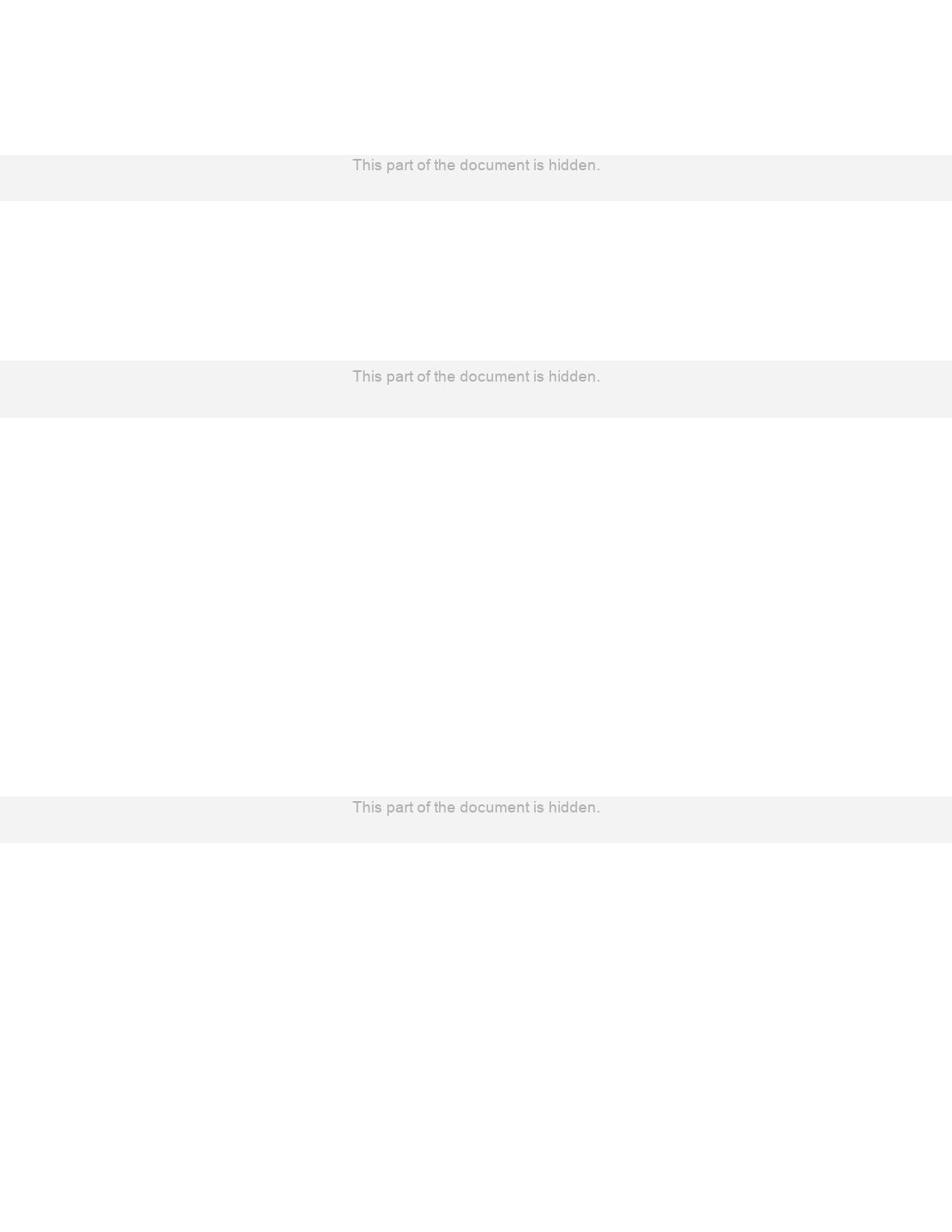
Page 8
38.
(Figure: Classical Versus Keynesian Macroeconomics) Refer to Figure: Classical
Versus Keynesian Macroeconomics. According to the Keynesian view, if this economy
shifts from AD1 to AD2 because of a large decline in investment spending by businesses,
the price level will _____, and real GDP will _____.
A)
increase; decrease
B)
not change; increase
C)
increase; not change
D)
decrease; decrease
39.
(Figure: Classical Versus Keynesian Macroeconomics) Refer to Figure: Classical
Versus Keynesian Macroeconomics. According to the Keynesian view, if this economy
shifts from AD2 to AD1, perhaps because of a large increase in government spending, the
price level will _____ and real GDP will _____.
A)
rise; fall
B)
not change; rise
C)
rise; not change
D)
rise; rise
40.
(Figure: Classical Versus Keynesian Macroeconomics) Refer to Figure: Classical
Versus Keynesian Macroeconomics. According to the classical view, if this economy
shifts from AD1 to AD2, perhaps because of a large decline in investment spending by
businesses, the price level will _____ and real GDP will _____.
A)
rise; fall
B)
not change; increase
C)
fall; not change
D)
fall; fall
41.
(Figure: Classical Versus Keynesian Macroeconomics) Refer to Figure: Classical
Versus Keynesian Macroeconomics. According to the classical view, if this economy
shifts from AD2 to AD1, perhaps because of a large increase in government spending, the
price level will _____ and real GDP will _____.
A)
rise; fall
B)
rise; not change
C)
not change; rise
D)
fall; fall
Page 9
42.
The General Theory of Employment, Interest, and Money, written by _____ and
published in _____, transformed the way economists thought about macroeconomics.
A)
Milton Friedman; 1946
B)
Paul Samuelson; 1940
C)
John Maynard Keynes; 1936
D)
Paul Lucas; 1966
43.
The General Theory of Employment, Interest, and Money is:
A)
the first economics textbook of the 1980s.
B)
a defense of fiscal policy written by Milton Friedman.
C)
an analysis of the Great Depression.
D)
an explanation of globalization.
44.
Keynesian economics stresses the role of:
A)
aggregate demand.
B)
aggregate supply.
C)
the long run.
D)
both aggregate demand and the long run.
45.
_____ was a _____ economist who believed that _____ in wages and prices could block
adjustments to full employment.
A)
Adam Smith; British; flexibility
B)
Milton Friedman; U.S.; inflexibility
C)
John Maynard Keynes; British; stickiness
D)
Robert Lucas; U.S.; stickiness
46.
The idea of sticky wages and prices is most closely associated with:
A)
monetarism.
B)
classical economics.
C)
Keynesian economics.
D)
rational expectations theory.
47.
Keynesian economics emphasized the:
A)
role of money.
B)
long run.
C)
impact of changes in aggregate demand.
D)
impact of changes in aggregate supply.
Page 10
48.
Which statement is TRUE?
A)
Keynes treated short-run macroeconomics as a minor issue.
B)
Keynes emphasized the short-run effects of shifts in aggregate demand on
aggregate output, employment, and prices, whereas the classical economists
focused on the long-run determination of the aggregate price level.
C)
The classical economists believed that the short-run aggregate supply curve was
upward sloping.
D)
The classical economists emphasized the short-run effects of shifts in aggregate
demand on aggregate output, whereas Keynes focused on the long-run
determination of the aggregate price level.
49.
We now typically refer to the Keynesian term “animal spirits” as:
A)
rational expectation.
B)
business confidence.
C)
adaptive expectation.
D)
irrational exuberance.
50.
The main ideas of Keynesian economics are the importance of the _____ and emphasis
on _____.
A)
long run over the short run; a vertical SRAS curve
B)
long run over the short run; the AD curve and the SRAS curve
C)
short run over the long run; the AD curve and a rising SRAS curve
D)
free market with no government intervention; monetary policy in the long run
51.
The groundbreaking book The General Theory of Employment, Money, and Interest was
written by famed economist:
A)
Ronald Reagan.
B)
John Maynard Keynes.
C)
Adam Smith.
D)
Barack Obama.
52.
Keynes believed that wages and prices were sticky. Therefore, a rightward shift of the
aggregate demand curve would cause a(n):
A)
decrease in the level of income.
B)
increase in the unemployment level.
C)
change in the long-run aggregate supply curve.
D)
increase in employment, production, and income.
Page 11
53.
According to Keynesian economics, a tax cut will _____ aggregate demand and output
by _____.
A)
increase; decreasing exports
B)
decrease; decreasing incentives to work and save
C)
increase; increasing income and consumption
D)
increase; decreasing government spending
54.
Keynes believed that to end the Great Depression:
A)
only a government takeover of industry could save the economy.
B)
the capitalist system needed only a narrow technical fix.
C)
a decrease in government spending would increase the budget deficit.
D)
a decrease in the money supply would cause inflation.
55.
During the 1940s, 1950s, and 1960s:
A)
the role of the government in the economy increased.
B)
the role of the government in the economy decreased.
C)
Keynes’s ideas were constantly challenged by free-market policies.
D)
Keynes’s views were accepted only by left-wing socialist economists.
56.
According to a Keynesian economist, a recessionary gap should be fixed with:
A)
a monetary rule.
B)
supply-side tax increases to balance the budget.
C)
decreases in government spending.
D)
discretionary fiscal policy.
57.
Macroeconomic policy activism:
A)
is the use of political activism made popular by liberal economists.
B)
mandates a balanced government budget.
C)
is the use of monetary and fiscal policy to smooth out the business cycle.
D)
was the tool used by classical economists.
58.
According to Keynes, the remedy for a recessionary gap was straightforward. The
solution was to:
A)
increase aggregate supply.
B)
increase aggregate demand.
C)
control big business.
D)
decrease government involvement.
Page 12
59.
Keynes argued that the surest way to bring the economy out of the Great Depression
was to:
A)
keep the economy in a liquidity trap until antitrust policy could be enforced.
B)
use expansionary fiscal policy.
C)
increase taxes and spend less.
D)
leave the economy alone, and flexible wages and prices would eventually lead to
increases in income and employment.
60.
Macroeconomic policy activism:
A)
is the use of monetary and fiscal policy to smooth out the business cycle.
B)
is the primary theory of classical economics.
C)
gives the Federal Reserve the sole responsibility for economic policy.
D)
advocates that all of the people in a democracy should decide what type of
economic policy is appropriate.
61.
The main consequence of Keynesian economics is:
A)
the development of economic policy rules.
B)
the rationale for macroeconomic policy activism.
C)
a consensus that fiscal policy is ineffective.
D)
a consensus that monetary policy is always effective.
62.
Keynes’s ideas were:
A)
quickly adopted in the 1930s to end the Great Depression.
B)
slowly but consistently used in 2008 to end the Great Recession.
C)
used somewhat to help reduce the Great Depression.
D)
ignored in the Great Depression.
63.
The main reason that the Great Depression ended was:
A)
effective monetary policy by the Fed under the leadership of Paul Volcker.
B)
the defeat of Adolf Hitler in Germany in the 1930s.
C)
Winston Churchill’s foreign policy.
D)
deficit spending in the United States to finance World War II.
Page 13
64.
The historical validation of Keynes’s theory came through the:
A)
expansion in aggregate demand resulting from drastic interest rate cuts in the early
1940s.
B)
successful application of his theories in the United States during the Great
Depression in the early 1930s.
C)
expansion in aggregate demand resulting from massive military spending in the
early 1940s.
D)
successful application of his theories in the United Kingdom during the mid 1930s.
65.
The consensus is that the Great Depression was ended by:
A)
imposing fiscal discipline and reducing budget deficits.
B)
following Keynes’s analysis regarding the “animal spirits.”
C)
increasing the money supply and lowering the interest rate.
D)
applying expansionary fiscal policy on a large scale.
66.
The Great Depression was ended in the United States by:
A)
the government running budget surpluses throughout the 1930s.
B)
the government increasing the money supply throughout the 1930s.
C)
central planning of the economy by the government.
D)
the huge amounts of government spending required to fight WWII during the early
1940s.
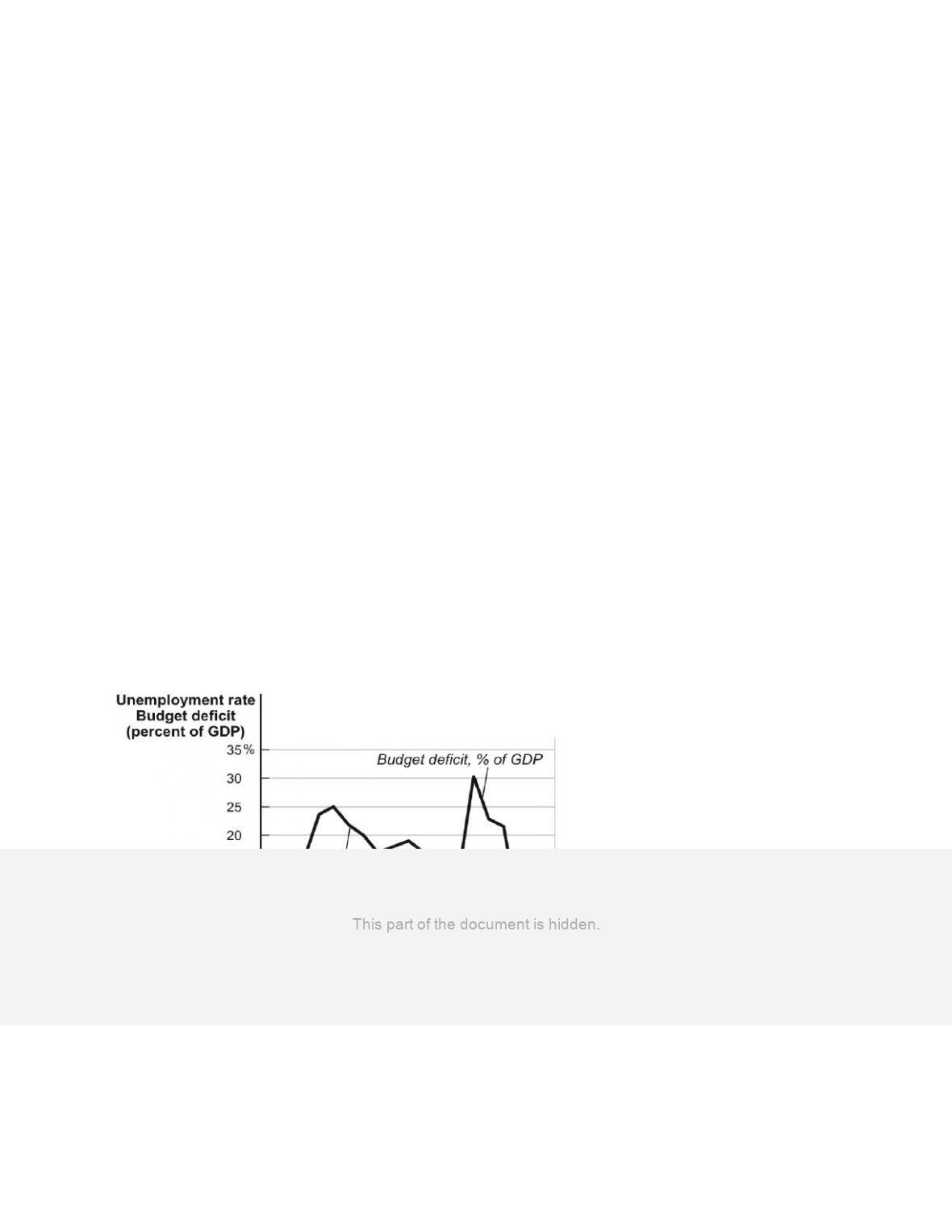
Use the following to answer questions 67-69:
Page 14
67.
(Figure: Fiscal Policy and the End of the Great Depression) Refer to Figure: Fiscal
Policy and the End of the Great Depression. The period from 1933 through 1936 would
seem to indicate that in the short run a moderate level of government deficit spending
can _____ the unemployment rate.
A)
reduce
B)
increase
C)
not affect
D)
eliminate
68.
(Figure: Fiscal Policy and the End of the Great Depression) Refer to Figure: Fiscal
Policy and the End of the Great Depression. The period from 1936 to 1938 would seem
to indicate that in the short run a decrease in government deficit spending can _____ the
unemployment rate.
A)
reduce
B)
increase
C)
not affect
D)
eliminate
69.
(Figure: Fiscal Policy and the End of the Great Depression) Refer to Figure: Fiscal
Policy and the End of the Great Depression. The period from 1939 through 1943 would
seem to indicate that in the short run a large increase in government deficit spending can
_____ the unemployment rate.
A)
reduce
B)
increase
C)
not affect
D)
reduce or increase
70.
Christina believes that shifts in aggregate demand cause a change in both real output and
the price level. She believes that an economic recession will not necessarily self-correct
in the long run, and therefore she believes that active fiscal and monetary policy is
justified to smooth out the business cycle. Christina is BEST described as a:
A)
classical economist.
B)
Keynesian.
C)
supply-sider.
D)
monetarist.
71.
Which statement is FALSE? Keynesian economics:
A)
emphasizes that factors other than the money supply can affect aggregate demand.
B)
provides the rationale for macroeconomic policy activism.
C)
emphasizes short-run economic fluctuations.
D)
emphasizes long-run fluctuations.
Page 15
72.
Because Keynes’s theory recognized the problem of interest rates being at the zero
bound (the liquidity trap), it:
A)
perceived the economy as being mostly self-adjusting.
B)
favored the use of monetary policy over fiscal policy.
C)
considered technological progress the answer to any economic slump.
D)
favored the use of fiscal policy over monetary policy.
73.
Keynesians argued that monetary policy would NOT be effective if:
A)
there was a liquidity trap.
B)
the Fed was independent of political pressure.
C)
other countries did not follow monetary policy similar to that of the United States.
D)
no one bought bonds when the Fed conducted open-market operations.
74.
In A Monetary History of the United States, 1867–1960, Milton Friedman and Anna
Schwartz argued that:
A)
only fiscal policy could be effective in managing the economy.
B)
the Depression was caused by irresponsible government spending.
C)
monetary policy should play a key role in stabilizing the economy.
D)
the Federal Reserve should be abolished.
75.
Friedman and Schwartz’s work A Monetary History of the United States, 1867–1960
showed that the business cycle historically was associated with fluctuations in:
A)
prices.
B)
interest rates.
C)
the money supply.
D)
business investment.
76.
Keynes’s theory did not endorse the use of monetary policy during the Great Depression
because:
A)
at the time, the nominal interest rate was very close to zero.
B)
during WWII, the convertibility of the pound sterling into gold was suspended.
C)
under the gold standard, the zero bound on nominal interest rates did not exist.
D)
monetary expansions were impossible under a gold standard.
77.
Milton Friedman and Anna Schwartz wrote:
A)
The Great Depression.
B)
The General Theory of Employment, Interest, and Money.
C)
The Wealth of Nations.
D)
A Monetary History of the United States, 1867–1960.
Page 16
78.
In a liquidity trap:
A)
fiscal policy becomes ineffective because of the high budget deficit.
B)
monetary policy becomes ineffective because the nominal interest rate is close to
the zero bound.
C)
the aggregate price level becomes downwardly sticky.
D)
any increase in government spending drives out planned investment spending.
79.
The main idea behind monetarism is that:
A)
the aggregate output will be even greater than potential output if the money supply
grows at a constant rate.
B)
the aggregate price level will increase proportionally if the money supply grows at
a constant rate.
C)
the government budget will have a deficit if the government spending grows at a
constant rate.
D)
the aggregate output will grow steadily at a constant rate if the money supply also
grows at a constant rate.
80.
Scenario: The Velocity Equation
Suppose that real GDP equals $10 trillion, nominal GDP equals $20 trillion, and the
aggregate price level equals 2. If the money supply is $5 trillion, then the velocity of
money is:
A)
5.
B)
8.
C)
4.
D)
10.
81.
Scenario: The Velocity Equation
Suppose that real GDP equals $10 trillion, nominal GDP equals $20 trillion, and the
aggregate price level equals 2. If the velocity of money is 2, the money supply is:
A)
$20 trillion.
B)
$10 trillion.
C)
$5 trillion.
D)
$40 trillion.
Page 17
82.
Scenario: The Quantity Theory of Money
Suppose that the money supply is equal to $10 billion and the velocity of money is 6. If
the aggregate price level is 4, then the real GDP is:
A)
$60 billion.
B)
$30 billion.
C)
$20 billion.
D)
$15 billion.
83.
Scenario: The Quantity Theory of Money
Suppose that the money supply is equal to $10 billion and the velocity of money is 6. If
the aggregate price level is 4, then the nominal GDP is:
A)
$15 billion.
B)
$60 billion.
C)
$20 billion.
D)
$10 billion.
84.
The velocity of money is equal to:
A)
nominal GDP divided by the money supply.
B)
real GDP divided by the aggregate price level.
C)
nominal wages divided by the aggregate price level.
D)
real GDP divided by the money supply.
85.
Milton Friedman’s argument was that the Fed should follow a monetary policy rule so
that the money supply would:
A)
grow at a slow and steady rate.
B)
remain constant.
C)
grow proportionally with the price level.
D)
grow at the same rate as the GDP growth rate.
86.
According to monetarism:
A)
Congress and the president should be responsible for controlling the money supply.
B)
output will grow steadily if the money supply grows at a steady rate.
C)
the Fed should vary the growth rate of the money supply on a monthly basis.
D)
changes in the money supply affect the real output only in the long run.
87.
Monetarism asserts that GDP will grow steadily if the:
A)
government keeps its budget deficit high.
B)
government engages in crowding out.
C)
money supply grows steadily.
D)
money supply grows faster than the economy.
Page 18
88.
If the money supply is growing at a constant rate of 2% and the economy undergoes a
negative demand shock, the theory of monetarism recommends:
A)
coordinating a monetary expansion with a fiscal expansion to increase aggregate
demand.
B)
raising the growth rate of money supply to 3% to lower the interest rate.
C)
lowering the growth rate of money supply to 1% to increase saving.
D)
maintaining the growth rate of money supply at 2% and letting the aggregate price
level fall.
89.
Milton Friedman was the leading figure in the movement called:
A)
Keynesianism.
B)
fiscalism.
C)
monetarism.
D)
big government.
90.
If crowding out occurs:
A)
increases in consumption are offset by decreases in government spending.
B)
increases in the money supply are offset by dollar outflows in foreign trade.
C)
increases in government spending cause higher interest rates and decreased
investment spending.
D)
decreases in government spending cause lower interest rates and decreased
investment spending.
91.
Crowding out is MOST likely when expansionary fiscal policy is accompanied by:
A)
expansionary monetary policy.
B)
open-market purchases.
C)
slow growth of the money supply.
D)
an investment tax credit.
92.
Monetarism suggests that:
A)
money should be backed by gold.
B)
the economy is unstable.
C)
monetary policy should be used to offset economic fluctuations.
D)
discretionary monetary policy does more harm than good.
Page 19
Use the following to answer questions 93-95:
93.
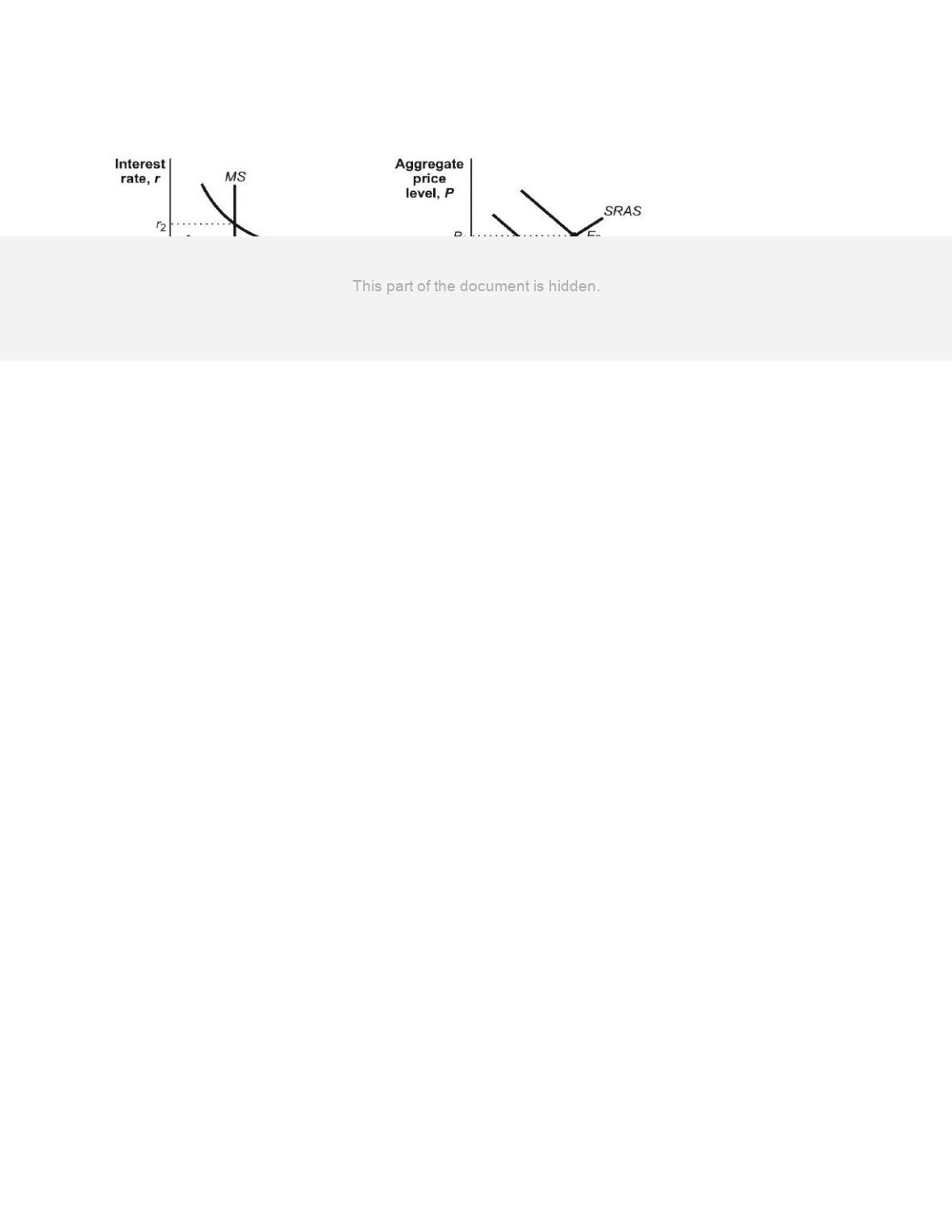
(Figure: Fiscal Policy with a Fixed Money Supply) Refer to Figure: Fiscal Policy with a
Fixed Money Supply. Assume that this economy is at E1. Now government deficit
spending is increased, but the Federal Reserve does NOT expand the money supply.
According to this model:
A)
real GDP will expand just as much as if the Federal Reserve had expanded the
money supply.
B)
real GDP will decrease because the Federal Reserve did not expand the money
supply.
C)
real GDP will expand, but not as much as if the Federal Reserve had expanded the
money supply.
D)
interest rates will decrease.
94.
(Figure: Fiscal Policy with a Fixed Money Supply) Refer to Figure: Fiscal Policy with a
Fixed Money Supply. Assume that this economy is at E2. Now government deficit
spending is decreased, but the Federal Reserve expands the money supply. According to
this model:
A)
real GDP will decrease just as much as it would if the Federal Reserve had not
expanded the money supply.
B)
real GDP will decrease, but not as much as it would if the Federal Reserve had
failed to expand the money supply.
C)
real GDP will expand, but not as much as it would if the Federal Reserve had not
expanded the money supply.
D)
interest rates will increase.
Page 20
95.
(Figure: Fiscal Policy with a Fixed Money Supply) Refer to Figure: Fiscal Policy with a
Fixed Money Supply. Assume that this economy is at E1. Now government deficit
spending increases and the Federal Reserve expands the money supply. According to
this model:
A)
real GDP might increase in the short run, but inflation can lead to a return to the
original level of real GDP in the long run.
B)
real GDP will decrease because the government expanded deficit spending.
C)
real GDP will decrease, but not as much as if the Federal Reserve had contracted
the money supply.
D)
interest rates will decrease.
96.
Friedman argued that with a _____ money supply, velocity is _____ that there’s not
much point in using monetary policy.
A)
steady increase in the; large
B)
constant; small
C)
steady increase in the; constant
D)
constant; large
97.
Friedman favored:
A)
activist monetary policy to stabilize the economy.
B)
activist fiscal policy coupled with a neutral monetary policy.
C)
a monetary policy rule.
D)
interest rate targeting.
98.
During the 1960s and 1970s, most monetarists believed that the velocity of money:
A)
was stable.
B)
was inversely related to the money stock.
C)
moved in tandem with the money stock.
D)
was irrelevant to the price level.
99.
After 1980, the velocity of money began to:
A)
stabilize.
B)
drift upward.
C)
drift downward.
D)
shift erratically.